Poaching at Petrenedle
1288
or 1323
|
Return to the Home
Page of the Farndale Family Website |
The story of one
family’s journey through two thousand years of British History |
The 83 family lines
into which the family is divided. Meet the whole family and how the wider
family is related |
Members of the
historical family ordered by date of birth |
Links to other pages
with historical research and related material |
The story of the
Bakers of Highfields, the Chapmans, and other related families |
On 1 July
1323 Adam (FAR00025), son of Simon the miller of Farndale (FAR00021), and Richard
(FAR00016), son of John the miller (FAR00021B), with three other unknown men, came into
Pickering Forest in a place called Petreneldel, and
took two deer. When they had been proclaimed by the forester, they sent
away one deer, which the foresters carried to the castle of Pickering, but the
wrongdoers carried away the other deer with them and thereupon did their will.
They did not come to a hearing on 3 October 1334 and the sheriff was ordered to
apprehend them. Later, Adam and Richard came before the justices and asked to
pay for licence to make concord for their offence so that they could be
redeemed. Adam paid 26s 8d and Richard paid 40s for this licence, and they
found mainpernors (or guarantors) for these
amounts (The Great Cowcher of the Duchy
of Lancaster, The National Archives, DL42/1 Folio 217, DL 42/1/23/U22 folios 217 to 218v, North Riding
Records Yorks, The Honour and Forest of Pickering, 1894, Volume
II at page page 96, 217
to 218).
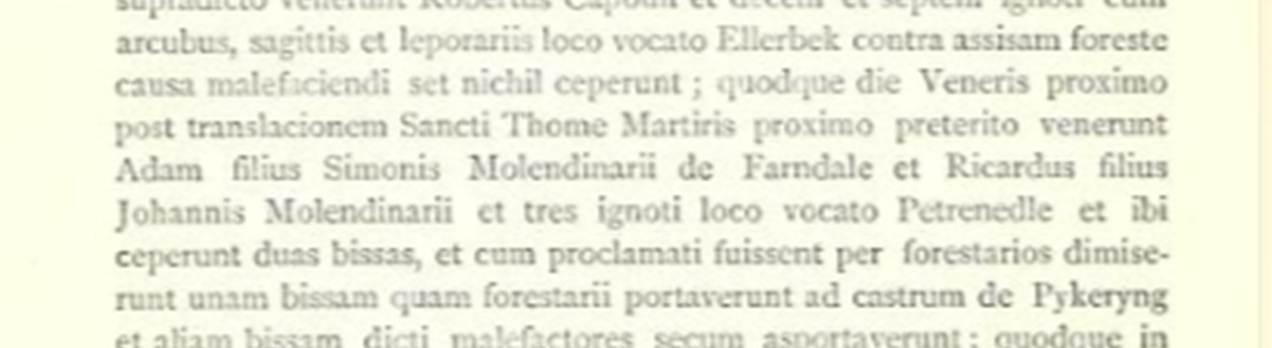
22 August 1323,
Pickering. To the sheriff of York. Whereas it is found by an inquisition
taken by Kckeriug. William de Ayremynne,
Humphrey de Waleden, aud
John de Kylvyugton, by the oath of the foresters,
verderers, regarders, and otber ministers of the
forest of Pykeryng', and of other lawful men of that
county, that the following persons committed trespasses of venison in the
forest after it came into the king's hands as escheat by the forfeiture of
Thomas, late earl of Lancaster : to wit, that on Saturday after St. Nicholas,
in the 16th year of the king's reign, William de Askeby and William son of
Robert Todde came into the place called ' Crossedale ' towards the north, and there William de Askeby
slew a hind, and carried the venison to the house of Robert Campioun
of Faimsnby, and Alan son of the said Robert and
Juliana, Robert's wife, received the venison, with Robert's knowledge and
consent, for the use of brother Austin (Astini) Stalworthman, a lay-brother of the abbey of Ryvaus, then gi-anger of Kekelmareys, who received and had part of the venison ; and
that on Friday before St. Thomas the Apostle, in the aforesaid year, Roger
Drye, Richard Drie, John le Someter
of the abbot of Whyteby, Henry Parker, Peter Daclom, Peter his groom, William de Elredby,
John Paulyn, the said Peter's groom, and Walter le Hunter came with bows and
arrows and live greyhounds, three of which belonged to the abbot, into the
place called ' Yearnolfsbek,' and there took a young
hart (sourum cerivi), and
carried the venison away with them; and that on Friday the feast of Midsummer,
in the aforesaid year, Peter Daclom, Peter his groom,
William Delredby, John Paulyn, Peter's groom, William
Page of Aton, William son of Ralph da Ruston, Walter le Honter,
John de Seton, Ambrose de la Chaumbre, and Robert Capoun, knight, came with five greyhounds, bows and arrows
to the moor of Hoton, and there took a young hart (sourum cervi), and carried the
venison away with them ; and that on Wednesday the feast of SS. Peter and Paul,
in the aforesaid year, John de Faucomberge and Robert
Capoun, knights, Robert Blaner, William son of Ralph
de Ruston, Walter le Honter, Peter Daclom, Peter his groom, William Dalredby,
John Paulyn, William Page of Aton, Ambrose de la haumbre,
John de Seton, Richard de Wyresdale, William de Boythorp, Richard le Forester, Thomas Dounyour,
and William de Eston, forester, came into the place called 'Le Lylhowwang and Ellerbek' with eight greyhounds, bows
and arrows, and there look a hart and a hind, and
carried the said venison away with them to Skelton castle ; and that on Friday
the morrow ol Martinmas, in the aforesaid year,
Robert Capoun, knight, Robert son of Marmaduke de Tweng, acd eight unknown men
with bows and arrows and four greyhounds ca'ne to the
place called ' Ellerbek,' and there took a hart and
two other deer (feras), and carried the venison away;
and that on Thursday before the Invention of the Holy Cross, in the aforesaid
year, Robert Capoun and seventeen unknown men came
with bows and arrows and greyhounds to the place called ' Ellerbek ' against
the assize of the Forest for the purpose of doing evil, but they took nothing;
and that on Friday after the Translation of St. Thomas last, Adam son of
Simon the miller of Farndale, Richard son of John the miller, and three unknown
men came to the place called ' Petrenedle,' and there
took two hinds, and when they were proclaimed by the foresters, they left one
hind, which the foresters carried to Pykeryng castle,
and the said malefactors carried the other away with them ; and that in
summer, in the 15th year, William de Shupton,
forester, came into the Hay of Scalby to a place called ' Steppiaate,'
and there slew a hind, and carried the venison to his chamber in Scaleby ; and that in the time of William le Wode, parker, William de Askeby came into the park of Blandeby to do harm upon the venison, but that he took
nothing ; that William de Askeby and another man unknown came into the moor of Kynthorp on their way to the said park for the like
purpose, and William le Wode, then parker, followed
them, and spoke with William, from whom he took as a gift a silk purse and
12d., so that he should not reveal the said deed to any one, and that Adam de
Loudon was the cympanion of William le Wode, parker, to commit liarm in
the park, but they [the jurors] do not know what they took Iherein,
but that what evil was done was done in the time of the said William : the king
orders the sheriff to take with him John de Rithre,
and to arrest all the aforesaid men and Juhana, and to deliver them to John de Kylvynton, keeper of Pykeryng
castle, whom the king has ordered to receive them and to keep them in prison in
the castle until further orders. (Close
Rolls of the reign of Edward II, 1323 to
1327, page 15 to 16).