|
Return to the Home
Page of the Farndale Family Website |
The story of one
family’s journey through two thousand years of British History |
The 83 family lines
into which the family is divided. Meet the whole family and how the wider
family is related |
Members of the
historical family ordered by date of birth |
Links to other pages
with historical research and related material |
The story of the
Bakers of Highfields, the Chapmans, and other related families |
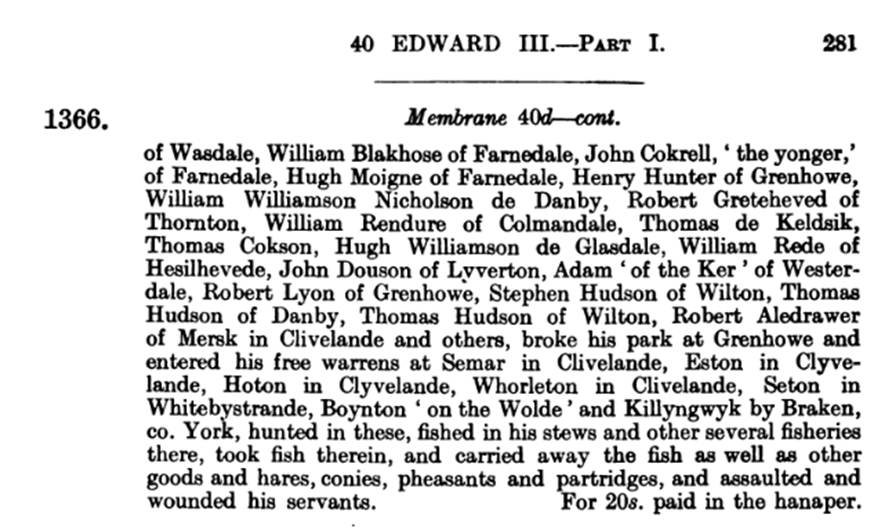
William Blakhose
of Farndale (BLA00001), John Cokrell the Younger of Farnedale (COK00001) and Hugh Moigne of Farnedale
(MOI00001) were
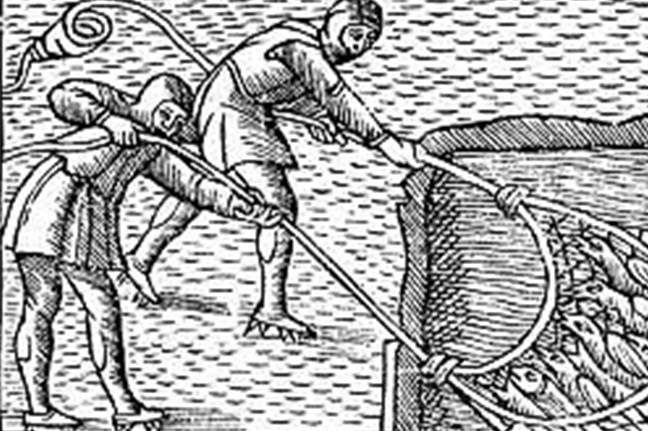
all fined 20s for poaching fish in 1366 (Calendar
of Patent Rolls, 40 Edward III, Part 1, pages
280 to 281).
‘February
10, At Westminster. Commission of Oyer and Terminer to John Mourbray, Thomas de Ingleby … on complaint by Peter de Malo
Lacu, ‘le sisme’, that William Birkhead of Wasdale
…William Blakhose of Farndale, John Cokrell the younger of Farndale …. broke park at Grenhowe
and entered his free warrens at Semar in Clyvelande, Whorleton in Clivelande, Seton in
Whitebystrande, Boynton ‘on the Wolde’ and Killyngwyk by Braken, co York, hunted in these, fished in his stews and other
several fisheries there, took fish therein, and carried away fish as well as
other goods and hares, conies, pheasants and partridges, and assaulted and
wounded his servants. For 20s paid in the hanaper.


A Commission of Oyer and Terminer was a legal
commission issued in England, authorizing judges to hear and determine criminal
cases, particularly those involving serious offenses like treason, felonies,
and misdemeanors. It literally means to hear and determine in
Anglo-French, reflecting its purpose of both investigating and adjudicating
cases. By the commission of oyer and terminer the commissioners (in practice
the judges of assize, though other persons were named with them in the
commission) were commanded to make diligent inquiry into all treasons, felonies
and misdemeanours whatever committed in the counties specified in the
commission, and to hear and determine the same according to law. The inquiry
was by means of the grand jury; after the grand jury had found the bills of
indictment submitted to it, the commissioners proceeded to hear and determine
by means of the petit jury. The words oyer and terminer were also used to
denote the court that had jurisdiction to try offences within the limits to which
the commission of oyer and terminer extended.
There is a separate page about poaching in Pickering Forest.