Ightfield
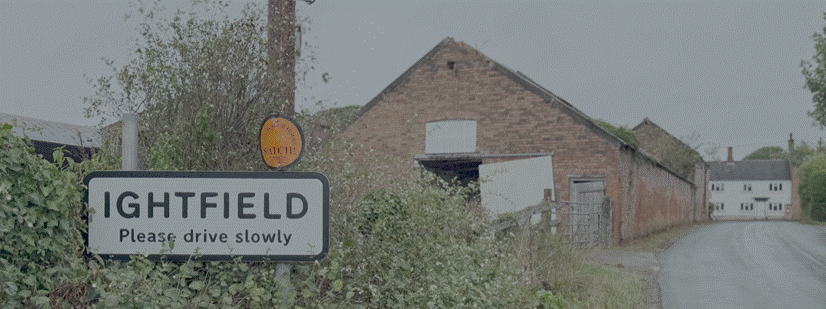
A history of Ightfield in the Middle Ages
|
Return to the Home Page of the Bakers Family part of the website |
The Bakers of Highfields Story
The Story of the Dods and Bakers and of Highfields,
Fenton House and Hasfield Court. A journey through the history of Cheshire
and Staffordshire, an Anglo-Saxon nobleman who retained his lands after the
Conquest, pottery at Stoke on Trent, an encounter with Elgar, and the history
of an Elizabethan manor house at Audlem |
The family tree of the Bakers of Highfields |
The Family Tree of the Dods, predecessors to the
Bakers of Highfields |
The Bakers of
Fenton House and Hasfield Court
The Family Tree of the pottery Bakers of Stoke on Trent |
The Family Tree of the Bellyse Family |
The main part
of this website tells the story of the Farndale family from Yorkshire Descendants of Arthur Baker, the story of the
Farndale ancestry is told through the main part of this website You can also return to the Farndale
website home page |
The genealogy of the family of James Hall, linked to
the Baker family through marriage to Arthur Baker |
Headlines of are
in brown.
Dates are in red.
Hyperlinks to
other pages are in dark
blue.
References and
citations are in turquoise.
Context and local
history are in purple.
1086
In the Domesday
Book of 1086, the area was initially recorded as Istefelt.
Over the centuries, it appeared in various medieval documents and letters
patent under spellings such as Ithfeld
and Hichtefeld
1227
The Audleys of Red Castle
Red Castle was a formidable
medieval enclosure castle, perched on a high crag made of red sandstone, which
gave the castle its name, and located within the historic parkland of Hawkstone
Park, about 10 kilometres south of Ightfield, near the village of Weston-under-Redcastle in Shropshire, with its surrounding historical
estates once including Ightfield. The castle was built in 1227 by Henry de
Audley, the Sheriff of Shropshire and Staffordshire, after he obtained a royal
license to fortify a natural outcrop of red sandstone. It served as a primary
Shropshire stronghold for the Audley family. Over the fourteenth century, many
surrounding estates, including Whixall, Marchamley, and Ightfield, were accounted for as members of
Red Castle's holdings under the Audley inquests. By about 1400, the castle was
no longer occupied. When the famous antiquarian John Leland visited around
1540, he recorded it as being completely ruinous.
During the thirteenth and
fourteenth centuries, the small rural parish of Ightfield was shaped by shifts
in manorial ownership, administrative restructuring, and the development of its
local infrastructure. At the turn of the
thirteenth century, the manorial estate transitioned away from its earlier
post-Domesday Norman tenancies. In the early 1200s, records from the Historic
England Research Records show the manor was held jointly or concurrently by
Walter Hose (Hussey) and Robert de Ightfield. This era saw the continued use
and fortification of the Ightfield Hall moated site. The substantial
rectangular island, defended by a moat averaging 23 meters wide, served as the
administrative and defensive heart of the local lordship. Towards the close of
the fourteenth century, the family of de Ightfield consolidated its
local standing through regional marriages and land deals. In 1377, Joan of
Harley settled a nearby manor upon William of Ightfield and his mother Agnes,
followed by a further settlement on Roger of Ightfield in 1380. This set the
stage for the manor's transition to the prominent Mainwaring family in the
subsequent century.
During the thirteenth and fourteenth
centuries, the relationship between Ightfield and Red Castle was one of feudal
submission and administrative dependency. Over the course of the 1200s, the Audleys aggressively expanded their footprint across the
North Division of the Bradford Hundred. According to medieval regional records
(such as the Hundred Rolls of 1255 and later 14th-century Inquests), the Audleys managed to absorb a massive constellation of local
estates. These included Whixall, Marchamley,
Losford, Hawkstone, and Ightfield.
1317
On 24 January 1317 at Woodstock
there was an order To Master John Walewayn, escheator this side Trent. Order
not to intermeddle further with the castle of Heleye
with the park and townships of Bettelleye, Tunstal and Hocton, and two parts
of the manor of Enedon, Co. Stafford, the castle
called 'The Red Castle,' with the memberai of Ithtefeld, Quekesliale, Lokkeswode, and Gravenhunge, the
hamlet of Marchumleye with the member of Kemettesden, co. Salop, as it appears by inquisition that
Nicholas Daudaleye, tenant in chief, and Joan his wife, countess of Lincoln,
were jointly enfeoffed thereof by John de Kynardeseye, and that they continued
their joint-seisin thereof until his death, and that the premises are not held
of the king but of other lords (Close Rolls of
the reign of Edward II, 1313 to 1318,
page 390). To prevent the Crown from
completely seizing the Audley ancestral lands and leaving his widow destitute
upon his death, Nicholas had used John de Kynardeseye
to execute a joint-enfeoffment. Before Nicholas died, he legally transferred
Red Castle, Ightfield, and his Staffordshire estates (like Heleye
Castle) to Kynardeseye. Kynardeseye
immediately granted them back to Nicholas and Joan jointly.
1325
The sheriff of Shropshire was
ordered to cause a coroner to be elected in place of John de Warenne of Ightfeld, who was insufficiently qualified (Close Rolls of the reign of Edward II, 1323 to 1327, page 303).
1331
A Charter by Henry III to the
abbot and monks of Combermere included a land with a wood at le Trepwode, the
gift of Roger de Ythfeld (Ightfield)(Calendar of Charter Rolls, Volume 4, Edward III, 1327 to
1341, page 204).
1354
On or
about 26 November 1354, there was a presentation of Adam de Knaresburgh to the church of Ightefeld,
in the diocese of Coventry and Lichfield (Patent Rolls of
the reign of Edward III, 1354 to 1358, page 145).
1355
The Le Strange of Blackmere Interest
On or
about 20 November 1355, there was a presentation of Thomas Banastre to the
church of Ithfeld, in the diocese of Coventry and
Lichfield, in the king’s gift by reason of his wardship of the lands and heir
of John son and heir of John Lestaunge of Blakemore,
tenant in chief. (Patent Rolls of the reign of Edward III, 1354 to 1358,
page 309).
The
medieval location of Ithfeld referred to in
the 1350 Patent Rolls entry is Ightfield. The medieval Diocese of Coventry
and Lichfield covered a vast area of the English Midlands and Northwest,
including all of Staffordshire and Derbyshire, as well as northern portions of
Shropshire and Warwickshire. Geographically, Ithfeld
was located within the historic Hundred of Hodnet, later part of the Bradford Hundred, and
ecclesiastically sat under the Archdeaconry of Salop, Shropshire, within the
diocese.
Thomas
Banastre was presented to become the priest. The lands belonged to the late
John Lestaunge, Le Strange, of Blakemore, who had been a tenant-in-chief,
holding his lands directly from the King. Because his son and heir, also named
John, was a minor, control of the estate and its ecclesiastical appointments
temporarily reverted to King Edward III until the heir came of age.
Sir
John le Strange, 2nd Baron Strange of Blackmere (1306
to 1349) had died shortly before this record, during the height of the Black
Death pandemic in July 1349. John le Strange, 3rd Baron (1332 to 1361) was born
in Whitchurch. He was only 17 years old when his father died.
The
primary interest exercised in 1355 was the advowson of the church of Ightfield.
In medieval England, an advowson was a valuable property right allowing the
lord of the manor to nominate, or present, the parish priest. This gave the Le
Strange family immense local political and spiritual leverage over who preached
and collected tithes in the parish. While the neighbouring manor of Whitchurch,
and its stronghold at Blackmere, served as the
family's primary seat, Ightfield was held by them as tenants-in-chief under the
King. However, the Le Stranges often sub-infeudated the actual manor house and
day-to-day lands of Ightfield to closely aligned local knightly families,
particularly the Warren (Warenne) family of
Ightfield.
The
Le Strange connection to Ightfield was deeply personal. The 2nd Baron's
daughter, the 3rd Baron's sister, Matilda
le Strange, married Griffith
Warren of Ightfield. Through this marriage, the Warren family, and later, their
successors, the Mainwarings, solidified their grasp
on the day-to-day lordship of Ightfield, while the Le Strange barons of Blackmere maintained overarching feudal superiority and
rights to the parish church.
1356
Griffin de Warenne
received a royal licence to transfer ownership (enfeoff) of the manor of Ightefeld (excluding 2 acres) to two clerks, William de
Botefeld and William de Ightefeld. A licence for £10 was to be paid to the
king by Griffin de Warenne, for him to enfeoff
William de Botefeld, clerk, and William de Ightefeld
of the manor of Ightefeld (2 acres of land therein excepted),
which is held of the king in chief, and for them to grant the same to him for
life, with remainders to Griffin son of John son of Griffin and Elizabeth, his
wife, in tail, and to the right heirs of the said Griffin de Warenne. And the £10 l have been paid in the hanaper. (Patent
Rolls of the reign of Edward III, 1354 to 1358, page 428,
see also Inquisition Ad Quod Damnum, Part 2,
page 490).
The clerks were then to grant the manor back to Griffin de Warenne
to hold for the rest of his life. After his death, the property was set to pass
to Griffin (the son of John, son of Griffin) and his wife Elizabeth, and their direct
heirs (in tail). If that line failed, it would go to the right heirs of the
original Griffin de Warenne. Griffin paid a
substantial fee of £10 into the hanaper (the financial department of the royal
chancery) to secure this licence.
On or
about 3 February 1356 there was a ratification of the estate of John de Cone
as parson of the church of Ightefeld, in the diocese
of Coventry and Lichfield, on the presentation of Ankeretta,
late wife of John Lestraunge; and revocation of the late presentation of the
King’s clerk Thomas Banastre to the said church (Patent
Rolls of the reign of Edward III, 1354 to 1358,
page 339).
King
Edward III had previously used his royal prerogative to present his own clerk,
Thomas Banastre, to the church of Ightfield. This entry cancelled, by revocation,
that royal presentation, showing that the King yielded the right of
presentation in this instance. Ankeretta, Ankaret, was a widow by 1356 and held the advowson
of Ightfield church, likely as part of her dower lands from her deceased
husband, John Lestrange (L'Estrange) of Blackmere.
1359
Griffin
de Warenna holds in fee the manor of Ightefeld, which is worth 20 marks yearly, and nothing else
which can be extended at present (Calendar
of Miscellaneous Inquisitions (chancery), Volume 3,
Edward III, Folio 379).
1363
In
1363, William de Blakelow, the vicar of Audlem (Aldelym),
exchanged his ecclesiastical post with John de Clone, the rector of Ightfield (Ightefeld). On or about 3 May 1363, there was a presentation
of William de Blakelow, vicar of the church of Aldelym,
in the diocese of Coventry and Lichfield, to the church of Ightefeld,
in the same diocese, in the king’s gift by reason of his wardship of John son and heir of John Lestraunge of Blakemere who held
in chief; on an exchange of benefices with John de Clone. (Patent
Rolls of the reign of Edward III, 1361 to 1364,
page 335).
The King, Edward III, held the right to appoint the new rector (in the
king’s gift) because he currently held the wardship of John, the underage
son and heir of John Lestraunge (Le Strange) of Blakemere. Because the Le
Strange family held their lands in chief, directly from the King, their
estates and accompanying rights, like appointing priests, temporarily reverted
to the Crown during a minority heirship.
1376
On 3 May 1376, at Westminster,
Edward III agreed the presentation of John de Shevynton to the church of
Ightfield within the Diocese of Coventry and Lichfield. This appointment
occurred as part of a mutual exchange of church livings (benefices)
between John de Shevynton and William Blakelow. On 3 May 1376 at Westminster
there was the Presentation of John de Shevynton, parson of the church of Bydulf, to the church of Ightfelde,
in the diocese of Coventry and Lichfield, in the king’s gift by reason of his wardship
of the land and heir of John de Straunge of Blakemere, who held it in chief; on
an exchange of the benefices with William, Blakelow.
(Patent Rolls of the reign of Edward III, 1374 to 1377,
page 265).
Bydulf was the medieval spelling for
Biddulph, Staffordshire and its church was St Lawrence’s.
1380
On 2 November 1380 at Westminster there
was recorded the Presentation of Stephen de Prees, parson of the church of Donyngton, in the diocese of Coventry and Lichfield, to the
church of Ightfeld, in the same diocese, in the
king’s gift by reason of the custody of the land and heir of John Lestraunge,
tenant in chief, being in the king’s hands; on an exchange of benefices with
John Shevyndon. (Patent Rolls of the reign of Richard II, 1377 to 1381,
page 408).
1392
On 20 May 1392, King Richard II
ordered the partition of Red Castle and its estates following the death of
Nicholas Audley of Heighley, who died without children. The
estate was originally granted to Nicholas's grandparents (Nicholas Audley and
Joan) and had passed down to his father (James Audley) and then to Nicholas
himself. Because Nicholas had no heirs, the property was ordered to be divided equally
into three parts among the descendants of his father's daughters: Margaret,
wife of Roger Hillary (James’s daughter from his first marriage), who was of
legal age; John Touchet, grandson of Joan (James's other daughter from his
first marriage), who was still a minor; and Fulk Fitzwarine, grandson of
Margaret (James’s daughter from his second marriage), who was also a minor.
The royal official (escheator) was
instructed to immediately hand over one-third of the estate to Roger and Margaret
Hillary, while holding the other two-thirds in the King's possession until the
underage heirs, John and Fulk, reached adulthood. On 20 May 1392 the escheator
of Shropshire, the march of Wales and Staffordshire was ordered in this regard, concerning the castle called Red
Castle with the members and appurtenances, to wit Ithefelde and other places (Close
Rolls of the reign of Richard II, 1389 to 1392,
page 468). See also Fine
Rolls of the reign of Richard II, 1391 to 1399,
page 32.
1399
Debt Collection and the
Vicar of Ightfield
On 16
April 1399 at Westminster, at the end of the reign of Richard II, a pardon for outlawry
was given for failing to appear before the justices of the common bench,
they having now surrendered to the Flete prison as certified by William
Thirnyng, chief justice, to John de Wall, Thomas Stuche of Whitchurche, and John Polford, the parson of Ightfeld for not appearing to answer Thomas de Stanley,
late parson of Whitchirche, toughing a debt of £50 5s
4d (Patent Rolls of the reign of Richard II, 1396 to 1399,
page 396).
The circumstances surrounding this
pardon for outlawry on 16 April 1399 stem from a classic late-medieval English
legal strategy used to handle unresolved civil debt collection. In fourteenth-century
England, the Court of Common Bench (Common Pleas) had no mechanism to try a
civil case, like a debt dispute, if the defendants simply refused to show up. To
force their appearance, the court would issue a series of summonses. If the
defendants repeatedly ignored them, the court used a legal fiction
and they declared the defendants outlaws. Outlawry in
a civil context did not mean they were dangerous fugitives. It meant they were
in contumacy (contempt of court). As outlaws, their property could be
seized by the Crown, and they lost their legal rights.
A pardon for outlawry was almost always
a bureaucratic formality indicating that the legal stalemate had ended. It was
granted because John de Wall, Thomas Stuche, and John Polford finally
surrendered themselves to the Fleet Prison in London or directly satisfied the
court's demands. The Patent Rolls frequently recorded these pardons once a
defendant came forward to face the music or settled the matter out of court.
The pardon restored their legal standing and protected their property from Crown
forfeiture, allowing the actual debt case to finally be heard or dismissed.
The Debt (£50 5s 4d) was a massive
sum of money in 1399 (equivalent to tens of thousands of pounds today). It
likely stems from a significant agricultural lease, church tithes, or a broken
commercial bond.
Whitchurch in Shropshire was a
wealthy rectory (5 miles from Ightfield). The Stanleys were one of the most
powerful families in the region (and would later become the Earls of Derby). As
the former parson, Stanley was likely collecting arrears, tithes, or bond
payments owed to him during his tenure.
It is probable that Polford, the Ightfield priest, and the local men (Stuche and de Wall) had entered into
a joint financial obligation or bond with Stanley regarding church lands or
local administrative business, which they failed to repay.
This was at the End of Richard
II's Reign. Richard II was preparing for his ill-fated military expedition to Ireland,
leaving England in May 1399. During this exact window, Richard's administration
was aggressively settling accounts, raising funds, and clearing court dockets.
Simultaneously, individuals were desperate to clear their legal slates and
secure their properties before the King departed and political instability
deepened. Indeed, Henry Bolingbroke would invade and depose Richard just a few
months later. In short, they were pardoned because they submitted to the court's
authority, resolving their technical status as outlaws so they could
legally address or settle the massive £50 debt they owed to the prominent
former local rector.
1413
In an Inquisition of 8 June 1413, John,
son and heir of Griffith Wareyn held the manor of Ightfield in his demesne as
of fee of the king in chief as an eighth part of a knight’s fee, with an annual
value of 10 marks payable by equal parts at Michaelmas and Lady Day. He died
on 4 February 1413 when Griffin his son and heir was aged 13 years and more.
In a separate record, Griffin Wareyn held 1 toft
with the advowson of Ightfield, service unknown, with an annual value of 2d.
(Calendar of
Inquisitions Post Mortem, Volume 20, (Henry V, 1413–1418), Folios 16,
114).
1415
In an Inquisition at Whitchurch on
17 December 1415, Griffin Wareyn, who died on 5 October 1414, held the manor of
Ightfield, as recorded in the first entry in 1413. Margaret, the daughter of
John Wareyn, is his sister and heir aged 13 years and more. (Calendar of Inquisitions Post Mortem, Volume 20, (Henry V, 1413–1418), Folio 293).
1418
The Audleys of Red Castle; the Wareyns of Ightfield and the Barons Talbot of Whitchurch
In an Inquisition on 21 January
1418, there was a writ for proof of age, of Margaret
daughter of John Wareyn who was in the custody of Philip de Eggerton by
the grant of Roger de Acton knight, to whom the keeping of the lands was
committed. In giving
evidence, the seventh juror was Thomas Dod, 39 and more
who gave evidence that John
his brother was retained for life by Lord Talbot on the day that Margaret
was born at Ightfield and baptised there on 11 June 1401, and
is now aged 17 years and more. (Calendar of Inquisitions Post Mortem, Volume 20, (Henry V, 1413–1418), Folio 844).
Richard Talbot, 4th Baron Talbot, died in
1396, and was succeeded by his young son Gilbert Talbot, 5th Baron Talbot. The
title Lord Talbot belonged to the senior branch of the family based at nearby
Blakemere and Whitchurch.
The manor of Ightfield was held by Griffin
Warren, Griffith de Wareyn. In July 1401, Griffin’s relative, Thomas Neville (5th
Baron Furnivall), married Ankaret le Strange, the widow of Richard Talbot (4th
Baron Talbot). This high-profile marriage brought the Talbot family into the
immediate local sphere of the Warrens. In feudal property records, Inquisitions
Post Mortem, it was recorded that parts of Ightfield
were held directly of Griffin Warren, but the senior Talbots held adjacent
dominant estates in the area, meaning their names frequently appear together in
medieval land charters. Ightfield later became the principal seat of the
Mainwaring family, who inherited it from the Warrens later in the 15th century.
The Mainwarings eventually married into the Talbot
family.
In an Inquisition on 1 November 1418 on
the death of Gilbert Talbot, Knight, jointly held the advowsons (the
legal right to nominate or appoint a priest to the parish church) of Whitchurch
and Ightfield in Shropshire and the Adjacent March of Wales, with his wife
Beatrice, who survived. (Calendar
of Inquisitions Post Mortem, Volume 21, (Henry V, 1418 to 1422), Folio 318).
In the early fifteenth century,
the relationship between the Audley family of Red Castle, the Wareyn family of Ightfield Manor, and the Barons Talbot of
Whitchurch, later Earls of Shrewsbury, was part of a multi-tiered feudal
hierarchy and land tenure network.
· On the top tier, the Audleys of Red Castle held supreme feudal
lordship over the area. The Audley family, at this time represented by the
Touchet-Audley line, including James Touchet, 5th Lord Audley, held the
paramount regional power from their seat at Red Castle (Hawkstone). In local
land registers and inquisitions, several neighbouring estates, including Whixall, Marchamley, and
Ightfield, were legally accounted for as members or dependencies of the
Red Castle estate. (see for instance Leach,
Francis (1891), The
County Seats of Shropshire, Hawkstone Park, page 10, with a sketch of
the Red Castle).
· In the middle tier, the Wareyns of Ightfield held their manor from
the Audleys. The Wareyn
family (alternatively spelled Warenne or Warren, led
by figures such as Griffin Wareyn) served as the immediate gentry lords
residing at Ightfield Manor. They held the manor of Ightfield under the superior
lordship of the Audleys of Red Castle.
· The Barons Talbot of Whitchurch
held Ightfield parish church's patronage or advowson from the Wareyns. The Barons Talbot of Whitchurch and Blakemere
(such as Sir Gilbert Talbot and his brother John Talbot, the famous 1st Earl of
Shrewsbury) were powerful national magnates. However, regarding local land
tenure in Ightfield, they actually held rights below
the Wareyns. Contemporary legal records (such as
Inquisitions Post Mortem) show that the Barons Talbot held
a plot of land (a toft) and the advowson of Ightfield Church (the
lucrative right to appoint the parish priest) directly of Griffin Wareyn.
The Mainwaring Interest
John Dod
married Johanna, daughter and co-heiress of John Warren of Ightfield. Through
her marriage, Johanna brought her inherited portion of the adjoining Calverhall and Cloverley lands directly
into the Dod family. Her husband, John Dod, benefited greatly from her status
as co-heiress. The Ightfield estate went to William Mainwaring of Peover who had married Johanna’s sister, Margaret (Baker, J Bellyse
(1982), Highfields, Audlem: Sixteenth Century Home of the Dod and Baker
Families, Audlem District History Society, page 3).
1439
A snapshot of the landscape at Ightfield in 1439
On 1 September 1439 there was a
property settlement, referred to as a settlement to uses or entailment,
concerning the manor of Ightfield, Shropshire. The record provided a very
detailed snapshot of the medieval estate's composition, the Mainwaring family
lineage, and how land was legally protected across generations. On 1 September
1439 at Westminster there was granted Licence, for 10 marks paid in the
hanaper, for William Maynwaryng and Margaret, his wife, to grant the manor of Ightfeld, 18 messuages, 6 tofts, 1 mill, 480 acres of land,
74 acres of meadow, 100 acres of pasture, 100 acres of wood, 40 acres of heath,
20 acres of moor and 4s. of rent in Ightfeld, held in
chief, except one acre of land in the said manor, to Richard Qwiksale, parson
of the church of Ightfeld, and Thomas del Heth, vicar
of the church of Drayton, their heirs and assigns ; and for them to grant the
premises, except the said one acre, to the said William and Margaret for life,
with successive remainders in tail to Laurence, their son, to George, his brother,
to Thomas, his brother, to the said William and Margaret, to William
Cholmonley, her son, to Richard, his brother, to Hugh, his brother, and to
Margaret, his sister, with remainder over to the right heirs of the first named
Margaret. (Patent Rolls of the reign of Henry VI, 1436 to 1441,
page 349).
Henry VI granted a royal licence
to William Mainwaring (Maynwaryng) and his
wife Margaret to legally transfer their estate. The estate comprised the entire
manor of Ightfield, minus one symbolic acre, which included 18 houses (messuages),
6 abandoned building plots (tofts), 1 mill, 480 acres of arable land, 74
acres of meadow, 100 acres of pasture, 100 acres of woodland, 40 acres of
heathland, 20 acres of moorland, and 4 shillings in rental income.
The mill would have been a local monopoly
on grinding grain, a major source of income for the lord of the manor.
By a legal manoeuvre, William and
Margaret transferred this property to two local clergymen: Richard Quixsale
(parson of Ightfield) and Thomas del Heath (vicar of Drayton); who then
immediately transfered it back to William and
Margaret to hold for the rest of their lives.
After William and Margaret died,
the estate would pass down a strictly defined sequence of heirs. First to their
son Laurence, then to his brother George, then to his brother Thomas. If those
lines failed, it moved to Margaret’s children from a previous marriage: William
Cholmondeley, then Richard, then Hugh, then Margaret. If all else fails, it
goes to the right (legal) heirs of Margaret.
The medieval legal fiction called
a feoffment to uses or a settlement meant that William and
Margaret did not want to sell Ightfield. Instead, they were using trusted third
parties, in this case, local churchmen who could be relied upon not to steal
the land, to legally restructure their ownership. By passing the land to the
priests and having the priests pass it back, they successfully created an entail.
An entail ensured that the estate could not be easily sold off, broken up, or
lost by a single irresponsible heir. The inclusion of Margaret's children from
her previous Cholmondeley marriage showed a calculated effort to keep the
estate within her bloodline, safeguarding the family's wealth even if her
Mainwaring sons died without children. Excluding exactly one acre was a common
legal loophole used to alter the terms of tenure or satisfy specific feudal
technicalities without transferring the entire title outright.
To resolve this administrative move they had to pay 10 marks (a substantial sum of money)
into the hanaper (the royal department that collected fees for sealing
official documents) because the land was held in chief, directly from
the King.
1499
William Maynwaring died on 3 May 1499 sised of the Manor of Ightfield in Shropshire, leaving
George Maynwaring, aged 50 and more, his son and heir. The manor of Ightfeld, was worth 10s, held of the king in chief, by
service of an eighth of a knight's fee. There were also Fifty acres of
pasture in Kempley, worth 50s, held of the earl of Shrewsbury in socage, viz.
by ¼ d for all service; a messuage and 60 acres of land in Coton within the
lordship of Weme, worth 4 marks, held in socage of the lord Dakurs,
by 2d rent, for all service; a messuage and 20 acres of land in Losford, worth 16s, held in socage of the lord Fitzwaren,
by Id rent; and two messuages and 16 acres of land in Hodnet,
worth 10s, held in socage of Richard Ludlowe, knight, by 2d rent. (Calendar
of inquisitions post mortem,
Henry VII, Volume 2, Folio 274).
William Mainwaring, often recorded
as the Good, was a prominent English gentleman from a cadet branch of
the Mainwaring family of Over Peover, Cheshire. He
died on 6 March 1497 or 1499. His son George Mainwaring was his initial heir,
though George died without a male successor. William Mainwaring moved from
Cheshire to Shropshire after marrying Margaret Warren (or Warenne).
Margaret was the daughter and co-heiress of John Warren, the Lord of Ightfield.
Through this marriage, William acquired the Manor of Ightfield, alongside
significant lands in both Shropshire and parts of Cheshire. This marriage
effectively established the Ightfield line of the Mainwaring family.
The marriage between William
Mainwaring and Margaret Wareyn was originally estimated to have been in about 1422, but has more recently been placed close to 1445.
William became a major benefactor of
the local community. His monumental brass inside the St. John the Baptist
Church in Ightfield records his local impact, calling him a special
benefactor to this church.
William’s eldest son, George
Mainwaring, inherited the Ightfield estates but died around 1513 without
surviving male heirs. As a result, the substantial Ightfield interest and
estate bypassed George’s immediate line and passed down to William’s second son,
Thomas Mainwaring, and subsequently to George's nephew, Sir John Mainwaring.
1531
In 1531 Richard Egerton, the son
and heir of the deceased courtier Sir Ralph Egerton of Ridley, was granted
official permission to take legal possession of his late father's lands. To
protect the inheritance and ensure it remained within the direct male lineage,
the properties were transferred to a group of trustees, including Richard
Manwaryng (Mainwaring) of Ightfeld. They held the
estates in trust for Richard Egerton and his future male heirs. Richard
Egerton, son and heir of Sir Ralph Egerton, deceased. Special livery to himself
and to Richard Manwaryng of Ightfeld and others as
trustees for him and his heirs male of his body, of
possessions in the counties of Chester and Surrey, the City of Chester and Flyntshire (Nortth Wales). Given
at Hampton Court, 4 December 1531. (Public Records of the reign of
Henry VIII, Volume 5,
Folio 627(6)).
Sir Ralph Egerton’s mother was
Margery Mainwaring, so the Egertons and the Mainwarings of Ightfield were maternal cousins.
By 1531, the Mainwarings
were firmly established as the dominant gentry family of Ightfield. The manor
was their primary ancestral seat and power base in Shropshire. The Mainwarings of Ightfield were not merely isolated
Shropshire squires. They belonged to an elite network of regional gentry. Serving
as a primary trustee for the heir of a highly influential royal favourite like
Sir Ralph Egerton, who was Henry VIII’s lifelong Standard-Bearer, evidences that the Ightfield family held significant social
status and political trust beyond Ightfield.
1539
A muster was taken on 10 April
1539 by Sir Richard Maynwaryng and Thomas Pygott for the Hundred
of Bradford, Shropshire, recording Ightfylde 19 names
(increased to 23 names in 1542), and Calverhall, 5
names (Public Records of the reign of Henry VIII, Volume 14 - Part 1, page
288, see also Public Records of the reign of Henry VIII, Volume 17, page
507). This was part of the General
Muster of 1539, a massive nationwide audit of England’s military readiness
ordered by Henry VIII. All men between the ages of 16 and 60 capable of
fighting, were recorded, generally categorising them into specific roles such
as archers or billmen. The spring of 1539 was a moment of profound geopolitical
crisis for Tudor England. The muster was not a routine administrative drill; it
was a urgent, defensive preparation against a very real
threat of a foreign Catholic invasion following the dissolution of the
monasteries and Rome’s excommunication.
Based on the numbers and the
standard format of the 1539 General Muster, the figures suggest that Ightfield
and Calverhall were agrarian, sparsely populated
settlements with very limited localised defensive capacity. Ightfield was a
small village capable of fielding roughly two squads of men. Calverhall was a tiny hamlet or a single large estate
cluster. Five men is barely enough to guard a local manor house, let alone form
a tactical military unit. If called upon, they would have been absorbed into
the larger infantry levy of the Bradford Hundred, which in turn joined the main
Shropshire county force under the command of the
regional gentry.
Further research
For detail on land transactions, Calendar of Fines,
counties of Chester and Flint, Edward I, 1280
to 1307, search for Ightfeld.