Leominster, Herefordshire in the early eighteenth century
The
home of the Baker family for a few decades
|
Return to the Home Page of the Bakers Family part of the website |
The Bakers of Highfields Story
The Story of the Dods and Bakers and of Highfields,
Fenton House and Hasfield Court. A journey through the history of Cheshire and
Staffordshire, an Anglo-Saxon nobleman who retained his lands after the
Conquest, pottery at Stoke on Trent, an encounter with Elgar, and the history
of an Elizabethan manor house at Audlem |
The family tree of the Bakers of Highfields |
The Family Tree of the Dods, predecessors to the
Bakers of Highfields |
The Bakers of
Fenton House and Hasfield Court
The Family Tree of the pottery Bakers of Stoke on Trent |
The Family Tree of the Bellyse Family |
The main part
of this website tells the story of the Farndale family from Yorkshire Descendants of Arthur Baker, the story of the
Farndale ancestry is told through the main part of this website You can also return to the Farndale
website home page |
The genealogy of the family of James Hall, linked to
the Baker family through marriage to Arthur Baker |
Headlines of are
in brown.
Dates are in red.
Hyperlinks to
other pages are in dark
blue.
References and
citations are in turquoise.
Context and local
history are in purple.
1700
In the early eighteenth century, Leominster experienced a period
of growth and stability as an established market centre. The town flourished
from the surrounding rich farmland.
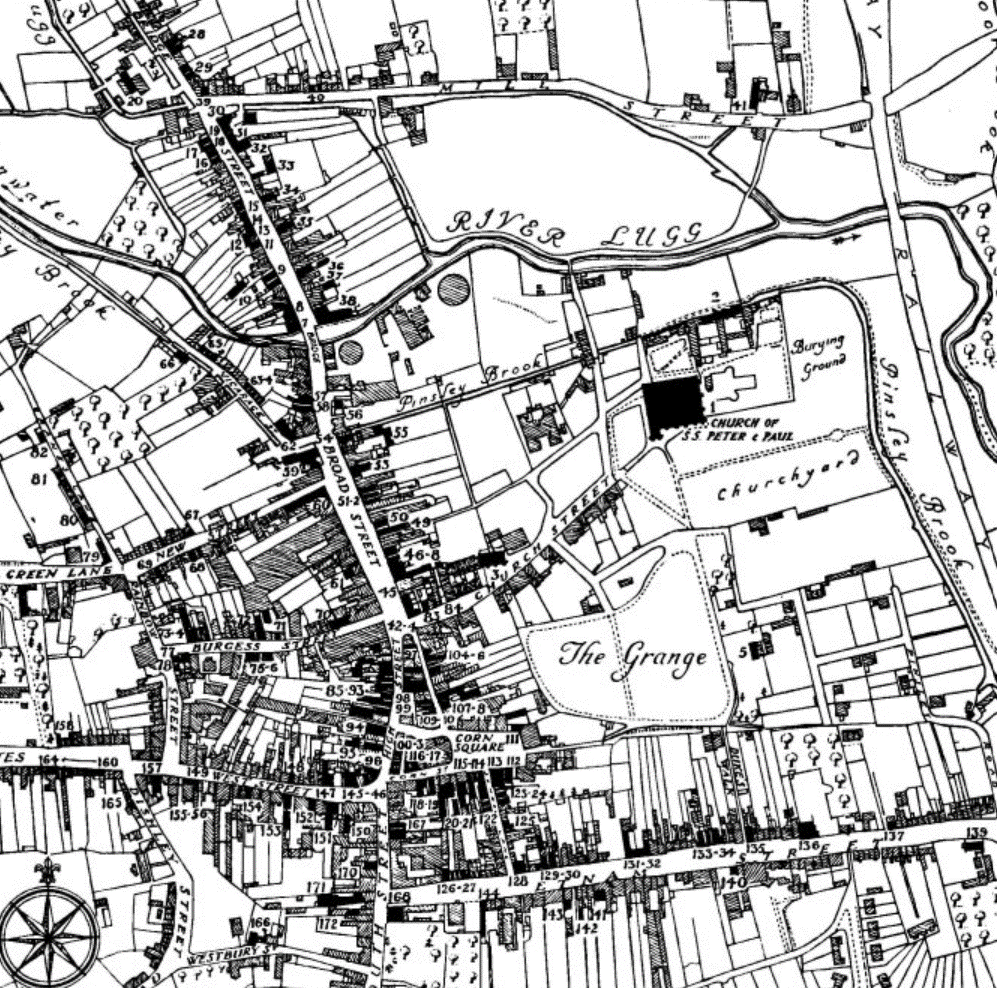
Leominster by the early twentieth century
1705
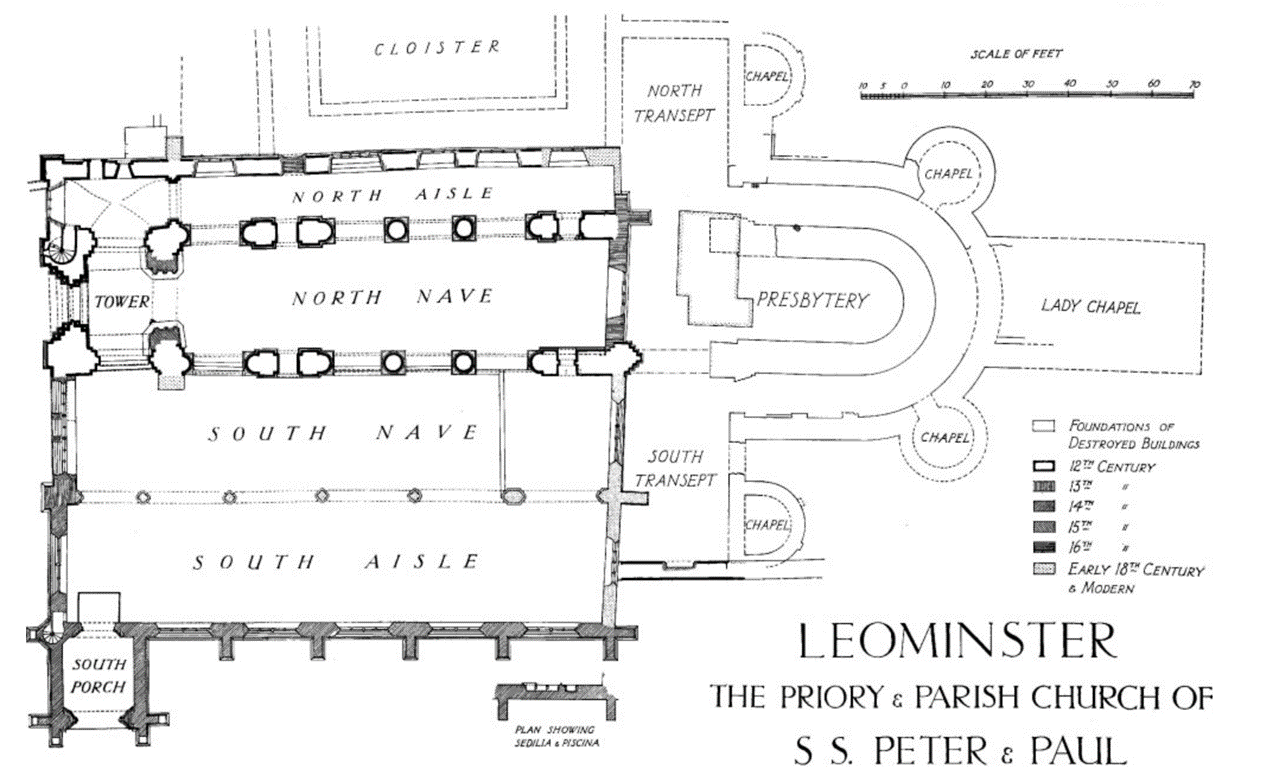
Following a devastating fire in 1699 that destroyed the roof and
central arcade, the Priory and Parish Church of St Peter and St Paul was
finally rebuilt and reopened. The arcade between the south nave and the south
aisle was reconstructed using pillars of the Tuscan order, but much earlier
work was re-used in the arches.
The old Priory House was fitted up by Thomas, Lord Coningsby (1692
to 1729) as a gaol, afterwards becoming in turn a mansion-house and a
workhouse.
A new fire engine house was constructed adjacent to the historic
Forbury Chapel, featuring a municipal schoolroom built directly above it.
1715
By 1715, it was highly regarded for growing hops and apples,
alongside its booming regional trade in cider and beer.
While its historic dominance in the wool trade, centred around the
famous local Ryeland sheep, whose prized fleeces were known as Lemster Ore, was beginning a very gradual, long-term
decline that lasted into the eighteenth century, it remained a significant
hallmark of the local economy. The town benefitted its position on the River
Lugg and Pinsley Brook. By the early 1700s, an
intricate network of artificial channels had been dug throughout the town to
power multiple watermills, laying the groundwork for early industrial efforts
like the famous Pinsley cotton mill built later in
the 1740s.
Structurally, early eighteenth century Leominster
was characterised by about 400 houses and six wards. It was during this era
that many of the town's traditional seventeenth century timber-framed buildings
began receiving updated, modern brick facades. Important civic structures like
the 1633 Buttercross Market House and the Forbury
Chapel, which served as a grammar school and courthouse, became the focal
points of daily town life.
Leominster solidified its reputation as a booming regional market
hub. While its historic medieval prominence in the wool trade, Lemster Ore, experienced a very slow decline,
the local economy flourished through an expansion in growing hops, cultivating
apples, and trading cider and beer.
1717
Local Baptist banker George Caswall was elected as the Whig Member
of Parliament for the Leominster constituency in a March by-election. The House
of Commons declared the election void on 30 May due to extreme bribery, with
agents paying up to 20 guineas per voter. Caswall won the subsequent re-run in
June regardless.
1719
A growing non-conformist dissenting congregation moved from their
temporary home on Etnam Street to build a permanent
Presbyterian Chapel on Burgess Street.
1721
Following the South Sea Bubble crash which saw George Caswall
expelled from the House of Commons, newly elected MP Edward Harley publicly
noted the town's systemic corruption, stating that Leominster had become
mercenary, and the best bidder will have the best interest to be served.
Thomas Fermor, the 2nd Baron Leominster, was raised in the peerage
by King George I and created the 1st Earl of Pomfret.
1723
On 10 October 1723, the town took delivery of two historic silver
maces gifted by Thomas, Lord Coningsby. Measuring 21 inches long and detailed
with oak leaves and acorns, these maces are still used today by the Leominster
Town Council for ceremonial events.
1729
Richard
Baker was a surgeon in Leominster, but also acting as a Master to an
apprentice named Edward Wellington of Hay, Breconshire. He joined his son
William at Audlem by 1736, but after Richard died on 24 May 1749, aged 73, he
was buried at Leominster on 26 May 1749.
At this time surgery in a rural English market town like
Leominster was radically different from modern medical practice. It was treated
as a manual trade or craft rather than an advanced academic science. Medical
care in Leominster was divided between university-educated physicians (who
diagnosed illnesses and prescribed internal medicines) and surgeons or
barber-surgeons (who performed physical, external interventions).
Later in the century, other prominent medical dynasties would
establish themselves in the town, such as the surgeon Henry Vaughan, born 1714.
Without modern hospitals (Leominster wouldn't get its first
dedicated cottage hospital until 1899), surgeons like Richard Baker travelled
to patients' homes or treated them in local inns. The procedures they performed
were limited to what could be done quickly to prevent shock and fatal blood
loss.
Surgeons in Herefordshire during this time did not attend medical
school. Instead, they entered the profession through a 7-year apprenticeship. A
young man would be bound to an established master surgeon (like Baker) to learn
anatomy, instrument maintenance, and basic procedures through hands-on
observation and practice.
Bibliography
Leominster, in An
Inventory of the Historical Monuments in Herefordshire, Volume 3, North West, London, 1934, British
History Online.
Leominster’s
Story, Leominster heart and heritage project.
Leominster, An
Inventory of the Historical Monuments in Herefordshire, Volume 3, North West. Originally published by His Majesty's Stationery
Office, London, 1934.