Market Bosworth in the first half of the Seventeenth Century
The
home of the Baker family for a few decades
|
Return to the Home Page of the Bakers Family part of the website |
The Bakers of Highfields Story
The Story of the Dods and Bakers and of Highfields, Fenton
House and Hasfield Court. A journey through the history of Cheshire and
Staffordshire, an Anglo-Saxon nobleman who retained his lands after the
Conquest, pottery at Stoke on Trent, an encounter with Elgar, and the history
of an Elizabethan manor house at Audlem |
The family tree of the Bakers of Highfields |
The Family Tree of the Dods, predecessors to the
Bakers of Highfields |
The Bakers of
Fenton House and Hasfield Court
The Family Tree of the pottery Bakers of Stoke on Trent |
The Family Tree of the Bellyse Family |
The main part of
this website tells the story of the Farndale family from Yorkshire Descendants of Arthur Baker, the story of the
Farndale ancestry is told through the main part of this website You can also return to the Farndale
website home page |
The genealogy of the family of James Hall, linked to
the Baker family through marriage to Arthur Baker |
Headlines of are
in brown.
Dates are in red.
Hyperlinks to
other pages are in dark
blue.
References and
citations are in turquoise.
Context and local
history are in purple.
Market Bosworth lies a few kilometres
north from the site of the Battle of Bosworth 1485 when the Tudor Henry VII
seized the throne from Richard III.
Between 1600 and 1650, Market Bosworth transitioned into a
prominent local estate under the influential Dixie family, while remaining a
small, slow-growing market community that eventually found itself caught up in
the religious and social upheavals of the English Civil War.
1567
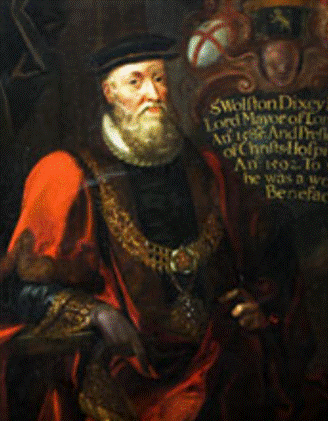
The manor at Market Bosworth was originally purchased by Sir
Wolstan Dixie (1524 to 1594), Lord Mayor of London in 1567, though he never
actually resided there. Although the first Sir Wolstan never lived at
Bosworth, he took a keen interest in his Leicestershire properties, and even
more so because his second wife hailed from the county (Foss, Peter J (1983), The History of Market Bosworth,
Sycamore Press, page 40).
1592
Sir Wolstan Dixie commissioned Toby Mathews to make a survey of
the manor of Bosworth in 1592 (Leicester Records
Office). This provides a detailed description of the sixteenth century
township, with its manor house, church, farms, cottages and population (Foss, Peter J (1983), The History of Market Bosworth,
Sycamore Press, page 40, who provides a conjectural map based on the
1592 survey). There were three inns, The Bull’s Head, The Unicorn
and The George. The town was served by a bake house and a washing well. Bosworth
was a small township with 59 families in 1564, 58 properties in 1592, 9 farms,
10 tenements and 35 cottages, built largely of mud and timber framed houses with
thatched roofs and built on Carrlton stone plinths. Some of the cottages were
of cruck construction, such as the present Rainbow Cottage with its cruck beams
still visible inside. (Foss, Peter J (1983),
The History of Market Bosworth, Sycamore Press, page 45).
All these properties were closely concentrated
in the town, and it was from this nucleus that the various roads diverged
towards the chapelries served by the mother church: Carlton to the north over St
Anne's Hill, Barleston to the east through the park,
Sutton to the south through the pastures of the Glebe, and Shenton to the
southwest. On the road to the hamlet of Coton was the windmill in a
field marked ‘windmill close’ in 1847 and described thus in 1592: “the windmill
and malt mill stand in the south part of the field between Bosworth and Coaton, which mills, together with the water mill is in the
occupation of Mr Thomas Styles”. (Foss, Peter J
(1983), The History of Market Bosworth, Sycamore Press, page 47). By
1588 there were twenty acres which had succumbed to enclosure, mostly for
cattle pasture, in all 678 acres held by the lord of the manor in ‘severall’ or enclosed compared with 288 acres of arable
farmed by Mr Thomas Styles. A recent analysis of the agricultural
developments in Bosworth between 1550 and 1660 showed that over 50% of the
farmers overall holdings in 1,284 acres of land constituted meadow and waste
for grazing, in closes and on the common cow pastures, and that cattle rearing
was the staple agricultural activity from the mid 16th
century onwards.
Central to the life of 16th century Bosworth
were the manor house and the church, the latter originally standing immediately
adjacent to the western entrance of the Lord’s moated homestead, and almost
within the area of the base court. (Foss,
Peter J (1983), The History of Market Bosworth, Sycamore Press, page 48).
1608
The Dixie family’s direct impact on the town began in 1608, when
his grand-nephew, Sir Wolstan Dixie of Appleby Magna (1576 to 1682), became the
first family member to move to Market Bosworth after inheriting the estate in
1594. His arrival initiated a major restructuring of the local landscape. He began
the construction of a grand manor house and surrounding parklands, setting the
stage for what would eventually become the modern Bosworth Hall.
It was to this moated manor house with its
timbered hall, stone barns and fine walks, that the second Sir Wolstan Dixie
came in 1608. His great uncle, the first Sir Wolstan, Lord Mayor of London, had
died in 1593 or 1594, leaving in his long and complicated Will the estate to
his heir and brother, Richard Dixie, who was himself then over 60 years old. It
was through Richard's son, John Dixie, that it came to the next generation,
another Wolstan, and it was this Sir Wolstan who took up residence at Bosworth
in the reign of James I, and who intended to carry through his great uncle's
wishes to the letter by completing the re foundation of the old grammar school
under the title of “The school of Sir Wolstan Dixie,
knight, in Market Bosworth, in the County of Leicester. (Foss, Peter J (1983), The History of Market Bosworth,
Sycamore Press, page 49).
|
|
|
|
The Dixies of Market
Bosworth traced their ancestry back supposedly to a certain Wolstan, Earl of Ellenden, who married the sister of King Egbert of Wessex Thomas
Dixie Married Anne Jephson Carnworth, Huntingdonshire |
|
|
|
|
|
|
|
|
|
|
|
|
|
|
|
Sir
Wolstan Dixie I
1524 to 1594 Merchant and Administrator Married Walkedon Married Agnes Draper,
daughter of Sir Christopher Draper, Lord Mayor of London Lord Mayor of London in 1585 He possessed not only the
manor of Bosworth, which he had purchased in 1567 from Henry Hastings, 3rd
Earl of Huntingdon, but of other lands and tenements in Bosworth, Gilmorton, Coton (Leicestershire), Carleton, Osbaston,
Bradley (Leicestershire) and North Kilworth No issue |
Richard
Dixie of Barnewell 1516 to 1593 Sir Wolstan Dixie’s estates
devolved upon his brother Richard, except the manor of Bosworth, which he
settled upon Richard's grandson, his own great-nephew, Wolstan Married Jane Crathorne
(1510 to 1598) |
|
|
|
|
|
|
|
John
Dixie of Catworth 1544 to 1640 A yeoman farmer of Catworth, Huntingdonshire Married Charity Henson |
|
|
|
|
|
|
|
Sir
Wolstan Dixie II of
Appleby Magna and later Market Bosworth 1576 to 25 July 1650 Inherited Market Bosworth
estate in 1594 Admitted to Gray's Inn in
October 1595 Knighted by James I in 1604
as Sir Wolstan Dixie of Appleby Magna, his newly acquired manor with its
large estate, which he bought for £500 In 1608 he moved to Market
Bosworth and commenced work on the original manor house and a grammar school High Sheriff of Leicestershire
in 1625 Married Frances Beaumont
(1580 to 1654), the daughter of Sir Thomas Beaumont of Stoughton Grange,
Leicestershire in 1598 |
|
|
|
|
|
|
|
|
|
|
|
Edward
Dixie 1599 to 1652 |
|
Sir Wolstan Dixie III First
Baronet of Market Bosworth c 1602 to 13 February 1682 Married (firstly) Barbara,
daughter and heiress of Sir Henry Beaumont, Bart. of Gracedieu,
Leicester Married (secondly) Frances,
daughter of Edward Hersilridge, Esq |
Frances
Dixie Married Walter Rolte of
Clifton, Bedfordshire |
Mary Dixie Married John Pelsant,
rector of Bosworth |
Jane Dixie 1610 Married John Adderley of
Weddington, Warwickshire |
Elizabeth
Dixie 1620 to 1681 Married Sir Verney Noel of Wellesborough in Sheepy, Leicestershire |
|
|
|
|
|
|
|
|
Funded from the Will of Sir Wolstan Dixie, the free Dixie Grammar
School introduced a foundational educational institution to the area. Because
Sir Wolstan Dixie died before seeing it completed, it was his great-nephew, also
Sir Wolstan Dixie who physically established the school building and endowed it
after moving to Market Bosworth in 1608. In line with standard Jacobean grammar
schools, its primary purpose was to teach Latin grammar, classical literature,
and Christian values to the boys of the Market Bosworth area. Despite being
heavily tied to the strictly Royalist Dixie family, the school ironically
became a breeding ground for radical religious and political thought in its
early decades. Its most distinguished early pupil was Thomas Hooker. Hooker
attended the school in the early 1600s, later became a prominent Puritan
leader, fled to America, and founded Hartford, Connecticut, later known as the
Father of American Democracy. The original seventeenth century
schoolhouse was much smaller than the current building. By the early 1800s,
this original structure had completely fallen into dilapidation, leading the
governors to demolish it and build the grand Georgian structure that faces the
Market Square today.
The early seventeenth-century rector of Market Bosworth and
prebendary of Lincoln was William Pelsant BD (Bachelor of Divinity), who was
the next most influential person in the town after Dixie. The town brought a wealthy
living and significant status to its rector. Pelsant had
been presented to the rectory of Market Bosworth in 1588 and held this
lucrative post for over four decades until his death in 1634. Pelsant did not always strictly conform to the established
Church of England practices. He was noted at one point for refusing to wear the
surplice, a common form of protest among Elizabethan and Jacobean
Puritan-leaning clergy who viewed the vestment as a remnant of Catholicism.
Alongside
his rectory at Market Bosworth, his appointment as a prebendary of Lincoln
provided him with additional ecclesiastical standing and estate properties
linked to the cathedral.
1610
In 1610, the town’s population was recorded at just 543 people.
The community grew at an incredibly slow pace during this era, barely
fluctuating over the course of the seventeenth century.
The town continued to rely almost entirely on its weekly Wednesday
market and bi-annual livestock fairs, which had been guaranteed by its 1285
royal charter.
1625
Sir Wolstan Dixie became High Sheriff of Leicestershire.
1630
In 1630 Sir Wolstan Dixie was listed as the only freeholder in
Market Bosworth (Nichols, John (1811), The history and antiquities of the
county of Leicester, Volume 4, Part 2, page 497).
1634
William Pelsant was succeeded as rector by Michael Hudson, an
extraordinary, militant seventeenth-century clergyman who briefly served as the
rector of Market Bosworth before abandoning his quiet parish duties to become a
martial operative, spy, and trusted confidant to Charles I during the English
Civil War. Despite being an ordained priest, Hudson proved remarkably adept at
military strategy. Charles I affectionately dubbed him
his plain-dealing chaplain because Hudson was uniquely willing to speak
his mind frankly to the monarch when other courtiers did not dare. His
strategic knowledge of the topography of northern England led to his
appointment as the Scoutmaster General for the Royalist army in the North. In
this role, he acted as a chief intelligence officer, managing scouts, mapping
terrain, and gathering vital reconnaissance data.
1640
The town centre retained its medieval layout, but new
timber-framed buildings emerged. A survivor of this period is the Rose
and Thistle Cottages, built in 1640 in the Market Place, which still
displays its original cruck A-frame structure. The
cottages date back to 1640, a date that remains engraved into the first-floor
timber framing. The names Rose and Thistle reflect the historical
ties of the Dixie family to both England and Scotland.
1642
During the English Civil War (1642–1651), the town of Market
Bosworth and its leading family, the Dixies, held a steadfast Royalist
allegiance. This pitted them directly against the wider county of
Leicestershire, which was heavily dominated by Parliamentarian forces, as well
as the Parliamentarian Coventry to the south.
The primary landlords and political controllers of Market
Bosworth, the Dixie family, were devoted supporters of Charles I. As the head
of the household during the conflict, Sir Wolstan Dixie actively supported the
Crown with both funds and loyalty throughout the war years.
Market Bosworth’s Royalist alignment placed it in a dangerous and
isolated position. Leicestershire was largely a stronghold for the Roundheads,
the Parliamentarians, anchored by the heavily fortified garrison at Leicester.
Because
of this, the area around Market Bosworth was frequently subjected to tactical
skirmishes, troop movements, and the forced quartering, housing and
feeding, of passing soldiers from both sides. Local estates
aligned with the King routinely faced heavy financial penalties, land
confiscations, and aggressive taxation by the local Parliamentarian authorities.
1644
The Second Battle of Bosworth was a minor but symbolic
cavalry skirmish fought on 1 July 1644 during the First English Civil War. It took
place on the exact geographical site where the historic 1485 Battle of Bosworth
Field was fought. While the massive Battle of Marston Moor was
developing further north in Yorkshire, smaller localised conflicts were
occurring across England. A force of roughly 120 Royalist troops loyal to Henry
Hastings, Lord Loughborough, was caught plundering the nearby town of Hinckley.
The Parliamentarian commander Lord Grey of Groby dispatched eighty
Parliamentarian horsemen under the command of Captain Babington to intercept
them. Despite being outnumbered, Babington's Parliamentarian cavalry overtook
the Royalists and decisively defeated them.
1649
Because the Royalists lost the English Civil War and England
entered the Interregnum, Puritan rule under Oliver Cromwell, Dixie found
himself in a difficult position in the aftermath of the Civil War. The
social and spiritual fabric of Market Bosworth was deeply strained following
the war. As the strict authority of the Church of England collapsed under
Parliamentarian rule, radical new religious groups emerged.
In 1649, George Fox, the founder of the Religious Society of
Friends, the Quakers, visited the town. The local population reacted with
hostility to his non-conformist preaching. Fox noted bitterly in his journal, The
people of the town and market fell upon us and stoned us very sore and abused
us.
While much of England saw the widespread seizure of Royalist
estates, the manor of Market Bosworth stayed under the control of the Dixie
family.
1660
Upon the Restoration of the Monarchy in 1660 under Charles II, Sir
Wolstan Dixie’s loyalty was formally recognised. He was officially created the
first Baronet of Bosworth, a title explicitly granted to honour his steadfast
support during the war.
By the late Stuart era and the end of the seventeenth century, the
Dixie resurgence culminated in the construction of the grand Bosworth Hall,
which replaced their earlier country seat and still stands today.
Bibliography
Foss, Peter J (1983), The History of Market Bosworth,
Sycamore Press.
Market Bosworth Society, Brief
History of Market Bosworth.