Richard (“Dick”) Dod Baker
5 October 1856 (baptised) to 23 September 1902
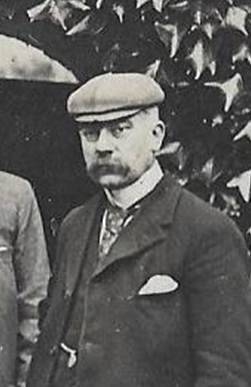
BAK00154
|
Return to the Home Page of the Bakers Family part of the website |
The Bakers of Highfields Story
The Story of the Dods and Bakers and of Highfields,
Fenton House and Hasfield Court. A journey through the history of Cheshire and
Staffordshire, an Anglo-Saxon nobleman who retained his lands after the
Conquest, pottery at Stoke on Trent, an encounter with Elgar, and the history
of an Elizabethan manor house at Audlem |
The family tree of the Bakers of Highfields |
The Family Tree of the Dods, predecessors to the
Bakers of Highfields |
The Bakers of Fenton House and Hasfield
Court
The Family Tree of the pottery Bakers of Stoke on Trent |
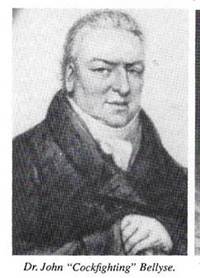
The Family Tree of the Bellyse Family |
The main part
of this website tells the story of the Farndale family from Yorkshire Descendants of Arthur Baker, the story of the
Farndale ancestry is told through the main part of this website You can also return to the Farndale
website home page |
The genealogy of the family of James Hall, linked to
the Baker family through marriage to Arthur Baker |
Headlines of Dick
Baker’s life are in brown.
Dates are in red.
Hyperlinks to
other pages are in dark
blue.
References and
citations are in turquoise.
Context and local
history are in purple.
1856
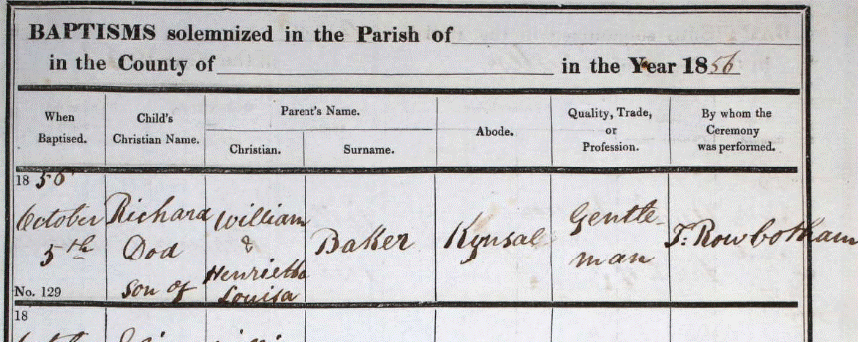
Richard Dod Baker was the son of William
and Henrietta Louisa (nee Bellyse) Baker (BAK00121). He was baptised on 5
October 1856 at Audlem (Audlem Parish Records).
1861
1861 Census – Kinsey
Heath, Buerton, Nantwich, Cheshire
William Baker, head,
widower, born Leominster, Herefordshire in 1788, 73, magistrate
Ann Baker, daughter,
unmarried, 38, magistrate’s daughter, born Buerton
Mary Baker, daughter,
unmarried, 33, magistrate’s daughter, born Buerton
Jane Baker, daughter,
unmarried, 30, magistrate’s daughter, born Buerton
George Baker, son,
unmarried, 28, solicitor, born Buerton
Charlotte Baker, daughter,
unmarried, 25, magistrate’s daughter, born Buerton
Henrietta Baker, granddaughter,
unmarried, 11, born London
Jane E Baker,
granddaughter, unmarried, 6, born Buerton
Richard D Baker, grandson, unmarried, 4,
born Buerton
A visitor, John R Piercy,
29 (who would marry Mary Baker in 1863)
3 house servants and a
groom
1871
1871 census – High Fields, Buerton,
Audlem, Cheshire
William Baker, 54, head, land owner
Henrietta Baker, his wife
46
Henrietta Baker, 22
John Bellyse Baker, 20
Richard D Baker, 14
Arthur Baker, 11
Charity Baker, 8
Charlotte L Baker, 4
Emily J Baker, 2
Two visitors, including
John Percy, their agent
Three servants
1874
Audlem Grammar School.
Distribution of Prizes. … The Chairman then called upon Master R D Baker, to
whom he had handed the “Captain’s” Prize, given by T L Boote Esq. … The following
pieces were recited by the pupils whose names are prefixed … Richard D Baker,
“Battle of Ivry” … Richard D Baker, “The Gambler’s Wife” … (Crewe Chronicle, 29
August 1874).
Ivry or The Battle of Ivry
is a once famous historical ballad written by Thomas Babington Macaulay written
in 1824, which was frequently republished in collections like the 1874 edition
of Lays of Ancient Rome, with Ivry and the Armada.
The Gambler's Wife is a nineteenth century descriptive
poetic ballad written by the American physician and poet Dr. Reynell Coates.
While it was originally published and set to music by composer Henry Russell in
1841, it remained popular throughout the Victorian era and was frequently
republished in poetry anthologies and public reading guides around 1874. The
poem is a tragic, dramatic temperance piece about a mother freezing to death
with her child while waiting through the night for her husband to return from
gambling.
On 14 December 1874 the
Grammar School put on a very pleasant evening of entertainment,
including Sir Thomas More, a tragedy in four acts in which Richard Dod Baker
played the role of Sir Thomas More, the Lord Chancellor. Sir Thomas More was
well represented by Mr R D Baker (Nantwich Guardian and Chronicle,
19 December 1874).
1880
Richard was less keen on field
sports than his brothers.
William Baker’s second son, Richard Dod Baker, was rather unusual
for his day and age, insomuch that not only did he take no interest in field sports, but took great delight in making fun of those who
did.
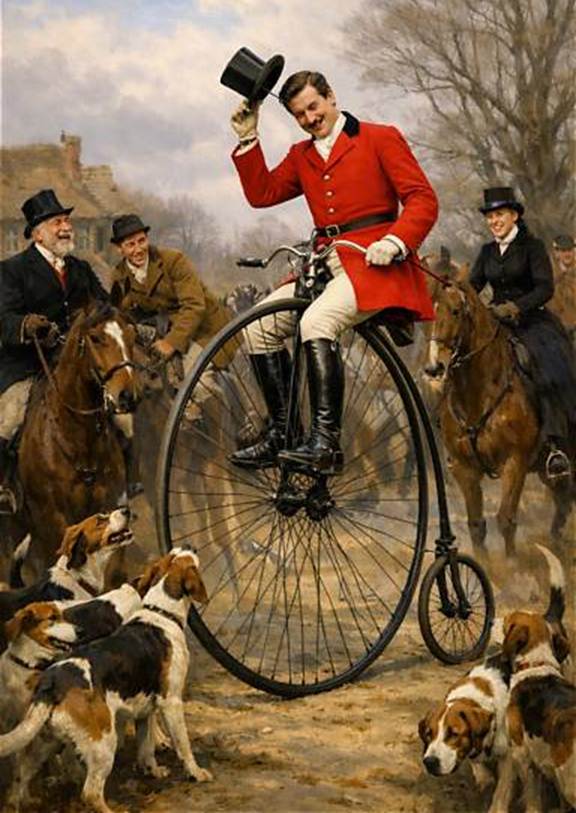
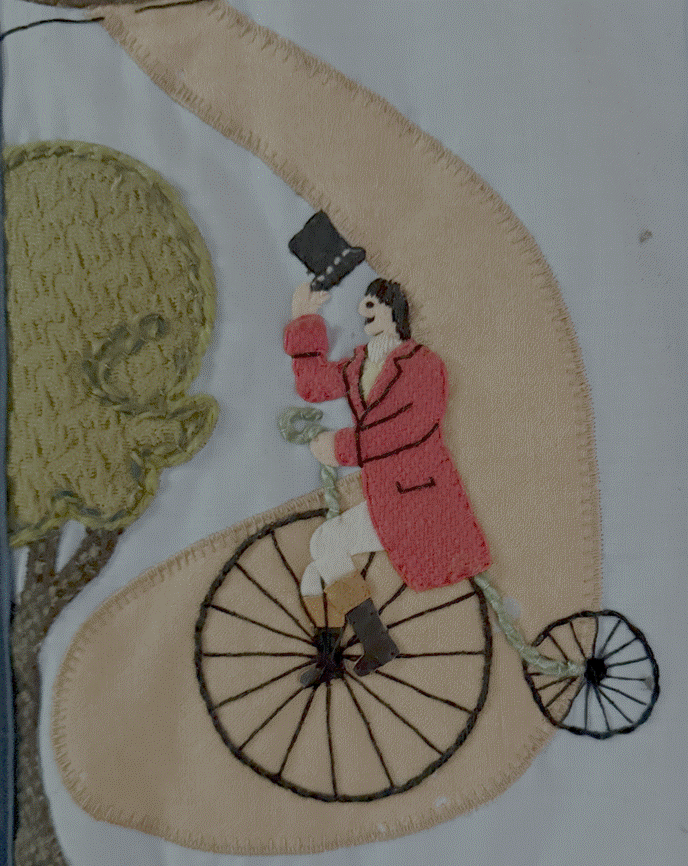
Richard Baker teasing the Cheshire Hounds, recreated by artificial
intelligence The same scene depicted in a Community Wall Hanging in
Audlem Church
In the early 1870s the Cheshire Hounds met regularly in Audlem
Square, under the mastership of HR Corbet, father of
the late Reggie Corbet of Adderley, a meet which Richard’s father and eldest
brother Jack always attended. Unknown to them there was an occasion when he
‘borrowed’ a top hat, pink coat and white breeches, also a penny farthing bicycle
from Mt Moseley in the village. When the meet assembled below the church at
eleven, he duly arrived in full hunting kit, riding the penny farthing and
raising his hat to the mounted company. Finally, when performing a specially deep bow to the master, he fell off at the feet of
that gentleman’s horse.
Audlem cricket had its hour of glory. At the end of the last
century Market Drayton held an Annual Cricket Week, when a
number of Lancaster County men stayed with their then captain, AN
Hornby, and played for the town, matches being arranged with the local towns
and villages, including Audlem
The captain of Audlem at this time was Arthur Baker of Hillside,
youngest son of William Baker of Highfields. Some idea of the quality of the
Audlem side may be gathered from the fact that the captain’s 13 years old
nephew Bellyse, on holiday from school, was brought in to complete the team.
Indeed, the main purpose of the game, a single innings match, was to allow the
spectators to watch the great Lancashire stars in action. Audlem, however, possessed
a fast bowler. He was one of the Shuker brothers, the local blacksmiths, whose
cannon ball deliveries were only exceeded in speed by their usual inaccuracy.
Audlem went in first and were dismissed, with little difficulty,
for 13 runs. The spectators settled down to watch the great men perform. Shuker
opened the bowling, and with his lighting delivery removed the batsman’s middle
stump. This success inspired him to hitherto unknown heights,
and helped no doubt by the un-Old Trafford like ground, he dismissed
Market Drayton for 11 runs.
The captain then came over to Arthur Baker and said, “Well,
Arthur, it’s been great fun. I suppose we’d better make it a two innings
match?”
“We’ll both go in again by all means,” was the reply, “but as far
as the match is concerned, it’s all over and we’ve won.”
“If that’s Audlem’s idea of good sportsmanship”, said their
captain, “Market Drayton will never play them again.” And for all I know to the
contrary they never did until the middle of the 1960s, when the club revised
after a lapse of twenty five years.
(Burton, Marjorie (1973),
Nineteenth Century Audlem, Audlem District Amenities Society, Johnson
& Son Nantwich Limited page 21).
Their brother, Richard, always known
as Dick, was of a similar nature. There is a tapestry in Audlem church, woven
by members of the W.I., and one of the squares depicts a gentleman in a pink coat
riding a penny farthing bicycle. The man so depicted was Dick Baker, who rather
enjoyed making fun of field sportsmen. One day, when hounds were due to meet in
Audlem Square, he borrowed an old pink coat of his father's and a penny
farthing from Mr. Moseley at the shop. Then, when all were assembled, he
arrived on the bicycle raising his topper to all and sundry. Unfortunately,
this caused him to fall off under the hooves of the Master's horse. Old
"Regie" Corbet, the Master, was equal to the situation. Turning to
the youth's father, "Really, Will," he said, "I should have
thought you could have turned your son out better mounted for an Audlem
meet." (Latham,
Frank (1997), Audlem: The History of a Cheshire Parish and its seventeen
townships, page 124).
1881
He was admitted as a
solicitor in 1881 and was a churchwarden of Audlem.
Census 1881, Highfields, Buerton,
Nantwich, Cheshire:
John Bellyse Baker, head,
single, born 1851, aged 30, gentleman
Henrietta Baker, single,
born 1849, his sister, aged 32, no occupation
Richard Dod Baker, single, born 1857, aged
24, solicitor’s general clerk
Arthur Baker, single, born
1860, aged 21, no occupation
Charlotte L Baker, single , 14, scholar
Emily Jane Baker, single,
aged 12, scholar
Mary Dobson, a visitor,
aged 33
Martha A Egerton, single,
19, servant
From the diaries of Richard’s three younger
sisters: The girls’ three
brothers, Jack (1850 to 1932), Dick (1856 to 1902) and Arthur (1858 to 1916),
were older and would have been in their 20s when the diaries were written. From
the entries it is clear that they lived outdoor lives
and enjoyed the traditional country sports. There are many references to their
days spent hunting and shooting. July visits to the races at Market Drayton,
cricket in the summer and skating in the winter, usually at Adderley and Shevington.
For them, oyster suppers seemed to have been popular.
1891
Census 1891, Sandy Lane, Audlem
Richard D Baker, head, single, 34,
solicitor
Henrietta Baker, single,
42, living on her own means
Charlotte L Baker, single,
24, living on her own means
Emily J Baker, single, 22,
living on her own means
Sarah Huntbach, general
domestic servant
1892
(Copy of a letter
regarding Highfields and Dod and Baker family written by J H Bellyse (or
possibly R D Baker) in about 1892, Baker Records 98)
Richard Dod Baker and The
Misses Baker are shown living at the Cedars, Audlem (Kelly’s Directory 1892).
1901
Census 1901 – The Cedars, Audlem
Richard D Baker, head, single, 44, solicitor,
born Audlem
Henrietta Baker, single, 52,
living on her own means
Charlotte L Baker, single, 34,
living on her own means
Emily J Baker, single, 32, living
on her own means
Sarah J Cooper, 23, servant
Miss Burton’s book tells
of a kindergarten run at the Cedars, the residence of Richard Dod Baker, solicitor,
by the Misses Baker (Latham, Frank (1997), Audlem: The History of a
Cheshire Parish and its seventeen townships, page 101).
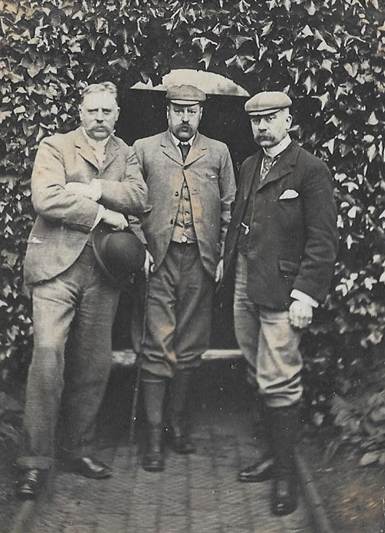
Arthur centre with Jack Baker and Richard Baker perhaps 1900
1902
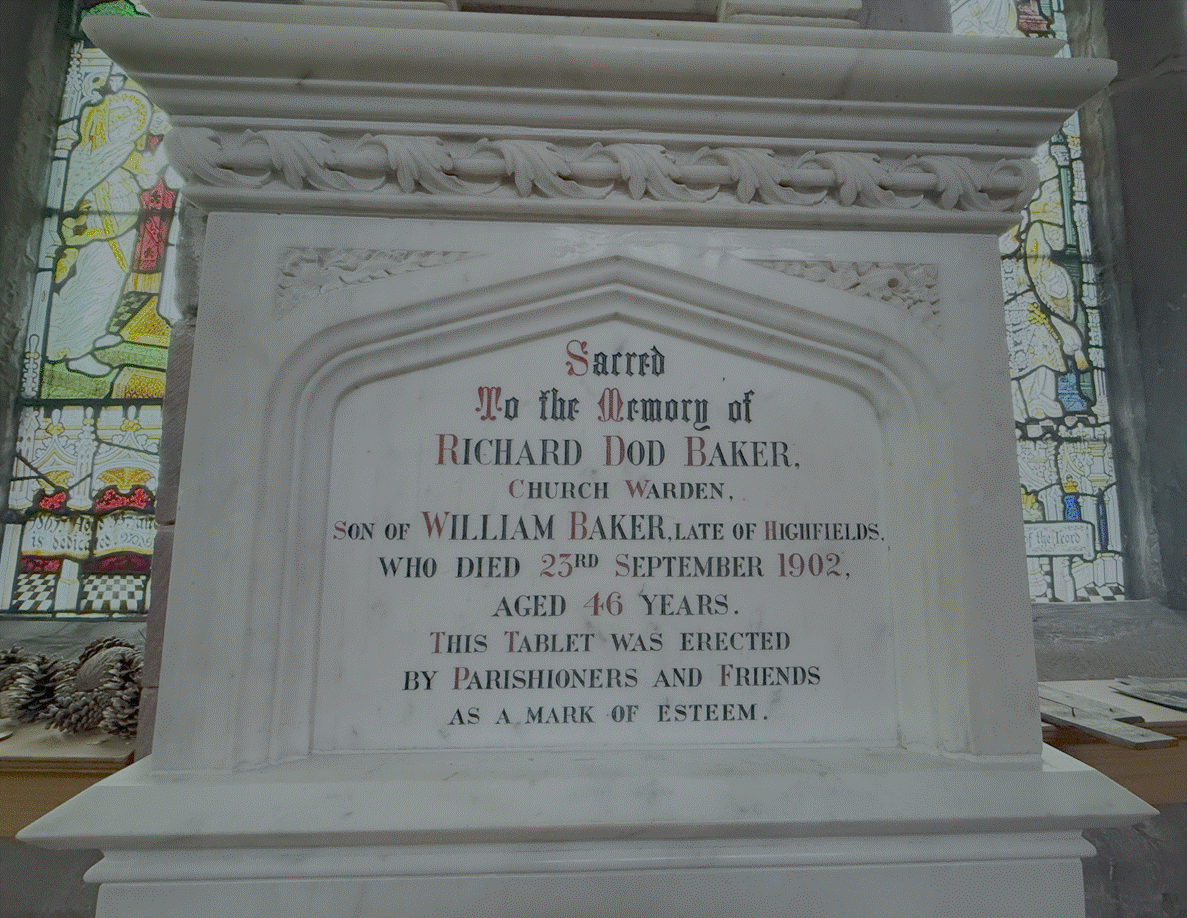
Richard Dod Baker died
unmarried on 23 September 1902. His
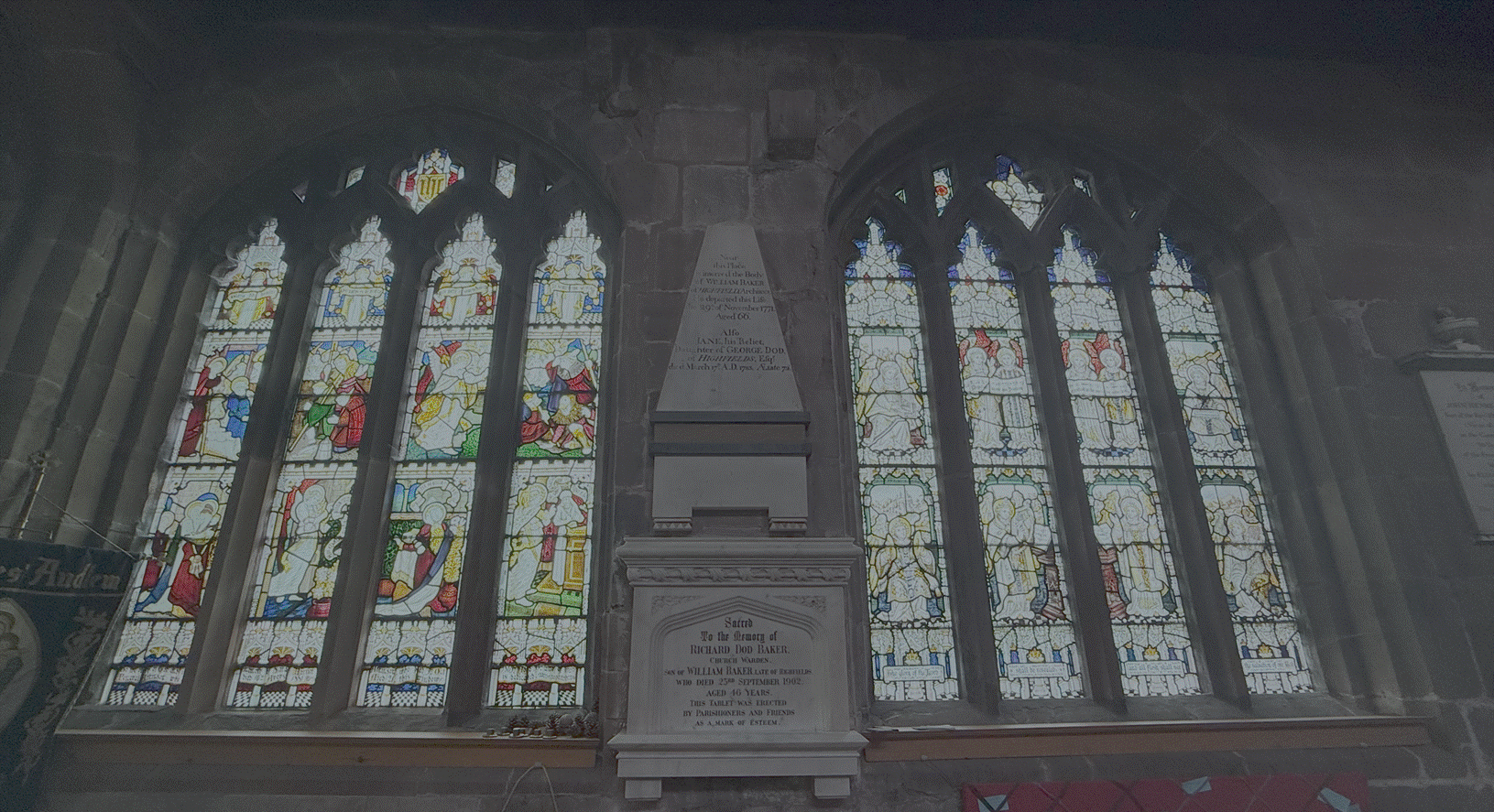
will was proved in 1902 with an estate of £24,574. The south wall also
houses three large stone memorials. The first is to “Richard Dod Baker, CW, son
of William Baker, died 23 September 1902, aged 46 years”. (Latham,
Frank (1997), Audlem: The History of a Cheshire Parish and its seventeen
townships, page 75).
Baker
Richard Dod of the “Cedars” Audlem Cheshire died 23 September 1902
Administration Chester 9 April to Henrietta Baker, Charlotte Louisa Baker and
Emily Jane Baker spinsters Effects £745 12s 7d (Probate
Record).