William Meath Baker of Hasfield and Fenton
“WMB”
1 November 1857 to 15 January 1935

BAK00310
|
Return to the Home Page of the Bakers Family part of the website |
The Bakers of Highfields Story
The Story of the Dods and Bakers and of Highfields,
Fenton House and Hasfield Court. A journey through the history of Cheshire
and Staffordshire, an Anglo-Saxon nobleman who retained his lands after the
Conquest, pottery at Stoke on Trent, an encounter with Elgar, and the history
of an Elizabethan manor house at Audlem |
The family tree of the Bakers of Highfields |
The Family Tree of the Dods, predecessors to the
Bakers of Highfields |
The Bakers of Fenton House and Hasfield Court
The Family Tree of the pottery Bakers of Stoke on Trent |
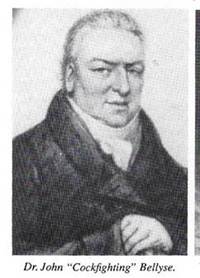
The Family Tree of the Bellyse Family |
The main part
of this website tells the story of the Farndale family from Yorkshire Descendants of Arthur Baker, the story of the
Farndale ancestry is told through the main part of this website You can also return to the Farndale
website home page |
The genealogy of the family of James Hall, linked to
the Baker family through marriage to Arthur Baker |
Headlines of
William Meath Baker’s life are in brown.
Dates are in red.
Hyperlinks to
other pages are in dark
blue.
References and
citations are in turquoise.
Context and local
history are in purple.
1857
William Meath Baker was the son of
Rev Ralph B and Frances (nee Singer) Baker (BAK00302).
He was born on 1
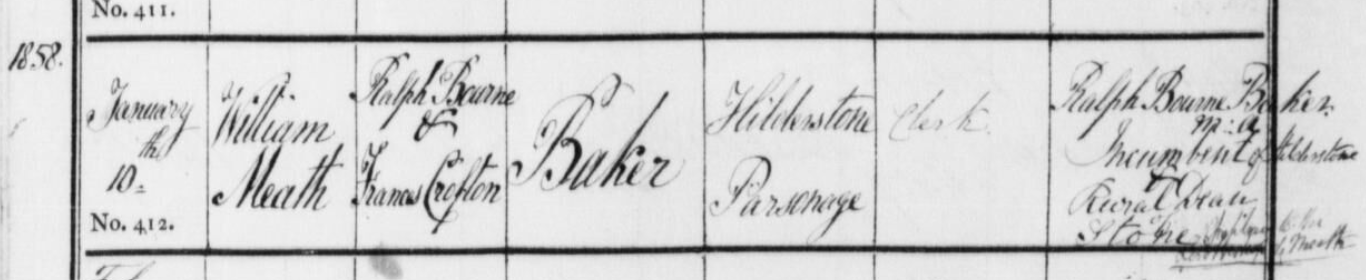
November 1857. He was baptised at
Christ Church, Hilderstone, Staffordshire on 10
January 1858 (Christ Church, Hilderstone Parish Records).
1861 Census - 22, Porchester Square,
Paddington
Ralph B Baker, Head , Married, Male, 58, 1803, Clergyman church
England without cure of souls, Kenton, Staffordshire, England
Frances C Baker, Wife, Married,
Female, 38 , 1823, Ireland
Mary F Baker, Daughter, Female,
12, 1849, Scholar, Ireland
Letitia J D Baker, Daughter,
Female, 9, 1852, Scholar, Ireland
William M Baker, Son, Male, 3, 1858, Hilderstone, Staffordshire
Jessie Goward, Servant, Unmarried,
Female, 25, 1836, Housemaid, Scotland
Sarah Death, Servant, Unmarried,
Female, 22, 1839, Cook, Kentish Town, Middlesex
Sarah Addison, Servant, Unmarried,
Female, 22, 1839, Nurse, Staffordshire
WMB was
educated at Eton and Trinity College, Cambridge. W.M.B.
was educated at Eton and Trinity College, Cambridge, gaining his M.A. in 1886
(Dodd, F (1987), The Baker Family
and Fenton, Presidential Address in Transactions 1986 to 1987, The
North Staffordshire Field Club, page 15).
1875
On his father’s death in
1875, he inherited the Gloucestershire and Fenton estates. On his father's death in 1875 he inherited the
Gloucestershire and Fenton estates and in the words of Dr. Percy Young, one
time Director of Music in Stoke, "he settled down to the duties of a
country squire and magistrate at Hasfield Court". (Dodd, F (1987), The Baker Family and Fenton,
Presidential Address in Transactions 1986 to 1987, The North
Staffordshire Field Club, page 15).
He inherited
Hasfield Court and Fenton House from his father in 1875 and came of age in 1880.
After his eldest son joined the Roman Catholic church in 1918
they agreed to break the entail on the estate so that it could be left to his
second son.
When William Meath Baker (his
mother was the daughter of the Bishop of Meath) inherited Hasfield Court from
his uncle in 1865 (sic, recte 1875), the house was a fine country seat for a
gentleman whose fortunes were founded in the Stoke-on-Trent potteries, but it
lacked space to enjoy some of the finer pursuits of a wealthy Victorian
life. Employing the architect, Frederick
Sandham Waller, Meath Baker commissioned a Billiard Room, Music Room and
adjoining Conservatory. The Music Room and Conservatory were adorned with fine
stained glass, appropriately featuring musical instruments in the Music Room
and apple and rose trees in the Conservatory. The Conservatory is lit by a
glass lantern roof and the restoration, with help from the Historic Houses
Foundation, is part of a larger plan by the family for the restoration of these
rooms and of the surrounding gardens. Outside as well, the gardens give a good
indication of the style of Victorian living at Hasfield with a walled kitchen
garden, beech maze, croquet lawn and far-reaching views from the terrace across
the Severn vale to the Cotswold escarpment. (Hasfield Court:
where Elgar played, Country Houses
Foundation).
1880
FENTON. CONGRATULATORY ADDRESS TO
MR W M BAKER. Arrangements have been made for a beautifully lithographed
congratulatory address to be presented today to Mr William Meath Baker, of
Hasfield Court, Gloucester, on the occasion of his attaining his twenty third birthday, and succeeding to the estates of the late Mr
William Baker, whose family have for many years taken great interest in the
welfare and improvement of this town. The address was signed by the Rev H C
Turner, vicar, the members of the local board, and many of the inhabitants, and
Mr. J Gimson was entrusted with the duty of making the presentation. (Staffordshire Daily Sentinel, 1 November 1880).
1881
THE BURIAL QUESTION. A notice has
been circulated throughout the district, signed by the Rev H C Turner, Messrs J
Gimson and F W Grove, churchwardens, and the committee, on the burial question,
calling attention to the fact of the churchyard being full; and that is just
been decided to accept the generous offer of Mr William Meath Baker to give a
quarter of an acre of land, adjoining the churchyard, as an addition to the
burial ground. The estimated cost of drainage, fencing etc is £70. Should the
amount not be raised, it will be necessary to make application to the Secretary
of State to close the churchyard, which would cause great inconvenience, as it
is believed two years at least must elapse before the proposed cemetery will be
ready for burials. It is suggested that as it is intended to benefit both
churchmen and Nonconformists it should be supported by every householder. (Staffordshire Daily Sentinel, 29 September 1881).
1881 Census – Hasfield Court, Hasfield,
Tewkesbury, Gloucestershire
Frances Crofton Baker, Head , Widow, Female, 57, 1824, Householder,
Ireland
Mary Frances Baker, Daughter, Single, Female, 32 , 1849, Householder’s daughter,
Ireland
Letitia Jane Baker, Daughter,
Single, Female, 28, 1853, House holders daughter,
Ireland
William Meath Baker, Son, Single, Male, 23, 1858,
Landowner, b a Stafford, Staffordshire,
England
Alice Frances Crofton, Visitor,
Single, Female, 32, 1849, Ireland
Helen Julianna Jenkins, Visitor,
Single, Female, 36, 1845, Bond holder, Ireland
John Belmont, Servant, Widower, Male, 59, 1822, Domestic servant butler,
Marwood, Devon, England
Thomas Smith , Servant, Single, Male, 18, 1863, Domestic
servant footman, Aston, Gloucestershire, England
Elizabeth An
Bedding, Servant, Single, Female, 28, 1853, Domestic servant housemaid, Forthampton, Gloucestershire, England
Laura Box, Servant, Single, Female , 27, 1854, Domestic servant cook, Monmouthshire, Wales
Clara Louisa James, Servant,
Single, Female, 32, 1849, Domestic servant ladies
maid, Tipton, Staffordshire, England
Kate Lake, Servant, Single, Female,
16, 1865, Domestic servant kitchen maid, Ashleworth,
Gloucestershire, England
Rose Emme Colebrook, Servant,
Single, Female, 19, 1862, Domestic servant house maid, Carmarthenshire, Wales
Louisa Westlake, Servant, Married,
Female, 39, 1842, Domestic servant housekeeper, Somerset, England
1884
The marriage between Mr William Meath Baker, of Hasfield Court,
near Gloucester, and Mary, only daughter of Captain Richard John Corbett (Retired
List), Indian Staff Corps, of La Pinedo, Hyeres, Frances, is arranged to take plavce early in June (Life, 24 April 1884).
WMB married
Hannah Mary Corbett, daughter of Captain R J Corbett of Hyeres, France in 1884.
He became High Sheriff of Gloucestershire and W.M.B.
married Hannah Mary Corbet, daughter of Captain R. J. Corbet of Hyeres, France
in 1884 and they had three children, William George Corbet Baker who became a
priest in the Church of Rome, Francis Ralph Meath and Edward John. His wife died
in 1906 and he remarried in 1909, his second wife being Sybil Agatha Wyrley of
Norfolk. The business continued to trade as William Baker & Co. making the
printed, sponged and pearl-white granite ware for export, mainly to Canada, at
the factory on the North side of City Road. The one opposite had changed to the
manufacture of encaustic tiles, still under Wm. Baker & Co.
(Dodd, F (1987), The Baker Family and Fenton,
Presidential Address in Transactions 1986 to 1987, The North Staffordshire
Field Club, page 15).
At the British Consulate, Marseille, and, on the 24th inst, at Saint Pauls Church, Hyeres les Palmiers,
by the Rev J A Alexander, assistant chaplain, assisted by the Rev Canon
Beresford, rector of Hovey-cum-Rotherby,
Leicestershire, William Meath Baker, only son of the late Rev Ralph Bourne
Baker, of Hasfield Court, Gloucestershire, and Fenton house, Staffordshire, to
Hannah Mary, only daughter of Captain RJ Corbett, ret list Indian Staff Corps,
of La Pinedo, Hyeres. (Gloucestershire Chronicle, 31 May 1884).
Baker – Corbett. May 24, at Hyeres
les Palmiers, William Meath Baker, only son of the
late Rev R B Baker, of Hasfield Court, Gloucester, and Fenton House,
Staffordshire, to Hannah Mary, only daughter of Capt R J Corbett, Retired List,
Indian Staff Corps, of La Pinedo, Hyeres. (Homeward Mail from India, China
and the East, 4 June 1884).
Baker-Corbett. May 21, at St
Paul’s Church, Hyeres les Palmiers, by the Rev J A Alexander,
assistant chaplain, assisted by the Rev Canon Beresford, rector of Hove-cum-Rotherby, Leicestershire, and previously at the British
Consulate, Marseilles, William Meath Baker, JP, only son of the late Rev Ralph
Bourne Baker, of Hasfield Court, Gloucester, and grandson of the late Most Rev
and Right Hon J H Singer, DD, Bishop of Meath, to H Mary, only daughter of
Captain R J Corbett, Retired List, Indian Staff Corps, of La Pinedo, Hyeres. (The Belfast Newsletter, 7 June 1884).
They had three children.
Although
W.M.B. did not take an active part in the running of the factories, he made fairly regular visits to Fenton when he presumably stayed at
Fenton House and, like his uncle William (IV), he was much involved in the
development of public and private buildings in the town. The transfer of local
government from the Parish to Improvement Commissioners in 1839 had
necessitated the provision of some public buildings. The new Improvement Commissioners
had built a Public Office, a Police house, a Police Station, incorporating
cells with bars on the windows and a meeting room cum court-room
on the first floor. But by 1873, a Local Board of Health had been formed and its business was carried out in the Court Room,
which of course, was also needed for the police Court. This was so inconvenient
that negotiations with W.M.B. were undertaken for the Local Board to use the
Athenaeum which he had inherited. (Dodd, F (1987), The Baker Family and Fenton,
Presidential Address in Transactions 1986 to 1987, The North
Staffordshire Field Club, page 15).
1887
Then in
1887 W.M.B. offered to build a larger building for the use of the Board - this
was to be Fenton Town Hall. It was agreed that the Board would rent the
buildings for ten years and surrender their lease of the Athenaeum, which was
then turned into a School of Art.
Alex
Scrivener, a prominent name in the early years of the Field Club, was the architect
and the cost of the building was £10,000. The foundation stone was laid on 9th.
July 1888 and the Staffordshire Advertiser reported the event, stating that
"Mr. Baker considerately bears the whole cost of new public buildings and
prepares to let the premises required for the public service at a reasonable
rental. The erection of the Town Hall marks the start of a new era in the
history of Fenton, for in conjunction with this a large square and new streets
are in the process of formation". The report went on to say that Mr.
Baker's honoured name was well known and justly respected by every party in the
township, Churchman and Dissenter alike and by rich and poor. In fact the town owed its prosperity in great measure to the
Baker family.
W.M.B.
did continue the development of the area around the new Town Hall with a major
rebuilding scheme. A line of buildings stretching from the Athenaeum to the
square in front of the Hall was erected. They are still there, occupied by
various shops and including a bank on the corner, which has retained the
original style of the buildings. They are brick with stone dressings and terra
cotta ornaments inserted - and must have looked very elegant in their prime. A
little further afield he built a number of terraces of
houses, some almost adjacent to his pottery and probably intended for his
employees, which replaced early small cottages. These houses are substantial
structures of various designs, some double fronted and all have two-storied
rear wings. They are quite imposing terraces, the frontages incorporating
moulded brickwork, terra cotta ornamentation and at intervals a cartouche bears
the monogram W.M.B. and date - all being around 1890. They can be seen on City
Road as it approaches Victoria Place and continue round the corner - a shop
being included near the corner. These look rather the worse for wear now as
they front a busy main road, but a terrace nearer to the old Fenton Railway
Station is in good condition and, I think, has a very elegant appearance. We
were told by an inhabitant that they are extremely sound structurally. They
still belong to the Baker family. W.M.B. also gave land behind his Town Hall
for a library although the building itself was erected with money provided by
Carnegie. There are several other substantial detached houses in the same area
which to me have very similar features to the buildings above and I have
enquired from Mr. Gregory Meath Baker as to whether there are records of
W.M.B.'s building enterprises. I was told that on W.M.B's
death in 1935 his son looked into the document strong
room only to find to his chagrin that it was virtually empty as all family
documents had been thrown away.
Mr. Alan
Townsend has kindly obtained bound copies of the Fenton Church Magazine, dating
from the end of the last century for me and these record the frequent visits of
both W.M.B. and his wife and also the continuing generous support given to the
Church by him, and by his aunt Mrs. Hitchman to fund raising for the Church,
for building and other activities. In 1864, the year of the Silver Jubilee of
the Church there had been suggestions that a new and larger church was needed
but nothing was done until towards the end of the 80's when the Bishop of Lichfield
commented that Fenton deserved something better than the present building. The
magazine says "Mrs. Hitchman has encouraged this proposal for rebuilding
by a generous contribution". She had given a total of £1,000. In a later
issue of the Magazine it was reported that W.M.B. had
added £1,000 and the trustees of Miss Charlotte Baker (another aunt) £200.
Charles Lynam, also very prominent in the Field Club, who was Diocesan Surveyor
and Architect was chosen to prepare the plans.
When the tower
of the old church was pulled down, two bricks were found with the initials W.B.
1855 and W.B. 1856. The later one was placed under the foundation stone of the
new church, which was laid on 14th May 1890 by the Bishop of Shrewsbury on
behalf of Mrs. Hitchman – who together with her sister Miss Charlotte Baker was
present. To mark the occasion a further £500 was given by Mrs. Hitchman, making
her total £2000. The total cost of the church was £6,738-14-4 so that at least
half of this was provided by members of the Baker family. Mrs. Hitchman died in
July of that year and in her will there were two legacies of £1000 to the
church and schools at Fenton as well as substantial legacies to North Staffordshire
Hospitals.
For the
next six years, numerous efforts were held to raise money to pay off the church
debt and for the building of a tower. Hopes were rising in 1896 when it was reported
that a Bazaar, to be held in Fenton, would be attended by the Prince and
Princess of Wales who were to stay at Trentham with the Duke and Duchess.
Fenton had a new Vicar, the Rev. the Hon. L. Tyrwhitt who was responsible for
this effort. This was a great event in Fenton and it
was hoped that people would be inspired to contribute generously so that the
tower could be erected. A leading non-conformist, Mr. J. Hewitt, promised
20,000 bricks for the tower and £5 towards bells which it had been decided to
install. It was learned that W.M.B. had in fact regularly paid £100 per year
which more than covered the £80 annual interest on the church debt so that any
money raised would actually reduce the debt. The
Bazaar was a great success. Among the donations were £500 from W.M.B., £250
from Mr. Gimson a well‑known manufacturer in
Fenton and £60 from Mr. Marshall of Marshall & Snelgrove. W.M.B. was present
at the bazaar and gave a vote of thanks to Lady Dartmouth who opened the second
day's proceedings. The church debt was cleared and there was over £900 to spare
for the church tower. In November 1987 Mr. Lynam reported that the tower could
be built for less than £1600 by making slight alterations to the original
design. As a result it was decided at an enthusiastic
meeting at which W.M.B. was present and promised a further £100 that the
construction of the tower should begin. It was finally completed and dedicated
in 1899. I have already referred to reminders of the Bakers in many parts of
Fenton. In the Church there are three metal plates in memory of three of the
ladies of the Baker family, and the old East window, now at the West end is a
memorial to Mrs. Baker wife of William (III). The church glass also contains
the arms of the Baker and Bourne families.
Perusal of
the Church Magazines of this period at the turn of the century shows that
whenever a particular need arose the Bakers were ready to meet it. A small
settlement for women had been founded in Longton where a trained group of women
workers conducted classes, visited the sick, befriended the friendless etc.
Larger premises were badly needed for this work and Mr. and Mrs. W.M.B.
generously came forward and met the difficulty by loaning their home, Fenton
House to the movement. The magazine states that "it is doubtful if a more
convenient and commodious building could possibly be obtained in the
district". It was opened by the Bishop on 11th.
December 1897 and continued to be used until 1914. After that it was used by
the incumbents of Fenton Church and in 1931 it was purchased and converted into
a vicarage.
(Dodd, F (1987), The Baker Family
and Fenton, Presidential Address in Transactions 1986 to 1987, The
North Staffordshire Field Club, page 15 to 17).
A typical
early nineteenth century pottery factory situated near the centre of Fenton
first aroused my interest in the Baker family as wrought iron gates in the
central archway incorporated the initials W.M.B. This monogram also appears as
a decorative feature on the upper fronts of a number of
terraces of houses in the vicinity of the factory so
it seemed obvious that W.M.B. was connected with the
local pottery industry. The mystery was solved by an article entitled
"Elgar's W.M.B. came from Fenton" which appeared in the Evening
Sentinel in 1981. The author, Mr. J. A. R. Brown, explained that William Meath
Baker (W.M.B.) was a descendant of the related families of Baker and Bourne,
pottery manufacturers and landowners and that W.M.B. owned an estate in
Gloucestershire. As a result, he had become acquainted with the family of
Edward Elgar's future wife and subsequently with the composer. This fact
enhanced my interest and I decided to look further in the
history of W.M.B.'s family and its connection with Fenton. (Dodd, F (1987), The
Baker Family and Fenton, Presidential Address in Transactions 1986
to 1987, The North Staffordshire Field Club page 9).
1888
WMB was a close friend of the
composer, Sir Edward Elgar, and was one of the friends portrayed in Elgar's Enigma
Variations of 1899. The Bakers had been acquainted with the family of
Edward Elgar’s future wife and thus became acquainted with Edward Elgar
himself. WMB’s mansion at Hasfield Court was about ten miles from a village
called Red-Marley d’Abitot where a friend of WMB’s
sister, Mary Baker lived. The friend was Caroline Alice Roberts, daughter of
the late Major General Sir Henry Gee—Roberts of Indian Mutiny and Sikh Wars
fame. Mary and Alice studied geology together with the local rector who was known
as ‘the Professor’ and they would often go fossil hunting on the Severn. (Dodd, F (1987), The Baker Family and Fenton,
Presidential Address in Transactions 1986 to 1987, The North
Staffordshire Field Club page 18).
In September 1888, Alice Roberts became engaged to Edward Elgar. Alice
Robert’s family, including two rather severe aunts were horrified at the idea
that Alice wanted to marry a music teacher and she was cut off from various
wills and ostracised. However the Baker family,
friends of Alice through WMB’s sister, Mary, remained close friends of the
couple. However
WMB and Mary continued to welcome the Elgars and their friends to Hasfield.
Mary Baker took them on holiday to Germany in 1892 and they visited Bayreuth, Heildelberg and the Bavarian Highlands.
1891
1891 Census – Hasfield Court
William M Baker, 33 living
on his own means
Hannah M Baker, his wife,
31
William G C Baker, 5
Francis M Baker, 4
Edward J Baker, 3
A house chef, butler,
lady’s maid, 5 house maids and a footman
1892
When Alice and Edward Elgar visited Hasfield
Court, Mary Baker
from Christmas 1892, found Edward rather shy. It was during this inaugural
holiday visit that Elgar famously played golf for the very first time, under
the instruction of fellow guest Richard Baxter Townshend. Hasfield
Court quickly became a frequent retreat for the composer.
WMB and Mary continued to welcome the Elgars and their friends to Hasfield Court.
Mary Baker
described how Edward Elgar would bring in hedgehogs from the woods at Hasfield Court and feed them in the house.
There is a story of him sitting in a strawberry bed and wishing that someone
would bring him champagne in a bedroom jug. Mary described how, during a very hot summer
visit, Elgar would wander into the Hasfield woods, gather up wild hedgehogs, and
carry them right into the main house. Much to the amusement, or perhaps dismay,
of the household, he would casually feed them inside the residence. On the same
trip, Elgar was found escaping the heat by sitting directly in the estate's
garden strawberry bed. As he lounged among the fruit, he lazily wished aloud
that someone would bring him champagne served in a large bedroom jug to help
him cool down.
On one occasion there was a call for someone to play the part of
an old man. WMB’s brother in law, Richard Baxter
Townshend, Letitia Baker’s husband was persuaded to take the part. His voice
was too high falsetto and soft for the role and he attempted a deeper voice but
was unable to keep it up and the audience were in tears with laughter.
Townshend had been a cattle rancher and gold prospector and was a good shot. He
had a weather-beaten face and was known to ride about Oxford on a tricyle. As he was somewhat deaf, he invented a bicycle
bell that sounded continuously.
Mr. Brown's article comments that with typical
generosity W.M.B. and his sister continued their long friendship and welcomed
the Elgars and their friends to Hasfield. Miss Mary Baker took them on a
holiday to Germany in 1892 when they visited Bayreuth, Heidelberg and the
Bavarian Highlands. In 1896, Miss Baker married the Rev. Alfred Penny, who had
been Vicar of Christchurch, Tunstall from 1890-1895 and then moved to
Wolverhampton. By his first marriage he had a daughter Dora who later wrote a
book - "Memories of a Variation" which contains many references to
life at Hasfield Court where, of course, she was often a visitor after her
father's marriage to Mary Baker. She became a great friend of the Elgars and the composer sometimes visited her parents home at Wolverhampton. She
describes how Elgar, on a visit to Hasfield during a long hot summer would
bring in hedgehogs from the woods and feed them in the house. He also sat in a
strawberry bed and wished that someone would bring him champagne in a bedroom
jug. According to Dora, W.M.B. was "a small wiry man, very quick and
energetic". He had an incisive way of speaking - and of laying down the
law sometimes. He was an excellent host and the Elgars called him "the
Squire". He was always well turned out, but often
wore his hunt coat and knee breeches at dinner when there was a house party -
he used to say it was a good way of wearing the coats out! He was a capital
companion for a days outing
and she spent many a jolly day climbing with him in Switzerland or on the Welsh
hills. He was also a great admirer of Wagner - he told Dora no other operas
were worth listening to! Dora also wrote that W.M.B.'s wife was a lovely
amateur singer and pianist and was a most charming and understanding friend to
her.
There were regular house parties at Hasfield
and Dora refers to one in particular when the guests
were in the library after breakfast and a quick step was heard coming along the
hall. "There's Bill - Now we shall get our orders for the day"
someone said. He came in, shut the door sharply behind him and stood against it
to explain the arrangements to get everyone to a Point to
Point meeting, then disappeared as suddenly as he had come, pulling the
door to behind him with a loud bang.
Evening entertainment was sometimes provided
by amateur theatricals and Dora describes one particular occasion when someone was needed to play an old man's
part. They persuaded W.M.B.'s brother-in-law, Richard Baxter Townshend (he had
married Letitia Baker) to take the part, much against his will. He had a high
falsetto, rather soft, voice but for the old man's part he tried to do a deep
bass voice but could not keep it up and his lapses into falsetto convulsed the
audience. He was a classical scholar at Cambridge, a first
class rifle shot who had been a cattle rancher and gold prospector. He was
rather eccentric looking with a brick-red weatherbeaten face and a shock of
grey hair, and rode about Oxford on a tricycle. Being
slightly deaf he invented the idea of a bicycle bell which could be set to ring
continuously like an alarm clock.
(Dodd, F
(1987), The Baker Family and Fenton, Presidential Address in Transactions
1986 to 1987, The North Staffordshire Field Club page 18 to 19).
1894
Nomination of
Sheriffs. On Monday the ceremony of picking the sheriffs for England and Wales,
with the exception of the Duchies of Lancaster and
Cornwall, took place at the London law courts. Sir W Harcourt, Chancellor of
the Exchequer presided; and among others in attendance were the Lord Chief
Justice and the Home Secretary. Some amusing excuses were made as usual. The
following are the nominations for Gloucestershire: (1) Thomas Dyer Edwards of Prinknash Park, near Gloucester; (2) William Meath Baker of
Hasfield Court, Gloucester; (3) James Tertius Dugdale, of Seizencote
House, Morton in the Marsh. (Cheltenham Chronicle, 17 November 1894).
1896
He became High Sheriff of Gloucester in 1896. New Sheriffs. Gloucestershire: Mr William Meath Baker, of Hasfield Court, Gloucester (Bath Chronicle and Weekly Gazette, 12 March 1896).
Friendship with Sir Edward
Elgar
When Edward Elgar visited the potteries
in October 1896, the first performance of Edward Elgar’s oratorio, King Olaf
was performed at the Victoria Hall, Hanley. The work had been commissioned for
the Hanley Festival. It was conducted by Elgar himself. After the performance,
Elgar wrote If ever I may come to the Potteries again I may come among
friends. WMB was in the audience and had already been a friend of Edward
Elgar for many years.
On the occasion of one of W.M.B.'s visits to the Potteries in October 1896 a most
important musical event took place at the Victoria Hall, Hanley. This was the first
public performance of Edward Elgar's oratorio "King Olaf" on the
final day of the Fourth Hanley Music Festival. The work had been specially
commissioned for the Hanley Festival largely on the recommendation of the very well known local conductor Dr.
Swinnerton-Heap, and it was conducted by Elgar himself, who had been a member
of the augmented orchestra since the Festival first
began. Mr. J. R. Brown's article in the Sentinel, mentioned earlier, records
that the performance was a triumph and the work was
said to be one of high importance, showing "distinct genius". He
records that after the performance Elgar wrote "If ever I may come to the
Potteries again I may come among friends" and Mr. Brown went on to say
that one man in the audience, William Meath Baker, had been a friend of Elgar
for many years. (Dodd, F
(1987), The Baker Family and Fenton, Presidential Address in Transactions
1986 to 1987, The North Staffordshire Field Club, page 18).
In 1896 Mary Baker married Rev Alfred
Penny and then moved to Wolverhampton. By his first marriage, Alfred had a
daughter called Dora who later wrote Memories of a Variation which
includes many stories about life at Hasfield.
1898
William Meath Baker was a close
friend of the composer Edward Elgar who often stayed at Hasfield Court, joining
in family life and certainly enjoying the Music Room. Meath Baker was a keen
fan of Richard Wagner and was Steward of West Midlands’ Three Choirs Festival in
1898 when Elgar was also staying with them. When Elgar had his greatest success
with the performance of Enigma Variations in 1899, he explained that he had
dedicated the music to his friends including several members of the Meath Baker
family (Hasfield Court:
where Elgar played, Country Houses
Foundation).
1899
R.
B. Townshend, Dora Penny and W.M.B. were to achieve immortality as a consequence of Elgar's visits to Hasfield. One evening in October 1898
Elgar was extemporising at the piano and his wife liked a new theme and asked
what it was. He replied "nothing; but something might be made of it.
Powell would have done it like this". He played another snatch and asked "Who is that like?" Alice said
"it is exactly like the way W.M.B. goes out of the room" and she
added "surely you are doing something that has never been done
before". This was the start of the Enigma Variations
which have been described as one of the
greatest orchestral works ever to be written by an Englishman. Elgar dedicated
it to "my friends pictured within". Number 3 of the variations,
called R.B.T., portrays his funny voice and bicycle bell in music. Number 4 is
W.M.B. and is a picture of energy and includes the sharp bang of the door. Dora
Penny herself is the subject of Number 10 - called Dorabella - Elgar's nickname
for her from Cosi Fan Tutte. The music parodies her youthful stammer. So, to
quote Dr. Percy Young, this great piece of music would have had a quite
different complexion without the Bakers of Hasfield Court and Fenton. (Dodd, F (1987), The Baker Family and Fenton,
Presidential Address in Transactions 1986 to 1987, The North
Staffordshire Field Club, page 18).
Elgar dedicated the
variations to my friends pictured within.
Each section was headed by
the initials of the friend portrayed, beginning with “CAE” or Caroline Alice
Baker, who he lovingly portrayed.
He called the third
variation “RBT” and his funny voice and his bicycle bell can be heard in the
music. The piece remembered Richard Baxter Townshend, a
friend whose caricature of an old man in an amateur theatre production is
captured in the variation. The variation depicts an amateur actor and mimic,
capable of extreme changes to the pitch of his voice, a characteristic which
the music imitates.
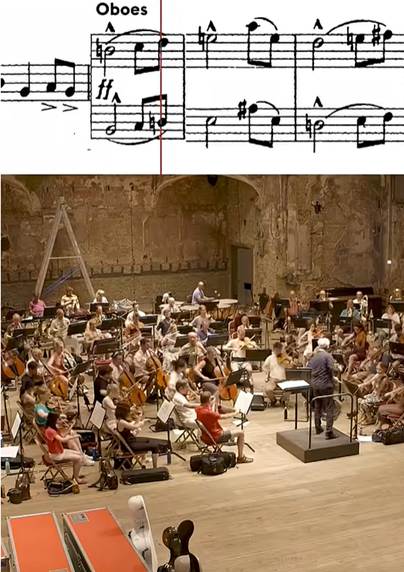
He called his fourth
variation “WMB” and the variation is highly energetic and includes a sharp bang
of the door. The piece recalled William Meath Baker, country
squire, gentleman and scholar, informing his guests of the day's
arrangements. The piece depicts a country squire, gentleman and scholar who has
just forcibly read out the arrangements for the day and hurriedly left the
music room with an inadvertent bang of the door.
“Go on,
turn over”. And the next piece was called No 4, WMB, another connection and a
great friend; very energetic and downright. Why did it remind me of him so? (Powell, R
(1937), Edward Elgar, Memories of a Variation, page 13).
William Meath Baker was a small, wiry man, very quick and
energetic. He had an incisive way of speaking and of laying down the law
sometimes. He was an excellent host and the Elgars called him ‘the Squire’. He was
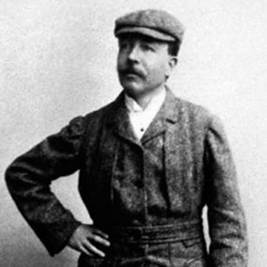
always well turned out, and it is odd that I had to choose the photograph of
him in his new bicycling kit for the set of portraits for the Variations, but
it was the only one available at the right date. I used to like seeing him at
the in the hunt coat and knee breeches which he usually wore at dinner when
there was a house party at Hasfield. He used to say it was a good way of
wearing the coats out! He was a capital companion for a day's outing. Many a jolly
day have I spent with him climbing in Switzerland or on the Welsh hills. We
were about the same height and walked rather well together. He was brother to
my stepmother and we were great friends. He was very good to me. I heard a good
deal of music with him, both at the three choirs and the Birmingham festivals and also at various concerts in London and elsewhere. He
took me to the opera at Covent gardener garden, Wagner only: no other was worth
listening to, according to him. Die Meistersinger was his favourite and I heard
that for the first time in his company. He also took me to Rheingold and to a
complete cycle of the Ring the following year. On one of my frequent visits to
Hasfield, a day that I particularly remember was when the whole party staying
there was taken over to a point to point meeting. The
ladies of the party were in the library after breakfast
and we heard a quick step coming along the hall. “There's Bill”, someone said, “now
we shall get our orders for the day”. He came in, shut the door sharply behind
him, and stood against it, “Oh here you all are! That's alright. Now about this
business today”, consulting a card in his hand, “the Brougham will take three,
five can go in the Brake, and someone will have to drive over with me in the
dog cart. His eye fell on me, sitting on the floor near the large wood fire.
“Dora, will you come?” “Oh please!” I cried joyfully. Now that really
was delightful and I knew that I was in for a jolly
day. “Well look here”, he went on, “we must get over to this place by twelve sharp and I've arranged the start for eleven fifteen”. And
he disappeared as suddenly as he had come, pulling the door to behind him with
a loud clap. Just before eleven fifteen, I came down, ready. “There you are!
Splendid. Let's shove off at once without waiting for the others”. Throughout
the day everything went according to plan, and at top speed. When the events
had all been run, we met for tea in a large tent. I remember the critical eyes
that observed my muddy shoes! Though the end of this Variation may remind those
who knew the subject well of the sharp shutting of a door, the music is
principally a picture of energy; of quick, decisive making, and the issuing of
orders. There is a tendency these days to take this Variation at such a pace
that it becomes almost chaotic rather than energetic. The correct tempo should
not be in doubt because the composer himself has made a gramophone recording of
the work. (Powell, R (1937), Edward Elgar, Memories of a
Variation, page 126).
|
Elgar’s Enigma
Variations IV, WMB
The Variation
immortalising William Meath Baker |
That
September it was Worcester’s turn for the Three Choirs Festival, and the
Variations were down for the Wednesday concert in the public hall: the second performance
after the production at St James's Hall, in June, under Richter. There were
several of us there and my stepmother came down for it too. As she had three
relations (brother, brother-in-law and stepdaughter), “Variants”, and at least
three friends besides, it is no wonder she wished to be present. I sat with WMB
and I'm afraid we did not behave very well; it was not easy to do so sitting
next to him as he always saw the fun in everything. He was immensely interested
and amused by RBT, obviously seeing the likeness but quite at a loss, as we all
were at first, to know how the likeness had been contrived. At the end of it he
burst out with “Well I'm damned!” When the finale was over
he remarked “well, you're the best of the bunch anyway!” He did not understand
his own Variation, that was clear, nor did the rest of the party. I shall never
forget the gauntlet that I always had to run afterwards, at the Star Hotel,
Worcester, where we were all staying for the concert. He wanted to know what
each Variation meant including his own, and I was put in a very awkward
position, with my father and stepmother, WMB’s sister, there as I could not
possibly have told what I knew about them, they would not have understood. (Powell, R (1937), Edward Elgar, Memories of a
Variation, page 31).
He called the tenth
variation “Dorabella” after Dora Penney, which was her nickname from Cosi Fan
Tutte ands the music parodies her youthful stammer. The piece depicted Dora Penney, daughter of the
Rector of Wolverhampton and a close friend of the Elgars.
But for the Bakers and
Hasfield Court, the Enigma Variations would not have been what they were.
“Enigma” person? WILLIAM MEATH BAKER (1857
– 1935) pottery manufacturer, Fenton. BECAME High Sheriff of Gloucestershire
and their entertained the composer Edward Elgar and his wife. The 4th of elgar's enigma variations is said to have been inspired by
the memory of Baker striding out of the music room at Hasfield court and
inadvertently banging on the door. He was a keen mountain climber and made
several ascents in the Swiss Alps. (Staffordshire
Sentinal, 13 March 1985).
1901
1901
Census – Hasfield Court
William Baker, 43, magistrate living on own
means
Letitia J D Townshend, sister,
living on own means
Butler, footman, cook, three
housemaids, scullery maid
1909
His wife Hannah died in 1909 and he married Sybil Agatha
Wyrley of Norfolk. She was an amateur singer with a
lovely voice and a pianist.
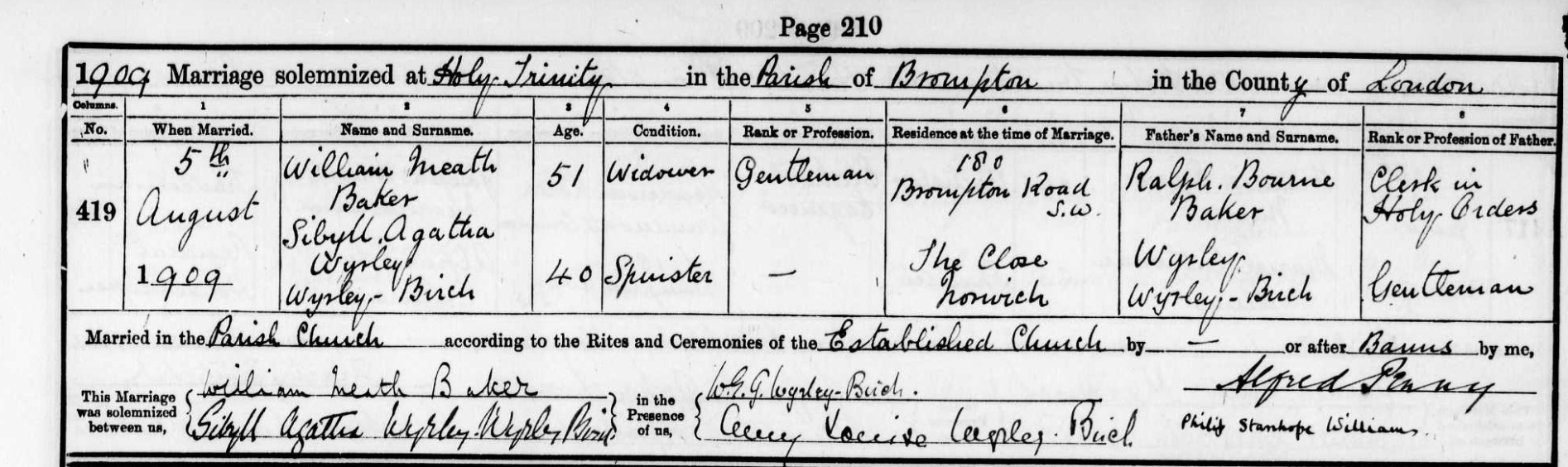
A marriage will shortly take place
between Mr William Meath Baker, of Hasfield Court, Gloucestershire and Fenton
house, Stoke-on-Trent and Sibyll Agatha Wyrley,
daughter of the late Mr Wyrley of Wretham Hall,
Norfolk, and the Birch, the Close, Norwich. (Staffordshire
Sentinel, Daily and Weekly, 15 July 1909).
The pottery business
continued to trade as William Baker & Co and continued to make printed,
sponged and pearly white granite war for export, mainly to Canada from one factory
and encaustic tiles at the other factory. WMB did not take an active role in
running the factories, but made regular visits to
Fenton and was involved in the development of public and private buildings in
the town. He built Fenton Town Hall. Many of the extensive works bore his
initials WMB.
He was a keen climber and
had regular trips to the Welsh hills and to Switzerland.
Regular house parties were
held at Hasfield. On one occasion there was a call for someone to play the part
of an old man. WMB’s brother in law, Richard
Baxter Townshend, who had married Letitia Baker was persuaded to take the part.
His voice was too high falsetto and soft for the role and he attempted a deeper
voice, but was unable to keep it up and the audience
were in tears with laughter. Townshend had been a cattle rancher and gold
prospector and was a good shot. He had a weatherbeaten face and was known to
ride about Oxford on a tricyle. As he was somewhat
deaf, he invented a bicycle bell that sounded continuously.
1911
1911 Census - Hasfield Court Near Gloucester,
Hasfield, Gloucestershire
William Meath Baker ,
Head, Married, Male, 53, 1858, Private means, Staffordshire Hilderston
Sibyll Agatha Wyrley Baker, Wife,
Married, Female, 42, 1869, Norfolk Wretham
Frederick John Sowter, Servant,
Single, Female, 26, 1885, Page domestic, Derbyshire Derby
George Sowter, Servant, Single,
Male, 16, 1895, Page domestic, Derbyshire Wirksworth
Agnes Gretton, Servant, Single,
Female, 41, 1870, Housekeeper domestic, Stafforshire Admeston
Louisa Coles, Servant, Single,
Female, 25, 1886, Lady’s maid domestic, Oxfordshire Watlington
Rosa Kate Shepherd, Servant,
Single, Female, 20, 1891, Housemaid domestic, Middlesex Enfield
Nellie May Baylifs, Servant,
Single, Female, 19, 1892, Kitchen maid domestic, Gloucestershire Turley
Clara May Carter, Servant, Single,
Female, 18, 1893, Rulley domestic, Gloucestershire Tirley
Priscilla Jane Carter, Servant,
Single, Female, 16, 1895, Between maid domestic, Gloucestershire Tirley
1921
1921 Census - The Court, Hasfield,
Gloucestershire
William Meath Baker ,
Head, Male, 1857, 63, Hilderstone, Staffordshire,
England No Occupation
Sibyll Agatha Wysley
Baker, Wife, Female, 1869, 52, Norfolk, England
Sarah Sparrowhawk, Servant,
Female, 1867, 53, Pembroke Dock, Pembrokeshire, Wales, Domestic, Private
Mabel Mathilda Dee, Servant,
Female, 1896, 25, Gloucester, Gloucestershire, England, Domestic, Private
Ellen Ruth Norman, Servant,
Female, 1891, 29, Surrey, England, Private
Rose Katherine Mansell, Servant,
Female, 1888, 33, Gloucester, Gloucestershire, England, Private
Dorothy Minnie Churchill, Servant,
Female, 1903, 18, Salwayash, Dorset, England, Private
1935
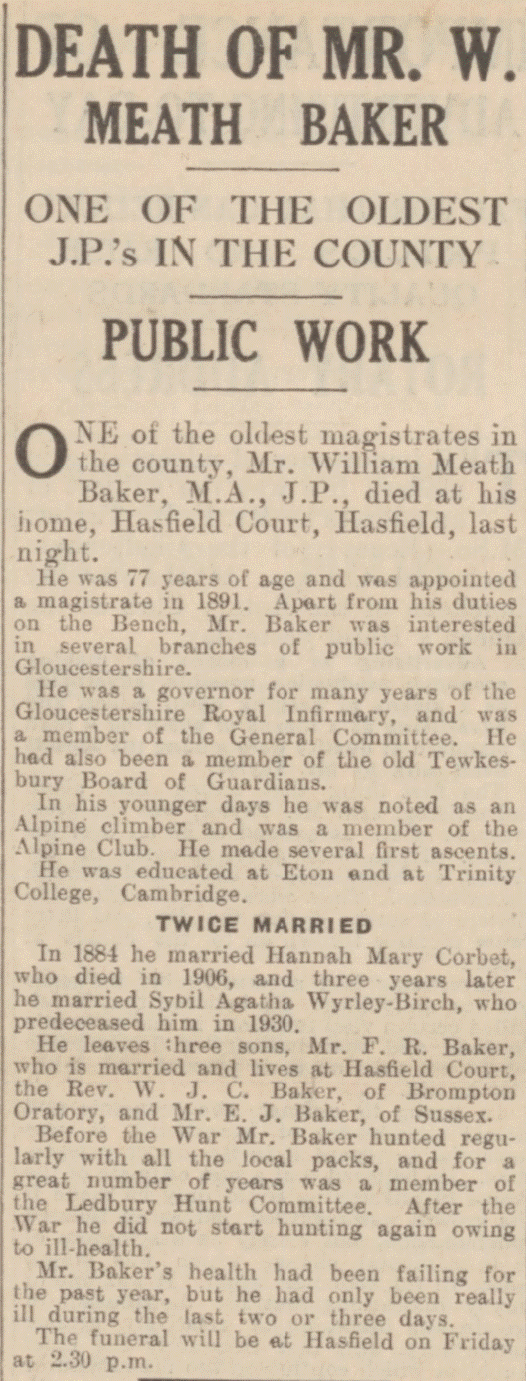
William
Meath Baker did on 15 January 1935 aged 77, and
was buried on 18 January 1835 (Hasfield Parish
Records).

W.M.B. continued to be associated with Fenton
up to his death in 1935. In 1933 his name appears on the list of patrons of the
Christmas Fair and Bazaar at the Church. On the first day the Bazaar was opened
by Mrs. Baker his daughter-in-law. The factory ceased trading in the depression
year of 1932 and the major interest of the family in Fenton was reduced
there-after. W.M.B.'s grandson is the present owner of Hasfield Court and there
are sons to continue the line which started with the architect William Baker
and Jane Dod of Highfields. (Dodd, F
(1987), The Baker Family and Fenton, Presidential Address in Transactions
1986 to 1987, The North Staffordshire Field Club, page 20).
WILL OF MR W MEATH BAKER. Mr William Meath Baker,
JP, of Hasfield Court, Gloucestershire, who died on January 15 last, aged 77
years, left gross estate of the value of £74,265 8s 5d with net personalty
£11,547 8s 3d. Mr Francis Ralph Baker, of the same address, son, and Mrs Mary
Frances Penny, of the Close, Lichfield, Staffs, sister, are the executors
Testator left: the right of presentation to the united benefice of Hasfield
with Tirley to his son Francis Ralph Baker, the right
of presentation of the living of Fenton to the rector of Stoke-on-Trent. He
also left £100 each to his grandchildren Lucinda Helen Mary Frances Baker,
Judith Baker and William Oliver Baker; £100 each to his godsons Maxwell
Johnston and Stanhope Francis St Maur Williams; and the residue of his
property, including certain settled funds, to his son Francis Ralph Baker. He
stated that he had already made provision for his other two sons. (Gloucester Journal, 23 May 1936).
Mr William Meath Baker, JP, of Hasfield Court,
Gloucestershire, who died on January 15, 1935, aged 77, left estate of the
gross value of £74,265, with net personalty £11,547. He left the right of
presentation of the living of Fenton to the rector both Stoke-on-Trent. (Staffordshire Advertiser, 23 May 1936).
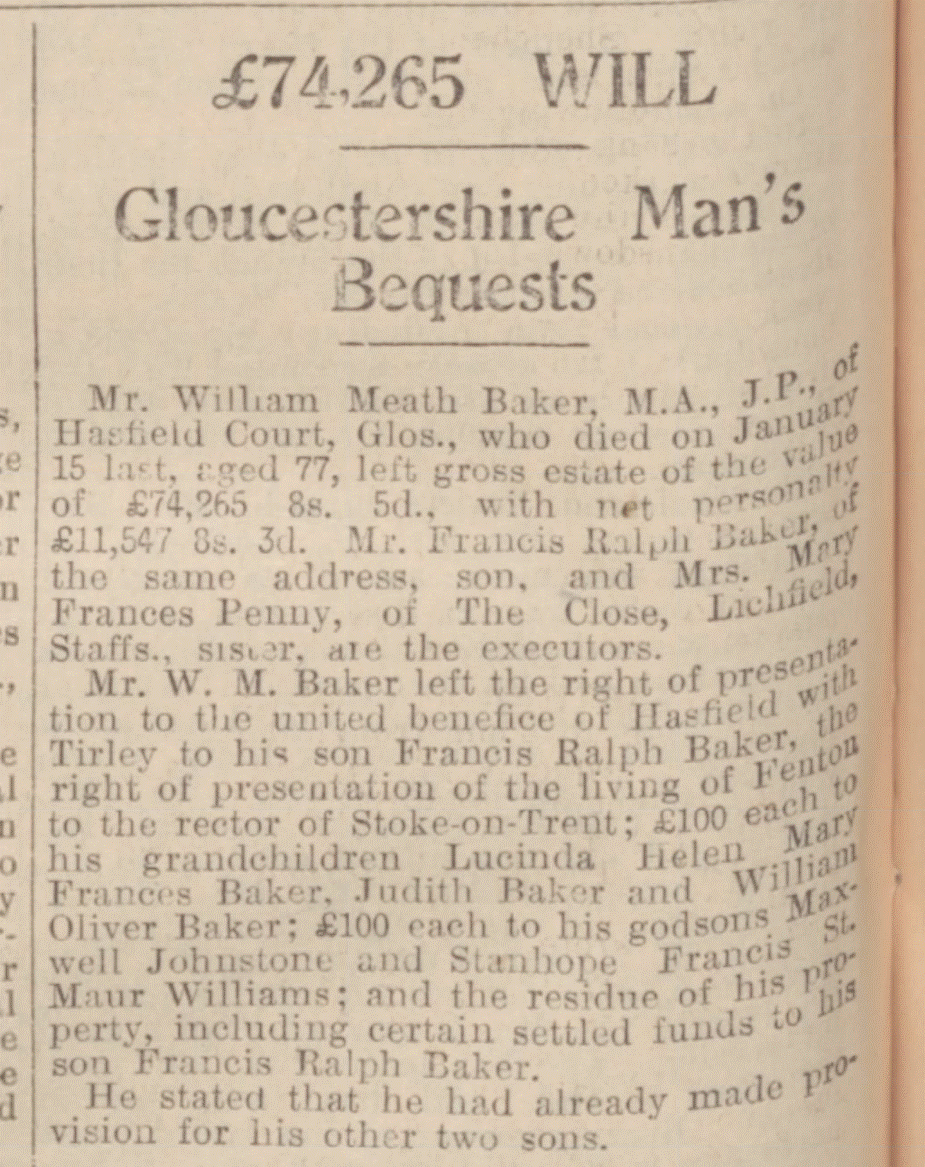
(The Gloucestershire Echo, 16 January 1935) (Cheltenham
and Gloucestershire Graphic, 23 May 1936)