Captain Edward Dod
11 October 1688 (baptised) to 1763
DOD00115
|
Return to the Home Page of the Bakers Family part of the website |
The Bakers of Highfields Story
The Story of the Dods and Bakers and of Highfields,
Fenton House and Hasfield Court. A journey through the history of Cheshire and
Staffordshire, an Anglo-Saxon nobleman who retained his lands after the
Conquest, pottery at Stoke on Trent, an encounter with Elgar, and the history
of an Elizabethan manor house at Audlem |
The family tree of the Bakers of Highfields |
The Family Tree of the Dods, predecessors to the
Bakers of Highfields |
The Bakers of Fenton House and Hasfield
Court
The Family Tree of the pottery Bakers of Stoke on Trent |
The Family Tree of the Bellyse Family |
The main part
of this website tells the story of the Farndale family from Yorkshire Descendants of Arthur Baker, the story of the
Farndale ancestry is told through the main part of this website You can also return to the Farndale
website home page |
The genealogy of the family of James Hall, linked to
the Baker family through marriage to Arthur Baker |
Headlines of are
in brown.
Dates are in red.
Hyperlinks to
other pages are in dark
blue.
References and
citations are in turquoise.
Context and local
history are in purple.
1688
Edward Dod was the son of George
and Charity Dod (DOD00101), and was baptised on 11 October
1688 (St James, Audlem Parish
Records).

Edward, Captain Royal Navy 1743,
commanding HMS Blandford, baptised 11 October 1688, died September 1763 (Burke, John and Burke, Sir Bernard (1836)(Eighteenth Edition, 1972), Bellyse Baker of
Highfields in Burke’s Landed Gentry, Volume 3, pages
35 to 38).
c 1710
He became a captain in the Royal
Navy.
Edward,
born in 1688, was a captain in the Royal Navy. During the earlier part of his
service, he was Lieutenant of HMS Dragon. Later he was given command of the
Blandford. (Baker,
J Bellyse (1982), Highfields,
Audlem: Sixteenth Century Home of the Dod and Baker Families,
Audlem District History Society, page 11).
During the 1710s, two
different Royal Navy warships carried the name Dragon or were renamed to
it: an older 38-gun fourth-rate frigate that was wrecked in 1712, and a 50-gun
ship of the line originally launched as Ormonde which took the name Dragon in
1715.
The first Dragon
returned to England for a refit in 1711, but on 16 March 1712, she was
completely wrecked on the Les Casquets rocks near Alderney in the Channel
Islands. If this was Edward’s ship, he would only have been 24 at this time.
The second Dragon
was built at Woolwich Dockyard as a 50-gun fourth-rate ship of the line and
launched on 18 October 1711. She originally bore the name HMS Ormonde.
She was officially renamed HMS Dragon in September 1715. She was
assigned to the Mediterranean Sea under Captain Streynsham
Master in 1716. She sailed with Admiral George Byng’s fleet to the Baltic Sea
in 1717, where she captured the Swedish vessel Fildrim
on 28 June. She then transitioned to patrols off Newfoundland and back into the
Mediterranean between 1718 and 1725 under Captain Thomas Scott.
1747
Captain Edward Dod
commanded the 24-gun sixth-rate Royal Navy ship HMS Blandford from February
1742/3 until September 1747, though there is an article suggesting he was given
command of HMS Blandford in 1747. The Lords of the Admiralty have appointed
Capt Edward Dod to be Commander of His Majesty’s Ship the Blandford, now at
Woolwich; which ship is ordered to be mann’d and victualled
with all Expedition (Kentish
Weekly Post, Canterbury Journal, Saturday 7 October 1747).
The third HMS Blandford
(1741), featured in frequent skirmishes with the French. Launched in October 1741,
her first master was Captain Robert Young.
The vessel had a crew of 140 officers and crew and was a 20 gun frigate. She served in home, Caribbean and American
waters for 20 years. Her Royal Navy service was eventful and in the 1740s she
captured three French vessels.
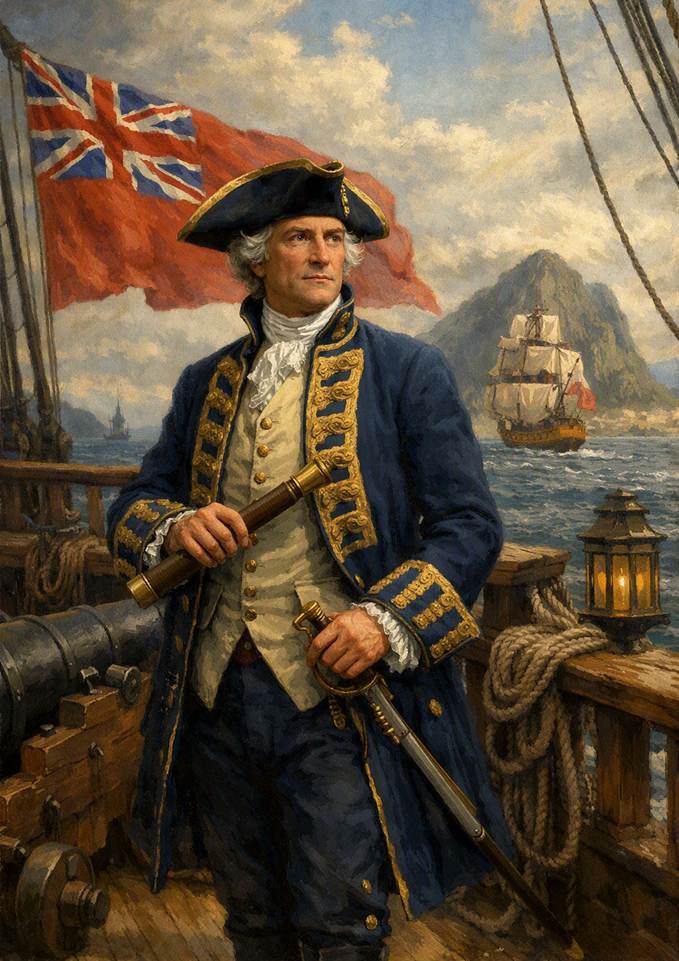
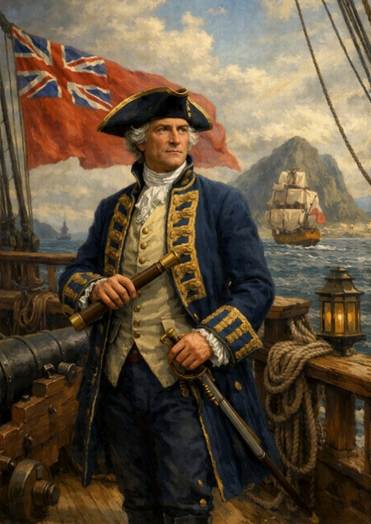
Captain
Edward Dod off Gibraltar, reimagined by artificial intelligence
During his service, his
ship encountered a superior French squadron of seven sails between Gibraltar
and Lisbon, leading to its capture and his temporary captivity in Brest, where
he bravely refused to betray British fleet secrets despite being threatened
with hanging. HMS Blandford was later released from her French
captivity.
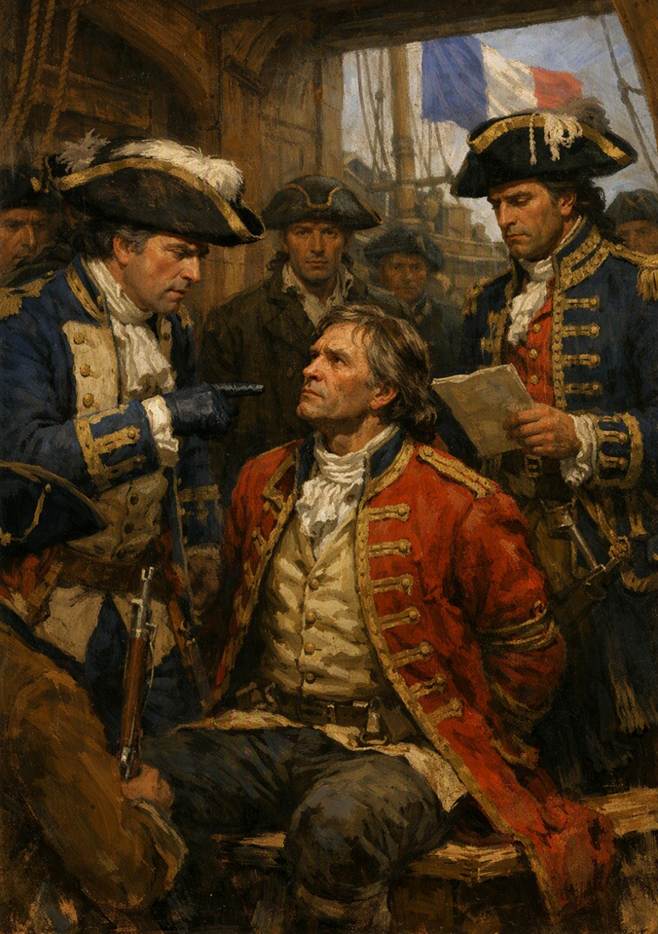
The
capture of Edward Dod, reproduced by Artificial intelligence
In Charnock’s Biographia Navalis there is the following report: His majesty's
ship the Blandford of 20 guns, Captain Dod commander has had the misfortune to
fall in with a French squadron of seven sail between Lisbon and Gibraltar and
was sent to Brest. The Captain was threatened with
being hanged if he did not discover to the Commodore whether there was any
English squadron at sea. This he very bravely refused to comply with.
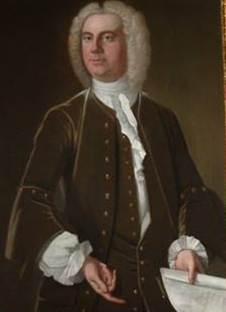
There is a portrait of
him, by Kneller, pointing, rather smugly, to a naval battle in the background.
A portrait
of Captain Edward Dod of the Royal Navy exists as an oil-on-canvas painting
attributed to or in the style of the prominent late-Stuart portraitist Sir
Godfrey Kneller (1646–1723) (Baker,
J Bellyse (1982), Highfields,
Audlem: Sixteenth Century Home of the Dod and Baker Families,
Audlem District History Society, page 11). Sir Godfrey Kneller (see Douglas Stewart, J
(183), Sir
Godfrey Kneller and the English Baroque Portrait) was the leading English
court painter from the reign of Charles II through George I, celebrated for his
efficient studio output and lifelike depictions of military, naval, and
aristocratic figures. The oil painting attributed as a Portrait of Captain
Edward Dod, Royal Navy (1688–1763) after or by Kneller has occasionally
appeared in regional fine art private auctions, meaning the original resides in
private hands rather than a permanent public gallery.
Vessels such as the
Blandford (1741) were the workhorses of the British fleet performing escort
duties and also providing support for amphibious
landings.
Penhallow Cuming was made
her captain in March 1757 and was a thoroughly bad officer. Two years later, he
was dismissed from the Royal Navy for cruelty. He would flog seamen who did not
immediately report from all quarters when ‘all hands on
deck’ was called.
After Royal Navy service, HMS
Blandford was paid off in Plymouth in 1763 and sold for £305.
1753
William Baker recorded in his
account books in April 1753 that Captain Edward Dod came to Highfields and
stayed a visit of 20 weeks. On the 12th August in
large firm writing: “Capt Dod went away”!
1763
Edward Dod died in or about 1763.