Twelfth and thirteenth centuries
Monastic
settlement and the growth of the Royal Forest
FAR00004
|
Return to the Home Page of the Farndale Family
Website |
The story of one family’s journey through two
thousand years of British History |
The 83 family lines into which the family is divided.
Meet the whole family and how the wider family is related |
Members of the historical family ordered by date of
birth |
Links to other pages with historical research and
related material |
The story of the Bakers of Highfields, the Chapmans,
and other related families |

Dates are in red.
Hyperlinks to other pages are in dark blue.
Headlines are in brown.
References and citations are in turquoise.
Context and local history are in purple.
Henry I 1100 to 1135
1128
As the Mowbray interest
emerged in the estate of Kirkbymoorside, Henry I reserved an extensive area
across Ryedale and Pickering as Royal Forest, solely for the use of the King’s
household. Officers were appointed to manage and protect the royal forests. In
Yorkshire, within the forested land from the Dove to the Seven was to be
preserved all my needful things, the hart and the
hind, the wild boar and the hawk, in the same land (Historic forests of England, Ralph Whitlock, 1979, page
160 to 161). The great royal forests of Galtres and
Pickering in time came to subsume the Farndale forest.
The earliest reference to
this royal forest of Farndale is in a precept of Henry I, given to the sheriff
Osbert in the first decade of the 12th century. "l order that the abbot
and monks of York may hold in peace and with honour all their woodland, and the
land from the water of Dove to the water which is called Seven, as once they
held it before the forest was made....... I also grant to the abbot and his
successors the whole of my forestry, and he shall cause to be preserved all my
needful things, the hart and the hind, the wild boar
and the hawk, in the same land." (Notes on the
History of Farndale in the Middle Ages,
Arthur H Whitaker, Ryedale Historian, Volume 1, 1965, page 9).
Yet, Arthur
Whitaker also observed that It seems fairly certain,
therefore, that the phrase ''between the waters of the Dove and the waters of
the Seven'' which constantly occurs in charters granted to the abbey, refers to
the lower reaches of the river Dove and not to that part of it which flows
specifically through Farndale. The situation is complicated by the fact that
the area under discussion was ‘also a royal forest, and that for the greater
part of the Middle Ages the abbots of St. Mary's were the king's foresters
there. (Notes on the History of Farndale in
the Middle Ages, Arthur H Whitaker,
Ryedale Historian, Volume 1, 1965, page 7). Arthur Whitaker is not quite right
that the abbots of St Mary were the King’s foresters, they were rather the
beneficiaries of grants of land there.
It seems likely that these
early references to the forest in the vicinity of Farndale, were not to the
dale itself, but to grants of land between the Dove and the Seven further
downstream in the vicinity of Hutton le Hole and Lastingham.
Henry I (1100 to 1135)
decreed that a huge area from York to the coast, including Ryedale and
Pickering, should be reserved as Royal Forest, where hart, hind, wild boar and
hawk were preserved solely for the King.
The Forest Laws were onerous and
at the heart of English political evolution for the next two and a half
centuries.
Officers were appointed
to guard the royal forests and new administrators were appointed such as the
fee foresters and serjeantes. Some of these
officers were able to hold their land rent free in return for the service as a
forester. When Henry I established the Forest of Pickering as a deer preserve
he gave Guy the Hunter half the Aislaby estate, in
return for training a royal hound. There was a story that two brothers were
given a falcon’s flight of land, for repelling a Scots invasion. Perhaps the
other brother was William of Aislaby, who had the
other half.
Serious punishments were
dealt to those who committed hunting offences, including the removal of body
parts for taking of deer.
Norman Kings had limited
leisure time and the reservation of most of England as royal forest was not
primarily for their own hunting experience. Just as the early Anglo Saxon kings
had focused their power on tribute centres, as the Norman kings travelled
around their kingdoms they sent word, often weeks in advance, of their intended
arrival at the royal estates. They would command the preparation of feasts,
supported by the killing of deer and other forest beasts at significant scale,
from their royal forests, to demonstrate their generosity and power. The elite
noblemen Also aspired to possession of their own deer parks, for which they
required a licence to enclose it.
This activity was a
frustration to the indigenous populations deprived of their common law rights,
and fined by a growing bureaucracy of royal officials for an expanding menu of
forest offences.
The forest of Galtres was rich in royal venison and in 1316, it comprised
100,000 acres with 60 settlements.
c 1135
It has been suggested that Henry I (1100 to 1135), the Conqueror’s
youngest son, first gifted pasture in Farndale and Bransdale to the nuns of
Keldholme to feed their sheep, pigs and cattle (The Placita de quo Waranto
of Edward I, page
195) although the record of this transaction, and the name of the place,
did not appear until the later thirteenth century in the reign of Edward 1
(1272 to 1307). There is doubt as to whether such a grant was made as early as
the reign of Henry I.
and the Prioress came and said that she had given
alms to such a man that Henry the Conqueror's son had given the nuns of Keldholm alms for the charter which he gave and that the
same King had given them pasture in the pasture of Yevewith
and there in Farndal; and pasture in Brandesal to feed their animals and sheep and pigs and
cattle there; and said that from the time of their conception they should have
taken and some of their cattle …
After the Harrying of the North by William the
Conqueror’s men in 1069 there must have been plenty of wasteland in Yorkshire
suitable for royal forests. The most important were the Forest of Galtres, which extended from Boroughbridge to the city of
York, the Forest of Farndale, around the river Dove in the heart of the
Yorkshire Moors, and the Forests of Knaresborough, Wensleydale and Hatfield
Chase. (Historic
forests of England, Ralph Whitlock, 1979, page 160
to 161.)
The
Forest was also well stocked with red deer. Even poachers, when well organised,
could account for 40 to 50 head in a day. The tallies of deer killed
legitimately by the constables of the Forest also include numbers of fallow
deer, and on one occasion in the early fourteenth century, two roe deer with
their calves.
(Historic forests of England, Ralph Whitlock, 1979, page 160 to 161.)
Stephen
1135 to 1154
When Henry I died
in 1135 he had precariously left the English throne to his daughter Matilda. The
throne was immediately seized by Matilda’s cousin, Stephen of Blois who reigned
until 1154. There followed another period of turmoil known as the Anarchy,
during which the elite classes again had to choose sides. It fell to Matilda’s
son by her second husband, Geoffrey Plantagenet (named after the sprig of
broom, planta genista, which he wore in his hair), to reclaim the throne
from Stephen in 1153 and establish a new Plantagenet monarchy in England. That
son, who became Henry II (1154 to 1189), found a land in crisis which coincided
with the emergence of Farndale from the shadows.
The uncertainty
was not yet over as Henry sought to wrest the church’s jurisdiction over the
legal affairs of his realm ending in the controversial murder of Thomas Becket
and faced another family revolt, spurred on by his ambitious wife Eleanor of
Aquitaine which was not resolved until the mid 1170s.
Henry
II 1154 to 1189
1154
The first written
reference to Farndale appeared in the Rievaulx Chartulary. This is explored
fully at FAR0002.
Both the Mowbrays
and the Stutevilles, who later recovered Kirkbymoorside from them, reserved
game in Farndale (The History
of Ryedale North Yorkshire, John Rushton, 2003, page 48).
The Ryedale monasteries were Rievaulx Abbey, Old
Malton Priory, and the small nunnery at Keldholme Priory. The community at St.
Mary's Abbey, York had begun its life at Lastingham, and along with nearby
monasteries at Newburgh Priory, Byland Abbey, Kirkham Priory, Ellerton Priory
and Little Marish Priory, had interests in the dale. Rievaulx in the 12th
century had 140 monks and a vast number of lay brothers, but numbers were later
much reduced and Abbey servants were replacing lay brothers. St. Gilbert had ruled
that Old Malton Priory should be limited to 35 canons regular.
(Life
in Ryedale in the 14th century, J H Rushton, Ryedale Historian, Volume 9, 1978, page 31).
Two Ryedale boroughs had been formed in the 12th
century; Helmsley, grafted onto an old village, and Malton laid at an old Roman
road crossing. Both gained their first stimulus from the castles of their
founders.
(Life
in Ryedale in the 14th century, J H Rushton, Ryedale Historian, Volume 9, 1978, page 45).
1166
The eventual outcome of the aftermath of the Anarchy was a more
centralised state when Henry II took castles across the land into royal control
and established legal jurisdiction over criminal and civil law after the Assize
of Clarendon in 1166 had wrested control from the church. Royal sheriffs
and justices took responsibility for the enforcement of the law and juries of
twelve local men were obliged to report to them under oath all the crimes that
had been committed in each community. This was a period when the reach of royal
government began to stretch into local communities.
By the end of the revolt, Roger de Mowbray was compelled to hand
back Kirkbymoorside to the House Stuteville along with many other fees. The
Mowbrays retained theoretical superiority over the fee, but the Stutevilles had
practical ownership.
Mowbray was not left undisputed in possession
of Farndale. Shortly after the 1154 Rievaulx Charter had been issued, Robert de
Stuteville III, supported by his brother William, began a dispute concerning
the rights of lands previously held by his grandfather. Ten years later, in the
reign of Henry II, a compromise was reached – they got land to the value of ten
knight’s fees. By this charter and a later in 1183, Robert de Stuteville
confirmed to the abbey of St Mary’s York, “the vill
of Hutton le Hole (Hoton Underhag),
and privileges in Farndale for the men of this vill
and the abbot’s hall and staff at Spaunton.
From then onwards Farndale West was part of
the manor of Kirkbymoorside, and Farndale East belonged to the manor of Spaunton and Lastingham Parish.
(Raymond Hayes, Farndale, 1961, unpublished, page
32).
Robert de Stuteville III therefore granted privileges in Farndale
to other monastic houses than Rievaulx. In 1166 Robert de Stuteville III
granted privileges in Farndale to a small daughter abbey of St Mary, York, Spaunton by Hutton le Hole (Curia
Regis Rolls in Early Yorkshire Charters, Volume 9, Stuteville, C
T Clay, 1952, page 87).
Confirmation by Robert de
Stuteville [III] to the abbey of St. Mary, York, of the vill
of Hutton [le Hole] ; and grant of privileges in Farndale for the abbey’s men
of Hutton and its hall of Spaunton, the abbey
granting that he should do what he wished in respect of the arable land on the
river Dove below the mill of Gillamoor, which he had
formerly put to the use of Godfrey his serjeant. Also confirmation of all the
tithes of his demesnes in accordance with the charter of his grandfather.
At about the same
time, perhaps a little before 1166, Robert de Stuteville granted Keldholme
Priory timber and wood in Farndale together with a vaccary (cow pasture from
the Latin vaccaria meaning cow), pasture and
cultivated land in East Bransdale (Assize Roll,
1076 8 to 9 Edward I in Early Yorkshire Charters, Volume 9, Stuteville,
C T Clay, 1952, page 92).
Confirmation by Robert de Stuteville III to
Keldholme priory of the place of Keldholme with land towards the north within
specified bounds, a park for growing herbs, the mill with the suit and multure of Kirkby [Moorside], land towards the south within
specified bounds, pasture in Ravenswyke, materials
there and in Farndale, pasture in Bransdale with the vaccary there, and the
bark of trees of the forest ; and gift of all the land of Rook Barugh [par.
Normanby].
It is usually stated that the priory of
Keldholme was founded by Robert de Stuteville in the reign of Henry 1. The only
evidence for this early date appears to be a statement made by the prioress at
the Quo Waranto
proceedings of 1278-81 that Henry the king, son of the Conqueror, issued
a charter to the nuns which she produced ; and, secondly, a statement that
there was a prioress named Sibyl living in that reign. With regard to the
first, any corroboration is lacking ; and it is significant that king John in
his confirmation (no. 13) refers to a charter of his own father, Henry II, and
not to any charter issued by Henry I, and gives as the principal donor Robert
de Stuteville, with the consent of his son William, which clearly identifies
him as Robert de Stuteville III. With regard to the prioress Sibyl the evidence
given is that she issued a charter witnessed by Stephen de Meinil. But there
were three Stephens of that name whose periods respectively were early in the
twelfth century, late in that century, and 1224-69. It so happens that a Sibyl
prioress of Keldholme issued a charter in the last of these periods, which
actually was witnessed by a Sir Stephen de Meyniil; and it would be a strange
coincidence if this was not the charter in question.
The evidence taken as a whole suggests that
the prioress was mistaken in supposing that the king’s charter that she
produced, which may well have been a charter of Henry II confirming gifts made
by Robert de Stuteville III, was one issued by Henry I; and it can be put
forward as an alternative hypothesis that the priory was founded by Robert de
Stuteville III, and that he issued the present charter shortly after the
foundation, at a date subsequent to his acquisition of the manor of Kirkby
Moorside after the accession of Henry II. The latest date for the foundation
can be taken as 1166, for in that year Geoffrey ‘magister de Duva’ witnessed
charter; he can be identified as Geoffrey ‘magister monialium
de Duua who witnessed another (no. 121 below) ; and
it is clear that the river Dove gave an alternative name to the Cistercian nuns
of Keldholme.
The site of the priory lies on the Dove less
than a mile to the east of Kirkby Moorside. Yauenwyth
seems to be identical with Revenwich’ and Evenewit which occur in king John’s charters (no. 13 and
note), and can so be identified with Ravenswyke which
lies less than a mile to the north of Keldholme. Farndale lies up the Dove to
the north of Gillamoor, and Bransdale about 3 miles
west of Farndale. The privileges granted to the priory, therefore, extended
over a wide area. Other charters issued or relating to it are printed at nos.
26, 51-2, 113, 144.
This implies that there was some earlier but limited settlement in
the area. The Keldholme property in Bransdale, which could still be identified
in a survey of 1610, never amounted to more than 40 or 50 acres at Cockayne at
the head of the valley.
The Abbey of St. Mary's, York, was the
neighbour of the Earl of
Lancaster on the west. The Forest of Spaunton,
strictly speaking, did not belong to the Abbot, the land did (see
Reg. Mar., folio 177), but the game
belonged to the King, whose foresters were not, however, allowed to enter, the
Abbot having the custody of hart, hind, wild boar and
hawk: this also sufficiently appears from pp.
266-271 of Vol. II., N.S., and p. 258 of the present volume. By grant
from King Henry I, confirmed by Henry II, the Abbot of St. Mary's was entitled
to tithe of venison throughout the county of York; he also had the custody of
the Forest of Spaunton, and an exchange was made; the
Abbot surrendered his right to the tithe in the forest of Galtres,
and by way of compensation had the forest of Spaunton;
the arrangement, however, was for a limited time only, namely, five years. The
arrangement does not seem to have given entire satisfaction to the Abbot. It
was rare to find deer in Spaunton Forest, and the
tithe in Galtres was better worth having. The Abbot
petitioned either that he might have the tithe in Galtres
again, or that the exchange might be permanent instead of temporary, and that
he might have license in mortmain to purchase land at the value of £20. The
petition does not appear to have been granted, and the arrangement was renewed
for a further term of five years. (The Duchy of Lancaster Records, from the North Riding Record Society, The Honour and Forest of Pickering, Edited by Robert
Bell Turton, Volume III, 1896, pages xi to xxvii).
The rapid growth
of monastic lands, especially during the middle and late twelfth century, due
mainly to the advent of the new orders, must have seemed the most remarkable
phenomenon of the times to laymen. In particular, the North-East of Yorkshire
was very intensively settled by the monasteries, predominantly those belonging
to the new orders. But such expansion was hardly accidental. Rather, it was the
industry and efficiency of the monasteries themselves which “obtained from a
rich man a valueless and despised plot by much feigning of innocence and long
importunity, putting in God at every other word. The wood was cut down, stubbed
up and levelled into a plain, bushes gave place to barley, willows to wheat,
withies to vines; and it may be that in order to give them full time for these
operations their prayers had to be somewhat shortened.” (Walter Map, De Nugis Curialium, page 75). (The
Monastic Settlement of North East Yorkshire, Bryan Waites, Yorkshire
Archaeological Journal, Volume 40, page 478).
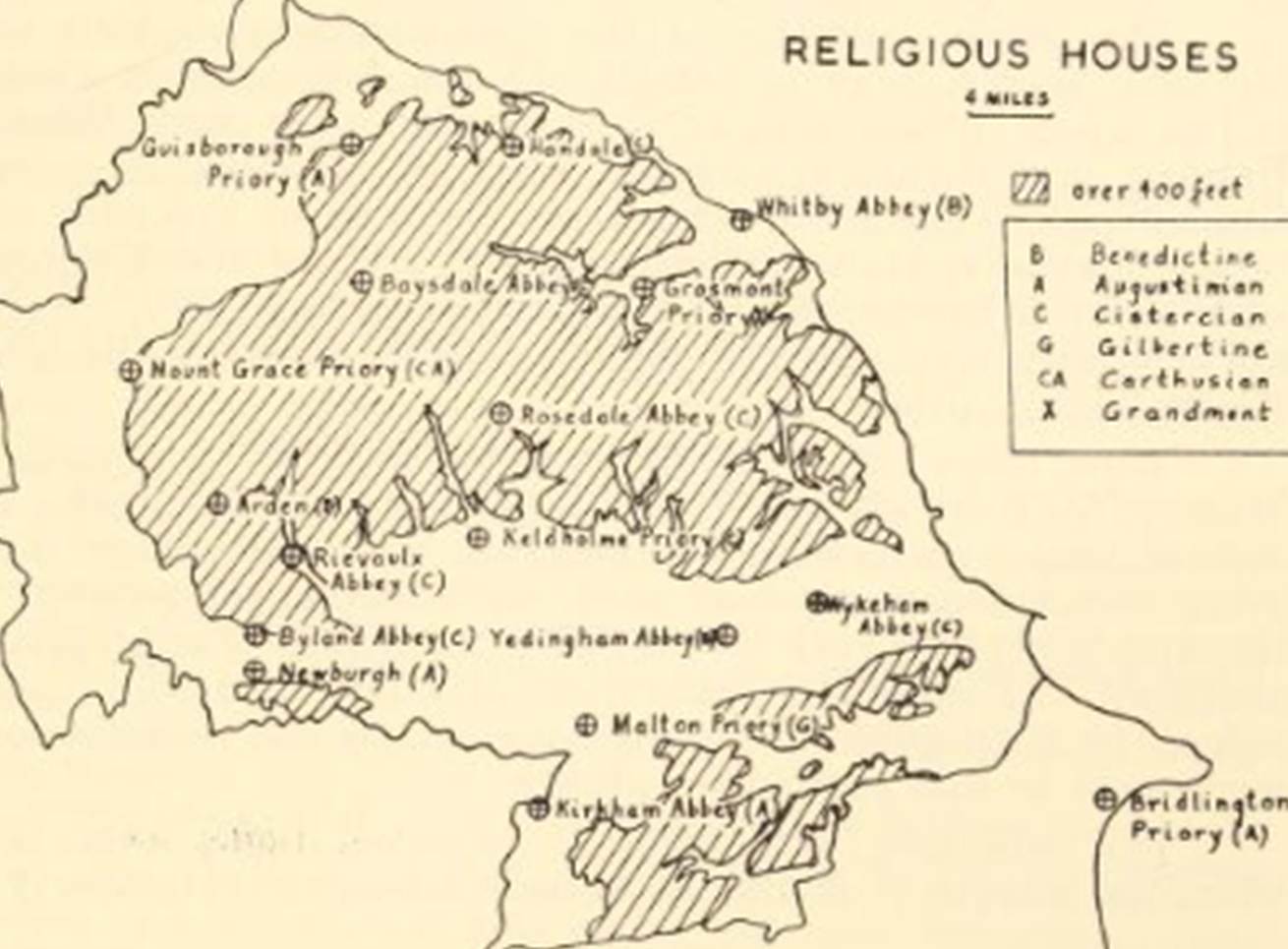
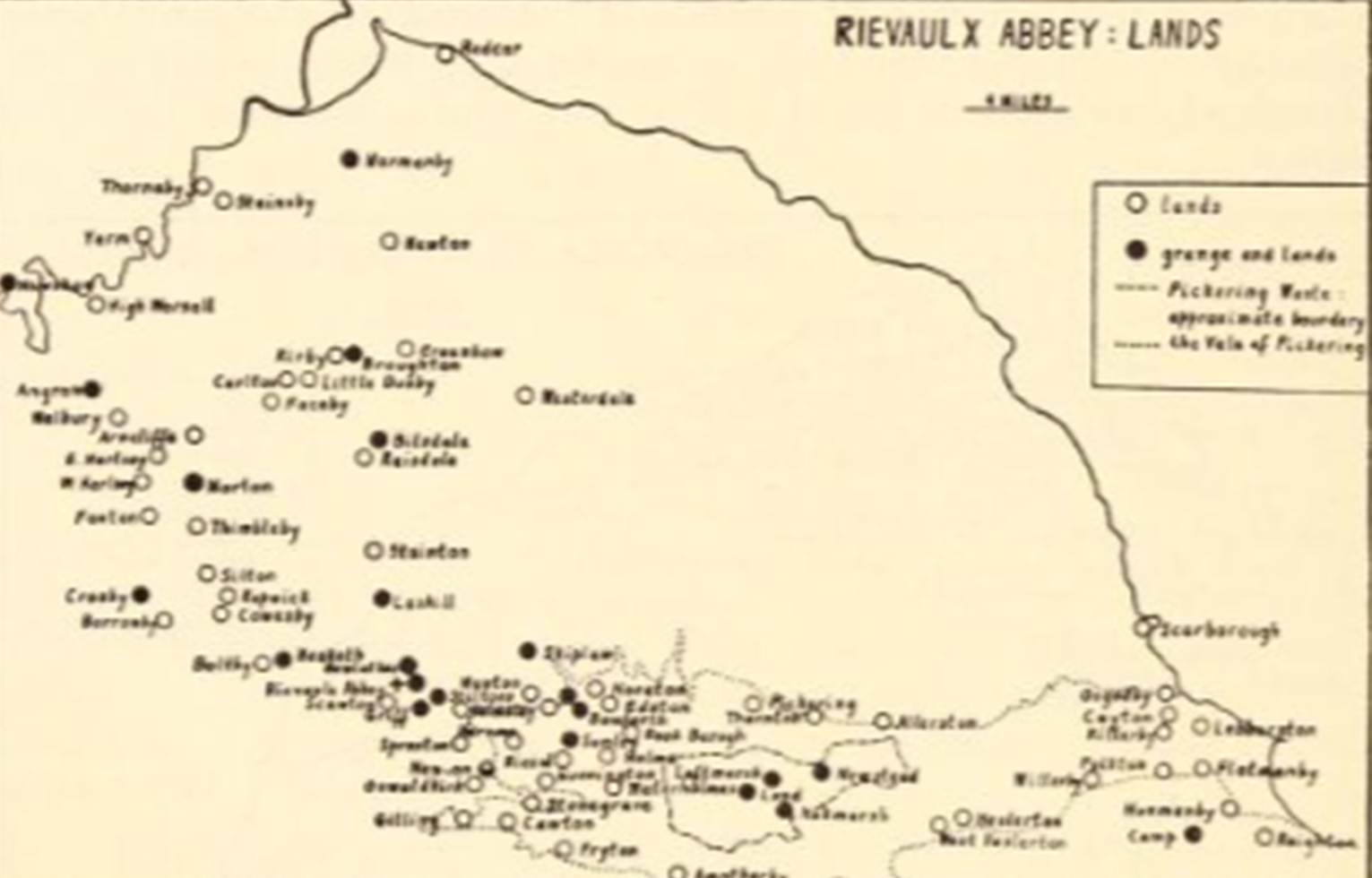
The lands of this
abbey extended over a much wider area than those of either Guisborough or
Whitby. But although many were located along the western margin of the moors
and in Cleveland the vast majority lay in the Vale of Pickering. (The Monastic Settlement of North East Yorkshire,
Bryan Waites, Yorkshire Archaeological Journal, Volume 40, page
480).
The accumulation
of land by the new monastic orders such as Rievaulx was alarmingly rapid and
large numbers of granges were established by the end of the twelfth century. At
Rievaulx, for example, the greater part of the lands were acquired and a large
number of granges established by the end of the twelfth century. Even by 1170
the monks had acquired all Bilsdale, Pickering Marshes, parts of Farndale and
Bransdale, the vills of Griff, Tileston, Stainton,
Welburn, Hoveton, and the lands in Hunmanby, Crosby, Morton, Welbury,
Allerston, Heslerton, Folkton, Willerby, Reighton. Some
donors had apparently not bargained for such a rapid increase in monastic
possessions. It came as a shock to find that the monks were not “all that was
simple and submissive; no greed, no self-interest.” (Walter Map, De Nugis Curialium,
page
77) The result was that men like Roger de Mowbray, Robert de
Stutville, Everard de Ros and other great lords (formerly great donors and
founders) began, unsuccessfully, to evict the monks from certain lands — but
monastic expansion continued. (The
Monastic Settlement of North East Yorkshire, Bryan Waites, Yorkshire
Archaeological Journal, Volume 40, page 481). Over time the
former donors of the landowner classes came to regret their gifts and began,
often unsuccessfully, to attempt to evict the monks from their lands.
1184
Concurrently with growing
tension between nobility and church, Henry II’s Assize of the
Forest 1184, also known as the Assize of Woodstock, imposed vigorous
control over the royal forests. By this time about a third of the lands of
England were royal forest. The carrying of bows and arrows in the royal forests
was forbidden, oaths of good behaviour were demanded and dogs had to have their
toes clipped to prevent them pursuing game. Savage penalties were often
imposed. A complex hierarchy of verderers, regarders and agisters were
appointed. Customary rights to timber were to be overseen. The right to wood
was referred to as bote. Pickering folk could use green or dray wood for housebote,
dry wood for firebote, or haybote
for fencing (John Rushton, The History of
Ryedale, 2003, page 80).
See the Forest Laws.
1193
It was, however, the
monasteries which had stimulated the rapid development of the wool trade in
England. In the twelfth and thirteenth centuries it was they who drew the
Italian and Flemish merchants so eagerly to the country. The story of how the
whole wool of the Cistercians and Premonstratensians for 1193-94 was taken for
the King’s ransom is well known. But in the North-East little other evidence is
available to show the extent of wool production on monastic estates in this
early period. (The monasteries of north east Yorkshire
and the medieval wool trade, Yorkshire
Archaeological Journal, Volume 52, 1980, page 112).
1201
The next mention of Farndale, also Farendale,
Farendal, Farnedale in
the thirteenth century, is in 1201 (Calendar of Rotuli Chartarum, 1199–1216, page
86). It formed part of the fee of the lords of Kirkbymoorside, of which
manor it was parcel. This seems to be a confirmation of the 1166 grant by
Robert’s son, William.
Know that we have granted the present charter
to confirm to St Mary, that the nuns who live at Keldholm,
the servants who have signed the charters given to them and granted and the
charters given to them confirmed by the gift of Robert de Stuteville and the
concession of William de Stuteville to his son, the place of Keldholm with the whole of the cultivated land towards the
north divided into charters and a park for vegetables and the mill Kirkeby and
the whole of the land towards the south and the land to the divided into
charters and pasture in the forest of Ravenwich and
the same in Farendala for building and repairing his
buildings and wood for the fireplace.
Robert de Stuteville had previously given the nuns of Keldholme
the right of getting wood for burning and building in Farndale.
1203
After the expensive
interlude of Richard I’s ambitions in the Holy Land, when few could resist
demands to fund the King’s ransom and his subsequent fresh consolidation of
royal power, King John (1199 to 1216) started to sell off tracts of royal
forests in the north east to raise revenue.
King John (1199 to 1216) needed
money to pay mercenaries to fight his wars and he readily sold privileges for
cash. He sold off most of the royal forests in north east Yorkshire. Ryedale
wapentake was deforested although some timber management customs remained.
Whitby Strand and Spaunton forests were returned in
1203 to the monasteries who supervised them. The forest between the rivers Dove
and Seven passed to the Abbots of St Mary’s York, and would be administered
from their manor of Spaunton. A small forest of
Farndale was retained by the Crown, with a forester living at Dowthwaite. The
Forests of Danby and Egton were returned to Barons.
The remaining royal
forests were Galtres Forest, reduced in size,
Pickering Forest and the small forest of Farndale. The King’s deer and boar
were sometimes hunted by the monarch and those he favoured, but were more
frequently culled to supply the King’s larder.
(John
Rushton, The History of Ryedale, 2003, page 78).
Nevertheless John
passionately embraced the Plantagenet legal machine to touch every aspect of
the lives of ordinary people (The Plantagenets, Dan Jones, 2013 page 181) since there was profit to be
made from the selling of writs. Travelling courts asserted royal rights across
the nation and royal eyres between 1207 and 1210 raised thousands of pounds
from the encroachment of forest land and from poaching offences.
In the early thirteenth
century Nicholas de Stuteville was the king’s forester, and the Abbot of St
Mary’s paid King John 100 marks and a palfry “for
having the forest of Farndale which the king has taken from Nicholas de
Stuteville”.
(Raymond Hayes, Farndale, 1961, unpublished,
page 32).
1204
Parks abutted the chief
houses. The hunt was the joy of life to the barons. Ryedale had been Royal
Forest until disafforestation in 1204 after which only the Forests of Farndale
and Spaunton remained to the Crown. Early Helmsley
Lords afforested their woods and held rights of free chase. The Kirkby Lords
had kept the hunting of deer. There was Bowforth
Moor, and Joan de Stuteville afforested woods. The park, a league in circuit
behind the castle, supervised by Nicholas the Parkkeeper in 1301, had 120 deer.
There was a forester here as well as at Cropton, where the Wakes had Black
Park. Lady Blanche Wake in 1332 took a soar and two
hinds. The Mowbrays had warren and a forester at Hovingham, but the family held
the Chase of Kirkby Malzeard and could take 42 deer
and 3 pair of sparrowhawk in Nidderdale yearly. The Stapletons had warren at
Wath and a park wall that eventually embraced the 300 to 400 acres of the
township. The Vescys had no park at Malton but had
limited hunting right in Pickering Forest. (Life in Ryedale in the
14th century, J H Rushton, Ryedale Historian, Volume 9, 1978, page
31).
1207
The 1166 charter (above) was produced by the abbot of St. Mary’s
in a plea (for which in 1206 he gave 2 marks for having a writ for the purpose
which he brought against Nicholas de Stuteville, the grantor’s son, in
Michaelmas term 1207, claiming common of wood and pasture in respect of Hutton
le Hole and Spaunton, belonging to his free tenement
in those vills as the right of his church, of which
abbot Savaric had been seised in the time of Henry
II. (Rotuli de oblatís et fíníbus in Turri londinensi
asservati, tempore regís Johannis, Record of Fine Rolls, 1199 to 1216, page
352).
Abb's Eborac gives
two marks of a certain man named Nichol de Stutevitt, who is not allowed to
leave the forest and pasture in Hotton and Spaunton,
which he has taken to the top of the hill. And unless he dies before Easter, he
will be buried three times.
At the same place and day, before the Lord
King himself, etc. Between Robert, Abbot of the Church of St. Mary, York,
plaintiff, and Nicholas de Stutevill, deforcer,
concerning the common of the wood and pasture of Hoton
and Spanton, which the same Abbot claimed to belong to his freehold, which he
has in the aforesaid villages of Hoton and Spanton.
Wherefore it was agreed etc., namely that the
same Nicholas acknowledged and granted for himself and his heirs to the
aforesaid Abbot, and the Church of St. Mary of York, and the Monks serving God
there and their successors, the aforesaid common forest and pasture of Hoton and Spanton. H, and T. to himself and his successors
in pure and perpetual alms, free and quiet from all secular service and
exaction, with all the things contained in the charter of Robert de Stutevill,
the father of the same Nicholas, which the same Abbot produced, and which the
same Nicholas warranted in these words:
Let all who have seen and heard this charter
know that I Robert de Stutevill have granted and
confirmed to the Church of St. Mary of York, and the Monks serving God there,
the town called Hoton in Ridal with all its pert,
as far as the water which is called the Doua. I have granted that
they may have in Farendale to their men of Hoton, and to their hall of Spanton, such soil as may be
necessary, for burning of the dead wood, and for building of the green, without
the certificate of my forester, and for their animals and pigs and their men of
the same, pasture and pannage at a low price without any sale or vastation. But
if my forester, or their forester, shall find any vastation or forfeiture
there, he shall see to it that it is repaired as may be necessary. It is also
to be known that I have also granted to the aforesaid Church and its men to
cultivate the land of Hogtweit, as much as was tilled
on the day on which this charter was made. They shall not till any more without
my consent, in like manner as they have granted; that I may do my will of that
profitable land which is on the Doua under the mill of Gillingmore,
which I had once accommodated to Godfrey, my servant. But I shall not till
anything of the wood without their consent.
(Yorkshire
Feet of Fines, Pedes Finium Ebor, regnante Johanne (1199 to 1214), Edited by W. Brown,
Surtees Society, volume 94, 1897, page 113 to 114).
Nicholas said that he had nothing in demesne in the vills, which he had confirmed to the abbot as far as the
river Dove, but that the claim was beyond the appurtenances of the vills, namely in Farndale, and of this he put himself on
the great assize.
A licence for a concord was accepted ; and the fine was
accordingly levied on 20 October 1207, by which Nicholas granted the common of
wood and pasture in pure and perpetual alms with all things contained in his
father’s charter.
1209
There are entries
in the Pipe Roll 1209, 1210 and 1211 which
refer to granting rights in the forest of Farndale to Nicholas de
Stuteville by the Abbot of York in the reign of King John and disputes that
arose therefrom. (Pipe Roll
Society, Volume 62 NS 24, Edited by Doris M. Stenton, The Great Roll of
the Pipe for the eleventh year of the reign of King John, Michaelmas 1209;
Volume 64 NS 26 The Great Roll of the Pipe for the twelfth year of the reign
of King John : Michaelmas 1210; Volume 66 NS 28 The Great Roll of the
Pipe for the thirteenth year of the reign of King John : Michaelmas 1211,
the National Archives E
372)
During the very
early years of the 13th century it appears that Nicholas Stuteville I was
granted the privilege of being the king's forester, for in 1209 we read (Pipe Rolls II John, Michaelmas 1209) that the
abbot of St. Mary's paid King John one hundred marks and a palfrey for having
the forest of Farndale which the king has taken from Nicholas de Stuteville''.
With suspicious celerity Nicholas, almost immediately, asked that "twelve
knights from Ryedale and Pickeringlythe' should make
a perambulation between the king's forest and his, for a fee to the exchequer
of 20 marks - This touchiness on the part of the two Nicholases concerning the
exact boundary of Farndale, and their obvious mistrust of the abbots of St.
Mary's (no doubt fully reciprocated by their reverences) seems quite remarkable
when one considers the vast estates of which both parties were possessed. (Notes on the History of Farndale in the Middle Ages, Arthur H Whitaker, Ryedale Historian, Volume 1,
1965, page 7).
c 1220
Concurrently with the monastic and royal interests in the forest
of Farndale, there evidence for the earliest cultivation of Farndale on behalf
of the noble landowners from the early thirteenth century by a lay community
and its population by tenanted farmers (FAR00004A).
1225
Discontent with the laws ensured that the forest became a
political issue. The Northern Barons, who included William de Mowbray and
Richard de Percy, were united in kinship and in their dislike of the King. They
led the revolt that led to Magna Carta wherein, hidden amidst a plethora of
more bespoke terms, there were some gems of English justice. No man should be
imprisoned except by the lawful judgement of his peers. Justice was not to be
delayed.
Since the worst excesses of royal authority were exercised in the
royal forests, such as at Pickering and Farndale, Magna Carta was accompanied
by the Charter of the Forest which sought to address the worst of the
restrictions and provide some limitation on the King’s power arbitrarily to add
to the growing size of the royal forests. John soon repudiated the agreement,
but the regime of the young Henry III reissued Magna Carta and the Charter
of the Forest in 1225 (The National Archives, Charter
of the Forest 1225) to provide some curb to royal power.
Nevertheless when Henry III (1216 to 1272) declared himself of
full age on 9 January 1227 even within the restrictions of the new law, he
began measures to reclaim the forest rights of the Crown (The Royal Forests of England, Raymond Grant, 1991, page
143). The political issue continued until the later fourteenth century, by
which time large areas of forest had been deforested.
By the early thirteenth century there was thus a tension between
the competing rights of Crown, nobility and the monasteries. The Crown sought
to regain its interests in the protection of the royal forests. The monasteries
increasingly relied upon their lay brethren’s efforts across their widespread
gifted lands to provide a commercial income, particularly from the blossoming
wool trade, to support their monastic communities. The elite landowners by this
time had come to realise that by clearing land for cultivation, they could
settle the villein classes to eek out a subsistence
level existence, while paying in service, goods or rent for the privilege.
We have to conclude that by the first half of the thirteenth
century, whilst there remained extensive protected forested land, there were
also islands across the dale relied upon by monastic houses for privileged
rights such as grazing and the collection of timber, and there was a fast
growing area within Farndale, perhaps centred around the Dove, but stretching
across the central dale, that was being rapidly claimed for cultivation and
settled for lay use.
See also the Forest Laws.
In 1225 Nicholas de Stuteville
II, the youngest son of Nicholas de Stuteville I, brought a case against the
abbot of St. Mary’s, York, complaining that there had been a breach of the
agreement made in the time of King John (and dating back to the grant of 1166)
between the then abbot, plaintiff, and Nicholas de Stuteville, Nicholas’s
father, whose heir he was. The dispute related to common of wood and pasture in
Hutton le Hole, Spaunton and Farndale.
The case was in progress
in 1227. Nicholas complained that the abbot had sold and destroyed wood to
his damage of 40 li (£40), a point in dispute being whether a
perambulation of bounds between the land of the elder Nicholas and the King’s
forest absorbed the common into the latter or not.
Eventually the
matter appears to have been settled by a final concord of 15 October 1233, when
facilities were given for the cattle of Nicholas and his men in Kirkby
Moorside, Fadmoor, Gillamoor
and Farndale. (Early
Yorkshire Charters, Volume 9, Stuteville,
C T Clay, 1952, page 19, [Yorkshire Fines? Volume 67. The same timber rights were
the subject of a further order by Henry III regarding the Farndale woodland in
1250, The National Archives, Fine Roll C 60/47, Henry III Fine Rolls Project).
The 1233 resolution recognised the grazing rights of Nicholas and his tenants
provided they do not tarry in the said pasture, whilst recognising the
abbot’s right to timber.
Entries
in the Curia
Regis for 1225 and 1227 refer to Nicholas de Stuteville and pastures at Hoton (Hutton), Spaunton and Farendal. Anno 10 Henry III (ie
1225):
It is ordered that Martin
of Pathutt should hear the case which is summoned to
him and his associates, and that he should be heard by Nicholas of Stuteville,
the petitioner, and that the petitioner, the Abbot of Stuteville, the tenant of
three woods in the forest of Farendale, where the
Abbot had given the gift of the King of England, and that the case which is
brought before him should be heard by the King of England, and that Martino
hear the case after his return to the bench in the Justice which began.
(Rotuli Litterarum Clausarum
in Turri Londinensi asservati, Volume 2, 1224 to 1227, page 142)
1227
The Forest of Pickering
was a royal larder, as evidenced in 12 Henry III (1227):
Of hunters sent up to
Pickering.
The Lord King sends Master Widonem and Johannem Stutlem, swine hunters, to capture in the forest
of Pykering, 20 bissas (possibly
Bisaro Boar) and 10 pigs for the Lord King's work.
And the bailiff of the aforesaid forest is commanded to admit them to this.
Witness as above. In the same way it is written to the constable of Pikering.
(Close
Rolls of the reign of Henry III, 1227 to 1231, page
5)
1228
In a verdict recorded in
the chancery records on 29 October 1228 Henry III decreed that the whole of
the forest of Galtres and the forest between the Ouse
and the Derwent, and the forest of Farndale, are ancient forests and that those
who trespassed into the forest were deceived in the perambulation of the
forest, in which it was recognized that certain parts of those forests were
newly afforested, which they have just brought back to the forest.
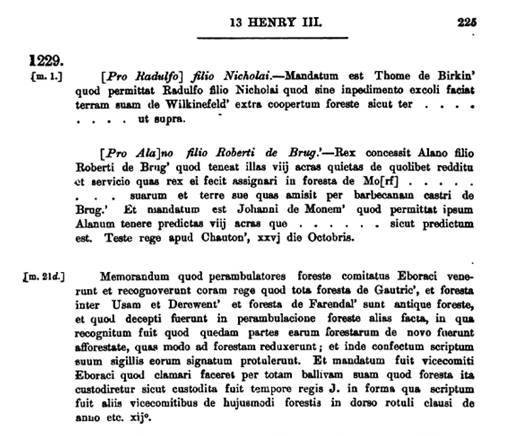
The Chancery Records of
1228 (The National Archives, C 47/11/1/22, Calendar of Close Rolls, 13 Henry III for 1229 page 225)
record the verdict dated 29 October 1228 in the Forest proceedings concerning
the forests of Derwent, Galtres and Farndale.
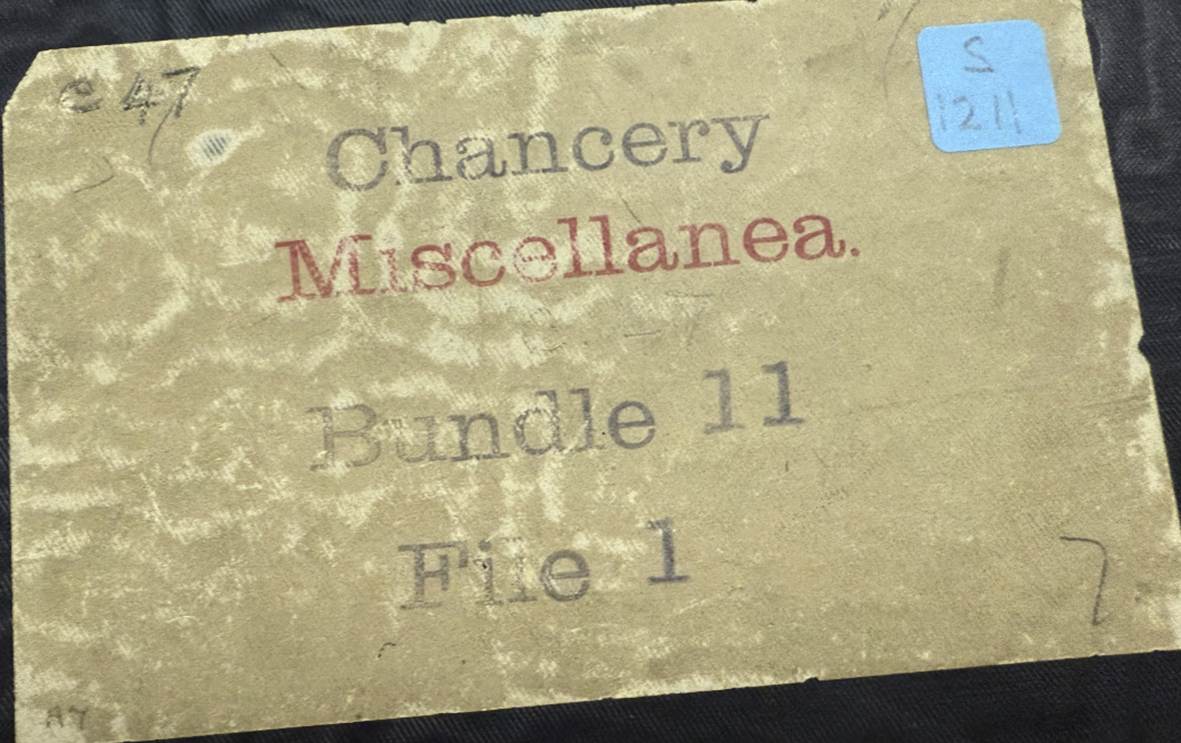
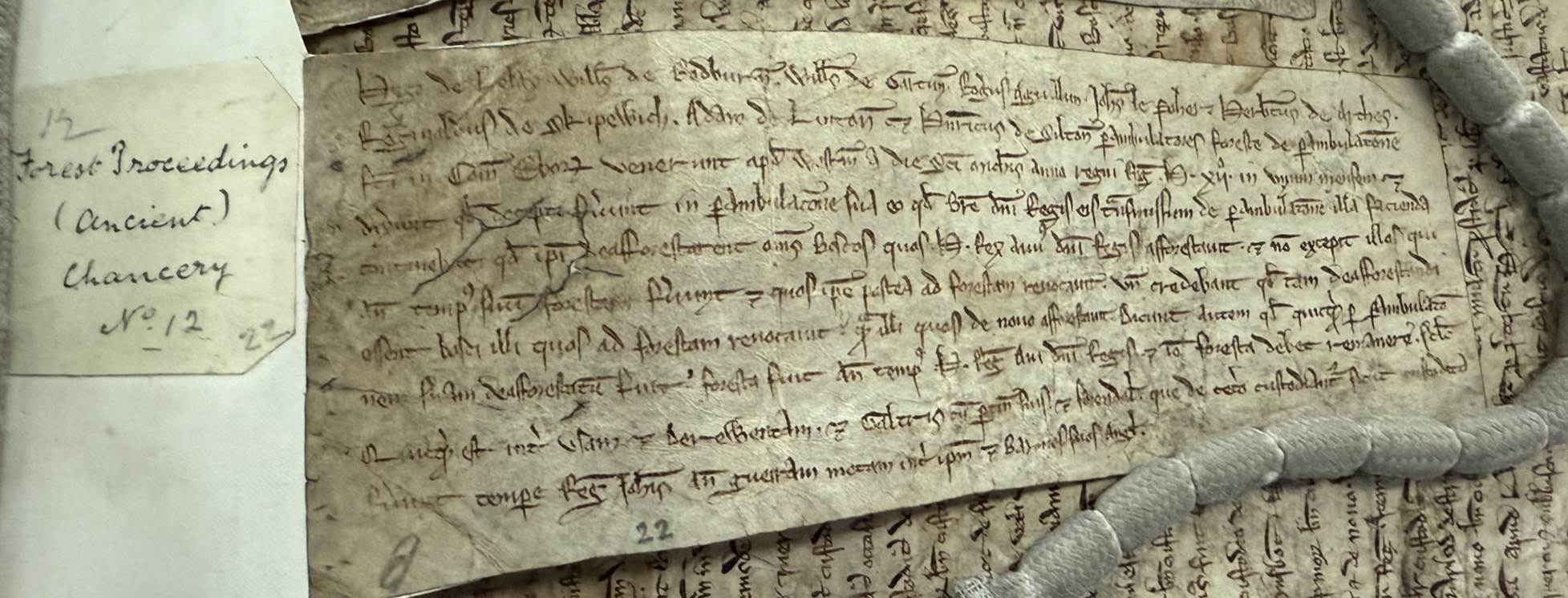
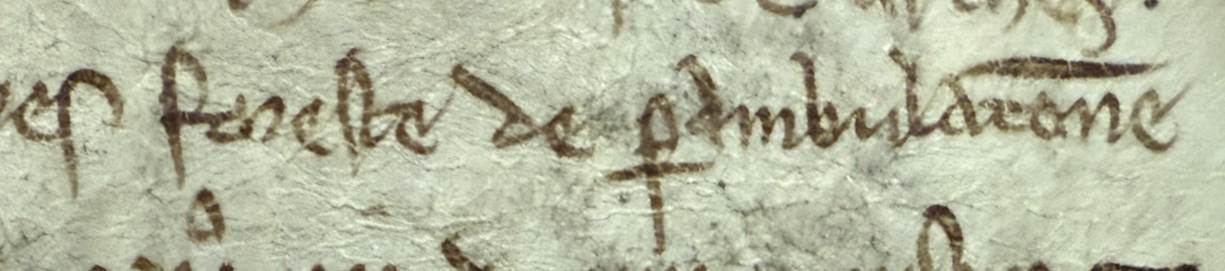
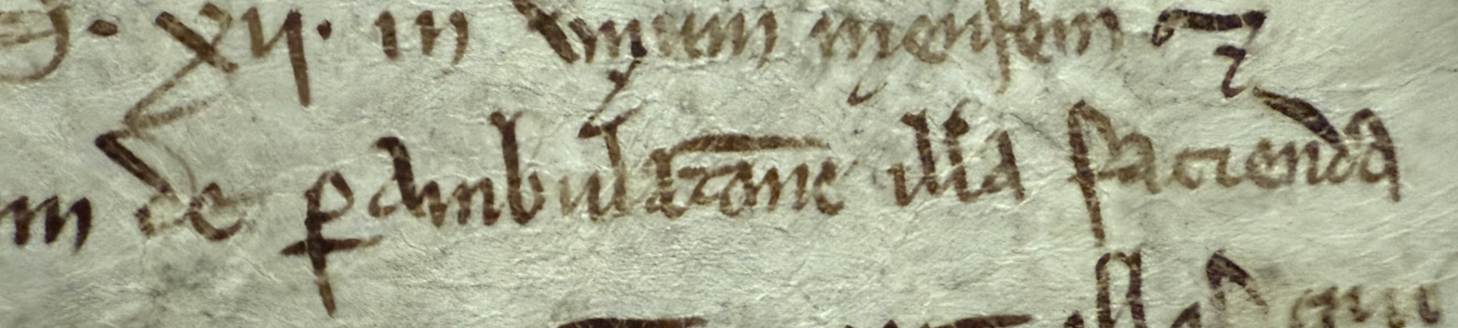
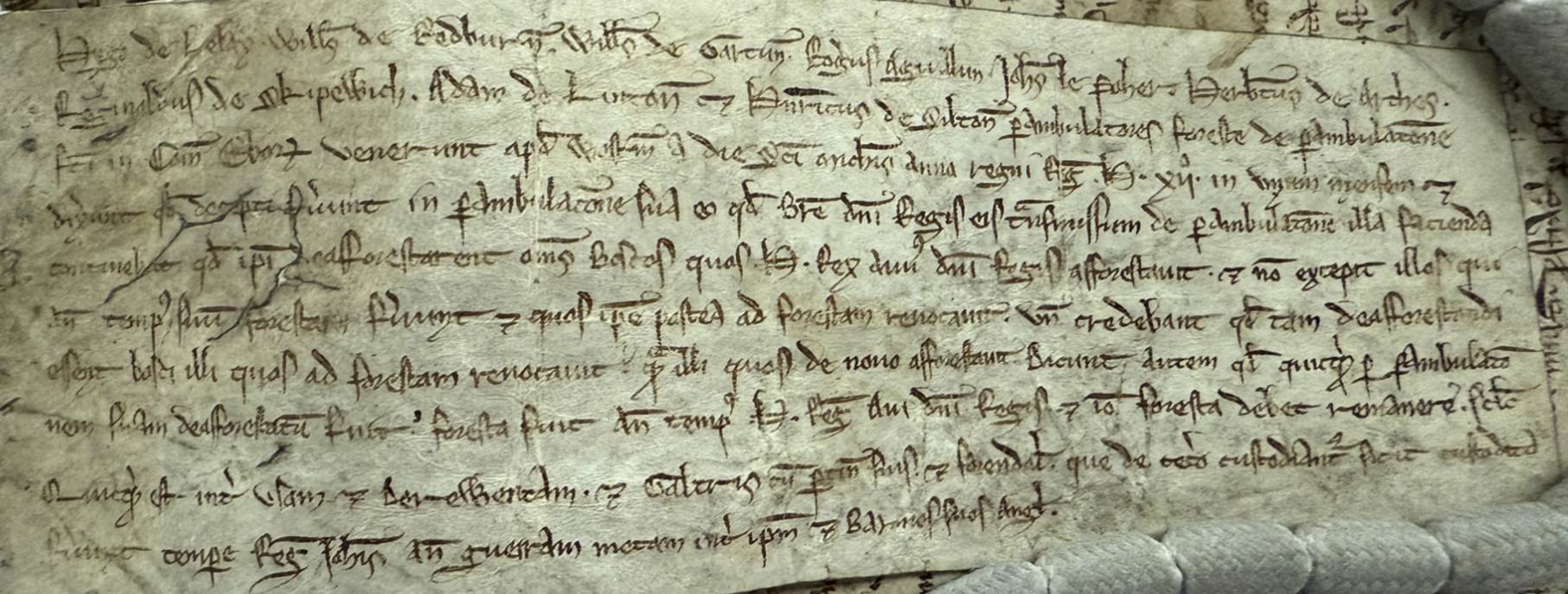
In this verdict, also
recorded in, Henry III decreed, the whole of the forest of Galtres and
the forest between the Ouse and the Derwent, and the forest of Farndale, are
ancient forests. The perambulators of the forest (those who trespassed into
the forest) were wrong in thinking they had free access to the forest, even
though it was recognised that some part of the forest had been recently
cleared.
The text in Latin reads Memorandum quod perambulators foreste comitatus Eboraci venerunt et recognoverunt coram rege quod tota foresta de Gaurtic’, et foresta inter Usam et Derewent’ et foresta de Farendal’ sunt antique foreste,
et quod decepti fuerunt in perambulacione foreste alias facta, in qua recognitum fuit quod quedam partes earum forestarum de novo fuerunt afforestate, quas modo ad forestam reduxerunt; et inde confectum scriptum suum sigillis eorum signatum protulerunt. Et mandatum fuit vicecomiti Eboraci quod clamari facaret per totam ballivam suam quod foresta ita custodiretur
sicut custodita fuit
tempore regis J. in forma qua scriptum fuit aliis vicecomitibus
de hujusmodi forestis in dorso rotuli clausi
de ann etc xij.
The full translation into English is It is to be remembered
that the walkers of the forest of the county of York came and recognized before
the king that the whole forest of Gaurtic, and the
forest between Usam and Derewent,
and the forest of Farendal, are the ancient forest,
and that they were deceived in the perambulation of the forest, in which it was
recognized that certain parts of those forests were newly afforested, which
they have just brought back to the forest; and thence they brought forth their finished
writing, sealed with their seals. And the sheriff of York was ordered to make a
cry through all his bailwick that the forest
should be guarded as it was guarded in the time of King J. in the form in
which it was written to the other sheriffs about such forests on the back of a
roll closed on the back of ann etc xij
A
perambulation of the forests of Yorkshire was made in 1229, when it was
certified that the whole forest of Galtres, the
forest between the Ouse and the Derwent, and the forest of Farndale were true
ancient forests of the king (The Royal Forests
of England,
John Charles Cox, 1905, page 125).
The
Revision of the Perambulations by Henry III. The Exploitation of the Forest by
Household Officials During Henry III’s Personal Rule – 1227 to 1259. On 9 January 1227 Henry III declared
himself to be of full age, and immediately began measures to reclaim the Forest
rights of his crown. … The foresters of fee were to be summoned to appear
before the king to show by what warrant they held their bailiwicks; likewise
everyone who had assumed any liberty in the forest since 1217, to produce his
authority. The jurors who had made perambulations in 1225 were summoned to
explain why they had put out of the forest districts which had been forest
before 1154, and also royal demesnes. Lands deforested during the reign of the
usurper Stephen and subsequently reclaimed by Henry II were not within the
terms of the Charter of the Forest. The jurors, having appeared before the king
were induced, probably by threats of amercement and imprisonment, to
acknowledge their error, and to modify their perambulations; they then received
the king’s pardon. …On 27 October 1228 the juries who had made the
perambulations of the Yorkshire Forests of Galtrees
and Farndale, and the forest between Ouse and Derwent, obediently amended their
verdicts. (The Royal Forests of England, Raymond Grant, 1991 including reference to
Farndale on page 143.)
Because of its situation on the very
doorstep of York, Galtres was a favourite hunting
ground of English kings, even in Saxon times. A survey made in 1229 designated
the entire area between the rivers Ouse and Derwent the royal forest of Galtres and numerous place names such as Sutton in the
Forest, Marton in the Forest, Huntingdon (hill of the huntsmen), Lund (a grove
or copse) and Raskelf (the
headland of roe deer) testify to its former extent and character. In 1316 this
forest was said to comprise about 100,000 acres and to contain some 60 villages. (Historic forests of England, Ralph Whitlock, 1979, page 160 to 161.)
1230
Of the
gifted bissas. It is ordered that the Lord of the
Isle should cause William of Wessex to have two bissas
in the forest of Pikering, of the king's gift.
Witness the king at Havering, the 23rd day of January, 14 Henry III (Close Rolls of the reign of Henry III, 1227 to 1231, page 286).
The King made regular gifts of game from Pickering Forest. In
another example in 1245, Of the deer given. The king to his beloved and
faithful Robert de Ros, his justiciary of the forest, greetings. We command you
that you cause Lecia, the wife of our beloved and faithful Roger de Thurkelby,
to have three deer in our forest of Pykering, of our
gift. Witness as above. (Close Rolls of the reign of Henry III, 1242 to 1247, page 335).
1231
Of the hunters sent to run. To the bailiffs of the forest of Pikering, greetings. We send to our forests of Pikering and of Galtres our
hunters to capture in our forest of Pikering 30 pigs
for our work and 1 bissas in each forest and in the
forest of Galtres and we command you that you send
our hunters to this end. Witness the king at Walingford, the 8th day of October (Close
Rolls of the reign of Henry III, 1227 to 1231, page 225 (Farndale, 1228), page
5 and page
286 and page 568).
1233
The
resolution of the 1225 dispute regarding land rights in Farndale recognised the
grazing rights of Nicholas and his tenants provided they do not tarry in the
said pasture, whilst recognising the abbot’s right to timber (Feet of Fines for the County of York (1232 to 1246),
Yorkshire Archaeological Record Series, Volume 67, 1925, page
7).
Between
Nicholas of Stuttvill, by Alan of Wassant
his attorney, plaintiff, and Robert, Abbot of Saint Mary, York, by Walter of Gaugy, his attorney, impedient:
as to common of wood and pasture in Houton, Spaunton
and Farendal; as to which Nicholas complains
that the Abbott does not adhere to the fine made in the King’s Court at
Winchester, in the time of King John, between Nicholas of Stutevill,
father of Nicholas, his heir, and the said Abbott.
Quitclaim
by Nicholas to the Abbot, his successors and his church of York. The Abbot
grants that, if the cattle of Nicholas and his heirs or of his men in Kirkeby, Fademor, Gillingmor and Farendale, hereafter enter upon the common of the said wood
and pasture of Houton, Spaunton and Farendal, they shall have free way
in and out, without ward set; provided that they do not tarry in the
said pasture. The Abbott receives Nicholas and his heirs into all etc.
(Case 263, File 26, No 14).
Page
21 (Bothine Wood in Farndale): The Prior admits
the right of Peter to the hull of Swinesheved; with all the wood on either side
the water and from Swinesheved as far as Blakehou; and from Blakehou to Ralph’s
Cross, all outside the shelter of Bothine Wood, as
far as Mosebech; And from Mosebech,
outside the shelter of Frihop Wood as far as Troch;
and from Troch, outside the shelter of the wood, as far as Yubech:
so that Peter and his heirs may hold as did the Prior when the houses that the
Prior held on that moor were pulled down by King's justices of the forest.
Saving to the prior, his successors and church, so much common of pasture in
that mooe as belongs to 7 bovates of land that the
Prior holds in the Vill of Danby. (Feet of
Fines for the County of York 1232 to 1246, Yorkshire Archaeological Record
Series Volume 67, page 21).
This
passage is referred to in the index as Botine
Wood in Farndale, 21.
When
Nicholas Stuteville died in 1233, his daughter Joan, the Lady of Liddell became
Lady of the Stuteville estates. She married Hugh Wake who died on Crusade in
1241, but left three sons including Baldwin Wake. Joan married her second
husband, Hugh le Bigod, but as a widow continued to be known as Joan de
Stuteville. Her seal was embossed with the image of a lady riding sideways, a
style which she is said to have been the first to adopt.
1236
For Robert de Creppyng, that he may have entry
into the castle of Pikering. It is ordered to the
sheriff of York that he freely and without hindrance permit Robert de Creppyng,
the king's servant, to have entry into the castle of Pikering
with oxen, cows and other cattle from the king's dominions to receive them
there. He shall also permit the same Robert to bring corn from the king's
dominion of Pikering into the same castle and to
thresh it there until the king's arrival in those parts. Witness as above. (Close Rolls of the
reign of Henry III, 1234 to 1237, page
290).
In 1237, Of the socage of Pykering. It is ordered that the sheriff of York should
return what he took of the socage of Pykering from
the feast of Saint Michael in the 20th year of his reign without delay to
Robert de Crepping to answer therefrom to the
Exchequer. Witness the king as above. (Close Rolls of the reign of Henry III, 1234
to 1237, page
444).
1243
Of the men of Pikering
and of Neuton. Because the king has received by an
inquisition which he ordered to be made by Robert de Ros, justiciar of the
forest, that the men of Pykering and of Neuton in the time of the predecessors of the kings of
England and of his own were accustomed to have pasture for their cattle in the
king's forest of Pykering, and that they were never
accustomed to give pannage for their pigs until the time when he took them away
from them, it is ordered to the same Robert that he cause them to have the
aforesaid pasture and pannage in the aforesaid forest in the manner in which
they were accustomed to have them at the aforesaid time. Witness W. Archbishop
of York at Wudest, the first day of April. (Close Rolls of the reign of Henry III, 1242 to 1247, page
93).
The King to his beloved and
faithful Robert de Ros, justiciary of the forest, greetings. We send to you
Philip de Condevr', our hunter, to capture in our
forest of Pikering' thirty or forty deer, if they can
be captured in the same forest without loss and destruction; and therefore we
command you to admit him to this. Witness as above (Close Rolls of the reign of Henry III, 1242 to 1247, page
115).
1244
By 1244, profits from wool sales were very large at Malton during
this period. £460 16s 8d was taken in 1251. This was the most profitable year
in the period 1244 to 1257. The least profitable year (1255) produced £243 19s
8d. Altogether the total from wool sales for the period was £5,224 9s 3 d.
Obviously wool growing was the principal occupation of the monastery, all the
more profitable because it was ‘an untaxed source of income’, for in accordance
with their charters the canons were exempt from all customs at the ports and
elsewhere. Such a preponderance of wool suggests that the canons ‘organised an
immense trade in Yorkshire and collected wool with great success’.
Wool was collected by larger houses from smaller. The Arden nunnery
tucked well away in the Hambleton Hills used to send its wool to Byland’s woolhouse at Thorpe, 10 miles away, where the agents of the
Italian merchants collected it, or where it would be despatched together with
Byland’s wool to Clifton near York. Malton had a supremely good situation for
wool collection. Roads converged upon the town which was located in the only
gap southwards from the Vale of Pickering. There was the road from Pickering on
the edge of the moors.
(The monasteries of north east
Yorkshire and the medieval wool trade,
Yorkshire Archaeological Journal, Volume 52, 1980, page 113).
1250
Henry III allowed access to the woodland of Farndale to the abbot of
St Mary’s, York in 1250.
On 9 July 1250 it was recorded in the Fine Rolls as follows: For the
abbot of St. Mary’s, York. Because the abbot of St. Mary’s, York, has
acquittance by the charters of the king’s predecessors, kings of England, as he
says, that he may not make regard in his wood of Farndale, the king has placed
that regard in respite until the quindene of
Michaelmas in the thirty-fourth year. Order to G. de Langley, justice of the
forest, to place that regard in respite in the meantime, so that he may then
come before the king ready to certify him more fully concerning that
acquittance.
This needs more work.
(possibly part of Excerpta è rotulis finium in Turri Londinensi asservatis, Henrico Tertio rege,
A.D. 1216-1272, 34, Henry III (1249 to 1250), 509, The
National Archives, Fine Roll C 60/47, Henry III Fine Rolls Project, this entry is not in the original roll).
For the men of Pikering and Neuton. It was ordered by G. de Langel, Justiciar of the
Forest, that the men of the king of Pikering and
Newton may have pasture for their cattle and cattle and hay outside the king's
hay and land as prohibited as in the king's forest of Pikering,
if not to the grave detriment of the same forest, as he may see fit; so that
the aforesaid king's men shall not be burdened beyond measure for the failure
of the foregoing. Witness the king at Chauton, the
26th day of October 1250 (Close Rolls of the reign of Henry III, 1247 to 1251, page 341).
Of oaks for the operations of Scardeburgh
and Pikering. It is ordered that G. de Langel,
justiciar of the forest, cause Robert de Crepping, sheriff of York, to have in
the hay of Scalleby, 20 oaks for the building and
repair of the houses of the king's castle of Scardeburgh;
he also cause the same sheriff to have in the king's forest of Pikering, 10 oaks for the repair of the houses of the
king's castle of Pikering. Witness as above. (Close
Rolls of the reign of Henry III, 1247 to 1251, page 306).
In 1251, It is ordered to William de Bossal,
steward of his forest of Pykering, that he cause
Robert de Crepping to have four oaks in the king's
forest of Pykering for the repair of the king's
cowsheds in the same forest (Close Rolls of
the reign of Henry III, 1247 to 1251, page 465).
In 1252, the steward of the forest of Pykering was ordered to cause Hugh le Bigod to have 4 deer
in the aforesaid forest from the king's gift (Close Rolls of the reign of Henry III, 1251 to 1253, page 124).
In 1253 the King granted the whole forest
of Farnedala to Joan de Stuteville’s second husband,
Hugh le Bigod until he returned from Vasconia (Gascony) where Henry was dealing
with an uprising stirred on by the harsh approach taken by his governor, Simon
de Montfort, another costly campaign which left the Crown heavily in debt (Calendar of Close Rolls, 37
Henry III page 368).
Pro Hugone le Bigod. Rex commisit Hugoni le Bigod’ totam forestam de Farnedala, quam nuper per consideracionem curie rex recuperavit
versus abbatem Sancte Marie Ebor’, custodiendam usque ad reditum regis
de Vasconi avel quamdiu regi
placuerit, eodeum modo quo prefatus abbas forestam iliam habuit; et mandatum est J. de Lessinton’
quod forestam illam eidem Hugoni liberet
custodiendam sicut predictum
est. Teste ut supra.
For Hugh
le Bigod. The King committed to Hugh le Bigod the whole forest of Farnedala, which the king had lately recovered by
consideration of the court against the abbot of St Mary York, to be kept until
the return of the King from Vasconi, or as long as it pleased the king, in the
same manner as the aforesaid abbot had that forest; and J. de Lessinton was ordered to release that forest to the same
Hugh to be kept as aforesaid. Witnessed as above.
Hugh Bigod (c. 1211 – 1266), the second Husband of Joan
de Stuteville, later became Justiciar of England from 1258 to 1260. He was a
younger son of Hugh Bigod, 3rd Earl of Norfolk. In 1258 the
Provisions of Oxford established a baronial government (the root of a
Parliament to control the King’s finances) of which Hugh's elder brother Roger
Bigod, 4th Earl of Norfolk was a leading member, and Hugh was appointed Chief
Justiciar. He also had wardship of the Tower of London, and, briefly, of Dover
Castle. But at the end of 1260 or in early 1261 he resigned these offices,
apparently due to dissatisfaction with the new government. Thus in 1263 he
joined the royalists, and was present on that side at the Battle of Lewes which
took place at the village of Fletching, north of Lewes. Hugh escaped but the
King and his son, Prince Edward, were taken prisoner.
On the authority of the
provisions a new justiciar was elected, the first to hold office in over twenty
years. The incumbent justiciar, Hugh Bigod, was given the task of undertaking a
judicial itineration of England for the purpose of dealing with any grievances
whether against the king, his administrators or anyone else. Bigod was
supported in this by two significant measures also sanctioned by the
provisions. First he was empowered to hear any kind of grievance by querela
alone, that is on a simple oral or written complaint. No formal judicial writ
was required to initiate legal proceedings. Secondly local commissions of four
knights were created to aid Bigod in uncovering improprieties. (An Introduction to and edition
of the Hugh Bigod Eyre Rolls, June 1258-February 1259, Andrew H Hershey, Dissertation, October 1991, King’s
College, London, page
2)
The Duchy of Gascony or Duchy of Vasconia was a duchy in
southwestern France and northeastern Spain, encompassing the modern region of
Gascony. The Duchy of Gascony, then known as Wasconia,
was originally a Frankish march created to control the Basques.
Crusading was a popular cause in the thirteenth century,
and in 1248 Louis joined the ill-fated Seventh Crusade, having first made a
fresh truce with England and received assurances from the Pope that he would
protect his lands against any attack by Henry. Henry III might have joined this
crusade himself, but for the rivalry between the two kings, after Louis's
defeat at the Battle of Al Mansurah in 1250, Henry announced that he would be
undertaking his own crusade to the Levant. He began to make arrangements for
passage with friendly rulers around the Levant, imposing efficiency savings on
the royal household and arranging for ships and transport, He was very eager to
take part. Henry's plans reflected his strong religious beliefs, but they also
stood to give him additional international credibility when claiming the return
of his possessions in France.
However Henry's crusade never departed, as he was forced
to deal with problems in Gascony, where the harsh policies of his lieutenant,
Simon de Montfort, had provoked a violent uprising in 1252, which was supported
by King Alfonso X of neighbouring Castile. The English court was split over the
problem. Simon and Eleanor argued that the Gascons were to blame for the
crisis, while Henry, backed by the Lusignans, blamed Simon's misjudgment. Henry and Eleanor quarrelled over the issue
and were not reconciled until the following year. Forced to intervene
personally, Henry carried out an effective, but expensive, campaign with the
help of the Lusignans and stabilised the province. Alfonso signed a treaty of
alliance in 1254, and Gascony was given to Henry's son Edward, who married
Alfonso's half-sister Eleanor, delivering a long-lasting peace with Castile.
On the way back from Gascony, Henry met with Louis for
the first time in an arrangement brokered by their wives, and the two kings
became close friends. The Gascon campaign cost more than £200,000 and used up
all the money intended for Henry's crusade, leaving him heavily in debt and
reliant on loans from his brother Richard and the Lusignans.
It is ordered to John de Lessington, keeper of
the forest of Pikering, that he cause the Earl of
Norfolk and the Marshal of England to have five deer in the aforesaid forest,
of the king's gift, and that he permit Hugh le Bigot to take them for the
aforesaid Earl's work. Witness as above. (Close Rolls of the reign of Henry III, 1251 to 1253, page
385).
1254
For Hugh le Bigod. It is ordered
to John de Lessington, justiciar of the forest beyond the Trent, that he cause
Hugh le Bigod to have four deer of the king's gift in the king's forest of
Pickering. Witness as above. (Close Rolls of the reign of Henry III, 1253
to 1254, page
263).
1255
The boundaries of the forest are given as follows in 1255: “from
the waters of the Dove to the water called the Seven in breadth, and in length
from the bounds of Cleveland, (the moorland ridges west from Ralph’s Cross to
Jenny Bradley north of Blowarth) to the road
running from Pickering to Helmsley by the land of Catwayt
(glades of Clatter Beck, very much as RH Hayes walked on the two day
perambulation in 1956). (Raymond Hayes, Farndale, 1961,
unpublished, page 32).
After the King’s return, on 2 May 1255 Hugh le Bigod paid 500
marks for the office of forester of Farndale, which included his right to hunt
hares with dogs in all Yorkshire’s forests (Calendar of Close Rolls, 39 Henry III, page 84. Calendar of Liberate Rolls, 39 Henry
III, page 212, Fine Rolls, C39/405, Henry III Fine
Rolls Project).
In April 1255 he became chief forester at Farndale in payment of a sum
of 500 marks (An Introduction to and edition
of the Hugh Bigod Eyre Rolls, June 1258-February 1259, Andrew H Hershey, Dissertation, October 1991, King’s
College, London, page 20).
Pro Hugone le Bygod. Mandatum est Johanni de Lexinton’, justiciario
forester egis ultra Trentam, quod cartam
quam rex fieri fecit Hugoni le Bygod de forestaria foreste de Farendale coram eo legi faciat, et concessionem illam teneri secundum quod in eadem
carta continetur: et forestarios,
viridarios et alios ministros
foreste pro quibus idem
Hugo respondere voluerit ad presentacionem suam in predicta foresta admittat. Test ut supra.
For Hugh
le Bygod. It was ordered to John de Lexinton, Justiciar of the King's forest
beyond Trent, that the charter which the king caused to be made to Hugh le Bygod concerning the forestry of the forest of Farendale he shall make a law before him, and that grant
shall be held according to what is contained in the same charter; and he shall
admit the foresters, greenkeepers and other ministers of the forest for whom
the same Hugh is willing to answer for his presentation in the aforesaid forest.
The Fine
Rolls recorded, Concerning a fine for having a liberty. Hugh le Bigod gives
the king 500 m. for having the office of forester of Farndale to him and his
heirs and for having a certain liberty, namely that with his own dogs he may
hunt hares etc. throughout all the king’s forests in the county of Yorkshire
and of the aforesaid 500 m. he has paid Arnald de Muntpesaz
£100 by the king’s order, and he will render 200 m. at the Exchequer of
Michaelmas in thirty-ninth year and £100 at the Exchequer of Easter next
following, and for issues of the seal for the aforesaid charter and liberty he
will render 12 m. 2s. at Pentecost next. And those 12 m. 2s. he has paid into
the king’s Wardrobe by Wibert of Kent for gold to be bought therefrom and thus
he is quit of those 12 m. 2s. (Fine Rolls, Henry III Fine Rolls Project, The National Archives C39/405, the last sentence
is a later addition and squeezed into the space between this and the next
entry)
Allocate to Hugh le Bygot, in his fine of 500 marks for the
forestership of Farndale, 100 l, paid at Westminster to Ernald de Mone Pesaz. The associated index
entries: Farndale, Farendale [co York NR], foresterhip of, 212. Forests (i),
chaces, hays, parks, warrens and woods named … Farndale … forestership of
Farndale, 212. (Calendar of the Liberate Rolls, 1251 to
1260, page 212).
The Calendar
of Charter Rolls, Volume 1, Henry III, 1226 to 1257, page 445 to 446 gives some more detail of the forestership of Farndale.
The extract suggests that the forest of Farndale stretched
between the Dove and the Seven from the road between Pickering and Helmsley
north into Cleveland.
This tends to suggest that the moorland area of Spaunton Moor
and Blakey Ridge was also wooded and part of the forest of Farndale at this
time.
The king sends Roger Bigod, Earl of Norwich, and Hugh Bigod to capture
forty deer in the king's forest of Pickering for the king's work, and four deer
for the earl's work; and the keeper of the same forest is commanded to admit
them to this (Close Rolls of the reign of Henry III, 1254 to 1256, page 134).
1258
In the course of the spring and summer of 1258 dissatisfaction with
the manner in which Henry III had governed England since the beginning of his
personal rule in 1234 reached a climax. In May of 1258 Henry finally agreed to
reform the realm and took an oath to that effect. A month later at the June
parliament held at Oxford, and only after additional pressure was brought to
bear on the king by the barons, substantive measures of reform were accepted by
Henry. These were the Provisions of Oxford.
Since the king had given Hugh le Bigod six deer in the king's forest
of Pykering in the past year, and the same Hugh did
not have those deer, and the king's writ to John de Eyville, justiciar of the
king's forest beyond Trent, directed to the king, it was ordered to the same
John that he cause the same Hugh to have the said six deer and four stags of
increase in the aforesaid forest of the king's domain. It is vacant because it
is in the roll of the closed in the year 4 (Close Rolls of the reign of Henry III, 1256 to 1259, page 233).
1259
When Brother Amedeus, master of the Templar Knights in England, in his
passage through the forest of the king of Pykering on
the day of the Beheading of Saint John the Baptist in the year 43, etc.,
captured a doe in the mora of Blakeham in the
aforesaid forest and when they killed the same master's captor, the king, by
his special grace, pardoned the said master and the aforesaid brothers and
relatives of the said master for the transgression they committed in driving
away and capturing the aforesaid doe. (Close Rolls of the reign of Henry III, 1256 to 1259, page 394).
1261
The king sends to Hugh le Bigod, keeper of the forest of Pickering,
Richard de Candover and William de Candover, the
king's hunters, to capture sixty deer for the king's work in the aforesaid
forest on the approaching feast of Saint Edward. And the aforesaid keeper is
commanded to admit them to this. Witness as above. (Close
Rolls of
the reign of Henry III, 1259 to 1261, page 412).
1262
It was ordered to Robert de Nevill, justiciar of the forest beyond
Trent, that he cause Marmaduke de Tweng to have two
deer in the forest of Pikering, of the king's gift.
Witness as above. (Close Rolls of the reign of Henry III, 1261 to 1264, page 72).
1267
On 30
June 1267 Edmund Crouchback knelt before his father, Henry III, to accept the
charter which made him Earl of Lancaster. He rose as the owner of land in
almost every corner of England, and which included the Honour and Forest of
Pickering (R Somerville, History of the Duchy of
Lancaster I, 1265-1603 (1953), Pastoral Farming on the Duchy of Lancaster’s
Pickering Estate in the Fourteenth and Fifteenth Centuries, Bryan Waites,
Yorkshire Archaeological Journal, Volume 49, page 77. North Riding Records Yorks, The Honour and Forest of
Pickering, 1894, Volumes I to IV, of which Volume II and Volume III is available on line).
The
Great Cowcher or caret regum (National
Archives DL42 References), comprises evidence of title for the
Duchy of Lancaster. It focuses on land and property transactions, including
details about the landscape and the nature of tenure across the duchy's
estates. It is an invaluable source for the Lancastrian holding in Ryedale
including the activity of the first settlers of Farndale.
This
was two centuries prior to the Wars of the Roses, but serves to illustrate that
the later competing interests between the Houses of York and Lancaster related
to a competition between noble houses, not as is often imagined today, a
geographical civil war involving the two modern counties.
See FAR00015A.
1276
The Inquisition Post Mortem taken on the death of Lady Joan de
Stuteville provides evidence of the extent of cultivated land in Farndale by
the mid thirteenth century (FAR00017).
By this time the medieval evidence provides a detailed record of the burgeoning population living in Farndale.
1282
The Inquisition Post Mortem taken on the death of Joan’s son,
Baldwin Wake provides evidence of a rapidly expanding community (FAR000020).
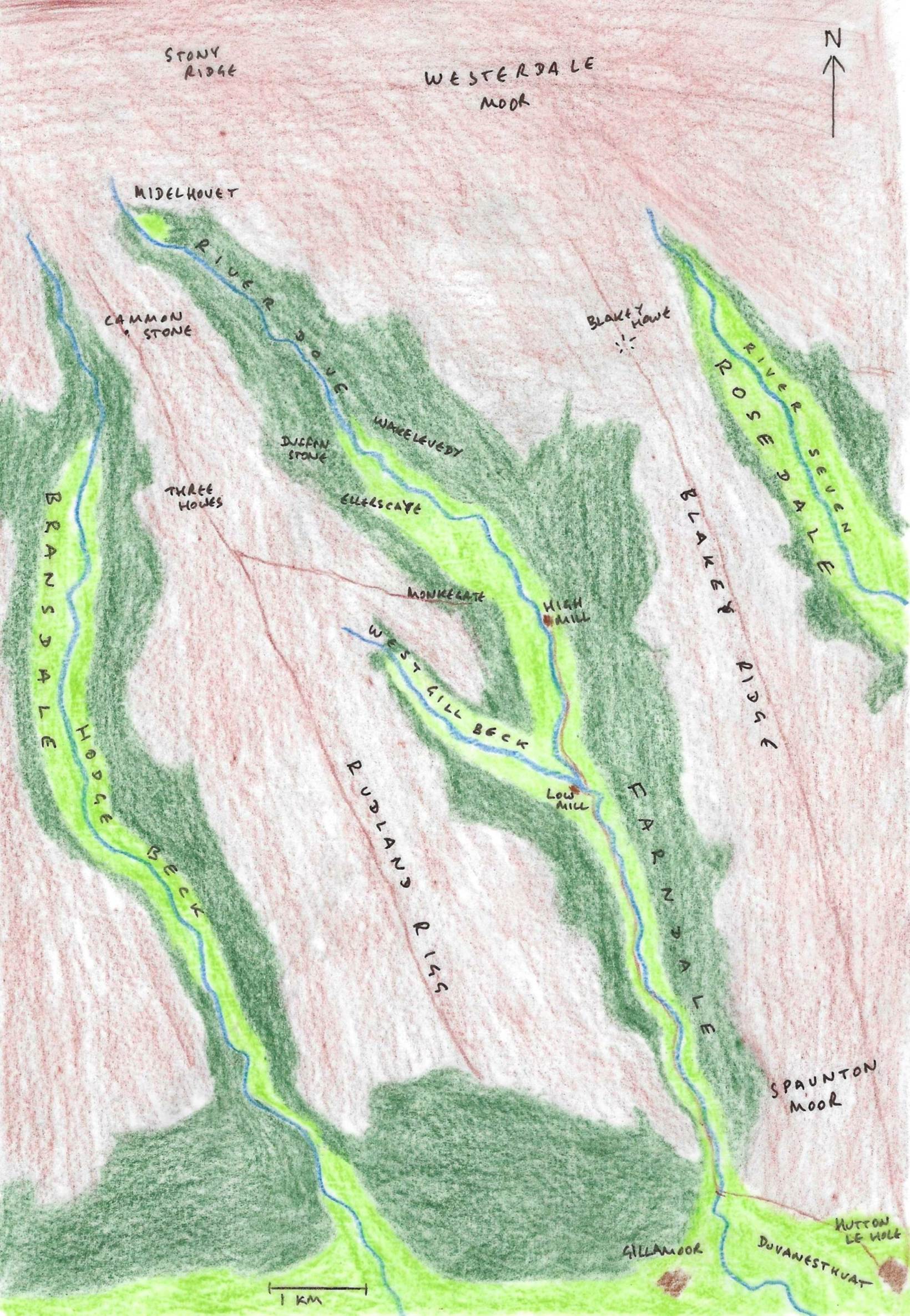
Representation of Farndale as it may have looked in the
late thirteenth century
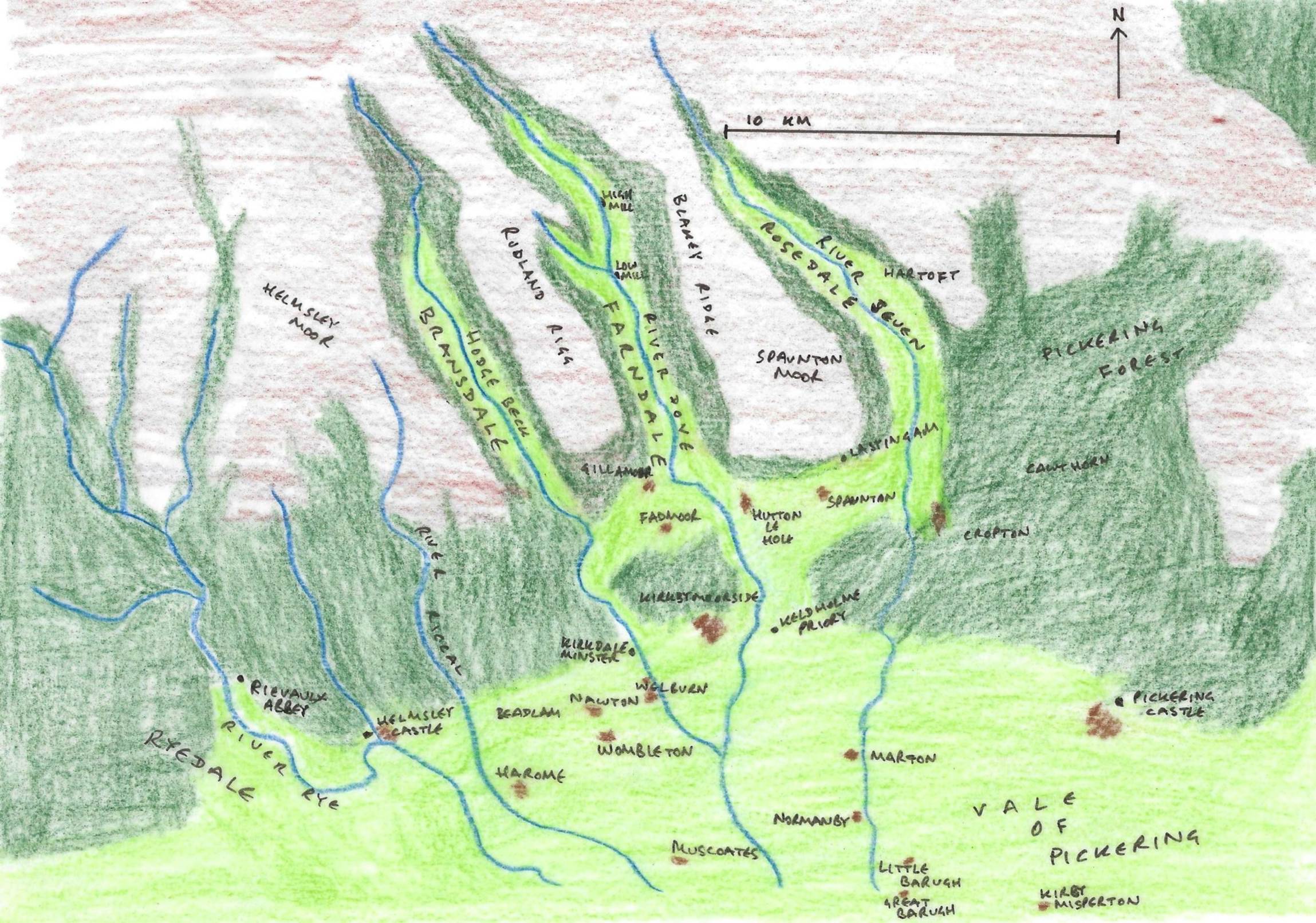
Representation of Kirkbymoorside Estate as it might have
looked in the late thirteenth century
(light green showing possible extent of cultivation)
1290
18 January 1290, Westminster. To Master Henry de Bray,
escheator this side Trent. Order to cause John Wake, son and heir of Baldwin
Wake, to have seisin of his father's lands, as the king has taken his homage
(Close Rolls of
the reign of Edward I, 1288 to 1296, page 68).
20 August 1295. To the sheriff of
York. Whereas the king granted by his letters patent, to Edmund, his brother,
that he and his heirs should have for ever in the chancery of the king and his
heirs certain justices by the king's letters to hold the pleas of the forests that
Edmund has of the late king's gift, as often as the king and his heirs should
send justices to hold such pleas in the king's forests, and that Edmund and his
heirs should have the ransoms, fines and amercements and all other things
arising from the said pleas in the same way as the king would have had them if
the forests were in his hands : the king orders the sheriff to cause the fines
that divers men of that county have made before William Wyther and Roger
Brabazon, Edmund's justices, lately assigned by the king to hold pleas of his
forest of Pykering, in that county, in their eyre,
and the ransoms and amercements in which such men fell before the said
justices, to be levied, according to the estreats of
the eyre delivered, or to be delivered, to the sheriff by the justices, and to
cause Edmund to have them, in accordance with the king's grant aforesaid (Close
Rolls of the reign of Edward I, 1288 to 1296, page 421).
2 November 1295. To the sheriff of
York. Order to cause to be levied all the fines made by men of that county
before William Wyther and Roger Brabazon, justices of Edmund, the king's
brother, lately appointed by the king to hold pleas of Edmund's forest of Pykeryng, and all ransoms and amercements in which they
fell before the said justices, and to cause them to be paid to Edmund, as the
king granted to him by his letters patent that he and his heirs should have at
their request in chancery certain jnstioes by the
letters patent of the king and his heirs to hold pleas of the forests that
Edmund has of the late king's gift, as often as the king and his beiis shall send justices to hold such pleas in their
forests, and that Edmund and his heirs should have the ransoms, fines and
amercements and everything else pertaining to the said pleas as fully as the
king would have had them if the forests were in his hands (Close Rolls of the reign of Edward I, 1288 to 1296, page 464).
1301
Detailed evidence of the inhabitants of Farndale is provided by
the 1301 Yorkshire Subsidy, a tax imposed to fund the Scottish Wars (FAR00029).