The
Forest of Farndale in 1325
The
Founding of a House of Friars, 30 July 1347
FAR00039
|
Return to the Home Page of the Farndale Family
Website |
The story of one family’s journey through two
thousand years of British History |
The 83 family lines into which the family is divided.
Meet the whole family and how the wider family is related |
Members of the historical family ordered by date of
birth |
Links to other pages with historical research and
related material |
The story of the Bakers of Highfields, the Chapmans,
and other related families |
Dates are in red.
Hyperlinks to other pages are in dark blue.
Headlines are in brown.
References and citations are in turquoise.
Context and local history are in purple.
An early planning dispute
with the local authority
Thomas
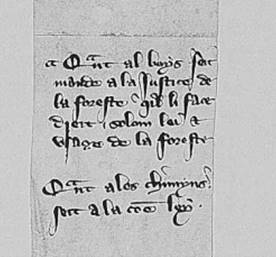
Wake had an early planning dispute with the justice of the forest, concerning
Farndale. He asked that the justice of the forest should be commanded to deliver his wood of Farndale. The King
seems to have replied that he should deliver a writ to the justice of the
forest to certify the reason for taking the wood.
In a
subsequent document, again he asked that the justice of the forest should be commanded to deliver his wood of Farndale and added that
the justice had seized it without reason. The document also asked that the
burgesses of Hull should be ordered not to build any new road on his land and
to destroy the roads they made while the King was under age, as Thomas Wake
says he is entitled to his inheritance in full.
The
status of these documents is marked that the endorsement was coram rege, ‘before the King’.
With
regard to the wood, the Justice of the Forest was to be ordered to do justice
to him, according to the law and usage of the forest. With regard to the
roads, he was to have recourse to common law.
The
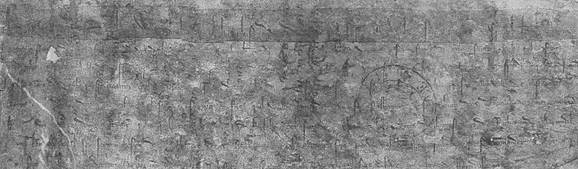
petitions have been completed from the printed text in Rotuli Parliamentorum, Volume 1 because the petition is now
largely illegible as a consequence of repairs.
The
petitions are dated to 1325 as the petition is published in Rotuli Parliamentorum,
Volume 1 from a Hale manuscript which
dated the petitions to the parliament held in 19 Edward II (1325) (Rotuli Parliamentorum, Volume 1, 418b number 8, J R S Phillips (Prome, Appendix
of Unedited Petitions, 1307-1337, The
National Archives SC 8/7/345), which suggests that these petitions
probably all do belong to 18 Edward II, although there is no indication that
they were presented either at the non-parliamentary assembly of October 1324 or
the parliament of June 1325. (National Archives, SC
8/8/358)
Thomas
Wake requested that he be allowed to account in the Wardrobe for his costs in
service with the king with foot-soldiers at Berwick and Edinburgh, and that the
debts of his ancestors be searched for in the Exchequer and allowance be made
for these against the costs. If the king was not prepared to grant this then he
requested that he be allowed to pay the debts in instalments with respite for a
year or two. He further requested that the Earls of Leicester, Richmond and
Arundel, and Despenser be ordered to accept one homage for Kirkby in the fee of
Mowbray, as each is demanding homage. He further requested that the justice of
the Forest north of the Trent be commanded to deliver his wood of Farndale.
Concerning
the first point he was told that he should come into the Wardrobe and show the
manner by which he was retained and how much he received, and if any indenture
was made between him and the King, and the King should be certified of this so
that he can say his will.
Concerning
the homage, if he is distrained, he should sue against those by whom he is
distrained.
Concerning
the last point, he should have a writ to the justice to certify of the reason
for the taking of this wood.

(see also full edition of later
copy of original petition, The Parliament Rolls of Medieval England, Editred Paul Brand, Anne Curry, Chris Given-Wilson,
Rosemary Horrox, W.M. Ormrod and J.R.S. Phillips, (Cambridge University Press,
2005), Appendix of Unedited Petitions, 1307-1337, Rotuli
Parliamentorum I, pp.431-47, no.39 (summary of
references))
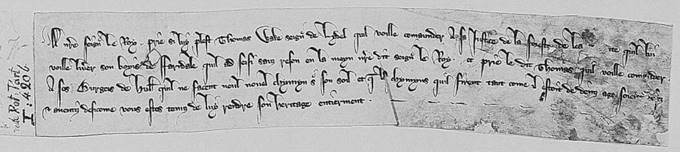
Another document relates to the same matter
of the wood of Farndale. Again it asks that the justice of the forest
should be commanded to deliver his wood of Farndale
and adds that he seized it without reason. It also asks that the
burgesses of Hull should be ordered not to build any new road on his land and
to destroy the roads they made when he (the King) was under age, as Thomas Wake
says he is entitled to his inheritance in full.
It seems that the justice of the forest was
then ordered to do justice to Thomas Wake, according to the usage and law of
the forest. However with regard to the roads, he should resort to the common
law.
Thomas Wake, lord of Lydel
addressed the King. He requested that the king command his Justice of the
Forest north of the Trent to deliver to him his wood of Farndale, which he has
seized into the king's hand for no reason. He also asks him to order the
burgesses of Hull not to build any new road on his land, and to destroy the
roads they made when he was under age, as the king is obliged to render him his
inheritance in full.
With regard to the wood, the Justice of the
Forest was to be ordered to do justice to him, according to the law and
usage of the forest.
With regard to the roads, he is to have
recourse to common law.
30 July
1347
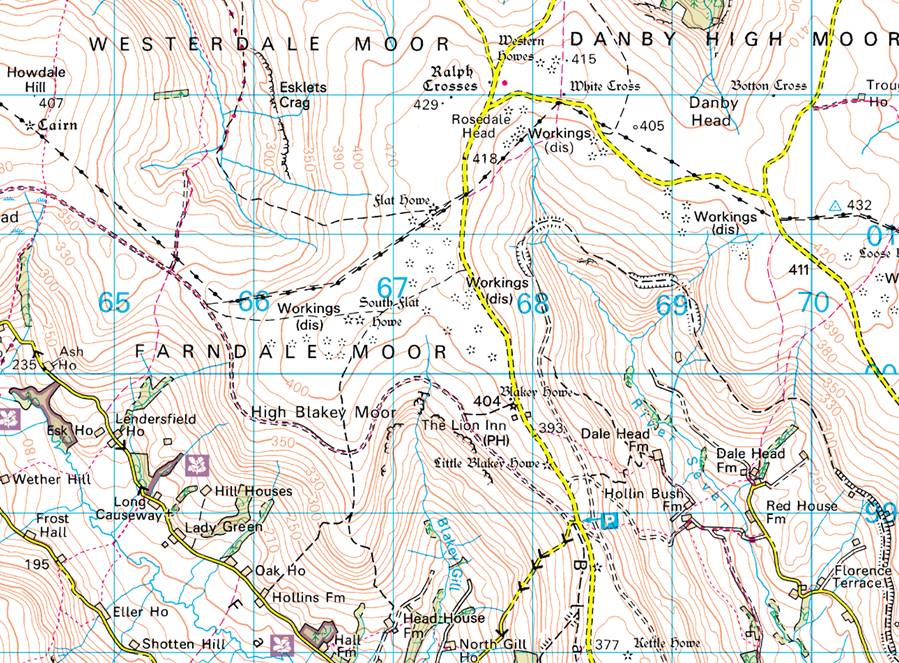
The Founding of a Priory on
Blakey Howe above Farndale
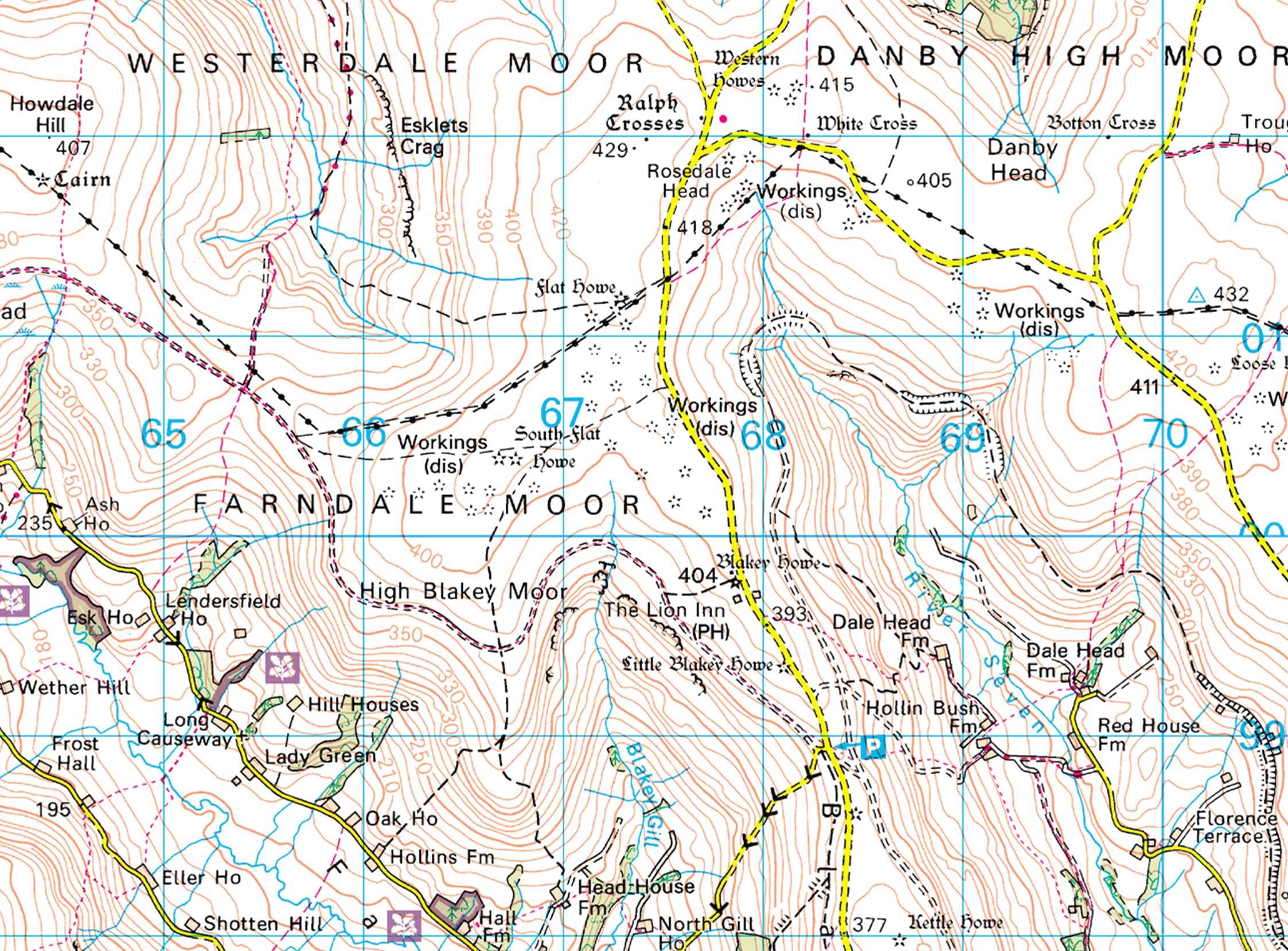
On 30 July 1347
Thomass Wake obtained licence for a grant of a toft and ten acres of land on
the moor at Blakenhowe, then part of Farndale, to the
House of the Holy Cross, to allow them to found a house of their order there,
and to build an oratory and dwelling houses (Calendar of Patent Rolls, 21 Edward III, page 370).

The
Friars of the Holy Cross, also called the Crutched Friars, were not one of the
four principal Mendicant Orders of Friars and they struggled in their bid for
recognition. They began to settle in York at the beginning of the reign of
Edward II but were disapproved of by the Archbishop of York. They were an order
of Mendicants said to have been founded by Gerrard, prior of St. Mary of
Morello at Bologna, and confirmed by Alexander III in 1169, being brought by
him into the Augustinian Rule. Initially they carried a cross fixed to a staff
and were therefore called fratres cruciferi (sometimes translated as “Crossed Friars”).
Later they wore a cross of red on their backs or chests. They appeared in
England in 1244, and similar orders existed in France and the Low Countries
from the thirteenth century.
The Crutched or
Crossed Friars, founded in 1169 were actually canons regular of a Roman
Catholic mendicant religious order. They were not monks, although they did take
vows. We have no record of whether they did build an oratory at Blakey, for
this must be the site referred to. The present enclosures there around the Lion
Inn cover about ten acres. 1348 to 1349 was the year of the Black Death, which
may have put an end to the activities of the friars in these parts. (Raymond Hayes, Farndale, 1961, unpublished, page 13).
The Crutched Friars, or Friars of the Holy Cross, were so called from
the cross they wore sewn on to their clothes. About 1312 some men entered the
North Riding in the dress of Mendicant Friars. They pretended to be members of
this order, and began to build a monastery in the park of Arnold de Percy at
Kildale. Here they celebrated Mas and offered daily prayers. In 1312 Archbishop
Greenfield forbade them to remain in his diocese because they had not received
authority to conduct services from him (The Early
History of the North Riding, William Edwards MA, 1924, page 156)
Two years later,
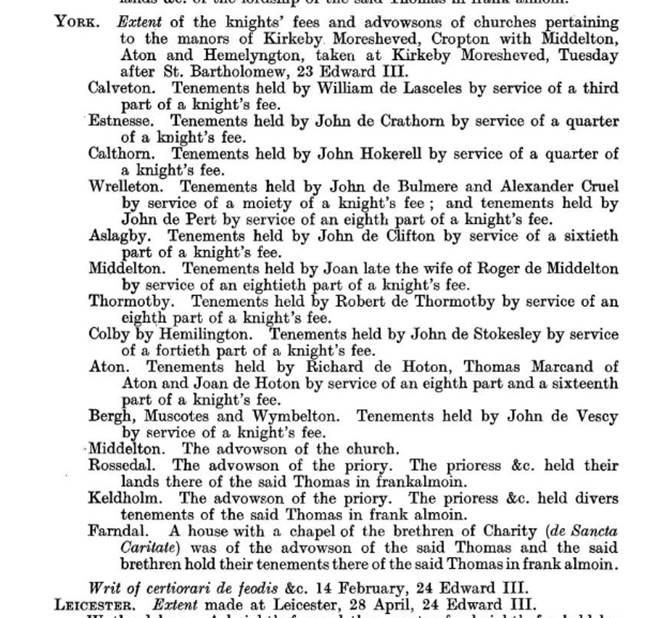
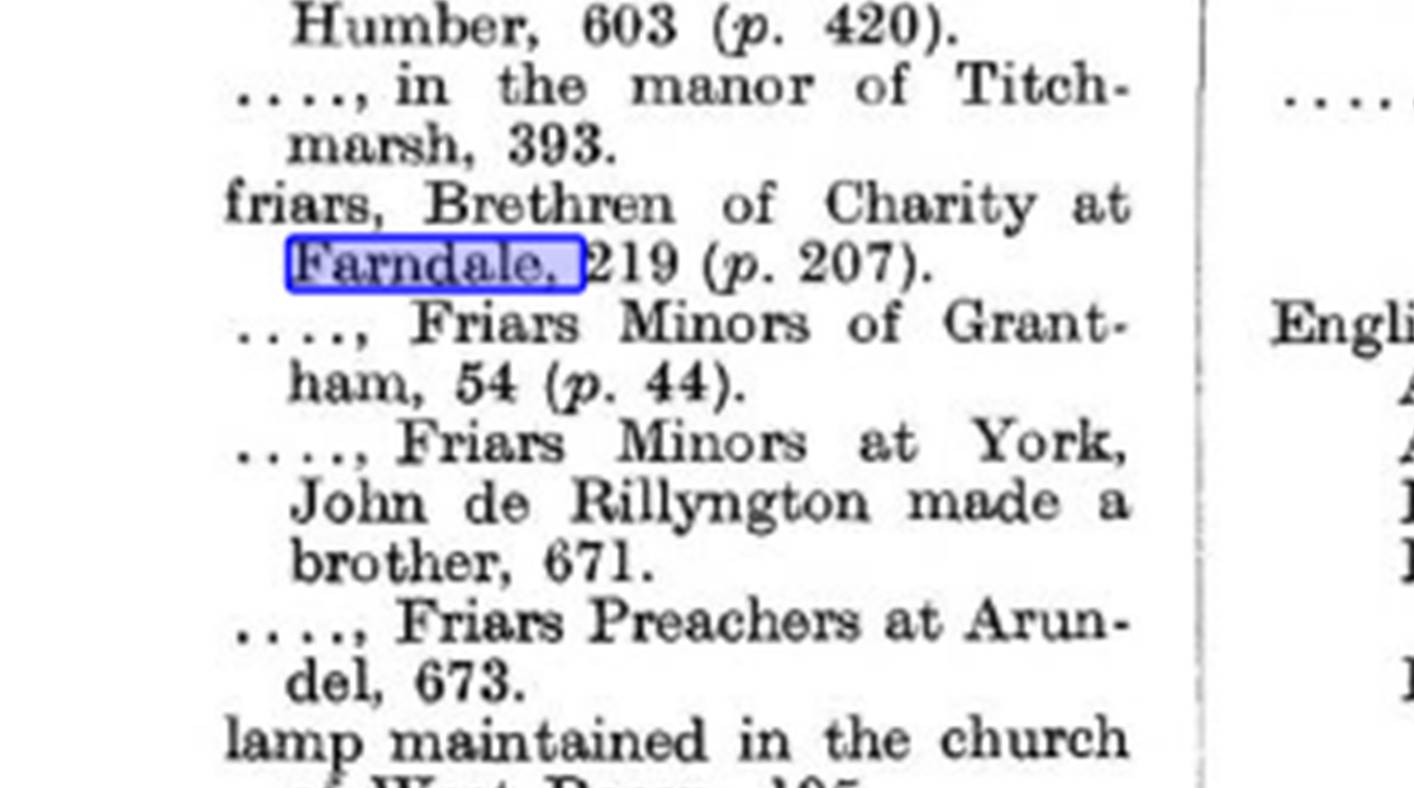
in the Inquisition Post Mortem on the death of Thomas Wake in 1349, in Farndal
a house with a chapel of the brethren of holy charity was of the avowson of the said Thomas and the said brethren
hold their tenements there of the said Thomas in frank almoin
(Calendar of Inquisitions, Volume 9, 23 Edward III,
page
207. frankalmoign was a feudal tenure whereby an ecclesiastical body
held land free of military service).

The
Brethren of Holy Charity, de Sancte Caritate, do
not appear elsewhere in the medieval records and it seems likely to have been a
reference to the same order. Religious bodies were often granted land for
building which they never in fact occupied. It was partly in an attempt to prevent abortive grants of land to the church to
avoid public burdens that Edward I passed the Statute of
Mortmain (literally property held by a ‘dead
hand’) in 1279.
Yet these
Brethren of Holy Charity do seem to have had a chapel on Blakey Ridge above
Farndale as evidenced by later records which recorded its existence (see
below). It has been surmised that the Lion Inn at Blakey might have been built
on the same site as the friars’ chapel. Since houses of friars traditionally
provided accommodation and refreshment to travellers, this seems a natural
progression.
In the year 1347, Lord Wake obtained "Licence for the
alienation of frank almoin..... to the Friars of the order of the Holy Cross, of a toft and
ten acres of land in the moor of Blackhowe in
Farndale for them to found a house of the order and build an oratory and
dwelling houses.”
The Friars of the Holy Cross (Crutched, Crouched, or Crossed
Friars) were not one of the four regular Mendicant Orders of Friars and they
had considerable difficulty in obtaining recognition. They began to settle in
York at the beginning of the reign of Edward II but, as Tanner puts it, were 'discountenanced'
by the Archbishop of York, who also closed their house in Kildale on land given
to them by Sir Arnald de Percy. This was in 1313. It is generally assumed that
the Friars never established themselves in Farndale. Tanner comments’ "what
settlement they obtained there I know not", whilst the modern writer of a
lengthy and well-documented article on the Order states bluntly- "two more
failures occurred about the same time'' of which one was the attempt to found a
house of the Order in Farndale. "Wake'', he goes on to say, ''had no doubt
to face the hostility of the Archbishop of York to his intended
beneficiaries". Thomas Wake died in 1349, two years after his grant of
land in Farndale to the Crutched Friars, and in the post mortem inquisition
into the extent of his estates there occurs this entry under the Manor of
Kirkby Moorside: "Farndale. A house with a chapel of the brethren of
Charity was of the advowson of the said Thomas, and the said brethren hold
their tenements there of the said Thomas in frank almoin".
The question naturally arises as to who were these "brethren
of Charity". Their full title is 'de Sancte Caritate'
- "of Holy Charity'. Extensive research has failed to find any reference
whatever to an Organisation or Order in medieval times known either as the
Brethren of Charity or the Brethren of Holy Charity. The huge 'Catholic
Encyclopaedia' has a lengthy article under the heading 'Charity' but no
suggestion that there was ever a medieval Order of that name; and there is no
mention of it anywhere in the extensive writings of Dom David Knowles, the
modern authority on religious orders and houses of this period. More cogently
to the point, perhaps, is that a careful ransacking of the Charters and Patent
Rolls of the period has brought to light no reference to any grant of land in
Farndale to a religious community other than the one quoted above; and in the
Middle Ages nobody alienated land in mortmain without licence from the king.
It is important to recognize that these 'Brethren of Holy Charity'
really were there in Farndale; they had a house and a chapel there. It
frequently occurred in the Middle Ages that religious bodies were granted land
for building which they never in fact occupied. Thus the licence for this grant
became 'abortive', and it was partly in an attempt to prevent this that Edward
I passed the Statute of Mortmain in 1279. This clearly was not the case in
Farndale and Chettle (H.C. Chettle in History New Series Vol. 34 page 204 et seq) is wrong when he suggests this.
Thomas Wake died childless, and the inheritance of his lands
passed to his nephew John, Earl of Kent, who survived his uncle by only three
years. It is in the post mortem inquisition on John's estates (Calendar of Inquisitions Post Mortem
Volume 10, page 50) that we learn he had the ''Advowson of the chapel
of the brethren of the Holy Trinity" in Farndale. 'Trinity' for 'Charity'
would appear to be a scribe's error, for in all succeeding inquisitions where
it is mentioned, (and this is in several up to the reign of Henry VI) the word
is uniformly given as 'Charity'.
Yet this use of the word 'Trinity' raises just a little
speculation, for in the later Middle Ages there was some confusion in peoples'
minds between the Trinitarians and the Friars of the Holy Cross. Dr. J.C. Cox
suggested (Victoria County History Berks, Volume 2, page 91) that
the two Orders could be identified. Chettle strenuously opposes this, yet he
has to admit that "'the confusion between the two Orders was old and
persistent"'.
Were, then, the Brethren of Holy Charity who had their house and
chapel in Farndale, the same people as the Crutched Friars to whom Thomas Wake
gave land in 1347? A categorical affirmative is impossible, but one suggests
that the weight of the evidence bears heavily in that direction. Where they
built their dwelling and chapel is a mystery which perhaps only the
archaeologist can now solve. The only clue - and that a very slender one - to a
possible location of the site is the phrase "in the moor of Blackhowe in Farndale". This would seem to rule out
its location in the valley and tempts one to consider the possibility of the
Lion Inn at Blakey as having been built on the site in question; but this is
pure conjecture.
(Notes on the History of Farndale
in the Middle Ages, Arthur H Whitaker,
Ryedale Historian, Volume 2, 1966, page 57)
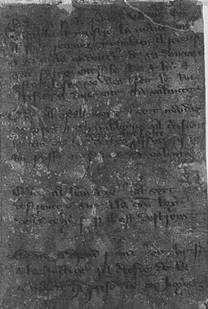
The record of
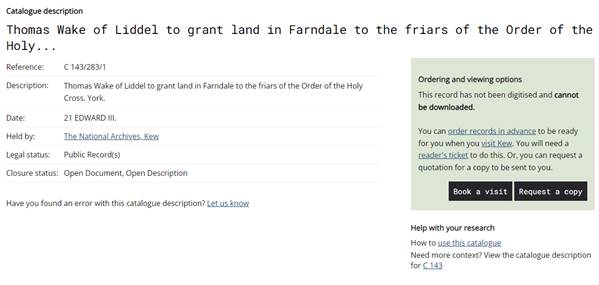
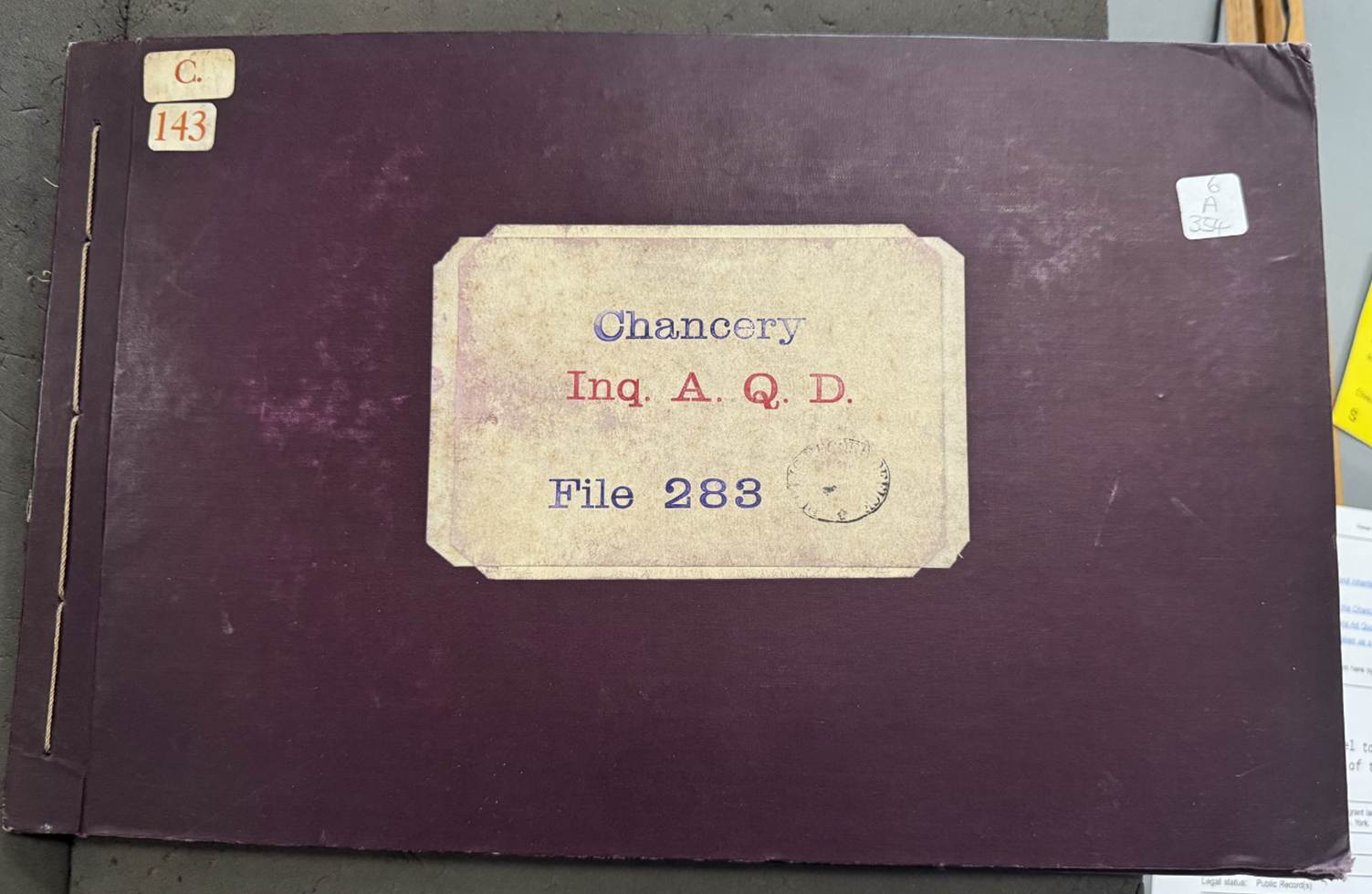
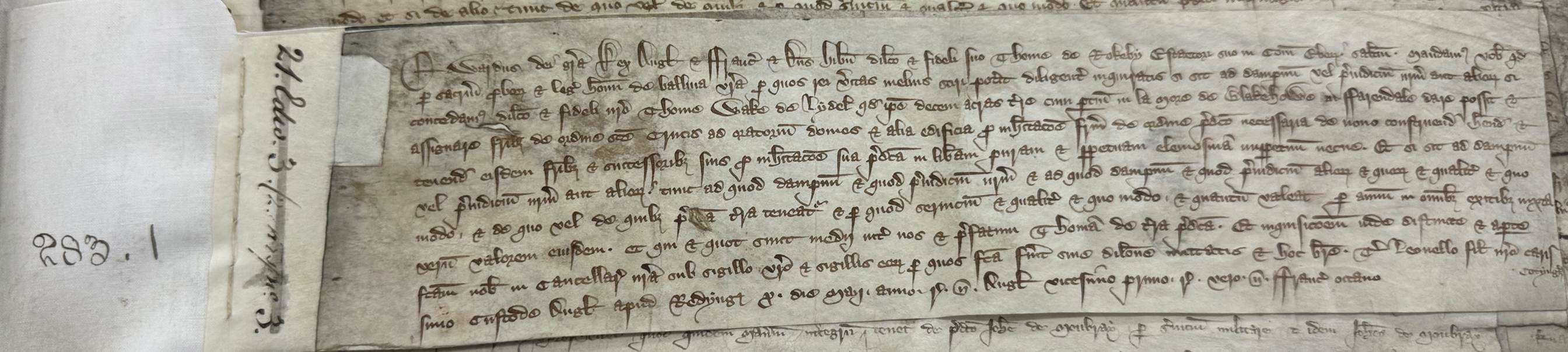
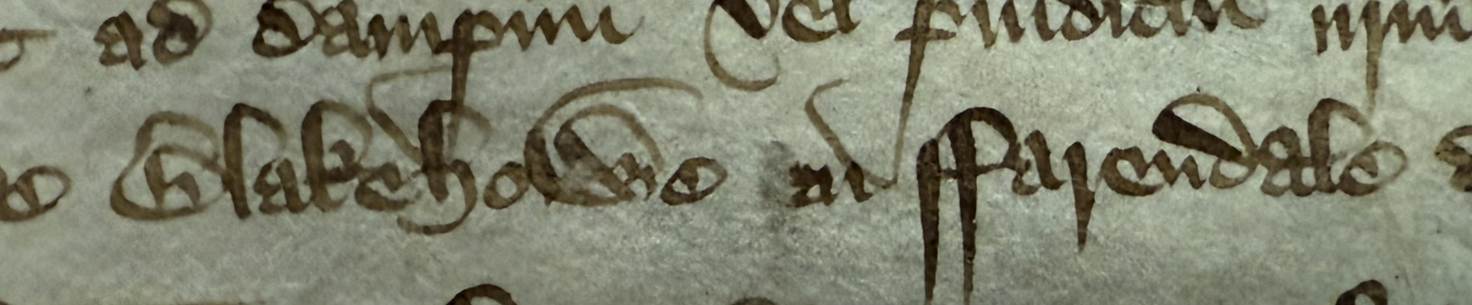
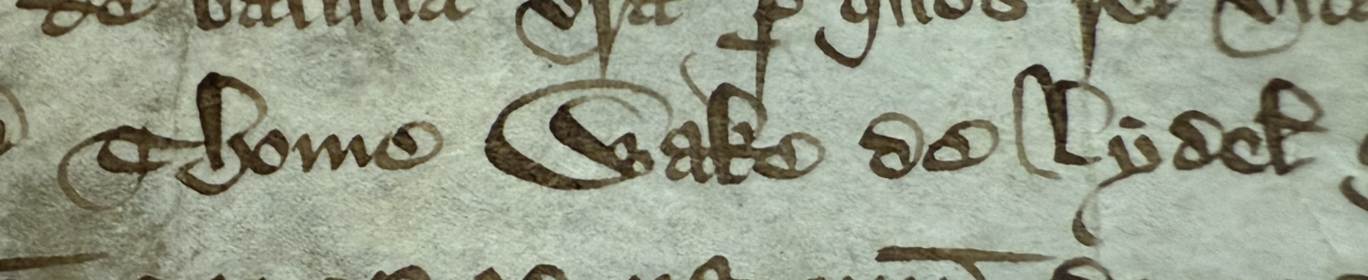
Chancery, in the form of an Inquisition Ad Quod Damnum (The National Archives C 143/283/1), referred to the grant of
land in Farndale by Thomas Wake of Liddel to the friars of the Holy Cross. It
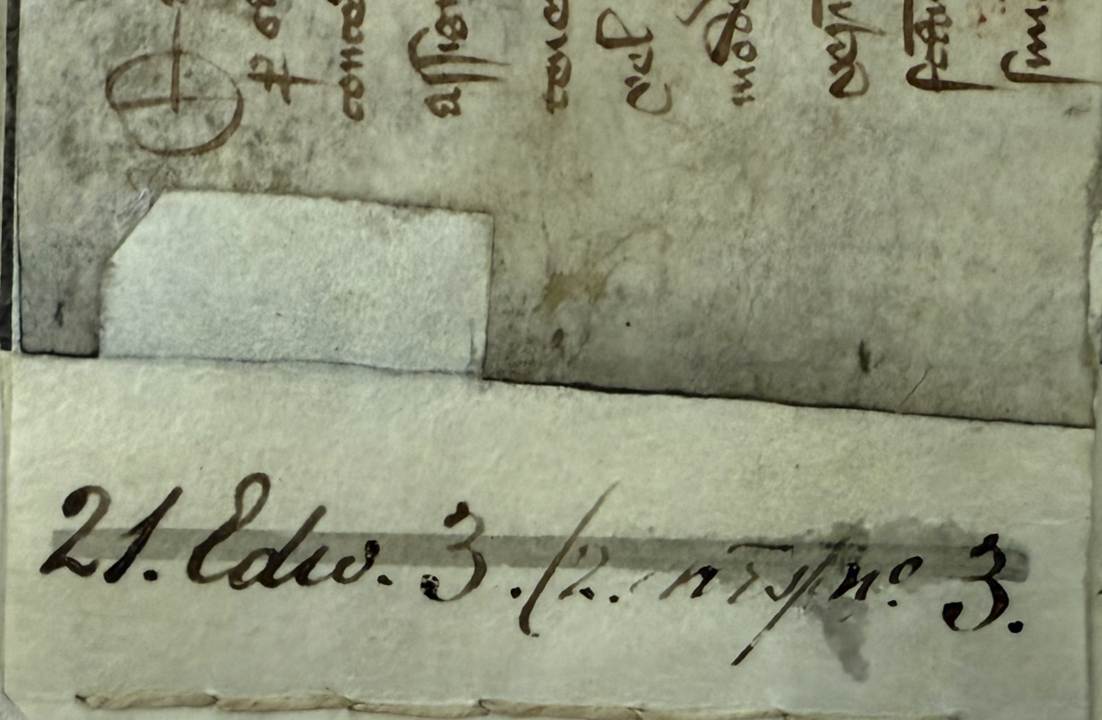
was dated the 21st regnal year of Edward
III being late 1347 to early 1348. The reference is therefore to 30 July 1347.
Exchequer
Inquisitions Ad Quod Damnum were
records between 1250 and 1461 taken as a result of applications to the Crown
for licences to alienate land, often to religious houses, or for grants of
other privileges such as the right to hold fairs or markets, or to close a
public road. The sheriff or escheator was to enquire by means of a sworn jury
whether the proposed grant or licence would be prejudicial to the interests of
the Crown or to anyone else.
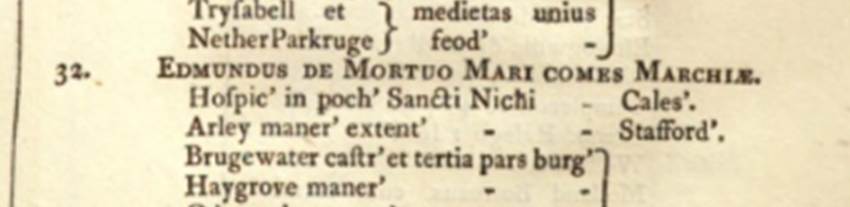
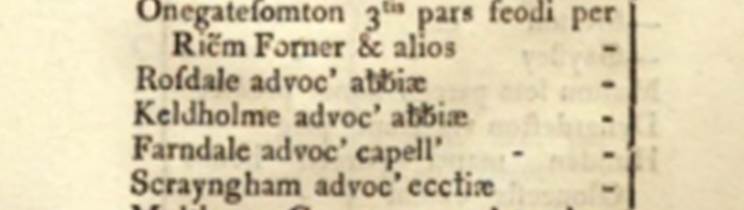
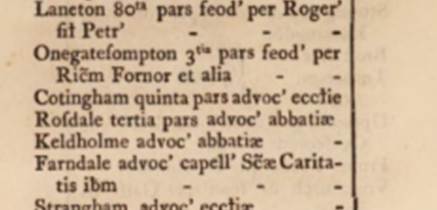
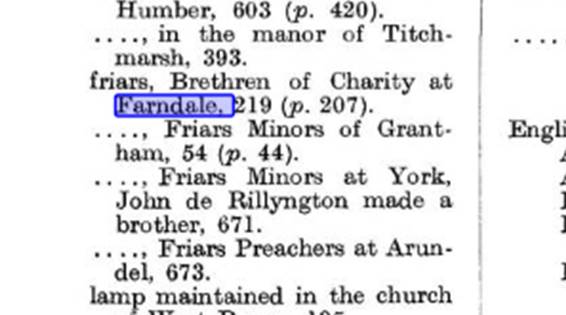
Calendar of
Inquisitions, Edward III, 1347-1352, Item 219 at page 207:
The poor of the bigger borough towns were
missioned by new brotherhoods of friars, Franciscan, Dominican and Carmelite,
each order with its own nuance of poverty, learned from preaching asceticism.
Refugee friars gained brief rural settlement at Hatterboard
outside Scarborough, at Kildale and at Farndale, but the movement was basically
urban The Dominican friars of Scarborough visited Pickering to preach the
crusade in 1291. The semi monastic order of Knights Templar was formed to
sustain pilgrimage to the Holy Land. The knights enjoyed considerable local
support. They acquired manors at Foulbridge, Allerston, Westerdale, Cold Kirby
and Lockton, along with a scattering of rents elsewhere and they made annual
collections. (The History of
Ryedale, John Rushton, 2003, page 85).
1415
The chapel of the Brethren of the Holy Charity was referred to in
1415 in the
Inquisition Post Mortem of Alice, wife of Thomas, late Earl of Kent on 21
March 1416 (Yorkshire
Inquisitions, 1416, YAS Collection).
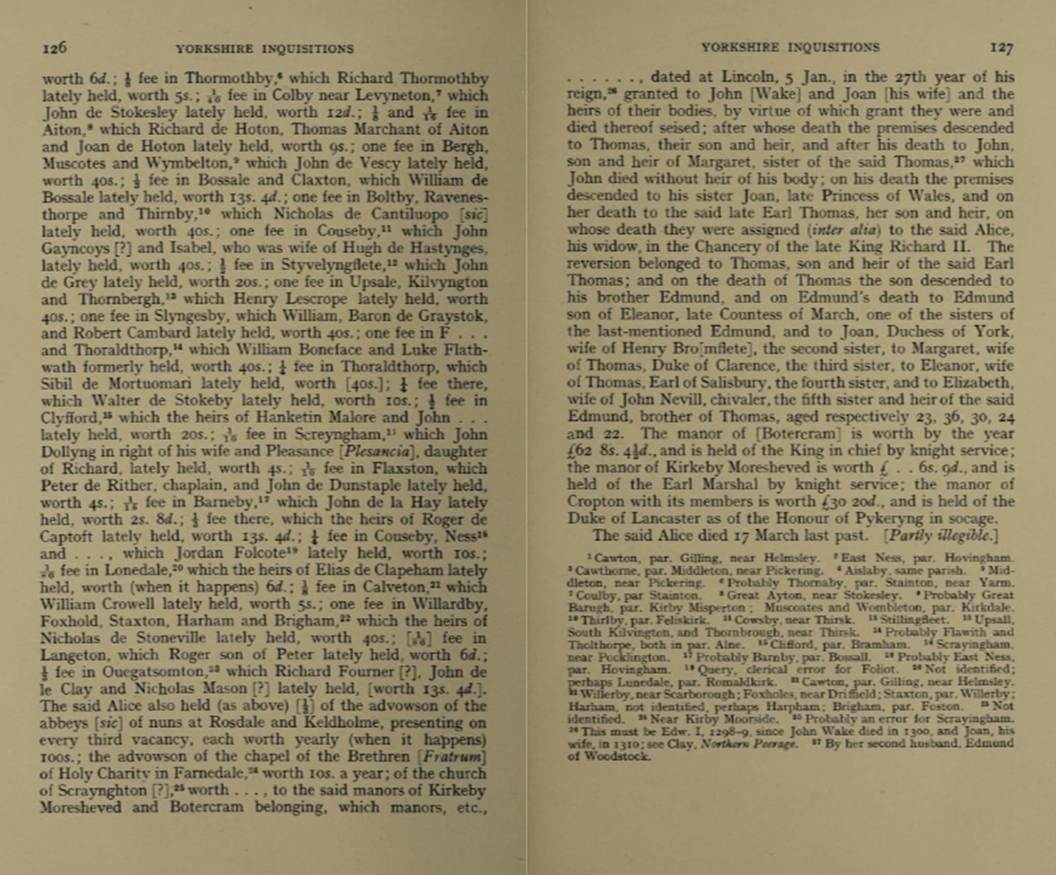
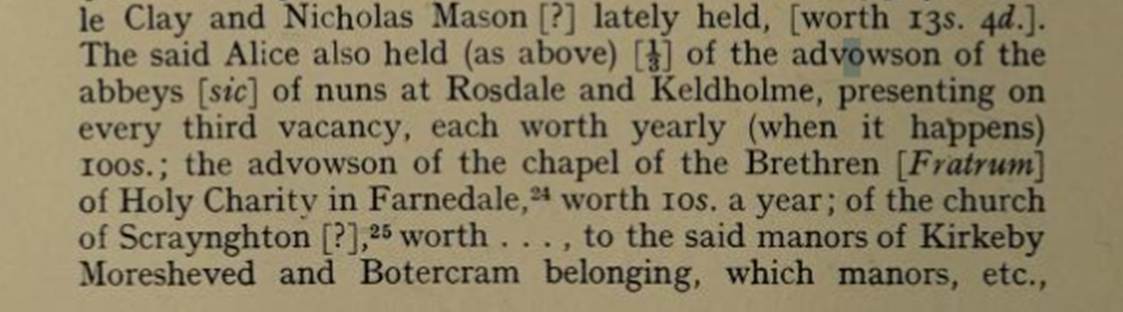
It is in the inquisition post mortem held into
the estates of Alice, late wife of Thomas late Earl of Kent, in 1415, that we
read "The said Alice also held...... the advowson of the chapel of the Brethren
of Holy Charity in Farndale, worth 10s a year.” (Notes on the History of Farndale in the Middle Ages, Arthur H Whitaker, Ryedale Historian, Volume 2, 1966, page 60).
1422
Elizabeth
nee Latimer, because she was the wife of John Neville, had an
interest in Farndale and the Chapel of the Brothers of Holy Charity there in 1
Henry VI (Calendarium inquisitionum post mortem sive escaetarum, Volume 4 (1413 to 1485), page
73).

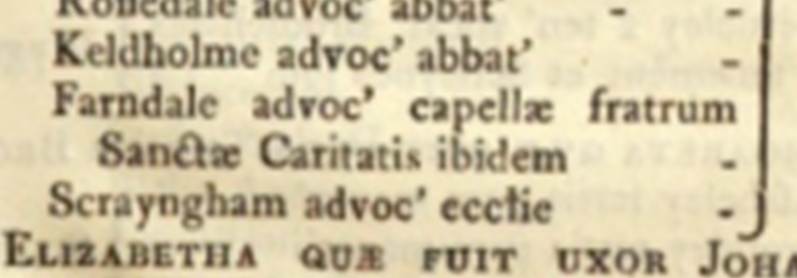
The
Chapel of the Brothers of Holy Charity therefore still existed then.
1424
The
chapel was listed again in 3 Henry VI (Calendarium inquisitionum post mortem
sive escaetarum, Volume 4 (1413 to 1485), page
89 and page 98)