Farndale Fair from 1350 and a licence to hold masses
in the chapel at Farndale, 1388
FAR00041
|
Return to the Home Page of the Farndale Family
Website |
The story of one family’s journey through two
thousand years of British History |
The 83 family lines into which the family is divided.
Meet the whole family and how the wider family is related |
Members of the historical family ordered by date of
birth |
Links to other pages with historical research and
related material |
The story of the Bakers of Highfields, the Chapmans,
and other related families |


Dates are in red.
Hyperlinks to
other pages are in dark
blue.
Headlines are in brown.
References and
citations are in turquoise.
Context and local
history are in purple.
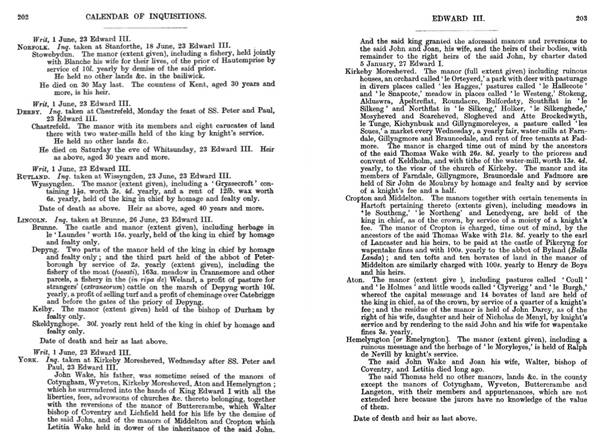
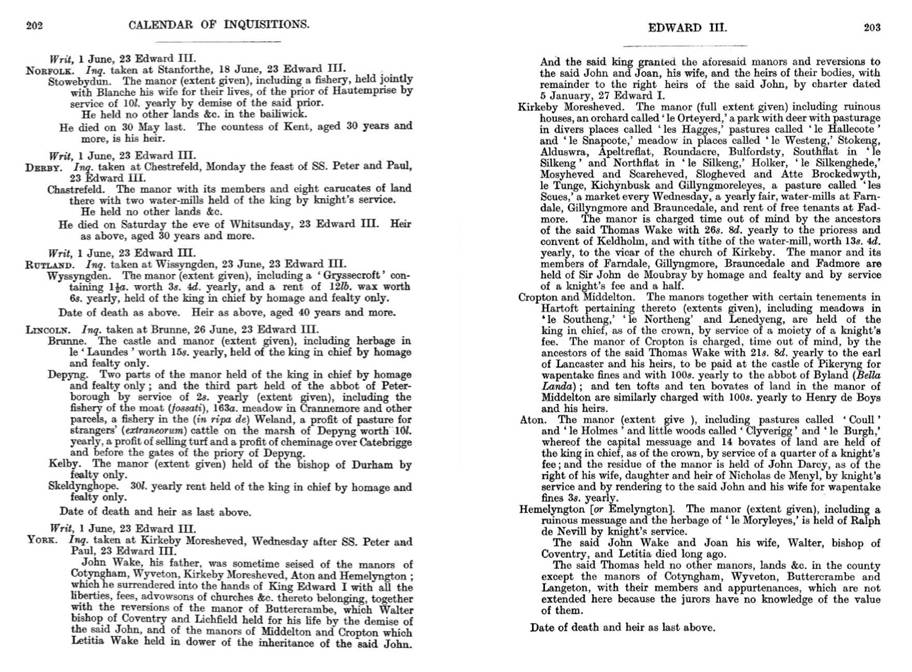
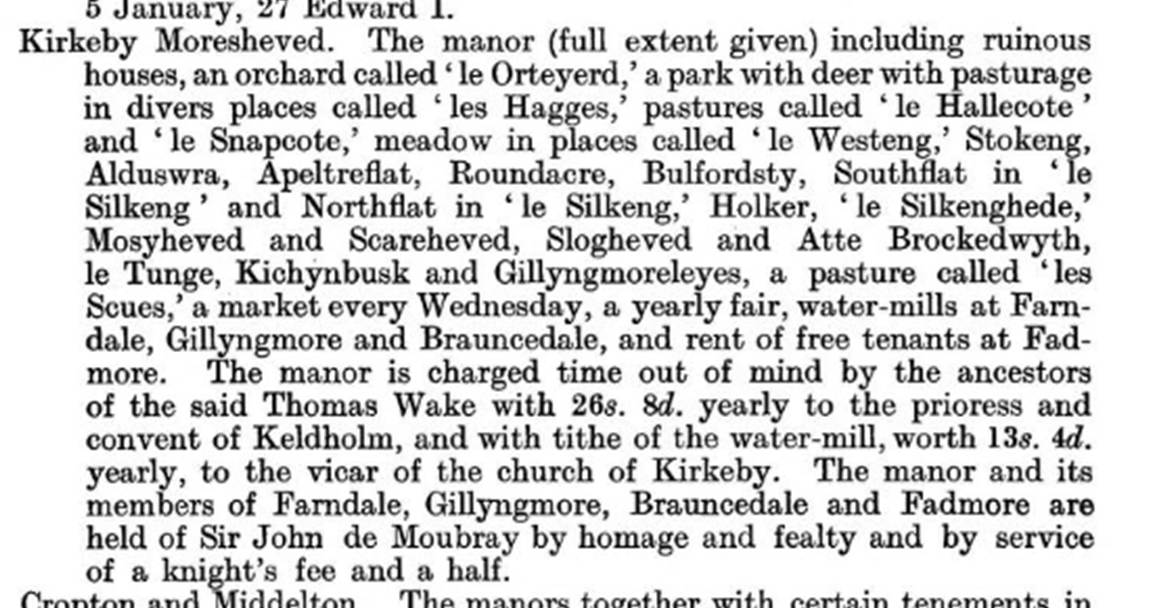
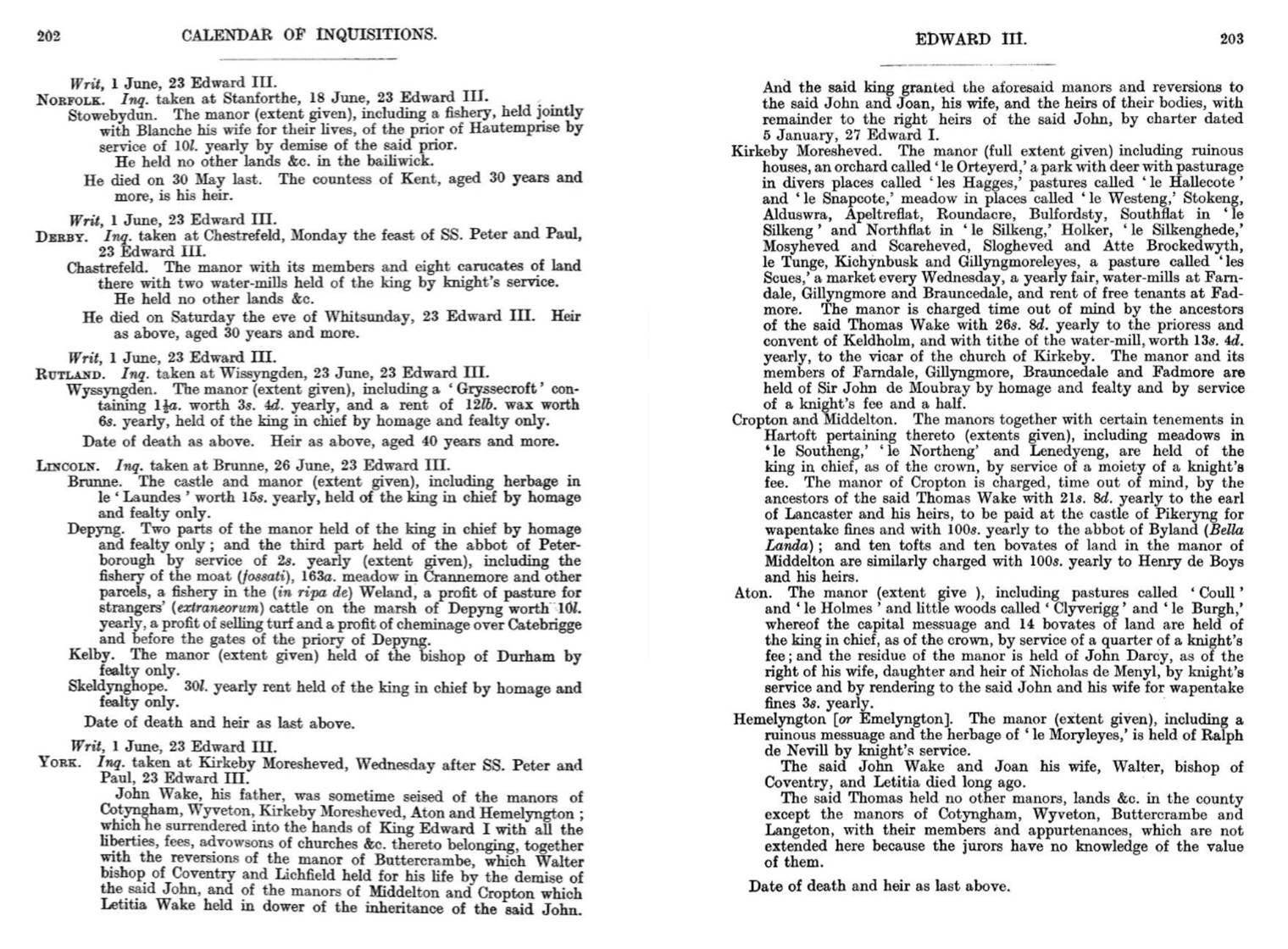
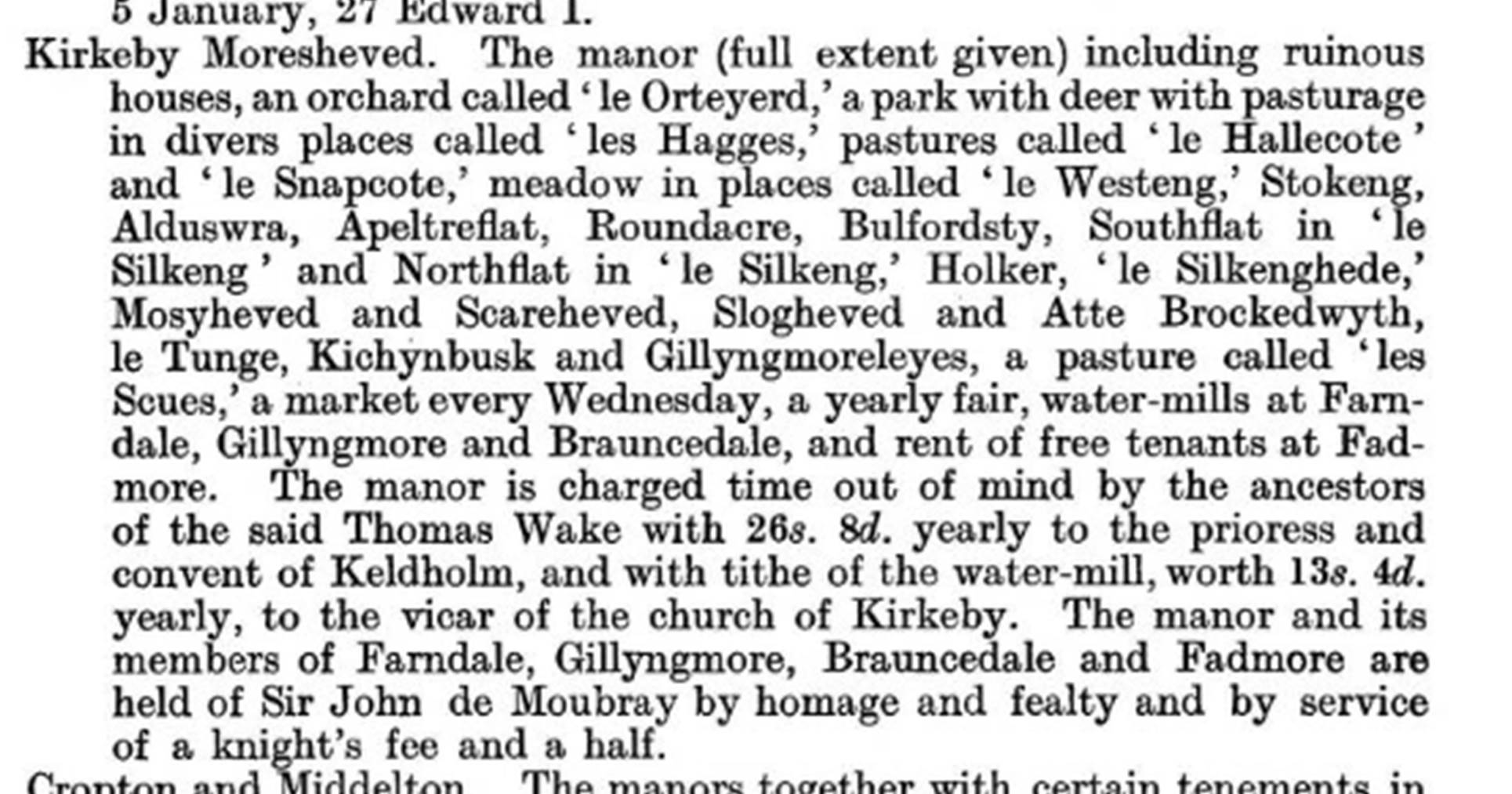
‘In 23 Ed III. Inquisition
taken at Kirby Moorseved refers to an early fair in Farndale.’ (Patent
Rolls).
23 Edward III = 25 January 1349 to 24 January 1350 - https://www.medievalgenealogy.org.uk/cal/reg11.htm
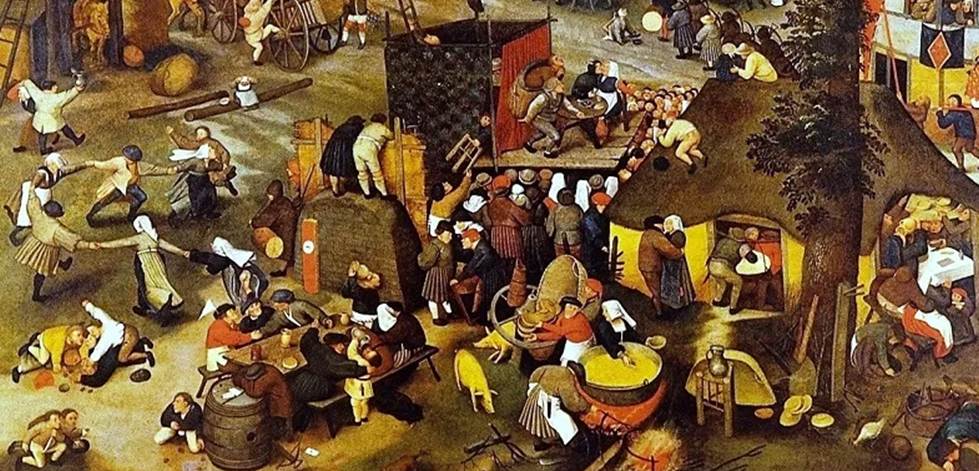
Robert
Manning in his Handling
Sin of 1303 spoke of people’s pleasures of carols, wrestling, of Summer
games in the chucrhyard, interludes, singing, piping, idle plays and japes,
‘making fool countenance’, jugglers and deeds of strength. Dancing bears were
protrayed in the stained glass of York Minster and many minstrels in the great
church at Bevelery. There were fifty two Sundays, a great many holy days, and the
slack seasons of the year. This was a young society and much that was done
would be thought of as children’s games. (The
History of Ryedale, John Rushton, 2003, page 123).
Handlyng
Synne by Robert Manning of Brunne is a Middle English verse
devotional work, intended for the use of both learned and unlearned men,
dealing with the theory and practice of morality, and illustrating this doctrine
with stories drawn from ordinary life. It was begun in the year 1303. It is
valued today for its simple and entertaining style, and for the light it throws
on English life in the Middle Ages
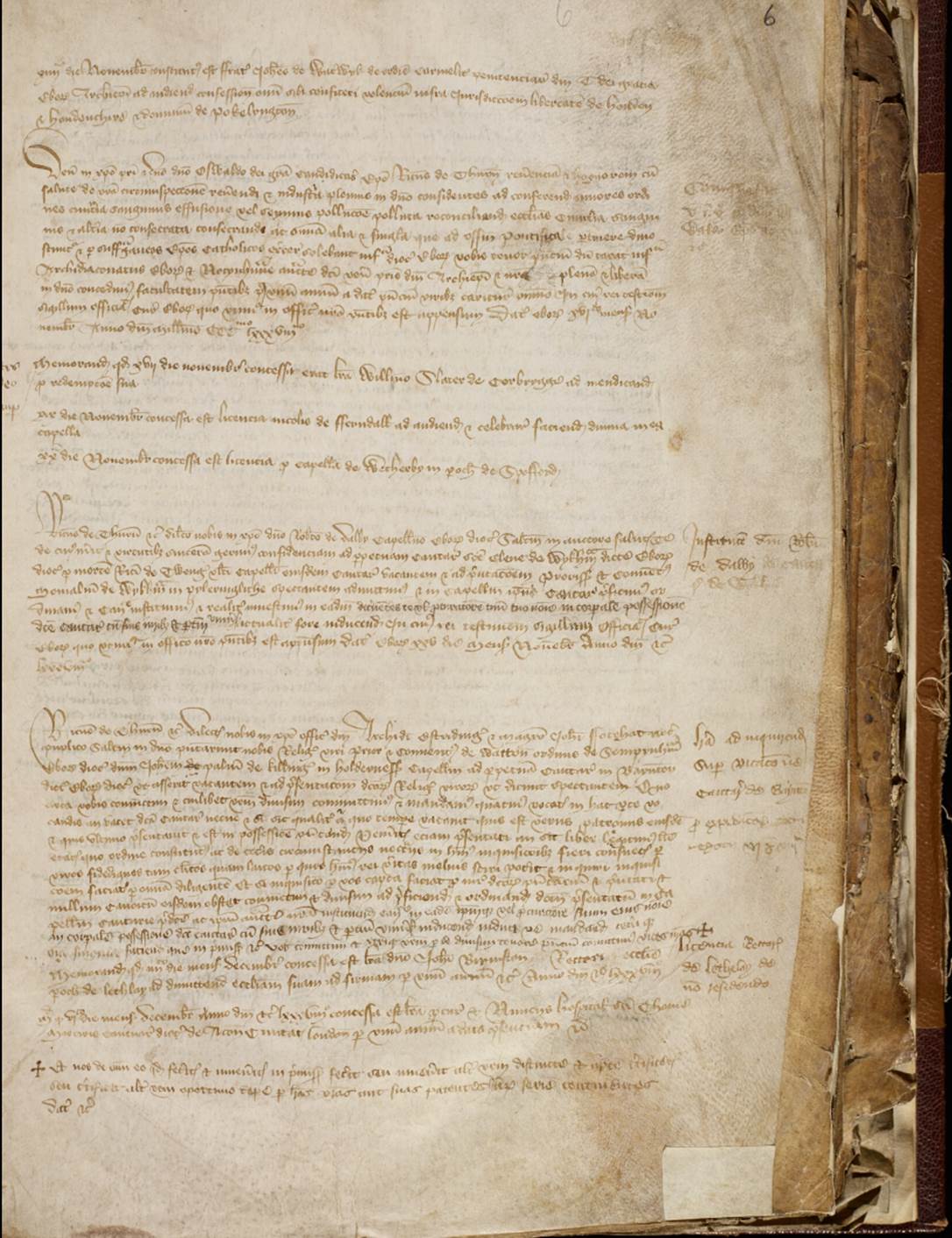
19 November 1388. Licence for the inhabitants of
Farndale (Ferndall) to have masses celebrated in the chapel of Farndale (the York Archbishop Registers, Register 14 f.6 (recto) entry
4).
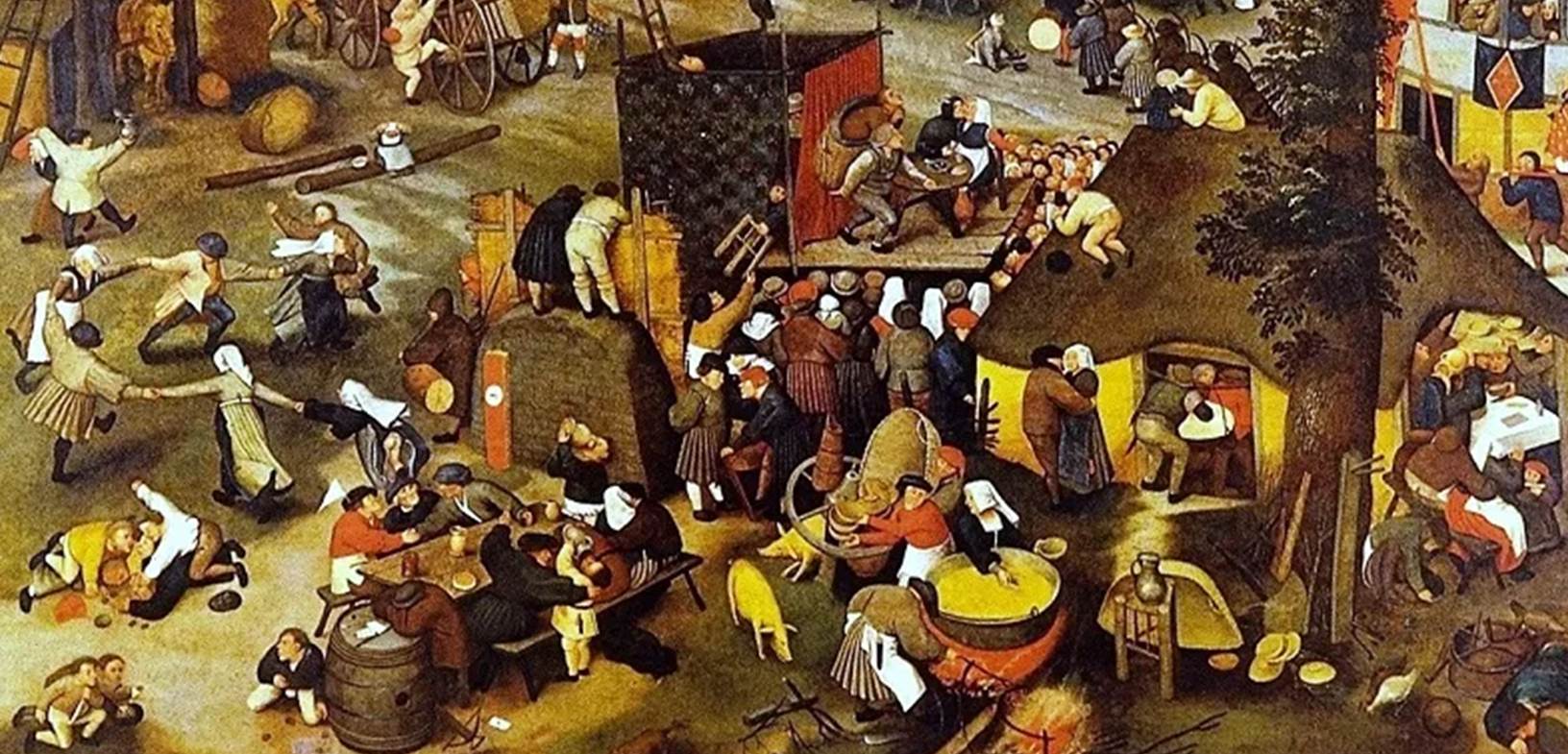
The Medieval Fair
The medieval fair 'was an institution of political, religious, legal, judicial
and above all, commercial importance. It was the scene of intense business
activity on both a local and international scale. It was here that the farmer
came to buy and sell his corn and cattle; it was here that the Italian
merchants came to negotiate for the wool they were to buy.
Buyers and sellers gathered in a place and at a time ordained by
charter or statute or by ancient custom. Usually a
fair would be a great spectacle organised on a large scale once or twice a year
on an important religious festival. A market, on the other hand, was usually
smaller and held more frequently, once or twice a week, for the purchase and
sale of provisions or livestock, publicly. A market might serve a more
restricted area though in certain specialised goods it could have a wider
influence. In most settlements, especially large towns, there were different
markets during the week concentrating on sheep, cattle, dairy products, etc.
Frequently, in medieval times, places having a market or markets were also the
locations of fairs, often as in the instance of Scarborough, of very long
duration. They were national, even international events.
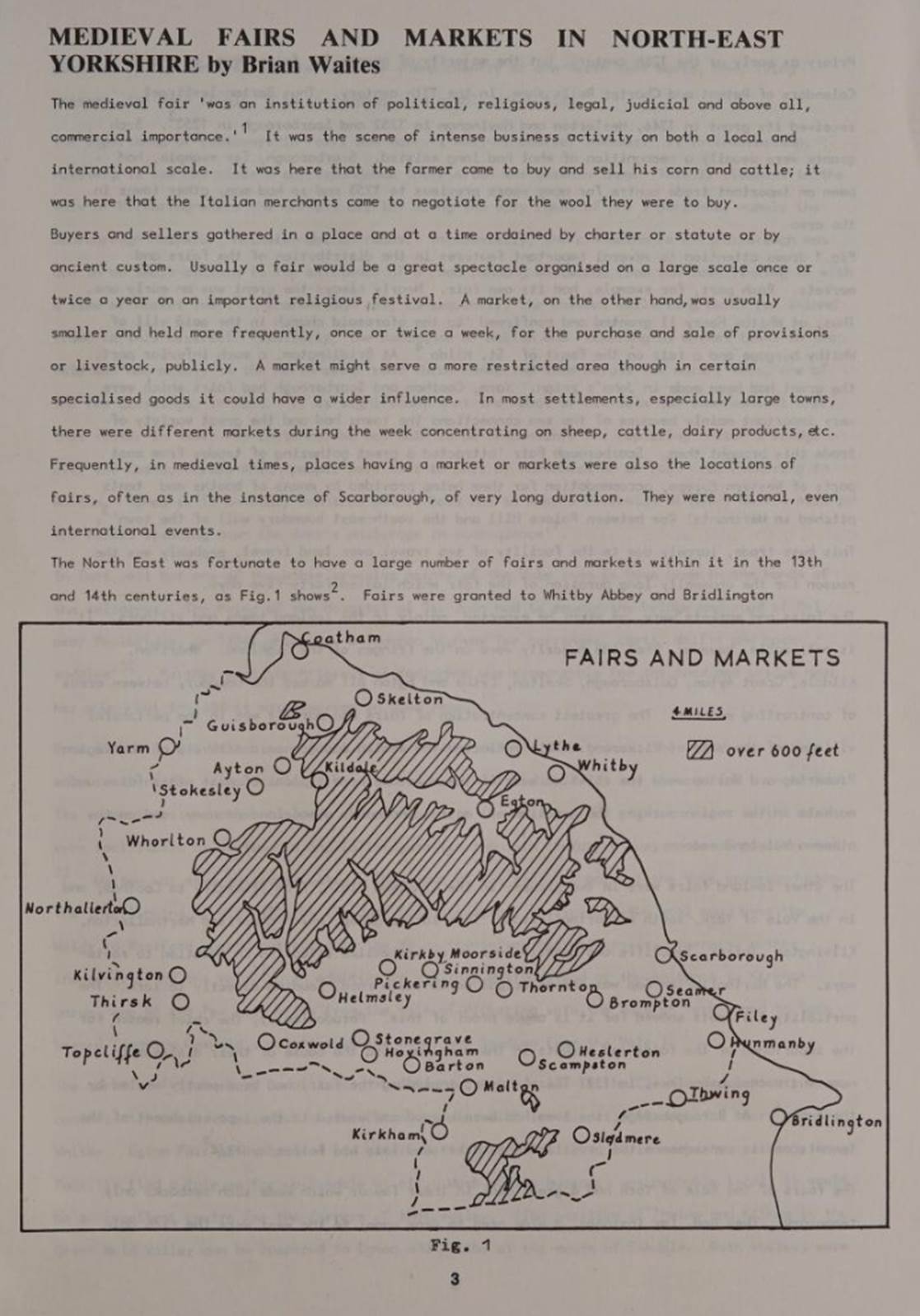
The North East was fortunate to have a large number of fairs and markets within it in the 13th
and 14th centuries.
The importance of routeways to fairs and markets was, of course,
obvious. It is interesting, however, to see how close a correspondence there often
was between them. This is clearest in the Vale of Pickering where the markets
all lay along the only roads of any importance, namely the
Scarborough-Helmsley, Helmsley-Malton roads. Incidentally, the predominance of
Scarborough was due in no small measure to the existence of a road running
westwards from the town linking it with a line of market tow Scarborough was,
consequently, the natural collecting point for inland trade in this district. Similarly,
the dominance of Malton and Pickering as market towns in the Vale was due
mainly to the north-south road which connected them across the marshy Vale, one
of the few crossings, in fact. It is significant that the Abbot of Rievaulx had
some control over this route; in 1334, for instance, he was said to be
responsible for repairing 'Friar's Bridge over the Costa, across which people
were wont to pass by horseback or on foot from Pickering to Malton. Since it is
so badly repaired people have had to make a diversion of about half a mile in
the forest treading down the deer's pasturage in consequence’. In fact, all but
one of the other crossing points of the Vale seem to have been in the hands of
the religious. The Prior of the Hospital of St. John had to repair the bridge
and road of Pul, near Foulbridge, in 1334, which was
a 'common highway for carriages, carts, drifts and pack-saddles.
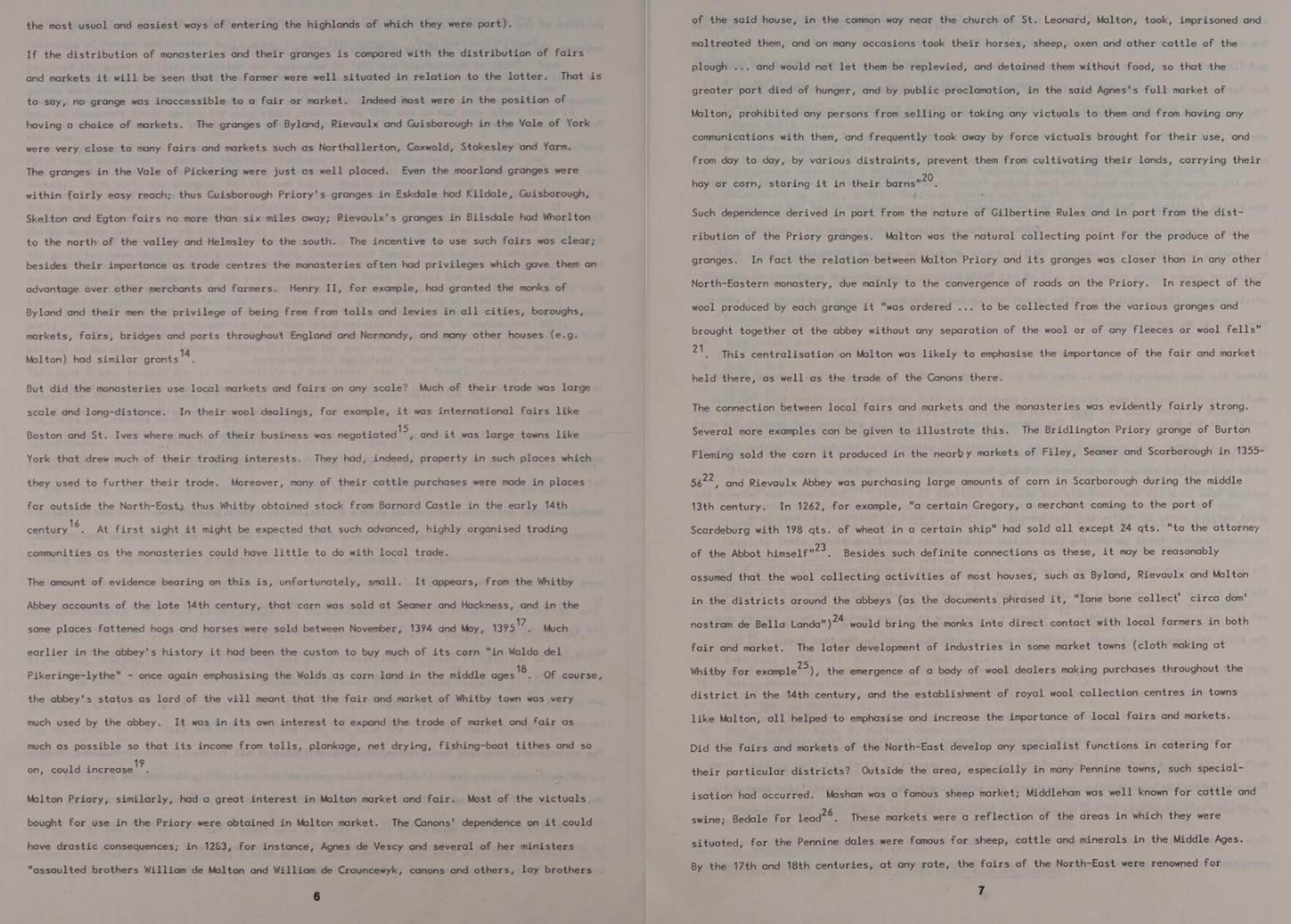
What evidence there is suggests that the medieval fairs and markets in
the North-East were important centres of economic activity, frequented by both
lay and monastic farmers. The distribution of fairs and markets shows in detail
that their collective hinterland reached to all parts of the area, even to the
remote moorlands. Indeed, in the Vale of Pickering and Cleveland such centres
were exceptionally well-placed not only in respect of local but also regional trade.
This was amplified by particular emphasis on the marketing of one or two
specialised commodities which were characteristic of the neighbourhood in which
the markets and fairs were located.
(Medieval Fairs and Markets in Northeast
Yorkshire, Bryan Waltes, Ryedale Historian,
Volume 11, 1982, page 3).
The Farndale Show
The tradition of a yearly fair continues to this day with the Farndale
Show.
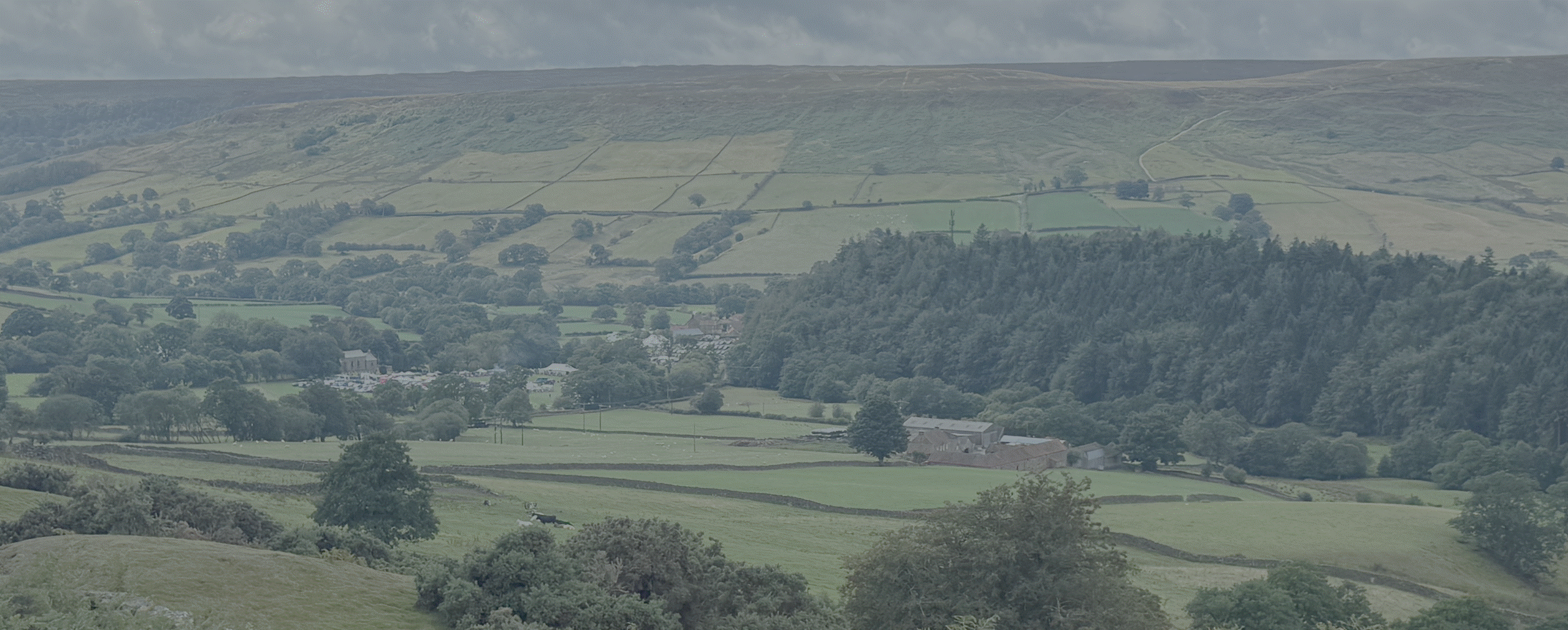
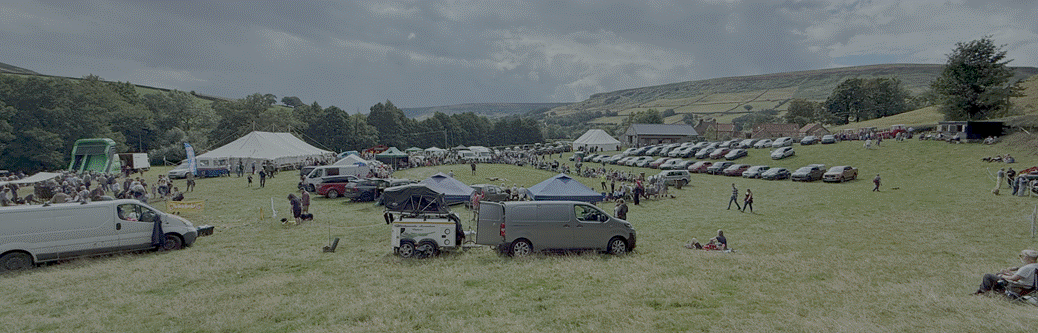
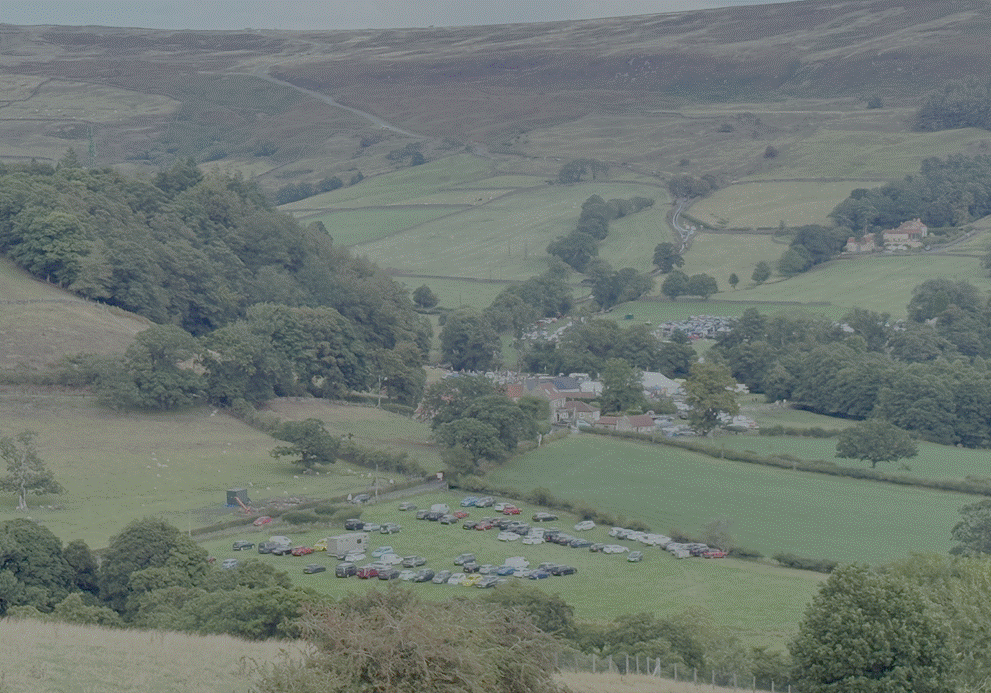
Farndale
Show 2026 (by the author)