Davy Farndale
c 1390 to c
1450
FAR00044A
|
Return to the Home Page of the Farndale Family
Website |
The story of one family’s journey through two
thousand years of British History |
The 83 family lines into which the family is divided.
Meet the whole family and how the wider family is related |
Members of the historical family ordered by date of
birth |
Links to other pages with historical research and
related material |
The story of the Bakers of Highfields, the Chapmans,
and other related families |
Dates are in red.
Hyperlinks to
other pages are in dark
blue.
Headlines are in brown.
References and
citations are in turquoise.
Context and local
history are in purple.
|
|
Tales of
archers and men at arms who fought with Richard II, Henry IV and Henry V and
an observation post in the home of the Nevilles and Richard III from which to
view the Wars of the Roses |
Davy Farndale may have been a son of John Farndale (FAR00048A), a veteran
soldier of the Scottish Wars in the 1380s and later a freeman butcher in York. Davy
may have been born in or about 1390.
The evidence for the York Line of the Farndale family, which
supports Davy’s family linkage, is explored in another
webpage.
In the medieval period, York was one of the most
important cities in England, second only to London in size and significance. It
was home to an archbishop, and pilgrims came from far and wide to visit the
magnificent Minster and the shrine of St William. There were also several
communities of monks who made York their home, living and working within the
city. The city’s guilds, grouping of craftsmen, traders, and industry leaders,
were a central part of life. York
was also an important place of power. It had a royal castle, and parliament met
in the city several times.
The evidence for
the York Line of the Farndale family, which supports Davy’s family linkage, is
explored in another webpage.
The reign of Henry V (1413 to 1422)
The Harfleur and Agincourt
Campaign of 1415
1415
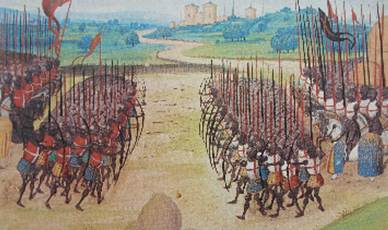
In August 1415, Henry V's invasion force, consisting
of thousands of men and horses, crossed the English Channel. They landed
unopposed on the Normandy coast and began their campaign by besieging the town
of Harfleur.
After taking Harfleur, Henry's army marched towards
Calais, but they were intercepted by a much larger French army near Agincourt.
Despite being outnumbered, the English, particularly their archers, achieved a
stunning victory.
The records of Davy do not appear until after the Agincourt
campaign, but it is possible that he was part of that famous English army too.
1417
The 1417 Normandy campaign
and the garrison of Harfleur
The victorious conclusion of Agincourt, from the
English viewpoint, was only the first step in the campaign to recover the
French possessions that Henry felt belonged to the English crown. Agincourt
also held out the promise that Henry's pretensions to the French throne might
be realized. Henry V returned to France in 1417 to establish his reconquest of
Normandy.
Henry V’s second invasion of France was delayed from
its original target of May 1417. Harfleur was the target of a naval blockade by
French forces. This blockade was an attempt to regain control of the
strategically important town, which was crucial for English operations in
France. The English, under the command of the Duke of Bedford, successfully
broke the blockade in a naval battle, securing Harfleur and preventing its loss.
On 1 August Henry and his army land in Normandy,
about twenty miles south of Harfleur, on the opposite, southern side of the
Seine. The town closest to their landing point is called Touques,
and at the first sight of the English, its citizens surrender without a fight. (Dan Jones, Henry V, 2024, page 308).
David
Farindon was a man at arms garrisoned at Harfleur under the command of
Thomas Beaufort in 1417 (Muster Roll, the National
Archive E101/48/17). This, and the records which follow, may have been
Davy Farndale, who may have been associated with the York Farndales. There was
also a Richard Farndon (see FAR00044)
garrisoned at Harfleur at the same
time.
It is possible that Davy had been at the siege in 1415 and had
stayed there, as part of the garrison. If so, he may have been inspired by
Henry’s speech, if there was such a speech as Shakespeare later wrote, at the
gates of Harfleur in 1415.
On the other hand, he may have joined the post Agincourt campaign
in 1417. After the losses sustained during the 1415 campaign, soldiers were
called upon to fill gaps in the ranks, and to expand the army for Henry V’s
further campaigns.
1418
David
Faryndon was a man at arms (foot) still garrisoned at Harfleur under
Thomas Beaufort in 1418 (Muster Roll, the National
Archives, E101/48/19).
1419
The
victory at Agincourt had inspired and boosted English morale, while it caused a
heavy blow to the French as it further aided the English in their conquest of
Normandy and much of northern France by 1419. The French, especially the
nobility, who by this stage were weakened and exhausted by the disaster, began
quarrelling and fighting among themselves. This quarrelling also led to a
division in the French aristocracy and caused a rift in the French royal
family, leading to infighting. In the Burgundian-Armagnac rivalry, the
Burgundian John the Fearless was murdered by a joint plot by the Armagnacs and
the dauphin, and a monk later commented that it was through the hole in his
skull that the English entered the noble Kingdom of France.
With John the Fearless dead, Henry remarked that I
shall now surpass all my ambitions.
By October 1419, Henry’s army had secured bridges across
the Seine close to Paris, giving him control of access into the city.
1420
By 1420, a treaty was signed between Henry V and King
Charles VI of France, known as the Treaty of Troyes, which acknowledged Henry
as regent and heir to the French throne and also married Henry to Charles's
daughter Catherine of Valois. Like Henry’s father, the French heir apparent,
the dauphin, was written out of his inheritance.
The Treaty of Troyes, signed on 21 May 1420, in Troyes, was a crucial
agreement during the Hundred Years' War. It stipulated that Henry V of England
would inherit the French throne upon the death of King Charles VI of France,
thus uniting the two crowns under a single ruler. This treaty aimed to resolve
the conflict by creating a double monarchy where England and France would be
ruled by the same king, Henry V and his heirs.
… the dauphin and the Armagnacs have been
disinherited and abused in the terms of the Treaty of Troyes. But they have not
been written out of existence. They still hold half of France, which as regent
of the kingdom, Henry now has a responsibility to bring back to obedience. (Dan
Jones, Henry V, 2024, page 352).
Following Henry’s marriage, the summer at first
proceeds in a straightforward fashion, as his army sweeps through the
countryside, smoking dauphinists from their dens (Dan
Jones, Henry V, 2024, page 353).
By June 1420 the town of Sens had surrendered. The
army then took Montereau.
There followed the siege of Melun between July and
November 1420. In 1420 the town of Melun surrendered to King Henry V. The siege
had rumbled on since June and had been fairly dramatic at times, with close
combat taking place literally beneath the walls as the besiegers and the
garrison dug mines and countermines in an attempt to bring the siege to an end.
James I of Scotland was present at the siege, brought to France in 1420 to be
Henry's trump card against the Scots serving on the Continent.
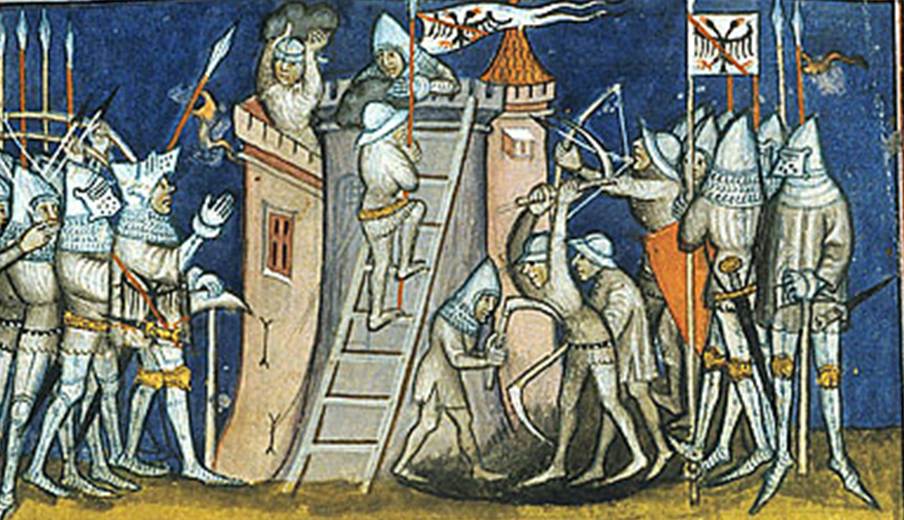
Siege of Melun from a late 14th century
manuscript
By 1 December 1420, Henry V entered Paris along with
Charles VI and the royal entourage. He returned to England in February 1421.
1421
The 1421 Campaign in France
In early Spring 1421, Henry’s brother Thomas, the
Duke of Clarence, who had been left to command the Anglo-Burgundian region of
France, had decided that it was time for a little chevauchee action, and took
about half the English troops into dauphinist Anjou.
He turned back at Angers, which he found too well defended, but soon
encountered a large force of French and Scottish troops.
The Battle of Bauge saw the defeat of the Duke of Clarence and his
English army by the Scots and French army of the Dauphin of France. The battle
took place on 22 March 1421. The Duke of Clarence, King Henry V’s younger
brother commanded the English army. The Earl of Buchan commanded the
Franco-Scottish army. The English army numbered around 4,000 men, of whom only
around 2,500 men took part in the battle. The Franco-Scottish army comprised
5,000 to 6,000 men.
After the English defeat at Bauge, Henry returned to
France, and reinforced his army. He landed at Calais on 11 June 1421. He
knows he will be in France for at least six months, since this is the length of
the contracts he has struck with the troops he brings (Dan Jones, Henry V, 2024, page 376).
His first action was to relieve Chartres, which was
being besieged by the dauphin. After a brief visit to Paris, his army then
mustered at Mantes on 9 July 1421. Henry then led his army to the dauphinist castle at Dreux, to the west of Paris. The King
besieged and captured Dreux quite easily, and then went south, capturing Vendôme and Beaugency before
marching on Orléans to draw out the dauphin’s army.
With the autumn approaching he moved north again in
late September to Meaux with more than 20,000 soldiers, a strategically
important dauphinist stronghold, which he sieged. The
siege was long and costly, with disease significantly impacting his forces. During
all his time in France, Henry has seldom had such thin resources, nor faced
such stubborn opponents, as he does at the siege of Meaux (Dan Jones, Henry V, 2024, page 378). The French garrison was commanded by a
singularly vicious lord known as the bastard of Vaurus.
The siege of Meaux was fought from October 1421 to
May 1422. Henry and his fellow commanders, the earls of March and Warwick
and Thomas Beaufort, duke of Exeter, are better versed in siege craft than
almost any men alive. They seize the suburbs of Meaux and blockade the city by
land and water. They dig trenches and mines and set up cannon and catapults.
They detach troops to go out into the surrounding area and reduce other
outposts of enemy troops. (Dan
Jones, Henry V, 2024, page 378).
Davy Farendon, Faryndon or Farndon was a man of arms in the Standing Force in
France under Richard Woodville in 1421 (Muster
Rolls, The National Archives, E101/49/37, m1, m2, m4, m5).
Richard Woodville (later the First Lord Rivers and
father of Elizabeth Woodville later wife of the Yorkist Edward IV), under whom
Richard Farendon served, had been granted various
domains, lordships and bailiwicks in Normandy in 1419 and 1420, culminating in
1421 with appointment as Seneschal of the province of Normandy.
Richard Beauchamp, 13th Earl of Warwick held high
command at sieges of French towns between 1420 and 1422, at the sieges of Melun
in 1420, and of Mantes, to the west of Paris, in 1421-22. The more significant
siege was of Meaux to the east of Paris.
Many allies of King Henry were there to help him in
the siege. Arthur III, Duke of Brittany, recently released from an English
prison, came there to swear allegiance to the King of England and serve with
his Breton troops. Duke Philip III of Burgundy was also there, but many of his
men were fighting elsewhere.
Casualties began to mount in the English army,
including John Clifford, 7th Baron de Clifford who had been at the siege of
Harfleur, the Battle of Agincourt, and received the surrender of Cherbourg.
Also killed in the siege was 17-year-old John Cornwall, only son of famous
nobleman John Cornwall, 1st Baron Fanhope. He died
next to his father, who witnessed his son’s head being blown off by a
gun-stone.
The English also began to fall sick rather early
into the siege, and it is estimated that one sixteenth of the besiegers died
from dysentery and smallpox while thousands died thanks to the courageous
defence of the men-at-arms inside the city.
On 6 December 1421 back in London, Henry and
Catherine’s son is born, the future Henry VI.
As the siege continued, Henry himself grew sick,
although he refused to leave until the siege was finished. Good news reached
him from England that on 6 December, Queen Catherine had borne him a son and
heir at Windsor.
1422
On 9 May 1422, the town of Meaux surrendered,
although the garrison held out. Under continued bombardment, the garrison gave
in as well on 10 May, following a siege of seven months. The Bastard of Vaurus was decapitated, as was a trumpeter named Orace, who
had once mocked Henry. John Fortescue was then installed as English captain of
Meaux Castle.
It seems likely that Davy took part in some or all of these siege
campaigns around Paris in 1421 and 1422.
The summer is blisteringly hot and disease is
everywhere. An epidemic of smallpox in Paris infects more children than anyone
can count. (Dan Jones, Henry V,
2024, page 385) At Meaux Henry had
already been suffering some of the symptoms of camp sickness, which had
troubled him sufficiently then that he brought a doctor from England to attend
him.
The dauphin offered one more opportunity for pitch battle
south of Paris, but the dauphin once again evaded a direct encounter. On his
return to Paris Henry stumbles and his end is close.
The
reign of Henry VI (1422 to 1461 and 1470 to 1471)
Henry
V died in 1422 and left a nine month old baby son, Henry VI. The
inter noble rivalry would soon pick up again.
1423
David
Farndon was
a man of arms at the Garrison of Gisors under Sir
Richard Merbury, listed in the Muster Roll of 30
December 1423 (Bibliothèque Nationale de France,
MS. Fr. 25767, no. 51 and 65).
Chateau de Gisors is a castle in in Normandy, about half way between
Paris and Rouen, a key fortress of the Dukes of Normandy. In 1419, Gisors Castle was taken by Thomas of Lancaster, 1st Duke of
Clarence, for the English. Although it has been estimated that the bailey could
have housed 1,000 soldiers, in 1438 the English garrison numbered just 90.
The English were
expelled for the last time in 1449. After that, the castle lost its military
importance and was gradually neglected until it was finally decommissioned in
1591.
The occupation of
Rouen and the martyrdom of Joan of Arc in 1431
1429 to 1431
In the last week of
April 1429, Joan of Arc set out from Blois as part of an army carrying supplies
for the relief of Orléans. She arrived there on 29 April and met the commander
Jean, the Bastard of Orléans and future Count of Dunois.
Orléans was not
completely cut off, and the Bastard of Orléans got her into the city, where she
was greeted enthusiastically She was initially treated as a figurehead to raise
morale, flying her banner on the battlefield. However she quickly gained the support
of the Armagnac troops and always seemed to be present where the fighting was
most intense.
On 4 May 1429, the
Armagnacs went on the offensive, attacking the outlying bastille de Saint-Loup.
Once Joan learned of the attack, she rode out with her banner to the site of
the battle, a mile east of Orléans. She arrived as the Armagnac soldiers were retreating
after a failed assault. Her appearance rallied the soldiers, who attacked again
and took the fortress.
On 5 May, no combat
occurred since it was Ascension Thursday, a feast day. She dictated another
letter to the English warning them to leave France and had it tied to a bolt,
which was fired by a crossbowman.
The Armagnacs resumed
their offensive on 6 May, capturing Saint-Jean-le-Blanc, which the English had
deserted. The Armagnac commanders wanted to stop, but Joan encouraged them to
launch an assault on les Augustins, an English
fortress built around a monastery. After its capture, the Armagnac commanders
wanted to consolidate their gains, but Joan again argued for continuing the
offensive. On the morning of 7 May, the Armagnacs attacked the main English
stronghold, les Tourelles. Joan was wounded by an arrow between the neck and
shoulder while holding her banner in the trench on the south bank of the river
but later returned to encourage the final assault that took the fortress. The
English retreated from Orléans on 8 May, ending the siege.
At Chinon,
Joan had declared that she was sent by God. At Poitiers, when she was asked to
show a sign demonstrating this claim, she replied that it would be given if she
were brought to Orléans. The lifting of the siege was interpreted by many
people to be that sign. Prominent clergy such as Jacques Gélu,
Archbishop of Embrun, and the theologian Jean Gerson wrote treatises in support
of Joan after this victory. The English saw the ability of this peasant girl to
defeat their armies as proof she was possessed by the devil.
A campaign to clear the
Loire towns began on 11 June when the Armagnac forces led by Alençon and Joan arrived at Jargeau
and forced the English to withdraw inside the town's walls. Joan sent a message
to the English to surrender. They refused and she advocated for a direct
assault on the walls the next day. By the end of the day, the town was taken.
The Armagnacs later took
Beaugency and pursued an English relieving force to
their defeat at the Battle of Patay. The Armagnacs went on to retake Troyes and
Reims, where Charles the Dauphin was crowned. However the Armagnacs failed to
take Paris.
Davy Farondon, Farendon or Faurudon was
a man at arms at the gates of the Garrison of Rouen under Richard Beauchamp,
Earl of Warwick, appearing on muster rolls on 10 November and 18 December 1429
and 3 February 1430 (Bibliothèque Nationale de
France, MS. Fr. 25768, no. 433, Fr. 25769, no. 447, Clairambault
166, no. 30).
In 1430, Joan of Arc was
captured at Compiègne by the Burgundians, allies of
the English. She was then transferred to Rouen.
On 23 May 1430, Joan
accompanied an Armagnac force which sortied from Compiègne
to attack the Burgundian camp at Margny. The attack
failed, and Joan was captured. After an attempt to escape, she was transferred
to Beaurevoir Castle. She made another escape attempt
while there, jumping from a window of a tower and landing in a dry moat; she
was injured but survived. In November, she was moved to the Burgundian town of
Arras. The English negotiated with their Burgundian allies to pay Joan's ransom
and transfer her to their custody. The final agreement called for the English
to pay 10,000 livres tournois to obtain her from Luxembourg. After the English
paid the ransom, they moved Joan to Rouen, their main headquarters in France.
David
Farndyn was a man at arms at the gates of the Garrison of Rouen under
Richard Beauchamp, Earl of Warwick, appearing on muster rolls on 28 May 1430 (Bibliothèque Nationale de France, MS. Fr. 25769, no. 501).
David
Farindon was a man at arms at the gates of the Garrison of Rouen appearing
on muster rolls on 1 July 1430 (The British
Library, Add. Ch. 11668).
Richard Beauchamp, 13th
Earl of Warwick KG (1382 to 1439) was an English medieval nobleman and military
commander. He was given responsibility for the education of the infant Henry
VI. He acted as superintendent of the trial of Joan of Arc. He played a significant
role in Joan of Arc's trial and execution as the superintendent and gaoler
during her imprisonment. He was tasked with overseeing her captivity in Rouen and
ensuring her presence at the trial, which ultimately led
to her conviction for heresy and subsequent burning at the stake. (See also an entry in the Household
Book of Richard Beauchamp for the years 1431 to 1432 dated 13 May 1431,
Warwickshire County Record Office CR1618/W19/5).
There is a
podcast about Richard Beauchamp’s role in the trial of Joan of Arc.
Davy Farndale may have been a guard under the orders of Richard
Beauchamp during Joan of Arc’s trial.
Joan of Arc was tried
for heresy at Rouen by Bishop Pierre Cauchon and ultimately burned at the stake
in 1431.
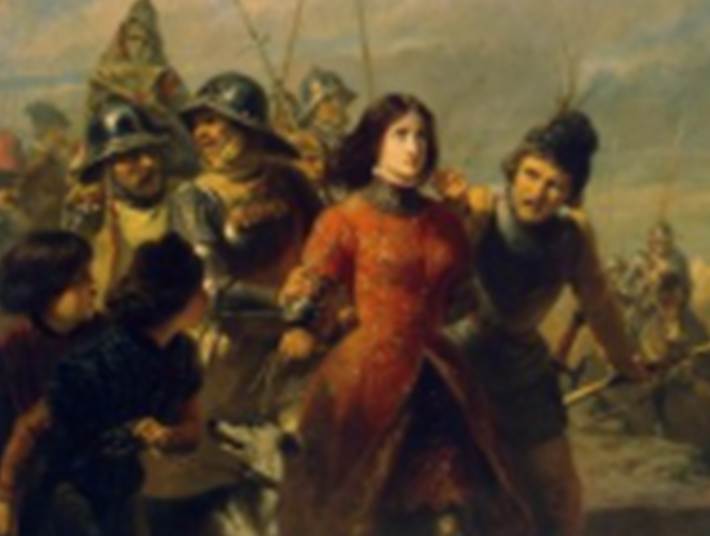
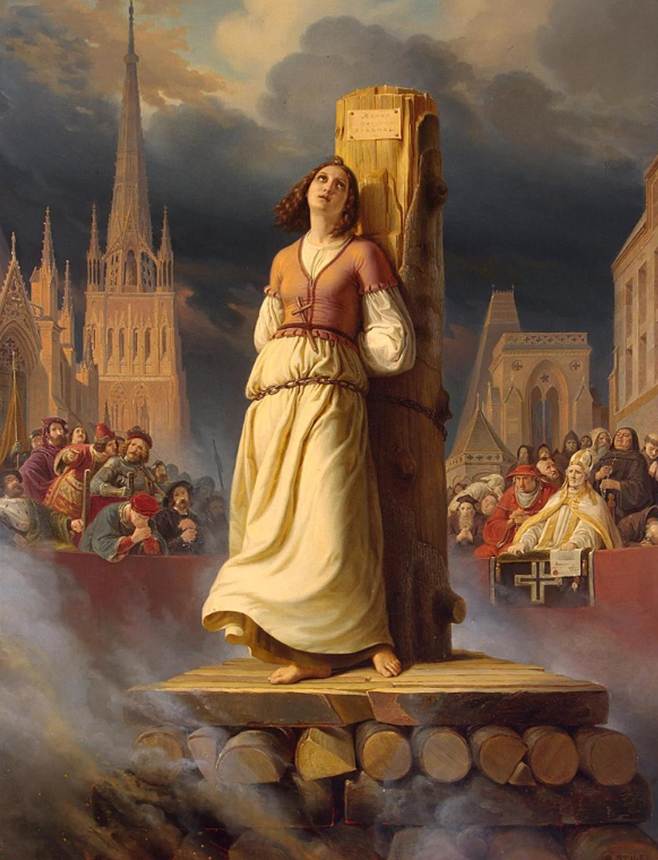
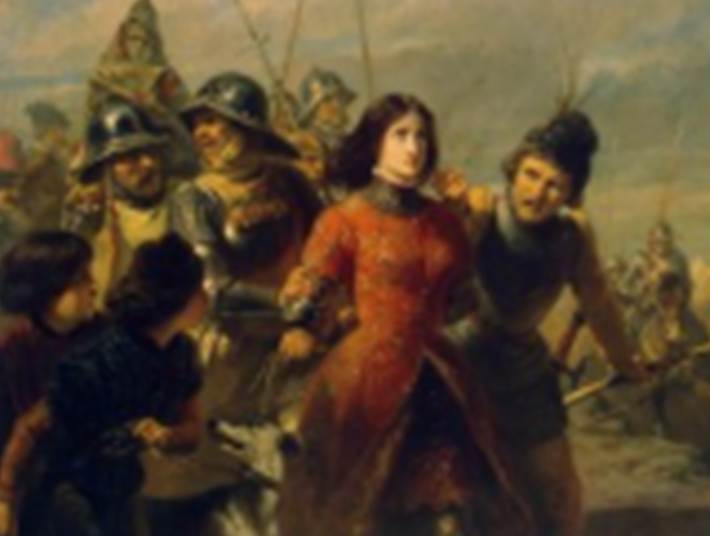
Joan of Arc, burnt at the stake in Rouen, 30 May 1431, a painting by
Hermann Stilke
David
or Davy Farindon, Farendon,
or Farindon was a man at arms at the gates of the Garrison of Rouen under
Richard Beauchamp, Earl of Warwick, appearing on muster rolls on 31 December
1430, and 9 February, 1 August, 17 October and 28 November 1431 (The British Library, Add. Ch. 7969 and 1442; Archives Nationales de France, K 63/13/20; Bibliothèque Nationale de
France, MS. Fr. 25770, no. 636 and 651).
Might
Davy, by then in his thirties, have witnessed the martyrdom of Joan of Arc?
The Hundred Years War in
the 1430s
1434
David Farndon was
a man at arms at the Garrison of Meulan under Sir
Richard Merbury and John of Lancaster, Duke of
Bedford listed on the muster rolls of 16 February and 29 March 1434 (Bibliothèque Nationale de France, MS. Fr. 25771, no. 814
and 840).
John
of Lancaster, Duke of Bedford (1389 to 1435) was a medieval English prince,
general, and statesman who commanded England's armies in France during the
Hundred Years' War. Henry V's last wish had been that Bedford should be
guardian of the kingdom and of the young king. The protector took up Henry V's
work of conquest, captured Meulan and other places,
and sought to strengthen his position by an alliance with Philip of Burgundy.
By
late 1434, England's ally Philip the Good, the Duke of Burgundy, began signing
a series of truces with the Armagnacs, leaving the English on their own. The
siege of Saint-Denis from late August to 4 October 1435 was the last act of
cooperation between the English and their Burgundian allies in the Hundred
Years' War. The English did not control Saint-Denis for long. By the time the
town had been recovered, the French had taken Meulan,
which blocked the main supply route from Paris to Normandy, further isolating
the English forces in the French capital.
1435
David
Farundon was an archer at the Garrison of Pontoise
under Sir Richard Merbury on the muster roll on 12
August 1435 (Bibliothèque Nationale de France, P.O.
472 (Bournonville), no. 2).
The English garrison of Pontoise was a strategically important town in the
Île-de-France region, and its castle was strengthened during the war. The
English garrisoned both the town and the castle. In 1441, the town and castle
were besieged by the French forces led by King Charles VII. The siege resulted
in the destruction of the English garrison, with many soldiers killed or
captured.
1438 to 1441
Davy
or David Farndon, Farinton or Farendon was a man at arms at the Garrison of Chateau
Gaillard under Richard Curson and John Stanlaw, David
Faringdon and Geoffrey Hilton, on 28 February and 12 October 1438 and 13 March
1441 (Bibliothèque Nationale de France, MS. Fr.
25774, no. 1308, Fr. 25775, no. 1374 and Archives Nationales
de France, K 66/1/5).
Château Gaillard is a
medieval castle now ruined which overlooks the River Seine. In the mid
fourteenth century, the castle was the residence of the exiled David II of
Scotland.
Château Gaillard had
been besieged for a year before it was surrendered to the English in December
1419. All the resisting castles except Mont Saint-Michel eventually fell, and
Normandy was temporarily returned to English control.
Étienne de Vignolles, a mercenary or routier
known as La Hire, recaptured Château Gaillard for the French in 1430.
However, the English
were revived by the capture and execution of Joan of Arc, and although by then
the war was turning against them, a month later they captured Château Gaillard
again.
When the French gained
ascendancy again between 1449 and 1453, the English were forced out of the
region, and in 1449 the castle was taken by the French for the last time.
1450
Davy
Farndale may have died in or about 1450.