Joan (“Jeannette”) the Fair Maid
of Kent
c 1328 to August 1385
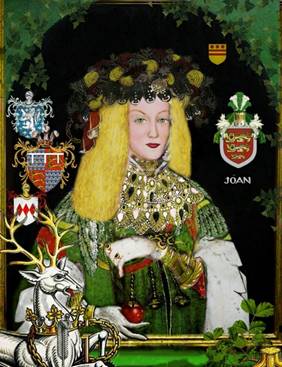
The most beautiful woman in all the realm of England
Proprietor of the lands which included Farndale
FAR00046A
|
Return to the Home
Page of the Farndale Family Website |
The story of one
family’s journey through two thousand years of British History |
The 83 family lines
into which the family is divided. Meet the whole family and how the wider
family is related |
Members of the
historical family ordered by date of birth |
Links to other pages
with historical research and related material |
The story of the
Bakers of Highfields, the Chapmans, and other related families |
Dates are in red.
Hyperlinks to
other pages are in dark
blue.
Headlines are in brown.
References and
citations are in turquoise.
Context and local
history are in purple.
|
The
narrative History of the Stutevilles The descendants of Robert de Stuteville to whom
our ancestors owed their allegiance in the eleventh and then from the late
twelfth century |
|
The Genealogy of
House Stuteville
A
Family Tree of the De Stuteville Family in Yorkshire |
|
The immediate ancestors and descendants of Joan of Kent |
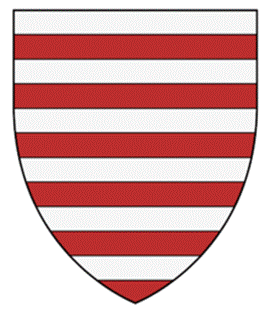
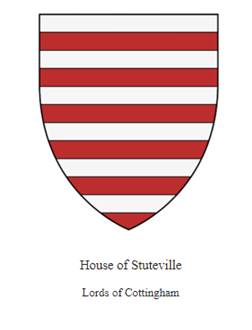
In 1352, Farndale
was part of the lands which fell to the Stuteville-Wake and Kent heir, Joan
Plantagenet (1328 to 1385), who came to be known as the Fair Maid of Kent. She
was the daughter of Margaret Wake, 3rd Baroness Wake of Liddell and Edmund of
Woodstock, the First Earl of Kent, and the youngest son of Edward I. The Fair
Maid provides glamour to Farndale’s story.
1328
Joan was born in
or about 1328. Joan was the daughter of Edmund of Woodstock,
1st Earl of Kent, by his wife, Margaret Wake, 3rd Baroness Wake of Liddell.
Edmund was the sixth son of King Edward I of England by his second wife,
Margaret of France, daughter of King Philip III of France. Edmund was a loyal
supporter of his eldest half-brother, Edward II, which placed him in conflict
with that monarch's wife, Queen Isabella of France and her lover Roger
Mortimer, 1st Earl of March.
1330
In March 1330,
Roger Mortimer had Joan’s father, Edmund of Woodstock arrested for treason and
accused of plotting to have a rumoured still living Edward II restored to the
throne. He was charged with treason, incriminating letters were produced,
and he was found guilty. He was summarily disinherited, his wife and children
sentenced to imprisonment in Salisbury castle, and Kent himself sentenced to
death outside the walls of Winchester castle. It was a mark of the savage,
terrifying nature of Mortimer’s decision that for some time no one could be
found to execute the sentence. Eventually another prisoner at Winchester,
responsible for cleaning the latrines, was given his freedom in exchange for
hacking off poor Kent’s head. Yet another earl had gone to his death, and this
one of royal blood. Edmund was the son of Edward I, and an even greater
casualty of the early fourteenth century’s killing time than Thomas of
Lancaster had been. (The Plantagenets, The
Kings who made England, 2012, Dan Jones,
page 430).
Edmund's
widow and four children (including Joan, who was only two years old at the
time) were placed under house arrest in Arundel Castle in Sussex, which had
been granted to Edmund in 1326 by his half-brother the king following the
execution of the rebel Edmund FitzAlan, 9th Earl of Arundel. It was a time of
great strain for the widowed Countess of Kent and her four children.
On 15 June 1330,
Edward and Philippa had their first child, Edward, later to become the Black
Prince.
As the Mortimer
regime grew in confidence the life of the young King Edward himself was at
risk. On 19 October 1330 William Montagu led a team of assassins through the
tunnels of Nottingham castle. They arrested Roger Mortimer, Earl of March, and
it was announced that Edward would henceforth govern his people according to
right and reason, as befits his royal dignity, and that the affairs that
concern him and the estate of the realm shall be directed by the common counsel
of the magnates of the realm and in no other wise.
Mortimer was
drawn and hung as a traitor for the murder of Edward II. Isabel was dispatched
to the luxury of Castle Rising in Norfolk.
They received respite after the new
king, Edward III, Joan's half-first cousin, reached adulthood and seized
control of affairs. He took on the responsibility for Joan’s family and looked
after them well.
1340
The young Joan
had been brought up, a royal princess in the Plantagenet court of Edward III
and her domain was the royal courts in southern England and France. She was
cousin of the King. She was under the charge of Queen Philippa.
In 1340, aged
only thirteen, Joan had secretly married the twenty six year old Thomas
Holland, her Knight. She had not first gained royal consent, which she was
required to do as a royal princess.
The chronology of the story had its difficulties, requiring as it
did a clandestine wedding and secret physical relationship between a 12 year
old girl of royal blood and a 25 year old soldier trying to make his way in
royal service. More likely, Holand and the countess, now 32 and 19, had
concocted a tale that might enable her to discard an unhappy marriage in favour
of a more recent liaison with a man of lower birth and much greater personal
appeal. (The Eagle and the Hart, The Tragedy of Richard II and Henry
IV, Helen Castor, 2025, page 9).
Shortly after the
wedding, Holland left for the continent as part of the English expedition into
Flanders and France. The following winter, while Holland was still overseas,
Joan's family arranged for her to marry William Montagu, son and heir of
William Montagu, first Earl of Salisbury, who had helped Edward III to secure
his throne from the Mortimer regime. It is not known if Joan confided to anyone
about her first marriage before marrying Montagu, who was her own age. Later,
Joan suggested that she had not announced her existing marriage with Thomas
Holland because she was afraid it would lead to Holland's execution for
treason. She may also have been persuaded by her mother to believe that the
earlier marriage was invalid.
1344
William Montagu's
father died in 1344, and Joan’s husband became the second Earl of Salisbury.
1348
When Holland
returned from the French campaigns in about 1348, his marriage to Joan was
revealed. Holland confessed the secret marriage to the King and appealed to the
Pope for the return of his wife. Salisbury held Joan captive so that she could
not testify until the Church ordered him to release her.
Joan, a radiant
twenty-year-old of royal blood, had grown up with the Black Prince. She was a
granddaughter of Edward I.
When Edward
created the Order of the Garter, the story was spread that the idea of the
Garter came spontaneously when the Countess of Salisbury dropped a garter
during a dance, and Edward picked it up, saying Honi soit
qui mal y pense, evil to him who thinks evil of it
and thus coining the Order’s motto. But the take is apocryphal, and probably
muddles an allusion to the countess of Salisbury’s (ie
Joan of Kent’s) scandalous marriage situation with a saucy account of the king
adopting a sexualised, feminine, item of clothing for the badge of a soldier’s
companionship. Edward’s parties were famously louche, this story found a
willing audience among sniffy monastic types who saw decadence and scandal at
the English court and shook their heads in disapproval.
It is more likely
that the idea of the garter came from Henry Grosmont who had sported garters in
his dandyish youth.
(The Plantagenets, The Kings who made England, 2012, Dan Jones, page 485 to 487).
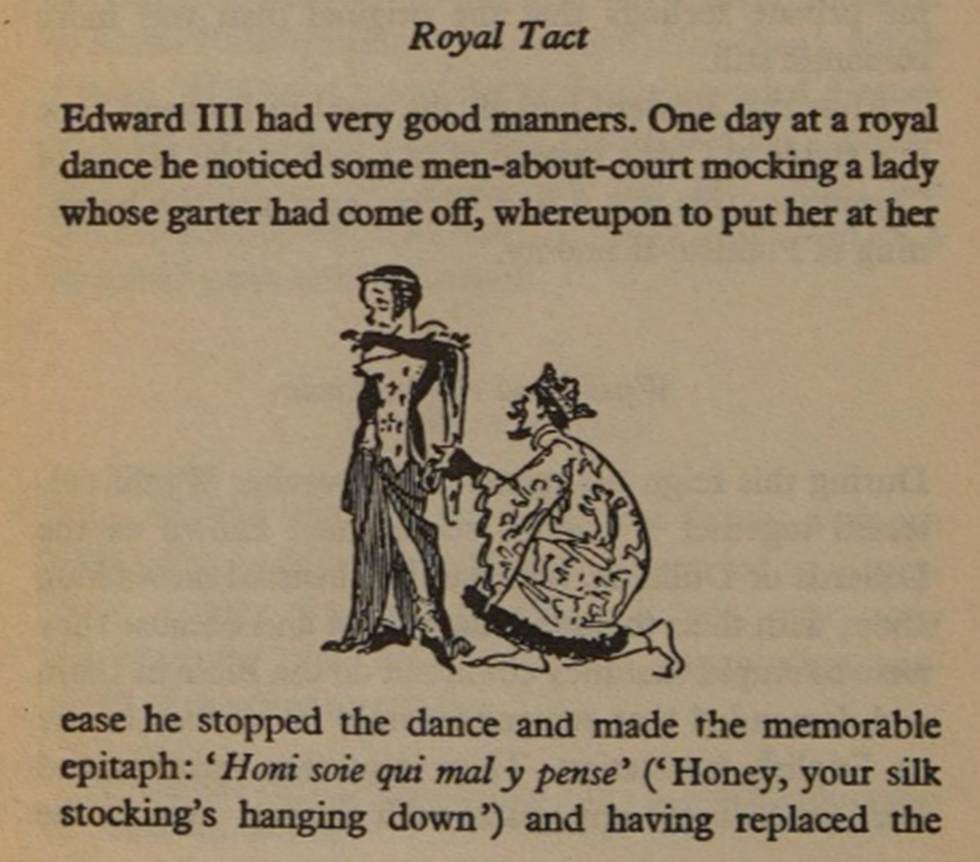
Edward III had
very good manners. One day at a royal dance he noticed some men about court
mocking a lady whose garter had come off, whereupon he put her at her ease and
he stopped the dance and made the memorable epitaph Honi soie
qui mal y pense (“Honey, your silk garter’s hanging
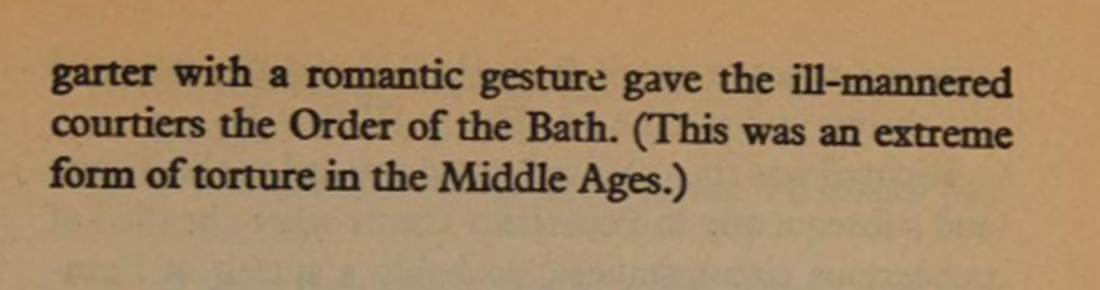
down”) and having replaced the garter with a romantic gesture gave the ill mannered courtiers the Order of the Bath (this was an
extreme form of torture in the Middle Ages) (1066 and
all that, Walter Sellar and Robert Yeatman, 1930).
1349
In 1349, the
proceedings ruled in Holland's favour. Pope Clement VI annulled Joan's marriage
to Salisbury and Joan and Thomas Holland were ordered to be married in the
Church.
Joan had
relinquished her place in the Salisbury title, for the lowly, though
impressive, knight, Thomas Holland.
Joan and Thomas
had five children.
1352
Joan, the newly confirmed wife of the military hero
Thomas Holland, inherited the titles 4th Countess of Kent and 5th Baroness Wake
of Liddell after the death of her brother John, 3rd Earl of Kent, in 1352.
John Wake, Earl of Kent, died in 1352 and his
Inquisition Post Mortem on 30 December 1352 (in 26 Edward III), confirmed that
Kirkbymoorside and Farndale continued to be held by service of one and a half
knight’s fees of John de Moubray (Calendar of Inquisitions
Post Mortem, Volume 10, (Edward III, 1352 to
1361), page
47 (Folio 46)).
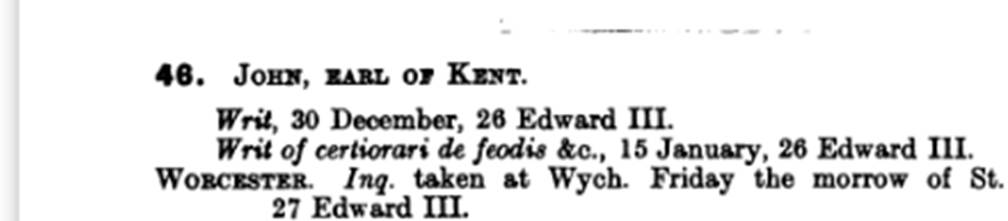
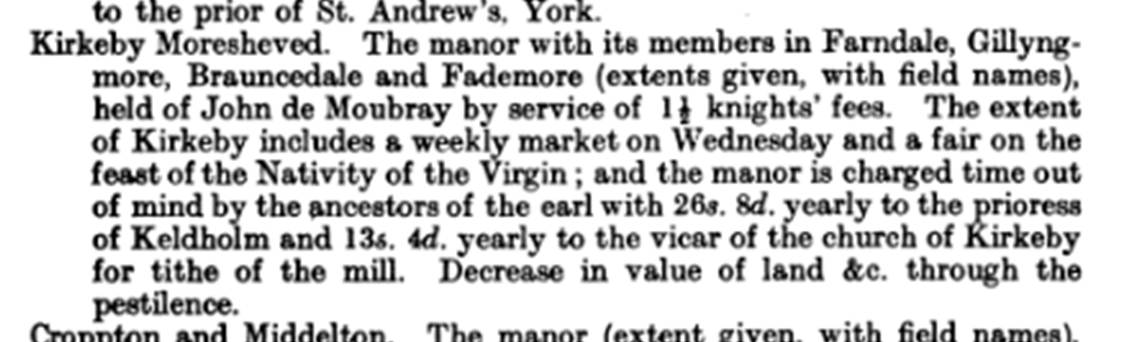
The manor with its members in
Farndale, Gillyngmore, Brauncedale
and Fademore (extents given, with field names), held
of John de Moubray by service of 1½ knights’ fees. The extent of Kirkeby
includes a weekly market on Wednesday and a fair on the feast of the Nativity
of the Virgin; and the manor is charged time out of mind by the ancestors of
the earl with 26s. 8d. yearly to the prioress of Keldholm
and 13s. 4d. yearly to the vicar of the church of Kirkeby for tithe of the
mill. Decrease in value of land &c. through the pestilence.
Joan,
Countess of Kent, 4th Countess of Kent, 5th Baroness Wake of Liddell the Fair
Maid of Kent (29 September 1326 or 1327 to 7 August 1385) became Lady of the
Stuteville-Wake Estates from 1352 to 1385
It is not likely
that she ever visited her lands at Kirkbymoorside and so sadly was probably
never seen in Farndale. She was more interested in royal politics and courtly
intrigue than in the tedious administration of her distant landholdings
In 1352, Joan
gave birth to a son, John Holland, named after his uncle.
1353
In 1353 an
Inquest taken at York during Edward III’s reign confirmed Joan’s Stuteville
holdings in Kirkbymoorside.
Kirkeby Moresheved. The manor with its members in Farndale, Gillyngmore, Brauncedale and Fademore (extents given, with field names), held of John de
Moubray by service of 1½ knights’ fees. The extent of Kirkeby includes a weekly
market on Wednesday and a fair on the feast of the Nativity of the Virgin; and
the manor is charged time out of mind by the ancestors of the earl with 26s.
8d. yearly to the prioress of Keldholm and 13s. 4d.
yearly to the vicar of the church of Kirkeby for tithe of the mill. Decrease in
value of land &c. through the pestilence.
(Calendar of Inquisitions Post Mortem,
26 Edward III, page
47)
Although practical ownership of Kirkbymoorside had been of the
House Stuteville since about 1175, the complexities of the feudal hierarchy
meant that the Stutevilles continued to hold the land of House Mowbray.
Thomas Holland,
whose modest possessions were unlikely to have kept Joan in the style to which
she was accustomed, but whose military charm seems to have nevertheless
entranced her, therefore took title to Joan’s lands, though he was not summoned
to take the formal title of Earl of Kent until 1360. With the Kent and old
Stuteville landholdings, the couple could live more luxuriously.
1354
The years of
happy marriage between Thomas and Joan were short. By 1354, Thomas had been
sent to Brittany to represent the King’s interests during the minority of the
Duke of Brittany.
1359
By 1359 he was
appointed captain general of England’s possessions on the continent.
1 July 1359,
Westminster. To the treasurer and barons of the exchequer. Order to view the
letters of acquittance made to the abbot of Stretford by Richard de Penbrugge,
knight, for a payment of £11 0s 12d yearly, and to cause those letters to be
allowed and the abbot to be discharged of the said sum, as the king lately took
the homage and fealty of Thomas de Holand, who married Joan, sister and heir
of John late earl of Kent, tenant in chief, for all the lands which the
said earl held in chief, and rendered those lands to Thomas and Joan …(Close Rolls of the reign of Edward III,
1354 to 1360, page
569).
1360
In Close Rolls of the reign of Edward III, 1360 to 1364, page
5, Thomas Holland and Joan his wife (cousin and heir of Thomas Wake) petitioned
the King.
Then, on 28
December 1360, Thomas Holland died of illness in Normandy.
Thomas Holland, Joan’s first wife, became Earl of Kent
until he died in 1360 and his Inquisition Post Mortem on 16 January 1360
included Kirkbymoorside with lands in Farndale held of John de Mowbray (Calendar of Inquisitions Post
Mortem, Volume 10, (Edward III, 1352 to 1361), page
554 (Folio
657)).


1361
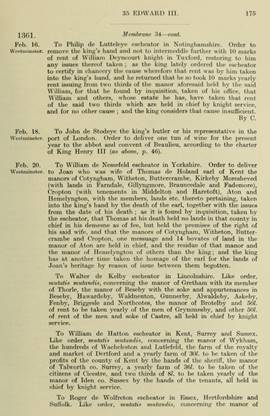
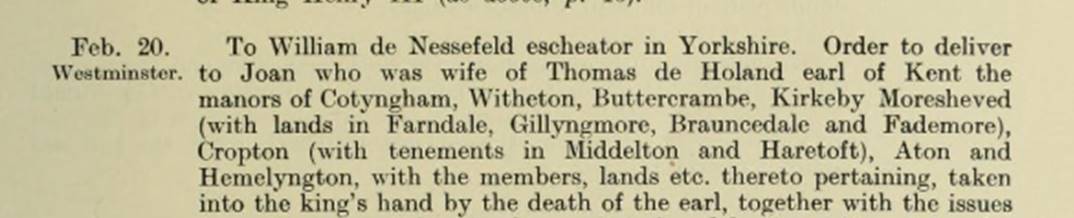
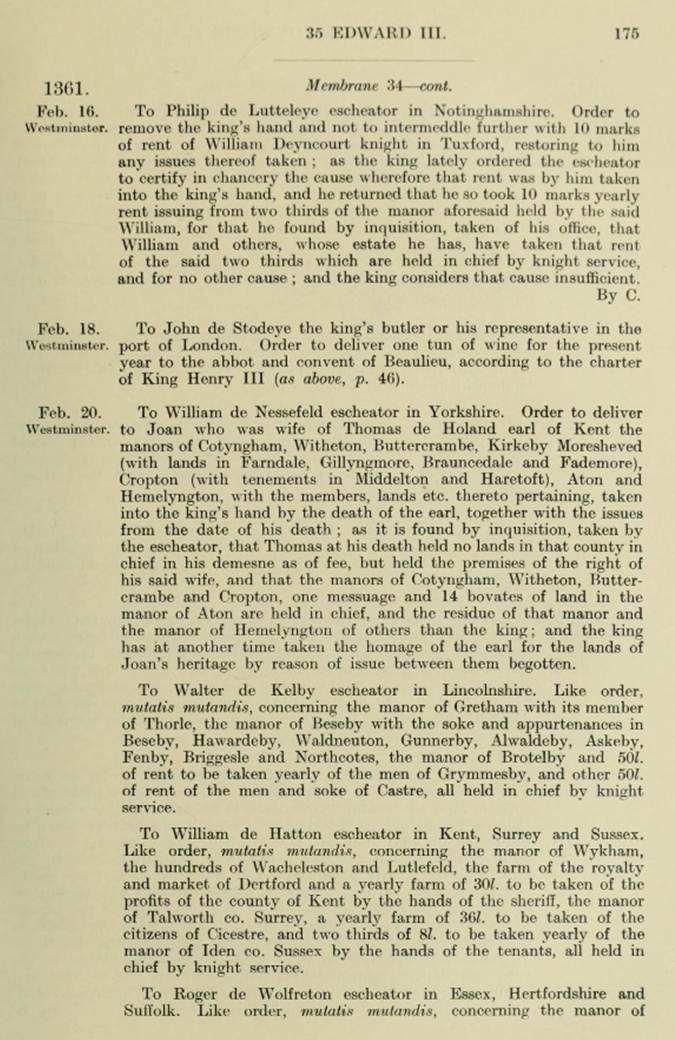
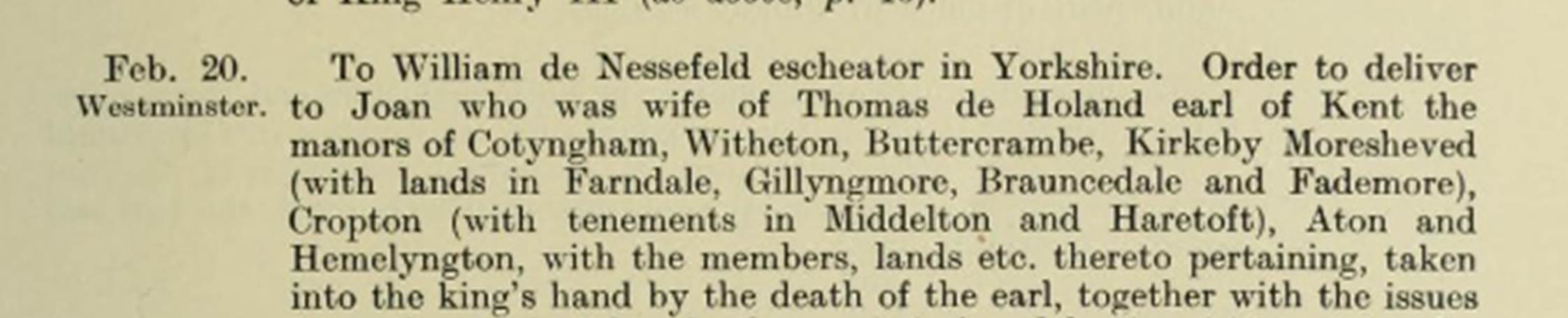
Feb 20, Westminster. To William de Nessefeld escheator in
Yorkshire. Order to deliver to Joan who was wife of Thomas de Holand earl of
Kent the manors of Cotyngham, Witherton,
Buttercrambe, Kirkeby Moresheved
(with lands in Farndale, Gillyngmore, Brauncedale and Fademore),
Cropton (with tenements in Middleton and Haretoft),
Aton and Hemelyngton, with the members, lands etc
thereto pertaining, taklen into the king’s hand by
the death of the earl, together with the issues from the date of his death; as
it is found by inquisition, taken by the escheator, that Thomas at his death
held no lands in that county in chief in his demesne as of fee, but held the
premises of right of his said wife, and that the manors of Cotyngham,
Witherton, Buttercrambe and
Cropton, one messuage and 14 bovates of land in the manor of Aton are held in
chief, and the residue of that manor and the manor of Hemelyngton
of others than the king; and the king has at another time taken the homage of
the earl for the lands of Joan’s heritage by reason of issue between them
begotten (Calendar of Close Rolls, 35 Edward III page 175).
So the Kent and
old Stuteville lands passed back to Joan.
(Close Rolls of the reign of Edward III,
1360 to 1364, page
215)
The lovely Joan
did not have to wait long before marrying the heir to the throne. It is
suggested that Ned, the young Prince of Wales, already had eyes for Joan, who
he had grown up with during their childhood. Joan was the King’s cousin, so Ned
was strictly of a different generation, but there were only a few years in age
between them.
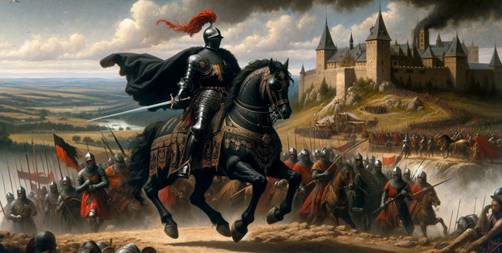
On 10 October
1361 Joan married her cousin Edward, the Black Prince, son of Edward III, the
Prince of Wales and heir apparent. As the Black Prince and Joan were related,
the prince also being godfather to Joan's elder son Thomas, a dispensation was
obtained for their marriage from Pope Innocent VI, though they appear to have
been contracted to marry before it was applied for. Joan was somewhat reckless.
The marriage was performed at Windsor, in the presence of King Edward III, by
Simon Islip Archbishop of Canterbury. According to Jean Froissart the contract
of marriage between Ned and his cousin Jeanette was entered into without the
knowledge of the king. The prince and his wife resided at Berkhamsted Castle in
Hertfordshire though many sources suggest it was used more as a hunting lodge.
For a short while
Farndale was held directly by the Prince of Wales, the Black Prince. Edward the
Black Prince was the son and heir apparent of King Edward III. Froissart's
Chronicles referred to the Black Prince at the battle of Crécy in 1346, and the
instruction given by his father Edward III that those with the prince should suffre hym this day to wynne his spurres, often
quoted as Let the boy win his spurs.
1362
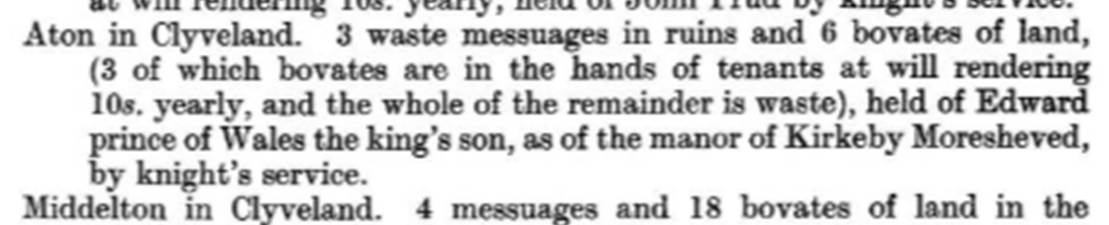
The estate of Kirkbymoorside was held of Edward, the
Prince of Wales, the King’s son, as recorded in the Inquisition Post Mortem of
John de Fritheby (Calendar
of Inquisitions Post Mortem, Volume 11, (Edward III,
1361 to 1365), page
260 (Folio 323)).
10 November 1362, Westminster … the king’s daughter
Joan princess of Aquitaine and Wales, sometime wife of Thomas Holand … (Close Rolls of the reign of Edward III,
1360 to 1364, page
372).
1363
In summer 1363, the Black Prince and Joan moved to Aquitaine
where they established their grand new court, living in such sumptuous state
that no other prince or lord in Christendom could match them (Jean Frioissant).
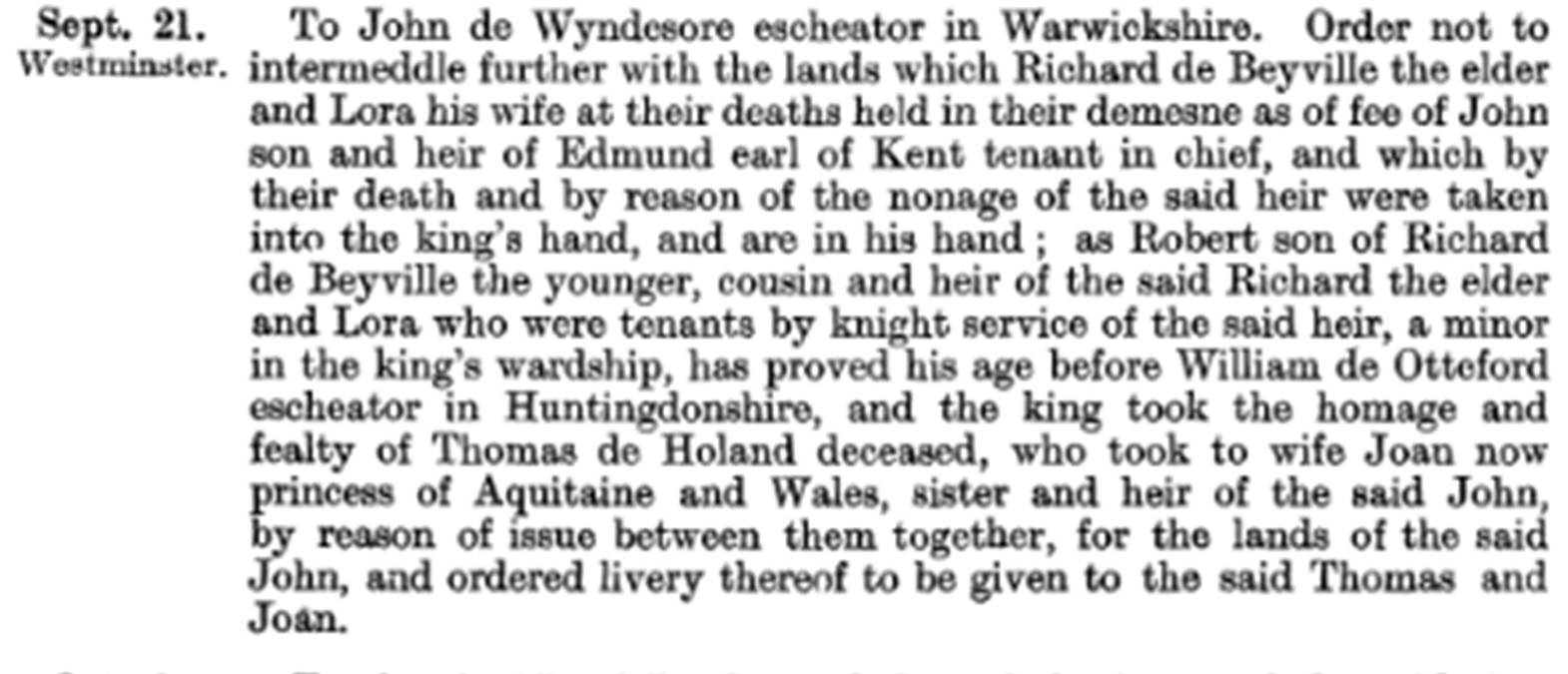
(Close
Rolls of
the reign of Edward III, 1360 to 1364, page
485).
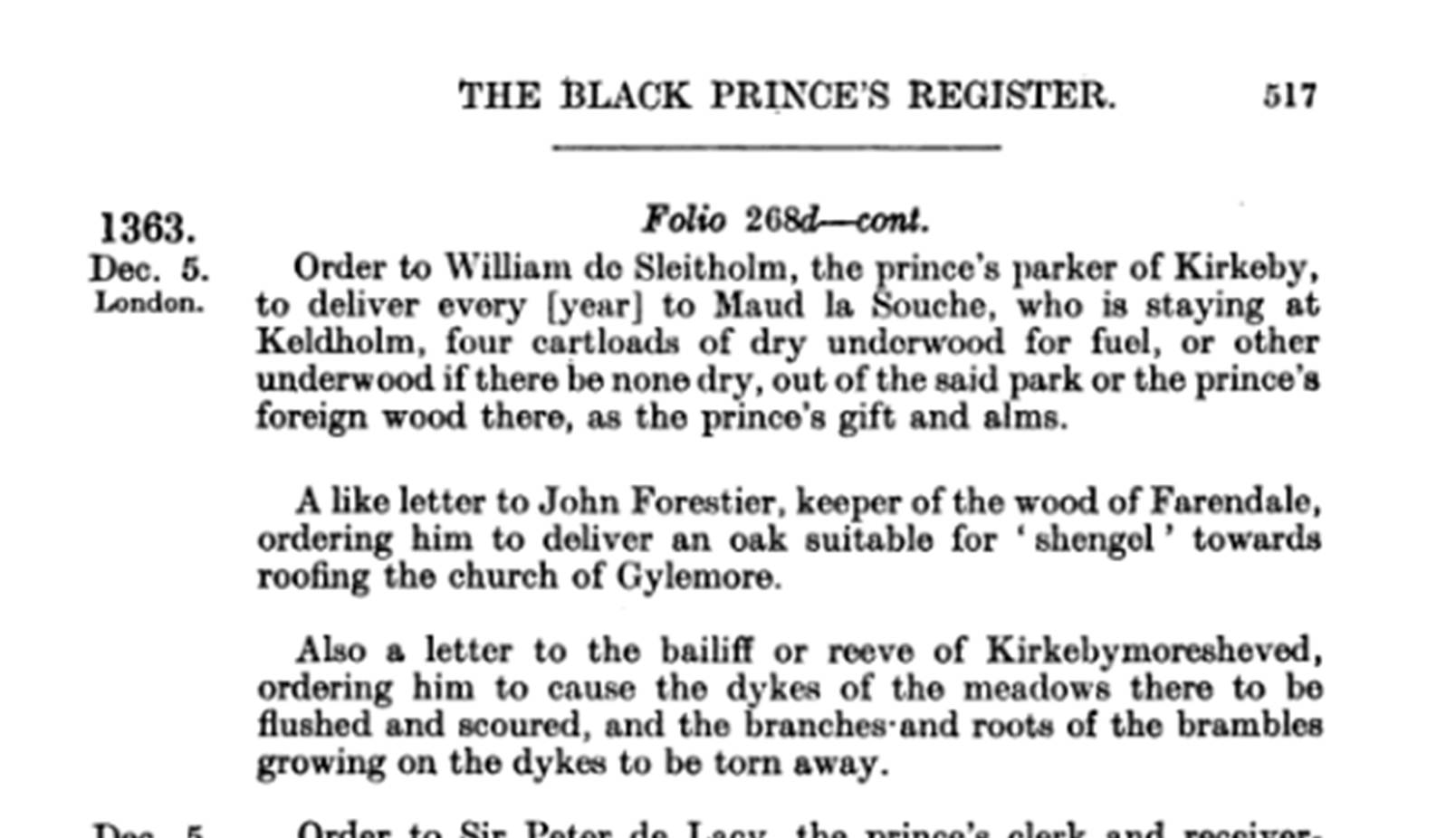
The Black Prince (1330 to 1376), the son of Edward III
(reigned 1327 to 1377), ordered his keeper of the Farndale wood to deliver a
single oak, suitable for shingles, for the roofing of Gillamoor
chapel (John Rushton, The History of Ryedale,
2003, 126, The Black Prince’s Register,
Part IV (1351 to 1365), page
517).
1365
However in 1365
Joan and her new husband, the Black Prince, formally settled the Kirkbymoorside
manor on her son by her former husband, Thomas Holland, the Second Earl of
Kent, and Alice FitzAlan, his wife and their heirs, with reversion to the
prince and herself. So Joan’s direct interest in Farndale passed on to her
Holland sons. Perhaps her elevated lifestyle meant that by 1365 she was not so
bothered about retaining her northern lands in her direct ownership. The Kent
and Kirkbymoorside lands thus passed down to the line of the Hollands.
There is a record
though that the Black Prince ordered his keeper of the Farndale wood to deliver a single
oak, suitable for shingles, for the roofing of Gillamoor
chapel. So Joan and the heir to the throne did retain some interest over the
Farndale lands. Farndale had after all been a royal hunting ground (John Rushton, The History of Ryedale, 2003, page
126).
Westminster. Quindene of
Trinity, 39 Edward Ill, 1365. Thomas de Holande
and Alesia daughter of Richard, Earl of Arundell, quer.,
Edward, Prince of Aquitaine and Wales and Joan his wife, def., of the manors of
Kirkebymoresheved, Bottercramp,
and Cropton: To hold to Thomas and Alesia and the heirs of their bodies, of the
king and his heirs ; reversion to the Prince and Joan and the heirs of Joan.
Thomas and Alesia gave £1,000. This concord was made by precept of the king.
(Feet of Fines for the county of York (1347 to 1377), Edited by W Pailey Baildon, Yorkshire
Archaeological Society Record Series, volume 52, 1915, page
111).
Joan and the
Black Prince had two sons of their own, Edward of Angouleme (1365 to 1370) and
Richard who became Richard II of England.
The French
chronicler Jean Froissart called Joan en
son temps la plus belle de tout la roiaulme d'Engleterre et la plus amoureuse,
"the most beautiful woman in all the realm of England, and the most
loving". The immortal title of the Fair Maid of Kent seems to have
been adopted later, though Froissant did refer to her
as cette jeune damoiselle
de Kent. She was described in the Herald Chandos’ Le Prince Noir, as
Une dame de grant pris, Qe belle fuist, plesante et sage, “a
lady of great worth, who was beautiful, pleasant, and wise.”
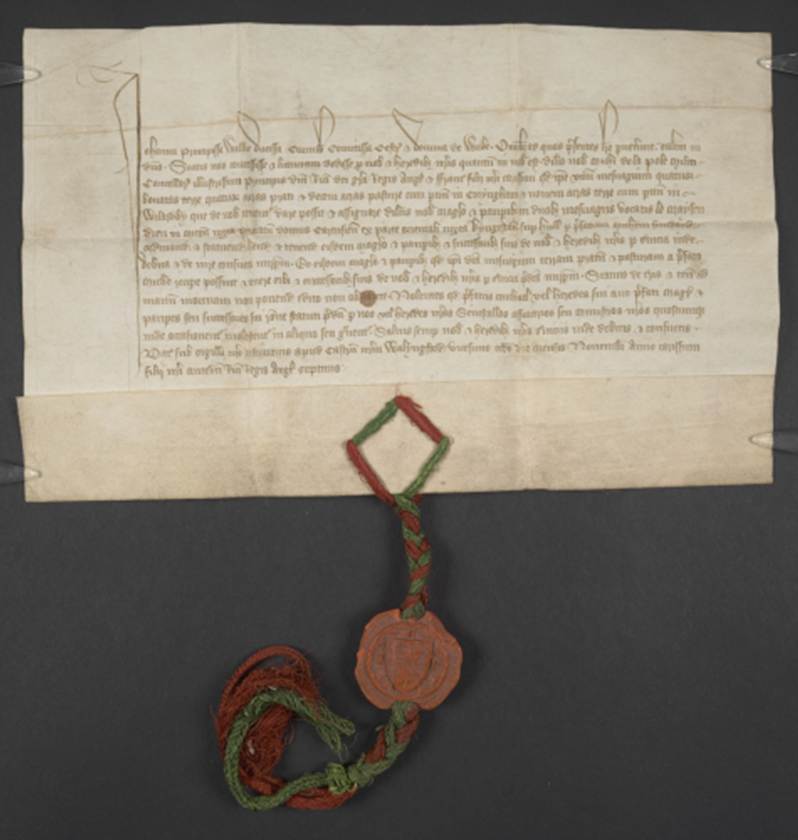
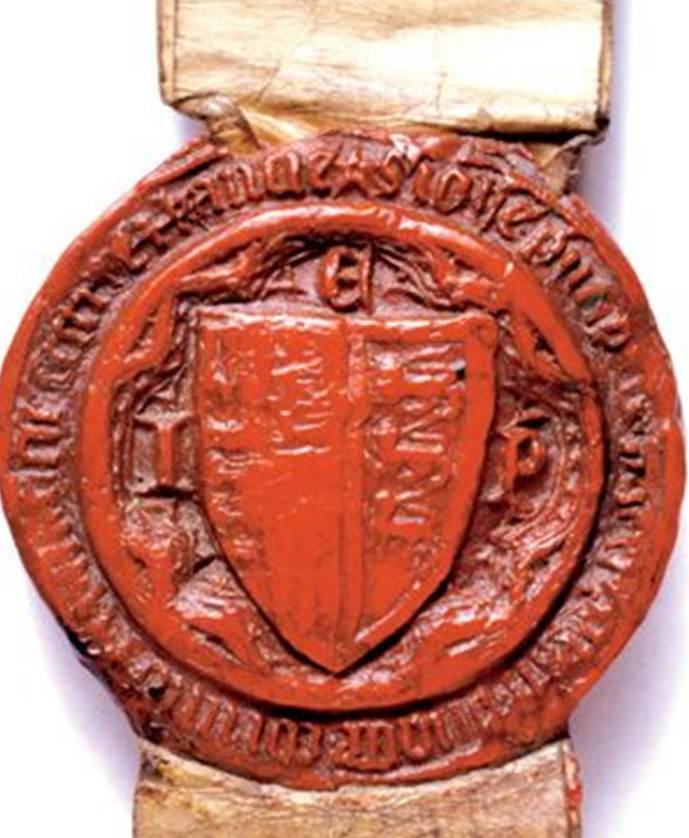
The seal
of the Fair Maid
It was Joan whose
honour, it was later suggested, Edward III protected in a famous incident which
was claimed to have given rise to the motto of Edward’s new Order of the
Garter, honi soi qui mal y pense.
The story
goes that Edward III was dancing with Joan of Kent, his first cousin and
daughter-in-law, at a ball held in Calais to celebrate the fall of the city
after the Battle of Crécy. Her garter slipped down to her ankle, causing those
around her to laugh at her humiliation. Edward placed the garter around his own
leg, saying, Honi soit qui mal y pense. Tel qui s'en rit aujourd'hui, s'honorera de la porter, "Shame on anyone who
thinks evil of it. Whoever is laughing at this thing today will later be proud
to wear it." The story is almost certainly apocryphal, and has also been
associated with the Countess of Salisbury, but it is the founding myth of the
Order of the Garter. Thomas Holland became one of the small number of selected
founding knights who joined to order in 1348. Joan herself was made a Lady of
the Garter in 1378.
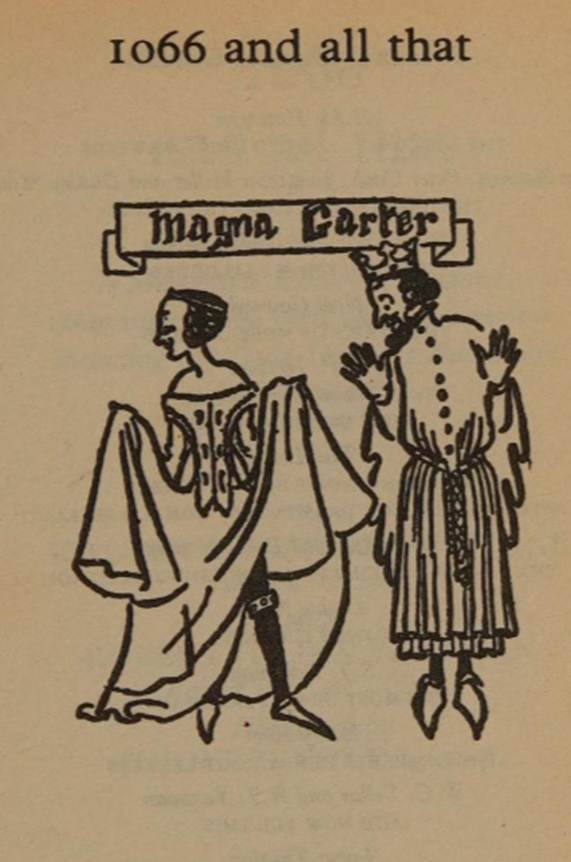
The incident
clearly caused hilarity in the most famous satirical history book which was
written in the 1930s.
1371
By 1371, the
Black Prince was no longer able to perform his duties as Prince of Aquitaine
due to poor health. He and Joan returned to England shortly after burying their
elder son.
1372
In 1372, the Black Prince forced himself to attempt
one final, abortive campaign in the hope of saving his father's French
possessions, but the exertion completely shattered his health.
1376
The Black Prince
returned to England for the last time on 7 June 1376, a week before his
forty-sixth birthday, and died at Westminster the next day.
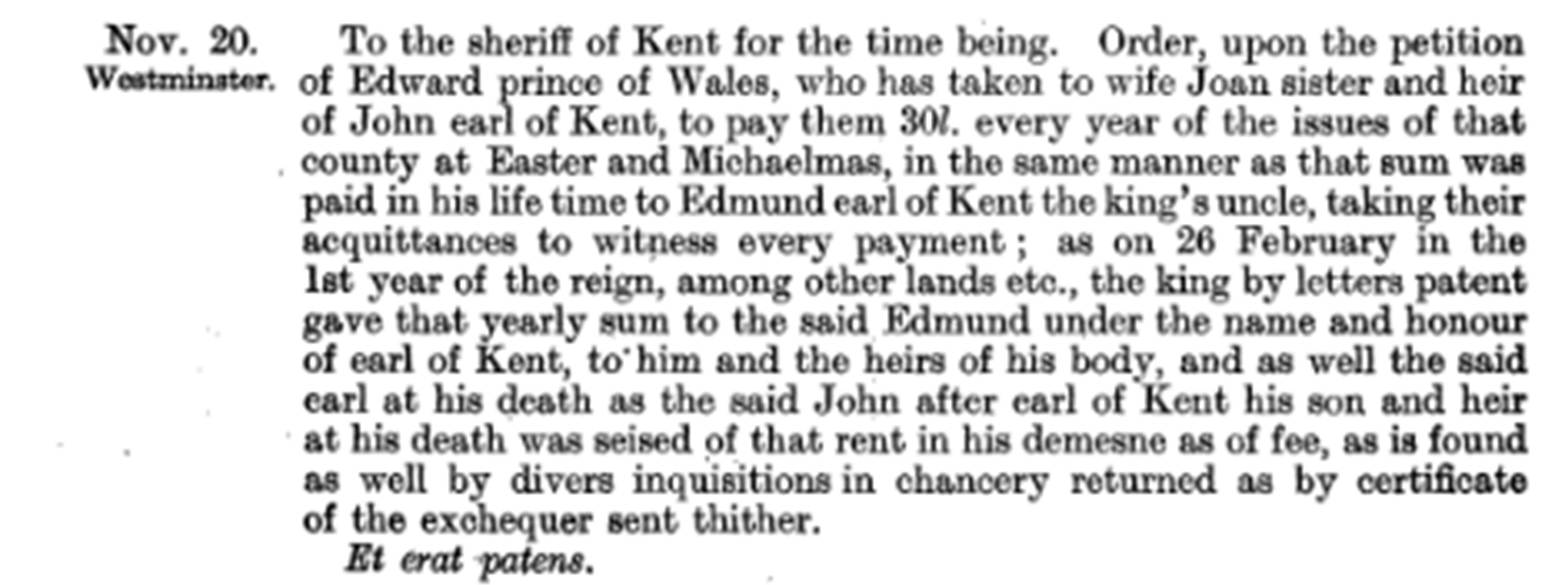
4 December 1376, Westminster. To the sheriff of
Kent for the time being. Order of the issues of the county to pay to Joan
princess of Wales every year £30 at Easter and Michaelmas by even portions,
as the same used to be paid to Edmund earl of Kent the king's uncle in his life
time, taking her acquittance ; as on 26 February in the first year of his reign
the king by letters patent gave to the said Edmund and to the heirs of his body
(among other things) SOL a year of the issues of Kent to be taken by the hands
of the sheriff under the name and honour of earl of Kent, and as well the said
earl as John his son and heir, after earl of Kent, was at his death seised thereof in his demesne as of fee according to that
grant, as is found by divers inquisitions and by certificate of the exchequer
sent into the chancery, wherefore on 20 November in the 36th year the king
ordered the then sheriff to pay to Edward prince of Wales and to the said Joan
his wife, being sister and heir of the said John, £30 a year from the said
John's death ; and now the said prince is dead. (Close Rolls of the reign of Edward III,
1374 to 1377, page
403).
1377
Joan's son Prince
Richard was now next in line to succeed his grandfather Edward III, who died on
21 June 1377. Richard was crowned as Richard II the following month at the age
of 10. As Queen Mother, Joan exercised considerable influence during the early
years of her son's reign. She enjoyed respect as a venerable royal dowager.
22 June 1377, Westminster. To the sheriff of Kent
for the time being. Order to pay to Joan, the king's mother £30 a year,
as it was paid to Edmund earl of Kent in his life time ; as on 26 February in
the first year of his reign among other lands etc. the late king gave to the
said Edmund his uncle and to the heirs of his body 30/ . a year of the issues
of Kent by the hands of the sheriff under the name and honour of earl of Kent,
and as well the said earl as John his son and heir, after earl of Kent, died thereof
seised, as is found by divers inquisitions and by
certificate of the exchequer, wherefore on 20 November in the 35th year of his
reign the late king ordered the sheriff to pay £30 a year to Edward the king's
father and to his said mother being sister and heir of the said John ; and now by
the late king's death that county has come to the king as parcel of his
realm, and it is his will that the said gift remain in force, more
especially for that it concerns his mother. (Close Rolls of the reign of Richard II,
1377 to 1381, page
21)
Early in his
reign, the young King faced the challenge of the Peasants' Revolt. The
Lollards, religious reformers led by John Wyclif, had enjoyed Joan's support,
but the violent climax of the popular movement for reform reduced the feisty
Joan to a state of terror. Nevertheless, on her return to London from a
pilgrimage to Thomas Becket's shrine at Canterbury Cathedral in 1381, when she
found her way barred by Wat Tyler and his mob of rebels on Blackheath, she was
not only let through unharmed, but she was saluted with kisses and provided
with an escort for the rest of her journey.
1378
Joan was made a Lady of the Garter in
1378.
1382
In January
1382, Richard II married Anne of Bohemia, daughter of Charles IV, Holy Roman
Emperor and King of Bohemia.
1385
When Edmund of
Langley’s wife Isabella gave birth to Richard of Conisbrough at Conisbrough
Castle, there were rumours of her affair with Joan of Kent’s son by her first
marriage, Thomas Holland. In a violent dispute over the matter he killed the
king’s friend, Ralph Stafford. The ill dowager queen pled for Richard’s mercy
which was declined and overwhelmed by grief, Jeannette died. She left a will,
dictated on the day before her death, in which she asked to be buried not in
Canterbury Cathedral with the Black Prince, but at Stamford in Lincolnshire
beside the tomb of John Holand’s father, her previous husband, Thomas. (The Eagle and the Hart, The Tragedy of Richard II and
Henry IV, Helen Castor, 2025, page 106).
Joan died on 7
August 1385 aged 57, at Wallingford Castle. She was buried beside her first
husband, Thomas Holland, as requested in her will, at the Greyfriars in
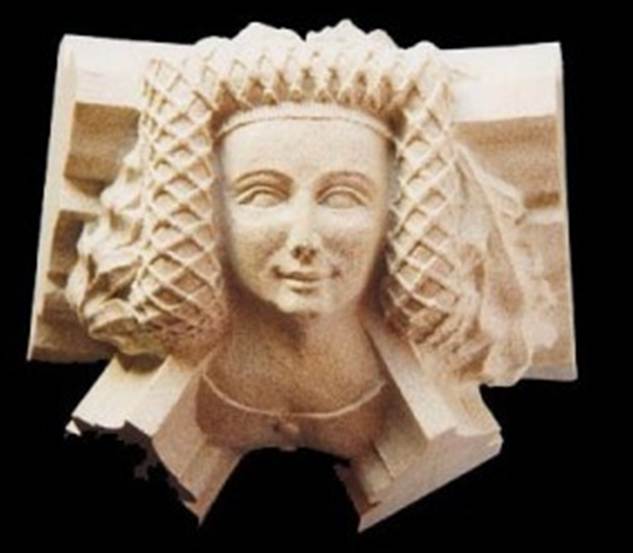
Stamford, Lincolnshire. The Black Prince had built a chantry chapel for her in
the crypt of Canterbury Cathedral in Kent, where he himself had been buried
with ceiling bosses sculpted with likenesses of Joan’s face.
12 October 1385, Westminster. To the bailiffs of
the city of Cicestre for the time being. Writ de intendendo in favour of Thomas de Holand earl of Kent, son
of Joan princess of Wales countess of Kent and lady Wake the king's mother, and
order of the farm of the city to pay him £36. a year and the arrears since the
said Joan's death ; as upon the finding of an inquisition, taken by John Olyver
escheator in Sussex, that she died seised of £36 a
year of rent to be so taken, the king took the earl's homage and fealty, and on
20 October last commanded livery to be given him of his mother's lands, and of
the king's gift the issues thereof taken since her death (Close Rolls of the reign of Richard II,
1385 to 1389, page
13).
There are plenty
of historical novels written about the lovely Fair Maid, the most renown of
Farndale’s proprietors (The
Shadow Queen, 2018 by Anne O’Brien; The
Fair Maid of Kent, 2017 by Caroline Newark
and The
First Princess of Wales, 2020 by Karen
Harper provide fictional depictions to fill the unknown gaps between the
historical evidence, of Joan of Kent's life at the English court in which her
mother, Margaret is a supporting character. There are also many biographies
such as by
Anthony Goodman, 2017)