The Inquisition Post Mortem for Farndale, 1276
The Inquisition Post Mortem taken on the death of Joan de
Stuteville in 1276 records significant information about the settlement of
Farndale by that time
FAR00017
|
Return to the Home Page of the Farndale Family
Website |
The story of one family’s journey through two
thousand years of British History |
The 83 family lines into which the family is divided.
Meet the whole family and how the wider family is related |
Members of the historical family ordered by date of
birth |
Links to other pages with historical research and
related material |
The story of the Bakers of Highfields, the Chapmans,
and other related families |
Dates are in red.
Hyperlinks to other pages are in dark blue.
Headlines are in brown.
References and citations are in turquoise.
Context and local history are in purple.
This process of assarting in Farndale by the lay nobility
was probably underway by the second or third decade of the thirteenth century.
We can judge the extent of this process, because there are three recorded
snapshots of the progress of cultivation in 1276, 1282 and 1301.
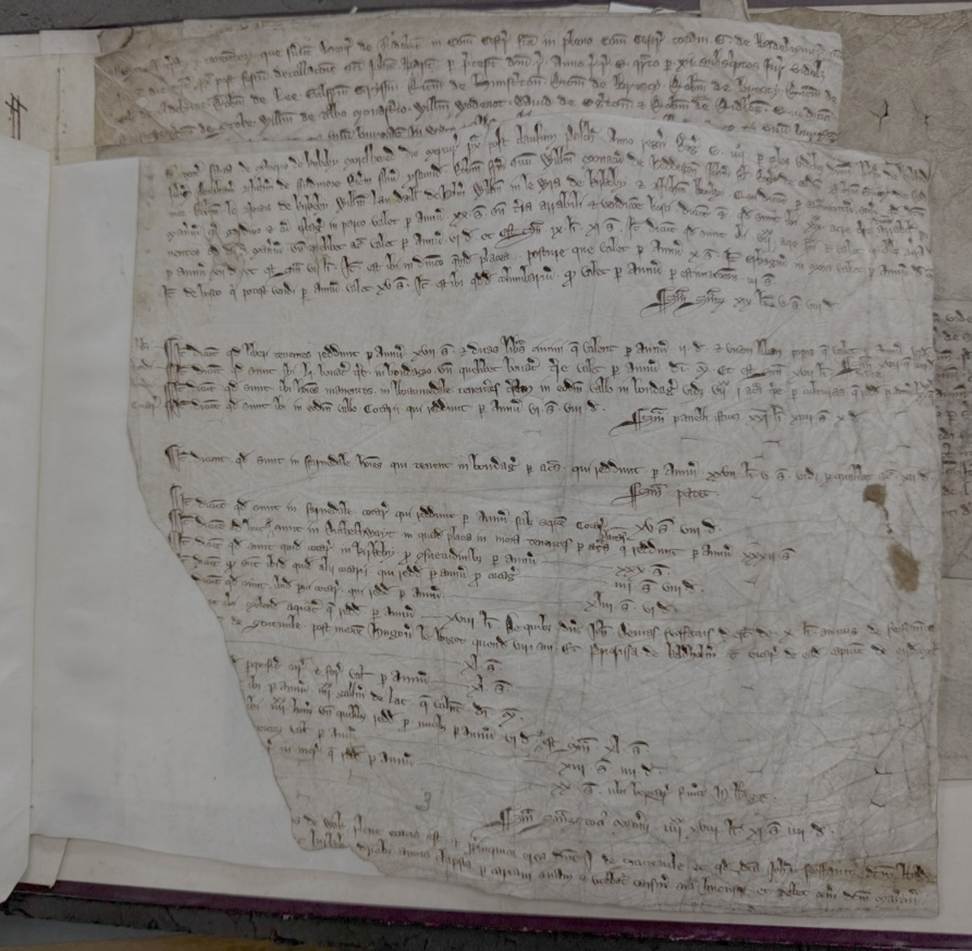
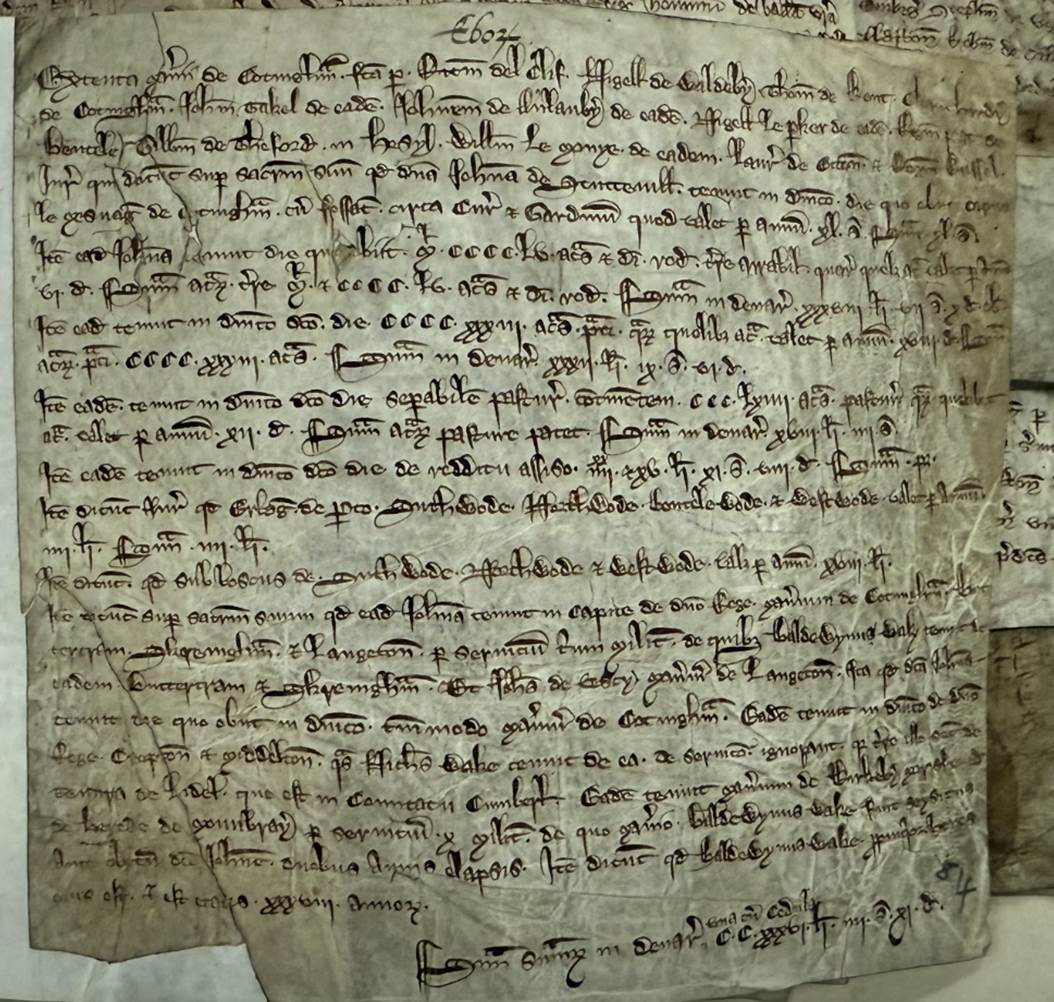
An Inquisition Post Mortem taken after Joan de Stuteville’s death
in 1276 evidenced the extent of settlement that had taken place. Bonded tenants
paying a standard rent of 1s per acre provided an income of £27 5s 0d . With
20s to a pound, this evidenced a cultivated area of 545 acres in Farndale.
Seven cottars in Farndale raised another 15s 8d and Duthethwayt
was listed separately as producing 32s per annum from holdings held by plot
rather than by acres. The record also evidenced that the watermill, now
enfeoffed to Sir John Denias, by then
rendered 18l per annum.
A separate page explains the Calendars
of Inquisitions Post Mortem (“IPM”).
The 1276 Inquisition Post
Mortem on the death of Joan de Stuteville
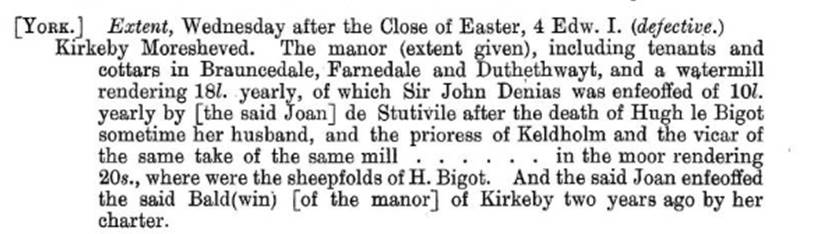
An
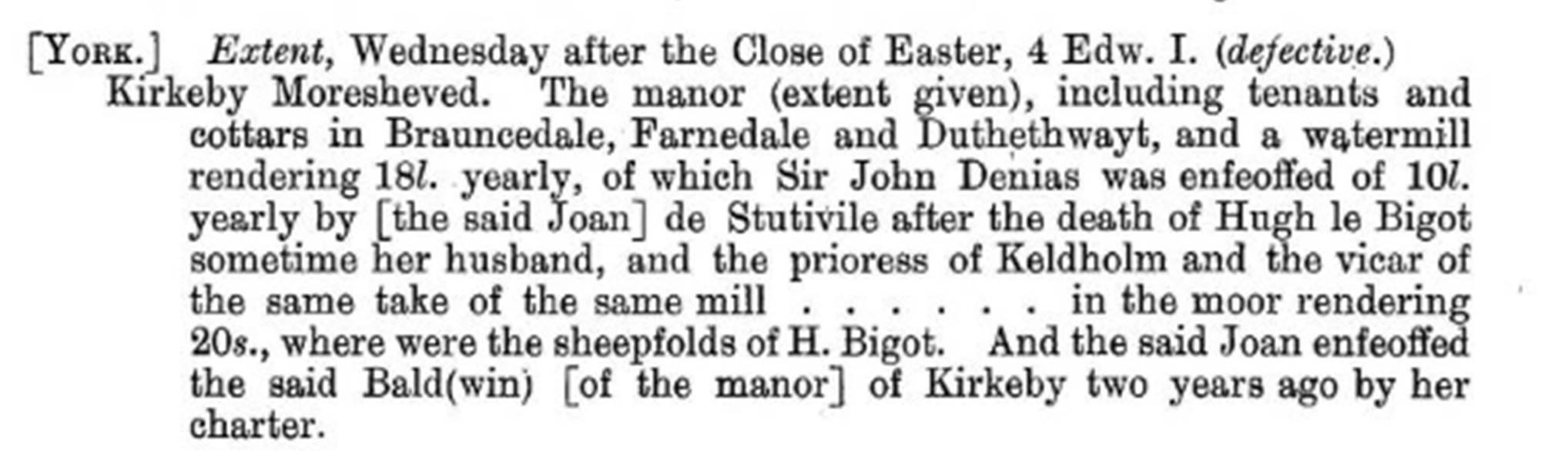
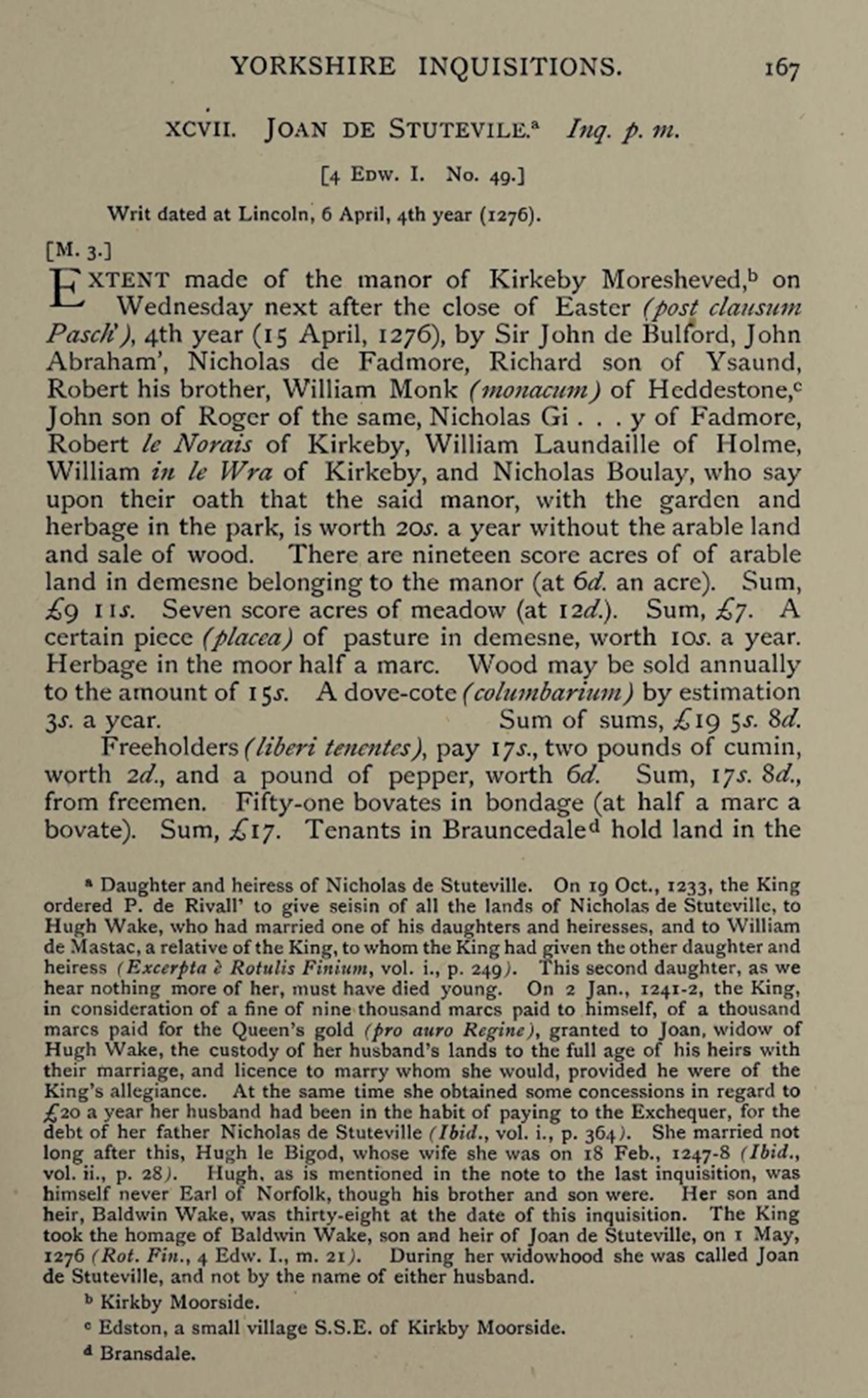
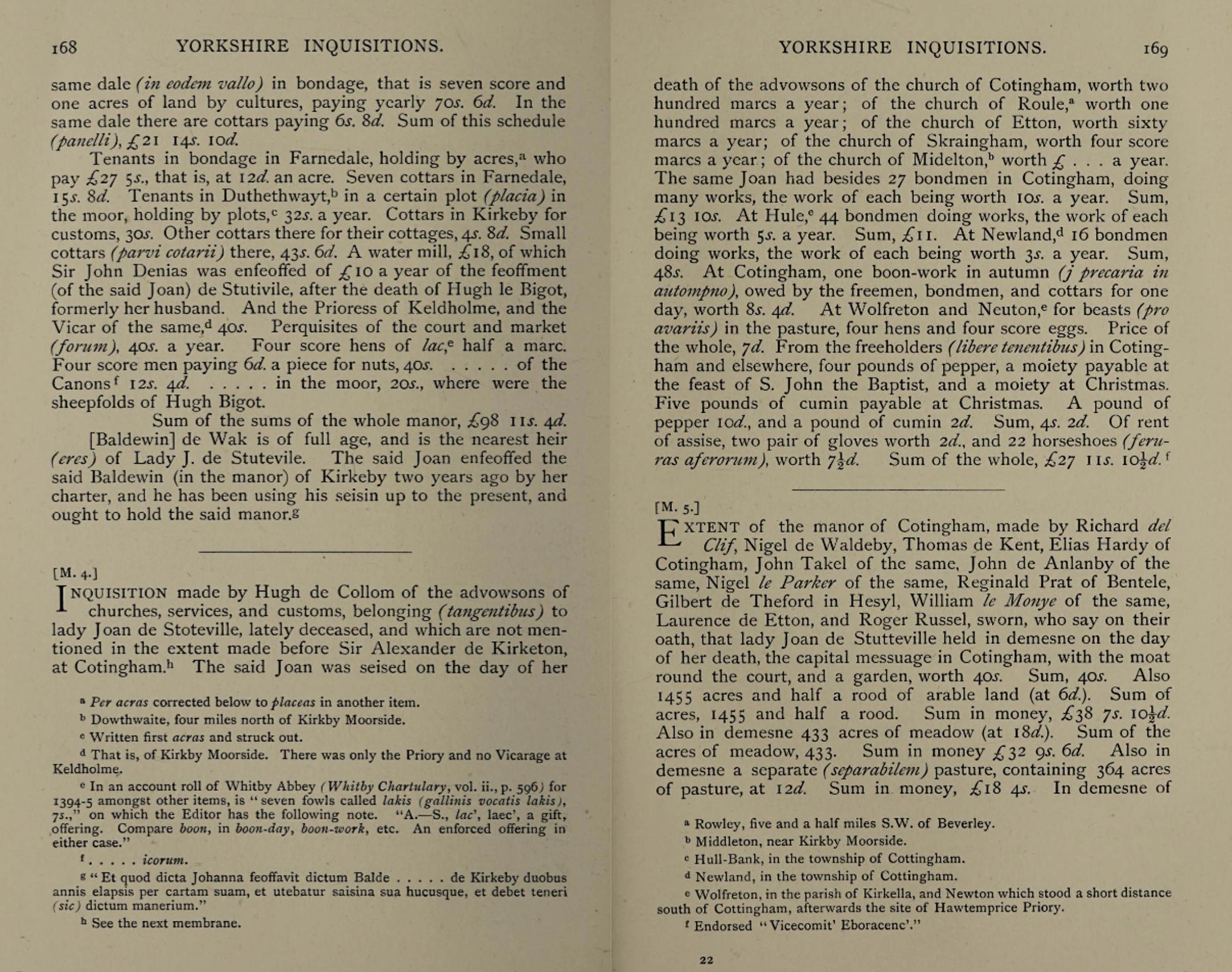
Inquisition Post Mortem taken after Joan’s death in 1276 evidenced the extent
of settlement that had taken place. Bonded tenants paying a standard rent of 1s
per acre provided an income of £27 5s 0d (Yorkshire Archaeological Record
Series, Volume 12 Yorkshire inquisitions of the reigns of Henry III and
Edward I (1241-83), vol 1, ed William Brown, 1892, page 167 to 168, the National Archives C 133/15/2,
Calendar of Inquisitions Post Mortem, Volume II,
Edward I, 1906, page 120).
With
20s to a pound, this evidenced a cultivated area of 545 acres in Farndale.
Seven cottars in Farndale raised another 15s 8d and Duthethwayt
was listed separately as producing 32s per annum from holdings held by plot
rather than by acres. The record also evidenced that the watermill, now
enfeoffed (ie giving freehold property in exchange
for a pledge of service under the feudal system) to Sir John Denias, by then
rendered 18 l (libra or pound - the £ sign developed from an elaboration of L)
per annum.
A
simple calculation based on these figures gives us a total of 545 acres farmed
by the 'tenants in bondage’, presumably villeins, and about 16 acres farmed by
the seven 'cottars'. If this acreage is compared with that computed by the
surveyor of Farndale (Map of Farndale surveyed by John Tuke with accompanying
Field Book, now in Duncombe Park Estate office, Hemlsley) in
1781-2, namely 4,711 acres, it will be seen that, however inaccurate the first
figure may be (and we have no reason to suspect its accuracy), the land under
cultivation in the dale must have been quite a small part of its total area. No
indication is given in this inquisition of the number of tenants in Farndale. (Notes on the History of Farndale in the Middle Ages, Arthur H Whitaker, Ryedale Historian, Volume 1,
1965, page 11).
In East
Bransdale, bondmen held another 141 acres paying a standard rent of 6d per
acre, but they are said to hold by cultures.
The
significance of these terms is explained in the IPM of
Joan’s Son, Baldwin Wake, taken only six years later in 1282 (see FAR00020),
where the bondmen are said to hold their land not by the bovate of land, but
by more or less. Thus standard bovate holdings, usually in the lowlands and
in some of the older settled moorland villas, had been dispensed with by 1282,
in favour of holdings of varied size rented by the acre.
The
regnal year 4 Edward 1 is 1276. See https://www.justcite.com/kb/search-technology/regnal-years/.
To the barons of the exchequer. Order to supersede
the distraint upon Baldwin Wak for the relief due from him to the king for his
lands by the death of Joan de Stuteville, his mother, of whom he is the heir,
as the king has granted respite to him until Michaelmas next.
To the
sheriff of Cumberland, escheator in the same county. Order not to intermeddle
further with the following lands, and to restore to Baldwin Wak anything
received from the issues thereof since 1 May, in the fourth year of the king's
reign, as the king took his homage on that day for the lands whereof Joan de
Stotevil), his mother, was seised in her demesne as
of fee at her death, and has rendered the said lands to him.
(Close
Rolls of the reign of Henry III, 1272 to
1279, page 281).
‘Tenants in bondage, holding by acres, who pay £27 5s,
that is 12d per acre. Seven cottars in Farndale, pay 15s 8d, tenants in Duthenwayt in a certain plot in the moor, holding
by plots 32s per year.’
This gives some idea of the number of people earning enough to pay
some sort of rent in Farndale in 1276.
It seems likely that one farm was Lady Wake’s Green Farm, later
referred to as wakelevedy in the 1301 tax
return.
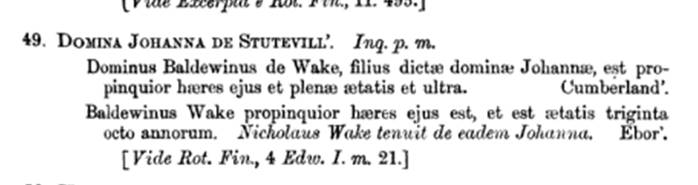
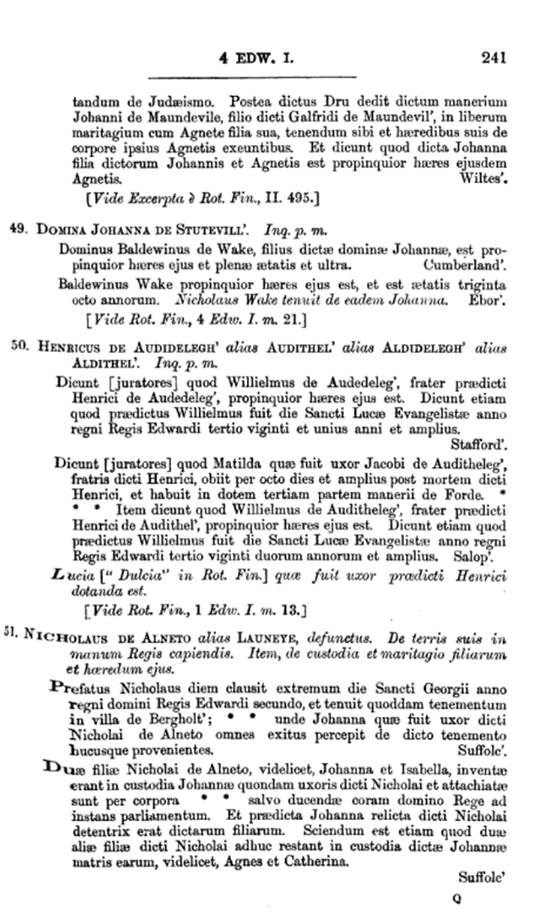
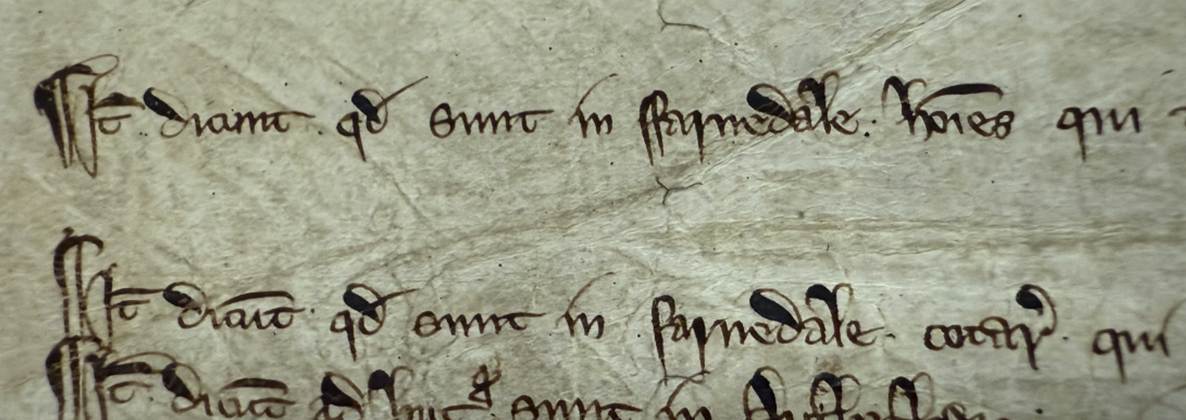
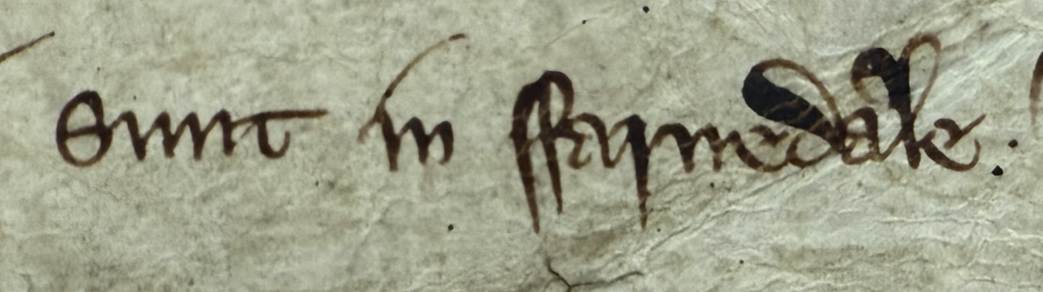
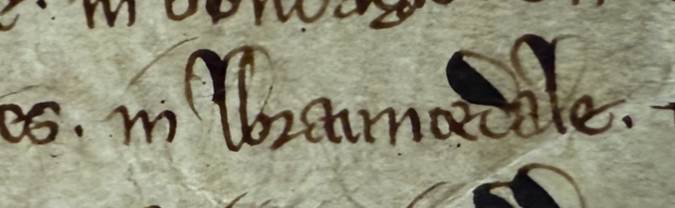
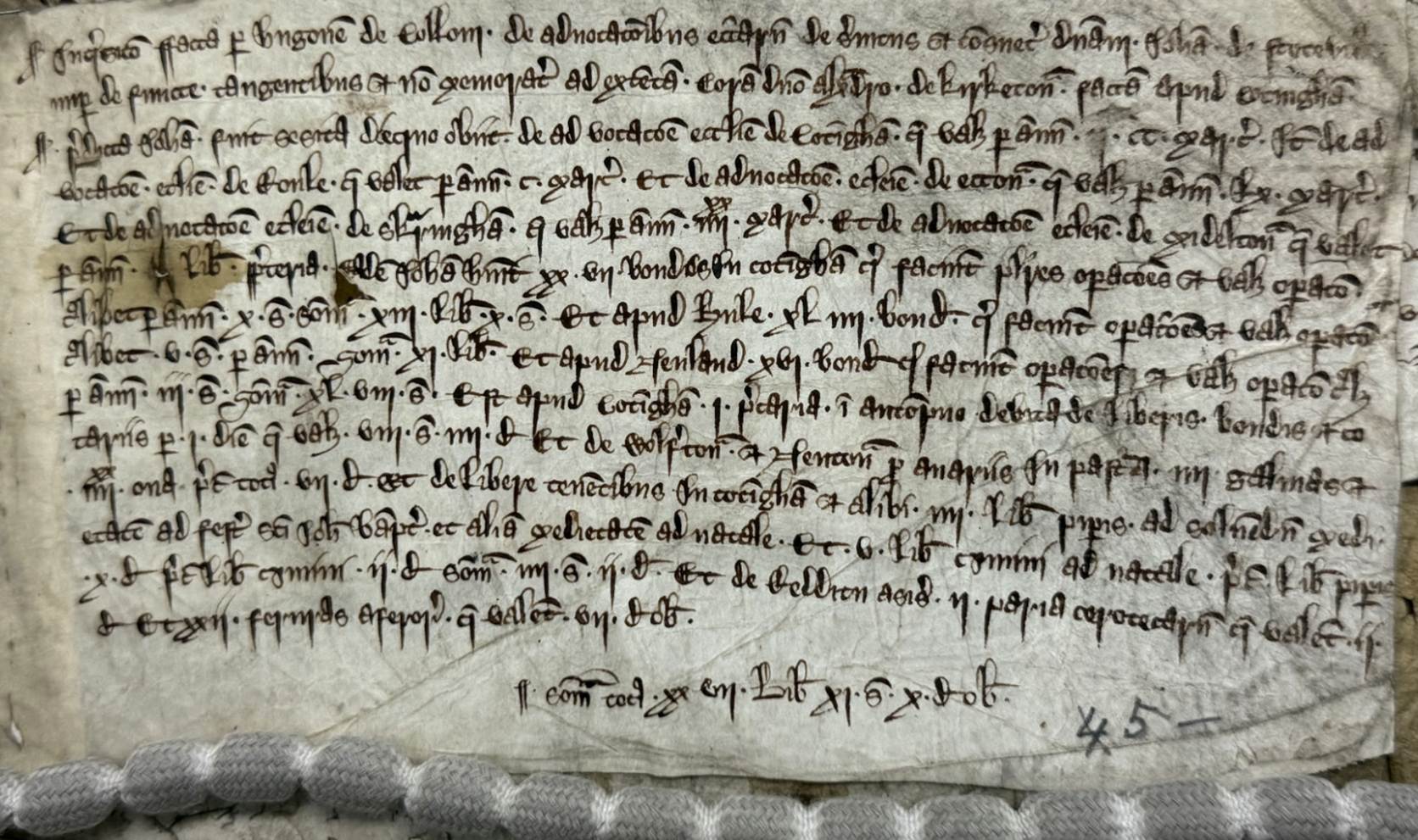
The Inquisition was also listed in 4 Edward I, interestingly with
specific reference in the summary to Farnedalle
(Calendarium inquisitionum post mortem sive escaetarum, Volume 1
(1216-1327), page 59 (View 66)).
The Deed can be viewed at the National
Archives C 133/15/2.
1277
To the
barons of the exchequer. Order to respite until otherwise ordered all debts
exacted by summons of the exchequer from Baldwin Wake, who is going with the
king in his expedition to Wales (Close Rolls of the reign of Henry III, 1272 to 1279, page
377).