The Hoover Dam
Historical and geographical information
|
Return to the Home Page of the Farndale Family
Website |
The story of one family’s journey through two
thousand years of British History |
The 83 family lines into which the family is divided.
Meet the whole family and how the wider family is related |
Members of the historical family ordered by date of
birth |
Links to other pages with historical research and
related material |
The story of the Bakers of Highfields, the Chapmans,
and other related families |

Dates are in red.
Hyperlinks to
other pages are in dark
blue.
Headlines are in brown.
References and
citations are in turquoise.
Context and local
history are in purple.
In 1932, still a finish carpenter, Jim Farndale (FAR00607) had
become Business Agent for the Carpenter's Union. It was in this year that he
first became involved in the Boulder Dam project. By 1935 Jim had proved
himself to be an efficient
administrator through his work with the Carpenter's Union and the Boulder Dam
Project. He developed a reputation for reliability and honesty.
Accordingly, in 1936, he was elected to
the Nevada State Assembly.
The Hoover Dam (Originally the Boulder Dam Project)
Hoover
Dam is a concrete arch gravity dam in
the Black Canyon of the Colorado River, on the border between Nevada and Arizona.
It was constructed between 1931 and 1936 during the Great Depression and
was dedicated on 30 September 1935 by President Franklin D. Roosevelt. Its construction was the
result of a massive effort involving thousands of workers, and cost over one
hundred lives. Originally known
as Boulder Dam from 1933, it was officially renamed Hoover Dam,
for President Herbert Hoover,
by a joint resolution of Congress in 1947.
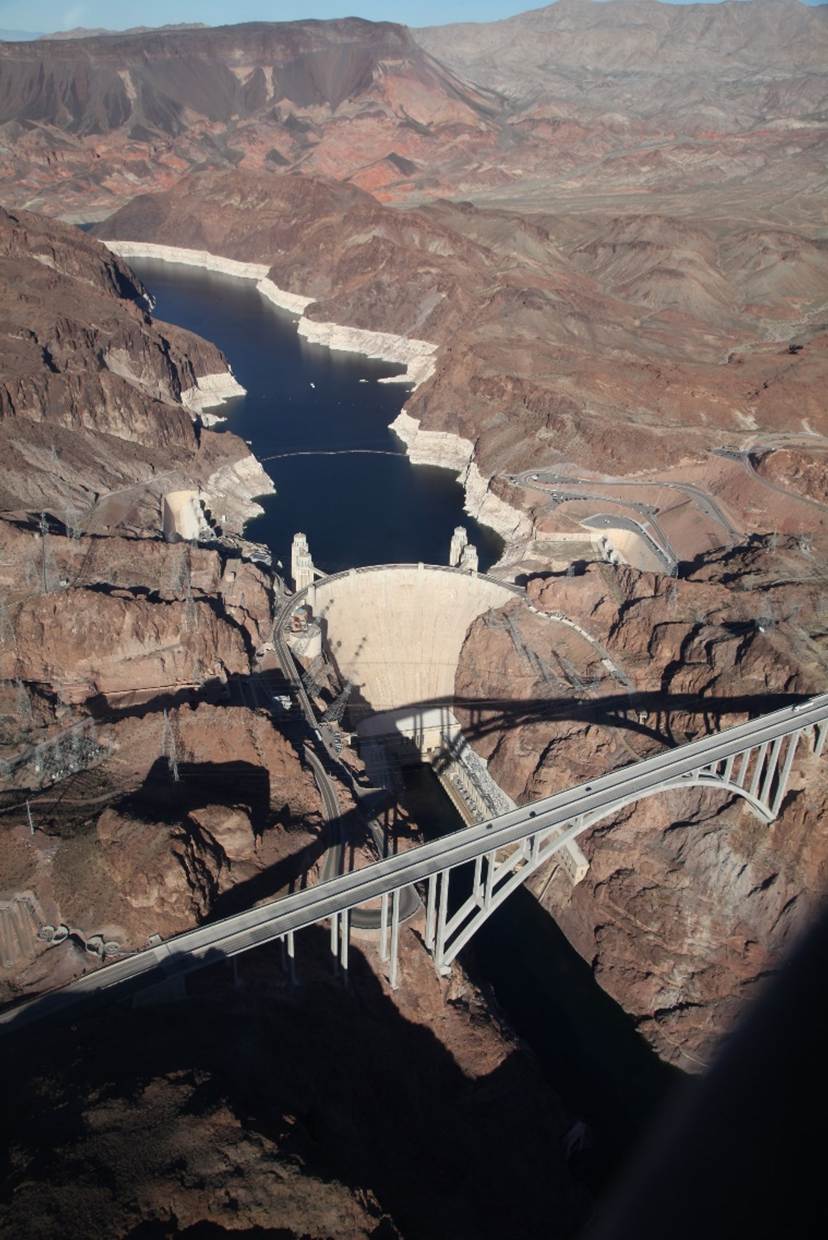
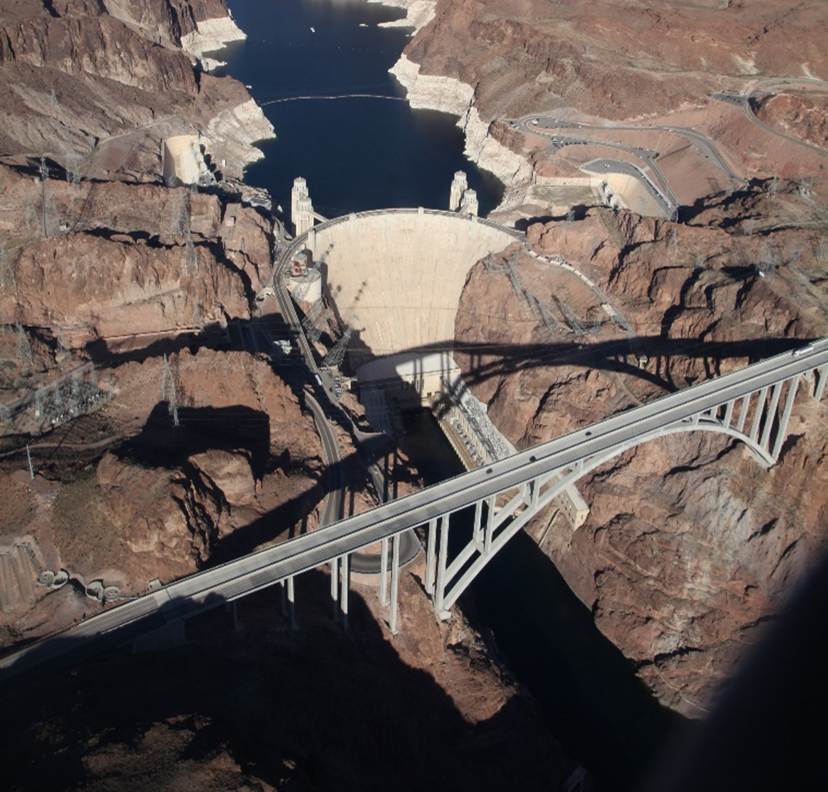
Flying over the Hoover dam in
2016
Since
about 1900, the Black Canyon and nearby Boulder Canyon had been investigated
for their potential to support a dam that would control floods, provide
irrigation water and produce hydroelectric power. In 1928, Congress
authorized the project. The winning bid to build the dam was submitted by a
consortium called Six Companies Inc. Construction on the dam
began in early 1931. Such a large concrete structure had never been built
before, and some of the techniques were unproven. The torrid summer weather and
lack of facilities near the site also presented difficulties. Nevertheless, Six
Companies turned the dam over to the federal government on 1 March 1936, more
than two years ahead of schedule.
Hoover
Dam impounds Lake Mead, the largest reservoir in the United States by
volume. The dam is located near Boulder City, Nevada, a municipality originally
constructed for workers on the construction project, about 30 mi
(48 km) southeast of Las Vegas, Nevada. The dam's generators provide power for
public and private utilities in Nevada, Arizona, and California.


River
view of the future dam site, c. 1904 Hoover Dam architectural
plans
Workers on a "Jumbo Rig"; used for drilling Hoover Dam's
tunnels
Soon
after the dam was authorized, increasing numbers of unemployed people converged
on southern Nevada. Las Vegas, then a small city of some 5,000, saw between
10,000 and 20,000 unemployed descend on it.
A
government camp was established for surveyors and other personnel near the dam
site; this soon became surrounded by a squatters' camp. Known as McKeeversville, the camp was home to men hoping for work on
the project, together with their families. Another camp, on the flats
along the Colorado River, was officially called Williamsville, but was known to
its inhabitants as "Ragtown".
When
construction began, Six Companies hired large numbers of workers, with more
than 3,000 on the payroll by 1932 and with employment peaking at 5,251 in
July 1934. "Mongolian" (Chinese) labor
was prevented by the construction contract, while the number of African
descent employed by Six Companies never exceeded thirty, mostly
lowest-pay-scale laborers in a segregated crew, who were issued separate water
buckets.
As
part of the contract, Six Companies, Inc. was to build Boulder City to house
the workers. The original timetable called for Boulder City to be built before
the dam project began, but President Hoover ordered work on the dam to begin in
March 1931 rather than in October. The company built bunkhouses, attached
to the canyon wall, to house 480 single men at what became known as River
Camp. Workers with families were left to provide their own accommodations until
Boulder City could be completed, and many lived in Ragtown. The
site of Hoover Dam endures extremely hot weather, and the summer of 1931 was
especially torrid, with the daytime high averaging 49 °C). Sixteen
workers and other riverbank residents died of heat prostration between
25 June and 26 July 1931.
The Industrial Workers of the World (“IWW”
or "Wobblies"), though much-reduced from their heyday as militant
labour organizers in the early years of the century, hoped to unionize the
Six Companies workers by capitalizing on their discontent. They sent eleven
organizers, several of whom were arrested by Las Vegas police. On 7
August 1931, the company cut wages for all tunnel workers. Although the
workers sent away the organizers, not wanting to be associated with the
"Wobblies", they formed a committee to represent them with the
company. The committee drew up a list of demands that evening and presented
them to Crowe the following morning. He was noncommittal. The workers hoped
that Crowe, the general superintendent of the job, would be sympathetic;
instead he gave a scathing interview to a newspaper, describing the workers as
"malcontents".
On
the morning of 9 August 1931, Crowe met with the committee and told them that
management refused their demands, was stopping all work, and was laying off the
entire work force, except for a few office workers and carpenters. The workers
were given until 5 p.m. to vacate the premises. Concerned that a violent
confrontation was imminent, most workers took their paychecks
and left for Las Vegas to await developments. Two days later, the
remainder were talked into leaving by law enforcement. On 13 August 1931, the
company began hiring workers again, and two days later, the strike was
called off. While the workers received none of their demands, the
company guaranteed there would be no further reductions in wages. Living
conditions began to improve as the first residents moved into Boulder City
in late 1931.
A
second labour action took place in July 1935, as construction on the
dam wound down. When a Six Companies manager altered working times to force
workers to take lunch on their own time, workers responded with a strike.
Emboldened by Crowe's reversal of the lunch decree, workers raised their demands
to include a $1-per-day raise. The company agreed to ask the Federal government
to supplement the pay, but no money was forthcoming from Washington. The strike
ended.
Before
the dam could be built, the Colorado River needed
to be diverted away from the construction site. To accomplish this, four
diversion tunnels were driven through the canyon walls, two on the Nevada side
and two on the Arizona side. These tunnels were 56 ft (17 m)
in diameter. Their combined length was nearly 16,000 ft, or more than
3 miles (5 km). The contract required these tunnels to be completed
by 1 October 1933, with a $3,000-per-day fine to be assessed for any delay. To
meet the deadline, Six Companies had to complete work by early 1933, since only
in late fall and winter was the water level in the river low enough to safely
divert.
Tunneling began at the lower portals of the Nevada tunnels in
May 1931. Shortly afterward, work began on two similar tunnels in the Arizona
canyon wall. In March 1932, work began on lining the tunnels with concrete. First the base, or invert, was
poured. Gantry cranes, running on rails through the entire length of each
tunnel were used to place the concrete. The sidewalls were poured next. Movable
sections of steel forms were used for the sidewalls. Finally, using pneumatic
guns, the overheads were filled in. The concrete lining is 3 feet (1 m)
thick, reducing the finished tunnel diameter to 50 ft
(15 m). The river was diverted into the two Arizona tunnels on 13
November 1932; the Nevada tunnels were kept in reserve for high water. This was
done by exploding a temporary cofferdam protecting the Arizona
tunnels while at the same time dumping rubble into the river until its natural
course was blocked.
Following the completion of the
dam, the entrances to the two outer diversion tunnels were sealed at the
opening and halfway through the tunnels with large concrete plugs. The
downstream halves of the tunnels following the inner plugs are now the main bodies
of the spillway tunnels. The inner diversion tunnels were plugged at
approximately one-third of their length, beyond which they now carry steel
pipes connecting the intake towers to the power plant and outlet
works. The inner tunnels' outlets are equipped with gates that can be
closed to drain the tunnels for maintenance.
To protect the construction site
from the Colorado River and to facilitate the river's diversion, two cofferdams
were constructed. Work on the upper cofferdam began in September 1932, even
though the river had not yet been diverted. The cofferdams were designed
to protect against the possibility of the river's flooding a site at which two
thousand men might be at work, and their specifications were covered in the bid
documents in nearly as much detail as the dam itself. The upper cofferdam was
96 ft (29 m) high, and 750 feet (230 m) thick at its base,
thicker than the dam itself. It contained 650,000 cubic yards (500,000 m3)
of material.
When the cofferdams were in
place and the construction site was drained of water, excavation for the dam
foundation began. For the dam to rest on solid rock, it was necessary to
remove accumulated
erosion soils and other loose materials in the riverbed until
sound bedrock was reached. Work on the foundation excavations was completed in
June 1933. During this excavation, approximately 1.1M m3 of material was
removed. Since the dam was an arch-gravity type, the side-walls of the canyon
would bear the force of the impounded lake. Therefore, the side-walls were
excavated too, to reach virgin rock, as weathered rock might provide pathways
for water seepage. Shovels for the excavation came from the Marion Power Shovel Company.
The men who removed this rock
were called "high scalers". While suspended from the top of the
canyon with ropes, the high-scalers climbed down the canyon walls and removed
the loose rock with jackhammers and dynamite.
Falling objects were the most common cause of death on the dam site; the high
scalers' work thus helped ensure worker safety. To protect themselves
against falling objects, some high scalers took cloth hats and dipped them in
tar, allowing them to harden. When workers wearing such headgear were struck
hard enough to inflict broken jaws, they sustained no skull damage. Six
Companies ordered thousands of what initially were called "hard boiled
hats" (later "hard hats") and strongly encouraged their use.
The cleared, underlying rock
foundation of the dam site was reinforced with grout, called a grout curtain.
Holes were driven into the walls and base of the canyon, as deep as 46 m
into the rock, and any cavities encountered were to be filled with grout. This
was done to stabilize the rock, to prevent water from seeping past the dam
through the canyon rock, and to limit "uplift"—upward pressure from
water seeping under the dam. The workers were under severe time constraints due
to the beginning of the concrete pour, and when they encountered hot springs or
cavities too large to readily fill, they moved on without resolving the
problem. A total of 58 of the 393 holes were incompletely filled. After
the dam was completed and the lake began to fill, large numbers of significant
leaks into the dam caused the Bureau of Reclamation to look into the situation.
It found that the work had been incompletely done, and was based on less than a
full understanding of the canyon's geology. New holes were drilled from
inspection galleries inside the dam into the surrounding bedrock. It took
nine years (1938–47) under relative secrecy to complete the supplemental grout
curtain.
The first concrete was poured
into the dam on 6 June 1933, 18 months ahead of schedule. Since
concrete heats and contracts as it cures, the
potential for uneven cooling and contraction of the concrete posed a serious
problem. Bureau of Reclamation engineers calculated that if the dam were to be
built in a single continuous pour, the concrete would take 125 years to cool,
and the resulting stresses would cause the dam to crack and crumble. Instead,
the ground where the dam would rise was marked with rectangles, and concrete
blocks in columns were poured, some as large as 50 ft square (15 m)
and 5 feet (1.5 m) high. Each five-foot form contained a series of
1-inch (25 mm) steel pipes; cool river water would be poured through the
pipes, followed by ice-cold water from a refrigeration plant.
When an individual block had cured and had stopped contracting, the pipes were
filled with grout.
Grout was also used to fill the hairline spaces between columns, which were
grooved to increase the strength of the joins.
The concrete was delivered in
huge steel buckets 7 feet high (2.1 m) and almost 7 feet in diameter;
Crowe was awarded two patents for their design. These buckets, which weighed 20
short tons (18 t) when full, were filled at two massive concrete plants on
the Nevada side, and were delivered to the site in special railcars.
The buckets were then suspended from aerial cableways which
were used to deliver the bucket to a specific column. As the required grade
of aggregate in the concrete differed
depending on placement in the dam (from pea-sized gravel to 9-inch or
23 cm stones), it was vital that the bucket be manoeuvred to the proper
column. When the bottom of the bucket opened up, disgorging 8 cu yd
(6.1 m3) of concrete, a team of men worked it throughout the form.
Although there are myths that men were caught in the pour and are entombed in
the dam to this day, each bucket deepened the concrete in a form by only an
inch, and Six Companies engineers would not have permitted a flaw caused by the
presence of a human body.
A total of 3,250,000 cubic yards
(2,480,000 cubic metres) of concrete was used in the dam before concrete
pouring ceased on 29 May 1935. In addition, 1,110,000 cu yd
(850,000 m3) were used in the power plant and other works. More than 582 miles
(937 km) of cooling pipes were placed within the concrete. Overall, there
is enough concrete in the dam to pave a two-lane highway from San Francisco to
New York. Concrete cores were removed from the dam for testing in 1995;
they showed that "Hoover Dam's concrete has continued to slowly gain
strength" and the dam is composed of a "durable concrete having a
compressive strength exceeding the range typically found in normal mass
concrete".[65] Hoover
Dam concrete is not subject to alkali–silica reaction (“ASR”), as
the Hoover Dam builders happened to use nonreactive aggregate, unlike that at
downstream Parker Dam, where ASR has caused measurable deterioration.
With most work finished on the
dam itself (the powerhouse remained uncompleted), a formal dedication ceremony
was arranged for 30 September 1935, to coincide with a western tour being made
by President Franklin D. Roosevelt. The morning of the
dedication, it was moved forward three hours from 2 p.m. Pacific time to
11 a.m.; this was done because Secretary of the Interior Harold L. Ickes had
reserved a radio slot for the President for 2 p.m. but officials did not
realize until the day of the ceremony that the slot was for 2 p.m. Eastern
Time. Despite the change in the ceremony time, and temperatures of
102 °F (39 °C), 10,000 people were present for the President's
speech, in which he avoided mentioning the name of former President Hoover, who
was not invited to the ceremony. To mark the occasion, a three-cent stamp
was issued by the United States Post Office Department bearing the name
"Boulder Dam", the official name of the dam between 1933 and
1947. After the ceremony, Roosevelt made the first visit by any American
president to Las Vegas.
Most work had been completed by
the dedication, and Six Companies negotiated with the government through late
1935 and early 1936 to settle all claims and arrange for the formal transfer of
the dam to the Federal Government. The parties came to an agreement and on 1
March 1936, Secretary Ickes formally accepted the dam on behalf of the
government. Six Companies was not required to complete work on one item, a
concrete plug for one of the bypass tunnels, as the tunnel had to be used to
take in irrigation water until the powerhouse went into operation.