Kilton Woods and Kilton Beck
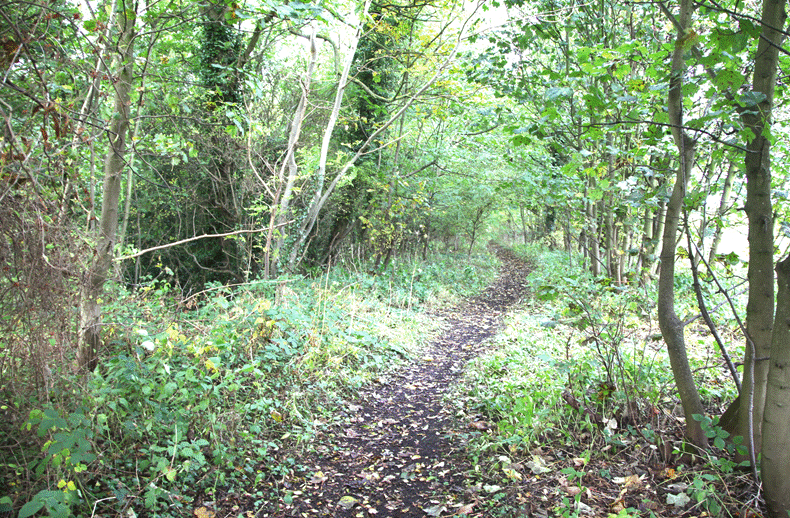
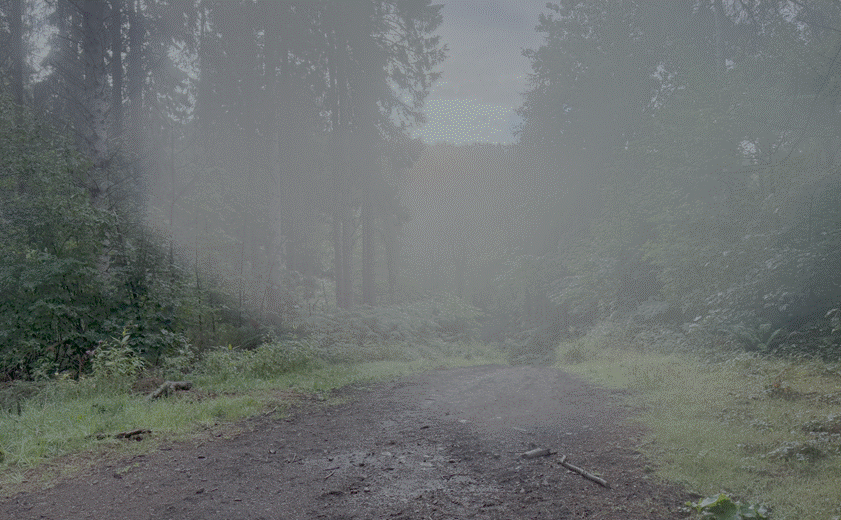
Kilton Woods, 2026
I remember planting, fifty years ago, the first
trees near the old castle walls, and they are now as lofty as their sires two
hundred years old. Here as I stand how reflection crowds my mind. There is no
corner of this wood unknown to me. I have traversed it a thousand times when a
boy. I have captured in it the owl, the crow, the cushat, the hawk, the cuckoo,
and every other forest bird, and also the squirrel, the weasel, the foumart,
the badger, the snake and the fox (John
Farndale)
|
Return to the Home Page of the Farndale Family
Website |
The story of one family’s journey through two
thousand years of British History |
The 83 family lines into which the family is divided.
Meet the whole family and how the wider family is related |
Members of the historical family ordered by date of
birth |
Links to other pages with historical research and
related material |
The story of the Bakers of Highfields, the Chapmans,
and other related families |


Dates are in red.
Hyperlinks to
other pages are in dark
blue.
Headlines are in brown.
References and
citations are in turquoise.
Contextual
history is in purple.
In 1864, John
Farndale wrote:
Kilton is a small
village, but the vale in which it stands abounds with woodland scenery.
At a short distance stands the remains of the old castle of Kilton, which once
belonged to the Thwings, where centuries ago there were no doubt great doings;
but time here has wrought vast changes, and the history of this once important stronghold
is now nearly buried in oblivion.
From the ruins of
the castle there is a fine view of the vast forest in which it stands, with the
river crawling through blocks of huge stones till it reaches the sea at
Skinningrove. Here I remember planting, fifty years ago, the first trees
near the old castle walls, and they are now as lofty as their sires two
hundred years old. Here as I stand how reflection crowds my mind. There is no
corner of this wood unknown to me. I have traversed it a thousand times when a
boy. I have captured in it the owl, the crow, the cushat, the hawk, the
cuckoo, and every other forest bird, and also the
squirrel, the weasel, the foumart, the badger, the snake and the fox. How
often I have heard the retreat of the huntsman’s horn, like Joab at the
death of Absolom, and how exulted when three cheers proclaimed the death of
poor Reynard. I remember once the fox hard run by the Cleveland and Roxby hounds,
and he took refuge between the old castle walls and the ivy creeping between.
Here he kept safe till the hounds came up, when he boldly bounced in the very
face of his enemies, and was soon overcome. Mr J Codling, of Roxby, caught him
yet alive, and brushed him in the presence of Consett Dryden Esq., myself and a few others, and
we made the wood resound with three cheers.
Here in the spring time when Nature is bursting into new life and
beauty, and every hill is carpeted with wild flowers, when
the feathered choir sing in joyful and delightful concert, and the busy bee
with its drony tone passes and repasses, how sweety
it is to stand and admire the skill and muse the praise of Him who brought them
into being.
Kilton Woods
Here blooming
flowers, with fragrant lips,
Sweet pleasure
gives to me,
While happy birds
with gladsome voice
Now flirt from
tree to tree.
The river as it
onward flows
Its pleasant
winding way,
Sings with smiles
of calm content
Its message day
by day.
On mountain high and
valley low
The voice of God
I hear,
And by the sea,
the rippling sea,
I ever feel him near.
I gaze upon the
silent night
And in the
heavens above,
And in golden
letters, clear and bright,
The stars sing God is love.
The cuckoo with
her well known voice,
Sings ever as she
flies,
And joyful
tidings brings to all,
She never tells
us lies.
She sucks the
eggs of other birds,
Which makes her
voice more clear;
And when she
sings, gay spring is come
And summer’s
drawing near.
Petrifying springs,
depositing carbonate of lime, abound in this locality. Amongst the
most remarkable may be noticed a spring in Kilton Wood, a little to the south
of the castle, and a remarkable sulphurous spring, which issues from the
aluminous schistus on the banks of the beck near
Kilton Mill. One gallon of water of this spring was found to be seventy two garins heavier than a
gallon of distilled water. In the immediate vicinity of Kilton Castle there is also
another petrifying spring, depositing carbonate of lime.
(A Guide to Saltburn by the Sea and
the Surrounding District, With remarks on its
picturesque scenery, Fifth Edition, Dedicated to John Thomas Wharton Esq of
Skelton, By John
Farndale. Late of Skelton Castle Farm, Darlington, Printed by Charles W
Hird, 1864)