The Merchant Adventures of John Christopher Farndale
the Younger
(FAR00308)
Master Mariner of Whitby (1830 to 1868)
|
Return to the Home Page of the Farndale Family
Website |
The story of one family’s journey through two
thousand years of British History |
The 83 family lines into which the family is divided.
Meet the whole family and how the wider family is related |
Members of the historical family ordered by date of
birth |
Links to other pages with historical research and
related material |
The story of the Bakers of Highfields, the Chapmans,
and other related families |
John Christopher Farndale the Elder was probably the grandson of
John Farndale (FAR00136)
who sailed colliers with James Cook out of Whitby. It is likely John
Christopher Farndale was the son of Robert Farndale, also a master mariner, and
buried in the churchyard of Dracula fame at Whitby.
Of
his family of five, John’s eldest son, William Farndale (FAR00289)
also became a master mariner and continued to captain the William and Nancy.
The third son, John Christopher Farndale the Younger (FAR00308)
captained other ships.
They all lived lives of adventure, perils at sea, and travel. His second son,
Thomas Farndale was a ship’s broker’s clerk who died aged only 31. His
daughter, Mary Farndale, was a straw bonnet maker and married a master mariner
in Whitby. His fifth child, James Farndale, died an infant. This was a family
of mariners at the heart of the maritime coal industry in the mid Victorian
era. The second generation ventured widely around the North Sea (often called
the German sea at the time) and the Baltic and further south. But John died
young, at the age of only 35.
A brig is a type of sailing vessel defined by its rig: two masts
which are both square-rigged. Brigs originated in the second half of the 18th
century and were a common type of smaller merchant vessel or warship from then
until the latter part of the 19th century. In commercial use, they were
gradually replaced by fore-and-aft rigged vessels such as schooners, as owners
sought to reduce crew costs by having rigs that could be handled by fewer men.
In Royal Navy use, brigs were retained for training use when the battle fleets
consisted almost entirely of iron-hulled steamships. Brigs were prominent in
the coasting coal trade of British waters. 4,395 voyages to London with coal
were recorded in 1795. With an average of eight or nine trips per year for one
vessel, that is a fleet of over 500 colliers trading to London alone. Other
ports and coastal communities were also be served by colliers trading to
Britain's coal ports. In the first half of the 19th century, the vast majority
were rigged as brigs, and that rig was retained for longer in the northeast of
England.
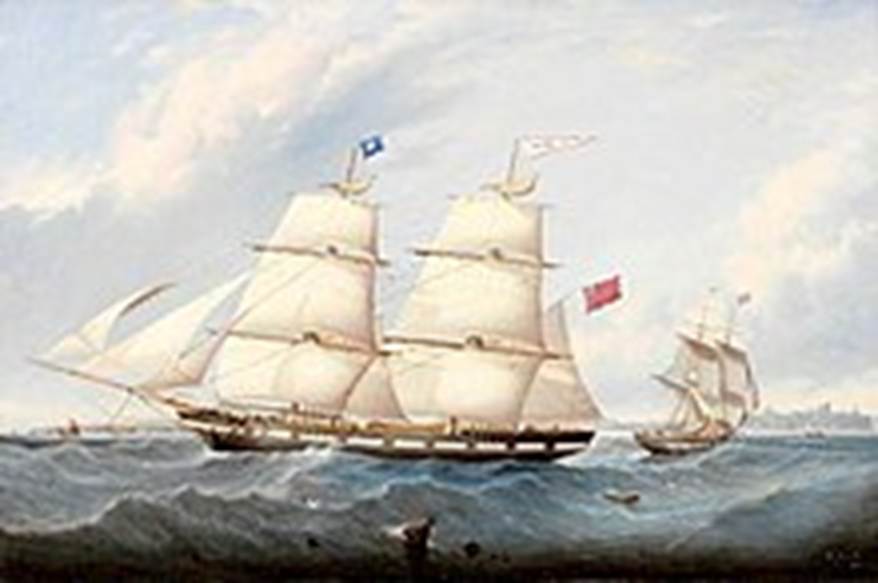
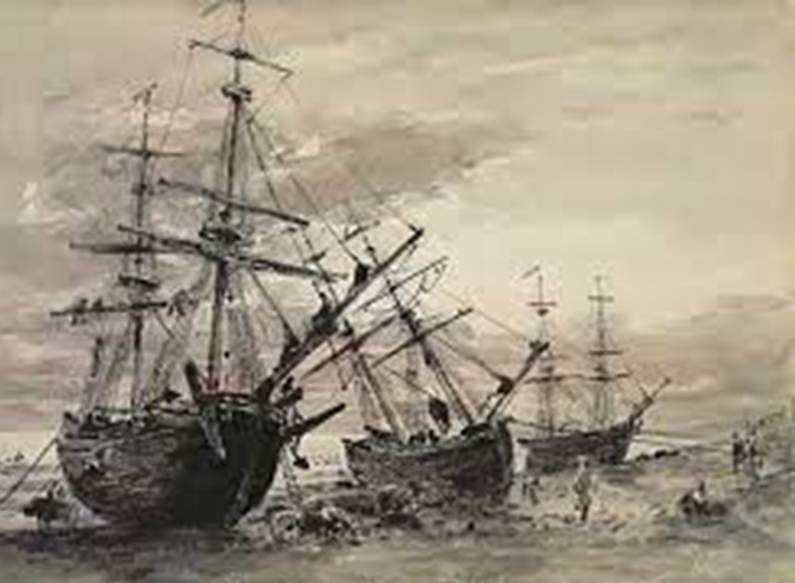
The Mary, a Brig of South Shields painted in 1855
The Traditional Song, the Collier Brig: Oh, the worst old ship
that ever set sail, Sailed out of Harwich on a windy day. Chorus: Stormy
weather, boys, stormy weather, boys, When the wind blows the barge will go. She
was built in Roman style, Held together with bits of twine. Skipper’s half Dutch
and he hasn’t got a clue, The crew were fourteen hands too few. Cook spilt the
dinner on the galley floor, Skipper caught his hand in the wheelhouse door. Off
Orford Ness we sprang a leak, Hear our poor old timbers creak. We steered our
way round Lowestoft next, The wind backed round to the sou-sou-west. Through
the Cockle to Cromer Cliff, Steering like a wagon with a wheel adrift. Up The
Humber and up to town, Pump, you devils, pump or drown. Then on a sandbank we
got stuck, Skipper’s drunk in the Dog and Duck. Up come a mermaid covered in
slime, We took her down the hold and we had a good time. We kept on course all
through the night, Nearly went aground at the Apex light. Coal was shot by a
Keadby crew, Bottom was rotten and it went right through. So when we saw the
brig was sunk, We went to the Barge and we all got drunk.
A master mariner is a licensed mariner who holds the highest grade of seafarer
qualification. He is thus given an unlimited master's license, with no limits
on the tonnage, power, or geographic location of the vessel that the holder of
the license is allowed to serve upon. A master mariner would therefore be
allowed to serve as the master of
a merchant ship of
any size, of any type, operating anywhere in the world, and it reflected
the highest level of professional qualification amongst mariners and deck
officers.
The
term master mariner has been in use at least since the thirteenth
century, reflecting the fact that in guild or livery company terms, such a
person was a master craftsman in
this specific profession, such as were also a master carpenter, master
blacksmith etc.
In
the British Merchant Navy a
master mariner who had sailed in command of an ocean going merchant ship was
titled “Captain”, although a
professional seafarer who held a restricted or limited master's certificate who
had sailed in command of a ship could also be titled captain.
Where
the movements of ships were recorded in the shipping news and other media, the
name of the ship was followed by the name of the Captain.
18
October 1830
John Christopher Farndale Junior,
son of John Christopher and Ann Farndale, was born in Whitby.
The younger John Christopher Farndale appeared to have got into
some trouble, as an apprentice mariner. The Hull Packet, 28 February
1845: CAUTION TO APPRENTICES.
JUSTICE ROOM, WHIOTBY. FEB 19. Before Thos Fishburn, and John Chapman, Esqrs.
On Saturday four sea apprentices, named Matthew Walker, John Christopher
Farndale, Isaac Wilson, and Thomas Hill, where charged with absenting themselves
from the ship Great Britain, belonging to Mr Joseph Tindale, of Whitby. The
charge was clearly proved by the master, and the lads failing to show any
justifiable cause for their misconduct, were committed to Northallerton for one
month’s hard labour. We hope this punishment will bring the young delinquents
to a sense of their duty, and act as a warning to others. It is notorious that
the owners of vessels in Whitby harbour, particularly the owner of the Great
Britain, have suffered considerably by the incorrigible conduct of their
apprentices; and Mr Tynedale is, in our opinion, worthy of praise for thus
stepping forward to put a check on such proceedings.
1853
By January 1853, John
Christopher Farndale was the captain of the collier brig, the John Stewart.
The Shipping and Mercantile Gazette,
13 January 1853: LOWESTOFT. Jan 12, SW by W,
fresh, cloudy … In Yarmouth Roads, 12 – the brig John Stewart, Farndale, from
Hartlepool for London, sailed Dec 25 …
From
his new captaincy of the John Stuart (probably spelt the John Stewart)(see
above), John Farndale was found to owe William Griffin, a seaman on that
vessel, the sum of £2 9s. The Shipping and Mercantile
Gazette, 21 March 1854: HARTLEPOOL POLICE. SHIP JOHN
STUART. John Farndale, master of the John Stuart, of Whitby, was charged before
J P Denton and RC Dixon Esquires, by
William Griffin, seamen on board the same vessel, with owing him 2l 9s.
Complainant had not signed articles when he was engaged, and the dispute was as
to the amount now due to him. The bench ordered 14s to be paid to Griffin.
1854
In February 1854 John Christopher Farndale was
captain of the John Stewart again, arriving in Hamburg. The Shipping and Mercantile
Gazette, 25 March 1854: HAMBURG. Arrived (March 21) …
John Stewart, Farndale, from Hartlepool …
1856
John Chrtsiopher Farndale captained the
Caspian of Whitby to Nyhamn (a harbour in Norway between Kristiansand and
Oslo on its sourthern shore). Lloyd’s List, 1 December 1856: LONDON. Entered
inwards, November 29 … NYHAM, Caspian, Farndale, B178 City Cl, Chapman … The North and South
Shields Gazette and Northumberland and Daily Advertiser, 4 December 1856: The brig Caspian,
Farndale, of Whitby, from Nyhamn, 22 days, was off Aldbro’ on the 27th ult … The Hull Daily News, 6 December 1856: LONDON. Nov 29. … Caspian,
Farndale, of Whitby, from Nyham …
1857
There was trouble for John
Christopher Farndale Junior, as captain of the Marmion. The Newcastle Journal, 22
August 1857: MARINE INTELLIGENCE. SHIELDS,
August 19. … The Marmion, Farndale, from Newcastle for Abo, put into Gothenburg
on Friday with damage, having been struck by lightning …
And more trouble for John
Farndale and the Marmion, two months later when he lost his ship and
cargo off Osel. Osel (now called Sarrremaa) is an island at the mouth of the Bay of Riga,
off modern day Estonia. (For interest, in 1719 Russia won a naval victory
against Sweden in the Great Northern War at the island.) The Newcastle Courant, 16 October 1857: Riga, October 5. The Marmion, Farndale, from Newcastle
for Abo, with coals, was stranded on the coast of Osel,
in the evening of September 27, ship and cargo lost, but stores saved.
The Newcastle Daily
Chronicle, 22 March 1860: ENTERED OUTWARDS. … Ada
(180), Farndale, Hamburg …
The Cambridge Independent
Press, 21 July 1860: WISBECH SHIP NEWS – JULY
18. ARRIVED. Ada, Farndale, from Narva
… Narva is in modern day Estonia, so John Farndale seems to have been sailing
regularly to the Baltic states and Russia delivering coal at this time.
John Christopher married
Christiana Ainslie of Wisbech on 3 July 1857. He had presumably met her on his
voyages through the port of Wisbech.
John trasnported
coals for Lotinga & Co. There was a Lotinga family in Newcastle at the
time, who were part of the Jewish community. Lotinga & Co appear to have
been shipping brokers based in Newcastle. The Newcastle Courant, 17
August 1860: Tuesday, August 14 … Ada,
Farndale, Cronstadt, 109 chs
coals, Lotinga & Co. The Newcastle Journal, 18 August
1860: Ada, Farndale, Cronstadt, 109 chs coals, Lotinga
& Co …
In August 1860, John sailed up the Baltic, via Elsinore to St
Petersburg in Russia. The Newcastle Courant, 31
August 1860: SOUND LIST, August 24, Ada,
Farndale, from Newcastle to Petersburg. The Shields Daily Gazette,
30 August 1860: ELSINORE. Aug … 25 – Arrived … Ada, Farndale, from Shields, for
St Petersburg …
The Shields Daily Gazette,
13 September 1860: CRONSTADT. Sept 1. Arrived …
Ada, Farndale, from Shields …
Lloyd’s List, 27
September 1860: WYBURG (Sept 21) Arrived …
Sept 18, Ada, Farndale, Cronstadt …
1861
The Public Ledger and Daily
Advertiser, 17 January 1861 shows that John Christopher Farndale captained the Ada
and arrived in Hartlepool from Dunkirk on 13 Jauary 1861.
The Newcastle Journal, 5
April 1861 shows that John Christopher Farndale captained the Ada
and arrived in South Shields from Hamburg.
The Cambridge Independent
Press, 6 July 1861 shows that John Christopher Farndale captained the Ada
and arrived with ‘deals’ (this may be a typo for coal) in Wisbech from Narva.
The Newcastle Guardian and
Tyne Mercury, 10 August 1861 shows that John Christopher Farndale captained the Ada
and travelled from South Shields to Petersburg.
The Shipping and
Mercantile Gazette, 1 February 1862 shows that
on 31 January 1862 John Christopher Farndale and the Ada were
listed amongst the Colliers that arrived on 31 January at Gravesend.
The Shipping and
Mercantile Gazette, 6 March 1862 shows that on 4 March 1862 John Christopher Farndale captained the Ada
and left West Hartlepool for Hamburg.
Lloyd’s List, 4 April 1862 shows that on 1 April 1862 John Christopher Farndale captained the Ada
of Whitby arrived in Hamburg.
The Shipping and
Mercantile Gazette, 23 April 1862 shows that on 19 April 1862 John Christopher Farndale captained the Ada
and arrived at Newcastle from Cronstadt.
The Newcastle
Courant, 23 May 1862 shows that on 14 May 1862 John Christopher Farndale captained the Ada
from Newcastle to Cronstadt.
The Newcastle
Guardian and Tyne Mercury, 14 June 1862 shows that on 1 June 1862 John Christopher Farndale captained the Ada
and arrived at Cronsdtadt.
Lloyd’s List, 24 July 1862 shows that on 20 July 1862 John Christopher Farndale captained the Ada
and arrived at Elsinore having travelled from Riga bound for Dover.
The Kentish Gazette
of 19 August 1862 reported the
proceedings of the Dover Police Court on Friday 9 August 1862 before Mayor E F Astley Esq and L Stride Esq:
ASSAULT ON THE HIGH SEAS
Benjaim Burvill, a mariner, was charged on a
summons with having, on the 9th inst, assaulted Edward
Sneller, another seafaring man, on board a British Ship called the
Ada, on the high seas near the South Foreland. Mr Fox appeared as attorney
for the defendant, and at his request the witnesses in the case were ordered
out of Court.
Edward Sneller stated that he lived at East cliff
and was a boatman. On Saturday evening last, about half past six or seven
o’clock, he boarded the brig Ada off South Foreland. He asked the
captain if he were bound for Dover with a cargo for Mr Fennis. The captain
answered ‘No’ and asked if witness were a ‘branch pilot’. Witness
said he was not, whereupon Burvill stepped forward and assured the
captain that he was a branch pilot. On hearing this, he said to the
captain, “He is no more a branch pilot than I am,” when Burvill
instantly raised his fist and gave witness a blow, which he received at
the back of the left ear, and which sent him reeling. He told Burvill he
should summon him to court for striking him on board a ship on the high seas,
and that he should subpoena the captain as a witness.
Cross examined, Did not have a few words with
Burvill – I never spoke to him. I got to the vessel first, but the captain gave
charge of the vessel to noone until Burvill declared that he was a branch
pilot, and ordered the jack to be hauled down. Burvill took charge of the ship
after I left it. Mr Fox: What made you leave the ship? Witness: Is that a fair
question to ask, gentlemen? – Mr Fox: Yes, you must answer it please – Witness:
I left the ship because I was not a branch pilot – Mr Fox: Then I ask you, if
you left the ship knowing you were not a branch pilot, what made you go on
board the vessel? – Witness: Why, there is a large class of men like
myself who do go aboard ships, and if a captain wants a man to assist him
into the harbour he is at liberty to have his services. Mr Fox: Then it was
not necessary for you to be a branch pilot to take the vessel into harbour?
Witness: No – Mr Fox: When you found defendant in charge of the ship you
thought it your business to tell the captain that he was not a branch pilot? –
Witness: Defendant was not in charge of the ship; he assumed the authority.
When this blow was struck he was leaning against the rail doing nothing. There
was a jack flying when I saw the vessel. It was taken down after Burvill
ordered the captain to haul it down. To the Court: The jack was flying at
the fore-top-gallant-mast head. Mr Fox: I suppose you wanted to be employed
instead of Burvill; that was the fact of the matter. – Witness: The fact of it
is, that I wanted to earn an honest livelihood like any other man. – Mr Fox:
Will you swear that he struck you? Is it not the truth that he gave you a
little bit of a push? – Witness: He struck me sir. I felt it for three days
afterwards, and was unable to eat any food on that side.
J C Farndale, the master of
the ship Ada,
said that on Thursday moring the complainant and defendant boarded his ship. He
believed the former was first on deck. He asked him if he was for Dover.
Witness made no reply, but walked to the lee side of the deck. Defendant then
came alongside, and as he had more the look of a pilot, and came in a
better class of boat (complainant’s havng much the appearance of a leisure
boat) witness responded to his inquiry whether he was bound for Dover, by
returning an affrmative answer. After that he asked Burvill if he were a branch
pilot, and he told him ‘yes’, and as they were crossing to the starboard side
of the deck he followed up the question with another, namely, if he could order
the jack to be hauled down, which he also answered satisfactorily. Upon hearing
that complainant said, “This man is no more a branch pilot than I am,” and then
followed the assault. As a reason for his peculiarity in putting the questions
he did, the witness explained that he had been warned that there was a
parcel of hovellers, who palmed themselves off as branch pilots with
a view to getting handsomely paid for taking vessels into port. Mr Fox (to the
witness): When this conversation took place about the jack, and Burvill ordered
it to be hauled down, you considered that he was engaged? Witness: I considered
that he was a branch pilot, and that the other man was not. - Mr Fox: You considered he was in charge of
the vessel? Yes after the jack was hauled down.
Mr Fox said he was perfectly satisfied from
the evidence of Sneller and the captain that an assualt had been committted.
It appeared from the latter’s statement however, that he regularly engaged the
defendant to pilot his vessel into port, who no doubt was very much annoyed at
the attempt made by the complainant to take bread out of his mouth. They all
knew that there was not too much for boatmen to do in this neighbourhood, and
perhaps they were not quite so amiable one towards aother as they might be. He
hoped, therefore, under all the circumstaces, that the magistrates would feel
the justice of the case met by passing a lenient sentence.
The Bench adjudged defendant to pay a fine of 10s
and costs.
A shorter version also printed in the Dover
Express under the headline ‘Unlicensed Pilots’. This article included a
slightly more understandable summary of the position taken for the defence at
the end: “Mr Fox did not deny the assult, but submitted that Sneller had
offered Burvill provocation,and that under the circumstances the smallest
penalty might be considered sufficient. The Magistrates however, thought the
defendant quite unjustified in what he had done, and fined him 10s and 12s
costs. The money was paid.”
Lloyd’s List, 26 November 1862 shows that on 22 November 1862 John Christopher Farndale captained the Ada
and arrived at Elsinore from Wyburg bound for London.
A Report in the London
Evening Standard, 5 December 1862: Whitby, Dec 3 – The two vessels reported
yesterday at anchor in Whitby Roads are still riding; they have not had any
communication with the shore, the sea being too heavy on the bar to venture
out. The one reported yesterday as being the Ada Farndall (sic) is now said to be the Wandererer, from
Wyburg to Wisbech.
The Public Ledger and
Daily Advertiser, 13 December 1862 shows that on 12 December 1862 John Christopher Farndale captained the Ada
and ‘entered inwards’, with reference to the customs house, via Wyburg and the
Surrey Canal. Their brokers were Northcote
1863
The Shields Daily Gazette, 5
February 1863 showed that on 28 January 1863 John Christopher Farndale captained the Ada
and arrived at Dieppe from Shields.
Lloyd’s List, 9 May 1863 showed that on 5 May 1863 John Christopher Farndale captained the Ada
and arrived at Elsinore from Stettin bound for London.
The Shipping and
Mercantile Gazette, 15 September 1863 showed that on 11 September 1863 John Christopher Farndale captained the
Highland Chief arriving at Elsinore from Newcastle bound for St Petersburg,
Russia.
The Shields Daily
Gazette, 15 October 1863 showed that on 4 October 1863 John Christopher Farndale captained the
Highland Chief and left Sheilds headed for Wyburg.
Lloyd’s List, 15 December 1863 showed that on 14 December 1863 John Christopher Farndale captained the
Highland Chief and arrived at Sutton Bridge from Wyburg.
The Shipping and
Mercantile Gazette, 3 May 1864 showed that on 26 April 1864 John Christopher Farndale captained the
Highland Chief arriving at Elsinore from Dantzic bound for Wisbeach (sic).
The Stamford Mercury,
13 May 1864 showed that on 11 May 1864 John Christopher Farndale captained the
Highland Chief arriving Wisbech from Danzig. The Cambridge
Chronicle and Journal of 14 May 1864 suggests Highland Chief, Farndale
arrived at Wisbech with wood from Grimsby. Perhaps she delivered coal to Danzig
and called in at Grimsby on the return voyage to pick up wood to deliver to
Wisbech.
The Shields Daily
Gazette, 11 June 1864 showed that on 2 June 1864 John Christopher Farndale captained the
Highland Chief arrived in Elsinore, travelling from Shields to St
Petersburg.
The Shields Daily
Gazette, 2 July 1864 showed that on 23 June 1864 John Christopher Farndale captained the
Highland Chief arrived in Cronstadt from Shields.
The Shields Daily
Gazette, 14 October 1864 showed that on 7 October 1864 John Christopher Farndale captained the
Highland Chief arrived in Cronstadt from Shields.
The Cambridge
Chronicle and Journal, 10 December 1864 showed that on 7 December 1864 John Christopher Farndale captained the
Highland Chief arrived in Wisbech carrying wood from Wyburg.
1865
The Cambridge Chronicle and
Journal, 21 January 1865 showed that on 18 January 1865 John Christopher Farndale captained the
Highland Chief arrived in Wisbech carrying coals from Sunderland.
Perhaps he knew his first child was due to be
born, so arraged his voyages into Wisbech during these months.
The Cambridge
Independent Press, 18 February 1865 showed that on 15 February 1865 John Christopher Farndale captained the
Highland Chief arrived in Wisbech carrying coals from Sunderland.
The Shipping and Mercantile
Gazette, 10 June 1865 showed that on 9 June 1865 John Christopher Farndale captained the Great
Northern arriving at Middlesbrough from London.
The Dunfermline
Saturday Press, 9 September 1865 showed that on 28 August 1865 John Christopher Farndale captained the Great
Northern arriving at Tonning from Alloa.
The Shipping and
Mercantile Gazette, 24 October 1865 showed that on 23 October 1865 John Christopher Farndale captained the Great
Northern arriving at Middlesbrough from London.
The Shipping and
Mercantile Gazette, 18 December 1865 showed that on 11 December 1865 John Chistopher Farndale captained the Medusa
from Hartlepool ‘cleared inwards’ for Tonning and cleared out 15th
for England? This couldn’t have been his brother, William Farndale as he was
captaining the Ythan on 17 December, though John Christoper was
captaining the Great Northern on 19 December?
The Shipping and
Mercantile Gazette, 20 December 1865 showed that on 19 December 1865 John Christopher Farndale captained the Great
Northern arriving at Middlesbrough from London.
1866
The Shipping and Mercantile
Gazette, 16 March 1866 showed that on 23 January 1866 John Chistopher Farndale who captained the
Medusa from Portsmouth heading for Bordeaux.
Lloyd’s List, 14 February 1866 showed that on 12 February 1866 John Chistopher Farndale who captained the
Medusa from Bordeaux arrived in Brindlington Bay.
The Cardiff Times, 9
March 1866 showed that on 3 March 1866 John Chistopher Farndale who captained the
Medusa from Bordeaux to Penarth and on March sailed to London.
The Shipping and
Mercantile Gazette, 16 March 1866 showed that on 15 March 1866 John Chistopher Farndale who captained the
Medusa from London to Sunderland in fine weather in a light SW wind.
The Public Ledger and
Daily Advertiser, 26 June 1866 showed that on 25 June 1866 John Chistopher Farndale who captained the
Medusa entered inwards with reference to the Customs House from Dantsic, on
the East Lane Tier, broker: Young.
The Cambrdge
Independent Press, 21 July 1866: The Isle of Ely Gazette. Wisbech –
Quick Passages. The screw steamer Cambridgeshire, Captain Huet, has just made
the passage from Shields to Cronstandt, laden with coals, in five days and
eighteen hours. The screw steamer, Medusa, Captain Farndale, also lade with
coals left Shields at the same time, and arrived at Cronsdadt ten minutes after
the Cambridgeshire. Both of the above named steamers are the property of
Richard Young esq MP.
The Public Ledger and
Daily Advertiser, 28 July 1866 showed that on 27 July 1866 John Chistopher Farndale who captained the
Medusa entered inwards with reference to the Customs House from Constadt,
broker: Young.
The Stamford Mecury,
14 September 1866: The Norfolk. Mr Young has recently added
a large screw steamer of the above name to his fleet of Baltic traders, and it
commenced its voyage, under Captain Farndale, a few days ago. A screw steamer is an old term for a steamship, powered
by a steam engine, using one or more propellors (also referred to as’screws’
for propulsion, also referred to an an iron ship. These new vessels started to
be used after Thomas Clyde applied Jon Ericsson’s screw propellor to steam
vessels in the USA.
The Hull and Eastern
Counties Herald, 4 October 1866 showed that on 2 October 1866 John Christopher Farndale captained the
Norfolk arriving from Dantzig.
The Shipping and
Mercantile Gazette, 9 November 1866 showed that on 5 November 1866 John Christopher Farndale who captained the
Norfolk arrived in Dantzig from Dublin.
The Shipping and
Mercantile Gazette, 14 November 1866 showed that on 9 November 1866 John Christopher Farndale who captained the
Norfolk arrived in Elsinore from Dantzig.
The Cambridge
Independent Press, 10 November 1866: The Isle of Ely Gazette. The
Knife. On the evening of the 26th ult, Mr Young’s screw steamer,
Norfolk, sailed from Amsterdam to Dantzic, and had proceeded but a short
distance on the passage when one of the sailors, named Allison Brown,
of Sunderland, refused to go on deck, and on the steward, a very
respectable man named Bridgman, going below and telling him he would be made
to turn out, Brown stabbed him in a savage manner in the back, and Captain
Farndale had to put back to Amsterdam, where Bridgman received every
possible attention from the doctors, while Brown was attended by H M British
Consul, who considerately sent him to the durace vile until the return
of the steamer to Amsterdam, when the case will be gone into, and Brown receive
the punishment he so richly deserves. ‘durance
vile’ is an old term usually for a long prison sentence.
The Shipping and
Mercantile Gazette, 17 December 1866 showed that on 17 December 1866 John Christopher Farndale who captained the
Norfolk entered inwards from Dantzig on the East Leg Tier, broker: Young.
The Hull and Eastern
Counties Herald, 17 January 1867 showed that on 9 January 1867 John Christopher Farndale who captained the
Norfolk arrived in Elsinore from the North Sea headed for the Baltic.
Lloyd’s List, 14 February 1867 showed that on 12 February 1867 John Christopher Farndale who captained the
Norfolk arrived in Cardiff from Cadiz.
Lloyd’s List, 12 March 1867 showed that on 11 March 1867 John Christopher Farndale who captained the
Norfolk arrived in Gravesend from Danzig.
The Shipping and
Mercantile Gazette, 11 April 1867 showed that on 6 April 1867 John Christopher Farndale who captained the
Norfolk arrived in Dantzig from Cardiff.
The Public Ledger and
Daily Advertiser, 21 May 1867 showed that on 21 May 1867 John Christopher Farndale who captained the
Norfolk entered inwards with referebce to the customs house, Pillau,
Church-hole, broker: Young.
The Shipping and
Mercantile Gazette, 4 June 1867 showed that on 4 June 1867 John Christopher Farndale who captained the
Norfolk arrived in Elsinore from England headed for the Baltic.
The South Shields
News, 9 November 1867 showed that on 3 November 1867 John Christopher Farndale who captained the
Norfolk from South Shields arrived Constadt and is loading for London.
1868
The Shipping and Mercantile
Gazette, 1 January 1868 showed that on 1 January 1868 The Norfolk captained by John Farndale, was discharging its
725 ton cargo at Victoria Dock (Tdl Basin, SS).
The Shields Daily
News, 21 Jauary 1868 showed that on 17 January 1868 The Norfolk, Farndale from Shields to Barcelona, put into
Portland Roads on Friday.
The Shields Daily
Gazette, 22 January 1868 showed that on 20 January 1868 The Norfolk (s), Farndale, from Shields for Barcelona, left
Portland on the 20th
On 22 January 1868 John
Christopher Farndale was lost at sea.
The Shipping and
Mercantile Gazette, 8 February 1868: NANTES – Feb 7: Advices from
Roscoff, dated Feb 5, state that the master of the Aigion, arrived at that
port, reported having seen a large steamer founder Jan 22, during a heavy
gale, in the neighbourhood of Ushant. Some papers, which are supposed to
have belonged to the Norfolk (s), Farndale, from Newcasle for Barcelona,
have been picked up near Plouescat, and a lifebouy, marked “Norfolk”,
has been picked up at sea by some Roscoff boats.
Lloyd’s List, 8 February 1868: NANTES – 7th Feb: Advices from
Roscoff, dated 5th Feb, state that the master of the Aigion, arrived
at that port, reported having seen a large steamer founder 22nd Jan,
during a heavy gale, in the neighbourhood of Ushant. The authorities had
received on the 4th, some ship’s papers found in a dressing
table, hermetically closed, picked up on the coast at Plouescat the
previous week. They were much inured by damp and illegible in many places,
but they were supposed to have belonged to the Norfolk (ss), Farndale,
from Newcastle to Barcelona. A lifebouy, marked “Norfolk”, has been found at
sea by some Roscoff boatmen.
The Yorkshire Post
and Leeds Intelligencer, 12 February 1868. The Late Gales. Loss of
Life and Shipping. There can now be no doubt of the total loss of the
steamer Norfolk, of Wisbech, Capt Farndale, from Newcastle for Barcelona,
some papers and a life buoy having been picked up on the French coast,
and nothing having been heard of the vessel or her crew. The crew of the
Poltarstjernan, of Hangesund, from Abo to Hull, are missing. … The brig Jane
and Margaret from Sunderland to London, laden with coal, struck on Sizewell
bank on Saturday, and came off, but immediately sank in deep water, her topsail
being just visible. The crew got off in the vessel’s boat and landed at Thorp,
having saved nothing but the clothese they had on. …
The Whitby Gazette,
15 February 1868: SUPPOSED LOSS OF A STEAMER – Grave doubts are
entertained for the safety of the screw steamer Norfolk, from Newcastle for
Barcelona. The Norfolk was commanded by Mr John Farndale, of this town.
Mr John Chambers and Mr Watson Leck, all belonging Whitby, were also on board.
She left Newcastle with a cargo of coals, and was last heard of in Portland
Roads. Some papers, which are supposed to have belonged to her, have been
picked up near Plouescat, and a life bouy marked “Norfolk” has been picked up
at sea by some Roscoff boats, and she is now long overdue.
The Norwich Mercury
19 February 1868:
Loss of the Norfolk
Intelligence has been received at Wisbech of the
loss of the fine steamship Norfolk, and all her crew, consisting of eighteen
persons. The Norfolk (which was launched about two years since, was o her
voyage from Newcastle to Barcelona, laden with coals, and the telegram was
received from Nantes Feb 7th, was as follows: “Advices frm Roscoff,
dated Feb 5th, stated that the master of Aigion arrived at that
port, reported havng seen a large steamer founder January 22nd,
during a heavy gale, from the neighbourhood of Ushuat. Some papers which were
supposed to have belonged to the Nofolk (s), Ferndale [sic], from Newcastle to
Barcaelona, have been picked up near Lpousecat, and a life buoy, marked orfolk,
has been picked up at sea by some Roscoff boats.”
The names of the crew so far as can be ascertained, were as follows.
Capt John C Farndale, 37, of Wisbech, had been seventeen years
master and was much respected, has left a widow and three children.
Wm H B Telford, 22, second officer. He had passed
his examination on the 8th of Jauary, with great credit, and
obtained the certificate at Sunderland only three days before he went on board.
He was educated as Wisbech Grammar School and son of Mr JH Telford, of Wisbech.
John Chambers, 38, third officer, married Capt
Farndale’s sister, and has left a widow and one child at Sunderland. This
was his first voyage in the Norfolk and only a few months ago he was
wrecked, and was four days on board the wreck, off Yarmouth.
Watson Lake, 25, was also a
relative of Captain Farndale. His mother is living at Whitby, and she has lost her
husband and five sons at sea.
William Donaby, about 25, boatswain, has left a
sister in Wisbech.
George Wenn, seaman.
George Cox, 18, son of Capt John Cox, of Robert
Lowe (s) and Qheen Street, Wisbech, apprentice.
Samuel Grdigman, 21, seaman, his parents reside
in the Leverngton Road, Wisbech.
John Stevenson, chief engneer; and
Eight others whose names are at preset unknown.
The Norfolk was the property of Richard Young,
Esq, MP, and was insured.
The Norfolk News, 22
February 1868: THE STEAM SHIP NORFOLK. The captain of this ill
fated vessel, which foundered off the Spanish coast on the 22nd
January, was Mr J C Farndale,, of this town. He had been seventeen years
master, and was much respected. He leaves a widow and three children to mourn
his loss. His brother in law W H B Tetford, 22, of Wisbech, was second officer
… [similar report to above]. … The Laborough from Sunderland, for Genoa, has
been wrecked off the Island of Sark, one of the Channel Islands, and Captain
Billett and crew drowned. Captain Billet was formelry in command of the Great
Northern until that ship was lost. It is a singular fact that Captain Billett
was a great fried of the late Captain Farndale, and was doned during the same
storm, and only a few miles distant from his friend.
The Essex Standard:
LOSS OF THE NORFOLK SCREW STEAMER. The following is a list of
the crew of the screw steamer Norfolk, of Wisbech, lost upon the French coast
in the storms of a few days ago. She was laden with coals from the Tyne for
Barcelona, and her crew signed articles at the South Shields shipping office: Master
John C Farndale, 50 years of age, belonging to Whitby, but residing at 14 New
Parade, Wisbech …
The Times, Thursday
20 February 1868, page 12 AND The Newcastle
Daily Journal, Friday 21 February 1868:
THE NORFOLK SCREW STEAMER.
The following is a list of the crew of the screw
steamer Norfolk, of Wisbech, lost upon the French coast in the storms of a week
ago. She was laden with coals from the Tyne for Barcelona, and her crew signed
articles at the South Shields shipping office:
Master: John C Farndale, 56 years of age, belonging to
Whitby, but residing at 14, New Parade, Wisbech;
Mate: William J Cousins, Portsmouth;
Second Mate: William H Telford, Wisbech;
Carpenter: Henry Nisbet, Sunderland;
Steward: Watson Leek, Whitby;
Boatswain: George Fern, Bridgewater;
Lamp trimmer: John Chambers, Whitby;
Seamen: Samuel Gridgeman, Wisbech; Samuel Matthews, Bristol; William Parry,
Manchester; William Donnelly, Wisbech;
Engineer: George Moody, South Shields;
Assistant Engineer: David Harkness, South Shields;
Leading Fireman: George Laund, London;
Firemen: Thomas Previlage, Trieste; Charles Gordon,
Manchester; William Rewscastle, South Shields, and Robert Graves, London.
The Ipswich Journal, Saturday 22 February 1868:
LOSS OF THE STEAMSHIP NORFOLK.
Intelligence has been received at Wisbech of the
loss of the fine steamship Norfolk, and all her crew, consisting of 18 persons.
The Norfolk, which was launched about two years since, was on her voyage from
Newcastle to Barcelona, laden with coals, and the telegram which was received
from Nantes, February 7th, was as follows:
“Advice is from Roscoff, dated February 5th,
stated that the master of the Aiglon arrived at that port, reported having seen
a large steamer founder January 22nd, during a heavy gale, from the
neighbourhood of Ushant. Some papers which are supposed to have belonged to the
Norfolk (s), Ferndale (sic), from Newcastle for Barcelona, have been picked up
near Plouescat, and a life buoy, marked Norfolk, has been picked up at sea by
some Roscoff boats.”
The names of the crews so far as can be
ascertained, were as follows: Captain John C Farndale, 37 of Wisbech, had been
17 years master and was much respected, has left a widow and three children.
William John Cousins, chief officer, from Hartlepool. William H B Telford,
22, second officer. He passed his examination on the 8th of January, with
great credit, and obtained the certificate at Sunderland only three days
before he went on board. He was educated at Wisbech grammar school. He was brother
of Mrs Farndale and son of J H Telford, of Wisbech. John Chambers,
38, third officer, married Captain Farndale's sister, and has left a
widow and one child at Sunderland. This was his first voyage in the Norfolk,
and only a few months ago he was wrecked, and was four days on board the
wreck, off Yarmouth. Watson Lake, 25, who was also a relative of Captain
Farndale. His mother is living at Whitby, and she has lost her husband and
five sons at sea. William Donaby, about 25, boatswain, has left a sister at
Wisbech; George Wenn, seaman; George Cox, 18, son of Captain John Cox, of the
Robert Lowe (s), and Queen Street, Wisbech, apprentice, Samuel Gridgman, 21,
seaman, his parents reside in the Leverington Road, Wisbech, John Stevenson,
chief engineer, and eight others whose names are at present unknown. The
Norfolk was the property of Richard young Esquire, MP, and was insured.
The Traditional Song, the Collier Brig:
Oh, the worst old ship that ever
set sail,
Sailed out of Harwich on a windy
day.
Chorus: Stormy weather, boys,
stormy weather, boys,
When the wind blows the barge
will go.
She was built in Roman style,
Held together with bits of
twine.
Skipper’s half Dutch and he
hasn’t got a clue,
The crew were fourteen hands too
few.
Cook spilt the dinner on the
galley floor,
Skipper caught his hand in the
wheelhouse door.
Off Orford Ness we sprang a
leak,
Hear our poor old timbers creak.
We steered our way round
Lowestoft next,
The wind backed round to the
sou-sou-west.
Through the Cockle to Cromer
Cliff,
Steering like a wagon with a
wheel adrift.
Up The Humber and up to town,
Pump, you devils, pump or drown.
Then on a sandbank we got stuck,
Skipper’s drunk in the Dog and
Duck.
Up come a mermaid covered in
slime,
We took her down the hold and we
had a good time.
We kept on course all through
the night,
Nearly went aground at the Apex
light.
Coal was shot by a Keadby crew,
Bottom was rotten and it went
right through.
So when we saw the brig was
sunk,
We went to the Barge and we all
got drunk.