The Alberta Farndales
This was a branch of the family who emigrated from the family of
Martin to Alberta in the early twentieth century. Some stayed, one travelled on
to the States, and my own grandfather later returned to Yorkshire
|
Return to the Home Page of the Farndale Family
Website |
The story of one family’s journey through two
thousand years of British History |
The 83 family lines into which the family is divided.
Meet the whole family and how the wider family is related |
Members of the historical family ordered by date of
birth |
Links to other pages with historical research and
related material |
The story of the Bakers of Highfields, the Chapmans,
and other related families |
Dates are in red.
Hyperlinks to
other pages are in dark
blue.
Headlines are in brown.
References and
citations are in turquoise.
Contextual
history is in purple.
This webpage
about the Alberta Farndales
has the following section headings:
·
Farndale
family history and Alberta
· Alberta, overview
· Timeline of
Alberta history
The Farndales of Alberta
See the Tidkinhow Line.
The Farndales are a very old North Yorkshire
family who can trace their ancestry back to Farndale itself on the North
Yorkshire Moors. One branch of the family went to Australia in 1854, but three
different families came to Canada at the beginning of the 20th Century. The
family which came to Central Alberta were all the sons and daughters of Martin
and Catherine Jane Farndale from near Guisborough Cleveland in England. It was
a large family of twelve, and there was not room for them all on the farm.
Of the twelve
children of Martin Farndale (FAR00364)(see the Tidkinhow Line), the following
emigrated to Alberta:
·
Martin Farndale (FAR00571),
settled around Trochu.
·
George Farndale (FAR00588),
settled around Three
Hills.
·
Catherine (Kate) Farndale (FAR00601),
settled around Three
Hills. Her
family the Kinseys continue to farm in the area.
·
James Farndale (FAR00607), who
then went on to America.
·
Grace Farndale (FAR00659),
who married Howard Holmes and had a ranch around Huxley.
·
Alfred Farndale (FAR00683) who
farmed near Huxley and later returned to Yorkshire.
William Farndale
(FAR00647)
emigrated to the State immediately to the east of Calgary, Saskatchewan.
Many Farndales broke the virgin prairie in Huxley, Trochu and Three Hills,
and made their mark there. They were among the first, and because of this,
Alberta held a special place in their lives. The army has trained at Suffield
near Medicine Hat, for many years, and Martin and his son Richard both trained
there.
Those associated with the Alberta prairie were Martin (from 1904), George (from
1905), Kate and James (from 1911), William (from 1913), Alfred and Peggy (from
1928), Grace and Howard Holmes (from 1928), Martin (from 1929), Anne (from
1930) and Geoffrey (from 1932).
Click here to
read Grace Farndale’s diary which touches on
Tidkinhow, before her emigration to Alberta
Alberta
Alberta
is one of the thirteen provinces and territories of Canada. It is a part of
Western Canada and is one of the three prairie provinces. Alberta is bordered
by British Columbia to the west, Saskatchewan to the east, the Northwest
Territories to the north, and the U.S. state of Montana to the south. It is one
of the only two landlocked provinces in Canada, with Saskatchewan being the
other.
The
eastern part of the province is occupied by the Great Plains, while the western
part borders the Rocky Mountains. The province has a predominantly continental
climate but experiences quick temperature changes due to air aridity. Seasonal
temperature swings are less pronounced in western Alberta due to occasional
Chinook winds.
Alberta
is the fourth largest province by area at 661,848 square kilometres and the
fourth most populous, being home to 4,262,635 people.
Alberta's
capital is Edmonton, while Calgary is its largest city.
Alberta's
economy is based on hydrocarbons, petrochemical industries, livestock and
agriculture. The oil and gas industry has been a pillar of Alberta's economy
since 1947, when substantial oil deposits were discovered at Leduc No. 1 well.
It has also become a part of the province's identity. Since Alberta is the
province most rich in hydrocarbons, it provides 70% of the oil and natural gas
produced on Canadian soil. In 2018, Alberta's output was CA$338.2 billion,
15.27% of Canada's GDP.
Until
the 1930s, Alberta's political landscape consisted of 2 major parties: the
centre-left Liberals and the agrarian United Farmers of Alberta. Today, Alberta
is generally perceived as a conservative province.
Before
becoming part of Canada, Alberta was home to several First Nations like Plains
Indians and Woodland Cree. It was also a territory used by fur traders of the
rival companies Hudson's Bay Company and North West Company.
Alberta
is renowned for its natural beauty, richness in fossils and for housing
important nature reserves. Alberta is home to six UNESCO designated World
Heritage Sites:
·
the Canadian Rocky Mountain Parks, Dinosaur Provincial Park;
·
Head-Smashed-In Buffalo Jump;
·
Waterton-Glacier International Peace Park;
·
Wood Buffalo National Park; and
·
Writing-on-Stone Provincial Park.
Other
popular sites include Banff National Park, Elk Island National Park, Jasper
National Park, Waterton Lakes National Park, and Drumheller.
For
the locations associated with the Farndales see Huxley,
Trochu and Three Hills.
Alberta Timeline
10,000
BCE
Paleo-Indians arrived in Alberta
at least 10,000 years ago, toward the end of the last ice age. They are thought
to have migrated from Siberia to Alaska on a land bridge across the Bering
Strait and then possibly moved down the east side of the Rocky Mountains
through Alberta to settle the Americas. Over time they differentiated into
various First Nations peoples, including the Plains Indians of southern Alberta
such as those of the Blackfoot Confederacy and the Plains Cree, who generally
lived by hunting buffalo, and the more northerly tribes such as the Woodland
Cree and Chipewyan who hunted, trapped, and fished for a living.
1870
The
Dominion of Canada bought the lands that would become Alberta as part of the
NWT in 1870.
From
the late 1800s to early 1900s, many immigrants arrived to prevent the prairies
from being annexed by the US. Growing wheat and cattle ranching also became
very profitable.
1882
The
District of Alberta was created as part of the North-West Territories in 1882.
As settlement increased, local representatives to the North-West Legislative
Assembly were added.
1905
In
1905, the Alberta Act was passed, creating the province of Alberta.
1909
Feeling abused by the railroads
and the grain elevators, militant farm organizations appeared, notably
the United Farmers of Alberta (“UFA”), formed in 1909. Guided
by the ideas of William Irvine and later by Henry Wise Wood, the UFA was
intended at first to represent economic interests rather than to act as another
political party. But farmers' dissatisfaction with Liberal provincial policies
and Conservative federal policies, combined with falling wheat prices and a
railroad scandal, drove the farmers to favour direct politics and the election
of three Farmer-oriented MLAs and a MP in the 1917 to 1921 period opened the
door to a general contesting for power in 1921.
1921
There was an overwhelming UFA
landslide in the provincial legislature in 1921. Alberta also gave strong
support to UFA and Labour candidates in the 1921 federal election. The elected
MPs worked with the Progressive Party of Canada, a national farm organization.
Together they held the balance of power for the minority Liberal and
Conservative governments in power for much of the 1920s.
1926
John E. Brownlee led the
UFA to a second majority government in the 1926 election. During his reign, the
UFA government repealed prohibition, replacing it with government sale of
liquor and heavily regulated privately run bar-rooms, passed a Debt Adjustment
Act to help indebted farmers, and aided workers with progressive wage codes. It
abolished the provincial police, passing law enforcement outside of the
municipalities to the RCMP.
1929
The government bailed out the
bankrupt Alberta Wheat Pool in 1929. The high point of Brownlee's
administration came after long negotiations with the federal government
concerning Alberta's natural resources.
1930
In 1930, control of the natural
resources was turned over to the province. Hurrying to hold an election before
the full effect of the Depression kicked in, Brownlee led the UFA to a third
majority government in the 1930 election. As he moved to the fiscal right, he
alienated socialists and labour groups.
1935
In 1935 the UFA collapsed
politically, and Its defeat was in part due to the John Brownlee sex
scandal and in part due to the government's inability to raise wheat
prices or otherwise mitigate the Great Depression in Canada. A prolonged drought in the southern two
thirds of the province produced low grain harvests and forced the abandonment
and/or foreclosure of thousands of farms, while there and elsewhere in Alberta
the financial picture for farmers was harmed by low world prices for grain.
Heavily indebted and operating with slim profit margins, farmers were open to
theories of banking and monetary reform that had been kicking around western
Canada since the start of commercial farming in the 1880s in western Canada.
The UFA leadership were leery of such proposals and farmers turned to
Aberhart's Social Credit movement as a weapon to do battle against what were
seen as grasping bankers and collection agencies.
After the defeat, the UFA pulled
back to its economic-activity core purpose, as a chain of co-operative
farm-supply stores and farmers' lobby group.
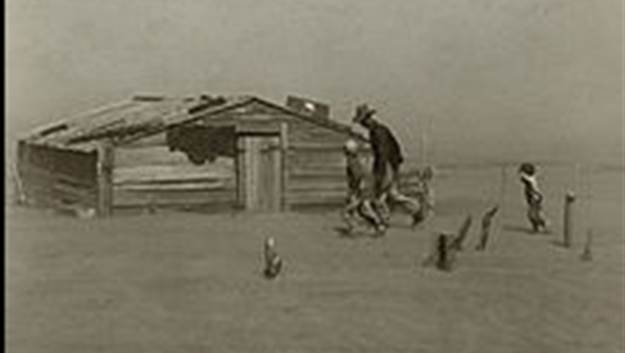
The Dust Bowl was a
period of severe dust storms that greatly damaged the ecology
and agriculture of the American and
Canadian prairies during the 1930s; severe drought and
a failure to apply dryland farming methods to prevent the aeolian
processes (wind erosion) caused the phenomenon. The
drought came in three waves, 1934, 1936, and 1939–1940, but some regions of the
high plains experienced drought conditions for as many as eight
years. With insufficient understanding of the ecology of the plains,
farmers had conducted extensive deep plowing of
the virgin topsoil of the Great Plains during the previous
decade; this had displaced the native, deep-rooted grasses that
normally trapped soil and moisture even during periods of drought and
high winds. The rapid mechanization of farm equipment, especially small
gasoline tractors, and widespread use of the combine
harvester contributed to farmers' decisions to convert arid grassland
(much of which received no more than 10 inches (~250 mm) of
precipitation per year) to cultivated cropland
The worldwide Great
Depression of the early 1930s was a social and economic shock that left
millions of Canadians unemployed, hungry and often homeless. Few countries were
affected as severely as Canada during what became known as the
"Dirty Thirties," due to Canada's heavy dependence on raw material
and farm exports, combined with a crippling Prairies drought known as
the Dust Bowl. Widespread losses of jobs and savings ultimately
transformed the country by triggering the birth of social welfare, a
variety of populist political movements, and a more activist role for
government in the economy.
By 1930, 30% of the labour force
was out of work, and one fifth of the population became dependent on government
assistance. Wages fell, as did prices. Gross National Expenditure had
declined 42% from the 1929 levels. In some areas, the decline was far worse. In
the rural areas of the prairies, two thirds of the population were on relief.
Further damage was the reduction
of investment: both large companies and individuals were unwilling and unable
to invest in new ventures.
In 1932, industrial production
was only at 58% of the 1929 level, the second lowest level in the world after
the United States, and well behind nations such as Britain, which only saw it
fall to 83% of the 1929 level. Total national income fell to 55% of the 1929
level, again worse than any nation other than the U.S.
Canada's economy at the time was
just starting to shift from primary industry (farming, fishing, mining and
logging) to manufacturing. Exports of raw materials plunged, and
employment, prices and profits fell in every sector. Canada was the worst-hit
because of its economic position. It was further affected as its main trading
partners were Britain and the U.S., both of which were badly affected by the
worldwide depression.
1947
Massive
oil reserves were discovered in 1947.
1967
The
exploitation of oil sands began in 1967.
One of the areas not affected
was bush flying, which, thanks to a mining and exploration boom, continued
to thrive throughout this period. Even so, most bush flying companies lost
money, impacted by the government's cancellation of airmail contracts in
1931-2.
1973
Flying over the
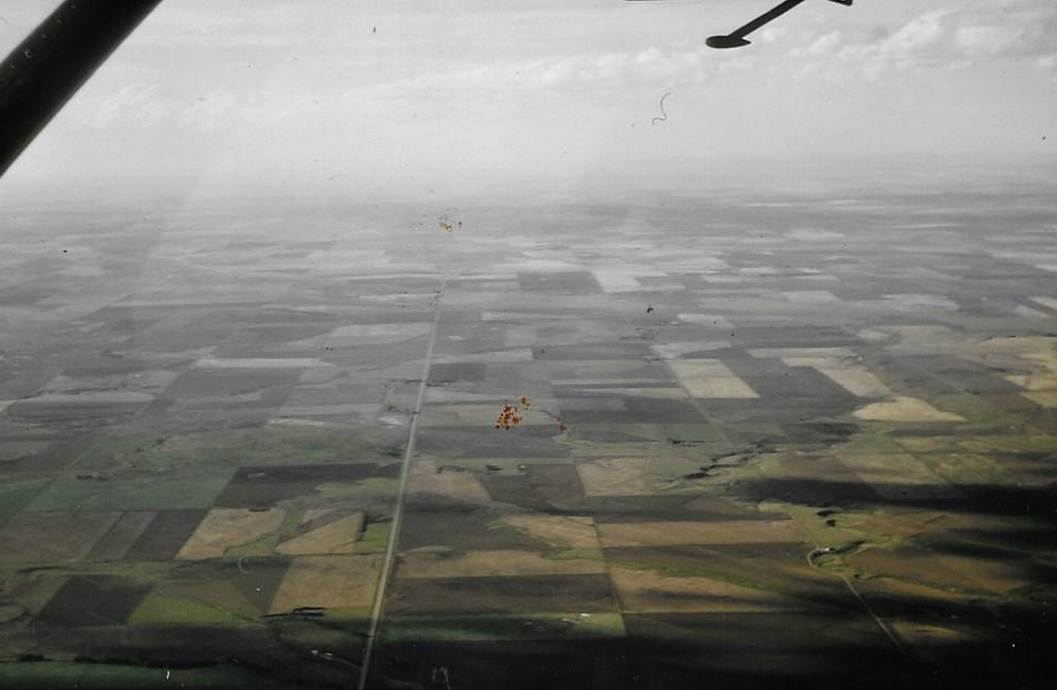
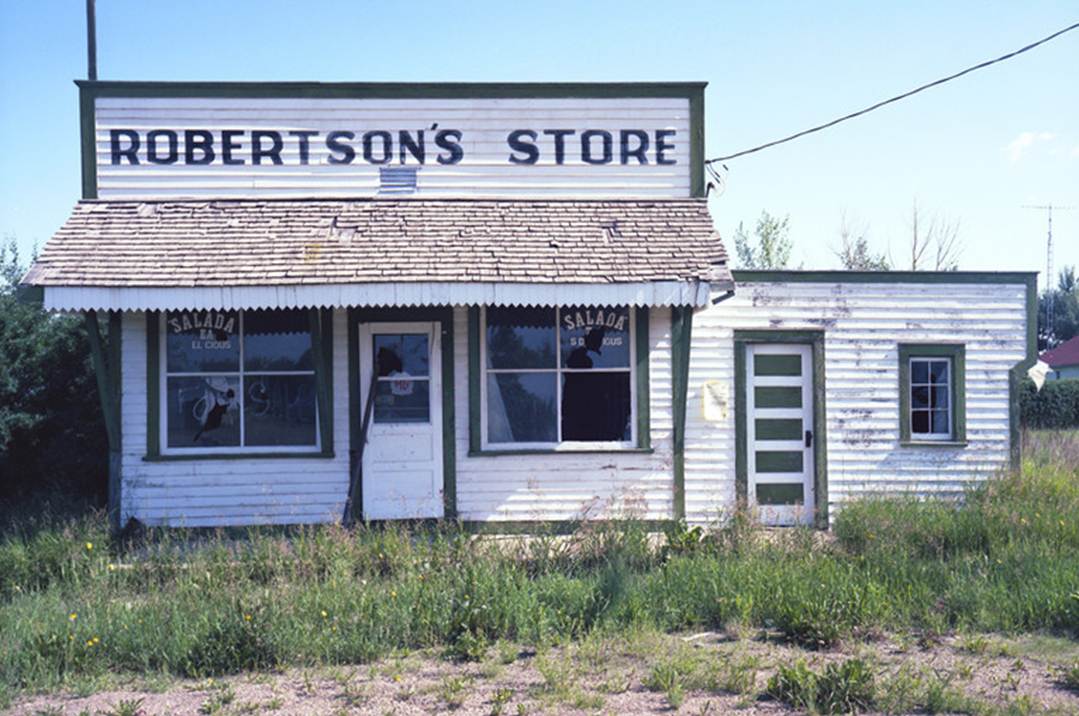
country around Huxley in July 1973 (taken by Martin
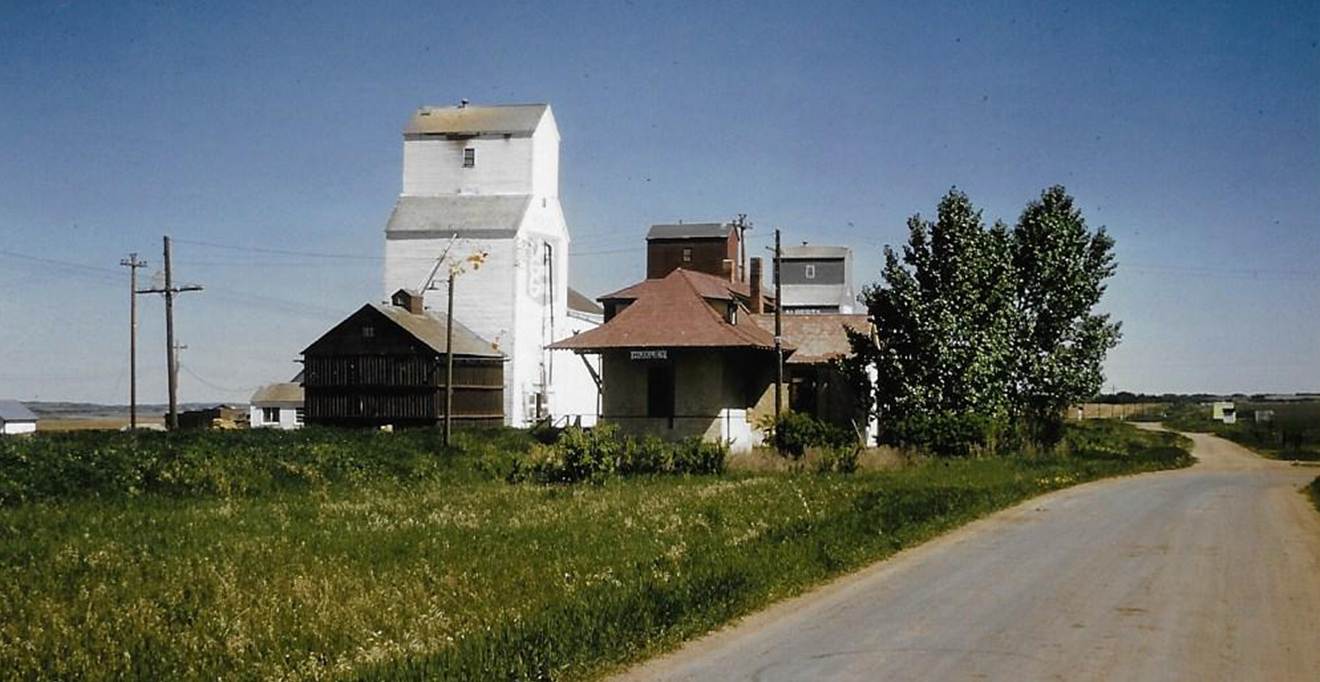
Farndale) The station at Huxley, taken in
July 1973
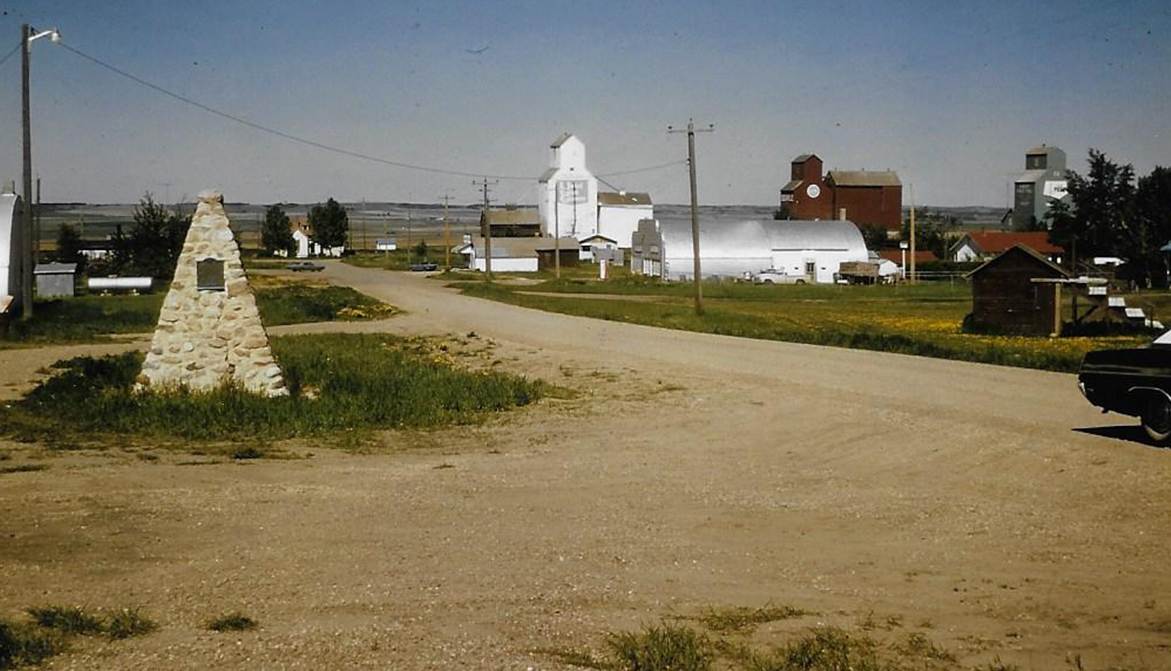
The main street of Huxley, taken in July 1973
…