Harringworth
A Medieval
History of the Manor of Harringworth, Northamptonshire
|
Return to the Home Page of the Bakers Family part of the website |
The Bakers of Highfields Story
The Story of the Dods and Bakers and of Highfields,
Fenton House and Hasfield Court. A journey through the history of Cheshire
and Staffordshire, an Anglo-Saxon nobleman who retained his lands after the
Conquest, pottery at Stoke on Trent, an encounter with Elgar, and the history
of an Elizabethan manor house at Audlem |
The family tree of the Bakers of Highfields |
The Family Tree of the Dods, predecessors to the
Bakers of Highfields |
The Bakers of
Fenton House and Hasfield Court
The Family Tree of the pottery Bakers of Stoke on Trent |
The Family Tree of the Bellyse Family |
The main part
of this website tells the story of the Farndale family from Yorkshire Descendants of Arthur Baker, the story of the Farndale
ancestry is told through the main part of this website You can also return to the Farndale
website home page |
The genealogy of the family of James Hall, linked to
the Baker family through marriage to Arthur Baker |
Headlines of are
in brown.
Dates are in red.
Hyperlinks to
other pages are in dark
blue.
References and
citations are in turquoise.
Context and local
history are in purple.
Harringworth in Northamptonshire
is about 30 kilometres to the east of Leicester, and about 50 kilometres
northeast of Coventry.
c 1000
Before the Norman Conquest, the land was held by an Anglo-Saxon
lord named Thorkil the Dane. The name may mean an enclosure of the dwellers at
the stoney place or may relate to a personal name, Hering or Haerra.
1066
Following the conquest, King William granted Harringworth to his
niece, Countess Judith. In 1075, Judith's husband, Waltheof, Earl of
Northumbria, joined the Revolt of the Earls against William. It was the last
serious act of resistance against the Norman Conquest of England. Some sources
claim that Judith betrayed Waltheof to the bishop of Winchester, who informed
her uncle, the king.
1086
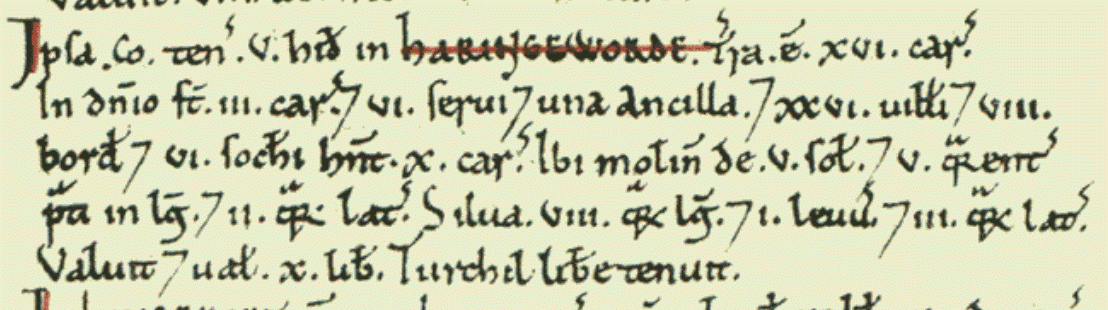
The Domesday Book of 1086 reveals that Harringworth was a
thriving, substantial settlement. It was recorded in the Hundred
of Corby with 47 households, placing it in the top 20% of largest
settlements in England at the time. The estate featured 16 ploughlands, a
watermill valued at 5 shillings, and significant woodland and meadow assets. (Powell-Smith, Anna, Harringworth,
Open Domesday).
1232
By 1232, the manor passed to the baron William I de Cantilupe.
1234
Around 1234, William I de Cantilupe established
a substantial 600 acre deer park, which was formally
stocked with royal deer sent directly from nearby Rockingham Forest. The family
significantly built up the village's status. By the end of the thirteenth
century, Harringworth’s parish church had expanded to
become one of the four largest in the entire region.
1273
When the last male heir, Sir George de Cantilupe,
died in 1273, the manor passed to his sister Millicent and her husband, Eudo de
la Zouche. Their descendants became known as the Zouche of Harringworth
branch.
Under the la Zouches, Harringworth
evolved into an official noble seat
1308
In 1308 William la Zouche was officially summoned to Parliament as
the 1st Baron Zouche of Haryngworth, locking the
village's identity to the peerage.
1387
In 1387, William la Zouche obtained a royal charter to hold a
weekly market and an annual fair. He was also granted a licence to crenellate, allowing him to transform the local manor house
into a fortified castle complex complete with a great hall, a private chapel,
and managed fishponds.
1485
The la Zouche family's fortunes shifted dramatically during the
Wars of the Roses. The 7th Baron Zouche remained staunchly loyal to King
Richard III. Following Richard’s defeat at the Battle of Bosworth in 1485, the
baron was attainted by Henry VII, meaning the family temporarily lost their
titles and lands.
However, because the Zouche family shared stepfamily ties with
Henry VII, via Elizabeth St. John, the family was eventually pardoned
and their Harringworth lands were restored.
c 1500
By the early Tudor period, the family had resumed their regional
prominence.
John Zouche, the 8th Baron Zouche, operated the estate throughout
the early 16th century.
1550
On 10 August 1550, the 8th Baron died at Harringworth, passing the
title and manor to his son Richard Zouche, the 9th Baron.
1569
On 19 June 1569 George Zouche, 10th Baron Zouche, died at the
family estate. His 13-year-old son, Edward Zouche, succeeded as the 11th Baron
Zouche.
c 1600
Facing financial strain, Edward Zouche, 11th Baron Zouche, sold
the family's ancestral estates at Harringworth and nearby Bulwick
to Francis Foxley. This ended over three centuries of the Zouche family's
direct lordship in the village.
1617
Francis Foxley died. In his will, he divided the Harringworth
property and lands among nine of his children, splintering the estate.
1619
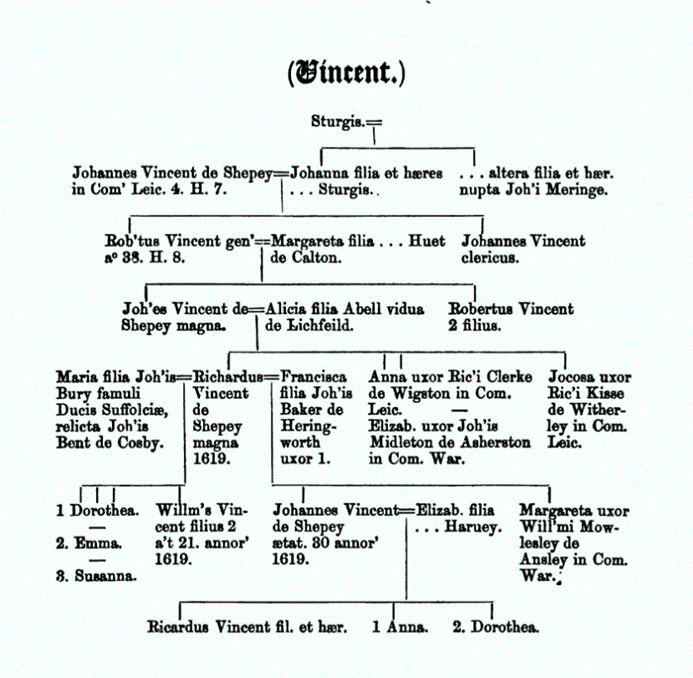
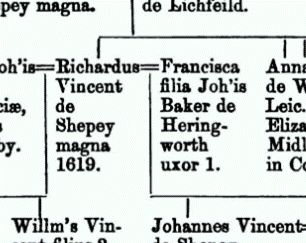
Based on Sampson Baker (BAK00008)'s Will, and pedigrees for the
Vincent family in the Visitation of Leicestershire, 1619 (Camden, William (1551-1623) and
others, The visitation of the county of Leicester in the year 1619, College
of Arms, page
79) there are hints of
connections to a Baker family of Harringworth, in Northamptonshire.
c 1620
Moses Tryon, a wealthy London merchant of Flemish origin,
systematically bought back the divided shares of the estate from the Foxley
children. He took up residence at Harringworth Manor, establishing a new gentry
presence.
1630
A detailed manorial map of the village was drawn, recording the
layout of the fortified Harringworth Manor house, documenting an inner and
outer courtyard with extensive buildings ranged along the north and west sides.
1652
Moses Tryon died. Following his death, Harringworth permanently
ceased to be the primary seat of a resident landowning family.
Mid-to-Late
17th Century
Deprived of its role as a primary manorial seat, the grand
medieval fortified manor house was largely dismantled and demolished for
materials. Concurrently, the Lords of the manor aggressively bought up local
copyholds (tenant land rights).
Late
1600s
The physical layout of the village shifted. While the grand manor
disappears, a number of substantial, high-quality
stone houses are built by affluent locals, many of which survive to the modern
day.
1695
The surviving Parish Registers for Harringworth officially began
recording local baptisms, marriages, and burials.
Bibliography
Harringworth, in An
Inventory of the Historical Monuments in the County of Northamptonshire,
Volume 6, Architectural Monuments in North Northamptonshire (London, 1984), British
History Online.
Harringworth
Manor, Gatehouse.