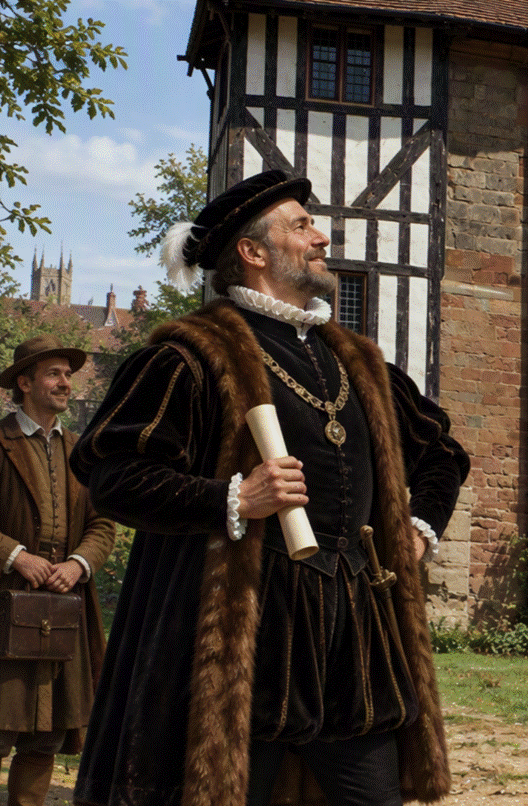
Sampson Baker of Charterhouse
c
1530 (estimated) to 1584
BAK00008
|
Return to the Home Page of the Bakers Family part of the website |
The Bakers of Highfields Story
The Story of the Dods and Bakers and of Highfields,
Fenton House and Hasfield Court. A journey through the history of Cheshire
and Staffordshire, an Anglo-Saxon nobleman who retained his lands after the
Conquest, pottery at Stoke on Trent, an encounter with Elgar, and the history
of an Elizabethan manor house at Audlem |
The family tree of the Bakers of Highfields |
The Family Tree of the Dods, predecessors to the
Bakers of Highfields |
The Bakers of Fenton House and Hasfield Court
The Family Tree of the pottery Bakers of Stoke on Trent |
The Family Tree of the Bellyse Family |
The main part
of this website tells the story of the Farndale family from Yorkshire Descendants of Arthur Baker, the story of the
Farndale ancestry is told through the main part of this website You can also return to the Farndale
website home page |
The genealogy of the family of James Hall, linked to
the Baker family through marriage to Arthur Baker |
Headlines are in brown.
Dates are in red.
Hyperlinks to
other pages are in dark
blue.
References and
citations are in turquoise.
Context and local
history are in purple.
Parry, Barbara (2026), Sampson Baker, Wikitree has undertaken a lot of
detailed and carefully researched work into Sampson Baker.
1525
Sampson may have been born in or
about 1525. He was the son of an, as yet, Unknown
Baker (BAK00007). Sampson's birth has been
estimated in another genealogy (Parry,
Barbara (2026), Sampson
Baker, Wikitree) as c1530, based on his brother being aged fifty when
Sampson died in 1584. I have brought the date forward five years, to try to
make sense of his later relatives. The other genealogy notes that there was
another Baker family in Coventry who made use of the first name Sampson Baker
(see BAK00017) from at least 1581 but found no
connection between the two families. That is right, though there is a strong
probability of a connection, for the reasons explained at BAK00010.
Sampson’s family may have
originated at Harringworth
in Northamptonshire, and this is explored further at BAK00007. In the sixteenth century, Sampson
was an uncommon or moderately rare given name that experienced a slight
resurgence or reappearance toward the end of the century, so it seems likely
that an individual sharing both Christian and Surname, came from the same
extended family. The name was moderately common in the twelfth century, driven
by devotion to Saint Samson, a sixth-century Welsh bishop venerated in Britain
and Brittany, and the biblical hero of strength. After the twelfth century, use of Sampson as a first
name dropped off significantly in England and France during the later medieval
period.
There are no records about his
early life.
1551
On 23 February 1551, during the
reign of Edward VI, a pardon was granted to Sampson Baker for forging coins. Whereas
Miles Harvord, late of Bristol, "yoman," on
10 July 4 Edward VI. and other times before and since, at Okeley
and elsewhere, Northamptonshire, counterfeited the king's coin of
"shillings" and "grotes" (a
groat was a silver coin worth 4d) of a mixed metal of copper and tin and
uttered them to the amount of £16; and whereas Thomas Brokes of Corby,
Northamptonshire, gentleman, and Sampson Baker of Ceaton,
Rutland, gentleman, aided in uttering (ie passing
into circulation) the said coins, Pardon to the said Thomas Brokes alias
Thomas Broke, the younger, and Sampson Baker, gentleman alias
"yeoman," for the said treasons or felonies; and restoration of goods
forfeited thereby. (Patent Rolls of the reign of Edward VI,
Volume 4, 1550 to 1553,
page 157). This may have been this Sampson
Baker, in which case he was in Rutland at this time, or a cousin or kinsman
(there were other Sampson Bakers at Harringworth). However it seems likely that Sampson Baker
himself was born in Harringworth. Harringworth sits directly across the river
boundary from Seaton, Rutland (where the 1551 counterfeiter was from), and is
right next to Corby (where his accomplice Brokes lived). This bridges the 1551
Rutland/Northamptonshire counterfeiter to the exact same area where the Baker
family held land.
Sampson Baker was then described
as a gentleman alias yeoman. In Tudor England, a yeoman
was a prosperous farmer or freeholder, while a gentleman belonged to the
minor gentry. The use of both terms indicates he was on the cusp of the social
divide, a wealthy commoner establishing himself as a gentleman. Baker was not
the physical manufacturer of the counterfeit coins; that was Miles Harvord, who
cast them in Northamptonshire using a base alloy of copper and tin. Instead,
Baker and Thomas Brokes acted as the critical utterers (distributors).
They took the fake shillings and groats (worth 4d) and successfully laundered or
circulated £16 of them. In 1551, £16 was a massive sum, equivalent to multiple
years of income for an ordinary labourer. Counterfeiting the King's coin was
legally classified as High Treason because it directly undermined the Crown's
authority and economic stability. Therefore, Baker was facing execution
(hanging, drawing, and quartering) and the total forfeiture of all his earthly
goods.
Ironically, the Crown itself was
heavily debasing its own coinage during the 1540s and early 1550s to pay for foreign
wars. The government's own official coins were frequently made of copper coated
in a thin layer of silver. Because the Crown was actively lowering the purity
of its money, the lines between official coins and illegal counterfeits were
blurred, often making juries and officials surprisingly lenient. As members of the local minor gentry, both men
likely had powerful patrons, family ties, or court connections capable of
petitioning the King's Privy Council for mercy. Royal pardons were rarely free. They frequently
functioned as revenue-raisers for the crown. It is highly probable that Baker
or his family paid a heavy fine or bribe to secure his life and the restoration
of goods forfeited thereby.
Perhaps this was a Tudor tale of a
disgraced young man who survived a brush with execution and used his remaining
assets to fully reinvent himself. After
surviving the treason charge, Sampson Baker went on to find a more legitimate path
to wealth. He served as a military officer under Lord Clinton at the Battle of
Saint Quentin in 1557. This military service for a powerful nobleman likely
provided him with the clean slate and capital he needed. Using his newly
acquired status, he purchased the manor of Little Packington from his former
commander (by then the Earl of Lincoln) in 1573, and in 1575 bought the
prestigious Coventry Charterhouse, cementing his legacy as a legitimate
Elizabethan gentleman.
1557
Sampson fought in the Anglo-French
War in 1557. This was a brief conflict that formed part of the wider Italian
War of 1551 to 1559, which resulted in England losing its final continental
possession, Calais. Mary I of England had married Philip II of Spain in 1554.
When Philip inherited the Spanish throne, he drew his wife's realm into his
ongoing war against France, despite the English marriage treaty requiring
neutrality. Henry II of France harboured English Protestant rebels, including
Thomas Stafford, who launched a French-backed invasion of England in 1557. This
forced Mary and her reluctant council to officially declare war on France. In
1557 England sent thousands of troops to join Philip's army in modern day
Belgium. Together, they helped besiege and decisively defeat the French forces
under the Duke of Montmorency on 10 August 1557. Seeking retaliation, French
forces noticed that the English defences at Calais were severely undermanned.
Henry II led a surprise winter assault, capturing the town in January 1558 and
stripping England of its last remaining stronghold in France. The war concluded with the Treaty
of Cateau-Cambrésis in 1559. The defeat dealt a
severe blow to English prestige, and the permanent loss of Calais ended
centuries of English continental land-holding.
Lord Edward Clinton (from whom
Sampson Baker purchased Little Packington in 1573, see below) was Captain
General or Coronell of the footmen, described in the transcript of an army
pay list, commanding 100 demilances, 52 light
horsemen and 299 footmen. The footmen were divided between three officers, one
of which was Sampson Baker. Lord Clinton, 299, whereof under George Devonishe 99, Nicholas Gorge 100, and Sampson Baker 100.
(Army pay list (1897) printed in the
manuscripts of the Right Honourable F.J. Savile Foljambe, of Osberton, pages
5 to 6).
During the Anglo-French War of
1557, Edward Fiennes de Clinton, 9th Lord Clinton, served as a key military
commander of the English expeditionary force sent to France. Lord Clinton was appointed as a
senior commander, frequently designated as the Lord General, associated with
William Herbert, 1st Earl of Pembroke, leading the 5,000-strong English
contingent sent to support King Philip II’s Spanish army. Clinton and the
primary English force arrived at the Battle of Saint-Quentin after the field
had largely been won by the Spanish and allied cavalry on 10 August 1557.
Despite missing the open-field clash, Clinton and his troops were present for
the final stages of the Siege of Saint-Quentin. Contemporary records note that
Clinton was later involved in high-level reviews of the operation, where he had
to address criticism regarding the lack of drilling and command of the English
sappers (military engineers) who assisted in the siege works. Even though his
forces missed the main combat, the English public credited the expeditionary
leaders with a share of the brilliant victory. Clinton's involvement
restored his standing with Queen Mary I; having previously been stripped of his
naval offices, he was reinstated as Lord High Admiral just months later in
February 1558 to lead naval retaliations against the French coast.
Sampson Baker served as a direct
subordinate officer to Lord Edward Clinton during the 1557 military expedition.
Baker's service under Lord Clinton in 1557 forged a lifelong connection between
the two men. Decades after the campaign, in 1573, Sampson Baker purchased the
manor of Little Packington in Warwickshire directly from his former commander,
who had by then become the Earl of Lincoln. A contemporary wall painting from
the Elizabethan era features Sampson Baker's coat of arms placed alongside a
panel displaying the Clinton shield, commemorating their historical ties.
1560
There was a Sampson Baker in Harringworth. This may
be a different Sampson Baker, if not him, perhaps a relative.
In 1560, there was a debt case in
Buckinghamshire, an index entry for which describes the plaintiff as Baker,
Thomas, of Myddelton Kaynes, executor of; (Nurshe, John) and the defendant as, Baker, Sampson,
of Harryngworth, Nhants,
gent.

(University of Houston, Debt case relating to Thomas
Baker of Myddelton Kaynes, Buckinghamshire and
Sampson Baker of Harryngworth, Northamptonshire)
Although there was a Will of a Thomas
Baker of Myddleton Kenys proved on the 3 February
1559 (The National Archives, PROB11/42A/299), the Will does not appear to
mention a Sampson Baker, so any connection between Thomas and Sampson is
uncertain.
On 21 June 1560 there was a grant
to Samson Baker of the wardship and marriage of Francis Conyars, son and heir
of Reynold Conyers, with an annuity of £8 of £8 from 17 February 1560 (Patent
Rolls of the reign of Elizabeth I, Volume 1, 1558 to 1560,
page 437). Reynold (Reginald) Conyers was a gentleman of
Wakerley, Northamptonshire. He was the son of Francis Conyers and Anne Blount.
Reynold married Elizabeth Chambers, the daughter of Geoffrey Chamber and widow
of the prominent Sir William Stonor. Reynold Conyers died in early 1560 and was
buried at Wakerley on 12 February 1560. His death left behind a young son and
heir, Francis Conyers (born around 1559), who became a ward of the Crown
because the family held lands directly from the monarch under feudal tenure. By
securing this grant on 21 June 1560, Sampson Baker bought the right to control
young Francis Conyers' upbringing, manage his inheritance until he reached age
21, and either marry him off or sell the marriage rights to another family for
a steep profit. The annuity of £8 issued
from February 17 (just days after Reynold's burial) was a Crown allowance paid
out of the child’s own estate to Baker to cover the costs of maintaining and
educating the young ward. Sampson Baker’s business
and legal network overlapped with Northamptonshire gentry, where the Conyers
family was seated. In fact, Reynold's brother, Edward Conyers, married into the
Griffin family of Dingley (Northamptonshire), and Reynold's widow Elizabeth
later married Edward Griffin. Baker was frequently involved in debt, land
speculation, and legal agreements with these circles of regional gentry.
1569
A Mr Sampson Baker, parson
was overseer and witness to the Will of a Fermin Grene of Harringworth 16 Aug
1569. In the actual Will, it seems the word vicar might not apply to the
Sampson Baker, but to the previously named person (a John Turner). There is no
information in Fermin Grene's Will to indicate whether this Sampson Baker is
also of Harringworth, or whether it is the same Sampson as in the legal case,
or the militia list. (Henry Isham Longden,
Northamptonshire and Rutland Clergy from 1500 Volumes 1 to 3, page 155 (not
yet seen), Parry, Barbara (2026), Sampson Baker, Wikitree).
In 1569, the name Sampson Baker
appears as one of the tenants involved in a legal case against George, Baron
Zouche of Harringworth, over common rights (The
National Archives REQ
2/149/12).
1570
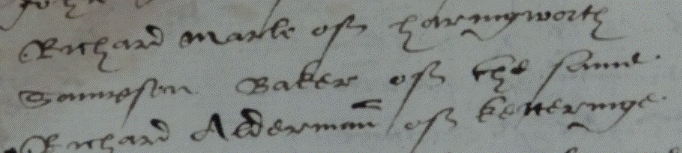
There was a Sameson
Baker listed in Harringworth in 1570 (Transcribed
extracts from the State Papers of Elizabeth I relating to Northamptonshire -
1558-1570 (SP
12/51, 59, 67, Folio f165v),
available on the Medieval Genealogy site).

1573
In 1573, Sampson Baker purchased
Little Packington from Edward Clinton.
Thomas Ireys held one-third of the
manor in 1327 and 1332, and transferred it in 1339 to
Philip de Aylestone and Katherine his wife, who was probably daughter of Thomas
Ireys. In 1376 Sir William de Clinton purchased one-third of the manor from
John Walters, whether of the Aylestone or Petemon
descent is unknown. Sir William died in 1431, and was succeeded by his son
John, who died in 1464, holding one-third of the manor, here called 'Litilpakenton'. His son John settled it on his wife Anne
and died in 1488, and his grandson Thomas, Lord Clinton, died in 1515, leaving
his five-year-old son Edward as heir; but the manor was settled on his widow, Joan,
who was still holder of it in 1524. In 1530 Thomas, Marquess of Dorset, died seised of the manor, presumably as overlord and guardian of
the heir. His rights passed to Henry, Duke of Suffolk, on whose attainder in
1553 his estates escheated to the Crown. In 1569 Queen Elizabeth restored
Little Packington to Edward, Lord Clinton, then Earl of Lincoln. He sold it
to Sampson Baker in 1573, and on the death of the latter in 1584 his nephew
Humphrey Baker succeeded. Humphrey sold the land in 1591 to Robert
Brudenell, thus effecting a reunion with the section inherited by Henry Murdac
three centuries earlier. Since then they have not been
separated. (Parishes: Little Packington, in A History of the County
of Warwick, Volume 4, Hemlingford Hundred, ed. L
F Salzman (London, 1947), British
History Online).
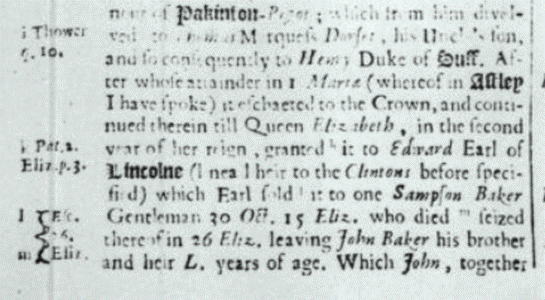
Regarding the manor of Pakington,
Queen Elizabeth, in the second year of her reign, granted to Edward Earl of Lincolne (heir to the Clintons before specified) which Earl
sold to one Sampson Baker, Gentleman, 30 October 15 Elizabeth (ie 1572 to 1573), who died seized there in 26 Elizabeth (ie 1583 to 1584), leaving John Baker his brother and
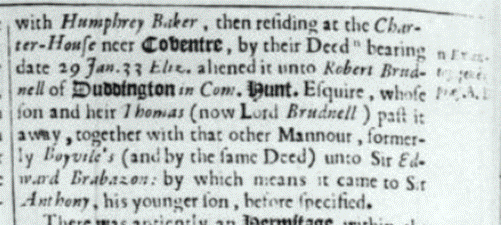
heir L years of age. Whioch John, together with
Humphrey Baker, then residing at Charter-House near Coventre, by their Deed bearing date 29 January 33
Elizabeth (ie 1590 to 1591), alienated it unto
Robert Brudnell of Dubbington. (Dugdale (1656), The
antiquities of Warwickshire illustrated: from records, leiger-books,
manuscripts, charters, evidences, tombes,
and armes: beautified with maps, prospects, and portraictures, page 716).
The manor of Packington
(historically spelled Pakington) was located at what is today Great
Packington in North Warwickshire, about 10 kilometres northwest of Coventry,
towards Birmingham, and 2 kilometres northwest of the village of Meriden. At that time in the sixteenth
century, the manor centred around a medieval manor house that originally
belonged to Kenilworth Priory. Following the Dissolution of the Monasteries, it
was purchased by the Fisher family.
1572
On 10 October 1572 a licence was granted for Thomas Andrew to
alienate the house and site of the Charterhouse by Coventry, to Thomas Ryley
for 33s 4d (Patent Rolls of the reign of Elizabeth I, Volume 5, 1569
to 1572, Folio 2478).
Although Robert Dudley had effectively sold the property to Sampson Baker by
1571, this licence involved Thomas Andrew and Thomas Ryley in an intermediary
step. In Tudor land law, a licence to alienate was a paid permit required from
the Crown to sell land held directly from the monarch. Thomas Andrew and Thomas
Ryley were acting as legal middlemen or dealing with a specific leasehold slice
of the estate. It was common for gentry to transfer properties to third-party
lawyers or merchants to execute legal trusts, satisfy outstanding bonds, or
clear titles before the final buyer could take clean possession. While Dudley
stepped away in 1571, Sampson Baker did not actually purchase the Coventry
Charterhouse until 1575. Once the legal titles were untangled from the
intermediaries of the early 1570s, Sampson Baker bought the estate and
permanently settled there.
1575
In 1575 Sampson Baker purchased the
Coventry Charterhouse. Since this was previously a Carthusian Monastery,
permission was required beforehand for the sale (Youings page 127) and on the 8 December 1575, the
previous owner, Thomas Ryley was given permission to sell the Coventry
Charterhouse to Sampson.
On 8 December 1575 there was
granted Licence for Thomas Ryley to alienate the house and site of the
Carthusian priory by Coventry to Sampson Baker. For 33s 4d (Calendar of the Patent Rolls,
Elizabeth I, Volume 7, Folio 1187, Page 157). In other words, this was Thomas
Ryley transferring the property to Sampson Baker after completing the legal
formalities.
The priory at the Charterhouse was
founded in 1381 by William la Zouche on 14 acres of land outside Coventry’s
city walls. On 6 September 1385, Richard II and his queen, Anne of Bohemia,
laid the foundation stone for the monastery's church and became its principal
patrons. Subsequent monarchs, including Henry VI and Henry VII, also served as
benefactors. Completed largely by 1410, Coventry Charterhouse was one of only nine
Carthusian monasteries built in England. The monks lived strict, isolated lives
as hermits in individual two-story cells, meeting only for specific daily
prayers. The complex also housed 12 schoolboys.
During the prosperous era from c
1420 to 1437), a monumental Crucifixion wall painting was created on the south
wall of the refectory, which remains one of the most important surviving pieces
of 15th-century medieval art in England.
As part of Henry VIII’s Dissolution
of the Monasteries, the last prior, Prior Bochard,
was forced to surrender the site to the Crown on 16 January 1539. The monastic
community was disbanded, and the site was aggressively looted. The church,
chapter house, and cloister cells were completely demolished
for their stone and timber, and 55 tons of lead were melted down and removed.
Only the Prior’s House, refectory, and the outer precinct walls were left
standing.
In 1542, the remaining structural ruins
entered private ownership. The property was acquired by Robert Dudley, the Earl
of Leicester, the famous favourite of Elizabeth I in the late 1560s. Dudley
converted the medieval monastic remains into a grand private residence,
installing a second-story floor and adding Tudor features like distinctive
chimneys.
During the mid-to-late 16th
century, the house was heavily decorated with Renaissance and Tudor wall
paintings, including a mural tied to Dudley's ownership. The newly modernised estate
was significant enough to host visits from Elizabeth I and her royal court
during this period. During Elizabeth I’s progresses through the Midlands,
particularly her visits to Dudley at nearby Kenilworth Castle, the Coventry
Charterhouse was used to house members of the Queen's grand royal retinue and
court.
Dudley, whose attention shifted
heavily toward expanding Kenilworth Castle and managing his vast estates
elsewhere, liquidated his interests in the property between 1570 and 1574. The estate
passed briefly through the market before a buyer with local ties emerged.
Sampson Baker, by then a wealthy
individual and former military officer, purchased the Charterhouse. Baker
immediately put his mark on the building by commissioning a striking, rare black
and white geometric mural on the first floor, which prominently features
the Sampson Baker coat of arms alongside a superimposed crest of the Clinton
family.
1576
Sampson proved his ownership of
the Coventry Charterhouse in 1576. In the Lord Treasurer's Remembrancer's
Office is De Sampson Baker, occasionato ad ostendendum quo titulo tenet Situm nuper Prioratus Carthusianorum Coventr. (Regarding
Sampson Baker, who has been called upon to show by what title he holds the site
of the late Carthusian Priory at Coventry) (Dugdale Monasticon
Anglicanum: a History of the
Abbies and other Monasteries, Hospitals, Frieries,
and Cathedral and Collegiate Churches, with their Dependencies, in England and
Wales, Volume 6, Part 1, Page
16, Michigan Record, 18 Elizabeth,
Roll 81).
1577
Sampson Baker of Coventrie Charterhouse appeared in a catalogue of
residents of Warwickshire dating from 1577-78, which was published in 1843. (Frederic Madden, Bulkeley Bandinel, John Gough Nichols (1843), Catalogue
of Residents in co. Warwick, 20 Elizabeth, published in Collectanea Topographica Et Genealogica).

1578
A legal case in 1578 might relate
to the same Sampson Baker. The county is Coventry but, this time, Sampson is
the plaintiff, and just described as a gentleman, with no more specific
residence. The defendants are Burnam, Thomas, of Northampton, glover; Shredley, Richard, of Parva Houghton, gent. (University of Houston
list).

1580
Chancery records a debt case involving
Sampson, where there is a confirmed connection to the Charterhouse. The first,
in 1580, was brought by Nicholas Woolryche, gent, in Lincolnshire and the
defendants were described as Morgan, John, of Stanyard, Nhants,
gent; Baker, Sampson, of Coventry, or of Charterhouse by Coentry,
gent (University
of Houston List).

All of the debt cases, and Edward Coke's
book, are in Latin so further details about Sampson, and the land he held, and
there is further work to locate the original documents and translate them.
Sampson Baker’s Coat of
Arms
Sampson Baker
owned the former Coventry
Charterhouse after the Dissolution of the Monasteries. Sampson Baker was
the owner of the Coventry Charterhouse during the later sixteenth century. The
National Trust notes that a Tudor black and white wall painting within
the Charterhouse includes the coat of arms of Sampson Baker and specifically
states that he owned the property from about 1575.
The Charterhouse
is a medieval monastic house and home to some of the finest examples of
medieval and renaissance art in England. It is a Grade I listed, fourteenth
century building, founded in 1381. Coventry Charterhouse has served as a
fourteenth century monastery to a family home and later as a garden that
produced exotic fruit for wealthy locals.
Former notable inhabitants include Robert Dudley, the primary favourite
of Elizabeth I, and John Whittingham who cultivated the nursery and walled
garden for food production.
The Coventry Charterhouse contains
several wall paintings, which also include two coats of arms. One of these is
that of Edward Clinton. The other has been identified as that of Sampson Baker.
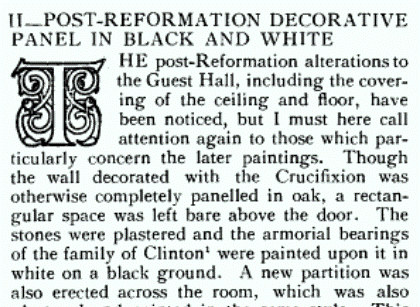
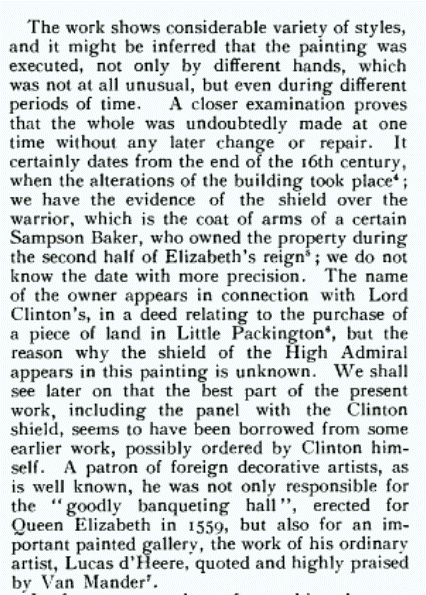
An early study of
the Charterhouse wall paintings by Pierre Turpin identified the heraldic shield
in the building as the arms of Sampson Baker, describing him as the owner of
the property in the second half of Elizabeth I's reign. (Pierre Turpin (February 1920), Identification of
the coats of arms: Ancient Wall-Paintings in the Charterhouse, Coventry.
II-Post-Reformation Decorative Panel in Black and White, in The
Burlington Magazine for Connoisseurs, Volume 36, Number 203 (pages
84 and 86 to 87 (3 pages), available through JSTOR) Turpin described the arms as azure,
a fess or between three swans’ heads erased of the same ducally gorged or
charged with as many cinqufoils gules – Crest an arm
embowed, habited with green leaves, in the hand proper a swan’s head erased or.
The Shield (The Coat of Arms). Azure
means the background (field) of the shield is blue. A fess is a
wide horizontal band across the middle of the shield. Or means gold (or yellow).
So, there is a gold horizontal stripe across the middle. There are three swans'
heads placed around the stripe, typically two above and one below. Erased
means the necks look jagged or torn off cleanly at the base, rather than cut in
a straight line. Of the same refers back to the
last colour mentioned, meaning the swans' heads are also gold. Each swan has a gold
ducal crown (gorged) worn like a collar around its neck. Charged
means something is overlaid on top. As many matches the previous count
(three), and a cinquefoil is a five-petaled heraldic flower. Gules
means red. This means a red five-petaled flower is placed on top of each swan's
head (or potentially on the fess, but usually it applies to the immediately
preceding subject or the fess depending on punctuation; in standard grammar
here, it likely means three red flowers are placed on the gold fess).
The Crest (The symbol above the
helmet) includes an arm embowed, an arm that is bent at the elbow. It is
habited with green leaves, the arm is clothed or
covered in green leaves instead of sleeves or armour. The hand is painted in
the hand proper, in its natural flesh tones. The hand is holding a gold swan's
head that is torn off at the neck.
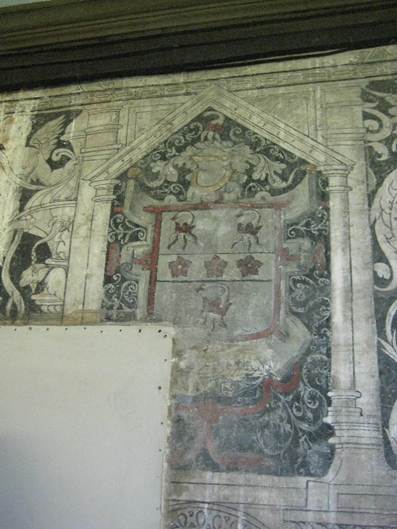
(The coat of arms of Sampson Baker, The Charterhouse,
Coventry, 2013)
The crest in the
Charterhouse just shows the swan's head with a coronet, not the version where
the swan's head is held in the hand of a bent arm, which some other Baker
families used. There are also differences in the colours - the coronets are red
(gules), not gold (or). There are several Baker families which
use similar coats of arms but the information
contained in various Visitations does not confirm links to this Sampson
Baker's family. (Wales, TC and Hartley CP (2004), The Visitation of London begun in
1687, Harleian Society Volume 17 page 457).
In the Catholic Records Society
volumes concerning recusants, there is an entry which shows that he had
a butler, called John Craddock, who later went to work for Humphrey Baker. John
Cradock of Sheldon in Warwickshire, late butler to Mr Sampson Baker of
Coventry, and since that, servant to Mr Humfry Baker of Shepey
(Sheepy) in Leicestershire, of the age of 38 yeres
or ther aboutes, examined
before the said Commissioners the daye and yere
aforesaid; whoe refuseth to
be sworne, but saythe: First,
that he hath bene in prison in the Marshallsey the 6 yeres or ther aboutes,
committed by Sir Francis Walsingham for recusancy, and was indivcted
in Surrey for the same cause, and hath bene examined before Mr Yonge and other
Commissioners. Item, he sayeth he hath neither lands nor goods. Item, he saith
he knoeth not nor hath had conference with any
Jesuits or semenarie preestes,
neither hath any suche resorted unto him, but refuseth to depose yt. Item, he
hath not had conference with any preachers and denyeth
to have any. Item, he refuseth to come to churche. Signed John Craddock. (Catholic Records Society Records
Volume 60: Recusant
Documents from the Ellesmere Manuscripts Published on Jan 1, 1968
Page 72).
In this examination of 1593, after
Sampson’s death, John Cradock, a 38-year-old Catholic recusant (someone who
refused to attend Church of England services) had been imprisoned in the Marshalsea prison for about
six years. His imprisonment was ordered by Sir Francis Walsingham, Elizabeth
I’s spymaster, for recusancy. He was officially indicted for this in Surrey.
He denied knowing or meeting with
any Jesuits or seminary priests (who were banned under Elizabethan law), though
he refused to swear an oath to prove it. He refused to speak with Protestant
preachers, explicitly stated he would not attend the established Church, and
refused to be sworn in under oath before the Commissioners.
Following the Elizabethan Religious
Settlement of 1559, attendance at the local Church of England parish was
mandatory by law. Those who refused to attend Anglican services were labelled recusants
(from the Latin recusare, meaning to refuse).
Initially, recusancy was punished by fines. However, by the 1580s, as
geopolitical tensions mounted, the state began viewing Catholic recusants not
just as religious dissidents, but as potential traitors loyal to a foreign
power (the Pope or Catholic Spain).
Walsingham ran an extensive domestic
and international espionage network. His primary mission was to uncover
Catholic plots against the Queen (such as the Babington Plot). The fact that a
working-class man like Cradock, a former butler and servant, drew the personal
attention of Walsingham indicates how wide Walsingham’s net was cast. The state
feared that servants in wealthy households could act as couriers or lookouts
for underground Catholic networks.
The Commissioners specifically cross-examined
Cradock about Jesuits and seminary priests. In 1585, the English Parliament
passed a law making it high treason for any Catholic priest ordained abroad to
enter England. Anyone who harboured or assisted them faced the death penalty.
Priests were smuggled into England from continental Europe to keep the Catholic
faith alive dynamically. They travelled in disguise and hid in priest holes
within wealthy manor houses. As a butler and servant, Cradock would have been
in a prime position to facilitate or know about these secret guests.
Cradock spent roughly six years in
the Marshalsea, a notorious prison located in Southwark, Surrey (just south of
London). Prisons in this era were profit-driven and brutal. Inmates had to pay
the gaoler for their own bedding, food, and drink. Since Cradock claimed he had
neither lands nor goods, his six-year survival in the Marshalsea suggests
he likely relied on the charity box of the prison,
or received covert financial support from wealthier Catholic
sympathisers outside.
We might wonder about the Bakers'
religious sympathies. In Elizabethan England, wealthy families were expected to
ensure their domestic staff conformed to the Church of England. The fact that
John Cradock was a radical, unyielding Catholic recusant who spent six years in
prison suggests one of two scenarios for his masters. It seems probable that
the Bakers were Church Papists, Catholics who outwardly conformed to Anglican
services to save their estates from devastating fines but privately maintained
traditional Catholic households. Employing a butler (the head of domestic
affairs) who was a staunch Catholic suggests the Bakers actively harboured and
protected co-religionists within their walls. Sampson Baker chose to buy and
live in a former Catholic monastery, The Charterhouse, which may have
reinforced a nostalgic or lingering attachment to the old faith.
If the examination took place around
1590–1592, Cradock’s arrest would have occurred around 1585–1586. This timing
suggests that shortly after Humphrey Baker took over his uncle's estates,
Walsingham's agents may have raided his household or targeted his staff. Having
his chief servant arrested by the Queen's spymaster for suspected ties to
underground Jesuit priests would have put Humphrey under immense political
pressure, threatening his social standing and his newly inherited wealth.
Surviving Elizabethan Court of Chancery
records show that Sampson and Humphrey were heavily litigious and frequently
sued for debts. Following Sampson's death in 1584, Humphrey was hit with
multiple lawsuits by creditors demanding repayment for his late uncle’s debts.
Under this financial strain, Humphrey eventually sold off the manor of Little
Packington in 1591.
1584
On 4 April 1584, perhaps aware
that he was dying, Sampson settled property on trustees for his nephew,
Humphrey Baker, in anticipation of Humphrey's marriage to Bridget Moore, the
daughter of Gregory Moore, senior, of Borne, in Lincolnshire. Both Sampson and
Humphrey were described as of the Charterhouse. (The marriage settlement of Humfrey Baker and
Bridget, daughter of Gregory Moore of Borne (Lincolnshire) gent, 1584
Derbyshire Record office, D156/M/L/1/2). Baker v Burdett: Complaint of Humfrey
Baker of Mythe (Leicestershire) gent that Robert has
not paid for land in Great Sheepey [Sheepy Magna]
(Leicestershire) Atherston [Atherstone]
(Warwickshire) and Ratiffe Culey [Ratcliffe Culey]
(Leicestershire) including D156/M/L/1/2/3 draft
answers; copy marriage settlement of Humfrey Baker and Bridget daughter of
Gregory Moore of Borne (Lincolnshire) gent, 1584; articles of agreement for
lands between Baker and Burdett, 1598/9.
Sampson then wrote his Will on the
18th April 1584.[14] In this, Sampson left the
Packington land, which he mentions that he had bought from Edward, Earl of
Lincoln, to his brother, John. Money was also left to two of John's children
who were under eighteen, as well as to his sister, Catherine Edmonds, a
servant, Margaret Morgan, and to various other individuals, including a John
Stafford, esquire, of Northamptonshire. Humphrey Baker was only mentioned as
Sampson's 'kinsman', with a request that his executors would be good and
consider him - possibly because the marriage settlement had already provided
for Humphrey.
The Will of Sampson Baker dated 5
May 1591 (The National Archives, PROB
11/77/346).
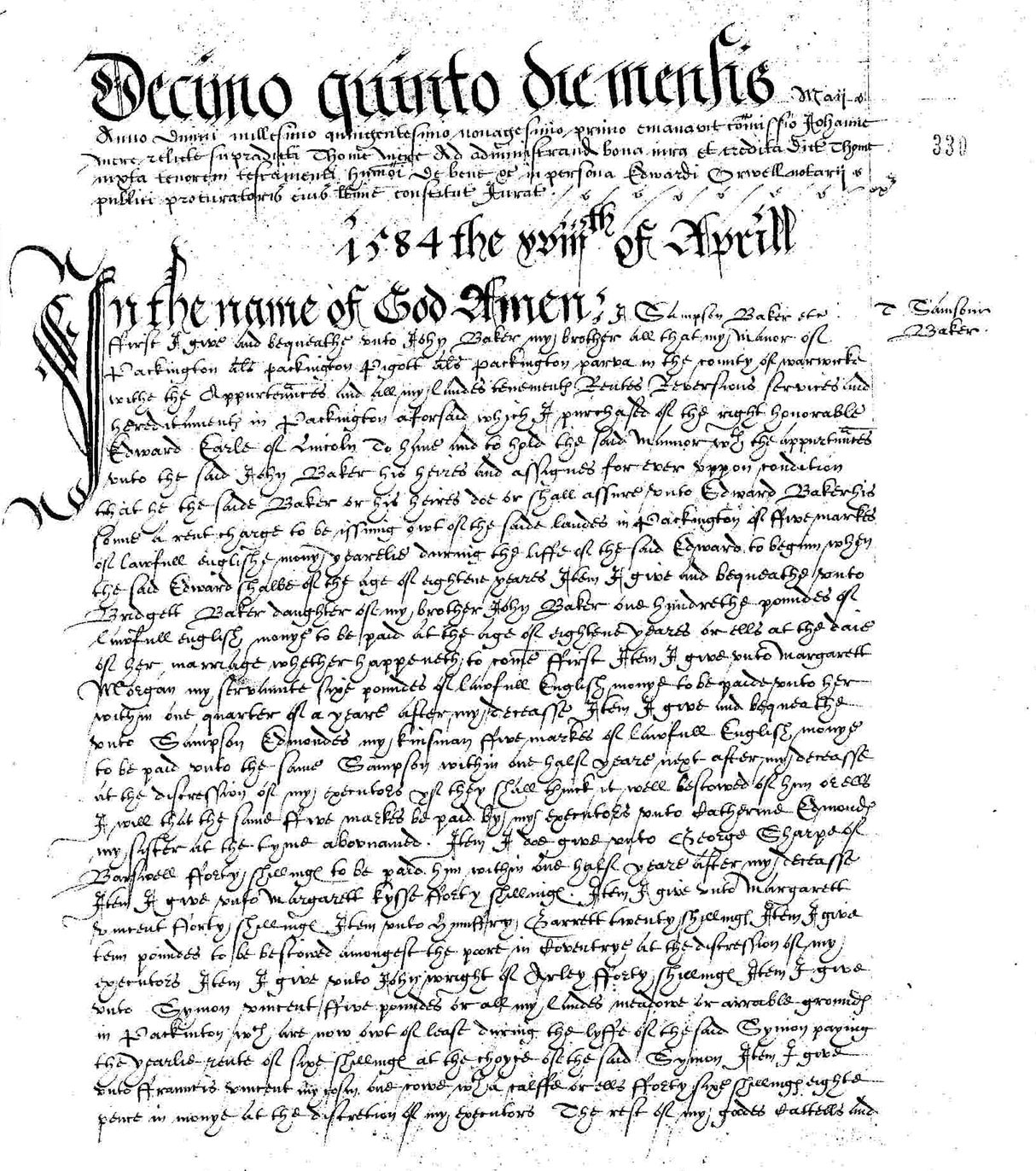
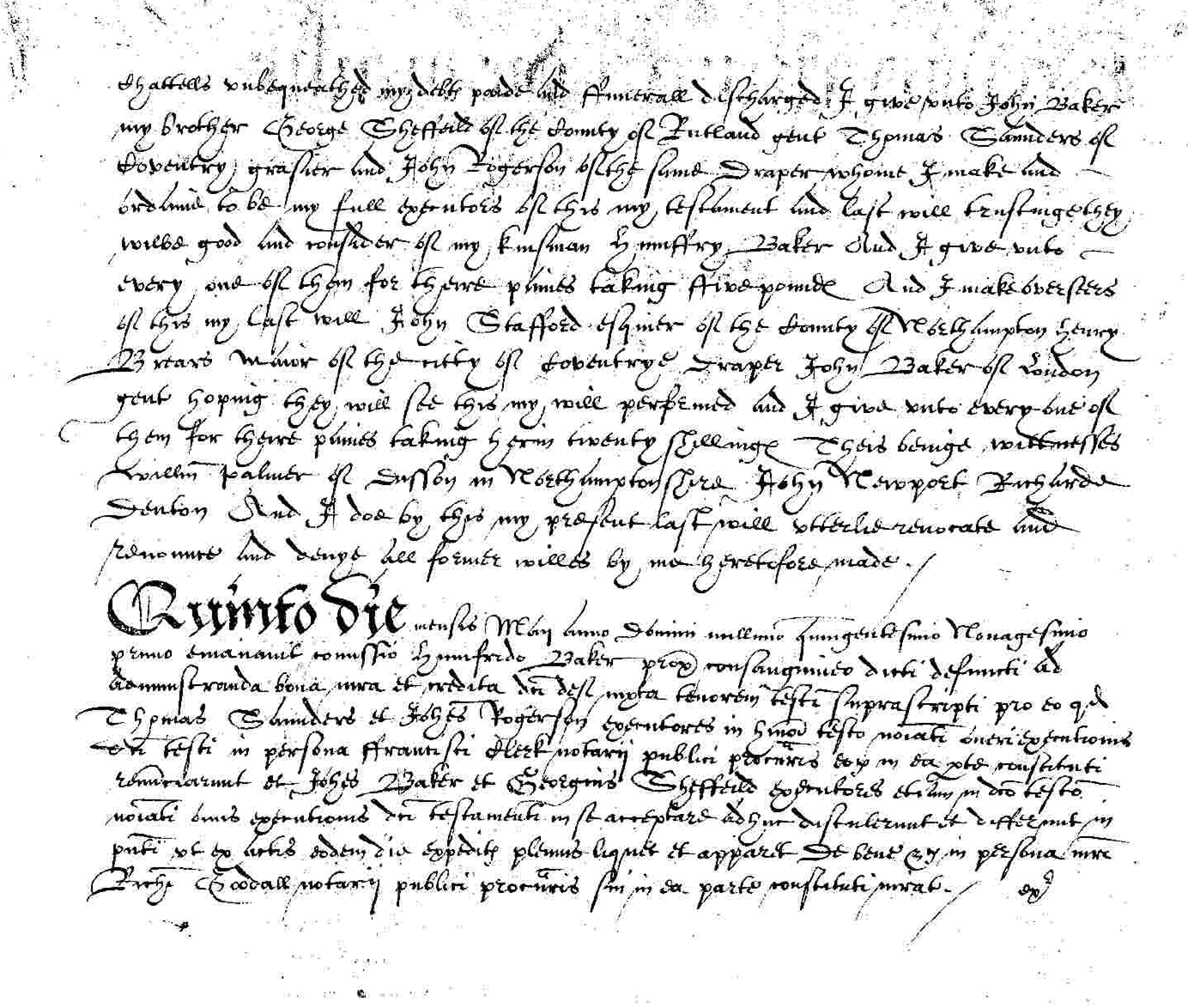
1584 the XVIIIth
of April
In the name of God
Amen I Sampson Baker etc.]
First I give and bequeathe
unto John Baker my brother all that my manor of
Packington al[ia]s
Packington Pigott al[ia]s Packington Parva in the
county of Warwicke
withe the Appurten[a]nces and all my landes tenements Rentes Reversions services and
hereditaments in Packington aforsaid which I purchased of the right honourable
Edward Earle of Lincoln to have
and to hold the said mannor w[i]th the appurtn[a]nces
unto the said John Baker his heires and assignes for ever uppon condition
that he the saide
Baker or his heires doe or shall assure unto Edward
Baker his
sonne a rent charge to be issuing owt
of the saide lands in Packington of five markes
of lawfull
Englishe mony yearelie during the liffe of the
said Edward to beginn when
the said Edward shalbe of the age of eightene yeares Item I give and bequeath unto
Bridgett Baker
daughter of my brother John Baker one hundrethe poundes of
lawfull English monye
to be paid at the age of eightene yeares
or ells at the daie
of her marriage whether happeneth to come First Item I give unto Margarett
Morgan my servaunte sixe poundes of lawfull English monye to be paide unto her
within one quarter of a yeare after my deceasse Item I
give and bequeathe
unto Sampson Edmondes my
kinsman Five markes of lawfull
English monye
to be paid unto the same Sampson
within one half yeare next after my deceasse
at the discression
of my executors yf they shall think it well bestowed
of him or ells
I will that the same Five markes be paid by my executors unto Catherine Edmonds
my sister at the tyme
abovnamed. Item I doe give
unto George Sharpe of
Barswell Forty shillinges
to be paid him within one half yeare
after my deceasse
Item I give unto Margarett Kysse Forty shillinges. Item I
give unto Margarett
Vincent Forty shillinges.
Item unto Humffry Garrett twenty shillinges.
Item I give
tenn poundes
to be bestowed amongst the poore in Coventrye at the discression
of my
executors Item I give unto John
Wright of Arley Forty shillinges Item I give
unto Symon Vincent Five poundes or all my landes meadowe or arrable grounds
in Packington w[hi]ch are now owt of lease during the lyffe
of the said Symon paying
the yearlie
rente of sixe shillinges at the choyce of the said
Symon Item I give
unto Francis Vincent my cosn one cowe w[i]th a calffe
or ells Forty six shillinges
eighte
pence in monye
at the discretion of my executors The rest of my goodes chattells and
chattells unbequeathed my debts paide and Funerall discharged. I
give unto John Baker
my brother George Sheffeild of the
county of Rutland gent Thomas Saunders of
Coventry grasier
and John Rogerson of the same draper whome I make and
ordaine to be my full executors of this
my testament and last will trustinge they
wilbe good and consider of my
kinsman Humffry Baker And
I give unto
every one of them for theire paines taking Five poundes And I make overseers
of this my last will John Stafford
esquier of the County of Northampton Henry
Brears maior
of the citty of Coventrye
draper John Baker of London
gent hoping they will see this my will
performed and I give unto every one of
them for theire
paines taking herin twenty shillinges Theis being wittnesses
Will[ia]m
Palmer of Duston in Northamptonshire John Newport Richarde
Denton And I doe
by this my present last will utterlie revocate and
renounce and denye
all former willes by me heretofore made.
(The Will is followed by the
statement of probate, which is in Latin)
Real Estate & Property
John Baker (Brother) inherited the
manor of Packington (also known as Packington Pigott or Packington Parva) in
Warwickshire, including all associated lands, rents, and services previously
purchased from the Earl of Lincoln.
This inheritance is conditional on
John (or his heirs) providing Edward Baker (Nephew, John's son) with an annual
rent charge of 5 marks from the Packington estate once Edward turns 18, lasting
for the rest of his life.
Monetary Bequests to Family
Bridgett Baker (Niece, John's
daughter) received £100, to be paid either when she turns 18 or on her wedding
day, whichever comes first.
Sampson Edmondes (Kinsman)
received 5 marks within 6 months of Sampson's death, provided the executors
believe it is well bestowed (appropriate). If they choose not to give it
to him, the money goes to his sister, Catherine Edmonds.
Bequests to Servants &
Individuals
Margarett Morgan (Servant)
received £6, to be paid within 3 months of his death.
George Sharpe of Barswell received
40 shillings within 6 months of his death.
Margarett Kysse
received 40 shillings.
Margarett Vincent received 40
shillings.
Humffry Garrett received 20 shillings.
Charity
The Poor of Coventry received £10
to be distributed at the discretion of the executors.
Sampson died in 1584 and an
inquisition post mortem was held. (The National Archives, C
142/205/195).
Following this, an entry appears
in the Calendars of Patent Rolls dated 18 November 1584, in which Gregory
Moore, Thomas Saunders, Richard Shute, and John Rogerson were pardoned for
receiving lands from Sampson Baker, through an indenture dated 4 April 1584. 274.
18 November 1584. Pardon of alienation for Gregory Moore, Thomas Saunders,
Richard Shuite and John Rogerson who, by indenture 4 April 26 Elizabeth (1584),
acquired from Sampson Baker lands [named] in Coventry. For £5 paid to the
queen’s farmers under patent. (The CPR fine for Gregory Moore
et al: Calendar of Patent Rolls 27 Elizabeth I (1584-1585) C 66/1254-1270,
Volume 27 Page 46). Although the lands are
not listed in the Calendar entry, since the date of the indenture is the date
of the marriage settlement, and the four people named in the pardon are also
those named in that document, it seems probable that this pardon relates to the
same lands as listed in the settlement.
Sampson's Will was not proved
until 1591. However there is no evidence of a dispute
that might explain the delay in proving it.
1585
In a second debt case, in 1585,
Sampson's executor, his nephew Humphrey Baker (BAK00010A), had to answer for Sampson, when
Roland Durant, an attorney, sued for debt. Baker, Sampson, of le
Charterhouse by Coventry, gent, executor of; (Baker, Humphrey, of Coventry,
gent) (University
of Houston Table).

The attorney, Roland Durant, had
acted for Sampson Baker in a case which is reported in Edward Coke's Book of
Entries (Edward Coke (1614), A
Booke of Entries). This case related to
land in Leicestershire, which two Coventry merchants claimed should descend to
them but which Sampson, through his attorney, argued was part of a larger
quantity of land belonging to the Stafford family, and which Sampson held from
them.