William Baker
c 1550 to 11 November 1615 (buried)
BAK00010
|
Return to the Home Page of the Bakers Family part of the website |
The Bakers of Highfields Story
The Story of the Dods and Bakers and of Highfields,
Fenton House and Hasfield Court. A journey through the history of Cheshire and
Staffordshire, an Anglo-Saxon nobleman who retained his lands after the
Conquest, pottery at Stoke on Trent, an encounter with Elgar, and the history
of an Elizabethan manor house at Audlem |
The family tree of the Bakers of Highfields |
The Family Tree of the Dods, predecessors to the
Bakers of Highfields |
The Bakers of Fenton House and Hasfield Court
The Family Tree of the pottery Bakers of Stoke on Trent |
The Family Tree of the Bellyse Family |
The main part
of this website tells the story of the Farndale family from Yorkshire Descendants of Arthur Baker, the story of the
Farndale ancestry is told through the main part of this website You can also return to the Farndale
website home page |
The genealogy of the family of James Hall, linked to
the Baker family through marriage to Arthur Baker |
Headlines of
William Baker’s life are in brown.
Dates are in red.
Hyperlinks to
other pages are in dark
blue.
References and
citations are in turquoise.
Context and local
history are in purple.
Research Note
It was once thought
that William Baker was born in about 1550 at Ryton upon Dunsmore, Warwickshire,
the son of John Baker and Marey Baker. Ryton upon Dunsmore, Warwickshire is
close to Coventry. This was based on Warwickshire
County Record Office DR0011/1:

(Ryton upon Dunsmore Parish Records)
Upon review, the
birth record appears to the year 1648, so this cannot be associated with this
William Baker. The previous view that the Bakers originated in the rural settlement
of Ryton upon Dunsmore, Warwickshire is therefore not pursued further.
c 1550
No record of
William Baker’s birth has been found. 1550 is on the cusp of the earliest
parish records, and it is likely that any record of William’s birth has not
survived.
Records from the
mid-to-late 1500s identify Sampson Baker (c 1525 (estimated) to 1584)(BAK00008) as a gentleman
of le Charterhouse by Coventry. In related legal disputes over merchant lands and
in his will, Sampson Baker is recorded alongside Humphrey Baker (BAK00010A), also designed
as a gentleman of Coventry.
William Baker
became a high-status mercer, a textile merchant. The mercers were Coventry's
wealthiest civic elite, often serving as mayors and aldermen. The fact that
Sampson Baker and Humphrey Baker were contemporary gentlemen operating
in Coventry's merchant property networks makes them possible relatives of
William. This is reinforced since William named his eldest son Sampson Baker
(born 1581), and the name continued to be used into the seventeenth century.
Although there were of course many families of Bakers in Coventry at the
relevant time, whilst the name Sampson was fairly common
in the twelfth century, it was much less so by the sixteenth century. A name
such as Sampson when used regularly over several generations, strongly suggests
a link to a significant individual of that name within the same family.
Sampson Baker’s Will
provides strong evidence of Sampson’s wider family. In Sampson Baker’s will he
did not leave his assets to his own descendants, but to his brother John Baker
and to other kinsmen. He probably had no family or surviving family of his own.
His Will mentions his nephew Humphrey Baker and John’s son and daughter,
Bridgett and Edward Baker. Sampson Baker’s Will does not mention William Baker.
Whilst the
evidence is not certain, it seems probable that William was either the son of
an unknown brother of Sampson Baker, or a cousin of Sampson Baker. I have adopted
the model of a brother. By adopting this model, we can build our analysis and
make sense of the wider circumstances. The precise relationships are uncertain.
It appears to me
to be probable that William Baker was a kinsmen of this
family. I have adopted a model, placing him as another nephew of John
Baker (BAK00009A) and Sampson
Baker (BAK00008). There are a number of possible reasons why this unknown brother was
not mentioned in Sampson’s Will, the most likely being that the unknown brother
had died prior to 1584. Having clearly selected Humphrey as his successor at
Charterhouse, there is no reason why Sampson would have made any provision for
William.
For present
purposes, this model allows us to explore the origin of the family, with
reasonable confidence that this was his family, even if the precise
relationships are uncertain. It may even
be that he was the son of a cousin of Sampson Baker, but some link appears to
me to be probable on the evidence available.
We also know from
William Baker’s Will in 1615 that he had a brother, Daniel Baker (BAK00010D). Daniel Baker
lived in Stratford upon Avon by 1586 and may have been the Daniel Baker who
belonged to the same social circle as William Shakespeare.
There is more
confidence in the records in constructing the history of the Baker family from
this point in time onwards.
1565
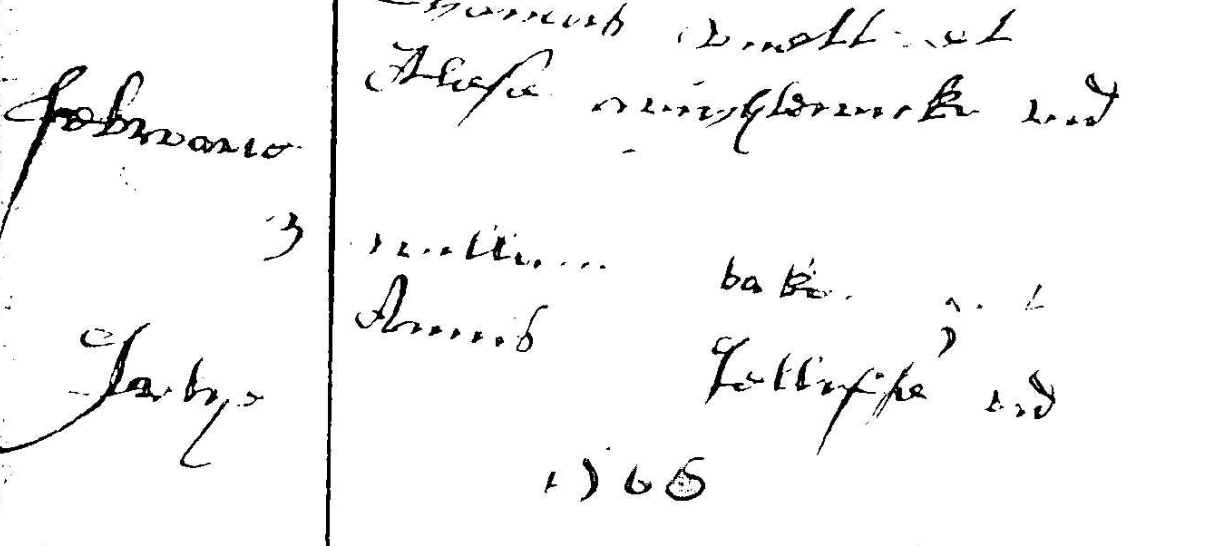
There was a
marriage of William Baker to Annes at the parish of St Martin in Birmingham on
3 February 1565 (Birmingham Archives DRO 34/1).
1577
Child Baker (BAK00015) was
born and died in 1577.
1579
Ane Baker (BAK00016) was born in 1579.
1581
Sampson Baker
(1581 to 1647) (BAK00017)
was born in 1581.
1583
Susanna Baker (BAK00018) was born in
1583.
1588
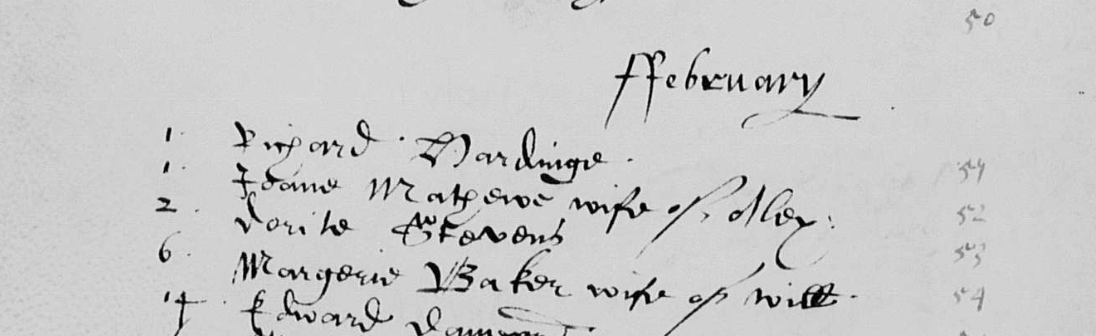
A Margery Baker
was buried at Holy Trinity, Coventry on 6 February 1588 (Holy Trinity, Coventry Parish Records). There was
a suggestion that William Baker’s wife may have been known as Margery.
On 24 September 1588
William Baker married Isabell Bonde (died
1613) at All Saints, Allesley, Warwickshire (All
Saints, Allesley Parish Records). Allesley is a village on the northwest outskirts of modern
Coventry. Both William and Isabell came from St Trinitye,
Coven. This seems to be a reference to Holy Trinity Church,
Coventry.

1592
Joan Baker (BAK00019) was born in 1592.
1594
William Baker (BAK00020) was born in
1594.
William Baker was a mercer. This was
recorded in his burial record.
A
mercer is a trader in textiles. Mercery was often a family run business, with
the husband marketing and selling the textiles at markets and public fairs.
During the fifteenth century mercers had grown their fortunes and instead of
mere merchants were regarded as of higher status and often held influential
positions such as aldermen and mayors. There was a flourishing overseas trade. However in the sixteenth century there was something of a
decline in the trade and growing rivalry with the Worshipful Company of
Mercers.
Around
1594, mercers in Coventry operated as elite textile and luxury merchants
navigating a period of economic strain. Organized under the local Mercers'
Company, they faced growing financial pressures amid a broader shift from
traditional wholesale trade toward retail shopkeeping. The
1590s marked a difficult era for Coventry, which was losing its prominent medieval
manufacturing status. A strict Puritan city council actively suppressed
public festivals and traditional guild-tied pageantry around this time. To
maintain their status, mercers increasingly retailed specialized non-cloth or
luxury lifestyle items, trying to mirror London fashions.
(see The City of Coventry: Crafts and industries, Craft
organisation to the 16th century, in A
History of the County of Warwick: Volume 8, the City of Coventry and Borough of
Warwick, ed. W B Stephens (London, 1969), British History Online, pages 157 to
162).
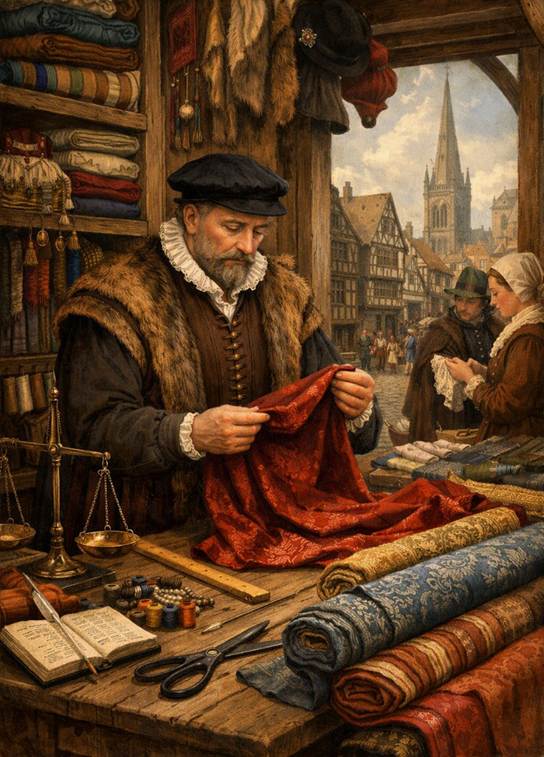
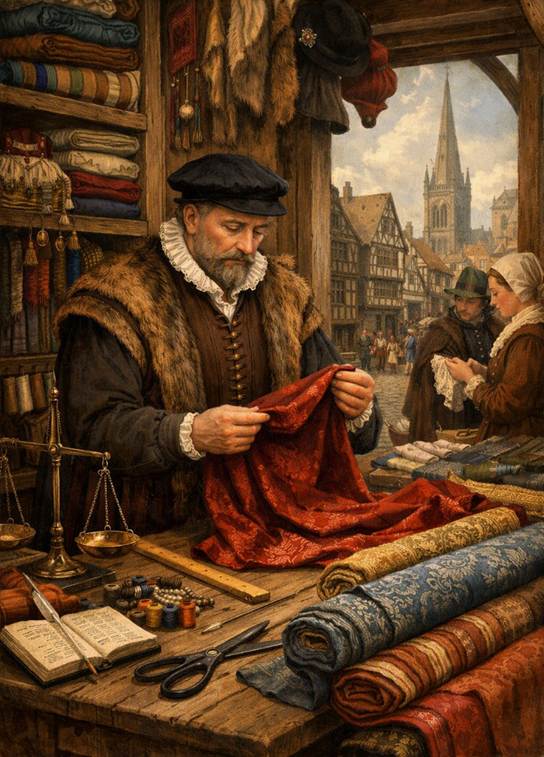
William Baker, a
mercer in Coventry in the late sixteenth century, reimagined using artificial
intelligence
1600
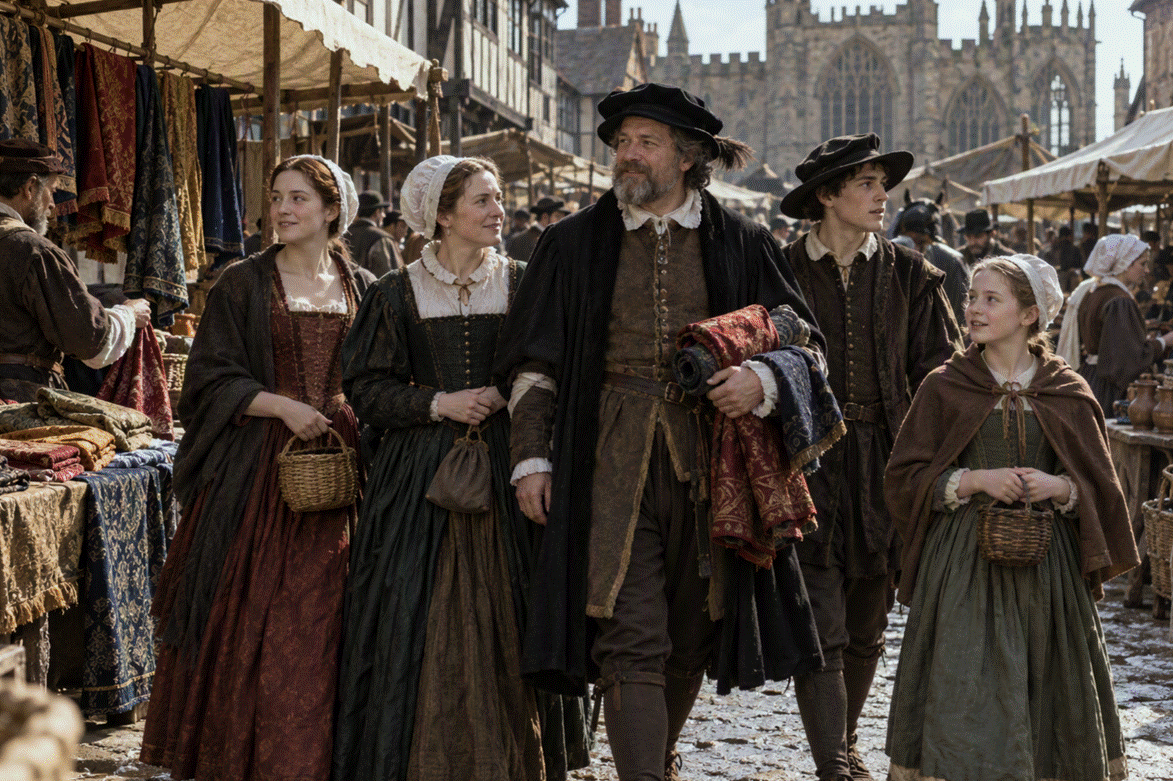
Reimagining
William Baker, with Anne (BAK00016), Isabell,
Sampson (BAK00017) and Susanna (BAK00018) in the market
in Coventry in about 1600
1613
Isabell is
thought to have died in or about 1613.
1615
William Baker, a mercer,
died at Coventry in 1615 and was buried on
11 November 1615 at Holy Trinity, Coventry (Holy
Trinity, Coventry Parish Records).
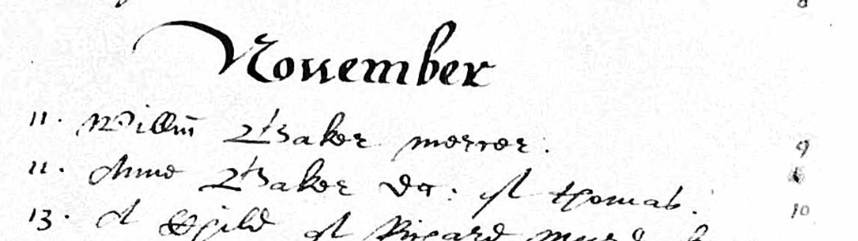
His Will was
dated 17 October 1615.
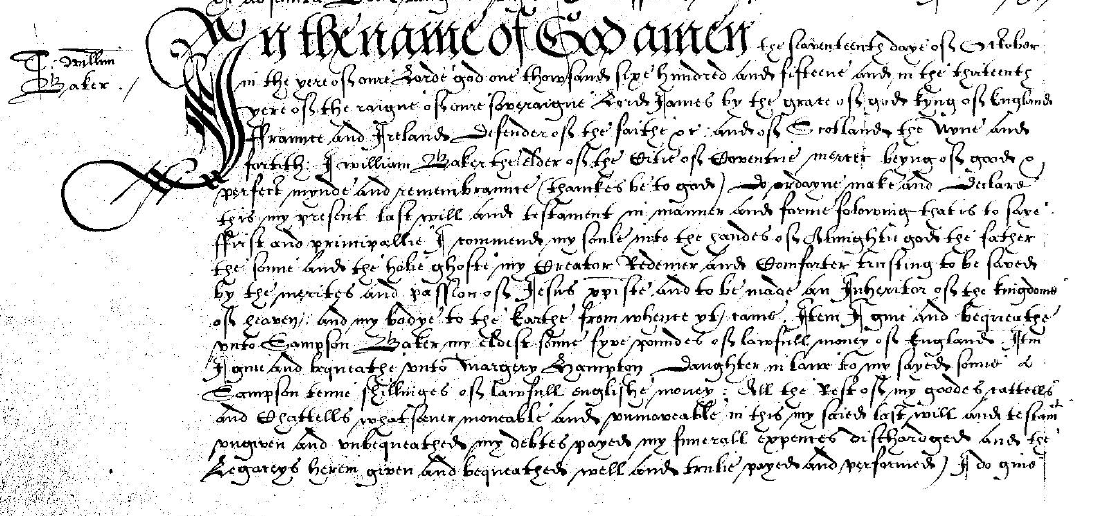
The Will of William
Baker, Mercer of Coventry. In the name of God amen the seventeenth daye of October
in the yere of our
Lorde God one thousand six hundred and fifteene and
in the thirteenth
yeare of the raigne of our sovereigne Lorde
James by the grace of God Kinge of England
Fraunce and Ireland Defender of the faith etc
and of Scotland the nynthe and
fortieth. I William Baker the elder of the
Cittie of Coventry mercer beinge of good and
perfecte mynde and remembrance thankes be
to God and knowinge the uncertaintie
of my lyfe doe make
and ordaine this my last will and testament in manner
and forme followinge that is
to saye
First and principally I comende
my soule into the handes of
Almightie God the father
the sonne and the holie ghoste my creator redeemer
and comforter trusting to be saved
by the merittes
death and passion of Jesus Christe and to be made an inheritor of the kingdome
of heaven, and my body to the earth from
whence it came. Item I give and bequeath
unto Sampson Baker my eldest sonne three poundes of lawfull money of England. Item
I give and bequeathe
unto Margaret Hampton daughter in lawe one pound.
Item unto
Sampson sonne
likewise of the saide Sampson Baker the yonger one good cowe and
one heiffer of twoe yeares olde. Item I will and
bequeathe unto Ellen Moncke and Hannah
Moncke in theis my saide last will and
testament one hundred pounds .
and therefore I do ordaine and make
one of the saids Executors [or Executrixes?] my sonne Mr William Baker, my sonne
John Baker, my daughter [name uncertain], and my brother Daniel Baker of
Stratford upon Avon.
In testimony
whereof I have hereunto sett my hand and seale this [day uncertain] day of [month uncertain] in the yeare of our Lord God one thousand six hundred ninety one. Signed, sealed, published and declared by the
within named William Baker for and as his last will and testament in the
presence of us who subscribed our names as witnesses thereunto in the presence
of the said William Baker and at his request and in the presence of each other:
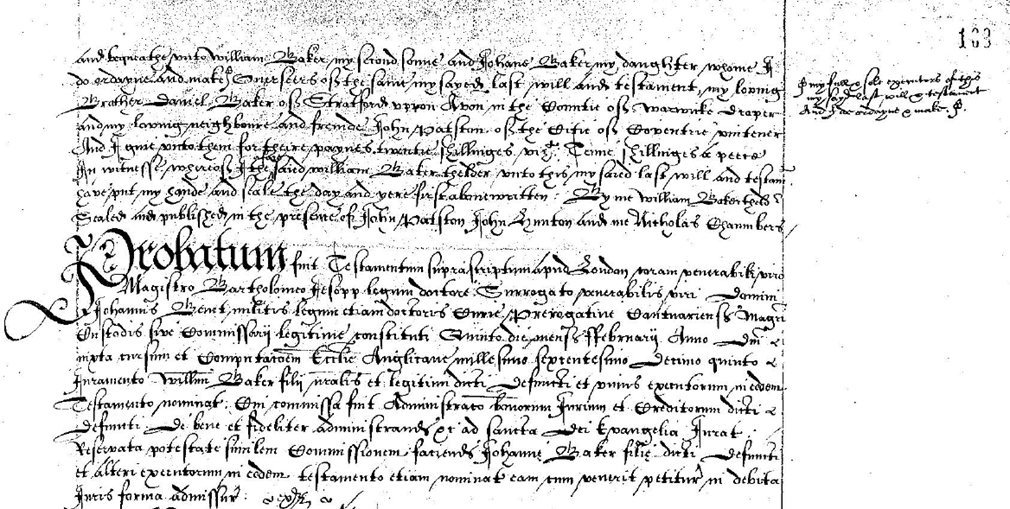
Probatum fuit Testamentum suprascriptum
apud London coram
venerabili viro ...
(Translation)
The above-written
will was proved at London before the Worshipful Sir [name], Doctor of Laws,
Surrogate of the Prerogative Court of Canterbury, on the sixth day of February
in the year of Our Lord 1691 [old style], by the oath of William Bakter the son
of the deceased and one of the executors named in the said will; administration
of all and singular the goods, rights and credits of the deceased was granted
to the said executor, power being reserved to the other executors named in the
will to take probate when they should wish to do so.
Probatum fuit testamentum suprascriptum
apud London coram
venerabili viro domino ... legum doctore
Surrogato venerabilis viri ... Curiae
Prerogativae Cantuariensis
... sexto die mensis Februarii anno Domini 1691 ... juramento
Willmi Baxter filii naturalis
et legitimi dicti defuncti et unius executorum in eodem testamento nominati .
(The National Archives, PROB
11/127/125).