Thomas Wolthwayte of
Farndale
c 1352 to c 1410
The Medieval
Inhabitants of Farndale
FAR00054
|
Return to the Home Page of the Farndale Family
Website |
The story of one family’s journey through two
thousand years of British History |
The 83 family lines into which the family is divided.
Meet the whole family and how the wider family is related |
Members of the historical family ordered by date of
birth |
Links to other pages with historical research and
related material |
The story of the Bakers of Highfields, the Chapmans,
and other related families |
Dates are in red.
Hyperlinks to
other pages are in dark
blue.
Headlines are in brown.
References and
citations are in turquoise.
Context and local
history are in purple.
Thomas may have been born in about 1350. We don’t know who his parents were.
He probably came from a family of early settlers and farmers. Farndale was
first cleared for agriculture from perhaps about 1220 (FAR00004A). So although we
don’t know about Thomas’ parents, it might be supposed that his grandparents
were the hard grafters who first broke up the forest in the dale and started
farming. As Farndale was an extension of the existing estate of Kirkbymoorside
Thomas’ ancestors before them, were likely to have come from the land at the
northern edge of the Vale of York, perhaps in the ancient agricultural lands
around Kirkdale. These lands were part of the same landholdings and estate as
Farndale.
Thwaite is a name
generally associated with fields, particularly in Cumberland, Lancashire and
the North Riding of Yorkshire. The name is usually from Old Norse thveit, but sometimes from Old Danish thwēt, both meaning clearing or meadow (The History of Ryedale, John Rushton, 2003, page 87).
Thomas’ name might suggest he lived in a cultivated part of Farndale known for
wolves, or it may refer to wool.
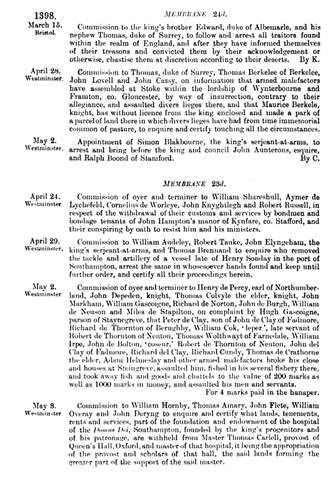
2 May 1398
A
Serious Armed Robbery
On 2
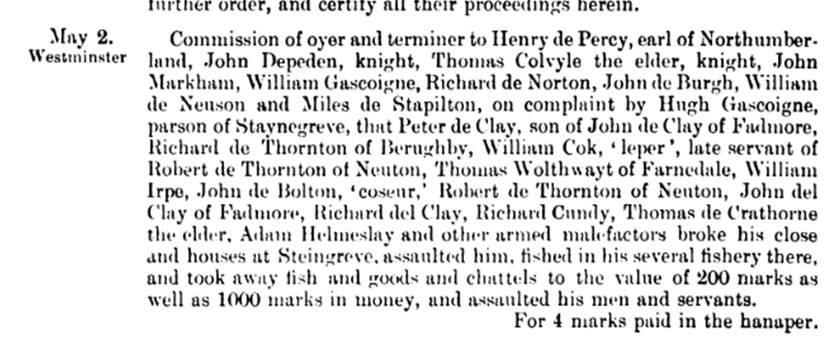
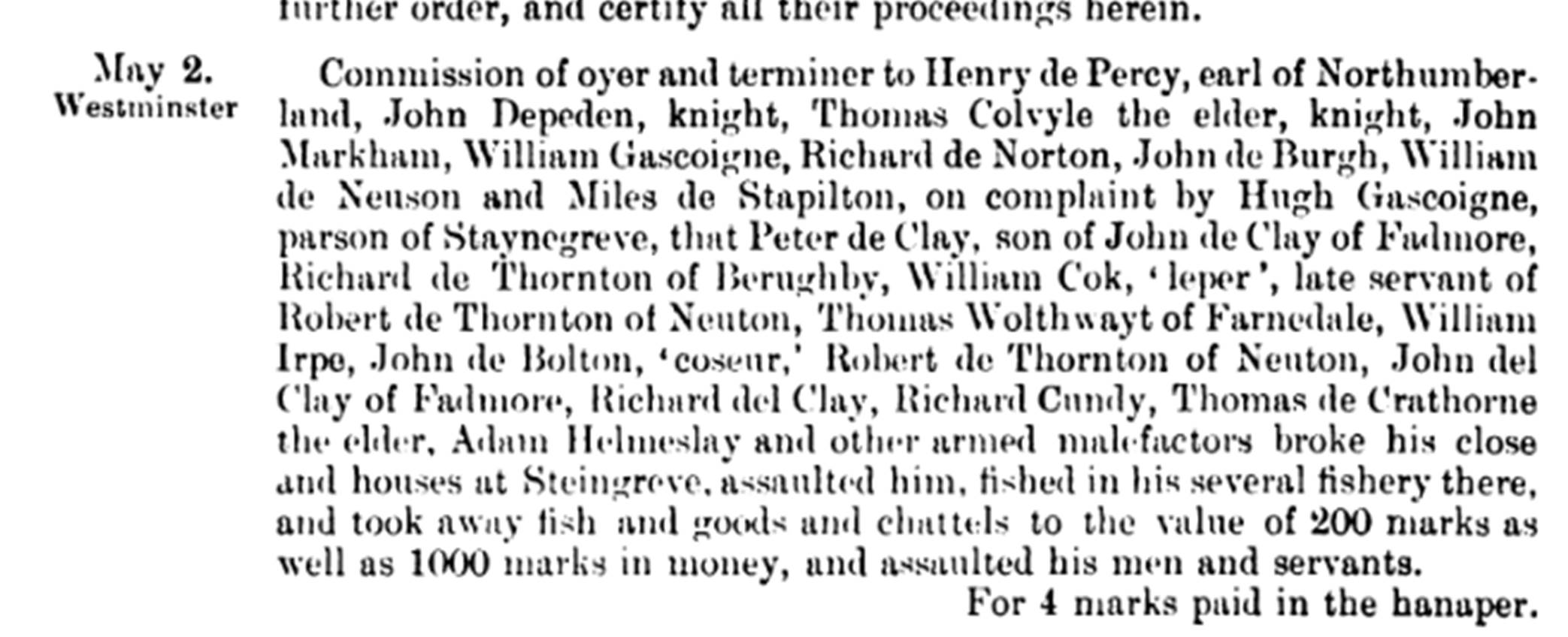
May 1398 at Westminster, a Commission of Oyer and Terminer was granted to Henry
de Percy, earl of Northumberland, John Depeden,
knight, Thomas Colvyle the elder, knight, John
Markham, William Gascoigne, Richard de Norton, John de Burgh, William de Nenson, and Miles de Stapilton,
on a complaint by Hugh Gascoigne, parson of Staynegreve,
that several individuals including Thomas Wolthwayt
of Farnedale (FAR00054), and other armed malefactors broke his
close and houses at Steingreve, assaulted him, fished
in his several fishery there, and took away his fish and goods and chattels
to the value of 200 marks as well as 1000 marks in money, and
assaulted his men and servants. For 4 marks paid in the hanaper.’ (Calendar of Patent Rolls, Richard II, 1396 to 1399, 21
Richard II Part III, 1398, page 365)
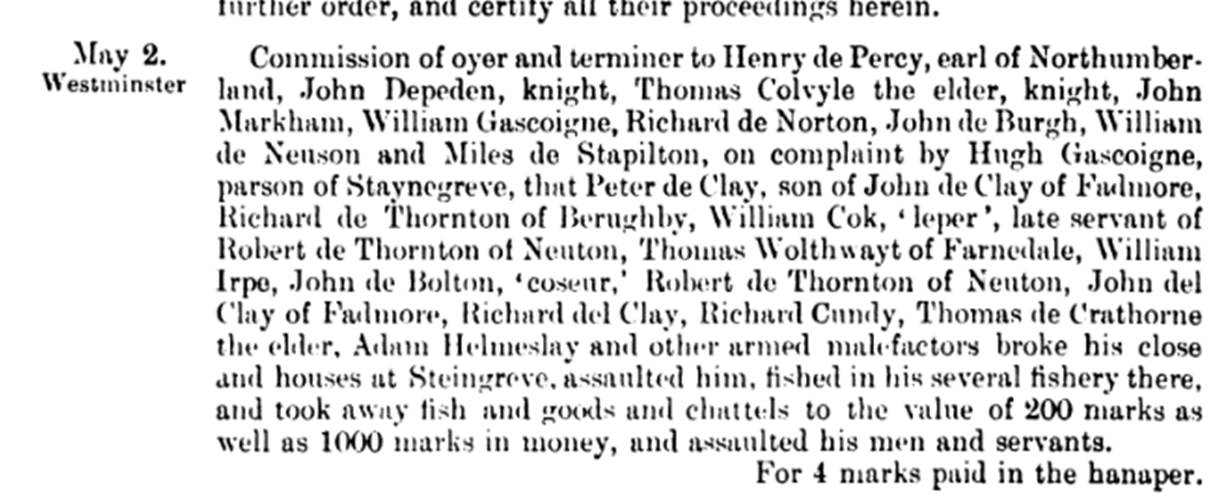
See details
and research notes.
In the closing
years of the 14th century, Thomas Wolthwayt
of Farndale was accused by Hugh Gascoigne, parson of Stone Grave, of breaking
into “his close and house at Stonegrave, assaulting
him, fishing in his several fishponds, and taking away fish and goods to the
value of 200 marks, as well as 1,000 marks in cash”. What perhaps astonishes us
most is the extent of the parson’s wealth – one cannot help feeling Thomas
could not be entirely to blame. (Raymond Hayes, Farndale, 1961,
unpublished, page 34).
About the same period, in the closing years of
the 14th Century, a certain Thomas Wolthwayt of
Farndale was accused by Hugh Gascoigne, the parson of Stonegrave,
of breaking into "his close and houses at Stonegrave,
assaulting him, fishing in his several fishery there and taking away fish and
goods and chattels to the value of 200 marks, as well as 1000 marks in money,
and assaultinghis men and servants". What
perhaps astonishes us as much as anything in this passage is the extent of the
parson’s wealth, and one cannot help feeling that perhaps Thomas was entitled
to a fish or two, at any rate (Notes on the History of Farndale in the Middle Ages, Arthur H Whitaker, Ryedale Historian, Volume 2, 1966, page 59).
1410
Thomas may have lived until about
1410.