Act 9
The Merchants of York

A family who settled in York to join
the new merchant life of the City
The history
continues with the lives of four generations of a merchant family who settled
in medieval York between about 1340 and 1425. The York Line is a medieval line of
the Farndale family who lived in York for four generations.
Scene 1 - The Freemen of York
Johanne
de Farendale had crossed the moors to Egton by 1301,
where he paid 22d in Edward I’s subsidy[1].
By
1314, John de Farndale was a sub tenant of Thomas Wake in Rosedale, the dale
adjacent to Farndale. John held 6 acres of land near the vill
of Cropton. He grew five acres with oats, which had been grown every year
between about 1314 and 1334 and one acre was wasteland[2]. Cropton is at the head of Rosedale, but from
later records, it is apparent that John’s land may have been at Hartoft, near
Rosedale Abbey. Johanne de Farndale, paid taxes at Cropton de Arthoft of 2s 1d in the Lay Subsidy of 1327[3] and 2s in the same place in the 1333 subsidy[4].
In 1336
Johannes left Rosedale to live at Hovingham, during which time he took on a
substantial loan of £8 from a chaplain called Thomas de Wrelton. This seems
strange, given early church rules against usury. The Council of Nicaea in 325
CE forbade the clergy to lend money at even low rates of interest and later
ecumenical councils applied usury rules even to the laity. As Christians were
forbidden to lend money, loans tended to be obtained from Jewish communities,
of which there was a strong community in York, or from lay
moneylenders. £8 equates to about £6,000 in today’s money, perhaps equating to
the value of 11 horses or 21 cows. This was a substantial debt, and it seems
likely that it was taken to set up a new business venture.
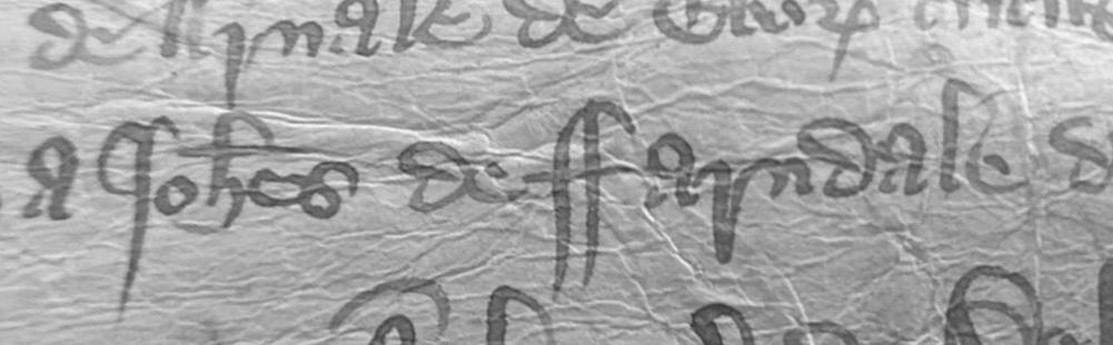
John Farndale’s loan, 1336, held by the
National Archives (C 241/115/94)
It
may have been by about 1338, having taken a loan at Hovingham, that John set up
a new business as a saddler in York. In 1363, Johannes de Farnedale
was admitted as a freeman of York as a sadler[5].
|
A History of York after the
Norman Conquest |

His
son, Johannes de Farndall, fil Johannis de Farndall, sadler,
was admitted as a freeman of York by patrimony in 1397[6].

In
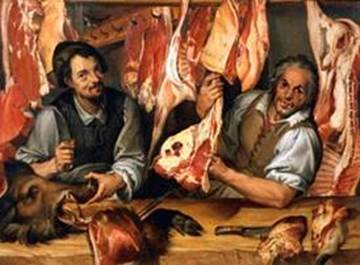
a third generation of this family, John de Fernedill was admitted as a freeman
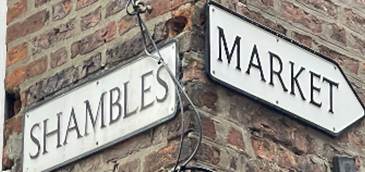
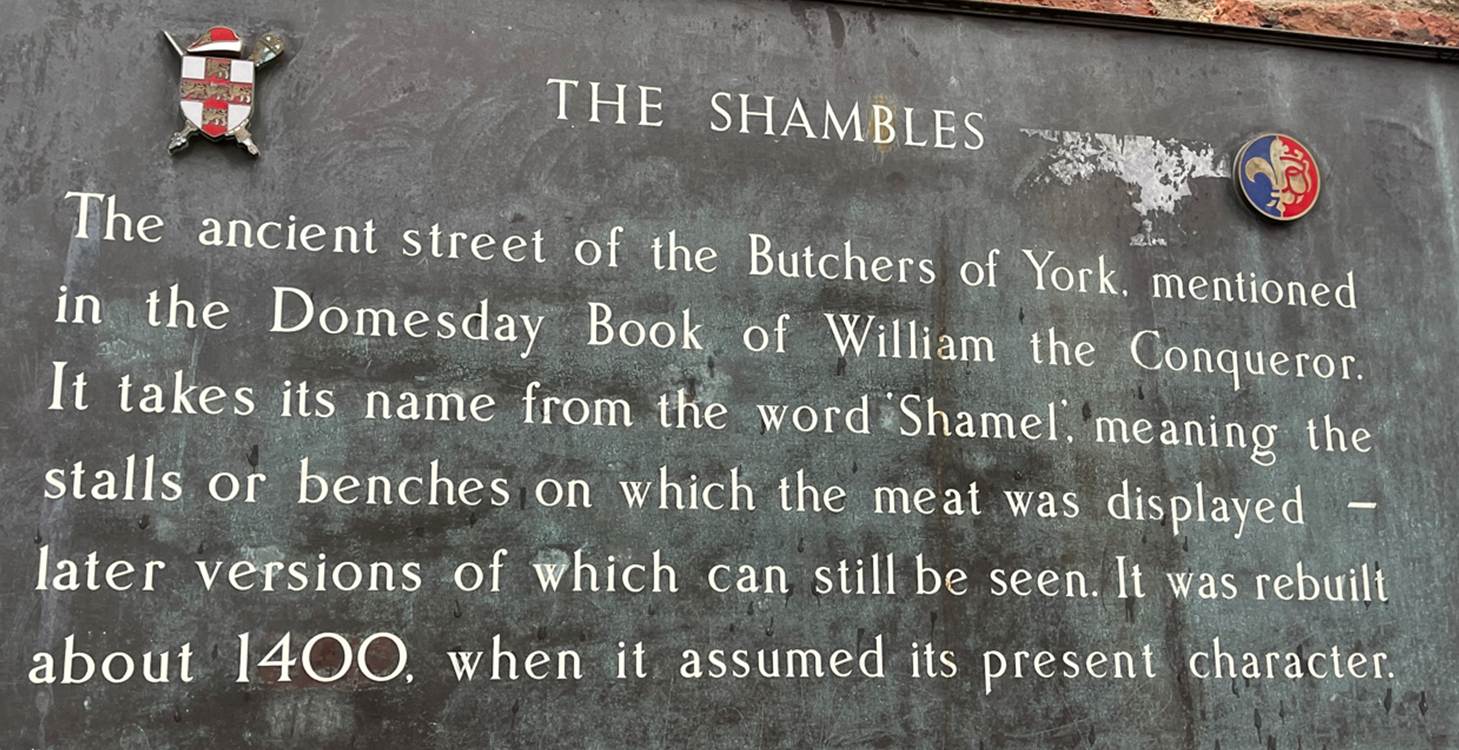
in York in 1408 as a boucher[7], most likely working in the Shambles, from
the Anglo-Saxon fleshammels, the shelves or
benches where meat was displayed the street, and York’s medieval street of
butchers’ shops. This John was likely John Farodell who served under Henry
Percy and John of Gaunt in Scotland between 1383 to 1389[8] and under Thomas Mowbray as part of a
standing force in the Scottish marches in 1389[9], alongside his brothers Henry Farendon[10] and William Faryndon[11]. We will explore their military exploits in Act 10.

It is likely that John worked in the medieval Shambles,
the street of butchers, from the late thirteenth century.
|
John de Farndale “The Saddler” c 1278 to 1372
John left Farndale
and settled in Egton for a while, before returning via Farndale to live in
Rosedale for many years, where he farmed 6 acres In 1336 he took a
loan of £8 and perhaps shortly afterwards set up a business as a saddler in
York, of which city he later became a freeman |
|
c 1334 to c 1405
A freeman of York in 1397 through patrimony from his father |
|
c 1352 to c 1425
John Farndale, and his brothers Henry and William, were archers
and men at arms called to fight in Scotland in 1389
John was later a butcher made freeman of York in 1408 |
|
The
street of the Medieval Butchers |


Davy
Farndyn was perhaps the fourth generation of this
same family, who served extensively in France during Henry V’s campaigns at
Harfleur[12] and later a man at arms at Rouen[13] where he served under Richard Beauchamp, Earl
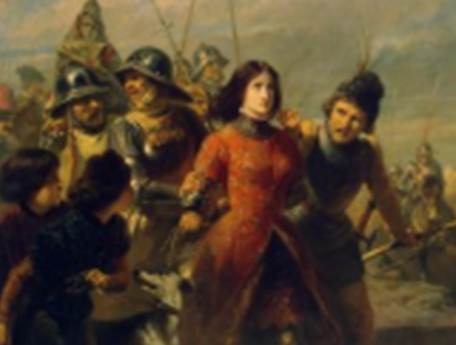
of Warwick, the superintendent and gaoler of Joan of Arc during her trial and
execution. Perhaps a descendant of the first Farndale community stood guard
over the martyr as she was burnt at the stake in 1431.
|
Davy
Farndyn
c 1390 to c 1450 Another veteran
soldier who fought extensively in France and was a soldier in Rouen during
the trial and execution of Joan of Arc |
Another probable son of John the
Saddler of York, William Farndale, moved to Doncaster at about the time of the
Black Death and we will pick up his story in Act 11.
Scene 2 – The Farndales of
Southcliffe
On 1 August
1547 the Will of Alice
Farndale (nee Pratt) of Southcliffe was proved. In the Name of God Amen,
the eleventh day of July 1547. I Alice Farndale of Southclif
do make and ordain this my last Will and Testament in a manner and form
following. First, I give my Soul to Almighty God, to Our Blessed Lady and All
the Ecclesiastical Company of Heaven and my body to be buried in the Churchyard
of North Cave. Item. I give to Jennet Brightin a
kerchief. Item. I give to Isabell Brightin a veil. Item. I give to my mother
Agnes Pratt a violet gown. Item. I give to my sister Isabell Prate (sic)
a red kirtle (outer petticoat). Item. I give to Thomas Brightin and to John
Pratt (her brother, see later), to either of them a calf of the best of
my part. Item. I give to Jennet Brightin a green
kirtle. Item. I give to my brother John Prate (sic) a stage of the best of my parte.
The residue of my goods, my debts paid and my will fulfilled, I give to Symon
ffarnedale and to Isabel my children whom I make
my executors. And further I will that my brother John Prate (sic) shall
have custody and keeping of my said children’s portions bequest unto them by
this my Testament unto they come to lawful years of age when I will that the
said portions go to the use and profit of my brother John Pratt provided
always that my brother John Lonsdale and Laurence shall have the custody and
keeping of my aforesaid children, Simon ffarnedaill
and Isabell as specified in their father’s Testament (clearly he was dead).
And also if my aforesaid children depart before they become to their years of age,
I will that my brother John Pratt do give unto John Lonsdale and
Laurence aforesaid, a cowe of my parte.
These witnesses, Symon Garthorne, Thomas Dean, Thomas Stevyns and Sir Robert
Barker, priest. Will proved on 1st August in the year above given, written
before Symon Garthorne and Master Robert Barker,
priest, witnesses to the Will and Commissioners before whom administration was
granted to John Prate, guardian of Simon and Isabelle ffarnedale,
minors.
 Alice Farndale (nee Pratt) of Southcliff, about twenty
kilometres southeast of York, might have married a descendant of the York
family, with whom they had two children, Simon and Isabell, who were left to
the guardianship of Alice’s brother John Pratt.
Alice Farndale (nee Pratt) of Southcliff, about twenty
kilometres southeast of York, might have married a descendant of the York
family, with whom they had two children, Simon and Isabell, who were left to
the guardianship of Alice’s brother John Pratt.

There was
also a reference in the Will at York of Thomas Yoward on 4
May 1554 To Wylson
wyff of Farndayll 4d.
Go Straight to Act 10 – Medieval
Warfare
or
|
This
is a new experiment. Using Google’s Notebook LM, listen to an AI powered
podcast summarising this page. This should only be treated as an
introduction, and the AI generation sometimes gets the nuance a bit wrong.
However it does provide an introduction to the themes of this page, which are
dealt with in more depth below. |
|