The House Mowbray

The descendants of Nigel D’Aubigny
who defined our family’s lives in the twelfth century
|
Return
to the Home Page of the Farndale Family Website |
The
story of one family’s journey through two thousand years of British History |
The 84
family lines into which the family is divided. Meet the whole family and how
the wider family is related |
Members
of the historical family ordered by date of birth |
Links to
other pages with historical research and related material |
The
story of the Bakers of Highfields, the Chapmans, and other related families |
The
Time Traveller’s Journey through North Yorkshire
The History of the North York Moors,
Ryedale, York, Cleveland and beyond |


The succession of the Mowbrays is in brown.
Dates are in red.
Hyperlinks to other pages are in dark blue.
References and citations are in turquoise.
Context and local history are in purple.
Geographical context is in green.
|
The
Genealogy of House Mowbray The Mowbray Family Tree accompanies this narrative
history |
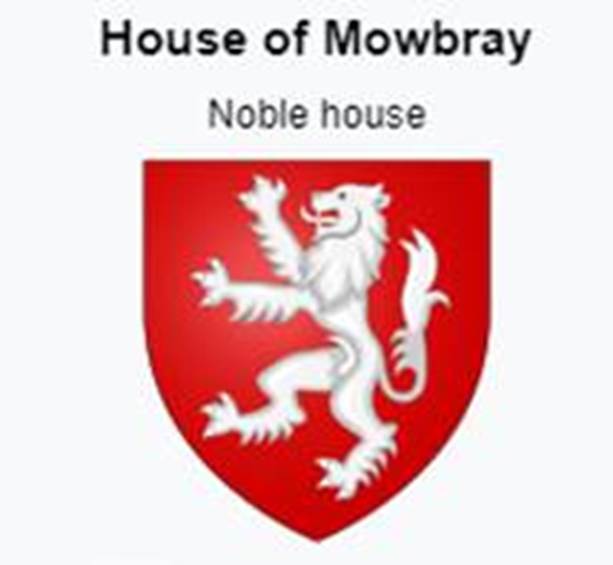
The House of
Mowbray was an Anglo-Norman noble house, with its ancestral roots at Montbray and Saint Martin d’Aubigny
in Normandy.
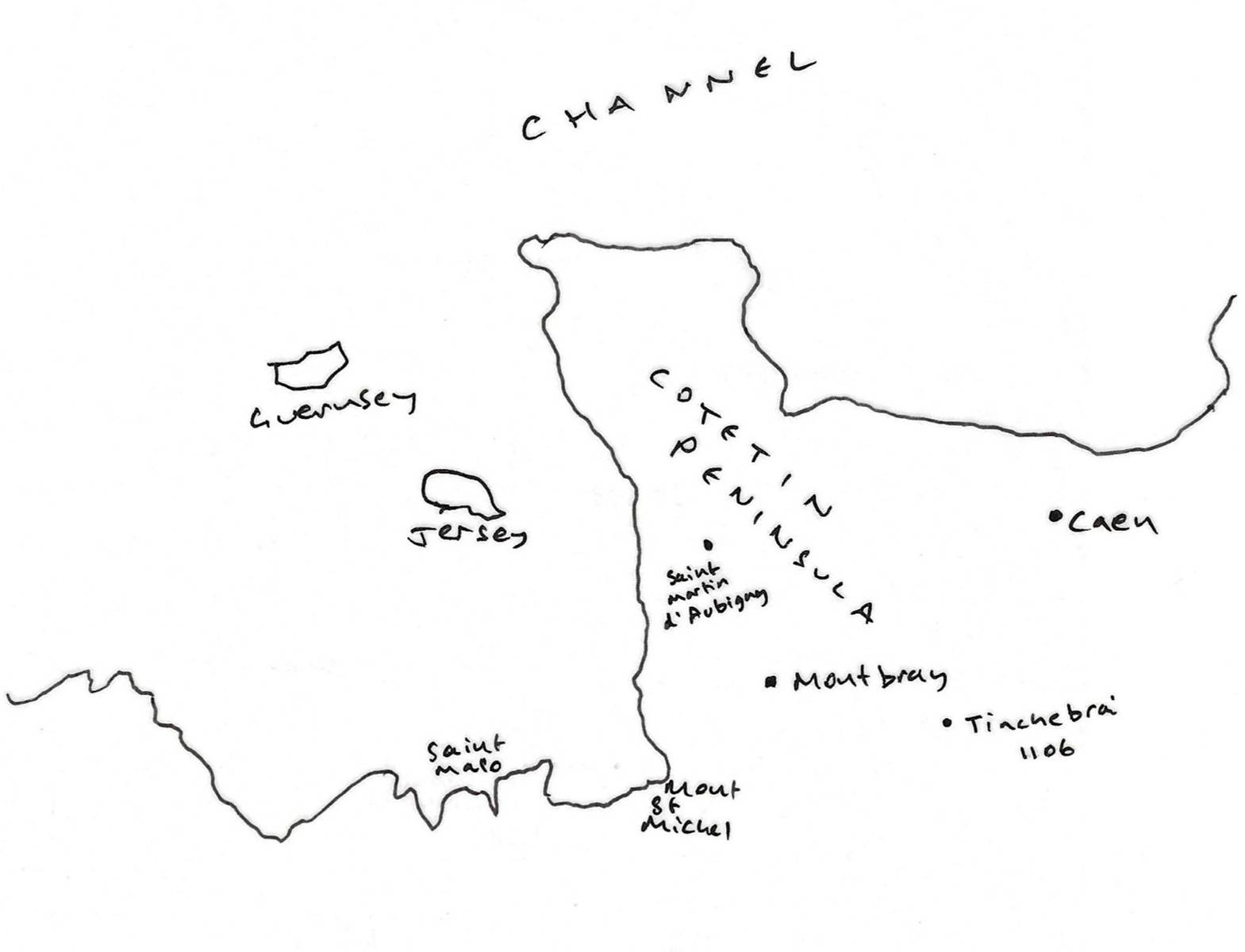
Montbray and Saint Michael d’Aubigny
1066
Following
the Norman conquest, Geoffrey de Montbray, Bishop of Coutances,
was given some two hundred and eighty English manors. His heir, the son of his
brother Roger de Mowbray, was Robert de Mowbray.
1080
|
1066 to 1154 Domination from northern France |
In
about 1080 Robert de Mowbray became Earl of Northumberland after Aubrey de
Coucy resigned. He became a powerful Norman lord known for his fierce military
prowess. He was described as powerful, proud, and formidable in battle, with a
dark, hairy, and stern appearance.
1088
In
1088, there was a significant uprising by Norman barons. It was sparked by the
division William the Conqueror’s lands between his two sons, with powerful
barons who held land on both sides of the English Channel rebelling in an
attempt to unite England and Normandy under a single ruler, Robert Curthose,
Duke of Normandy, instead of King William II (William Rufus) of England. The
rebels included barons with interests in Normandy and northern England,
including Robert de Mowbray, Geoffrey de Montbray, and Roger Bigod.
Concurrently,
King Malcolm III (Malcolm Canmore) of Scotland seized the opportunity,
attacking northern England, including Durham and York,
supporting the anti-Norman sentiment and the rebels.
In
response, William II promised land and money to win over the rebels; appealed
to the English people promising the best law that had ever been in this land;
and launched a direct military campaign. Robert of Normandy failed to provide
timely support and the rebellion failed.
Robert
de Mowbray was one of the pardoned barons.
1093
King
Malcolm III of Scotland was killed on 13 November 1093, at the Battle of
Alnwick near the castle, ambushed by English forces led by Robert de Mowbray,
Earl of Northumbria, while on a raid into England. His son Edward was also
killed, and his wife, Queen Margaret, died a few days later from grief.
1095
Robert
de Mowbray married Matilda de L’Aigle, daughter of
Richer, Lord of L'Aigle, in 1095.
Rebellion
in the North
However
in that same year, Robert de Mowbray conspired against William Rufus to put
Stephen, Count of Aumale and Lord of Holderness, on
the throne. He captured four Norwegian vessels lying in the Tyne. He briefly
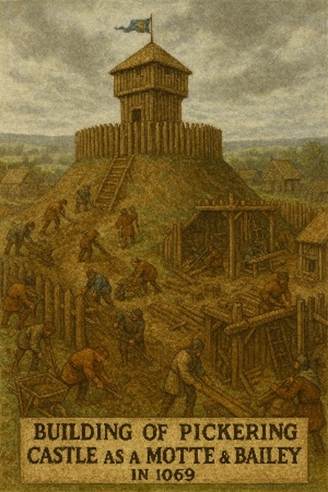
seized the wooden New Castle. The first New Castle, had been
built by Robert Curthose around 1080 on the Roman fort site. It was a wooden
motte and bailey castle constructed to control the strategic bridge. New Castle
was ultimately captured, and the castle became royal property, a crucial base
for controlling the North, and later rebuilt in stone.
Mowbray
was summoned to attend the Curia Regis
to explain his actions, but failed to attend. William finally led an army
against him. Mowbray withdrew to Bamburgh Castle, to which William laid siege,
building a temporary siege castle alongside it, known as Malvoisin, or evil
neighbour. When Mowbray left the castle with a small ensemble of knights,
he was pursued to Tynemouth. There he was surrounded for six days, wounded in
his leg, captured and taken back to Bamburgh. His wife surrendered the castle
after the besiegers threatened to blind her husband.
As
punishment, Robert was imprisoned for life and his marriage to was dissolved
and his lands confiscated. He later became a monk. His lands were given to the
new husband of his former wife.
Nigel d’Aubigny (1070 to 21 November 1129), Lord of Mowbray
Nigel d’Aubigny was the son of Roger d’Aubigny
and Avice de Mowbray, born in about 1070.
1100
After
the mysterious death of William II (Rufus) in 1100, in order to secure support,
his younger brother Henry I agreed in his coronation charter that he would
restore the laws of Edward the Confessor. He married Matilda in a sign of
restoration of the more ancient line of kings. Carta Libertatum,
the Charter of Liberties, was a royal proclamation issued upon Henry I’s
accession to the throne to reform abuses of power by William Rufus and to
secure support from the church and barons. It is considered a landmark document
and a precursor to Magna Carta, as it established the principle that the
king was bound to certain laws. Key promises included an end to feudal abuses,
unfair taxation, and simony, but many of these promises were later ignored by
the king once his position was secure.
The
early part of Henry I’s reign was dominated by struggle with his older brother
Robert Curtose, which took him to Normandy for much of his time, leaving
Matilda and Roger, Bishop of Salisbury, to administer the English Kingdom.
Roger
d’Aubigny was an avid supporter of Henry I.
1106
Battle
of Tinchebrai
Henry
I defeated his elder brother and rival Robert Curthose at the Battle of Tinchebrai in Normandy in 1106. After his victory he
visited York and Pickering. Henry I redistributed land from
Robert Curtose’s supporters, including from Robert de
Stuteville to his new men, including Robert’s son, Nigel d’Aubigny,
ancestor of the Mowbray family and Robert de Brus. Nigel d’Aubigny was
described as one of the most favoured of Henry's new men.
1107
A
royal favourite, Nigel was thus rewarded with marriage in 1107 to the former
wife of the imprisoned Robert de Mowbray, Matilda de L’Aigle
through whom he assumed the escheated (reverted to the crown) Norman
fief of her former husband. At the same time he was given other lands. Robert de
Stuteville, who had followed the cause of Robert Curtose
was deprived of the Kirkbymoorside
estate in 1106 and it was also granted to Nigel d’Aubigny.
He also had a castle at Thirsk.
The Mowbray honour would become one of the wealthiest
estates in Norman England. Nigel’s uncle, William was made king's
butler, and William’s son William d'Aubigny became
1st Earl of Arundel.
From
1107 to about 1118, Nigel served as a royal official in Yorkshire and
Northumberland. In the last decade of his life he frequently travelled with
Henry I, probably as one of the king's trusted military and
administrative
advisors.
1118
The
marriage with Matilda was childless. Following a decade of childless marriage
and the death of her powerful brother, Nigel repudiated his marriage with
Matilda based on his consanguinity with her former husband.
In
June 1118 Nigel married to Gundreda de Gournay (died
1155), daughter of Gerard de Gournay and his wife Edith de Warenne, and hence
granddaughter of William de Warenne, 1st Earl of Surrey.
1120
As
the tragic white ship incident deprived the Norman royal line of its heir,
Nigel and Gundreda had a son, Roger, who would
inherit the Mowbray estates including the Mowbray lands in Normandy and take
the Mowbray surname and found the prominent Mowbray family line.
1129
Nigel d’Aubigny died whilst in Normandy on 21 November 1129. It
is said that be became a monk shortly before he died. He was buried at the
Priory of Bec.
Roger I de Mowbray
(1120 to 1188), Lord of Mowbray
On Nigel d’Aubigny’s death Roger became a ward of the Crown and Gundreda administered the estate on his behalf.
Roger’s minority was from 1129 to
1138.
1131
Grants
of land to Rievaulx
The
Cistercian Abbey of Rievaulx was founded
in 1131.
It was Gundreda
who granted the whole of Welburn and Skiplam together with the western side of
Bransdale to Rievaulx Abbey, who developed the locality as a series of granges
and cotes, including Colt House and Stirk House in Bransdale. Through his
mother, Roger made multiple religious foundations in Yorkshire.
On an unknown date but during Roger’s
minority, there was a grant to Rievaulx by his mother Gundreda
on his behalf, of land which included land at Middelhoved,
on the northern heights of Farndale,
adjacent to an ancient route over the moors known as Thurkilesti.
Gundreda,
wife of Nigel de Albaneius, greetings to all the sons of St. Ecclesiff. Know that I have given and … confirmed, with the
consent of my son, Rogeri de Moubrai,
God and St. Marise Rievallis and the brothers there. . . for the soul of my
husband Nigel de Albaneius, and for the safety of the soul of my son, Roger de
Molbrai, and of his wife, and of their children, and for the soul of my father
and mother, and of all my ancestors, whatever I had in my possession of
cultivated land in Skipenum, and, where the
cultivated land falls towards the north, whatever is in my fief and that of my
son, Roger de Moubrai, in the forest and the plain, and the pastures and the wastins, according to the divisions between Wellebruna and Wimbeltun, and as
divided from Wellebruna they tend to Thurkilesti,
and so towards Cliveland, namely Locum and Locumeslehit, and Wibbehahge and Langeran, and Brannesdala, and
Middelhoved, as they are divided between Wellebruna and Faddemor, and so
towards Cliveland.
To
all . . . Rogerus de Molbray, greeting. You may know
that I have given to the Church of St. Mary of Rievallis, for the soul of my
father, Nigel, and my mother, Gundreda, the grant of my heirs, Nigel and
Roberti, in perpetual alms, with all its appurtenances . . . and the divisions
which are called below are: — from the west, that is, from Wellebruna
… and so as they are divided they stretch as far as Langaran,
and thence as far as Apelgard and divided from Cliveland and Middelhovet…
1135
The
Anarchy
Things got
complicated in England after the death of Henry I in 1135 led to a succession
crisis. There was sporadic conflict between the daughter of Henry I and dowager
empress of Germany, Matilda and Stephen of Blois, William I’s grandson. This
period of breakdown in royal authority is known as The Anarchy, during
which time King Stephen reigned precariously from 1135 to 1154.
Roger
de Mowbray fought for Stephen against Matilda, and her son, the future Henry
II.
1138
Based at Thirsk with his mother, on reaching
his majority in 1138, Roger took title to the lands awarded to his father by
Henry I both in Normandy, including Montbray, from
which he would adopt his surname, as well as the substantial holdings in
Yorkshire and around Melton, later to become Melton Mowbray.
The Scots took advantage of the
Anarchy and invaded the northern lands into Yorkshire. The House Brus had joined the Scots, but most of
the Norman barony remained loyal to Stephen. Soon after
his majority, also in 1138, he participated in the Battle of the Standard against the
Scottish invaders, named after a wagon carrying a
crucifix and silver pyx. According to Aelred of Rievaulx, he acquitted
himself honourably. With his mother, Roger had sheltered
the monks of Calder, fleeing before the Scots in 1138 and supported their
establishment at Byland Abbey in 1143.
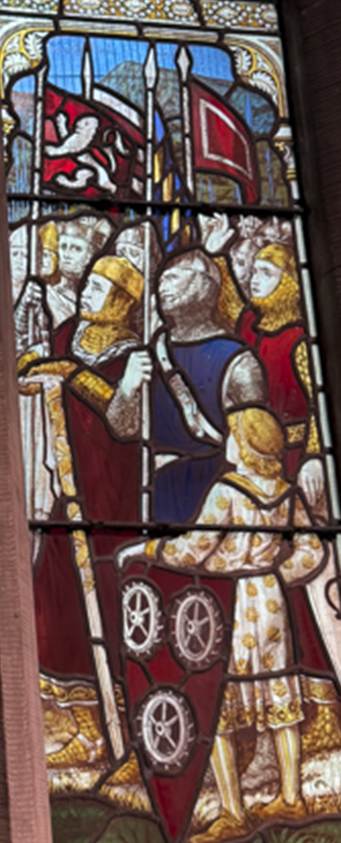
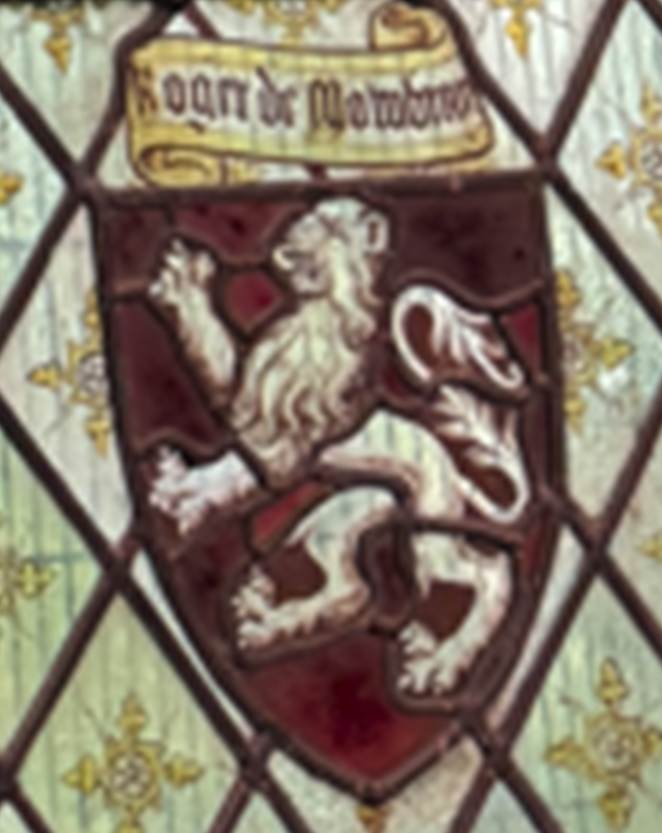
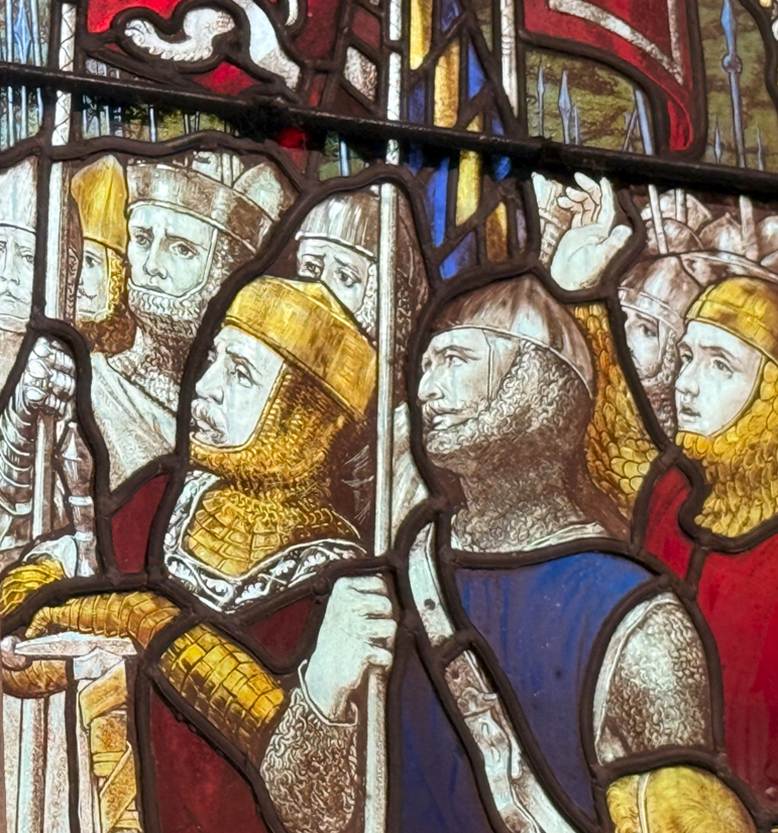
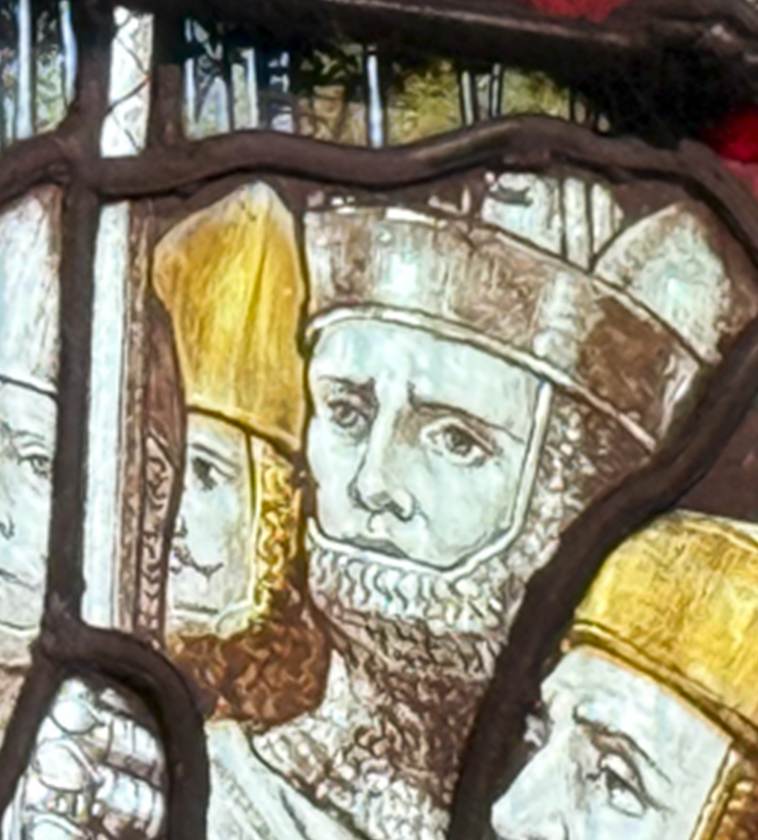
Roger de Mowbray at the Battle of the
Standard, 22 August 1138 (Stained Glass Window at Helmsley Parish Church)
Thereafter, Roger's military fortunes were
mixed. Whilst acknowledged as a competent and prodigious fighter, he generally
found himself on the losing side in his subsequent engagements.
1141
Roger de Mowbray was captured with Stephen
at the Battle
of Lincoln in 1141.
Soon after his release, Roger married
Alice de Gant (who died in about 1181), widow of Ilbert de Lacy and daughter of
Walter de Gant. Roger and Alice had two sons, Nigel and Robert. Roger also had
at least one daughter, donating his lands at Granville to the Abbaye aux Dames
in Caen when she became a nun there.
1143
Roger
continued to be a significant benefactor and supporter of several religious
institutions in Yorkshire including Fountains Abbey. He supported the
establishment of Byland
Abbey in 1143. In 1147, he facilitated their relocation to lands near
Coxwold. Roger is credited with assisting the establishment of thirty five
churches.
1147
In 1147, Roger joined Louis VII of
France on the Second Crusade. John of Hexham wrote that he defeated a Muslim
leader in single combat.
1150
Roger made a
generous donation of two carucates of land or about 240 acres, a house and two
mills to the Order of Saint Lazarus, headquartered at Burton St Lazarus
Hospital in Leicestershire, after his return from the crusades in 1150.
1154
The
Plantagenet era begins
The
future Henry II was the son of the Dowager Roman Empress Matilda and Geoffrey
of Anjou. His father Geoffrey was also known as Plantagenet from the
sprig of
yellow broom blossom (planta genista) he wore in
his hair. In January 1153 the young Henry crossed the channel and arrived at
the walls of the dilapidated castle at Malmesbury in Wiltshire with knights and
3,000 infantry. Stephen was forced to move his much larger army to meet Henry,
but bitter winds and heavy rain devastated his force, which arrived demoralised
and unready to fight. Stephen was forced to retreat. Henry at last had an
advantage in a land wearied by war.
In
November 1153 there was a formal truce and Henry was accepted as heir. In the
interim, Stephen also agreed to act on Henry’s advice.
By 1154
Matilda’s son, Henry II was recognised as Matilda’s future heir to the royal
throne.
|
1154 to 1399
England in the Middle Ages |
In
October 1154 Henry was campaigning in the Vexin
region near Normandy when Stephen died on 25 October 1154.
For
the first time a new King was crowned with dignity and without rush in a smooth
transition of power. His coronation was at Westminster on 19 December 1154. He
promised stability. This saw the end of Norman rule, and the start of a period
of rule in England by the House of Anjou, sometimes referred to as the Angevins
or more usually, the Plantagenets. Henry II was married to the powerful
Eleanor, heiress of the Duchy of Aquitaine. It was this marriage which brought
England into the Angevin empire.
In 1154, as
the Plantagenets started their long dynasty, Roger granted a wood in Farndale called Midelhoved, and another wood
called Duvanesthuat to the new Cistercian
Abbey of Rievaulx.
He
bestowed upon the new Cistercian monastery of Rievaulx, Midelhovet, that
clearing (or meadow or forest) in Farndale where the hermit Edmund used to
dwell; and another clearing which is called Duvanesthuat
and common of pasture in the same valley of Farndale (Cartularium Abbathiae de Rievalle reproduced by the Surtees
Society Publication Volume 83, 1889, page
36). The full text reads: Roger de Molbrai to all the faithful, both his own and others, alms.
Let it be known that I have granted . . . to the brothers of Rievallis, in
perpetual alms, Midelhovet — that is, that forest in Farnedale
where Edmund the Hermit dwelt, and another forest which is called Duvanesthuat, and the common pasture of the same valley —
that is, Farnedale : and in the wood timber for
material, and for the proper uses of those who shall dwell there, save the
wild. Witness Samson de Alb[aneia] ; and Peter de Tresc ; and Anschetill Ostrario ; and Walter Parr ; and Eichard
de Sescal [or ? Desescal.]
; and John Scribe ; and Walter de la Eiviere ; [and] Einald le Poer.
It was only to be expected that the
Cistercian monks would seek to extend their properties into the Mowbray
territories further east. Roger de Mowbray, son of Nigel d’Aubigny,
grantee of the Stuteville lands, was holding Kirkbymoorside. The whole area was
regarded as a private forest of the Mowbrays. The grant was made saving
Roger’s wild beasts, and it seems to have been anticipated that the monks
would want to build a new dwelling there, probably to use as a grange or cote.
The
Mowbrays’ loss of their interest in the estate of Kirkbymoorside
However with Henry II’s accession to
the English throne, the tide had now turned again, so Robert de Stuteville, grandson of the first Robert, now laid
claim to the barony of which his family had been deprived by Henry I. It was in
these circumstances that Roger de Mowbray gave Kirkbymoorside to the Stutevilles for
10 knights’ fees in satisfaction of his claim. This arrangement however was not
ratified in the King’s courts. The Mowbrays remained technically the feudal
superiors, but the Stutevilles now held the Kirkbymoorside lands in practice.
1170
On
29 December 1170 four heavily armed men entered Canterbury cathedral. They
tried to arrest the unarmed Becket. When he resisted he was beheaded and
brutally killed. They believed that this was what Henry had wanted. The church
and society across Europe were appalled.
1172
The Great Revolt
In 1172, Henry II’s son, Henry the
Young King, 18 years old, married to Margaret of France, anointed as Henry’s
successor and reanointed in 1172 at Winchester, had grown frustrated at being
denied the true powers of kingship.
After
his brother John was given strategically important castles in Normandy as a
wedding gift, the jealous young Henry slipped away to the court of the French
King. The 15 year old brothers Richard and 14 year old Geoffrey chose to
support his rebellion. After years of loyalty, Henry II’s wife Eleanor of
Aquitaine also joined the rebellion. Eleanor did not reach Paris, but was
arrested by Henry’s agents and taken to Chinon Castle. Another civil war had
begun.
1173
In Summer 1173 there were a series of
inconclusive battles across France as Henry II, following the
controversial death of Thomas Becket in 1170, faced the Great Revolt,
the uprising by his eldest sons and rebellious barons, supported by France,
Scotland and Flanders.
The rebels were unimpressive and Henry
had the upper hand in England and France. The war took place on multiple
fronts, but Richard had more impressive noblemen in his support. Richard de
Lucy, justiciar of England supported the King, as did the recently reconciled
church.
Roger de
Mowbray was one of the powerful Anglo-Norman barons who joined the rebellion
led by King Henry II's son, Henry the Young King, which was also supported by
the King of Scots, William the Lion. Mowbray's castles linked the rebel forces
in the Midlands with the Scottish army in the north.
In June 1173 William the Lion attacked
Northumberland with a Scottish army in support of the rebellion. Some of the
sokemen of Pickering
were fined for their involvement.
Henry II's forces, led by his
illegitimate son Geoffrey, bishop-elect of Lincoln, moved against Mowbray's
strongholds in Yorkshire. Facing defeat, Roger de Mowbray reportedly left his
castles to his sons' defence and joined the Scottish King William in the north.
Mowbray's son Robert defended the castle of the Island at Kinnardferry on the Isle of Axholme,
but was forced to surrender and was captured. Geoffrey then quickly took Kirkby
Malzeard castle before laying siege to Mowbray's main
fortress at Thirsk.
Roger de Mowbray was with William the
Lion at Alnwick when a small force of Yorkshire barons loyal to Henry II,
including Robert de Stuteville, surprised and captured the Scottish king on 13 July
1174. While some accounts suggest Mowbray himself escaped at this point and was
captured later when the general rebellion collapsed, other sources indicate he
was taken prisoner with the King of Scots. Bernard de Balliol and Robert de Stuteville
captured the Scottish King at Alnwick and imprisoned him at Richmond
Castle.
Both Kirkby Malzeard and Thirsk Castle were demolished.
Roger de Mowbray, with his sons, Nigel
and Robert had supported the Revolt of 1173 to 1174 against Henry II, and the
Mowbray fortunes had turned again.
1175
There
was peace by 1175, when Robert de Stuteville
supervised the building of new castles in Edinburgh and Scarborough. Roger de Mowbray was compelled to return
Kirkbymoorside to the de Stutevilles along with
many other fees. The rising Stuteville family
recovered much of the old estate forfeited by their ancestors, including Kirkbymoorside.
1186
Roger
left for the Holy Land again in 1186, but encountered further misfortune being
captured at the Battle of Hattin in 1187. His ransom was met by the Templars,
but he died soon after and, according to some accounts, was buried at Tyre in
Palestine. There is, however, some debate amongst historians about his death
and burial and final resting-place.
Nigel (“Nele”) de
Mowbray (1146 to 1191)
Nigel had
lived most of his life in his father's shadow. He married Mabel de Clare in
about 1170. They had four sons, William (Nigel’s successor), Philip (ancestor
of the Scottish Mowbrays of Barnbougle), Robert, and
Roger (ancestor of the Mowbrays of Kirklington).
1188
Nigel took
over his father's estates in England and Normandy in 1188.
1189
In 1189
Nigel de Mowbray attended the coronation of Richard I The Lionheart.
1191
In 1191
Nigel de Mowbray set off for Palestine but died on the journey and was buried
at sea.
William de Mowbray
(1173 to 1224), Lord of Mowbray
Nigel’s
eldest son was William married to Agnes D’Aubigny, daughter of William
D’Aubigny, the 2nd Earl of Arundel. They had two sons, Nele and Roger, and a
daughter Maud.
1193
It is said
that William was with Richard I returning from Palestine, and witnessed a
charter of the King at Spiers in Germany 20 November 1193, when Richard spent
his second Christmas in captivity.
1194
William
received livery of his lands in 1194 after a payment of £100. He was then
called to pay more for Richard's ransom.
1197
William
Mowbray was a witness to the treaty with Flanders in 1197.
After Richard's death in 1199,
William de Mowbray swore allegiance to King John and remained loyal to John
after the loss of Normandy in 1205 when he lost all his Norman holdings,
including Montbray, to the French king forever.
1200
Kirkbymoorside and the Stuteville Fee
A dispute broke out again between William de Stuteville, son of Robert de Stuteville and William de
Mowbray, grandson of Roger de Mowbray. A century earlier, Nigel D’Aubigny had
acquired the lands of Robert de Stuteville, a supporter of Henry’s brother
Robert Curthose in his failed bid for the English crown, in 1107, his property
forfeited his property to Henry and redistributed to Nigel.
In 1200 Robert’s descendant, William,
reactivated his family’s claim against the Mowbrays, and in that year William
offered the sum of 2,000 marks (over £1,300) to King John to secure a judgement
in the matter. When the case was brought
before the king’s justices, however, it ended in a compromise, and one highly
favourable to Stuteville. William was
nonetheless still under obligation to pay and, like others before him, had little
alternative but to borrow from Jewish moneylenders. William had gambled everything on the
favourable outcome of a risky legal action and had failed. It is clear that, when he embarked on
rebellion against John, he had nothing to lose.
However in due course William de Mowbray
confirmed the previous agreement and gave 9 knights’ fees in augmentum.
Henceforward Kirkbymoorside was held of the Mowbrays by the heirs of the Stutevilles until the end of the 14th century.
1214
The
Northern Barons
William
Mowbray was prominent amongst the northern barons who forced the Magna Carta on
John in 1215.
In
summer 1214, John planned another invasion of Poitou. Some of the Yorkshire
barons held no continental lands, and had little interest in John’s overseas
interests. William de Mowbray and Peter
de Brus refused to join the overseas adventure to Poitou or to pay war
taxes in 1214. These barons were prominent amongst the northern barons who
forced the Magna Carta on John in 1215.
The
Northern Barons were led by Eustace de Vesci. John pressed on extracting
increasing levies, including scutage, a tax substitute tax payment for feudal
obligations of military service at increasing levels.
In
February 1214 John sailed from Portsmouth for La Rochelle and his campaign
started well through the spring. However he was then deserted by his Poitevan barons and forced to retreat. His German and
Flemish allies were defeated at the Battle of
Bouvines on 27 July 1214, a typical medieval battle.
After Bouvines, John’s continental aspirations were over. He returned weaker
than ever.
Baronial
disquiet burst into the open and two meetings over the winter failed to resolve
their differences.
1215
In
January John wrote to his new ally Innocent II pleading his case, but the
barons insisted that John obey the Charter of Liberties issued by Henry I at
his coronation in 1100, confirmed by Henry II in 1154, promising not to plunder
church property nor charge exorbitant feudal dues. Innocent appointed
Archbishop Langton to mediate, but supported John’s position.
This was civil war and the rebels and
the Earl of Salisbury each made a dash for London. The rebels reached London on
17 May 1215 where the rich citizens supported them and the poor ones were
afraid to murmur against them (Roger de
Wendover). Yet John was still King, and now with papal support.
On 10 June 1215 baronial envoys agreed
the Articles of the Barons
as the basis for negotiation, comprising 49 provisions relating to justice and
feudal process.
Magna Carta
On 19 June 1215, the barons started to
renew their homage to the King who wore the regalia of the Empress Matilda to
stress the ancient status of the Plantagenet line. In return John and his
allies began to endorse terms of an agreement drawn up by the barons.
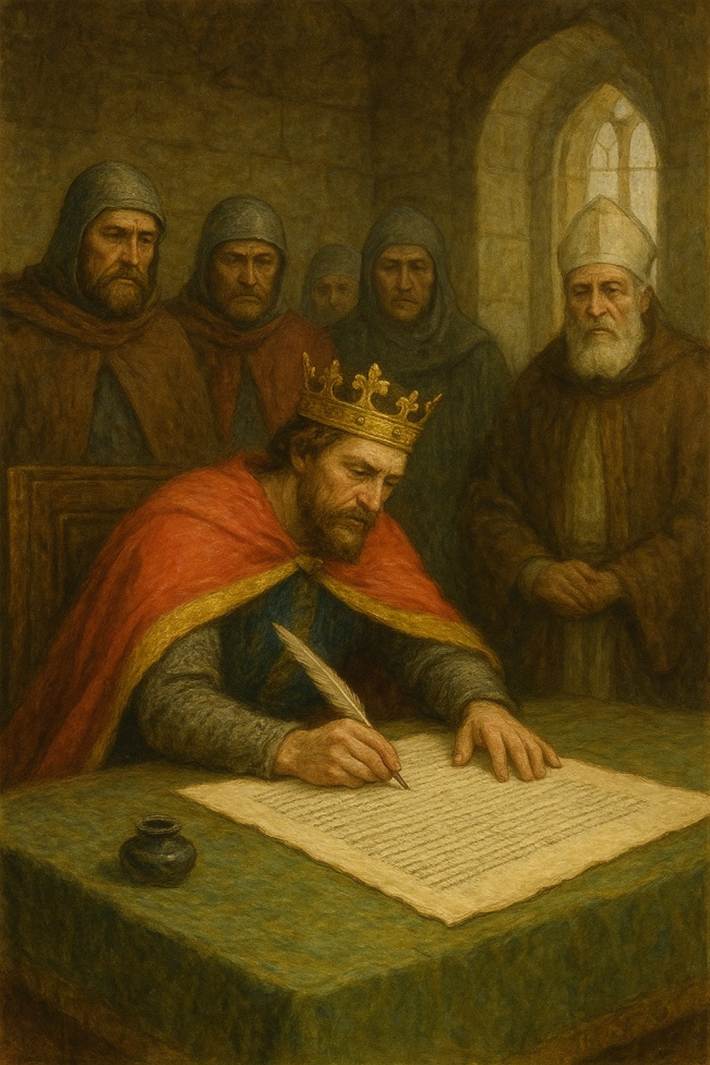
King John signed Magna Carta
at Runnymede in June 1215. It included a resolution of countless grievances of
the day, but it also embraced some fundamental legal principles which have
passed through to contemporary legal doctrine, including that:
· No
Freeman shall be arrested, or imprisoned … but by lawful judgment of his peers (Article 39,
see also Article 21);
· We
will not sell, or deny, or delay right or justice to anyone (Article 40);
· The
English Church shall be free (Article 1);
· The
City of London is to have its ancient liberties (Article 13);
· It
is to be lawful in future for every man to depart from our kingdom, and to
return to it, safely and securely, by land and water, saving our allegiance,
except in time of war for some short time, for the sake of the common utility
of the kingdom
(Article 42);
· Men
who reside outside the forest are not in future to come before our forest
justices upon common summonses, unless they are involved in pleadings, or are
the pledges of a person or persons who have been attached for forest business (Article 44);
· All
the forests which have been afforested during our reign are to be disafforested
immediately, and the same is to be done with regard to rivers which have been
fenced off by us in our time
(Article 47);
together with lengthy more detailed
provisions relating to the nuances of English customs and feudal duties.
·
Imposed restraints on monarchy;
·
Might be taken as the first example of
a written constitution, which was unusual across Europe at that time;
·
Represented a contract between
monarchy and the community of the realm, which started to emerge as a distinct
legal entity.
William
de Mowbray
was on the
council of 25 barons set up
under Magna Carta.
Yet
this was nothing more than a contractual basis for civil war. Stating that a
king should govern according to the law and making sure that he did so were, it
turned out, quite separate matters. These questions would lie at the heart of
every major disagreement between king and country for the rest of the
Plantagenet years. (The Plantagenets, The Kings who made England, 2012, Dan Jones, page 214).
In
less than 2 months John annulled the terms of the Charter. John in desperation
declared the Pope the feudal overlord of England and asked him to annul Magna
Carta.
The twenty five barons, including William, were ex-communicated by Pope
Innocent III on 16 December 1215 for their actions against the King.
1216
King
John died on 19 October 1216. At this point Magna Carta was a failed peace
treaty, but in time it would be renewed and regain its status.
Henry
II
Henry
II reigned for 56 years. He was nine years old when he was crowned in a hurry
after his father’s death in Gloucester Abbey.
1217
William was taken prisoner at the Battle of Lincoln 20
May 1217, but managed to redeem his lands by the surrender of the Lordship of Bensted, Surrey to Hubert de Burgh.
1221
William was
also present at the siege of Bitham Castle in
Lincolnshire in 1221.
1224
William died
shortly before 25 March 1224 and was buried at Newburgh Abbey. Agnes was living
as a nun at Buckland in 1232.
Roger II de Mowbray,
1210 to 1266, Baron of Thirsk
Roger was
the younger son of William de Mowbray.
1225
Henry
III reaffirmed Magna Carta and agreed to an amended form which included
forest rights. The 1225 reissued documents were, in the long run, far more important
than the versions that had been foisted upon John at Runnymede, or the two
updates that had been issued by the minority government as it attempted to
cling to, then to shore up power in 1216 and 1217. Together they formed a grant
that would change the course not just of Henry’s reign but of the Plantagenet
generations that followed him. No longer an ad hoc collection of liberties
asserted hotchpotch, the charters became a symbolic statement of political
principle. The reissue of the Charter of the Forest was particularly important,
for it represented a physical limitation of the reach of the Plantagenet
kingship. Forest law was onerous and generally resented by private landowners.
Resisting the creep of royal forest literally meant confronting the most
powerful arm of kingship on the ground. Committees of men were appointed to
physically walk the boundaries of the royal forests and provide reports on its
extent. (The Plantagenets, The Kings who
made England, 2012, Dan Jones, page 227).
1237
After 13
April 1237 (the date of their marriage grant) Roger de Mowbray married the
daughter of Thomas de Furnival of Worksop and Bertha de Ferrers. They had two
daughters, Joan and Elizabeth.
1252
Roger was
granted a market and faire at Hoveringham in 1252.
1257
By 1257 Roger de Mowbray had married Maud de
Beauchamp, eldest daughter of Sir William de Beauchamp. They had a son, Roger.
1258
Roger was
summoned for service in Scotland in 1258, and against the Welsh in 1260.
Simon
de Montfort and the Barons’ Revolt
The
barons were insistent upon their right to advise the King. By 1258, the barons
were growing impatient again with royal authority. In 1258, seven barons led by
Simon de
Montfort, Earl of Leicester, took an oath to bring the king under control.
Henry declared of Montfort: “I fear
thunder and lightning, but by God’s head I fear you more …”. A series of
events followed that saw the rise of Simon de Montfort as the uncrowned King of
England.
Then
at Oxford he was forced to take another oath to support a wide ranging
programme of reform, the
Provisions of Oxford, allowing 4 knights in each county to investigate
abuses by royal officials, appointing a government of 24 to oversee the
government, and appointing Hugh Bigod, Roger’s younger brother as justiciar.
Hugh Bigod (c 1211 to c 7 May 1266), who married Joan de Stuteville,
was Chief Justiciar of England from 1258 to 1260. At the end of 1260 Hugh
resigned his offices, apparently due to dissatisfaction with the new government
and in 1263 he joined the royalists, and was present on that side at the Battle
of Lewes.
1264
At
the Battle
of Lewes on 14 May 1264, a royal army with 1,000 armed knights, was intent
on revenge against the rebels. A smaller rebel army was commanded by Simon de
Montfort, then 56. Yet when Edward’s army attacked the rebel cavalry, they were
drawn away from the main battlefield and returned to find the devastation of
the royal cause. Henry was taken prisoner. The Mise of Lewis was the
agreed peace treaty. Reinforcing the Provisions of Oxford. Henry was now even
more a puppet in the hands of Simon de Montfort. This was the lowest point in
the Plantagenet story.
1265
In
1265, the heir, the Lord Edward defeated the rebel army at the Battle of Evesham on 4 August
1265. Simon de Montfort was killed by a 12 man hit squad who mutilated his
body. Other rebel leaders were also killed.
1266
Roger
de Mowbray died in 1266.
Roger III de Mowbray,
1254 to 21 November 1297, 1st Baron Mowbray
1270
Roger
de Mowbray married Rose de Clare, after 15 July 1270. She was the daughter of
Sir Richard de Clare, Earl of Gloucester and Hertford. They had seven sons and three daughters including Sir
John Lord Mowbray.
1272
Henry
III had died in November 1272.
Edward
I
Edward
I took his time to return home from Crusade, having amassed debts of over
£100,000. He basked in the glory of a returning crusader, and took part in
tournaments in France. He finally sailed into Dover on 4 August 1274 and his
coronation was on 19 August 1274.
1278
Roger came
of age in 1278.
1282
Roger was summoned for military
service against the Welsh in 1282 and 1283, against the Scots in 1291, and to
Gascony in 1294.
1295
He
was summoned to Parliament in 1295 as Rogero du Mubray.
Roger de Mowbray was summoned to parliament by Edward I, by which act he is
held to have become the first Lord Mowbray.
1296
In 1296 he obtained a charter of free warren, allowing
him to hunt freely in his demesne lands, which were ultimately held by the
King.
1297
Roger died at Ghent in Flanders shortly before 21
November 1297 and was buried at Fountains Abbey.
John I de Mowbray, 1286
to 1322, 2nd Baron Mowbray
When his
father died the young John found himself a royal ward, and his wardship was
purchased by William de Braose, the Lord of Gower. John found himself betrothed
to William's six year old daughter Aline de Braose.
1298
John and
Aline were married in about 1298 in Swansea.
1306
He was
knighted on the 22 May 1306.
1307
Edward II
The
conditions inherited by Edward II were more advantageous than many of his
predecessors, but he was eyed with suspicion from the start. He preferred the
company of jesters, singers, actors, carriage drivers, diggers, oarsmen and
sailors (the chronicler, Ranulph Higden). He
had a reputation for favouritism, most notably to the Gascon knight, Piers
Gaveston. The king dishonoured the good people of his land and honoured its
enemies, such as flatterers, false counsellors, and wrongdoers, who gave him
advice contrary to his royal estates and the common profit of the land, and he
held them very dear. (The Anonimalle
chronicler, written at St Mary’s Abbey, York).
1308
After
attending the coronation of Edward II in 1308 John appears to have remained a
loyal supporter of the new king, and was appointed to a succession of offices.
John serving
in annual summer campaigns against the Scots each year until 1319.
1321
The
Contrariants
John
de Mowbray joined Thomas, Earl of Lancaster's rebellion against King Edward II
in 1321 to 1322, supporting Lancaster's opposition to the Despensers. John de Mowbray
participated in sieges, and marched south with Lancaster. This opposition came
to be known as the
Contrariants.
Armed
rebels loyal to the Marcher lords crossed the border into England in May 1321
to destroy lands recently given to the Despensers. Edward now faced rebellions
amongst the Marcher lords to the west and the northern lords around the Earl of
Lancaster who built a coalition of northern lords.
John joined
in besieging the King's castle of Tickhill near Doncaster in 1321 to 1322, after which
orders were issued for his arrest.
1322
He accompanied the Earl of Lancaster in his march
south. They retreated from Burton-on-Trent to Boroughbridge, where the Battle
of Boroughbridge was fought on 16 March 1322. John was captured and, with
two dozen or so barons, he was condemned as a traitor.
On 23 March
1322, together with Roger de Clifford, John was drawn by three horses through
the streets of York on his way to the
scaffold. There he was hung in chains. His body was left to hang at York for
the next three years before Edward II finally relented and allowed his remains
to be taken down and buried at the church of the Friars Preachers in York.
Since John
de Mowbray had died as a condemned traitor all the de Mowbray lands fell into
the possession of Edward II, who also imprisoned both John's widow Aline and
his son John in the Tower of London.
Abeyance
1323
In 1323, Hugh
Despenser forced Aline to sign over all her rights to her lands granted to
her from her father, including the castle and manor of Bramber.
John was the
only son and heir to Sir John de Mowbray and Aline de Braose. He was baptised
at Hoveringham, and betrothed to Maud de Holand,
daughter of Sir Robert de Holand and Maud de la Zouche at an early age, but the
marriage never took place.
At his
father's execution in 1322, John was twelve. He and his mother were imprisoned
at the Tower of London by the Despensers.
1327
John II de Mowbray, 29
November 1310 to 4 October 1361, 3rd Baron Mowbray
Edward
III
After Edward
III became king and with the fall of the
Despensers, the imprisoned Mowbrays were released, their lands and
properties returned. John was summoned to Parliament in 1327 and served in the
Scottish and French wars.
Aline
recovered her inheritances in 1327, and married for a second time, to Sir
Richard de Peshale, Sheriff of Salop and Stafford. Sir Richard later had
complaints against her son, including the carrying away of his oxen, mowing of
his crops and fishing in his stream.
John
III married the Plantagenet Joan of
Lancaster, youngest daughter of Henry of Lancaster and Maud de Chaworth between
1327 and 1328 and they had one son and two daughters.
1346
John II was one of the commanders of the English Army
at the Battle of Neville's Cross, Durham in 1346, where the chronicler Lanercost wrote He was full of grace and kindness - the
conduct both of himself and his men was such as to resound to their perpetual
honour.
1347
He was also
present at the siege of Calais in 1347.
1351
Before 4 May
1351 he married Elizabeth de Vere, but they had no children.
1354
In 1354 his
title to Gower was contested by Thomas Beauchamp, the Earl of Warwick, and the
Court of Common Pleas settled in favour of Warwick.
1356
John
witnessed the surrender of Balliol of the Scottish crown in favour of Edward in
1356.
1361
John died of
the pestilence at York and was buried at the
Church of Friars Minor at Bedford. Elizabeth later remarried to Sir William
Cossington of Kent, and she died 16 August 1375.
John III de Mowbray,
24 June 1340 to 19 October 1368, 4th Baron Mowbray
John III had
livery of his lands on 14 November 1361.
John had married Elizabeth Segrave in
1349. whose marriage with the heiress of John de Segrave, 4th Baron Segrave, by
the heiress of Edward I's son Thomas, earl of Norfolk and marshal of England,
further increased the family's wealth and property. In addition to a vast
accession to their lands, the earldom of Nottingham and the marshalship of
England were bestowed on them by Richard II, and the dukedom of Norfolk
followed.
John de
Mowbray and twenty-six others had been knighted by Edward III in July 1355
while English forces were at the Downs, before sailing to France.
In 1356, he had
served in a campaign in Brittany.
1368
John III was
killed in Constantinople in 1368 whilst en
route to the Holy Land.
John IV de Mowbray, 1
August 1365 to 12 January 1383, 1st Earl of Nottingham, 5th Baron Mowbray
John was the
elder son of John III de Mowbray. John and his brother Thomas were granted to
their great aunt Blanche Wake, a sister of their grandmother, Joan of
Lancaster.
1377
Richard
II
John IV was
knighted on 23 April 1377. He was created Earl of Nottingham on 16 July 1377,
when Richard II was crowned. As joint tenants of the estates of William
Beauchamp of Bedford, he and William Latimer, 4th Baron Latimer successfully
claimed the right to serve as Almoner at the coronation.
1383
John IV died
before 12 February 1383, aged seventeen and unmarried, and was buried at the
Whitefriars in Fleet Street, London. The earldom of Nottingham became extinct
at his death.
Thomas Mowbray I , 22 March
1366 to 22 September 1399, 1st Duke of Norfolk, Earl of Nottingham and Norfolk,
Baron Segrave and 6th Baron Mowbray
He was
succeeded in the barony of Mowbray by his younger brother, Thomas de Mowbray
who became the 6th Baron
Mowbray.
Thomas was a
favourite with King for a while and was vested as a Knight of the Garter in
1383.
Thomas
married Elizabeth Le Strange and later Elizabeth Fitzalan, daughter of Richard,
11th Earl of Arundel. Thomas and Elizzabeth Fitzalan had four children, Lady
Margaret (Howard), Thomas Mowbray II, the Second Duke, John de Mowbray and Lady
Isabel Mowbray.
1386
He became
Earl of Nottingham, a title held by his dead brother, on 12 January 1386 but by a new creation of
the earldom.
1387
The
Lords Appellant
Thomas
Mowbray was one of the five Lords Appellant who effectively seized control of
the government from Richard II. His role was central to their success,
particularly in lending legal authority to their actions and overseeing the
execution of the king's favourites during the Merciless Parliament. As the Earl
Marshal, Mowbray was one of the two heads of the Court of Chivalry.
As
the furious King moved to confront the Appellants, he called on de Vere’s new
Cheshire army to join him in London as the Appellants allied with Thomas
Mowbray, Earl of Nottingham and John of Gaunt’s son, Henry, Earl of Derby. There
were many in England who saw Thomas of Lancaster as a martyr, even a saint, and
it was a history Henry knew intimately: the terrifying risks of taking up arms
against the crown, and the terrifying reasons it might sometimes prove
necessary. His father was 700 miles away. The decision was his. A week after
Woodstock, Arundel and Warwick confronted Richard in Westminster Hall, Henry
sent Mary and the children back to the safety of Kenilworth. He summoned his
men and rode north. (The Eagle and the Hart,
The Tragedy of Richard II and Henry IV,
Helen Castor, 2025, page 146).
Mowbray
joined the other Appellants (the Duke of Gloucester and the Earls of Arundel,
Warwick, and Derby/Bolingbroke) in raising an army and defeating the king's favourite,
Robert de Vere, at the Battle of Radcot Bridge in
December 1387.
1388
The
Merciless Parliament was an English parliamentary session from February to June
1388, dominated by the five Lords Appellant. Having defeated Richard II's
forces at the Battle of Radcot Bridge, the Appellants
used this parliament to effectively seize control of the government, accuse the
king's allies of treason, and carry out a brutal purge of his court. The
appellants seized back the definition of treason to embrace those who indicted
the king to act against his own will. The Statute of Treason of 1352 had been
left far behind by these new intricate arguments.
Detailed
legal arguments followed over the following months when Richard sat through
state trials lasting 4 months. The Appellants targets, some of whom had fled,
were found guilty of treason if necessary in absentia. De Vere, de la
Pole, Neville and Tresilian were the principal
accused. Most had fled but Tresilian was found and
hanged. Nicholas Brembre was executed as was Simon Burley (though Henry and
Mowbray dissented). Michael de la Pole remained exiled in France until his
death in 1389. Robert de Vere was sentenced to death in absentia and
died near Louvain in 1392 of injuries from a hunting accident – his embalmed
body brought back to England in 1395 by the King.
The
Appellants were expressly indemnified against reprisal for their actions.
Mowbray
and Henry Bolingbroke seem to have been moderating influences on the more
radical Appellants, such as Gloucester and Arundel, initially dissuading them
from fully deposing the king in late 1387.
Confidence
in Thomas of Woodstock and the Earl of Arundel’s leadership was crumbling. They
had found the challenges of balancing threat against funding as difficult as
those before them. They had taken funds for a seaborne campaign that achieve
nothing. Henry had distanced himself from the Appellants and Thomas Mowbray was
drifting back to the King. Arundel and Woodstock were now exposed.
1389
Mowbray
eventually became disillusioned with the Appellants' extreme measures and
reconciled with Richard II by 1389. This shift in allegiance set the stage for
his later involvement in the king's revenge against his former comrades in
1397.
1390
In 1390 Thomas was appointed Marshal
of England for life.
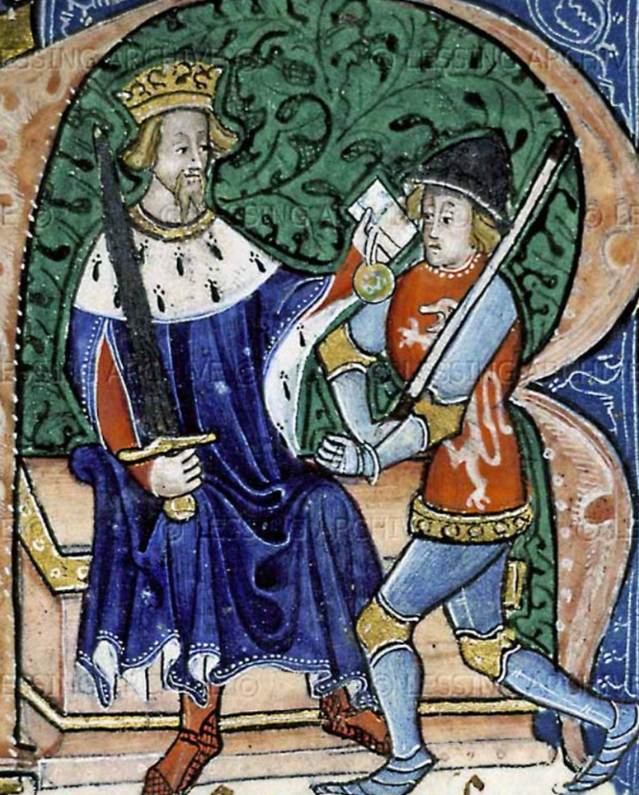
Thomas
Mowbray appointed Earl Marshall by Richard II in 1390
1394
Richard
II, on an impulse, sailed for Ireland to stamp his authority there. He took
with him Thomas Mowbray, with whom he had reached a rapprochement, Roger
Mortimer, Thomas Holland and Edward, son of Edmund of Langley. His
army of more than 8,000 men was the largest force brought to the island during
the late Middle Ages. The invasion was a success, and a number of Irish
chieftains submitted to English overlordship.
1397
The
Revenge Parliament
Thomas
Mowbray, then Earl of Nottingham, played a key role in the arrests of the
Appellants in 1397, primarily by securing the person of Thomas of Woodstock,
Duke of Gloucester, and later overseeing his death. Mowbray was acting on
behalf of King Richard II, who was seeking revenge for the Appellants' actions
a decade earlier.
Mowbray was
part of the King's retinue that went to Thomas
of Woodstock, Duke of Gloucester's residence at Pleshey
Castle to arrest him. Mowbray then took custody of Gloucester and transported
him to Calais, where Mowbray was the Captain.
Gloucester
was entrusted to his keeping at Calais, and in September 1397 he reported that
his prisoner was dead. The duke had been murdered, and Mowbray was probably
responsible, although the evidence against him is not conclusive.
As Earl
Marshal, Mowbray officially oversaw the execution of another prominent
Appellant, Richard FitzAlan, Earl of Arundel, at the Revenge Parliament
in September 1397. Froissart recorded that Thomas Mowbray actually beheaded his
brother-in-law, Arundel, himself.
For his
loyalty and service in dispatching the Appellants, Richard II rewarded Mowbray
with the title of Duke of Norfolk and a share of the forfeited estates. He
received most of Arundel's lands in Surrey and Sussex.
The
relationship between Henry Bolingbroke and Richard II had come to a crisis at
the end of 1397.
Mowbray
expressed fears to Henry Bolingbroke that Richard II could not be trusted and
planned to arrest them both, despite having previously pardoned them for their
roles in the 1388 Merciless Parliament.
The
man whose fears for the future began to overwhelm him was Thomas Mowbray. Like
Henry, Mowbray had just been declared blameless for his part in the events of
1387-8. Unlike Henry, he could look for encouragement to his years of restored
closeness to the king. But the fate of Woodstock and Arundel had demonstrated
that pardons in whatever form or iteration
offered no reliable protection against future royal vengeance – and,
with Richard, closeness did not erven mean safety. In fact, it had left Mowbray
trapped in a new dilemma. The rumours racing around the capital were unanimous:
as captain of Calais he was responsible for Woodstock’s death, which had not
been the result of illness or accident, but murder. And what made Mowbray’s
position terrifying was that the rumours were true.
(The Eagle and the Hart, The Tragedy of Richard
II and Henry IV, Helen Castor, 2025,
page 300). In December Mowbray confided his fears that We are about
to be undone in Henry Bolingbroke. In an atmosphere of fear, Bolingbroke confided
in his father, and Gaunt decided that the safer course was to report the matter
as treason to the king.
1398
At
a parliament at Shrewsbury Abbey in late January 1398, Bolingbroke revealed the
whole story of Mowbray’s conversation. Richard seemed to relish the fears of
both men and kept them waiting overnight. On 31 January 1398, Richard ordered a
commission to investigate the matter. Eventually the commissioners’ response
was to refer the argument to a higher power. Henry and Mowbray were each
accusing the other of treason. If neither claim could be independently
verified, they said, the case should be tried by combat. The two dukes would be
required to stake everything not on law and judgement but a duel, a chivalric
game turned to deadly reality. (The Eagle
and the Hart, The Tragedy of Richard II and Henry IV, Helen Castor, 2025, page 310).
At
Coventry upon Saint Lambert’s day. There shall your swords and lances arbitrate
The swelling difference of your settled hate (Richard II, Act 1, Scene 1, Shakespeare).
In
April at Windsor, called upon to make up their quarrel or formalise Henry’s
charges against Mowbray, Henry accused Mowbray of embezzlement, treasons over
18 years, and the murder of Woodstock. Mowbray responded that Henry was a liar.
Meanwhile
the King invented ever more elaborate methods to keep his subjects in check. He
demanded confessions before considering petitions for forgiveness and amnesty.
Admissions of guilt, including from Lord Mayor of London Richard Whittington,
acknowledged unspecified offences, becoming known as blank charters and
gave Richard carte blanche to impose fines and demands at will.
Exile
The
tournament between Bolingbroke and Mowbray was set for Gosford Green near Caludon
Castle, Mowbray's home in Coventry on 16 September 1398. As the
two men prepared for battle, the unpredictable Richard II stopped the
competition. The king’s official declared that both dukes had bravely defended
their honour, but the matter was so grave that the king ordered their
banishment from the realm. Perhaps fearing the consequences of one of them
winning, and gaining an unwelcome enhancement in prestige, he ordered instead
that Bolingbroke be exiled for 10 years (later reduced to 6), and Mowbray for
life.
Bolingbroke:
How long a time lies in one little word! Four lagging winters and four wanton
springs End in a word; such is the breath of kings
(Richard II,
Act 1, Scene 3, Shakespeare).
Mowbray
was stripped of his duchy and was exiled. He
lived in Paris until treaty was signed between England and France.
1399
Thomas Mowbray went to Jerusalem on
pilgrimage, but died of plague in Venice where he was buried at St George's Abbey.
Henry IV
On 30
September 1399 Richard Scrope, Archbishop of York, read a statement that
Richard II had agreed to resign the crown on the grounds of his inadequacy.
Whether he had resigned, Henry Bolingbroke took the throne, claiming the crown
and giving his oath in English to be understood by all. The crown had been
seized and a new king elected. A Rubicon had been crossed which set the scene
for the Wars of the Roses.
|
The Houses of
Lancaster and York 1399 to 1485
England during the reigns
of Henry IV, Henry V and the Wars of the Roses |
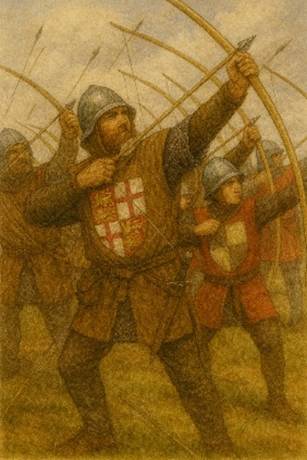
Thomas Mowbray II, 17
September 1385 to 8 June 1405, 4th Earl of Norfolk, Earl of Nottingham, Baron
Segrave and 7th Baron Mowbray
Upon the
death of his father in Venice, Thomas Mowbray II succeeded him as Earl of
Norfolk and Nottingham, but not as Duke of Norfolk. He also received his
father's title of Earl Marshal, but on a strictly honorary basis, the military
rank being held by Ralph Neville, 1st Earl of Westmorland, as the Marshal of
England.
He was
betrothed to Constance Holland, daughter of John Holland, 1st Duke of Exeter, then
a child, but the marriage was never consummated.
Thomas was the elder of two sons.
1405
The Scrope Rebellion
He became
involved with the rebellion of the Percies in the
north, and raised an army with Richard le Scrope, Archbishop of York. He was
later deserted by the Earl of Northumberland, and brought to justice on Shipton
Moor by a large royal army under John of Lancaster and the Earl of Westmorland.
Seeking a parley, they were arrested as soon as they disbanded their followers.
When Chief Justice Sir William Gascoigne refused to pass sentence upon them
before they were tried by their peers. However Henry IV had both Mowbray and Scrope summarily beheaded in York on 8 June 1405.
This
conspiracy is the main historical context for Shakespeare's
Henry IV, Part 2, and the
execution is described with the words, Some guard these traitors to the
block of death, Treason's true bed and yielder up of breath.
John Mowbray V, 1392
to 19 October 1432, 2nd Duke of Norfolk, Earl of Norfolk, Baron Segrave and 8th
Baron Mowbray
John Mowbray
was the second son of Thomas Mowbray I and brother of Thomas II.
When still a
youth, he married Katherine de Neville, daughter of Ralph de Neville and Joan Beaufort, grand daughter of King Edward III. They had a son, John 3rd
Duke of Norfolk.
|
This history of the family who
influenced the Wars of the Roses in whose seat our ancestors lived |
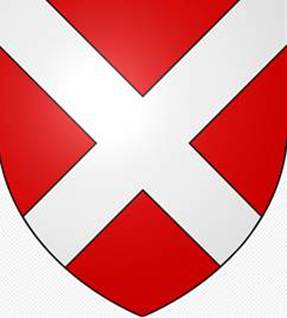
1415
John Mowbray
actively served the crown in France during the Hundred Years' War. His first
campaign was in 1415 with Henry V, but he fell badly ill with dysentery and had
to return to England. For this reason, he missed the Battle of Agincourt.
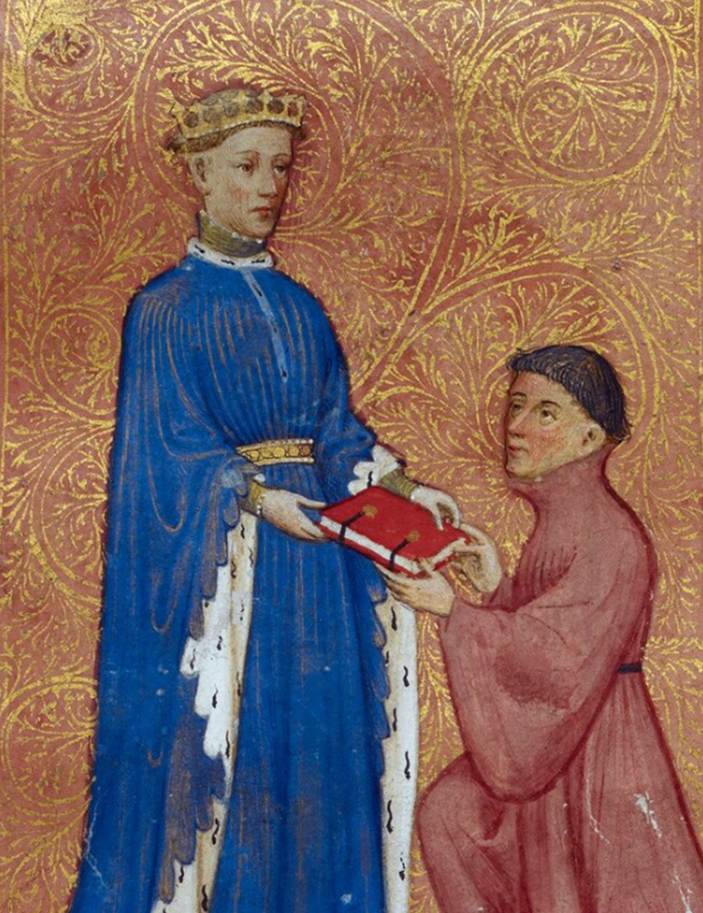
Henry V
and John Mowbray
John
had married Lady Katherine Neville, daughter of Ralph Neville, 1st Earl of
Westmorland on 12 January 1412, when she was about 15 years old. This connected
the Mowbrays to future kings Edward IV and Richard III, as she was Cecily
Neville's sister, making Mowbray their uncle by marriage. They had a son, John.
1422
When Henry V
died in 1422, Mowbray remained a leading commander of the armed forces in
France for the new boy-king, Henry VI. He continued campaigning there for the
next five years, and, when parliament decided it was time to crown the new
young king, in both Westminster Abbey and in France, Mowbray acted as both
royal bodyguard and councillor. He also took part in Humphrey, Duke of
Gloucester's personal campaign in Hainaut, which appears for once to have been
profitable to him.
1425
John’s
titles and estates had been progressively restored by Henry V. When his mother
died in 1425 he inherited her large share of his father's estates, and he also
received promotion from Earl of Norfolk to Duke of Norfolk. This resolved a
precedence dispute with Richard Beauchamp, Earl of Warwick and marked a key
step in regaining his family's status, tying him closely to the crown as a
loyal Lancastrian supporter.
1432
John Mowbray V died. He was buried at Epworth, where his
father had founded a priory.
John Mowbray VI, 12
September 1415 to 6 November 1461, 3rd Duke of Norfolk, Earl of Nottingham and
Norfolk, Baron Segrave and 9th Baron Mowbray
John married Eleanor Bourchier, the
daughter of William Bourchier and Anne of Gloucester, the daughter of Thomas of
Woodstock (youngest son of King Edward III) and Countess of Buckingham. They had one son, John.
He succeeded
to the office of Hereditary Sheriff of Norfolk after his father's death in 1432
at the age of sixteen, placed under the protection of Humphrey of Lancaster,
Duke of Gloucester.
1455
The Wars
of the Roses
John
supported Richard, the Duke of York at the beginning of the War of The Roses in 1455.
1459
John swore
allegiance to the Lancastrians in 1459.
1461
John switched
sides back to the Yorkist cause by 1461 before the Second Battle of St Albans. Mowbray
marched north with Warwick and the captive King Henry VI to intercept the
approaching Lancastrian army led by Margaret of Anjou. Mowbray commanded the
vanguard on the right flank of the Yorkist deployment. The Yorkists were defeated in the
battle on 17 February 1461, and Mowbray, along with Warwick, retreated to
London, abandoning the King to his wife's victorious forces.
Shortly
after this defeat, Mowbray attended the council that declared the Yorkist
leader Edward, Earl of March (later Edward IV), as the rightful king.
The
Lancastrian army returned to the north where, on 29 March 1461, York and
Lancaster met at the Battle of Towton. It was one of the longest and bloodiest
battles fought on British soil, fought in bitter Yorkshire weather and no
less bitter spirit.
Mowbray's
movement during the Battle of Towton, the bloodiest battle on English soil,
swayed the victory to the Yorkists. He brought reinforcements late into the
combat. He was rewarded by the new regime but did not live to enjoy it.
John served
as Earl Marshal at King Edward IV's coronation June 1461.
However John Mowbray VI died on 6
November 1461.
John VII Mowbray, 18
October 1444 to 14 January 1476, 4th Duke of Norfolk, Earl of Nottingham,
Norfolk, Surrey and Warenne, Baron Segrave and 10th
Baron Mowbray
John VII had
married Elizabeth Talbot (1442-1510), daughter of John Talbot, 1st Earl of
Shrewsbury (1384-1453) and they had a daughter, Anne Mowbray (1472-1481).
John VII had been created earl of Warenne and Surrey in his father's lifetime in 1451. On 24 March 1451 the earldoms of
Surrey and Warrenne were revived in his favour. They
had become extinct on the death in 1415 of Thomas, Earl of Arundel, whose
sister, Elizabeth Fitzalan, married his great-grandfather, Thomas Mowbray, 1st
duke of Norfolk (1366-1399).
1469
John Mowbray
featured in the
Paston Letters. Maintaining his father's baseless claim to Caistor Castle,
he besieged and took it in September 1469, during the confusion of that year,
and kept possession, with a short interval during the Lancastrian restoration
of 1470 to 1471, until his sudden death on 17 January 1476, when it was
recovered by the Pastons.
1476
John VII died on 14 January 1476.
Anne de Mowbray, 10
December 1472 to 19 November 1481, 8th Countess of Norfolk, Baroness Segrave
and 11th Baroness Mowbray
At his death John’s vast inheritance
devolved on his only child Anne.
Anne de
Mowbray, the last of her line, was married on 15 January 1478 in St. Stephen's
Chapel, Westminster to the four year old Richard, Duke of York, second son of
Edward IV, who had been created Earl of Nottingham, Earl Warrenne, and Duke of
Norfolk. The young Richard was murdered in the Tower before the marriage was
consummated, aged only 10, one of the Princes in the Tower.
1481
However Anne died in 1481 at the age
of eight.
It is
generally assumed that Anne then joined the Queen's household, dying three
years later at the royal residence in Greenwich, three weeks before her ninth
birthday. She was given a state funeral and was laid to rest in a lead coffin
in the Chapel of St. Erasmus of Formiae in
Westminster Abbey. When the chapel was demolished in 1502 to make way for the
Henry VII Lady Chapel, Anne's coffin was moved to the Abbey of the Minoresses
without Aldgate, where her mother later took up residence. In 1964, Anne's vault
was rediscovered after almost 450 years when workmen broke down a wall eleven
feet underground on a site near St Clair Street, London. The Museum of London
was called in to examine the coffin and its contents which were duly identified
as the red-haired young Duchess. On 31 May 1965 Anne's remains were reinterred
at Westminster after lying in state in the Jerusalem Chamber in a ceremony
attended by the current Lord and Lady Mowbray.
House Mowbray after
1481
The Mowbray
and other baronies fell into abeyance between the descendants of her great
grandaunts Margaret and Isabel, daughters of Thomas de Mowbray, first duke of
Norfolk.
1483
Margaret had
married Sir Robert Howard, and their son, John Howard, the Jockey of Norfolk,
was created Duke of Norfolk and Earl Marshal of England on 28 June 1483.
One of Richard
III's first acts was to raise his friend Lord John Howard to the vacant titles
of Duke of Norfolk and Earl Marshall. The Earl Marshall commanded the soldiers
of the King's Household. The new Duke of Norfolk's son and heir, Thomas, was
created Earl of Surrey.
John Howard
was born in about 1421 and succeeded to the Howard estates at age 18. He was a
soldier and spent most of his life in active duty. He supported the House of
York during the War of the Roses and fought bravely at the Battle of Towton, a
major Yorkist victory, that resulted in Edward IV being crowned King. John
Howard's influence grew at court and he became a friend of Richard, Duke of
Gloucester, the future King Richard III. In 1483 King Edward IV died at age 41
leaving the crown to the eldest of his two sons, both only young children.
Richard, Duke of Gloucester became Lord Protector for his nephew. The young
King Edward V and his brother disappeared into the Tower of London and were
never seen outside its walls again. Richard of Gloucester was crowned King
Richard III. There is some suggestion that John Howard may have had a hand in
the murder of the 2 princes.
1485
In August
1485 Henry Tudor landed in Wales, gathered an army and began to assert his
claim to the throne. His claim was weak, but the Lancastrian supporters backed
Henry Tudor. The Duke of Norfolk led support for the king. At the battle of
Bosworth the Duke of Norfolk, then over 60, led the king's troops and fought
valiantly but was killed. Seeing his father fall, the Earl of Surrey charged,
was quickly surrounded and taken prisoner. Richard III also was killed and
Henry Tudor became King Henry VII. The Howard estates were confiscated by act
of Parliament and the Earl of Surrey was imprisoned and in danger of being
executed as a traitor.
Isabel de
Mowbray married James Berkeley, 1st Baron Berkeley (died in 1462), and her son
William, created Earl of Nottingham (28 June 1483) and Marquis of Berkeley (28
January 1488), sold the Axholme and Yorkshire estates
of the Mowbrays to Thomas Stanley, 1st Earl of Derby. His descendants, the
earls of Berkeley, called themselves Barons of Mowbray, Segrave, and Breuse of
Gower.
So the
following heirs of the Mowbrays were the Howards and the Berkeleys,
representing the two daughters of the first duke of Norfolk. Between them were
divided the estates of the house, the Mowbray dukedom of Norfolk and earldom of
Surrey being also revived for the Howards (1483), and the earldom of Nottingham
(1483) and earl marshalship (1485) for the Berkeleys.
Both
families assumed the baronies of Mowbray and Segrave, but Henry Howard was
summoned in his father's lifetime (1640) as Lord Mowbray, which was deemed a
recognition of the Howards' right.
1777
Their
co-heirs, from 1777, were the Lords Stourton and the
Lords Petre.
1878
In 1878 Lord
Stourton was summoned as Lord Mowbray and Segrave.
The dignity
of the Mowbray House is claimed as the premier barony, though De Ros ranks
before it.
1901
Lord
Stourton's son claimed, but unsuccessfully, in 1901–1906 the earldom of Norfolk
(1312), also through the Mowbrays. Of the Mowbray estates the castle and
lordship of Bramber is still vested in the Dukes of Norfolk.
The
Mowbrays’ lion rampant coat of arms was adopted by the Hospital of Burton St
Lazars alongside their more usual green cross.
Early Yorkshire
Families and Illustrative Documents, 1973,
Yorkshire Archaeological Society