The House Plantagenet
1154 to 1399
John signs Magna Carta watched over by the
Northern Barons, 1215
The
period of Plantagenet rule
|
Return to the Home
Page of the Farndale Family Website |
The story of one
family’s journey through two thousand years of British History |
The 83 family lines
into which the family is divided. Meet the whole family and how the wider
family is related |
Members of the
historical family ordered by date of birth |
Links to other pages
with historical research and related material |
The story of the
Bakers of Highfields, the Chapmans, and other related families |
Headlines are in brown.
Dates are in red.
Hyperlinks to
other pages are in dark
blue.
References and
citations are in turquoise.
Context and local
history are in purple.
Geographical
context is in green.
|
The Normans and
Plantagenets Genealogy
|
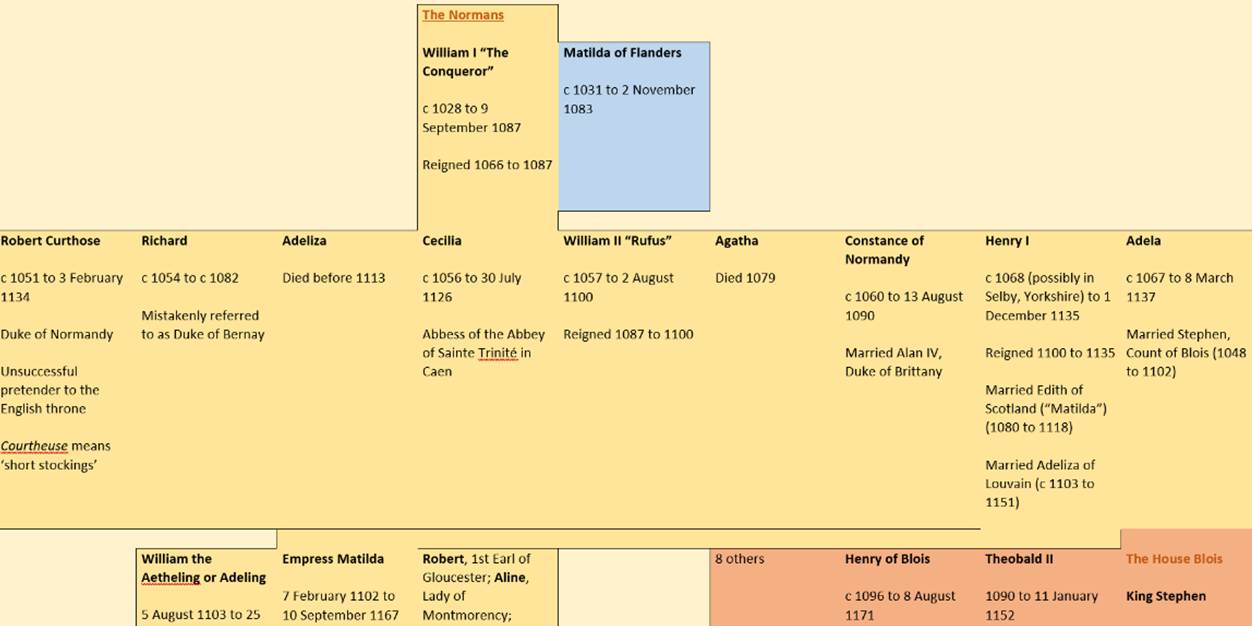
Go back to The
Normans.
1149
The 16 year of
Henry, son of the Dowager Roman Empress Matilda and
Geoffrey of Anjou landed in Devon on 13 April 1149. Whilst he could
understand English, he did not speak the language, speaking Latin and French.
He had been to England twice previously and had studied at Bristol in 1142 when
he met the mathematician and astrology Adelard of Bath. Stephen responded by
paying off his small band of mercenaries and dispatching him back to Normandy.
1151
Having been
invested by Geoffrey as duke of Normandy, Henry did homage to Louis VII of
France.
In September
1151, Geoffrey Plantagenet died.
1152
On 18 May 1152
Henry Duke of Normandy married Eleanor, duchess of Aquitaine.
Eleanor of
Aquitaine
Eleanor was born
in 1124, the eldest daughter of William X, Duke of Aquitaine and Count of
Poitou. Her grandfather was William IX, the Troubadour Duke, a poet and wit who
established the romantic culture of southern France. Aquitaine was large and
sprawling and included Gascony, Bordeaux, Auverge and
La Manche. It was wealthy, including from its tapping of the pilgrim routes to
Compostela. In 1137, William X died and Eleanor was swiftly married to the 17
year old French prince, Loius, bringing union with the French Crown and its
protection.
France was a
conglomeration of duchies, with the King of France at the Isle de France,
struggling to keep control over rival duchies.
Almost
immediately after the marriage, Louis VI of France died, and Eleanor was Queen
of France.
The marriage was
not a good match. The lively and rich culture of Aquitaine, where the langue
d’oc was spoken, was barely compatible with the
more austere French court, which spoke langue d’oil.
Eleanor influenced her husband to some rash decisions and soon gained a
reputation for brining scandal and political chaos. She bore two daughters, but
the marriage was doomed.
On 21 March 1152
the marriage was annulled. This immediately placed Eleanor in danger, having
lost her protection. She held the key to possession of Aquitaine and was the
prey of host of suitors.
She had met Henry
in 1151 in Paris. Eleanor sent a message to Henry from Poitou asking him to
abandon another invasion of England, to marry her in haste. They were married
in Poitou on 18 May 1152. The marriage transformed the ownership of the French
realm. Henry added Aquitaine to his control of Normandy, Anjou, Maine and
Touraine. Within months, Eleanor was pregnant.
There
is an In Our Time podcast, Eleanor of
Aquitaine (c
1122-1204), who was a ruler in her own right as well as married to the king of
France and then to the king of England.
1153
Recognising the
mood of the nation, and their distrust of foreign soldiers, Henry sent his
mercenaries home across the channel where they drowned in a storm. Astutely he
started to negotiate with the wider political community, offering an end to the
ravaging of land, protection through sound leadership, and judicial reform.
In July 1153
there was an encounter with Stephen’s army at Wallingford near Oxford. As at
Malmesbury Stephen’s soldiers were unwilling to fight, tired of his leadership.
It was becoming clear that Stephen had little option but to recognise Henry as
his legal heir. Stephen’s eldest son, Eustace IV, Count of Boulogne had most to
lose. However he fell ill and died in August 1153.
1154
In
October 1154 Henry was campaigning in the Vexin region near
Normandy when Stephen died on 25 October 1154.
Henry II, 1154-1189
1154
This saw the end of Norman rule, and the start of a period of rule
in England by the House of Anjou, generally referred to as the Angevins or more
usually, the Plantagenets.
Henry II was married to the powerful Eleanor, heiress of the Duchy
of Aquitaine. It was this marriage which brought England into the Angevin
empire.
There is an In Our Time podcast on
Eleanor of Aquitaine
(c1122-1204), who was a ruler in her own right as well as married to the king
of France and then to the king of England.
At this point,
England’s history might have become more integrated with European history.
Henry was
energetic from the start, addicted to the chase beyond measure; at the crack
of dawn he was often on horseback, traversing wastelands, penetrating forests
and he would wear the whole court out by continual standing (Gerald of Wales). He was peripatetic and his
travelling court was described as smelly from its constant journeying.
The immediate
issue was to heal a nation that had been at civil war for nearly 20 years. He
stamped out remaining pockets of rebellion, expelled mercenaries and
decommissioned illegal castles.
1155
The weavers were
granted a royal charter, the oldest livery company in London.
1156
By 1156 there was
a serious rift between Henry and his brother Geoffrey and after a family
conference at Rouen, Henry isolated his brother and consolidated his French
titles by doing homage to Louis VII of France, for his holdings of Normandy,
Anjou and Aquitaine. Geoffrey resisted for a while but in 1157 he was somewhat
appeased when he was elected to be Count of Nantes. Geoffrey died in 1158 and
Henry was able to expand his direct power over Nantes. Appeasing his family was
a constant battle for Henry.
1157
Henry received
homage from Malcolm IV of Scotland and reasserted royal influence in Wales. He
compelled the surrender of lands in Northumbria ceded during the period of the
Anarchy thirty years earlier and began to strengthen English defences.
By the end of the
1150s Henry’s territory was vast and far more significant than any of his royal
ancestors.
1158
Thomas Becket
In 1158 Thomas Becket,
by then Henry’s close friend and adviser, by then Chancellor of England,
arrived in Paris to negotiate the marriage of the infant Prince Henry to the
baby French princess, Margaret. Although generally a pious man, he arrived with
flamboyant pageantry. Becket had risen from an obscure role as clerk to the
Archbishop of Canterbury.
There
is an In Our Time podcast, Thomas
Becket (c 1118 to
1170).
1159
In June 1159
Henry marched across southern France with the largest army of his reign. He had
torched Cahors, Auvillars and Villemur
and approached Toulouse. He sieged the city from June to September 1159. The
Plantagenet’s claim to the city was tenuous, through Eleanor’s family. After a
difficult siege, when the French Capetian King Louis VII, to whom Henry had
given homage, arrived, Henry ceased his siege. This was Henry’s high watermark.
1160
Thomas Becket was
at the height of his influence. He was Chancellor and Archdeacon of Canterbury.
He had rich benefices (ecclesiastical offices) including as the Provost of St
John’s Beverley (Beverley Minster) in the East Riding of Yorkshire.
Across Europe,
there was increased tension between the papacy and secular royal authority in
questions of authority and jurisdiction. European Kings were regularly
threatened with Interdict, banning religious ceremony throughout their realm).
The King started to see Becket as a bridge between the Crown and the Church.
Henry recognised that his energetic intentions for his own realm were held back
by an over powerful church.
1161
Theobold, the Archbishop
of Canterbury, died on 18 April 1161. Henry saw an opportunity to replace him
with Becket. The ecclesiastical community of England, including the Canterbury
monks were not impressed. They felt it was their right to appoint the
archbishop and saw Becket as unfit on multiple grounds including his inadequate
education; his record of treatment of the Canterbury monks; and his bias
towards the Crown. Matilda the Queen Mother sought to discourage her son.
Henry was not to
be dissuaded. On 2 June 1161 he was ordained as a priest and the next day he
was consecrated as archbishop.
Yet almost at
once Becket started to distance himself from the Crown. He seemed to wish to
disprove his unworthiness for his new role. He immediately resigned as
chancellor and he asked the Pope to strengthen Canterbury’s authority over the
archbishopric of York. The ecclesiastical community were pleasantly surprised
as Henry was horrified.
1161
The abolition of the
Danegeld tax, first raised in 991 to pay off Viking raiders.
1163
By 1163 Henry was
determined to press forward with his church reform.
On 1 July 1163 at
the Council of Woodstock, Henry and Becket quarrelled over the payment of
sheriff’s aid, a form of aid paid to local sheriffs to help with peacekeeping.
Henry wished to centralise this revenue directly into the exchequer, but Becket
responded to the King that it does not become your excellence to deflect
something that belongs to another to your use. Henry’s response was By
God’s eyes! It shall be given as revenue and entered in the royal rolls; and it
is not fit that you should gainsay (contradict) it.
In October 1163
Henry summoned an ecclesiastical council at Westminster. He demanded obedience
to the ancient customs of the realm and a resolution to the contentious issue
of criminous clerks. About 1/6th of Englishmen by this time were
technically defined as clergymen. The church demanded the right to discipline
criminous clerks, for crimes including theft, rape, violence and murder. The
church did not have the power to order trial by ordeal, mutilation nor
execution and Henry was appalled at crimes which went unpunished. Henry
therefore wished that those clergymen called to answer for crimes, be stripped
of their orders, and tried by civil courts. The debate became heated.
Henry demanded
the return by Becket of castles granted to him during his chancellorship. He
retorted Were you not the son of one of my villeins?
1164
Constitutions of
Clarendon
In January 1164,
Henry issued a 16 point document called the Constitutions of Clarendon. The aim
was to clearly define the boundaries between Crown and Church. The principal
issue which came to dominate the debate, was the issue of criminous clerks.
They were issued as a chirograph, implying their permanence. Becket was
appalled. He denounced the new law, and suspended himself from his priestly
duties. He wrote to the pope begging absolution for his part in Henry’s
actions. In November 1164 he took a small boat across the channel, and did not
return for 5 years. He was dejected at first and punished himself with
asceticism, but over time his despair turned to anger.
1167
Empress Matilda
fell ill and died in September 1167. A
generation passed with her.
1168
Henry was at the
peak of his authority.
It was at about
this time that he turned his attention to succession.
In 1165, King Louis
VII of France had a son, Philip and began to consider how he might pass on a
more impressive inheritance, leading to increased tension with the English
king. Military exchanges began to occur in border regions and dissent was
encouraged by the Scots, Welsh and Bretons.
Henry endeavoured
to exercise his own succession planning in a way which would not exacerbate
tensions with the French Crown. He secured strategic marriages by his daughter
Matilda with Saxony and his son Geoffrey with Brittany.
Henry’s son
Richard was a child of the south of France – his name was more common around
Poitiers than Rouen. Eleanor had ambitions to return to Aquitaine and was close
to Richard as her vehicle to do so. Louis remained jealous of Aquitaine and
Henry suggested that Richard might marry Louis’ young daughter Alice. It was a
generous proposal to the French King and an attempt to reconcile French and
English interests.
It was at this
point that Becket reappeared on the scene in France, pressured to apologise and
reconcile with Henry. Yet he just couldn’t do it. He submitted to the King’s
mercy and judgement, but just couldn’t prevent himself from adding the caveat saving
God’s honour, a phrase that had been at the root of the quarrels of 1163.
Realising nothing had changed, Henry took offence
1170
London’s
population was about 30,000.
By 1170, the
still modestly powered Capetian monarchy in France started to undermine
Aquitaine and a rivalry began which would last for another three hundred years
or so. Philip II Augustus of France became less friendly and symbolically
felled the elm tree where French Kings and Norman Dukes had met for centuries.
In July 1170
Henry I had his son Henry anointed as King, rex designantus,
as an act of succession planning, by the archbishop of York.
Henry II’s son
Henry, the “Young King” was thus associated with his father in running the
Kingdom from about 1170. He may have controlled lands in Pickering
Vale.
Becket was
furious at the breach of protocol in bypassing his role as archbishop of
Canterbury and crossed to England on 30 November 1170. He angrily preached
venomous words and excommunicated numbers of his enemies.
Word reached
Henry in Normandy at Christmas. His famous, though often misquoted, response
was What miserable drones and traitors have I nurtured and promoted in my
household who let their lord be treated with such shameful contempt by a low
born clerk?
There is an In Our Time podcast on
Thomas Becket (c1118 to
1173).
1171
Henry retreated to
Ireland and landed at Waterford in October 1171, where he spent the next six
months.
By Spring 1172, the pope’s anger had thawed and impressed by
Henry’s efforts in Ireland he praised the king for subjugating a barbarous race
who were ignorant of divine law. He returned to the Contienant
and at a meeting of reconciliation the Compromise of Avranches recorded a peace between king and church.
Having resolved his first significant dispute, Henry’s troubles
were soon to be compounded by sporadic rebellions by Henry’s sons, encouraged
by Eleanor. In consequence, Henry II started to reassert the authority of the
English crown. This in turn led to heavy taxation of the English population.
Meanwhile Henry the Young King, 18 years
old, married to Margaret of France, anointed as Henry’s successor and
reanointed in 1172 at Winchester, had grown frustrated at being denied the true
powers of kingship. Henry
had given to his son John strategically important castles at Chinon, Loudion and Mirebeau as a
wedding gift.
The jealous young
Henry slipped away to the court of the French King. The 15 year old Richard and
14 year old Geoffrey chose to support his rebellion. After a marriage of
loyalty, Eleanor also joined the rebellion, usurped herself in Aquitaine by her
husband’s unilateral decision making, Richard’s future domain. Bizarrely
Eleanour found herself allied to her former husband Louis VII of France.
However Eleanor did not reach Paris, but was arrested by Henry’s agents and
taken to Chinon Castle. A rumour spread that the 50 year old queen had been
dressed as a man, and scandal quickly spread.
Henry sent messengers to the French court in Paris to ask for the
return of his rebellious sons. The French King enquired Who Asks, and
when the messenger replied The King of England, Louis responded Not
so, the King of England is here.
1173
In Summer 1173
there were a series of inconclusive battles across France.
In June 1173
William the Lion attacked Northumberland with a Scottish army in support of the
rebellion. Some of the sokemen of Pickering were fined for
their involvement. Bernard de Balliol
and Robert de Stuteville captured the
Scottish King at Alnwick and imprisoned him at Richmond Castle. Roger Mowbray of Thirsk joined
the rebels and he was attacked by royal forces. He was defeated on two
occasions around Northallerton.
The rebels were
unimpressive and Henry had the upper hand in England and France. The war took
place on multiple fronts, but Richard had more impressive noblemen in his
support. Richard de Lucy, justiciar of England supported the King, as did the
recently reconciled church.
1174
War resumed in Spring 1174. William the Lion had regrouped and his
army was growing. Philip of Flanders planned to invade England and landed in
East Anglia. Henry left Barfleur with a large army in
July and headed for Canterbury. Rather than engage the enemy, he adopted a
hearts and minds approach. He assumed the appearance of a pilgrim. He asked for
absolution from the bishops and put on a show of public penance for the Becket
episode. His efforts won the propaganda war.
It was at the same time that Henry the Lion renewed his attacks on
northern castles. A band of Yorkshire knights whose scouts had traced the
Scots’ movements towards Alnwick launched a surprise attack, ;leading to the
death or capture of all the Scottish knights and the capture of William the
Lion.
By August 1174, Henry had returned to the Continent, with the
threat in England largely subdued. The young Henry and Philip of Flanders
meantime besieged Rouen, but as Henry approached they sued for peace.
Henry allowed the return of lands and possessions taken during the
rebellion. His wrath was reserved for the senior members of the rebellion.
Eleanor remained imprisoned for the rest of Henry’s reign, deprived of her
longed for Aquitaine lands. On 1 December 1174 William the Lion was forced to
sign the Treat of Falaise, sealed at York, which made William the personal
liegeman of Henry II and Henry the Young King.
The Henrican court of the mid 1170s was
uncommonly magnificent. Henry’s victory in the Great War established him as the
pre-eminent ruler in Europe. (The Plantagenets, The Kings
who made England, 2012, Dan Jones, page 93).
Louis VII signed a non agression pact.
1175
During the extended peace into 1175, Robert de Stuteville supervised the building of castles in Edinburgh and Scarborough.
The rising Stuteville family recovered much of the old estate forfeited by their
ancestors, including Kirkbymoorside.
In 1175 the King of Connaught agreed the Treaty of Windsor who
confirmed Henry as feudal overlord of most of Ireland.
England was recognised as the most powerful kingdom in Europe.
Ambassadors attended the English court from across Europe including Frederick
Barbarossa, emperor of Constantinople (1122 to 1190). There were prestigious
offers of marriage for Henry’s youngest daughters. Joan married the King of
Sicily and Eleanor married the King of Castile.
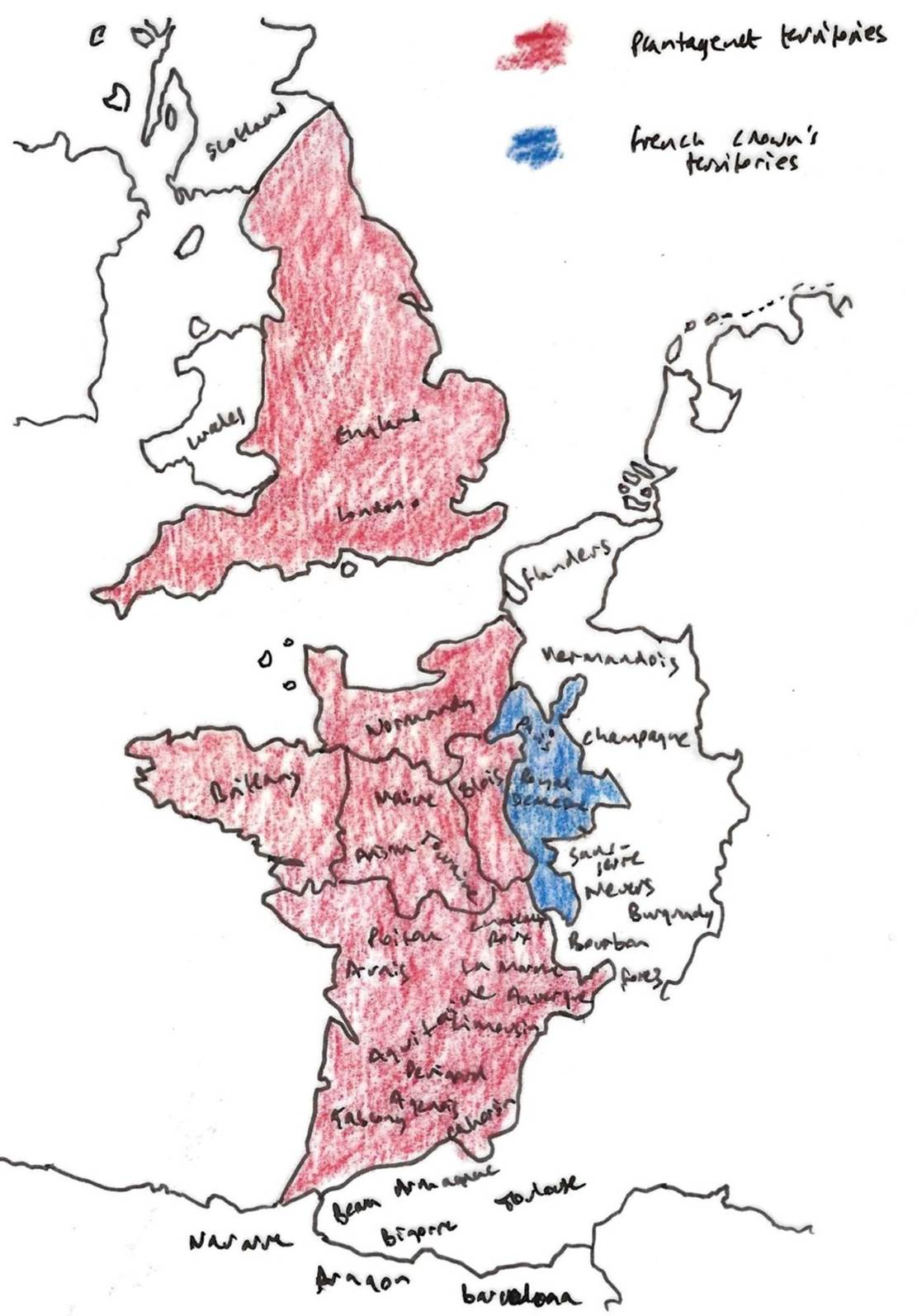
Plantagenet lands
at their peak
1176
Castles
In 1176 Henry I took
every castle in England into his own hand. Even his most loyal subjects such
as Richard de Lucy gave up their castles. Henry spent heavily on rebuilding
castles. The jewel was the castle at Dover overlooking the approach to England
from north west France.
Law
Henry also began
a decade of legal revolution. The Constitutions of Clarendon 1166 had brought
the whole system of criminal jurisdiction into royal control. He now
consolidated this by appointing royal sheriffs and justices to deal with
significant crimes such as robbery and murder. A standard procedure was
introduced. Juries of presentment, of 12 men, were required to tell the justice
under oath of all the crimes that had been committed in their locality. Royal
sheriffs were given the jurisdiction to investigate crimes.
In January 1176,
the Assize of Northampton consolidated further the powers claimed by the
Constitutions of Clarendon. Punishment was made harsher following the disorder
of the civil war.
England was
divided into 6 judicial circuits of eyres
and royal judges began to tour around all the realm. Crimes were investigated
retrospectively.
Henry also pushed
the royal grip over justice to the civil law. He introduced a system by which
land disputes could be settled quickly by appeal to the royal court through the
assize of novel disseisin. Juries could be questioned by royal justices
regarding disputed lands which had been unjustly disseised and the
losing party was amerced or penalised with damages. The writ in an
action of novel disseisin was short and formulaic. Royal law became
indispensable to the administration of the political landed economy.
1178
The royal court, curia
regis, was reorganised. Five members of the royal
council were appointed to remain in Westminster to hear cases full time. This
was the burgeoning of England’s supreme court and in time became the Court of
King’s Bench.
1179
By 1179, the
royal jurisdiction had grown further. Darrein presentment established
rights over appointments to the Church’s benefices. Mort d’ancestor
settled disputes over inheritance. Writs de recto, of right, allowed
ordinary folk who felt that justice had been denied to them to appeal to the
royal court over the head of their local lords.
1180
Louis VII of
France died. The 16 year old Philip II succeeded him.
Henry the Young
King was starting to grow ambitious again. He started to refer to himself as King
of England, Duke of Normandy, Count of Aquitaine, son of King Henry of famous
memory. He ws immature though, with little
practical experience. He expended energy on the tournament field and spent vast
sums to portray himself as a military hero.
1181
The Assize of
Arms 1181 encouraged scutage, payments made by magnates in lieu of
supplying troops and military service, which allowed some controlled
demilitarisation by the Crown.
1182
In 1182 the 49
year old Henry made his will.
Henry the Young
King was starting to renew his demands for more power. He asked for formal
possession of the duchy of Normandy but was denied by his father again. Once
again, enraged, he rode to the French court and allied himself to his brother
in law, Philip II.
With promises of
an increased allowance, a meeting was held between Henry I, the Young Henry,
Richard and Geofrey at Le Mans to agree a reconciliation in the division of the
Plantagenet lands. He proposed that the princes all swear an oath of allegiance
to their father, with Richard and Geoffrey to do homage to the Young King for
Aquitaine and Brittany. Richard refused. The Young Henry had been making his
own overtures to barons of Aquitaine to out manoeuvre his brother and the two
had their own squabbles. The Young King negotiated with his father but in bad
faith.
1183
The impasse of a
further family dispute saw another turn when Henry the Young King died at
Martel on 11 June 1183.
Henry then
announced a new succession plan whereby Aquitaine would be given to John,
implying that Richard would become heir to the throne of England. Richard
refused again. He was not willing to give up Aquitaine. Henry snapped and
demanded that Richard hand back Aquitaine to his imprisoned mother Eleanor,
which in practice meant it would pass to Henry’s direct control. Richard
finally agreed. Two years followed when Henry avoided further discussions about
the succession plan.
1185
Henry II’s
enquiry into assets and status of widows and wards, Rotuli
de Dominabus et Pueris et Puellis de XII Comitatibus.
The Templars’
enquiries into land holdings, Rotuli de Dominabus. There is an In
Our Time podcast on The
Knights Templar and the growth and great military and
financial strength of the famous order whose knights had a mission to protect
pilgrims in the Holy Land.
The earliest
recorded windmill was built at Weedley in Yorkshire.
There
is an In Our Time podcast, The Twelfth
Century Renaissance.
1186
Henry I’s son
Geoffrey, Duke of Brittany, died in 1186.
1187
Relations cooled
again between the Plantagenet and Capetian kings. Philip could not yet match
Henry for wealth, experience or military cunning, but in 1187 he began to
explore other ways to discomfort his rival (The
Plantagenets, The Kings who made England,
2012, Dan Jones, page 106). When Richard visited the French court,
Philip embarked on a charm campaign. Philip honoured Richard so highly that
every day they ate at the same table and shared the same dishes, at night the
bed did not separate them (Roger of Howden).
The last comment has been over interpreted and was in fact a comment on a
strong friendship. Richard started his dreams of a crusade in the Holy Land and
was convinced of his father’s wishes to undermine him.
The Feet
of Fines, judgements pertaining to land ownership, began.
Jerusalem fell to
Muslim forces under Saladin and the Christian states founded in the Levant
after the First Crusade, referred to as Outremer, were threatened. Richard was
the first nobleman north of the Alps to take the oath to join a Crusade in
autumn 1187. William II , King of Sicily, Richard’s aunt’s husband, dispatched
a force of knights in 50 ships and Frederick Barbarossa sent troops overland in
1188.
1188
A Saladin Tithe
was levied in England to fund the Third Crusade. This was a tax of 10% on all
moveable property collected by the Templar and Hospitaller knights under threat
of excommunication to defaulters.
There
is an In Our Time podcast, The Third
Crusade, from death
of the Holy Roman Emperor, Frederick Barbarossa, to the famous rivalry between
Richard I and Saladin.
1189
In January 1189,
Henry became badly sick. He begged for Richard’s return, but Richard aided the
King in his border raids against Henry. After an intended peace conference
during a period of Henry’s recovery, Philip and Richard launched a surprise
attack on a series of castles until they attacked Henry’s base at Le Mans. The
ill Henry uncharacteristically gave up the fight. By July 1189 Maine and Tours
had fallen. He then agreed to a long list of demands from Philip.
On 6 July 1189,
Henry I died. He had been abandoned by his family. Richard was at his deathbed
and his father hissed to him God grant that I may not die until I have may
revenge on you. However Richard would now take his throne.
Richard I (The Lionheart),
1189 to 1199
Richard was
crowned on 13 September 1189 at Westminster Abbey. Richard was the favourite
son of Eleanor of Aquitaine, and she saw the coronation of a Merlin prophesy, The
eagle of the broken covenant will gild it over and rejoice in her third nesting
(Historia Regum Brittaniae, Geoffrey of Monmouth, Book 7, Chapter
3).
His first act was
to prepare almost at once for the Crusade he had sworn to join. He assembled a
large fleet, a treasury of gold and silver and a comprehensive supply of
provisions. He spent £14,000 in a year in his preparation.
Richard is remembered
for his zealous crusading which took him away from England for all but 6 months
of his decade long reign. Having taken the oath in 1187, he had been delayed by
his quarrels with and the death of his father.
There is an In Our Time podcast on the Third Crusade.
Richard met
Philip II of France at Nonancourt after Christmas in
1189 to agree a mutual defence pact, and swearing not to attack each other’s
lands, to allow the Crusade to proceed. Both shared a mutual suspicion of the
other.
Richard’s brother
John Lackland had not taken the Cross and was initially placated by
confirmation of his lordship of Ireland, the title of Count of Mortain in
Normandy, earldoms across England, castles in the Midlands, and marriage to
Isabella of Gloucester. Then regretting the power bloc given to John, Richard
attempted to ban him from England, but settled on appointing loyalists to
govern England during his absence and to control John. Administration of
England was given to Hugh de Puisat, Bishop of Durham north of the Humber and
William Longchamp, Bishop of Ely in the south.
1190
Richard departed
on Crusade and met Philip II in Burgundy before proceeding to Lyon and
Marseille to meet Richard’s fleet.
1191
In early 1191
Eleanor took Berengaria of Navarre to meet Richard for their marriage. They
caught up with him in Sicily on 30 March 1191. Richard had been there for six
months, capturing Messina and flying the English flag above the city walls.
Philip II already
frustrated by Richard’s aggressive military style, was distraught to learn that
Richard no longer intended to marry his sister Alice, to whom Richard had been
engaged.
Cyprus
Eleanor left
Berengaria and departed for home while the English crusaders sailed for Crete,
but were blown off course to Cyprus, an independent Greek territory ruled by
the Byzantine tyrant, Isaac Comneus. On 5 May 1191 Richard led an attack which
landed at Limassol and pushed the Cypriots back to Famagusta. On 12 May 1191
Richard married Berengaria at the Byzantine chapel of St George in Limassol.
Richard then completed his conquest of Cyprus, a staging post for the Levant,
over the following three weeks. Richard wrote that we have subjected to
ourselves the whole island of Cyprus with all its strongpoints. In order to
raise further funds for the Crusade, he then sold the island to the Templars
for 100,000 Saracen bezants.
Acre
Richard then
landed at Acre on 8 June 1191 to join a year long siege of the city. Philip II
had joined the siege a few months previously. The siege was a place of
suffering, atrocity and depravity. Relations immediately grew more tense
between the Plantagenet and Capetian kings. Richard fell badly ill at the siege
and was dogged by illness for much of the Crusade. On 5 July 1191 the defences
of Acre were breached and an armistice with Saladin saved it from sacking. By
the agreement Saladin agreed to pay 200,000 dinars, to release 2,000 prisoners
and to return the True Cross.
In August 1191
Richard massacred 2,600 Muslim prisoners outside Acre. The Crusaders then
marched south and took Jaffa, Jerusalem’s port.
It was at this point
that Philip II decided to return home, generally portrayed as an act of
cowardice, but probably the result of constant humiliation by Richard.
Richard was now
the commander in chief of the Third Crusade.
Trouble at Home
Whilst in Sicily,
Richard had indicated that his nephew, Arthur of Brittany should succeed him if
he died on Crusade. John had reacted badly to this move and seized the castles
of Nottingham and Tickhill, south of Doncaster. Geoffrey, Archbishop of York,
was an illegitimate brother of Richard and John and allied with John. Geoffrey
landed at Dover, but soon fled with William Logchamp’s men chasing him. He took
sanctuary in St Martin’s Priory, but after three days was dragged out into the
streets. This act lost Longchamp the loyalty of the appalled churchmen of
England, remembering the treatment of Thomas Becket. John used the opportunity
for a propaganda campaign against the Chancellor who was barred at the gates of
London and denounced as a traitor. Longchamp was stripped of his office. John
was named supreme commander of the realm.
1192
In April 1192,
Richard heard of events at home and sent Walter of Coutances,
Bishop of Lincoln, to mediate between John and Longchamp. By May 1191, he heard
that John was plotting with Philip II of France, who saw advantage in the
succession crisis. He realised that time was running out before he must return
home.
It was also in
April 1192 that Conrad of Montferrat was told that he was to be King of
Jerusalem. However as he travelled through Tyre to a celebratory dinner, he was
stabbed by two assassins. Since Richard had favoured Guy of Lusignan for the
role, rumours spread that he had ordered the assassination. Richard’s position
worsened and a stalemate ensued with the possible outcome of Saladin
controlling Jerusalem and Richard the coastal ports. Richard wrote to Saladin You
and we together are ruined.
In July 1192
Richard feigned an attack around Acre but Saladin seized Jaffa, Jerusalem’s
port, but Richard managed to retrieve the situation in seaborne assaults.
However this was the last act of the Third Crusade. A three year truce was
agreed on 2 September 1192. Saladin kept Jerusalem but agreed that a limited
number of Christians could travel to the Holy Sepulchre. The True Cross
was never returned to the Crusaders.
In October 1192
Richard sailed for home. He left Henry, Count of Champagne as the nominal king
of Jerusalem. Richard took home a legendary status though, as the Lionheart.
Richard’s name
across Europe however was blackened. He had deposed the ruler of Cyprus,
refused spoils to those who felt entitled, and incurred the hatred of most of
the elite families of Europe. By the time he reached Corfu his enemies had
restricted his routes home and he was forced to travel through hostile
territory. When shipwrecked off Istria, he was forced to travel through central
Europe. When fifty miles from Vienna, Richard was captured and delivered as a
prisoner to Leopold, Duke of Austria.
Carlisle came
under English rule in 1192.
1193
In January 1193
John did homage to Philip II in Paris and offered to marry his brother’s
spurned bride, Alice. He then attempted to raise a rebellion in England.
However allies of Richard resisted his attempt.
In February 1193,
Leopold sold Richard to Emperor Henry VI. Richard was tried by the emperor on
March 1193, but spoke so eloquently and regally, in so lionhearted a manner,
it was as though he were seated on an ancestral throne at Lincoln or Caen (William the Breton).
Nevertheless Richard’s
ransom drew a heavy tax toll on the English population. His kingdom was
subjected to a 25% tax on income and moveables. The nobles of England were
asked to contribute personally to the ransom. Demands were made of monasteries
and churches who were ruthlessly tapped for funds. It took 6 months to raise
his ransom.
1194
On 4 February
1194, Richard was released for 100,000 marks, with hostages left for another
£50,000 marks.
Richard landed at
Sandwich on 20 March 1194 after an absence of four years.
On 17 April 1194,
he consolidated his control over his kingdom at a formal crown wearing
ceremony, almost as solemn as a full coronation. Hubert Walter, Archbishop of
Canterbury, chief justiciar and a papal legate, was made head of government.
With eyes now on France, local knights were appointed to oversee the
exploitation of all sources of royal revenue across the kingdom. This was a
continuation of a process begun by Henry II whereby royal government reached
deeper into local society.
On 12 May 1194,
only two months after his return, Richard left Portsmouth to sail to Barfleur, never to return to England.
In Normandy, John
threw himself to Richard’s feet and begged forgiveness. Richard forgave him as
a child who was badly advised, threatening retribution against John’s allies.
Eleanor at the age of 72, retired to Fontevraud.
Richard now
turned his attention to confrontation with Philip II, who deployed all Capetian
resources along the borders with the Plantagenet empire.
1195
In the winter of
1195 to 1196, Richard sacked Dieppe and had other successes.
1196
Philip focused on
the Norman Vexin and concentrated his effort there,
putting off claims to the south and Aquitaine.
In 1196 Philip managed
to gain custody of Richard’s nine year old nephew, Arthur of Brittany, Henry
II’s only legitimate grandson, and only heir presumptive. Philip established a
relationship with Arthur that would complicate matters for the Plantagenets.
1197
The dispute
turned in Richard’s favour during 1197 and in that year he built the new
Plantagenet forward base of Chateau
Gaillard at Les Andelys, the Saucy Castle, which soon became his
favourite residence. The castle formed one end of a defensive line running from
Portsmouth through Rouen to Les Andelys.
1198
Baldwin of Artois
opened a second front against Philip when he attacked in Artois and the
Plantagenets dominated the Vexin.
1199
On 13 January
1199 Richard and Philip agreed a long term truce, mediated by the Papal Legate
Peter of Capua. However negotiations dragged on to March when Richard attacked
a castle at Chalus-Chabrol in a scorched earth assault. It was there that a
bold defender fired a bolt in the direction of Richard’s party and struck
Richard in the left shoulder. The infection spread. On 6 April 1199, Richard
died.
King John, 1199-1216
There were two
candidates for Richard’s succession, Arthur of Brittany or John. John had
proved himself to be treacherous and self serving.
Philip II of France supported Arthur’s claim and the Plantagenet heartlands in
France, where the drama initially played out, tended to favour Arthur. The
barons of Anjou, Maine and Touraine declared for Arthur.
On Richard’s
death, John seized the royal treasure at Chinon. In Rouen, John was welcomed
and invested as Duke of Normandy on 25 April 1199. Eleanor at 75, though
despairing of her son’s previous actions, was his mother, and supported his
claim to Aquitaine. In England William Marshall rallied support for John.
Reluctantly the tide turned to John albeit neither the Gascons nor the men
of Limousin, the men of Poitou or Anjou, or the Bretons agreed to it at all,
for they had no love for his overlordship (William
Marshall).
On 27 May 1199,
John was crowned, at Westminster Abbey, a little over a month after the death
of his brother, King Richard I. John was said to have shown unseemly levity
and left before receiving the Sacrament. His first wife, Isabella of
Gloucester, was not crowned with him.
Charter Rolls
began recording royal grants issued by the Chancery.
John was far more
interested in his Continental holdings than in England. Philip had supported
Arthur of Brittany as his rival, and Anjou, Maine and Touraine were threatened.
In autumn 1199 John marched against Philip in Anjou. On 22 September 1199 Arthur
had submitted to John after falling into his possession, but then fled to
Philip’s court.
The England in
which John had been born and over which he ruled was a unified and
sophisticated realm. It occupied the largest part of the British Isles, sharing
fluctuating borders in the north with the kingdom of the Scots and in the west
with the territories of the Welsh princes. The English also had close links
with the Irish over whom they claimed lordship, with varying degrees of
success. Even closer ties lay across the Channel where, until the early period
of John’s reign at least, English kings had controlled large swathes of France,
Beyond this the Plantagenet family was connected by blood to the ruling houses
of Castile, Sicily, the Holy Roman Empire and the kingdom of Jerusalem. (Realm Divided: a Year in
the Life of Plantagenet England, Dan
Jones, 2016, page 17).
By the time of
John’s reign England’s population was at the very least two million, and may
well have been as high as four million. Most of these lived in small, scattered
villages of a few hundred people, and sustained themselves on meagre rations by
farming the land and rearing animals. (Realm Divided: a Year in the Life of Plantagenet England, Dan Jones, 2016, page 18).
By the turn of
the thirteenth century Scotland had a population of about 400,000 compared to
about 4 million in England. Scotland had become a multi
cultural melting pot, from its inheritance of fourth century Gaelic
speaking folk from Dalriada with origins in Antrim and their mixing with the
Gaelic speaking Picts to more recent settlement by folk from the Low Countries,
encouraged by David I, and intermarriage with English earls including Norfolk,
Kent and Pembroke. In Lothian, the bulk of the population spoke northern
English or French rather than Gaelic, whilst those north of the Forth and the
Western Isles, continued to speak Gaelic. Trade was the backbone of its success
and the Scots were building boats for export to the Low Countries. Flemish
merchants established bases in Berwick and Edinburgh and assimilated into
Scottish life. Indeed during Edward I’s invasion in 1296 it was the Flemish who
put up the most robust resistance. (Robert the Bruce, the Champion of a Nation, Stephen Spinks, 2024 page 20).
1200
In mid January 1200 John met Philip II, who hoped John to be a
Plantagenet who he could control. The Plantagenets had continuing rivalries
with Philip Augustus of France.
In May 1200 a
‘permanent’ peace was agreed in the Treaty of Le Goulet, which ended a
succession war after King Richard I's death. Philip recognised John as king in
exchange for John ceding territory including the Norman Vexin,
paying 20,000 marks as a succession duty, and recognising Philip's suzerainty
over his French lands. The treaty was a significant victory for Philip,
solidifying his power over the remaining English holdings in France. The treaty
was filled with instructions from Philip more appropriate to those of an
imperious feudal lord.
The cost of
maintaining a costly war with France was probably too much for John, and he may
have had little alternative to the substantial concession given to France by
the treaty. John had an appetite for power, but not for a fight. This was the
ebbing of a hundred years of Plantagenet acquisition.
Manorial records
began to include administrative details of estates.
The population of
England in 1200 was about 3.3 million, based on historians' estimates. This
figure represents a period of significant population growth that had been
occurring since the eleventh century.
1201
King John stayed
overnight at William de
Stuteville’s Cottingham Castle in 1201 and William de Stuteville bought the
office of sheriff of Yorkshire.
1202
The Patent
Rolls, provide a record of royal correspondence and helps to trace
individuals in the Middle Ages.
The Fourth
Crusade (1202 to 1204) was called by Innocent III to recapture Jerusalem, but
culminated in the Sack of Constantinople and the partition of the Byzantine
Empire.
On 29 July 1202
Eleanor of Aquitaine, then 78, was captured by Arthur of Brittany and a posse
of knights. John rode 80 miles to her rescue and freed his mother, capturing
Arthur and with the additional impact of ending resistance in Aquitaine. Arthur
ended his days in a miserable imprisonment at Falaise. John should have offered
Arthur some protection and recognition of his status, but the imprisonment
became notorious. John was increasingly obsessed by the fear of further
treachery. As he became more unpopular his cruelty extended to Arthur who he
ordered to be blinded and castrated which Arthur’s jailer, Hubert de Burgh did
not carry out, but instead leaked that Arthur had died of natural causes. As
news reached the Bretons, they were furious and John became increasingly
isolated.
1203
In the years
between his accession and the winter of 1203 to 1204, John was driven out of
Anjou, Maine, Touraine, much of Aquitaine, save for a small area around
Bordeaux in the region known as Gascony, and, most seriously of all, Normandy. This was a
problem since aristocratic families had held lands on both sides of the
Channel, but when lands were taken into direct French control, they had to make
a choice, since it was impossible to pay homage to two different kings who were
regularly enemies. It also meant that the formerly often absentee kings of the
Plantagenet world were replaced by a greedy and ever present King John. (Realm Divided: a Year in the Life of Plantagenet England, Dan Jones, 2016, page 22).
By 1203 Philip and
his allies held Brittany and dominated in Anjou, Maine and Touraine. John’s
forces were pushed back deep into Poitou and his castles in Normandy were under
constant threat.
On 3 April 1203,
an angry and drunk John appears to have walked down to Arthur’s cell, now
transferred to Rouen, and is said to have slain him with his own hands, tying a
heavy stone and the body and tossing it into the Seine.
John continued to
base himself in Rouen during the summer of 1203. Philip was pressing his
advantage across Plantagenet lands seemingly at will. Plantagenet morale was in
freefall.
In December 1203
John left Normandy for the last time. Of the vast dominions conquered by
Henry II and defended by Richard I, a ragged core remained. John was totally
inadequate to the task and it was the best he could do to flee the
embers of his collapsed continental empire with his tail between his legs.
(The Plantagenets, The Kings who made England, 2012, Dan Jones, page 169).
The Plantagenets
had been forced back to their island dominion in England.
1204
The Plantagenet
prize, Chateau Gaillard fell to the French in March 1204.
On 1 April 1204
Eleanor of Aquitaine died. Without his mother’s help, John, already unpopular
in Aquitaine, was struggling with his options. A significant portion of the
Aquitaine nobility scrambled to make peace with Philip of France. John’s
brother in law, Alfonso VIII of Castile invaded Gascony in southwest Aquitaine,
claiming title through his wife, John’s sister Eleanor.
Close
Rolls recorded grants made by the monarch to individuals or groups.
In a bitterly
cold winter of 1204 to 1205 winter crops were ruined, prices soared, and the
cost of wheat rose tenfold in a year. It was rumoured that after punishing John
in Normandy, he was now punishing him in England. There was general concern
about the security of the homeland, the threat of invasion taken seriously.
1205
In summer 1205
John sought to regain some initiative. He prepared two expeditions – an
amphibious assault on Normandy and a simultaneous advance on Poitou. This was
the largest mobilisation since Richard’s Crusade and included a significant
naval force. Men and supplies were gathered, with countless horseshoes, nails,
crossbow bolts and arrowheads struck. A new national coinage was commissioned,
with John’s image.
The barons were
not enthusiastic. The losses in Normandy meant that the nobility were no longer
Anglo-Norman barons, but forced to choose to be English or French subjects.
There was a mass mutiny at Portsmouth, humiliating John, and stumping out his
invasion plans.
Meantime John’s
subjects were not relishing his permanent residence in England. He was
itinerant, barely staying for more than a day before moving on. He revelled in
luxury, took regular baths and his procession included a snaking caravan train
of carts and horses, churning the muddy roads.
Justice
John started to
take a particular interest in the law, involving himself in the most modest of
legal cases. He therefore touched the lives of ordinary people in a significant
departure from his Plantagenet predecessors. He gathered advisers and officials
to administer the judicial system.
1206
During the winter
of 1205 to 1206 John turned to bribery, sending gifts to his allies on the
Continent and went on a charm offensive to his northern lands including
Yorkshire, Cumberland, Cheshire and Lancashire.
John had a
burning need to raise funds to undertake the more costly task of regaining
territory rather than, as his immediate predecessors, defending it. He
therefore exploited royal revenue sources, scraping every penny from his
subjects.
In April 1206 he
managed to embark a new expedition bound for Poitou. He landed at La Rochelle
and made significant gains before Philip II mobilised, and John sought to
consolidate his gains by agreeing to a two year truce.
1207
Tyranny
From 1207 John
ruled cruelly over his kingdom, as he sought to improve his fortunes.
John imposed a
taxation of a thirteenth on moveables, raising a vast £57,425 which equated to
two years revenues.
He also used the
justice system as a source of revenue. Justice had become a source of royal
profit since Henry II’s reforms, by selling writs, from fines and forfeitures. The
eyres that travelled the country both restored law and order and brought a
great deal of money to the Crown, and the accompanying forest eyres, which
aggressively asserted the rights of the Crown over the extensive forest land
that stretched across England, were pure profit making enterprises. A
series of forest eyres between 1207 and 1210 squeezed thousands of pounds from
forests where land had been encroached and wild beasts hunted, raising £8,738
alone from forest eyres. (The Plantagenets, The
Kings who made England, 2012, Dan Jones,
page 183).
John also used
the justice system to tax and politically control the English barons. Through
the process of legal cases, wealthy litigants could offer bribes. It was the
way of the world, and the practice was milked by John. He also pursued his
entitlement to feudal incidents. The king guaranteed the nation’s protection
against internal and external threats in return for allegiance and customary
payments. A complex system had evolved around the rituals of baronial family
life with levies when an eldest son was knighted, a daughter married, or the
passing of inheritance. Aristocratic widows could be auctioned off, and infants
and youths who came into their inheritance were taken into the king’s wardship,
which could be sold for control and profit. John took these levies to new
levels, charging 7 times the going rate for inheritance of estates under
penalty of seizure of lands.
On 1 October 1207
Isabella of Anglouléme gave birth to the first
Plantagenet son since John himself, named Henry after his grandfather.
1208
Papal Interdict
A lunar eclipse on
15 February 1208 heralded dark times.
With the death of
Hubert Walter, archbishop of Canterbury in 1205, John had sought to regain his
control over the church and the appointment of archbishops and chose John de
Gray, Bishop of Norwich, but the Pope overturned his decision and consecrated
Cardinal Stephen Langton, a theologian and scholar on 17 June 1207. John sent
furious letters to the Pope and then expelled the monks from Canterbury,
declaring Langton and enemy of the Crown.
On 23 March 1208
Pope Innocent III placed England under interdict, forbidding almost all forms
of church service. Marriages took place in porchways and the dead were buried
outside the walls of towns.
Yet from this
disaster for his realm, John took advantage. He started to seize church
property and then allowing the dispossessed clergy to buy v=back their property
on onerous conditions. He collected vast sums from the English church over the
ensuing five years. He enjoyed himself while doing it. Perhaps his most
inventive scheme was to take hostage and ransom back his clergy’s illicitly
taken wives, concubines and mistresses. Since plenty of clergy had babies in
their houses, it was a price many of them had no choice but to pay. (The Plantagenets, The Kings who made England, 2012, Dan Jones, page 190). Innocent’s revenge
had provided John with the perfect means to grow the royal wealth.
1209
By November 1209
John was personally excommunicated, potentially an invitation to other monarchs
to invade, but no invasion came.
At Christmas
1209, John started to tap the wealth of the Jews, encouraged by unspeakable
acts of cruelty.
At the Treaty of Norham William the Lion of Scotland paid a large sum and
provided hostages for peace.
1212
In 1212 the
Yorkshire Hermit, Peter of
Pontefract, who lived an ascetic life near Wakefield, prophesised that evil
would befall John and that his Crown would be taken from him by the following
Ascension Day, 23 May 1213. John committed the hermit to custody in Corfe
Castle pending the outcome of his prophesy. Hubert, away with him! Imprison
him. And on that day at noon, whereon he says I shall yield up my crown, let
him be hanged. (King John, Act 4, Scene 2,
Shakespeare). When the day passed with John still on the throne, Peter
protested that his prophesy had been fulfilled and the crown had indeed passed
to another. John ordered him to be dragged by horses to Wareham and hanged
there with his son.
This was a time
of superstition and the rumours had spread widely.
John had success
in Ireland and Wales in 1212 and engaged in extensive castle building. Despite
disappointments in France, the Plantagenet realm was extending its dominion
across the British Isles.
However he began
to encounter increasing guerrilla attacks from Welsh resistance on the Marcher
castles.
By this time
tensions with his barons was growing, perhaps exacerbated by his close
proximity within his realm in England. There had been an overwhelming extension
of royal power over the past few years, with a tidal expansion of the common
law and the royal standard flying over half of England’s castles. The officials
who administered the law were drawn from low bred professional men and allies
of John. Ordinary English freemen benefitted from John’s new regime, better
able to protect their property and challenge their social superiors. The main
losers were the barons, whose power was eroded. The King increasingly saw it as
his right to settle arguments and legal cases between the barons, seeking royal
advantage in their resolution.
At the end of
1212, John was also increasingly eager to reconquer Normandy and commit
resource to foreign alliances.
The Fifth Crusade (1213 to 1221) was another attempt to recapture
the Holy Land by first conquering Egypt to weaken Muslim power. After capturing
the Egyptian port city of Damietta in 1219, the Crusade ultimately failed due
to leadership disputes, logistical problems, and a disastrous advance on Cairo,
ending with the Crusaders being forced to retreat in 1221.
The first great naval victory in English history was won against
the French at the Battle of Damme in the tidal inlet of Zwyn, off the
Flanders coast, on 30 May 1213 where a French fleet of 1,700 vessels assembled
to invade England and execute a papal decree to depose John. The fleet was
attacked under command of William de Longspée, Earl of Salisbury, in the
harbour and it was a bitter thing for the King of France to see his ships at
sea burning and belching forth smoke, as if the very sea were on fire (William Marshall).
Concurrently with the naval battle, John was making peace with the
Pope and reconciliation slowly progressed. The downside for John was a fall in
income from his ecclesiastical levies.
1214
In summer 1214,
John planned another invasion of Poitou. Some of the Yorkshire barons held no
continental lands, and had little interest in John’s overseas interests. William de
Mowbray and Peter de Brus refused to join
the overseas adventure to Poitou or to pay war taxes in 1214. These barons were
prominent amongst the northern barons who forced the Magna Carta on John in
1215.
The Northern
Barons were led by Eustace de Vesci.
John pressed on
extracting increasing levies, including scutage, a tax substitute tax
payment for feudal obligations of military service at increasing levels.
In February 1214
John sailed from Portsmouth for La Rochelle and his campaign started well
through the spring. However he was then deserted by his Poitevan
barons and forced to retreat.
His German and
Flemish allies were defeated at the Battle of Bouvines on 27 July 1214,
a typical medieval battle. After Bouvines, John’s continental aspirations were
over. He returned weaker than ever.
Baronial disquiet
burst into the open and two meetings over the winter failed to resolve their
differences.
1215
On 5
May 1215 some of the rebellious barons formally renounced their fealty and duty
of homage to John, rejecting him as their king. They were led by Eustace de
Vesci and Robert Fitzwalter, Marshal of the army of God and included
William de Mowbray, Richard de Percy and Roger de Montbregon, lord of Hornby in
Lancashire. They were tied closely by kinship, marriage and territorial
proximity, and their dislike of John’s regime.
This was civil
war and the rebels and the Earl of Salisbury each made a dash for London. The
rebels reached London on 17 May 1215 where the rich citizens supported them and
the poor ones were afraid to murmur against them (Roger de Wendover). Yet John was still King, and
now with papal support.
On 10 June 1215
baronial envoys agreed the Articles of the
Barons as the basis for
negotiation, comprising 49 provisions relating to justice and feudal process.
Magna Carta
On 19 June 1215, the barons started to renew their homage to the
King who wore the regalia of the Empress Matilda to stress the ancient status
of the Plantagenet line. In return John and his allies began to endorse terms
of an agreement drawn up by the barons.
King John signed Magna Carta at Runnymede in
June 1215. It included a resolution of countless grievances of the day, but it
also embraced some fundamental legal principles which have passed through to
contemporary legal doctrine, including that:
· No Freeman shall
be arrested, or imprisoned … but by lawful judgment of his peers (Article 39, see also Article 21);
· We will not sell,
or deny, or delay right or justice to anyone (Article 40);
· The English
Church shall be free (Article 1);
· The City of
London is to have its ancient liberties (Article 13);
· It is to be
lawful in future for every man to depart from our kingdom, and to return to it,
safely and securely, by land and water, saving our allegiance, except in time
of war for some short time, for the sake of the common utility of the kingdom (Article 42);
· Men who reside
outside the forest are not in future to come before our forest justices upon
common summonses, unless they are involved in pleadings, or are the pledges of
a person or persons who have been attached for forest business (Article 44);
· All the forests
which have been afforested during our reign are to be disafforested
immediately, and the same is to be done with regard to rivers which have been
fenced off by us in our time (Article 47);
together with lengthy more detailed provisions relating to the
nuances of English customs and feudal duties.
·
Imposed restraints on monarchy;
·
Might be taken as the first example of a written constitution,
which was unusual across Europe at that time;
·
Represented a contract between monarchy and the community of the
realm, which started to emerge as a distinct legal entity.
William de Mowbray was on the council of 25
barons set up under
Magna Carta.
There is an In Our Time podcast on Magna Carta.
Yet this was
nothing more than a contractual basis for civil war. Stating that a king should
govern according to the law and making sure that he did so were, it turned out,
quite separate matters. These questions would lie at the heart of every major
disagreement between king and country for the rest of the Plantagenet years. (The Plantagenets, The
Kings who made England, 2012, Dan Jones,
page 214).
In less than 2
months John annulled the terms of the Charter. John in desperation declared the
Pope the feudal overlord of England and asked him to annul Magna Carta.
1216
War then resumed
with France when Philip II declared John’s crown to be forfeited after finding
him guilty of the death of Arthur of Brittany. The French King and his son,
Louis landed in Kent on 14 May 1216. And advanced to London, then Winchester
before besieging Dover Castle.
John manoeuvred
about his realm to secure his hold over baronial towns and evade his enemy. In
October he lost his treasures in the Wash, misjudging the tide in a crossing.
He lost his portable chapel, relics, packhorses, supplies and some members of
his entourage who were droned. Soon afterwards he took ill with dysentery and
grew weaker and he died on 19 October 1216.
At this point Magna Carta was a failed peace treaty, but in time
it would be renewed and regain its status.
Henry III, 1216-1272
Henry
II reigned for 56 years. He was nine years old when he was crowned in a hurry
after his father’s death in Gloucester Abbey. He had a serious
character and was deeply pious. He swore to bring justice and abolish bad laws
and did homage to the Pope swearing an oath to put England under the protection
of the Church.
The invading
French force remained at Westminster and castles were garrisoned by French
knights. England was partitioned.
However Henry was
surrounded by a group of loyal advisers led by Henry’s regent, the elderly
William Marshal, Earl of Pembroke and including Peter des Roches and Hubert de
Burgh.
1217
In 1217 William
Marshall led a military force to Lincoln. There is an In
Our Time podcast on the
Battle of Lincoln, fought on 20 May 1217 between the forces of the boy king
Henry III, led by William Marshal, and supporters of Louis of France. Marshall
rallied his troops: These men have seized and taken by force our lands and
our possessions. Shame on the man who does not strive, this very day, to put up
a challenge. If we beat them, it is no lie to say that we will have won eternal
glory for the rest of our lives. The French were defeated. In August they
were defeated again at sea when Hubert de Burgh won a naval victory over the
French at Sandwich. The French returned home.
1219
William Marshall
died in 1219. Henry was now old enough to be consulted and the regency
continued by triumvirate of Pandulph, the new Papal
legate, Peter des Roches and Hubert de Burgh.
1220
There was a
second and more elaborate coronation in 1220.
Peter des Roches
fell from grace and Hubert de Burgh dominated the regency.
In he early 1220s the English faced Welsh aggression from
Llewelyn the Great of Gwynedd.
1223
Philip II died
and his son became Louis VIII. His first act was to attack the Plantagenet
lands in Poitou.
1224
La Rochelle fell
in summer 1224, removing a vital English foothold. The Aquitaine baron Hugh de Lusignan overran
much of Gascony. It became urgent to retake the lands taken by the French but
this had been the recent point of tension between John and the English barons,
who didn’t see the value in continental adventures.
Two interventions
helped to rally the English barons to the cause. The first was the threat of
another invasion of England, with rumours of a gathering of French shipping.
The second was a
move intended to heal the wounds of John’s reign, but reissuing Magna Carta.
1225
The Real Magna Carta
and the principle of Compromise
On 15 February
1225 orders were sent to each county sheriff to proclaim and observe the
charters, while also making provision for a tax collection which would unlock
considerable sums for Henry’s expedition of reconquest.
But the genie
was out of the bottle. A process had been agreed and begun by which
finance for military expeditions was bargained for with detailed concessions of
political liberties, written up in the form of charters that were distributed
far and wide across the realm. The feudal prerogatives of kings and their
rights over their subjects were not a matter for debate and discussion with the
political community. (The Plantagenets, The
Kings who made England, 2012, Dan Jones,
page 229).
Henry reached the
age of 18 in 1225 and could have ended the minority government, but there was
no clean break and real power continued under Hubert de Burgh, Earl of Kent.
1228
In the Sixth
Crusade (1228 to 1229), Holy Roman Emperor Frederick II used diplomacy rather than warfare
to negotiate a treaty with the Ayyubid sultan, al-Malik al-Kamil, that
temporarily returned control of Jerusalem, Bethlehem, and Nazareth to the
Christian kingdom of Jerusalem.
1229
Henry attempted
to invade Normandy in 1229 and 1230, but was constrained by Hubert de Burgh’s
caution.
1231
The overbearing
Peter des Roches returned from Crusade to add to the minority government
constraints on Henry.
1232
On reaching the age
of 25, Henry II was forced to seize the administration of the kingdom from
those who had been governing during his minority, not fully achieving that goal
until 1234. Having grown up with no royal role model, he was a vague lad, who
took time to seize his destiny.
In July 1232
there was a violent quarrel at Woodstock between Henry and de Burgh. He was
imprisoned at Devizes castle and Peter
des Roches, the warrior Bishop of Winchester, took the leading role in his
place. For two more years Henry was controlled by his ministers.
1234
Henry at last
retired Peter des Roches and took control of his government, at first in a
somewhat half hearted fashion, but in time
increasingly imposed an absolute form of monarchy. He acknowledged that his
ministers had not properly followed the Manga Carta provisions and reserved
some of the arbitrary land seizures. Yet at the same time, he began to
reimagine the Crown as a spiritual bestowal, and took to idolising Edward the
Confessor. From 1234, Henry devoted himself to the cult of the Confessor. He was
overtly pious at a time when the monarchies across Europe were competing for
acts of asceticism and religiosity, epitomised by the sublime Saint Chapelle, built from 1238. (The Plantagenets, The Kings who made England, 2012, Dan Jones, page 236). Henry spent a tenth
of his revenue, 33,000 a year, on building projects. He aspired to the holy
finery of kingship.
During Henry
III's reign, the Palace of Westminster became a more prominent centre for
government with the construction of new buildings and courts, and the addition
of royal apartments like the elaborate Painted Chamber. He also made the Palace
a more regular venue for royal ceremonies and public occasions.
His European
Policy became problematic. He struggled in his relations with the papacy after
John had declared England a Papal Fief. He had battles for Sicily and lands in
France and he faced challenges from the Welsh and the Scots.
As papacy
continued to administer parts of the clergy and to take revenues, the system
was resisted including an attack by Sir Robert de Thwenge of Kilton
in 1232.
1236
The Commons Act
allowed manorial lords to enclose common land for their own use.
Henry married the
12 year old Eleanor of Provence in Canterbury on 20 January 1236. Whatever
the world could afford to create pleasure and magnificence were there brought
together from every quarter (Chronica
Majora, Matthew Paris).
1238
Simon de
Montfort, a charismatic noble Frenchman who had arrived in England in 1230,
married Henry’s 23 year old sister, Eleanor of Leicester. Simon de Montfort
wore a hair shirt and was not a likeable man, and his marriage shocked the
nation. The barons objected to not being consulted. However de Montford at
first became a royal favourite of his brother in law.
1239
Eleanor gave
birth to a son, named Edward after Henry’s role model. It was an odd name for a
Plantagenet prince.
Not long
afterwards Henry fell out with Simon de Montford, who had borrowed £2,000 under
pledge of the King’s name, and the de Montforts were
forced to flee from England. He joined Henry’s brother, Richard Earl of
Cornwall, on Crusade from 1239 to 1241, the Baron’s Crusade. The crusade
highlighted the declining support for crusading and the focus of European
monarchs on their own affairs.
1240
The earliest Inquisitions
Post Mortem (“IPM”) (escheats) recorded information regarding property,
family descents and alliances, especially between 1270 and 1350.
1242
Gunpowder was
introduced into Europe, possibly through trade along the Silk Road or via the
Mongol armies. Roger Bacon's Opus Majus in 1267, included a gunpowder
recipe. Its initial use was in siege warfare, with early weapons being small
and expensive due to the cost of saltpeter.
There is an In
Our Time podcast, Roger Bacon,
the medieval English scholar, an early pioneer of science who became known as
Doctor Mirabilis.
Henry had begun
to consider reclaiming continental territories and after the cooling off period
of the intervening Crusade, appointed de Montford as a general. The Poitou
expedition did not go well, with humiliating losses, though de Montfort fought
bravely.
1247
On 12 October
1247, Henry, dressed humbly in a poor cloak, performed a lavish ceremony at St
Paul’s cathedral, with a recently purchased relic, a vessel said to have
contained the blood of Christ, further portraying a pious kingship in which
Henry was the priest and pilgrim king.
In 1247, Simon de
Montford was persuaded not to return on Crusade, but to deal with the
troublesome region of Gascony. He took on his new role with over-enthusiasm. He
used his funds quickly, and as quickly gained enemies from all sides.
1250
The first map of the
British Isles by Matthew Paris is a
regional map that broke from the mappa
mundi tradition by prioritising geographic layout and orienting north at
the top. The map is not to scale but is rich with over 250 named features based
on travellers’ accounts and written itineraries.
Ther North York
Moors were labelled as Blac ha mor (Blackamore). York was eboracu. Whitby was Wi tebi.
1252
Gascony was in
uproar and Henry III recalled Simon de Montfort to face trial by the royal
council. de Montfort was furious at the affront to his dignity. His words to
the King were ill advised and although the royal council did not find against
him, the relationship between the king and his brother in law was beyond
repair.
Henry was forced
to personally visit Gascony and subdue it with lavish expenditure. However his
vision to restore Plantagenet realm over Normandy, Anjou and Aquitaine was
beyond his means.
By the 1240s, the
new arrangement sealed with the fresh recognition of Magna Carta in 1225, to
exchange military funding for political concession, had been formalised by
meetings which had started to be referred to by 1246 as a parliament.
Between 1248 and 1249 four parliaments had refused taxations and Henry was
forced to raise funds by selling royal resources and issuing a second coinage.
His new sources for revenue started to hit hardest his knights and lower born
subjects. Henry granted multiple sheriffs who imposed unpredictable exactions
of funds.
The English had
not needed French land, as the country was under-populated after the Black
Death. Successive English kings had been obliged to persuade their subjects to
come into partnership with them to help achieve their ambitions for the French
throne. The result was that in England, military service was offered, not
assumed, and royal revenue was a matter of negotiation, not of taxation imposed
on the realm. English kings were, in practical terms, dependent on obedience,
freely given, and that had to be earned. (Tudor, the Family Story, Leanda de Lisle, 2014, page 2).
He increasingly
relied on the Lusignan brothers for loans and was seen by his barons to have
been unduly influenced by favourites. The barons grew frustrated when their
complaints against the Lusignans were ignored.
Meanwhile Henry
had started aspiring to a new Crusading expedition, recapturing Jerusalem and
taking Sicily, an entirely unrealistic venture, retrieving his family’s
historic gains. He foolishly made a promise to Pope Innocent IV to regain the
island and incurred new debts to the papacy. Defaulting on his dents or his
oath risked a fresh interdict on England.
1255
The Rotuli Hundredorum
(“the Hundred Rolls”) recorded the rights of the Crown over land and property.
1257
By 1257, his
problems of finance, faction, and foreign policy had combined to create for
Henry a perfect storm. The country was growing deeply sceptical about his
ability to rule. The coffers were empty. The Lusignans were loathed. He was
committed to his Sicilian madness, on which he had mortgaged his kingdom and
his immortal soul with no way of making his payments. (The Plantagenets, The
Kings who made England, 2012, Dan Jones,
page 256).
Simon de Montfort and the Barons’ Revolt
The barons were insistent upon their right to advise the King, and
there crystalised some early ideas of communal rights and more radical ideas.
By 1258, the barons were growing impatient again with royal authority. In 1258,
seven barons led by Simon de Montfort, Earl of Leicester, took an oath to bring the king under control.
Henry declared of Montfort: “I fear
thunder and lightning, but by God’s head I fear you more …”. A series of
events followed that saw the rise of Simon de Montfort as the uncrowned King of
England.
On 30 April 1258,
a posse of knights and noblemen, bonded by a pact of mutual alliance,
approached the king’s hall. Rebellion was rife in Wales, the Lusignans were out
of control, and disease spread through the country. These were desperate times.
They left their swords outside and approached the king with respect. Henry was
furious however that they dared to approach him in their armour. Roger Bigod, 4th
Earl of Norfolk told him that he, and his son, the Lord Edward, should swear an
oath that they would be bound to consider the advice of a panel of 24 barons,
half elected by the king and half by magnates, should not impose taxes, and
should hand over the royal seal. Henry and Edward complied.
As with John in
1215, the Plantagenet king could not be so easily contained and he wriggled to
escape the effects of the meeting.
Then
at Oxford he was forced to take another oath to support a wide ranging
programme of reform, the Provisions of Oxford, allowing 4
knights in each county to investigate abuses by royal officials, appointing a
government of 24 to oversee the government, and appointing Hugh Bigod, Roger’s
younger brother as justiciar. Hugh Bigod (c 1211 to c 7 May 1266), who married
Joan de Stuteville, was Chief Justiciar of England from 1258 to 1260. At the end of
1260 Hugh resigned his offices, apparently due to dissatisfaction with the new
government and in 1263 he joined the royalists, and was present on that side at
the Battle of Lewes. Hevede he now here Sir
Hue de Bigot, All he shulde equite
here twelfmoneth scot - Shulde he never more with his fot
pot To helpe Windesore (The Song of
Lewes).
On 18 October
1258 proclamations were made across England confirming the provisions, in
Henry’s name, but with government now controlled by the barons.
The Barons
Simon de
Montfort’s Idea was to make the Parliament more Representative by inviting one
or two vergers, or vergesses, to come from every
parish, this causing the only Good Parliament in History. Simon de Montfort,
though only a Frenchman, was thus a Good Thing, and is very notable for being
the only good Baron in history. The other barons were, of course, all wicked barons.
They had, however, many important duties under the Baronial System. These were
(1) To be armed to the teeth; (2) To extract from the Villein (medieval term
for agricultural labourer, usually suffering from scurvy, Black Death etc), Saccage or Soccage, tollage and tallage,
pullage and ullage, and in extreme cases, all other banorial amenities such as umbrage and porage
(These may be collectively defined as the banorial
rites of carnage and wreckage); (3) to hasten the King’s death, deposition,
insanity etc and make quite sure there were always at least three false
claimants to the throne; (4) to resent the attitude of the Church (the Barons
were secretly jealous of the Church which they accused of encroaching their
rites); and (5) to keep up the Middle Ages.
(1066 and all that, Walter Sellar and Robert Yeatman, 1930).
Henry disappeared
into religious piety.
1259
On 4 December
1259, Henry III was forced to make peace with Paris and agree to the Treaty
of Paris. Normandy, Maine, Anjou and Poitou were surrendered to France. He
renounced all English claims to French territory except that of Aquitaine and
Gascony. He did homage to Louis IX as a peer of France rather than as king.
Henry was
flattered by Pope Alexander IV in 1258 as Rex Christianissimus,
the most Christian king, but in the Divine
Comedy, Canto VII,
begun in 1308, Dante describes Henry III as the king of simple life and
plain (il re della semplice vita). The poet placed him in the
Ante-Purgatory, the valley of negligent rulers, alongside other European
monarchs who failed to fulfil their duties on Earth.
Henry had become
a man of irrelevance, old and broken and royal power insofar as it still
burned, started to shift to his 20 year old son, the Lord Edward.
1262
Henry obtained a
papal bull in 1262 freeing him from the obligations of the Provisions of
Oxford.
1263
Civil armed
conflict took hold. By 1236, having watched his father squirm, the 25 year old
Edward, was growing increasingly frustrated with the response to the rebels. The Song
of Lewes depicted the pride and ferocity of Prince Edward who grew wary
of the degenerate race of the English, which used to serve, inverting the
natural order of things, ruled over the king and his children.
At the Battle of Lewes on 14 May 1264, a royal army with 1,000 armed knights, was intent
on revenge against the rebels. A smaller rebel army was commanded by Simon de
Montfort, then 56. Yet when Edward’s army attacked the rebel cavalry, they were
drawn away from the main battlefield and returned to find the devastation of
the royal cause. Henry was taken prisoner. The Mise of Lewis was the
agreed peace treaty. Reinforcing the Provisions of Oxford. Henry was now even
more a puppet in the hands of Simon de Montfort. This was the lowest point in
the Plantagenet story.
There is an In Our Time podcast on
the Second Baron’s War
(1264 to 1267) and Simon de Montfort's seizure of power from Henry III and his
family while supporting new, broader parliaments.
Simon de Montfort
was a divisive tyrant who divided the spoils of war unevenly and exercised
autocratic rule. Though uncomfortable keeping Prince Edward imprisoned, he
treated him badly, seizing his lands for the de Montford family and constrained
under perpetual escort. Although the rebellion was eventually crushed, the
barons wars of this period started to give more force to ideas of a parlement.
There was an early hint of a commun de Engleterre, and of the idea of a Commons.
1265
On 28 May 1264, Edward made a dash for freedom by horse, declaring
Lordings, I bid you good day! Greet my
father well, and tell him I hope to see him soon and release him from custody!
Edward met Gilbert de Clare, 7th Earl of Gloucester,
proclaimed a rebel by de Montfort, at Ludlow, where they came to an agreement,
creating a new royal coalition. They destroyed all the crossings over the
Severn and trapped Montfort’s men on the Welsh side. The Montfort army was on
the defensive.
Edward
defeated the rebel army at the Battle of Evesham on 4 August
1265. Simon de Montfort was killed by a 12 man hit squad who mutilated his
body. Other rebel leaders were also killed.
The Lord Edward
After Evesham
Henry did not fully regain the Crown however, for it was now the Lord Edward,
who had proved himself in battle, who took political control of the realm.
Edward would
later be known as Longshanks, for his lanky build, but after Evesham he
was known as the Leopard. Whereunto shall the noble Edward be
compared ? Perhaps he will be rightly called a leopard. If we divide the name
it becomes lion and pard; lion, because we saw that he was not slow to attack
the strongest places, fearing the onslaught of none, with the boldest valour
making a raid amidst the castles, and wherever he goes succeeding as it were at
his wish, as though like Alexander he would speedily subdue the whole world, if
Fortune's moving wheel would stand still for ever ; wherein let the highest
forthwith know that he will fall, and that he who reigns as lord will reign but
a little time. (The Song
of Lewes).
A period of
retribution followed in autumn 1265 and by Christmas pockets of disinherited
rebels started to engage in acts of resistance.
1266
The royalists
slowly became more secure in their control of the realm. They laid siege of the
rebel stronghold at Kenilworth, where a peace was agreed, the 41 clause Dictum
of Kenilworth, pronounced on 31 October 1266. Whilst defending the king’s
right to exercise his lordship freely it also reimposed the duties of Magna
Carta and the Charter of the Forest.
1267
The Treaty of Montgomery
in September 1267 brought peace to Wales.
The Statute of
Marlborough comprised 29 detailed chapters on a range of legal matters. It was
part of the process intended to restore royal authority and curb the misuse of
power by feudal lords following the Second Barons' War. It is one of the oldest
English statutes that still has portions in force today. Its most important
provisions targeted the feudal practice of distraint, the seizure of
property.
1270
In Easter 1270,
Edward persuaded parliament to grant a Crusader tax, and he prepared to leave
on Crusade. The Eighth Crusade (1270) was a military expedition led by King
Louis IX of France, which focused on Tunis instead of the Holy Land. As Edward
travelled to the Levant, he found the venture had begun to unravel and soon its
focus was North Africa. He soon found himself in the complex politics of the
Middle East. Edward made the best of a disastrous episode.
1271
Marco Polo
arrived in China.
1271
The Ninth Crusade
(1271 to 1272) also known as Lord Edward's Crusade, was the final major
medieval crusade to the Holy Land, led by Prince Edward of England (later King
Edward I).
1272
On 17 June 1272,
his 33rd birthday, Edward was attacked with a dagger by a Baybar messenger, He struck the Saracen a blow with his
fist, on the temple, which knocked him senseless to the ground.
On their way home
at Sicily the news reached Edward that the 65 year old Henry
III had died in November 1272.
Edward I, 1272-1307
The Fine
Rolls recorded payments to the Crown for grants and privileges.
Long before Henry
III had died (of a surfeit of Barons etc) Edward I had taken advantage of the
general confusion and the death of Simon de Montfort (probably of a surfeit of
Vergers) to become King before his reign had begun. Edward I was thus a strong King
and one of the first things he did was to make strong arrangements about the
Law Courts. Hitherto there had been a number of Benches there, on all of which
a confused official called the Justinian had tried to sit. Edward had them all
amalgamated into one large Bench called the King’s Bench, and sat on it himself (1066 and all that, Walter Sellar and Robert Yeatman, 1930).
1274
His first
priority was to protect the rights of the Crown and he issued a document akin
to the Domesday Book, the Hundred
Rolls, which set up a survey into the smaller sub divisions of the realm,
undertaken between November 1274 and March 1275. Every hundred was visited by
royal commissioners who asked detailed, wide ranging questions.
1275
Edward embarked
on a programme of legal reform.
The First Statute of Westminster
addressed a vast
array of issues within the English legal system, effectively acting as a code
in itself. Its main purpose was to enhance the administration of justice,
correct abuses of power by local officials, and consolidate existing laws and
customs into a single, comprehensive framework. The Statute of Westminster
formalised the system of entail (primogeniture). An entail was a
legal device to ensure that property would be handed down in a way that suited
the ancestor, normally to a male heir, thus keeping the family estate intact.
1277
Wales had been a
constant problem for the Plantagenets and during the Barons’ Wars Llewelyn had
allied with de Montfort, with the Treaty of Montgomery 1267 sealing in the
Welsh advances. In 1275 Llewelyn married by proxy Simon de Montfort’s daughter,
Eleanor, exiled in France, and Edward intercepted her journey to Wales and
imprisoned her. He followed this up with an invasion of Wales. In summer 1277
Edward assembled an army of 15,000 men to crush the Welsh rebel, Llewelyn ap Gfruffudd, Llewelyn the Last, Prince of
Wales (grandson of Llewlyn the Great).
This was a
campaign of well organised logistical planning, with thousands of crossbow
bolts amassed and coinage minted to pay the army. Engineers carefully struck a
route for the advancing army through north Wales. The army reached deeply into
Llewelyn’s territory and the Welsh fell back to the mountains. Edward then took
Anglesey. Llewelyn was defeated.
Llewelyn was
subsequently allowed to formally marry Eleanor and there was a period of
rapprochement , though a fragile one.
After his victory
Edward imposed an onerous form of English law upon the Welsh, trying to crush
the spirit of the Welsh people.
1278
The Statute
of Gloucester reasserted and consolidated royal authority that had
diminished during Henry III’s reign. It sought to bring the franchises (private
jurisdictions) of powerful barons and local lords under control and to
strengthen the King's common law courts.
1279
The Statute of Mortmain
prevented land being given to the Church without royal licence. The term mortmain
literally means "dead hand," referring to property held by a body
that never dies and therefore could not perform the feudal services or pay the
related taxes required of landholders.
There was a
programme to streamline royal finances and issue fresh coinage which during
Henry II’s reign had been so intolerably debased by money clippers and
forgers, that neither natives nor foreigners could look upon it with other than
angry eyes and disturbed feelings (Matthew
Paris).
1282
Llewelyn’s
brother, Dafydd, stormed Hawarden Castle and attacks on other castles followed
as Wales fell back into rebellion.
Edward repeated
his strategy of 1277 to reimpose the English will in Wales, funded by large
loas from Italian bankers. Llewelyn lead the Welsh resistance in the north and
Dafydd roamed more freely. Hostilities continued into the winter when Llewelyn
was ambushed and killed at Irfon Bridge. Fighting
continued under Dafydd.
There followed
the greatest programme of castle building that England had ever seen. The
programme had started in 1277, and the castles were carefully planned to form a
network of strategically important sites. The most impressive castle was built
at Caenarfon on the site of a Roman fort, Segontium. Around many of the castles planned
settlements emerged as towns, to found each castle clearly within its locality,
and to provide income.
This all came at
considerable cost. The first Welsh War cost circa £23k, the second circa £150k,
and the castles cost between £13k to £20k.
1283
The final Welsh
stronghold of Castell y Bere was captured and Dafydd was captured in June. He
was punished with a traitor’s death.
1284
The subjugation
of Wales was accompanied by an imposition of the legal revolution taking place
in England, cemented by the Statute
of Rhuddlan, also the Statute of Wales, which overhauled the Welsh legal
and administrative system. It established English legal and administrative
structures. It replaced Welsh criminal law with English common law but allowed
Welsh law to continue for civil cases, created shires like Anglesey,
Caernarfon, and Merioneth, and set up new administrative offices to govern the
region.
1285
The Statute
of Winchester led to Parish Constables organised to question strangers and
patrol towns to maintain the peace. The statute revolutionised criminal justice
and reformed England's policing and military obligations by establishing
collective responsibility for crime. Key provisions included the requirement
for citizens to raise the hue and cry to pursue criminals, and for
entire communities to be held accountable for crimes if the perpetrator was not
caught. If a crime was committed and no criminal produced for trial, then the hundred
would be punished collectively. The statute also mandated that freemen keep
arms and established community watches, and required roads to be cleared of
woods to prevent ambushes. The statute also instigated a programme of clearing
roads across England: It is commanded that highways from one trading town to
another shall be enlarged wherever there are woods, hedges or ditches, so that
there shall be neither ditches, underbrush nor bushes for two hundred feet on
the one side and two hundred feet on the other, where men can hide near the
road with evil intent.
Kirkby's
Inquest was a survey of the county of York, commissioned by John de Kirkby,
Bishop of Ely in 1285. The document, officially titled The Survey of the
County of York, provides valuable information on land ownership, fees, and
tenures within the county and was later published in 1867 by the Society of
Antiquaries for the County of York.
1288
Piepowder Courts
set up to try offenders at fairs and markets.
The Taxatio Ecclesiastica listed 8,500 churches
and chapels across the country.
1290
A growing
population and wealth gave an opportunity for overseas interests.
In 1290, there
was an attempt to take control of Scotland.
Lay
Subsidy Rolls began to record taxes imposed on the laity (commoners).
Anti Semitism
On 18 July 1290
the Edict
of Expulsion ordered the Jewish minority population in England to leave the
realm by 1 November on pain of death. This was the result of a deal agreed with
the anti semitic nobility. It was also part of a
wider anti semitic movement that erupted all across
Europe at the same time. It was the culmination of half a century of increasing
hostility to the Jewish population. For instance in 1269, Henry III had
restricted the terms on which the Jews could trade and made blasphemy by Jews a
hanging offence.
One of the worst
anti-Semitic massacres of the Middle Ages had taken place in York in 1190.
The city’s entire Jewish community was trapped by an angry mob inside the tower
of York Castle. Many members of the community chose to commit suicide rather
than be murdered. A new Jewish community later became re-established in York
and stayed until 1290, when Edward I expelled all Jews from his kingdom. Jews
were only permitted to return to York in the 17th century.
On 10 October
1290 a group of poor Jews boarded a boat bound downstream on the Thames with
royal warrants of safe passage. They wore yellow book-shaped badges on their
coats to distinguish them, as was required by law. They carried all their
possessions and were bound for the coast and expulsion to continental Europe.
Their synagogues had been burnt and many friends and relatives had ben beaten or hanged. As they entered the open sea they
were allowed to stretch their legs on the tidal Isle of Sheppey. The boat’s
master then sailed away, leaving them to be drowned by the incoming tide. (The Plantagenets, The Kings who made England, 2012, Dan Jones, page 318).
Edward’s
landowners were delighted with the result and rewarded Edward with a tax of one
fifteenth on all moveable goods, yielding £116,000, the largest levy in the
Middle Ages. The people groaned inconsolably’ wrote the Osney chronicler of its effect on the ordinary English
folk. The Jews groaned even loader as they dispersed throughout Europe. (The Plantagenets, The Kings who made England, 2012, Dan Jones, page 323).
Scottish
succession crisis
In September 1290
the 7 year old Margaret, the Maid of Scotland, to become the Lady of Scotland,
sailed from Norway to Scotland. She was the granddaughter of Alexander III,
King of Scotland, who died in 1286, leaving no heir. Scotland had been ruled by
a council of guardians for four years while efforts were made to resolve the
succession crisis. They had settled on Margaret as the solution.
When they
disembarked on Orkney, Margaret died, after a week of illness, at Kirkwall. She
may have eaten bad food at sea and died from food poisoning.
The Scottish royal line of succession,
stretching back 300 years to Duncan, was broken. There were fears of civil war
and the elite of Scotland wrote to Edward I to resolve the crisis. It was at
this time, on 28 November 1290, that Edward’s wife Eleanor died. She was
brought back to Westminster in twelve stages and Edward ordered stone crosses
to be erected at each place where her body lay, later known as the
Eleanor Crosses.
Concurrently with
his grief, Edward was called on to decide the Great Cause,
or the Scottish succession crisis. The resolution was complex, with 13
claimants to the throne. The case took 2 years to resolve and focused on the
claims of John Balliol or Robert Bruce, descendant of the
House Brus of Skelton. Edward resolved the matter not for goodwill, but for
the political advantage of the English crown. His driving motive was to
reestablish feudal rights over the Scottish Crown.
Scotland’s earls
included Moray, Atholl and Mar, but unlike their English counterparts who held
lands widely across different parts of the kingdom, the Scottish earls held
immediate lordships associated with their title.
1292
After a conference
at Norham Castle, the case was finally settled in
November 1292 in favour of John Balliol, who was inaugurated as King of
Scotland on 30 November 1292 at Scone, the ancient royal capital.
Edward had
required Balliol to swear his fealty to the English crown, to bear faith and
loyalty to you of life and limb and of earthly honour, against all folk who can
live and die. Edward claimed a right of overlordship, to hear appeals
against the legal decisions of the Scottish king. He saw fit to then exercise
his new powers vigorously. The effect would ultimately be to destroy
Balliol’s kingship and drive the whole of Scotland into fierce opposition to
the English. Far from embedding his authority deep into Scottish affairs,
Edward was driving the Scots into the arms of the French. (The Plantagenets, The Kings who made England, 2012, Dan Jones, page 329).
1293
War with France
The Channel and
the Atlantic seaboard of France were the focus of busy trade. There was
increased competition between shipping merchants in England, Normandy,
Flanders, Gascony and Csstile. By the early 1290s,
this degraded into piracy.
This was the
pretext for Philip IV of France (crowned in 1285) to demand suzerainty over
Gascon citizens to try them for piracy and summon Edward to
appears before the French parlement.
1294
Edward refused
and France and England were at war.
An English army
was rapidly prepared and alliances made with Germany, the Low Countries and
Burgundy. In October 1294 a force under
John of Brittany embarked for Gascony.
In September 1294
the third Welsh rebellion, at scale, was launched by Madog ap Llewelyn and
Edward’s third invasion of Wales began in the winter. Victory was absolute once
again, but cost £54,000 with another £11,300 to build Beaumaris Castle on
Anglesey. There was another funding
crisis for wars on multiple fronts.
1295
The south coast
of England was increasingly attacked by French ships.
About a quarter
of the English nobility once again refused to rally for the Crown to fight
royal wars for distant Gascony.
In response,
Edward was forced to adopt the new tradition to negotiate for funds with
concessions. The first legally elected legislature, the Model
Parliament. It was the first representative parliament because and included
representatives from different parts of society, from the clergy, nobility, and
commoners, with two knights from each shire and two burgesses from each town.
This composition became the model for subsequent parliaments, even though it
was originally called to get financial support for wars.
With rumours of a
French invasion of England, Edward rallied support for military mobilisation.
War with Scotland
Then Edward’s
crisis worsened when his puppet king in Scotland, John Balliol, was stripped of
power and a 12 man council was re-established to rule in Scotland. As Balliol
had been unable to resist Edward’s growing demands, his people rejected him as
a failure. Edward’s bullying tactics on the Scottish king had backfired. He
had, rather, drawn together two enemies, France and Scotland.
When the French
raided in Kent, and a French force of around 10,000 men burned most of the town
of Dover to the ground, Edward I demanded assistance from his Scottish
vassals, but instead they made an alliance (“the Auld Alliance”) with
France.
1296
Edward’s Army
(the reference to Proud
Edward’s Army in the Flower of Scotland is to Edward II who was
later defeated at Bannockburn) marched for Scotland in February 1296. The Scots
responded by crossing the Tweed and started the Scottish Wars of
Independence, a precursor to the Hundred Years War with France. There was
forty years of border instability from 1296 to 1346. Raiding parties terrorised
and destroyed villages around Carlisle.
During this
period manor houses and granges often built moats.
On 30 March 1296
the English army attacked Berwick
upon Tweed, with a naval assault from the sea and a violent attack through
the street of the harbour town. Walter of Guisborough recorded that 11,060 were
killed before the clergy pleaded for mercy. As the victorious English army dig
an 80 ft wide ditch around the captured town, they sang Scattered are the
Scots, Huddled in their Huts, Never thrive will they, Right if I read, They
tumbled in the Tweed, That lived by the sea! (recorded by Peter Langtoft). Each side began a tradition to
mock and insult the other.
Balliol renounced
his fealty to Edward. Scottish raiding parties reached Northumberland and
stories spread of 200 schoolboys being burnt alive in a church.
Scottish earls
then seized the castle at Dunbar, but the Earl of Surrey routed the Scots and
their resistance melted away. The campaign had taken just 21 weeks. Edward
paraded throughout Scotland as far as Elgin and Banff. Balliol was publicly
humiliated. Edward seized the government records and the royal regalia of
Scotland from Edinburgh. The Stone of Destiny was taken to Westminster Abbey.
Edward began a period of direct rule. The rebuilt Berick upon Tweed, became a
centre of English power.
1297
Edward turned his
attention to France and called a parliament to meet at Salisbury in February
1297. However despite successes in Scotland, the parliament did not cooperate
in further funding. Estates across the country had suffered from demands for
war funding, with recent war costs at c £250,000 with about £75,000 of debt
incurred. Two particularly heavy taxes in 1295 and 1296 had been raised and
there was forced requisition of food and equipment.
Fighting in
France, beyond the realm, was felt to be beyond the obligation of the nobility.
Roger Bigod, Earl of Norfolk, confronted the King and argued that he had no
right to insist on their service in Gascony. The barons also felt it was not
their duty to fight alone, and other than alongside their king. The Earls of
Norfolk and Hereford compiled a list of grievances, the Remonstrances,
protesting his excessive taxation and breaches of Magna Carta to fund his wars.
By March 1297,
Edward was still attempting to convene his campaign to Gascony and managed to
secure a lay tax in return for the reissue of Magna Carta and the Charter of
the Forest. He engaged in a campaign of persuasion, arguing I am castle for
you, and wall, and house.
Edward ordered a
general levy of an eighth on all moveables, levies on the church and a seizure
of wool sacks. The tension between the king and nobility was moving towards
civil war. Nevertheless, in this precarious state, Edward sailed for Flanders
to begin his campaign in northern France. It was a disaster; his coalition with
Germany and the Cinque Ports collapsed, and he was forced to sue for peace.
Yet having
muddled to a peace with France, on 11 September 1297 a Scottish army under
William Wallace routed an English army under the Earl of Surrey at Stirling
Bridge. The English force included mounted cavalry commanded by Sir
Marmaduke de Thweng.
Another
parliament met and tried to reconcile their differences. On Edward’s part he
issued the
Confirmation of the Charters on 10 October 1297, which again restated Magna
Carta and the Charter of the Forest, adding new clauses including the abolition
of the maltote duty on wool and agreement that
taxation in future required the common assent of the realm.
1298
William Wallace
camped at Callendar Wood near Falkirk and the English army were driven further
into Scottish territory. On 22 July 1998 the armies met at the Battle
of Falkirk. Led by King Edward I, the English army used the longbow to
devastating effect, shattering the Scottish schiltrons
or spear formations. The Scottish cavalry fled, and a heavy Scottish defeat
followed. William Wallace and the entire Scottish nobility escaped.
The English army
fell back to Carlisle.
1299
The 60 year old
Edward I married Philip IV’s young daughter, Margaret of France.
1300
The population of
England in 1300 is estimated to have been between 4 and 6 million people, with
some scholars suggesting it was closer to the higher end of that range. This
figure represents a significant increase from previous centuries, driven by
economic growth during the Medieval Warm Period.
A son was born in
Yorkshire to Edward and Margaret, Thomas of Brotherton, named after Thomas
Becket.
The 16 year old,
Edward of Caernarfon was the eldest surviving son of Edward I’s marriage to
Eleanor of Castle. He wasn’t turning into the Plantagenet king he was intended
to be, disliking the tournament field and growing too close to his young
companion, Piers Gaveston.
English armies
were raised to deal with the Scottish threat in 1300, 1301 and 1302. However
the Scots, learning from Falkirk, avoided a direct fight.
1301
Another son,
Edmund of Woodstock, was born.
In the winter of
1301 Robert Bruce, grandson of Robert V de Brus, the claimant to the Scottish
throne in the Great Cause in 1290, defected to the English.
1302
There was a
reconciliation between Edward I and Roger Bigod, Earl of Norfolk.
1305
William Wallace
was captured and executed in London, his head stuck on a spike on London
Bridge.
The disappointing
Edward of Caernarfon was thrown out of court by the frustrated king after an
argument with his chief minister, William Langton.
1306
Having previously
turned coat to the English Robert de Brus
murdered the Guardian of Scotland, John Comyn, Lord of Badenoch, and was
crowned Robert I, King of Scotland. Edward I was sick in Winchester and
transported by litter.
Edward of
Caernarfon was granted Gascony and at the Feast of the Swans (when a pair of
golden swans were brought into the hall after the feast), he was knighted, as
his aged father vowed to avenge Robert I’s actions. His struggled up towards
Scotland and oversaw a savage pursuit of Robert I during 1307 to 1308.
1307
Violent arguments
continued between the king and his son. You bastard son of a bitch! You want
to give lands away? You, who have never gained any? As the lord lives, were it
not for fear of breaking up the kingdom, you should never enjoy your
inheritance. (A vitriol uttered by Edward to his son in February 1307,
according to Walter of Guisborough).
Edward I died on
7 July 1301. He left debts of about £200,000 as the Scots and the Welsh were
reasserting their opposition to English rule.
The conditions inherited by Edward II were more advantageous than
many of his predecessors, but he was eyed with suspicion from the start. He
preferred the company of jesters, singers, actors, carriage drivers, diggers,
oarsmen and sailors (the chronicler, Ranulph
Higden). He had a reputation for favouritism, most notably to the Gascon
knight, Piers Gaveston. The king dishonoured the good people of his land and
honoured its enemies, such as flatterers, false counsellors, and wrongdoers,
who gave him advice contrary to his royal estates and the common profit of the
land, and he held them very dear. (The Anonimalle chronicler,
written at St Mary’s Abbey, York). The intimacy of
Edward and Gaveston, a shared adoptive brotherhood, was greeted with horror by
their contemporaries. Gaveston had been banished by Edward I in 1305, but the
new king’s first act was to recall him, make him Earl of Cornwall, and award
him with marriage to Margaret de Clare, daughter of Edward’s sister, Joan of
Acre. Many were outraged and offended by Gaveston’s promotion and his
increasing power as a quasi king.
The population
reached about 5 million.
Social mobility
increased in England with a growth of a mercantile, middle class.
1308
Edward II was
crowned at Westminster on 25 February 1308. Despite a strict protocol to the
order of procession, Gaveston proceeded in pride of place directly behind
Edward II and his Queen Isabella of France. The congregation was stunned.
Edward swore his oaths in French rather than traditional Latin. Edward’s Queen
was sidelined for Gaveston at the feast. The anger felt about the Coronation
generated a political crisis.
Parliament met in
1308, led by Henry de Lacy, Earl of Lincoln, and demanded that Gaveston be
exiled and declaring that homage and oath of allegiance are more in respect
of the crown than in respect of the king’s person, recognising a clear
distinction between the king and his office.
This was a statement of opposition shared by almost all the barony of
the realm. There was only one baron, Sir Hugh Despender, who remained in the King’s
camp. He was an ardent loyalist who had paid a significant sum to marry his
son, Hugh Despenser the Younger, to the sister of the Earl of Gloucester in
1306.
Edward II had a
wave of favourites or hangers on at Court, of whom the worst were the
Suspenders and Peers Gaveston. There were two memorable Suspenders, the Old
Suspender and the Young Suspender (1066 and all
that, Walter Sellar and Robert Yeatman, 1930).
Edward appointed
Gaveston to be his Lieutenant in Ireland and awarded him castles and manors,
clearly misunderstanding the new reality that kingship was based on consensus
and compromise. Edward then focused on achieving Gaveston’s return.
1309
Statutes at
Stamford modified purveyance, the forced purchase of provisions for the
army, and mitigated excessive royal powers in return for which Gaveston
returned to England and took back his earldom of Cornwall. Edward and Gaveston
immediately reverted to their former behaviour and tensions returned.
Edward continued
to take purveyances and imposed a tax of a twenty fifth for the northern
garrisons and public anger grew.
1310
Parliament
admonished the king for breaching Magna Carta, his poor advisers and, perhaps
unfairly at this stage, for losing Scotland. They demanded resolution by 12 discreet
and powerful men of good reputation. On 20 March 1310, 21 Ordainers, responsible for carrying out the
Ordinances, were elected.
1311
After an
ineffective intervention by Edward in Scotland in 1310, Robert Bruce invaded
the north of England in 1311.
The House
Lancaster
Several
influential magnates died while Edward was in Scotland, including Henry Lacy,
Earl of Lincoln. His daughter, Alice, was married to the king’s first cousin,
Thomas, Earl of Lancaster. Thomas inherited the two Lacy earldoms, which
provided a vast power bloc for the House Lancaster. He already held three earldoms of Lancaster,
Leicester and Derby. His father was Edward I’s brother, Edmund; his mother
had been a queen consort through her marriage to Henry I of Navarre; his half sister Joan of Navarre was queen of France. Lancaster
was thus directly descended both from Henry III and Louis VIII of France.
Plantagenet and Capetian blood ran in his veins. Thomas had been a close
companion of the king, but had drifted out of the King’s circle from 1308 and
forced into a reformist position by the manifest abuses and favouritism to
Gaveston. When Lancaster inherited the Lincoln estates, he was at a stroke
created the most powerful nobleman in England. The Lincoln inheritance boosted
his income to £11,000, almost double that of the nbext
most senior earl, Gilbert, earl of Gloucester, and gave him lands throughout
the kingdom. He could raise private armies of retainers, and wield power at
both a national and local level.
Like Simon de
Montfort had been, he was an abrasive figure. He was an unpopular landlord who
often abused his rights over his tenants.
Lancaster became
the most ardent of the Ordainers. He was heavily
involved in preparing the schedule of 41 articles presented to the King in
1311.
(The Plantagenets, The Kings who made England, 2012, Dan Jones, page 371).
The 1311 Ordninances were a set of regulations imposed by
English barons and clergy on Edward II to limit his power and address issues of
royal maladministration and favouritism, particularly toward Piers Gaveston.
Key aspects included the permanent exile of Gaveston, restricting the king's
ability to levy new taxes, and transferring more power from the monarch to a
baronial council for decisions on justice, war, and finance.
Gaveston left
Britain as an exile on 3 November 1311.
In November,
Lancaster and the Earl of Warwick presented a second round of the Ordinances,
to purge the King’s household of anyone associated with Gaveston. This further
move backfired as the angry King recalled Gaveston from exile. Gaveston landed
in Yorkshire to meet his wife Margaret who had given birth to a daughter, Joan.
He met the Kiong at Knaresborough and on 18 January 1312, Edward declared the
judgement against Gaveston unlawful, and restored all lands to him.
1312
Piers Gaveston
was captured by the furious barons on 19 May 1312 at Scarborough Castle. Aymer
de Valence, Earl of Pembroke, held him a prisoner in the name of the political
community of England. He was later marched to Deddington in Oxfordshire and
then to Warwick Castle where the Earls of Lancaster, Hereford and Arundel
assembled. It was Lancaster who took charge, and bore the ultimate risk, for
Gaveston’s fate. He was sentenced to death and on 19 June 1312 he was executed
on Blacklow Hill, and beheaded.
A line had been
crossed as the death sentence was passed with quasi judicial
authority, breaching 150 years of the Plantagenet adherence to the rule of law.
Violence was a political tool. There was a fragile attempt in the following
years by Lancaster and the King to co-exist.
1313
The King and
Queen attended a lavish state visit to France in Paris.
In November 1313
parliament finally consented to war with Scotland.
1314
Robert Bruce, with a smaller army of 6,000 infantry and 500 light cavalry,
were camped in the hunting ground known as New Park, south of Stirling.
There is an In
Our Time podcast on the Battle of Bannockburn of
1314, an important victory for Scotland in its fight to win independence from
England.
The fact that the English were defeated has so
confused Historians that many false theories are prevalent …What actually
happened is quite clear from the sketch map shown above. The causes of the
English defeat were all unfair and were (1) the Pits;… (2) Superior numbers of
the English … (3) Foul riding by the Scottish knights …
(From 1066 and all that, Walter Sellar and Robert
Yeatman, 1930).
The English army
under Edward II was smashed at Bannockburn on 24 June 1314, which would become
an end to English ambitions in Scotland.
Robert Bruce was stronger than ever in Scotland. Scots raiders were free
to sweep deep into Yorkshire.
The north of England
was relatively defenceless and faced raids from Scotland and destruction of
crops and seizing of animals.
Edward’s military
failures against France and Scotland marked his unhappy reign.
1315
The embalmed body
of Piers Gaveston was buried at King’s Langley on 2 January 1315. The King was
accompanied by a new inner circle, comprising the Earls of Pembroke, the new
Earl of Hereford, and Hugh Despenser the
Older and the Younger. The Younger Despenser was becoming the King’s close
friend.
The Great Famine
followed bad weather and poor harvests between 1314 to 1317. There was
widespread unrest, crime and infanticide. Heavy rain in 1315 caused flash
floods. Massive lakes formed in the low lying parts of Yorkshire. The Vale of
Pickering suffered widespread and prolonged flooding in 1315. The entire region
was subject to incessant, torrential rain that led to saturated land, failed
harvests, and widespread loss of livestock, contributing to one of the worst
crises of the medieval period. Everywhere the downpour ruined the crops in
the ground, plunging England into a state of appalling famine that lasted for
two years. People starved in the countryside. Whole villages sank into beggary,
as crop yields plummeted by over 80%. People ate anything they could find: bird
droppings, pets, damp and rotten corn and on occasion, human flesh. Mob
violence broke out over the scraps of food or the tiny yields of what few
plants could grow in the waterlogged ground. Meanwhile disease spread
among sheep and cattle, destroying England’s wool revenue and meat supplies and
putting pressure on the military garrisoned in Scotland. Food shortages and
sodden living conditions made life on the military frontier hungry and
insanitary. (The Plantagenets, The Kings who
made England, 2012, Dan Jones, page 388).
In these
circumstances the Earls of Lancaster and Warwick reimposed observance of the
Ordinances, and purged royal ministers including Despenser the Elder.
In France Philip
V died and was succeeded by Louis X, with fresh requirements for diplomatic
missions. Robert Bruce’s brother Edward opened a new front by invading Ireland
in May 1315.
The
Great Famine (1315 to 1322) caused widespread starvation and enhanced the
political instability. This was a period of lawlessness, with the Folville gang operating in
Leicestershire and the Coterel gang operating in the Peak District.
1316
Nomina Villarum recorded names and lordship in every town under royal
jurisdiction.
In the void, Edward retrieved his latest group of favourites,
headed by the Despensers, and bolstered by Hugh Audley the Younger, Roger
Damory and William Montagu. For those less loyal, Edward resorted to paying for
their loyalty. The Despensers were given royal grants of land mainly in Wales
and the Marches.
The King’s son John of Eltham was born in 1316 and Eleanor of
Woodstock in 1318.
1317
Crisis deepened in 1317. In the north Edward faced the Scottish threat
and the assembly of an army by Lancaster, who attacked the castles of the
King’s favourites. Civil War loomed once again.
1318
A pretender John Powderham claimed to be Edward I’s son and
rightful successor, and though he didn’t live long he raised doubts of Edward’s
royal lineage.
A fragile peace was agreed with Lancaster in 1318.
1321
Armed rebels
loyal to the Marcher lords crossed the border into England in May 1321 to
destroy lands recently given to the Despensers. Edward now faced rebellions
amongst the Marcher lords to the west and the northern lords around the Earl of
Lancaster who built a coalition of northern lords. This opposition came to be
known as the Contrariants.
In August 1321 a parliament at Westminster drew up a list of
accusations against the Despensers and demanded their exile. Edward was angry.
Walter Reynolds, Archbishop of Canterbury wrote of the risk of shipwreck of the
realm. Hugh Despenser the Younger was recalled only a few weeks after his
exile. Edward still had allies including Thomas Brotherton, Earl of Norfolk and
Edmund of Woodstock, Earl of Kent as well as the native lords of Wales, Rhys ap
Gruffudd and Gruffud Llwyd.
1322
Robert Bruce rode through Yarm and nearly captured Edward III at
Byland Abbey. Rievaulx abbey was damaged.
Edward began to attack Lancaster’s castle in February 1322, and
took some of them, including Kenilworth. He combined this with a propaganda
campaigning, claiming Lancaster’s treason and collaboration with the Scots. He
claimed that Lancaster had invited the Scots to invade England. The alliance of
the Contrariants crumbled and the rebels were rounded up at Boroughbridge in
Yorkshire. Thomas of Lancaster was taken from York to Pontefract and imprisoned
in a tower he had built in the hope of containing Edward. He was sentenced to
be hung, drawn and beheaded, mitigated to a beheading, which took place at
once.
John de Mowbray, Roger Clifford and Jocelin d’Eyville
were hanged the following days and their corpses placed on a gibbet in York.
More executions followed. The King hated all the magnates with such mad fury
that he p[lotted the complete and permanent overthrow of all the great men of
the realm (Flores Historiarum, Roger of Wendover). A death sentence on two
Roger Mortimers, Marcher lords involved in the Dispenser attacks, was commuted
to life imprisonment.
The Ordinances were repealed. Edward handed out the spoils of the
civil war. Those Contrariants who survived the executions were offered back
their lands at extortionate cost. The Despensers were heavily rewarded with
land and fresh earldoms. Vast sums from confiscated estates bolstered the royal
treasury.
A half hearted failure of an expedition
to Scotland turned to a thirteen year truce with the Scots.
Edward’s Tyranny
The King’s enemies were now vulnerable and no one was safe. The years
1322 to 1226 were a period of grotesque cruelty. The king’s harshness has
indeed increased so much that no one, however great or wise, dares to cross the
king’s will (The Life of Edward II).
Yet by taking
away all benefits of his overlordship over most of the nobility, except his
favourites, he undermined his own regime.
1323
On 1 August 1323,
Roger Mortimer was helped to escape from the Tower of London. He fled to
France, where he was welcomed by the new King Charles IV.
1324
Charles IV
mobilised a significant army to the borders of the Duchy of Gascony and began
to besiege its towns. England was at war with France again. Distrusted by his
own nobility, Edward was in a precarious position. Edward decided to sue for
peace, and was persuaded by his Queen, Isabella of France, that she would be
the ideal ambassador. It was a mistake. Though she had remained visibly loyal
to Edward, she had been sidelined for Gaveston and Despenser, her lands taken
from her and her servants imprisoned. She was spied upon by Despenser’s wife,
Eleanor de Clare. She was delighted to leave England and whilst she did her
duty to negotiate a fragile truce with France, she then refused to come home.
Edward was then
persuaded that, rather than endure the humiliating homage to Charles IV as his
vassal, he should send the young Prince Edward in his place. After the 12 year
old boy gave homage, he was expected to return with his mother, but Isabella
now had the trump card, and declined to return. Edward sent furious letters,
but to no avail.
1325
In 1325 Isabella
committed the ultimate snub to Edward II, when she allied with the escaped
Roger Mortimer and started to appear
with him in public as a couple.
1326
Isabella and
Roger Mortimer landed at the mouth of the Orwell in Suffolk on 24 September
1326 with 700 Dutch and German mercenaries. As they marched through England
supporters flocked to their side and Londoners rose in revolt on 15 October
1326. Anarchy took hold and supporters of the realm started to flee. Isabella
moved west and Lancastrian forces laid siege to Bristol castle on 18 October
1326. Edward and the younger Despenser fled towards Ireland, but was forced to
take refuse at Caerphilly castle.
A statement was
issued in Bristol that, since the King had fled, his son the 14 year old
Edward, Duke of Aquitaine, should take control of the government (the Close Rolls).
Despenser was
hanged the next day for his unauthorised treatment of Thomas of Lancaster. The
King and Dispenser were captured trying to flee Caerphilly by Henry of
Lancaster, Thomas’ younger brother. Despenser was dragged through the streets
of Hereford with a Latin inscription on his tunic, Quid gloriaris
in malicia qui potens est
in ininquitae, ‘Why do you glory in Malice, you
who are mighty in iniquity’? He was dragged to the ground by the mob and then
hauled to the court where he was summoned, to be roped to four horses and
dragged through the streets of Hereford and then hanged from a fifty foot
gallows, so all could see.
Edward II was
imprisoned in Kenilworth castle.
1327
Henry of
Lancaster and the Bishops of Winchester and Lincoln sought to persuade Edward
to abdicate his kingship, but he refused. He was deposed and on 14 January 1327
a proclamation across London declared that he had resigned.
A long parliament
of 71 days ended in Edward II being deposed. He was murdered soon afterwards.
Edward III, 1327-1377
The Mortimer
Regime
The outcasts of
Edward II’s reign were quickly reinstated. The sentence of treason on Thomas of
Lancaster was reversed and his lands returned to his brother Henry of
Lancaster. Edward and three of Mortimer’s sons were knighted by Henry of
Lancaster.
The 14 year old
Edward was crowned at Westminster on 1 February 1327. Edward swore to hold
and preserve the laws and righteous customs which the community of the realm
shall have chosen.
Queen Isabella
controlled access to her son and was in turn controlled by Roger Mortimer.
The
peace with France was fragile and on 1 February 1327 as Edward was crowned,
there was a Scottish attack on Norham Castle.
The Treaty of Paris was significant triumph for the French King
Charles IV, who recovered substantial territories and imposed a heavy financial
penalty on England. England held only the Gascon coast between Bordeaux and
Bayonne in southwest France at a punitive cost of 50,000 marks.
Border raids from Scotland continued. Edward and his mother
rallied with a force of 500 Flemish knights in May 1327 at York. While the army
was mustering, a serious fight broke out between the Hainault mercenaries and
local English archers. The exact cause of the dispute is not specified in
detail by chroniclers, but it escalated into a running battle throughout the
city. Both sides suffered significant losses, with around 100 men reportedly
killed in the conflict before order was restored.
When the army marched north, the Scots under Sir James Douglas,
adopted their usual tactic of melting into the countryside until they attacked
the royal encampment at Stanhope Park near Durham crying Douglas! and
cutting the ropes of the king’s tent.
On 23 September
1327, the deposed king Edward died in a dungeon in Berkeley Castle in
Gloucestershire. Few questioned the cause of his death at the time, but over
time it came to be assumed that he was murdered, probably on the orders of
Roger Mortimer. In October 1330 it was stated in Parliament that the deposed
king Edward had indeed been murdered. The exact method of his death is debated,
but popular legend claims he was killed with a red-hot poker, while some
historians suggest he was smothered with a bed.
1328
Funds
ran short and at the Treaty of Edinburgh-Northampton a settlement was
agreed with Scotland to wave its right of overlordship. This ended the First
War of Scottish Independence by recognising Scotland as an independent kingdom
and Robert the Bruce as its rightful king. In exchange for peace, Scotland
agreed to pay a war damages sum of £20,000 and to have Robert's son, David
(later David II), marry Edward's 6 year old sister, Joan of the Tower. Despite
being a formal peace accord, the treaty's stability was short-lived, with the
Second War of Scottish Independence beginning a few years later.
Isabella and
Mortimer had allied with the Count of Hainault before their invasion of
England, and on 26 January 1328, the young Edward married Philippa of Hainault
at York Minster in an opulent ceremony filled with gold, no doubt to impress
the northern lands with the royal majesty. The largesse was largely funded by
the Italian bankers, the Bardi family who were in time ruined by Edward’s
regular defaults on payment, which in turn allowed the rise of the Medicis.
Charles IV of
France died.
Mortimer began to
accumulate land throughout the Marches and Wales, confiscated from the traitors
of 1326. As consort to the King’s mother, Mortimer soon began to preside over
the affairs of the realm, holding round tables, and calling himself Arthur, from
his Welsh ancestry. Disillusion grew against him, particularly after the
disastrous conclusions of affairs with France and Scotland.
1329
Henry of
Lancaster led the opposition which fringed on civil war by January 1329 and the
king’s half uncles, Thomas Earl of Norfolk and Edmund of Woodstock, Earl of
Kent and husband of Margaret Wake, also threatened the Mortimer regime.
1330
As the Mortimer
regime grew in confidence the life of the young King Edward himself was at
risk. On 19 October 1330 William Montagu led a team of assassins through the
tunnels of Nottingham castle. They arrested Roger Mortimer, Earl of March, and
it was announced that Edward would henceforth govern his people according to
right and reason, as befits his royal dignity, and that the affairs that
concern him and the estate of the realm shall be directed by the common counsel
of the magnates of the realm and in no other wise.
Mortimer was
drawn and hung as a traitor for the murder of Edward II. Isabel was dispatched
to the luxury of Castle Rising in Norfolk.
Edward’s Majority
The 18 year old king began his reign with a series of tournaments,
with pageantry and music. He had been tutored by Richard de Bury, a scholar,
diplomat, and bishop of Durham, (later author of Philobiblon,
The Love of Books, a Latin treatise in praise of books, completed in 1344) and
Edward spoke Latin and French. He had a fascination with the heroic figures of
history.
Judicial Reform
His early administrative activity replaced the outdated eyre courts, which might
take seven years on circuit, with royal commissions of oyer and terminer
(‘hear and judge’).
1332
Edward assembled a massive invasion force to reestablish royal
rule in Ireland.
However on 11 August 1332 at Dupplin Moor,
near Perth, David II of Scotland engaged with rebels who had lost everything
after Bannockburn, led by John Balliol’s son Edward, known as the
Disinherited. The small army of rebels prevailed and declared Edward
Balliol as king at Scone on 24 September 1332. This focused the immediate
crisis in Scotland.
1333
At a parliament in January 1333, Edward revoked the Treaty of
Edinburgh-Nottingham and made plans to invade Scotland. He reestablished the
English capital at York from 1333 to 1337. His household troops were bolstered
by mercenaries including the Hainaulters and ordinary
soldiers were recruited by array, or press gang, paid a wage once they
stepped outside the kingdom. They included infantry (armed with spears and
knives), archers who rode to battle on horseback and then dismounted, and hobelars,
light cavalry.
From spring 1333, the English barons William Montagu, Henry Percy
and Henry Grosmont of Lancaster supported Balliol, and laid siege to Berwick.
At the Battle of Halidon Hill on 19 July 1333,
the English defeated a large Scottish army led by Sir Archibald Douglas. With a
combination of longbowmen and dismounted men-at-arms, Edward’s army decimated
the tightly packed Scottish ranks as they advanced across difficult, boggy ground
to relieve the siege of Berwick-upon-Tweed. The battle resulted in a disastrous
defeat for Scotland, the death of its commander, and the subsequent surrender
of Berwick to the English.
His victory enabled Edward to confirm Balliol as king in Scotland.
1334
As Balliol gave homage to Edward III in Newcastle, David II and
his queen, Joan of the Tower, sought sanctuary in Normandy at Chateau Gaillard.
Scottiosh resistance continued under Robert Bruce’s
grandson, Robert Stewart.
1335
Edward ravaged the Lowlands of Scotland.
1336
Edward ravaged the Highlands of Scotland.
1337
At the parliament
in March 1337, Edward created 6 new earldoms. William Montagu became Earl of
Salisbury; Robert Ufford became Earl of Suffolk; William Clinton, Earl of
Huntingdon; Henry Grosmont, Earl of Derby; William Bohun, Earl of Northampton;
and Hugh Audley, Earl Dean of Gloucester. Edward wished to create a new
generation of nobility of individuals who had proved their service to him.
Edward of
Woodstock, the Black Prince became Duke of Cornwall, the first use of the
French duc.
Whilst Edward I
distrusted the nobility and Edward II had created a clique of favourites,
Edward III recognised that it was more effective to nurture a community of
interest between king and the elite classes. The nation was on the brink of war
and a unity of purpose was more important than ever.
By 1337 Edward
had lost interest in Scotland and turned his attention to France.
The Hundred Years War
against France (1337 to 1453)
War with France
became more open by 1337. Edward renounced his feudal allegiances to France and
raised a new royal standard with the lions of England. This was the start of the Hundred
Years War, which stretched from Scotland to the Pyrenees.
The causes of the
war are more complex.
· The duchy of
Aquitaine was a deep seated cause of dispute between the English and French
crowns since 1259 when Henry III did homage to the French King and abandoned
claims to Normandy.
· The death of
Charles IV and accession of Philip VI had ended the Capetian line and began a
period of dynastic uncertainty.
· The French crown
more recently had begun a more aggressive policy of expansion.
· France was drawn
into direct competition with England in trade battles in the low countries.
· There was
competition for control of the shipping routes across the Channel, particularly
wool routes to Flanders and wine routes from Bordeaux.
· There was tension
regarding the status of Scotland (a French ally since 1295). Philip’s support
for David Bruce since 1334 was provocative.
· Since 1334 Edward
III had given asylum to Robert of Artois, Philip IV’s principal domestic enemy.
Philip demanded Robert’s extradition in December 1336. This was the casus
belli for war.
When Philip’s
ultimatum was refused, Philip formally confiscated Ponthieu and Gascony, the
act which began the Hundred Years War.
The French
propaganda poem, Voeux du héron, The Vows
of the Heron, blamed Robert of Artois for complicity in starting
hostilities and Edward of cowardice. The poem is set during a royal banquet
held by Edward. The central event occurs when Robert of Artois presents Edward
with a roasted heron, a bird considered a symbol of cowardice at the time.
Robert taunts Edward, proclaiming the heron should be given to the most
cowardly man alive, Edward, for his reluctance to press his claim to the French
throne and invade France.
The first three
years from 1337 were a phoney war, with each side manoeuvring for position.
Edward focused his main effort in the Low Countries and began to construct
alliances. Philip focused on Gascony and advanced south to Bordeaux.
By October 1337,
Edward was styling himself King of France.
1340
On 26 January
1340 the citizens of Ghent recognised Edward as King of England and also of
France. The event held in the packed marketplace of Ghent, marked the most
profound reimagining of the Plantagenet Crown since Edward I had determined to
make himself a modern day Arthur. Edward’s formal assumption of the royal
titles and style of the king of France fundamentally changed relations between
the two kingdoms in a way that had not been achieved even under Henry II. And
it would spark an exhausting, seemingly endless period of hostility between the
two realms, that would become known as the Hundred Years War. (The Plantagenets, The Kings who
made England, 2012, Dan Jones, page 453).
On 6 March 1340,
Edward’s son John was born in St Bavo’s Abbey in Ghent, and came to be known by
the English name, John of Gaunt.
The English
destroyed the French fleet at Sluys
in Flanders on 24 June 1340. Philip’s Great Army of the Sea comprised 213
French and Genoese ships and had blockaded ports and patrolled the Channel, a
devastating blow for the English wool trade. The English fleet was about 150
ships strong. The battle was fought as any battle was fort on land or at sea,
with volleys and bolts and arrows and clashes of men at arms. The French fleet
was shackled together to provide a barrier on the mouth of the Zwin, but this led to them being trapped by the English who
gained a significant early naval victory in the encounter.
War with France
saw huge burdens in taxation. By 1340, the cost of war to the English was about
£400,000 and dents had accrued with the Bardi and the Peruzzi of Florence, the Pontari of Florance and the Busdraghi
of Lucca. Heavy taxation was raised each year from 1337 to 1339, at tenth and
fifteenths. Monopolies were sold in the wool market. This was a time of popular
protest songs. A famous poem of the
time, known as the Song against the King’s Taxes, penned by a member of
English clergy towards the end of the 1330s, remarked that Edward III ate off
silver and paid in wood, in references to the wooden tallies used as a system
of royal credit, when he should be paying in silver and eating off wood.
Since 1300, the
population of England had been subjected to almost constant war with Scotland
and France, the Great Famine which had lasted about 7 years which caused
plummeting wages; and constant and onerous taxation.
On 1 December
1340, after retuning to find a poorly guarded Tower
of London in time of war, Edward purged his government. A public commission of
Oyer and Terminer was dispatched to root out corruption.
1341
Nonarum Inquisitiones recorded a valuation for taxation purposes.
Edward’s purges
and dispute with the Archbishop of Canterbury gave rise to tension and
opposition. By 3 May 1341, he was forced to climb down, reconciling with the
archbishop and agreeing to a programme of reform, including the accountability
of tax collectors.
From these
concessions, he was able to secure a new force of taxation through the
imposition of a direct tax on wool.
In April 1341
Duke John III of Brittany died and the War of Breton Succession (1341 to 1365),
a civil war for control of the Duchy of Brittany between the rival houses of
Blois and Montfort, provided an opportunity for the English.
Edward began to
aspire to a completely turn back the clock in Plantagenet interests on the
Continent to the situation before the Treaty of Paris in 1259 and the loss of
Normandy in 1204.
In July 1341
David II returned to Scotland from Normandy and replaced Robert Stewart as
guardian of the realm, re-establishing the Bruce family’s hold in Scotland.
1344
A new gold
coinage was issued depicting Edward as the King of England and France.
1345
The long wars
with the
Scots, involving the people of Yorkshire, ended with an invasion by David
II of Scotland in 1346, encouraged by the French. He reached York, but failed
to take the city.
Archbishop de la
Zouche rallied Yorkshiremen to resist the invasion and a crushing defeat was
inflicted at Neville's Cross. David was imprisoned.
1346
In July 1346 a
vast fleet of 750 ships disembarked a force of thousands of soldiers into
Normandy, lands once firmly held by the Plantagenet kings. Edward planned a
three pronged attack into Brittany (led by William de Bohun); south to Gascony
(led by Henry Grosmont); and to Normandy (the largest force of about 15,000
men, led by Edward).
The Army
Before the
Hundred Years War, warfare was rooted to the principles of chivalry, with which
commoners were not participants. By the 1320s experienced soldiers fought on
foot alongside commoners. Ideas of feudal service were replaced by professional
soldiers, who undertook operations contrary to the chivalric code including
ambush, siege, raids, looting, burning, rape. The archers were the prime
example of new commoners forces, firing arrows which could easily penetrate
knights’ armour. The commoners were given opportunities to accumulate
significant wealth through war booty, and ransoms, as well as their pay.
There is an In Our Time podcast on medieval chivalry.
Edward’s army
comprised archers (perhaps half the force), long trained to fire the longbow;
engineers, miners and others. Many had been pressed into service, sometimes
pardoned criminals. This was a new more professional form of army, which had
learnt field tactics from their encounters in the Scottish wars.
Edward ordered
restraint as the army crossed Normandy. The vanguard was led by the 16 year old
Edward, Prince of Wales. They stormed Caen on 26 July 1346, the first major
engagement of the Crécy campaign. The town was brutally sacked for five days.
By 12 August 1346, they were only 20 miles from Paris. The army then turned
south towards Flanders to link up with the Flemish army, only to find the
Flemish army disbanded when they reached the rendezvous point.
Edward defeated
the French at a forest between Wadincourt and Crécy
on 26
August 1346, the first battle in Europe where cannons were used. Philip had a force of about 25,000 soldiers including
Genoese mercenaries. The English gained the advantage by their ability to fire
at a rate of 5 or 6 arrows per minute. The Black Prince was wounded, but
famously when the King was advised of his plight he asked whether he was dead
or felled, and on being told the latter, he remarked as long as my son is
alive, suffer him this day to win his spurs. This decisive victory …
naturally ended in a complete victory for the All Black Prince, who very
romantically ‘won his spurs’ by slaughtering one third of the French nobility
(1066 and all that, Walter Sellar and Robert
Yeatman, 1930).
After the battle the Black Prince adopted the badge of an ostrich
feather in memory of King John of Bohemia, who though blind had charged into
the fray of battle.
There is an In Our Time podcast on
Crécy.
The victory at
Crécy was an important strategic moment, when the political community in
England saw a tangible return for their hardships.
In September
1346, the English army began its brutal siege of Calais. The people of the town
grew increasingly desperate as they starved.
A Scottish
invasion was defeated at Neville’s
Cross near Durham, by forces under command of Ralph Neville and Henry Percy
on 17 October 1346. Four Scottish earls were captured.
The Hundred Year
War saw an increased feeling of English identity, reinforced by centralised
royal administration,
The general
population lived in dangerous and difficult times, though they did enjoy
relative safety.
1347
In October 1347 a
deputation of citizens wearing nooses around their necks to symbolise their
subjugation, surrendered to Edward. Queen Philippa pled for clemency and the Burghers
of Calais were spared, but the town of Calais fell to English hands for the
next two centuries.
1348
The Order of the Garter was
created in 1348 after Crécy. This was part of a European fashion which included
the Order of the Star in France and the Company of the Black Swan in Savoy. The
Order of the Garter was founded on St Georghe’s Day 1348 with 26 founding
members being sworn. New members could not be added until old members died.
Edward’s purpose was to instil a code of chivalric honour that might provide a
purpose to bearing arms in France. It made foreign service into a badge of
honour. St George’s Chapel came to symbolise military prowess, spiritual
devotion, lavish ceremonial and romantic gentility.
The Black Death
The Black
Death reached England in 1348 and ravaged the country from 1348 to 1351. There is an In
Our Time podcast, The Black Death.
As a third to a
half of the populations of settlements across England were wiped out, there was
a shortage of labour; apprenticeships could no longer be passed within
families, giving new opportunities to others; women took on new rules and
gained a degree of power; and technology such as mills were increasingly relied
upon.
Following the
Black Death, Edward III took steps to keep society running as it had before the
plague. Edicts were issued requiring folk to maintain their obligations.
There
is an In Our Time podcast, about the religious orders of the Dominicans
and the Franciscans, the Blackfriars and Greyfriars, who were a great force for change in
Catholic Europe.
1349
The Ordinance of Labourers in 1349 (ratified as the Statute of Labourers
1351) and Statute of Artificers fixed prices at pre plague levels, required
people to work at those levels and forbad employers to pay more. Serfs were not
to leave their manors. Even the wearing of clothes was regulated so that
ordinary folk would know their station.
New Commissioners
of Labourers were appointed to investigate excessive wages and prices.
There was an
overhaul of local justice. Commissioners of the Peace launched the justice of
the peace system.
Moral writers
such as William
Langland (1330 to 1386), author of Piers Ploughman, wrote of society
becoming unruly and materialistic.
The population
had been reduced from 6 M in 1300 to 2.5 M in 1350 due to the famines and then
the Black Death.
In December 1349
a betrayal was intercepted to retake Calais, so that Edward III and the Black
Prince were waiting to defend it.
The Later Middle Ages, 1350
to 1550
1350
On 22 August
1350, Philip VI of France died. He was succeeded by his son, John II, Duke of
Normandy.
There was a year long truce with France, and Edward turned his
attention to his enemy Castile, also ruled by a new king Pedro I the Cruel,
whose warships had been disrupting the wool trade by attacking English ships in
the Channel, culminating in a sea battle off Winchelsea on 29 August 1350.
1351
The earliest
surviving churchwarden accounts including for Ripon and Hedon in Yorkshire.
1354
At peace talks at
Guînes in 1354 and under Henry Grosmont at Avignon
later in the winter, Edward proposed renouncing his claim to the French crown
in return for recognition of full English sovereignty over Aquitaine, Poitou,
Anjou, Maine, Touraine, Limoges, Ponthieu, Normandy, Quercy
and Limousin.
The proposal was
refused and peace talks collapsed.
1355
Edward organised
two large invasion forces. Expeditions and deep raids continued the war with
France.
Edward landed in
Calais in October, but then returned to wreak chaos in a terrible chevauchée
in the Lowlands of Scotland.
1356
Having wintered
in Bordeaux, the Black Prince led a brutal chevauchee campaign in south
west France. The picture of a French countryside ruined by relentless English
attacks was provided by Jean de Venette who described the devastation caused by
English raids on France, including the burning of villages and plunder of peasants.
He described the destruction of rural life, the displacement of families, and
the chaos that followed military defeats, which led to a breakdown of order.
His chronicle also criticized the French nobles for failing to protect the
common people and for their self-serving behaviour. John II came under
increasing pressure to confront the English.
The English
defeated the French at the Battle
of Poitiers on 19 September 1356, led by the Prince of Wales, the
‘Black Prince’. The French outnumbered the English-Gascon army by perhaps
2:1, but the French lacked leadership and were goaded to attack, but then
slaughtered as they cut through lines of bush. The French suffered a
devastating loss with the capture of many French noblemen, and the capture of
the King, John II. It was the most crushing defeat inflicted by a Plantagenet
prince.
John II’s ransom
was set at an impossible sum of 4 million gold écus,
and a draft Treaty of London which contained the same proposal as in 1354.
1359
With John II
still his captive, Edward embarked on a third invasion in summer 1359. English
armies marched on Reims, the seat of the French Crown. The city was however
well defended, and Edward abandoned his siege in January 1360.
1360
As the English
army marched westwards, they faced a storm outside Chartres which destroyed
much of their baggage train.
The Treaty of Brétigny
was agreed on 8 May 1360. Edward gave up his claim to the French throne
and reduced John II’s ransom to 3 million gold écus
whilst John agreed to stop supporting the Scots. Both sides were
required by its terms to surrender a measure of sovereignty: the English king
would give up his claim to the throne of France, and the French king would
retire his claim to jurisdiction over Aquitaine (The Eagle and the Hart, The Tragedy of Richard II and Henry IV, Helen Castor, 2025, page 13).
With rejoicing in
England, the ‘Great Peace’ was declared. However it didn’t last.
John II was
released on 5 December 1360 after his ransom was raised, including the first
minting of the gold franc, the franc a cheval. France was devastated and
financially ruined. Yet the wheel would turn again.
The Gough Map, the oldest surviving road map of
Great Britain.
1362
As Edward turned
50, with funds from French ransoms, the royal household was a place of luxury
and splendour, including an overhaul of Windsor Castle.
The language
spoken across England increasingly turned from French to English. Travelling
minstrels sang ballads in English of Robin Hood and this was the time of
English vernacular poets including Geoffrey Chaucer (c 1343 to 1400), William
Langland (c 1330 to c 1386), John Gower (c 1330 to 1408) and the Gawain
or Pearl Poet (late fourteenth century). The Statute of Pleading changed
the language for parliamentary address to English.
There
is an In Our Time podcast, about the centuries old myth of the most
romantic noble outlaw, Robin Hood and whether he was a yeoman, an aristocrat,
an anarchist or the figment of a collective imagination.
Edward turned his
attention to succession planning:
· Edward, the Black
Prince, wedded to Joan of Kent since 1361, Prince of Wales, Duke of Cornwall,
Earl of Chester, was granted the Duchy of Aquitaine.
· Lionel of Antwerp
became Duke of Clarence, an Irish title, joined with his earldom of Ulster held
by his marriage to Elizabeth de Burgh, appointed lieutenant of Ireland in 1361,
with 50 knights, 300 men at arms and 540 mounted archers.
· John of Gaunt
became Duke
of Lancaster after the death of Henry Grosmont in 1361, having married his
daughter Blanche of Lancaster in 1359.
· Edmund of Langley
was granted Flanders and the Low Countries and the northern French districts of
Ponthieu and Calais. In time in 1385, during Richard II’s reign, Edward would
become the Duke of York.
Edward was
organising his realm, but in doing so, he was building potential competition
between new blocs of power, including the House of
Lancaster and the future House of York.
1363
In summer 1363, the Black Prince and Joan moved to
Aquitaine where they established their grand new court, living in such
sumptuous state that no other prince or lord in Christendom could match them
(Jean Frioissant).
1364
John II of France
died and repayments on his ransom ceased. The devasted French kingdom rallied
under a new Valois king, Charles V (reigned 1364 to 1380). The new king
benefitted from the skill of a new general, Bertrand du Guesclin.
England was drawn
into the struggles over the Castilian throne. Pedro I the Cruel had switched
allegiance from France to England in 1362 and Charles V was intent on
punishment, supporting Henry of Trastámara’s bid to
depose Pedro. Support for the Castilian was very expensive and the Black Prince
was responsible for levying unpopular hearth taxes, fouages,
in Aquitaine. Pedro handed over his daughters Constance and Isabella as
collateral against repayment of the £175,000 expedition. They later married
John of Gaunt and Edmund of Langley.
1367
The Black Prince
and Joan had a second son born on 6 January 1367, Richard. His baptism was
attended by Pedro of Castile, James IV of Majorca and Richard of Armenia, later
imagined as the three magi heralding a special birth. Richard always knew he was special. From the moment of
his earliest memories, his life was set apart, his presence in the world shaped
by his God given destiny (The Eagle and the
Hart, The Tragedy of Richard II and Henry IV,
Helen Castor, 2025, page 3). He was not yet a direct heir to the
throne, but his older brother Edward, died three years later on 20 September
1370.
John of Gaunt and
Blanche of Lancaster had a son, Henry, born in April 1367, three months after
Richard. From the very first, the duke would show Henry that duty was the
defining principle of their privileged life (The
Eagle and the Hart, The Tragedy of Richard II and Henry IV, Helen Castor, 2025, page 16).
The Black Prince
won a victory in Castile at Najera. Henry of Trastámara
fled after another significant tactical victory for the young Edward. Pedro
retrieved his throne but found he was unable to pay back the Black Prince for
their help leaving the prince effectively bankrupt. The English army suffered
serious disease in the summer heat and the Black Prince himself fell ill, never
to be the same again. He was forced to raised more onerous fouages
on Aquitaine and the frustrated nobility appealed to Charles V of France as the
sovereign lord of the Duke.
Left with nothing
to show from his Spanish campaign except mounting debt, the Black Prince turned
to taxation in Aquitaine to fill the hole in his regime’s accounts. But his
attempt to impose significant levies to be collected for an unprecedented five
consecutive years provoked resistance from some of the principality’s most
powerful lords. (The Eagle and the Hart, The
Tragedy of Richard II and Henry IV,
Helen Castor, 2025, page 13).
1368
French troops
massed on the border of Aquitaine. The agreement reached at Brétigny was
faltering.
After his
mother’s death and father’s military duties in France, the two year old Henry
Bolingbroke was sent to live in the household of Henry of Grosmont’s
sister, Blanche, Lady Wake and Thomas Wake, 2nd
Baron Wake of Liddell.
1369
More and more
towns rebelled against Plantagenet rule in Aquitaine and large areas were
overrun. Henry of Trastámara regrouped. The futility
of the Black Prince’s campaign was exposed.
Meantime Lionel
of Antwerp was struggling with his responsibilities in Ireland.
Queen Philippa’s
health was in decline as Edward took solace in her servant, Alice Perrers, a
girl in her early twenties. On 15 August 1369, Philippa died. The king was old
and suffering ill health himself.
There was famine
in England.
Yet faced with
these problems, the only response for Edward, was resumption of hostilities
against France. The Peace of Brétigny had collapsed.
1370
A chevauchee commanded
by Sir Robert Knolles ran short of funds and disbanded 6 months into a two year
campaign.
The Black Prince
with John of Gaunt struggled to hold back French attacks on Aquitaine. After
the surrender of Limoges, the Black Prince carried on a litter, ordered the
death of innocent people.
This was the time
of the emergence of peasant farmers (yeoman class) holding up to 100 acres.
1371
The Black Prince
was a broken man. With his princess and their surviving son Richard, uniquely
precious now as he passed his fourth birthday in January, the prince sailed
home to England at the start of 1371. The voyage exacted such a physical toll
that it was three months before he was strong enough to move on from Plymouth
to rejoin his father at Windsor (The Eagle and
the Hart, The Tragedy of Richard II and Henry IV, Helen Castor, 2025, page 14).
1372
An English fleet
was captured trying to invade Aquitaine.
1373
The English ally John
de Montfort in Brittany was forced into exile. Aquitaine was almost overrun.
The Channel suffered under constant piracy. Repeated requests for taxation were
funding fruitless campaigns. As the once charismatic king deteriorated, with
his son the Black Prince also ill, there was a power vacuum in his realm. The
king’s relationship with Alice Perrers was an
increasing scandal.
By 1376, the
might of English Aquitaine had been reduced to a precarious coastal strip from
Bordeaux to Bayonne. (The
Eagle and the Hart, The Tragedy of Richard II and Henry IV, Helen Castor, 2025, page 17).
1376
The interest
groups of the political classes, merchants, knights and country gentry, began
to consider it their duty to correct the approach of the king.
The Good
Parliament protested as a Commons about the costs of the French Wars and
elected a new office, the Speaker. Bolstered by oaths of mutual support, the
commons met as the Good Parliament from 28 April to 10 July 1376 hoping to
reform the government and address widespread corruption during the final,
ineffective years of Edward III's reign. They elected Sir Peter de la Mare as
their speaker and he played the now established bargaining tool declining to
approve taxation without reform. Complaints were made about members of the
royal household including the chamberlain Lord Latimer, Lord Neville, and
against Alice Perrers. The Good Parliament's reforms were short-lived. John of
Gaunt, who effectively controlled the government, systematically undid most of
its work after Parliament was dissolved and Peter de la Mare was imprisoned.
Gaunt saw only complaint about royal policy.
On 8
June 1376 the Black Prince, hero of Crécy, Poitiers and Najero, died. Thus died the hope for the English. According to
his will, he was buried at Canterbury, beside Thomas Becket. His tomb was
emblazoned with his motto, Ich dien, I serve.
A French poem read Such as you are, sometime was I. Such as I am, so you
will be. I thought little of Death So long as I enjoyed life. On earth I had
great riches, land, houses, great treasure, horses, money and gold. But now I
am a poor captive, Deep in the ground I lie. My great beauty is all but gone,
my flesh is wasted to the bone.
Any remaining hope for the realm now lay in his 9 year old
surviving son, Richard of Bordeaux.
1377
A Poll Tax was levied on almost every individual except paupers in
1377, 1379 and again in 1381. As Gaunt seized back the initiative after the
Good Parliament, at a parliament in January 1377, he demanded taxation, under a
perceived French threat of naval assaults on the south coast. However
parliament would not agree to another traditional levy on moveables, but to an
innovation, a poll tax of 4d on every citizen over the age of 14, shifting the
burden further down the scale from the elite classes and the Commons’
interests.
William Langdale’s poem, Piers Plowman provides significant
description of medieval farming practices.
The earliest records from the Court of Common Pleas date from
1377.
On 21 June 1377
Edward III died after a reign of just over 50 years. A lavish funeral followed
on 5 July 1377. The first and most pressing issue to be tackled was not the
day to day administration of government; for a king too incapacitated to rule
to be succeeded by a king too young meant that, one way or another; the lords
would have to continue as improvised caretakers until Richard came of age.
There would be time to decide exactly how. What mattered was that the centre
must hold. However great the danger from France, the war would have to wait.
The urgent task was to bury the old king with honour, and confirm the unity and
loyalty of the realm by crowning the new. (The
Eagle and the Hart, The Tragedy of Richard II and Henry IV, Helen Castor, 2025, page 29).
Richard II, 1377-1399
Richard II was only
a boy king at his accession … being told he was unbalanced, he got off the
throne again in despair, exclaiming gloomily “For God’s sake let me sit on the
ground and tell bad stories about cabbages and things”. Whereupon his cousin
Lancaster (spelt Bolingbroke) quickly mounted the throne and said he was Henry
IV Part I (1066 and all that, Walter
Sellar and Robert Yeatman, 1930).
Richard II, the Boy King, was crowned in 1377. Richard II was the
son of the Black Prince and Joan the Fair
Maid of Kent, daughter of Margaret Wake, 3rd Baroness Wake of Liddell. and
of descent of the House
Stuteville, the landowning family of Kirkbymoorside, and therefore of
Farndale.
Richard sought
disengagement from the French Wars. He focused his attention on the arts and
architecture.
The reign of
Richard II was generally regarded as disastrous.
· He came into
conflict with the nobility who aspired to military ambitions in France.
· He came into
conflict with the Commons who despaired a peacetime taxes at wartime levels to
fund his domestic aspirations.
Richard’s
coronation was on 16 July 1377. He was soaked in mass adoration. He took the
throne by right of the Plantagenet line. He was cheered and honoured as a
Christlike saviour of a troubled people (The
Plantagenets, The Kings who made England,
2012, Dan Jones, page 530).
A formal regency
was urgently required for the 10 year old king, but the only candidate, John of
Gaunt was deeply suspected, so by way of compromise, it was decided that
Richard II should rule in his own right, guided by a series of councils of 12
men, with government conducted in his name, but exercised by his wider
household. Those closest to the king were Sir Simon Burley, his former
governor, Sir Guichard d’Angle and Aubrey de Vere.
It was a fudge
and a fiction, the plan to which England’s political community resorted in the
attempt to manage the inconvenient truth of Richard’s age. In such troubled
times, since Richard was the focus of the kingdom’s loyalty, then Richard must
be seen to rule. Officially, there would be no minority; officially the king
would exercise his authority as freely as his grandfather before him. But the
official story could not be made real. In practice, government would be
authorised by the crown, but not directed by the ten year old king. Instead,
decisions would be taken by his leading subjects, their loyal ‘advice’ given
executive force until the king could be ready to steer the ship of state
himself. (The Eagle and the Hart, The Tragedy of Richard II and
Henry IV, Helen Castor, 2025, page 43).
The threat from
France was immediate. They refused to maintain a fragile peace and invaded the
Isle of Wight on 21 August 1377, looting and taking a thousand marks as ransom
for the island.
Over the
following three years there were unimpressive engagements with the French,
Scotland and Ireland.
1379
In response to
desperate pleas for funds in the face of a haemorrhaging of cash in the
administration and defence of the realm, the Commons resorted to two more
impositions of the poll tax, stoking the resentment of lesser landholders and
townsfolk that they were shouldering an unfair share.
1380
Charles V of
France died succeeded by his son Charles VI. There was a brief lull in French
aggression.
In October 1380, John
of Gaunt led a force to the Scottish border. A 15 year truce had been agreed in
1369, but there were nevertheless regular clashes across the border
particularly between the Percy family of Northumbria and the Douglas family to
the north. In 1380 there was a significant raid into northern England led by
William Douglas, the first Earl of Douglas. This retaliation followed English
incursions into Scottish lands, part of the ongoing border skirmishes. Gaunt’s
show of strength was enough to quell the violence for a while.
In November 1380,
the Commons agreed to the imposition of the third round of poll tax from every
subject over the age of 15 at the rate of 12d, three times the original
imposition, albeit the total tax a person paid was variable, with the poorest
theoretically paying the least and the wealthiest paying more to make up the
difference.
1381
In 1381, Gaunt
rode north again to quell violence across the Scottish border.
The Peasants’
Revolt
The Peasants’
Revolt led by Wat Tyler arose from tensions from high taxes and fixed
incomes following the Black Death (see also Law
and Administration). There had been other uprising across Europe, including
the Jacquerie in France in 1358. There is an In Our
Time podcast on the
Peasants’ Revolt, 1381.
The population
had fallen over time during the fourteenth century following the Black Death.
The poll taxes sparked a growing tension since the restructuring of medieval
society since the Black Death, held back by statutes which had intended to keep
the general populace in its place including labour statutes imposing limits to
wages and restraint on forms of dress.
Particularly in
the south and east working men and women in the countryside and in the towns
could see the opportunities for greater prosperity and greater freedom that,
after the devastation of the plague, should have been theirs for the taking.
For some time they had also been able to see exactly who stood in their way:
the wealthy and powerful who, having failed in their duty to defend the realm,
did nothing but swap the hats they wore while they lined their pockets. (The Eagle and the Hart, The Tragedy of Richard II and
Henry IV, Helen Castor, 2025, page 53).
At first there
was evasion. A third of the population seem to have vanished into thin air. In
March 1381 commissioners of inquiry were given sweeping powers o identify those missing from the records.
More proactive
resistance began as a series of rebellions in Essex and Kent. On 30 May 1381,
John Bampton imposed a poll tax in Brentwood, Essex and a significant uprising
was triggered, insisting on reductions in taxation, the end of serfdom, and the
removal of some senior officials and law courts. Written records were burnt in
Maidstone, Rochester and Canterbury.
There was
disorder spread to York,
Scarborough and Beverley.
There were riots aimed at the ruling elite in Scarborough on 23 June 1381,
inspired by the same grievances as in the south, with one of the bailiffs
paraded around the town to shouts of houtays. The northern riots were also targeted at
civic administrators, but also at the church – in York there were attacks on
the Dominican friary. Henry Percy, Earl of Northumberland set up commissions to
investigate these events.
Whilst drawn from
ordinary folk in villagers, they were led by yeoman, parish priests, village
constables and more well off farmers. They targeted lawyers, royal servants and
wealthier landlords. They recognised some restraint and required those living within
12 leagues of the sea to stay behind to protect the coast against French
invasion.
John Ball, a
renegade Yorkshire priest, Jack Straw and Wat
Tyler, a tiler of houses and an evil, malevolent man (Jean Friossant) led the rebels to London where
they linked up with disaffected Londoners and approached Greenwich and
Blackheath. The royal party moved to the Tower for safety. The unpopular John
of Gaunt’s residence, the Savoy, was destroyed with barrels of gunpowder and
the Temple was ransacked and records burnt.
John Ball asked When
Adam delved and Eve span, who then was the gentleman? suggesting that
social hierarchy and privilege are not natural or divinely ordained, but are
instead products of oppression. By referencing Adam's digging and Eve's
spinning, which were common forms of labour, Ball argued that all people were
created equal at the beginning and that the current system of lords and serfs
was unjust.
They met Richard
II who showed personal courage at Mile End on 14 June 1381, where charters were
conceded, granting to the rebels many of their demands, including a general
pardon, a promise of no return to serfdom, freedom of labour and land rents
fixed at a maximum of 4d per acre.
The rebels
continued to hunt down their targets after the meeting, perhaps inspired by
Richard’s agreement that they could hunt down traitors. London fell to chaos.
The dead bodies of over a hundred Flemish traders were piled up in the streets.
The rebels stormed the Tower and seized and beheaded the chancellor, Archbishop
Sudbury of Canterbury and the treasurer, Robert Hales.
However there was
a further meeting between the rebels at Smithfield, just outside the city
walls. Wat Tyler, who had not been at Mile End, unintimidated by the king’s
presence, adopted an unexpected familiar stance, addressing Richard as brother.
Richard was frustrated by this insolence and by the continued violence after
the meeting at Mile End. Violence broke out. Tyler was stabbed and killed by
the bullish mayor of London. As a disastrous spiralling of the encounter
threatened, Richard declared that he was their king and their only captain and
called on them to be at peace. The remaining rebels seemed awed by the king and
in bewilderment, they started to disperse.
Over the
following days, control was reestablished. As the diehard rebels were rounded
up, Richard supported the reestablishment of the law through the shires.
Wrestling with a hesitation to undo a royal edict he had issued at Mile End, he
was persuaded that the traitors of the rebellion could not be rewarded.
After the
peasants dispersed, Richard II publicly declared the earlier agreements
invalid, commenting, Villeins you are, and villeins you will remain; in
permanent bondage, not as before, but incomparably harsher.
The rebellion was
eventually quashed. However the germs had been sewn for greater rights for the
general population.
Thomas of
Woodstock’s Brittany campaign failed with his withdrawal in January 1381. With
a poll tax now off the table, funds had run out. Yet viable terms for peace
with France remained out of reach. As a stopgap, the Commons started to look to
savings in the costs of the royal household and a royal commission was
appointed to review its administration and its size.
1382
Richard II
married Anne of Bohemia on 20 January 1382, the sister of Wenceslaus IV, King
of Bohemia, and sister of the queen of Hungary and Poland in an imperial
alliance. She was the granddaughter of the blind king of Bohemia commemorated
by the Black Prince by his ostrich feather badge and daughter of Charles IV,
King of Bohemia and Holy Roman Emperor. The Bohemian alliance placed England on
the side of the Roman Pope Urban VI in the schism with Avignon, in which
France, Scotland and Castiel supported the Avignon Pope Clement VI. The
relationship was a loving one between two teenagers.
Daily government
was arranged by the Black Prince’s former servant, Michael de la Pole, but
Richard favoured Robert de Vere, the young Earl of Oxford. The older magnates
of the realm found themselves sidelined, including Richard’s uncles, John of
Gaunt, Edward of Langley and Thomas of Woodstock. Richard was irresponsible in
rewarding his friends.
After the
Peasant’s Revolt Gaunt had returned from Scotland amidst threats to his person
in the aftermath. He had sought but was refused, sanctuary at Alnwick, the
castle of Henry Percy, the new Earl of Northumberland. On his return to London
a duel had been proposed, which threatened the stability of the realm, and a
hearing was summoned instead, and an unsatisfactory compromise of sorts
reached. After Richard had sat in judgement over his uncle, Gaunt’s power over
the affairs of state was in decline.
In France, only
Calais and a strip of Gascony remained in English hands and piracy in the
Channel was rife. There was disagreement on strategy. The most favoured
approach was a strategy through Flanders and in 1383 Bishop Despenser of
Norwich launched a crusade in Flanders. John of Gaunt, by then married
to Pedro the Cruel’s daughter Constance, favoured attack through Castile.
1383
A strategy by
Gaunt to seize the Castilian throne and turn the Castilian navy from French to
English support was not a success. Gaunt failed to persuade the Commons to
grant him a loan, as his influence waned.
With the death of
Edmund Mortimer, Earl of March, son in law of Lionel of Antwerp, Richard II saw
an opportunity to exercise royal control over the estates during the minority
of his son Roger Mortimer, but to depart from tradition by taking on the direct
administration of the estate rather than continue to work with the Mortimer
household and to siphon off funds to the Crown. Richard’s new chancellor, Lord Scrope advised against this course and was dismissed. For
while, with no chancellor, the king did whatever he liked. The strategy
of controlled advise of the king was falling apart.
The drain on
England’s resources was inexorable: the beleaguered garrisons at Calais, Brest
and Cherbourg; the forces stretched thin in Aquitaine, on the Scottish border,
in Ireland; the threadbare defences of England’s coasts. But escape from an
untenable status quo would require a strategy, and it was no longer clear how,
where or by whom such decisions might effectively be reached. (The Eagle and
the Hart, The Tragedy of Richard II and Henry IV, Helen Castor, 2025, page 81).
Gaunt advocated a
flawed strategy to defeat Castile (where Gaunt’s own interests lay, in his
claim through marriage) and then France by way of an exhausted Portuguese
regime. The ‘way of Portugal’ though was flawed since Portugal had
recently made peace with Castile.
The Flanders
Campaign
The alternative
was more attractive, to exert pressure on France via Flanders. The warlike
Henry Despenser, Bishop of Norwich, was keen to take up this ‘crusade’,
sanctioned by the Roman Pope against his enemy the supporters of the Avignon
papacy. Parliament was more tempted by the ‘way of Flanders’ led by the
16 year old King (the age of his father at Crécy), but Rex laborare noluit (‘the king
did not want to go’). So Despenser was dispatched. Despenser’s Crusade was a
failure that ended in humiliation for Despenser.
The army sailed
from Sandwich in May 1383 and landed in Calais. They quickly captured several
towns, including Gravelines, Dunkirk, Poperinge, and
Nieuwpoort, and defeated a Franco-Flemish army near Dunkirk.
Against the
advice of some commanders who wanted to move into France, Despenser was
persuaded by his Ghent allies to besiege the well-defended city of Ypres, which
was loyal to the count and France. The siege, which began in June, was a
turning point. The English and Ghent forces, lacking proper siege equipment,
were unable to breach the city's strong defences.
After an
eight-week siege, news of a large French army, led by the young King Charles
VI, approaching forced Despenser abruptly to abandon the siege on 8 August
1383. The English forces split and retreated, with some captains accepting
bribes to surrender conquered towns. By the end of October, the remaining
demoralised and disease-ridden crusaders had returned to England.
Despenser was
impeached in Parliament for mismanagement and disobeying the king's orders not
to launch offensive operations without an appointed lieutenant. His lands and
income were confiscated by the King, though they were later restored in 1385.
The failed campaign strengthened France's position in the Low Countries,
crippled England's wool trade for years, and discredited Church-led military
expeditions.
Richard was by
then cocooning himself in a majestic world of luxury and peace and did not
enjoy experiencing the stress of decision making in the real world outside it.
He found it unacceptable when asked by the Commons to live within the means of
his realm. He showed no signs of his grandfather’s approach of communication
and understanding of the realm’s real interests. He appointed the loyal Michael
de la Pole as Chancellor in spring 1383. He appointed Simon Burley as constable
of Dover Castle, responsible for the defence of southern England. He also
rewarded Robert de Vere.
1384
Richard FitzAlan,
Earl of Arundel, was growing increasingly frustrated with the situation and
began to openly criticise the poor management of the realm, stirring Richard’s
wrath.
Paralysis
continued in the lack of imagination to deal with the realm’s multiple threats
which Michael de la Pole summarised in November 1384, the French with their
great resources of manpower, the Castilians with their fleet of galleys, the
Flemish with their many large ships, and the Scots who can enter the realm of
England on foot at will.
On 14 December
1384 the Scots took Bewick upon Tweed. Richard was volunteered to deal with the
threat.
1385
As rumours of a
massing of a French fleet off Flanders reached England in February 1385 the
King and Gaunt fell out over allegations of Gaunt’s loyalty to the king and of
the king’s attempts to have Gaunt assassinated, tentatively mediated by Joan,
the king’s mother, now 57 and immobilised by her ill health and weight.
Richard’s behaviour was increasingly erratic. He hurled outbursts of anger at
William Courtenay, the archbishop of Canterbury, at one point lunging wildly
with his sword when he met the archbishop on the Thames in his royal barge.
The Scottish
Campaign
As these internal
squabbles continued, the French decided, that, lacking a bridgehead to Europe,
they would land an army in Scotland and invade England from the north. An
advance guard of French troops, with artillery, commanded by Admiral Jean de
Vienne, sailed from Flanders to Scotland in May 1385. A temporary truce between
England and Scotland was due to expire on 15 July 1385.
In a triumph of
necessity over experience, the greatest army the country had seen in forty
years gathered at breakneck speed in support of the young king. And de la
Pole was as good as his word: when the lords and their troops assembled under a
hot sun at York in mid July, just six weeks after the
decision to fight had been taken, Richard was there. (The Eagle and the Hart, The Tragedy of Richard II and
Henry IV, Helen Castor, 2025, page 103).
Richard led an
expedition to oust French garrisons from Scotland. It turned into a fiasco. His
army comprised 14,000 to 20,000 men led by most of the English nobility. Gaunt
led the largest division, which included his son, Henry; and Langley and
Woodstock were joined by Arundel, Warwick, Stafford, Salisbury and
Northumberland as well as experience soldiers Michael de la Pole, Simon Burley
and Aubrey de Vere. Although Richard raised Edmund of Langley to become Duke of
York and Thomas of Woodstock, Duke of Gloucester, he also made de la Pole Earl
of Suffolk and de Vere Marquis of Dublin, outranking the royal dukes.
In scale and
spectacle, his first military expedition rivalled the most impressive of his
grandfather’s campaigns. Yet tension and mistrust radiated through the army.
When
Edmund of Langley’s wife Isabella gave birth to Richard of Conisbrough at Conisbrough Castle, there were
rumours of her affair with Joan of Kent’s son John Holland, by her first
marriage to Thomas Holland. In a violent dispute John Holland killed the king’s
friend, Ralph Stafford. The ill dowager queen pled for Richard’s mercy which
was declined and overwhelmed by grief, Jeannette died.
Richard’s mother was dead, his friend murdered, his brother a
murderer, and two of his earls bereaved. His army pressed on, only to discover
that they could not locate the enemy. Wraith
like, the Scots and the French had melted away before them, leaving the English
unable to force a battle but constantly at risk from the soldiers they could
not see.
The Scots refused
to give battle and retreated into the hills.
Richard reached
Edinburgh in August to find the town deserted except for a garrison in the
castle above them. The English burned the abandoned city. Richard’s expedition
then began to collapse for its logistical shortcomings. Food grew short and
disease took its hold. Despite Gaunt’s urging to continue, the young king had
had enough. The campaign was over, having achieved nothing.
The army
dispersed at Newcastle on 20 August 1385 and Richard returned to Westminster
after only three weeks.
The invasion
threat was thwarted by their enemy’s failings. The French had not enjoyed their
new alliance with the Scots who they found to be uncouth and uncultured, the
country poor and primitive, the food inedible and the lack of wine almost
insupportable. The Scots objected to their guests’ presumption of their own
superiority in all things. It became clear that the main body of French
troops was not en route to Scotland,
but dealing with a new threat from the Duke of Burgundy.
(The Eagle and the Hart, The Tragedy of Richard II and
Henry IV, Helen Castor, 2025, page 104
to 107).
At a parliament
on 23 October 1385, the state of the realm was alarming, with the exchequer
empty after the recent fiasco. There were calls for restraint on the king who
continued to respond angrily. A concession was thrashed out including a new
commission to investigate the state of royal finances.
With regard to
the external threat from France, parliament began to be persuaded by Gaunt’s
strategy of the ‘way of Portugal’.
1386
The Castilian
Expedition
Encouraged by the
Castilian defeat at the Battle of Aljubarrota in
1385, which secured Portuguese independence, and eager to be rid of his
powerful uncle, Richard II formally recognised Gaunt as King of Castile and
parliament provided financial support for a Castilian expedition in March 1386.
For Gaunt it was an opportunity to make real the paper crown gained through his
marriage to Constanza.
The disgraced
John Holland, supported by John of Gaunt, whose daughter Elizabeth was pregnant
with his child, managed reconciliation with the king and joined Gaunt’s
expedition as constable of the army.
Gaunt’s son Henry
remained behind to take care of Lancastrian interests.
Gaunt sailed from
Plymouth in July 1386 with a substantial army, including Thomas Chaucer, the
son of the poet Geoffrey Chaucer. He landed at Corunna in Galicia in northwest
Spain, where he established his court.
In November 1386,
Gaunt met with King John I of Portugal. Their alliance was formalised by the
Treaty of Windsor in May 1386, the oldest diplomatic alliance still in force
today, and cemented by the marriage of Gaunt's eldest daughter, Philippa, to
the Portuguese king. A joint invasion of central Castile was planned for early
1387.
In autumn 1386
the French amassed an overwhelming army and fleet around Lille. After almost
fifty years of fighting, after the terrible reverses at Crécy and Poitiers, the
loss of Calais, the concessions at Brétigny, after humiliation and defeat, at
last the kingdom of France would have its revenge (The Eagle and the Hart, The Tragedy of Richard II and
Henry IV, Helen Castor, 2025, page 117).
Gaunt’s exodus to Castille gave opportunity to the French. By the first week
in August the sheer scale of what the French were preparing to unleash in the
east had become horrifyingly apparent. The indications were that England
faced a full scale invasion.
Local officials
began to muster all able bodied Englishmen, and parliament met to be asked for
another £155,000, a higher request than to any previous parliament, having
already funded the Castilian campaign. The result was uproar. The men who
sat listening to de la Pole were frightened and they were angry.
The Wonderful
Parliament
The Wonderful
Parliament reminded the king, then 18, of his responsibilities. At first he
refused to be summoned. In Richard’s world, the imminent invasion and the
empty treasury were a sideshow. What mattered was that his subjects had dared
to demand the removal and impeachment of his chancellor, a man who stood at the
heart of his royal household and who represented his own personal authority.
For Richard, this was not an argument about policy or strategy, but a full
blown assault on his divinely ordained kingship. (The Eagle and the Hart, The Tragedy of Richard II and
Henry IV, Helen Castor, 2025, page 122).
Eventually though
he conceded so as he watched the expulsion of de Vere and Sir John Fondham, the
treasurer. The Commons forced Richard II to dismiss his Lord Chancellor,
Michael de la Pole whom it then impeached as well and he was replaced by Bishop
Arundel. The parliament created a commission to oversee the administration,
audit royal finances, take control of the exchequer and exercise the authority
of the great and privy seals.
Relationships
between the king and his parliament had broken down. Whilst these actions were
declared to be in the king’s name, that was not how Richard saw it.
A few weeks later
the threat of invasion dissipated as the size of the assembled force had proved
too much to maintain in the field and the campaigning season drew to an end.
As a son was born
to Henry Bolingbroke and Mary de Bohun, the future Henry V, the England into
which Henry is born is a realm of 2.23 million people, who are ruled by a king
and governed by a few thousand members of a small, closed, aristocratic and
clerical caste (Henry V, Dan Jones, 2024, page 14).
Childhood was
divided into a period of 7 years of infantia,
then a period of puerita from 7 to 14, and
then adolescence to about the age of 21.
By Christmas,
Richard had released Michael de la Pole.
1387
In February 1387
the king embarked on a 9 month tour of his realm with de Vere and de la Pole.
He began to plan to reassert his authority. In the royal principality of
Chester, he began to build up a permanent power base of retained soldiers. The
county of Cheshire in particular had a remarkable depth of military experience
and expertise on which the Black Prince had drawn heavily for his campaigns
overseas in the 1360s. It was also one of only three palatinates in the
kingdom; that is, a territory where the king’s writ did not run. Instead its
lord had the right to exercise judicial authority within its borders in the
king’s name and on his behalf. In Cheshire, therefore, Richard was both king
and lord. (The Eagle and the Hart, The
Tragedy of Richard II and Henry IV,
Helen Castor, 2025, page 134).
Richard began to
consider the legal basis of his obligations under the Wonderful Parliament and
began to see treason in the attempt to subdue the king’s will. He expanded the
common understanding of treason to embrace anyone who tried to reform the realm
in parliament (mirroring the suggestion in 1386 that treason might embrace
resisting the authority of the council). Treason was the worst of all
crimes, carrying the worst of all punishments for members of the political
class: not only death for the traitor himself, but the destruction of his name
and his line through the permanent forfeiture of his estates (The Eagle and the Hart, The Tragedy of Richard II and
Henry IV, Helen Castor, 2025, page 136).
As Richard
plotted, a new grouping that came to be known as the Appellants, gathered a new
opposition to the king’s personal advisers, aiming to permanently exile de Vere
and others. On 14 November 1387 Thomas of Woodstock, the Duke of Gloucester and
the Earls of Arundel and Warwick formally approached the King at Waltham Cross,
appealing that those advising the king were guilty of treason. The Appellants
accused Michael de le Pole, Earl of Suffolk; Robert Tresilian, the Chief
Justice; Nicholas Brembre; and de Vere, Duke of Oreland.
There was a
skirmish at Bourton on the Hill when many Cheshire men deserted. De Vere fled
for France. The skirmish at Radcot Bridge was a decisive conflict on 19 December
1387, in which the Lords Appellant, led by Henry Bolingbroke, defeated the
forces of Robert de Vere, Earl of Oxford, who was loyal to King Richard II. De
Vere, trying to advance, was trapped by Bolingbroke at the bridge, with its
central arch broken to prevent him from crossing. De Vere fled the battlefield,
while his army was routed, leading to a significant weakening of Richard II's
authority and the eventual condemnation of his key allies in the Merciless
Parliament.
On 30 December
1387 Richard was forced to meet the Appellants, supported by 500 heavily armed
soldiers, at the Tower. He faced threat of deposition. With uncertainty as to
how that might play out, and the absence of an heir, the option of deposition
was postponed for another time. By 1 January it was apparent that the
problem had no solution and Richard’s crown was replaced on his head without
anyone outside the Tower knowing there had been a brief interregnum (The Eagle and the Hart, The Tragedy of Richard II and
Henry IV, Helen Castor, 2025, page 150).
Geoffrey Chaucer
wrote his Canterbury Tales.
Meantime, the
Castilians, led by John I, adopted a strategy of avoidance, refusing to engage
in open battle and using French mercenaries to harry the English forces. John
of Gaunt’s English army, already weakened by the climate and difficulty
foraging, suffered heavy losses due to dysentery and other diseases. The
campaign became an ignominious failure of sieges and attrition.
The Merciless Parliament was an English parliamentary session from
February to June 1388, dominated by the five Lords Appellant (as they were now
called in the records). Having defeated King Richard II's forces at the Battle
of Radcot Bridge, the Appellants used this parliament
to effectively seize control of the government, accuse the king's allies of
treason, and carry out a brutal purge of his court. The appellants seized back
the definition of treason to embrace those who indicted the king to act against
his own will. The Statute of Treason of 1352 had been left far behind by these
new intricate arguments.
Detailed legal arguments followed over the following months when
Richard sat through state trials lasting 4 months. The Appellants targets, some
of whom had fled, were found guilty of treason if necessary in absentia.
De Vere, de la Pole, Neville and Tresilian were the
principal accused. Most had fled but Tresilian was
found and hanged. Nicholas Brembre was executed as was Simon Burley (though
Henry and Mowbray dissented). Michael de la Pole remained exiled in France
until his death in 1389. Robert de Vere was sentenced to death in absentia
and died near Louvain in 1392 of injuries from a hunting accident – his
embalmed body brought back to England in 1395 by the King.
The Appellants were expressly indemnified against reprisal for
their actions.
A tense peace
between the King and his realm followed. The Merciless Parliament had been
traumatic for Richard, who was now deprived of his close advisers. For the time
being he left government in the hands of the Appellants and withdrew. He did
not forget though.
By 1388, John of
Gaunt was forced to come to terms with the House of Trastámara.
In the Treaty of Bayonne, he and Constance renounced their claims to the throne
in return for a large annual financial compensation. The agreement was sealed
by a marriage between his daughter Catherine and the Castilian heir, the future
King Henry III, thus ultimately achieving his dynastic goal through diplomacy
rather than conquest.
The Battle of
Otterburn
In August 1388 as
French galleys raided the south coast, Scots poured across into the northern
borders. The Scottish nobles James, 2nd Earl of Douglas and John Dunbar, Earl
of Moray led their army toward Durham while Archibald Douglas, 3rd Earl of
Douglas at the time Lord of Galloway, and Robert Stewart, Duke of Albany, at
the time Earl of Fife, coordinated a simultaneous attack on Carlisle Castle.
The attack was timed to take advantage of divisions on the English side between
Ralph Neville, 1st Earl of Westmorland and Henry Percy, 1st Earl of
Northumberland who had just taken over defence of the border. It was also in
revenge for Richard II's invasion of Scotland in 1385.
Sir Harry Percy,
son of the Earl of Northumberland, was showing the daring that led the Scots to
nickname him Hotspur. On 5 August 1388 he met the Scottish leader, James
Douglas, at Otterburn. After a dramatic evening clash, Hotspur pursued the
retreating Scottish raiders. Hotspur's rashness and eagerness to engage the
Scots and the tiredness of the English army after its long march north,
contributed to the English defeat, despite having a three to one advantage in
numbers. The Scots successfully captured many English knights, including
Hotspur, but the death of Douglas in the fighting made it a pyrrhic victory for
Scotland.
The English
ballad, The Ballad of
Chevy Chase, told the story of a large hunting party crossing a
parcel of hunting land, or chase, in the Cheviot Hills. The Percy out of
Northumberland, An avow to God made he That he would hunt in the mountains Of
Cheviot within days three In the maugre of doughty Douglas, And all that e’er
with him be. The fattest harts in all Cheviot He would kill and carry away. ‘By
my faith,’ said the doughty Douglas again, ‘I will let that hunting if I may!’
The Scottish ballad, The Battle of Otterburn mocked Of fifteen hundred Englishmen Went home
but fifty-three; The rest were slain in Chevy Chase Under the greenwood tree.
1389
Richard launched
into a tirade against his parliament on 3 May 1389, declaring that he was 22
years old and that we desire and will the freedom to rule. However
Richard began to govern with greater responsibility than before.
John of Gaunt
returned from Castile and took more responsibility in November 1389. The young
Henry was freed to seek adventures overseas. With a truce with France under
negotiation, in 1389, Henry was one of the English knights who jousted in the
prestigious Tournament of St Inglevert, near Calais.
The event featured a joust of war, using sharp, uncapped lances, and showcased
Henry's skills against some of the most formidable French knights of the era,
including Jean de Meingre (Boucicaut). He
joined crusading expeditions; contemporaries remarked that he never lost a
battle, and John Gower described him as full of knighthood and all grace.
In 1390 he supported the unsuccessful siege of Vilnius, capital of the Grand
Duchy of Lithuania, by Teutonic Knights. He briefly returned home in 1391. He
was a guest crusader in the second expedition to Lithuania in 1392. He went on
pilgrimage to Jerusalem in 1392 to 1393 and vowed that he would one day lead a
crusade himself to free Jerusalem (which he never achieved). He returned to England by summer 1393.
A temporary truce
was agreed between England and France on 18 July 1389, effectively ending the
second phase of the Hundred Years' War and inaugurating the longest period of
sustained peace during the conflict.
1390
Gaunt rejoined
the Council in March 1390. The magnificence of court was emphasised as for the
first time the King came to be addressed as Your Majesty and Your
Highness. He adopted a new symbol of his kingship in the white hart.
This was a period
of patronage of the arts. John Gower wrote Confessio
Amantis, a 30,000 line love poem, along with
Geoffrey Chaucer’s Canterbury
Tales. New ambitious buildings were erected by the master builder,
Henry Yevele. The Wilton
Disptych, full of cryptic symbolism, depicted
the king presented to the Virgin and child by three saints.
As the 1390s
progressed, Richard started to recast his reign in a more personal and
authoritarian style, with a spiteful edge to those who had previously opposed
him. Whilst his more successful Plantagenet predecessors had tended to mix with
their subjects rather than set themselves aloofly apart, Richard sought to
amplify his superiority through court spectacle. This grew into a pathological
desire to dominate.
Harvests were
poor in 1390 with a winter scarcity of grain and high prices. You might see
babies and children on the roads and in their houses crying and clamouring with
hunger and begging for bread, and their mothers with none to break for them
(Henry Knighton). In the west and north
there were fresh outbreaks of plague.
1392
Charles VI of
France suffered his first psychotic fit at Le Mans. For the next thirty years
he suffered from a combination of paranoia, delusion, schizophrenia and
severe depression, which cxamne in boiuts lasting for months at a time. The political
effects of the king’s condition were catastrophic. The madness of king
Charles caused a power vacuum in France. (The
Hollow Crown: The Wars of the Roses and the Rise of the Tudors, Dan Jones, 2015, page 7).
1393
Negotiations
continued at Leulinghem progressing the truce of 1389 and began to anticipate a
27 year peace, induced by financial strain on England, Richard’s desire for a
truce, and the mental illness of the French king. The two kings agreed to meet
face to face in February 1394 to resolve the final questions including the
status of Calais, and whether Gaunt might give homage to the French king in
place of Richard. The deal was finally sealed on 27 May 1393. The truce lasted
13 years before hostilities resumed in 1402.
Unrest grew in
Cheshire and Lancaster focused on Gaunt, Woodstock and Gaunt’s son Henry for
their part in securing peace with France, but remaining loyal to Richard. It
primarily threatened Lancastrian interests and was dealt with by Gaunt. The
Earl of Arundel and Gaunt quarrelled and the king humiliated Arundel requiring
his apology.
1394
On 24 March 1394,
John of Gaunt’s wife, Constanza, died, aged 39. The loss was a matter of
regret, but he took solace in Katherine Swynford.
On 4 June 1394,
the young Henry’s wife, Mary de Bohun had died. The loss shattered his world.
Richard’s beloved
queen, Anne, died on 7 June 1394. Richard was struck with something more than
grief, a return to the violent petulance of his youth. He became increasingly
obsessed with his great grandfather, Edward II. The royal funeral was lavish.
When Arundel appeared late to request permission not to attend, Richard struck
him with a staff, the air thick with tension. There was increasing unease at
Richard’s state of mind.
For Henry,
Richard, Gaunt, and England, nothing would be the same again. (The Eagle and the Hart, The Tragedy of Richard II and
Henry IV, Helen Castor, 2025, page 215).
After
the funerals Gaunt sailed for Aquitaine and Richard, on an impulse, for Ireland
to stamp his authority there. He took with him Thomas Mowbray (with whom he had
reached a rapprochement), Roger Mortimer, Thomas Holland and Edward, son of
Edmund of Langley. His army of more
than 8,000 men was the largest force brought to the island during the late
Middle Ages. The invasion was a success, and a number of Irish chieftains
submitted to English overlordship.
Richard’s grief
over the death of his wife was tempered with a display of buoyant energy as he
ordered the demolition of the palace of Sheen where they had spent much of
their time.
1395
As he composed
his own epitaph to accompany his queen in due course, he commissioned a full length
portrait of himself. He had Westminster Hall remodelled, the public stage
for the exercise of his kingship.
1396
Richard married
the 7 year old Isabella of Valois, daughter of King Charles VI of France,
ratifying the Leulinghem peace, but with obvious issues arising in the timing
of the birth of Richard’s heir, though with a dowry of 800,000 francs.
In October 1396,
Richard II met with Charles VI of France near Calais to finalise the 28-year
truce and a strategic alliance. The meeting included magnificent festivities
and the solemnisation of Richard's marriage to Charles's daughter, Isabella of
Valois, in November. They also agreed to work together to end the Great Schism
and planned for future peace talks. Richard had everything he wanted. For
thirty years to come, England and France would be at peace. His treasury was
full of French gold. His new wife represented the reconciliation of the two
kingdoms, and her royal blood was the twin of his own…. Richard had always
known he was special. Now the world reflected what he knew, and he would at
last be free to rule as he pleased. (The
Eagle and the Hart, The Tragedy of Richard II and Henry IV, Helen Castor, 2025, page 258 to 259).
John of Gaunt
married Katherine Swynford. To observers who knew him only in public, and
many more besides, it was an astonishing decision: that the greatest of the
king’s subjects, a man whose daughters were queens, should stoop to marry his
mistress, the daughter of a mere knight, a woman who had given him four
children conceived in adultery…. But those closest to Gaunt – including
Henry, to whom the new duchess of Lancaster had been part of his family for as
long as he could remember – were well aware of Katherine’s intelligence, her
grace and dignity, and recognised how much sustenance this enduring
relationship could bring to a man whose life had been driven relentlessly by
duty as well as ambition…. John, Henry, Thomas and Joan Beaufort had
been born out of wedlock, but their parents’ belated marriage meant that, if
Church and state could be brought to agree, they might one day be recognised
among their father’s legitimate offspring. (The
Eagle and the Hart, The Tragedy of Richard II and Henry IV, Helen Castor, 2025, page 245 to 246).
As Richard II
reacted to the pressures of the past decade or so against him, he banned acts
to restrain royal power, effectively renouncing the principles of Magna Carta.
He started to imagine a golden age of peace and prosperity.
1397
Against the usual
grain of disagreements between the Plantagenet Kings and parliament, there was
growing discontent primarily at the lack of war with France.
On 24 January
1397 Richard announced that he had promised to send an army to Italy to assist
the French king in his war against Milan. He wished for funds. This was not in
the interests of the English Crown and the Commons were astounded. They
declined to provide the funding and the King’s reaction turned to crisis. In
the end parliament was forced to concede a taxation grant without requiring him
to be at war, a dangerous precedent that increased his financial independence.
Richard was consolidating his personal power, insisting on being addressed with
new, elaborate titles, the vocabulary of imperial power, including Your Majesty.
Freed from the
constraints of war with France, the king was becoming unpredictable.
Tyranny
On 10 July 1397 a
posse, led by Richard himself, set out to Pleshey
Castle to arrest Thomas of Woodstock, the Duke of Gloucester after which he was
transported to Calais.
A trial was held
in an intimidating marquee set up beside Westminster Hall in September. The
Chancellor began with biblical quotations introducing the gathering as a
correction of the realm, so that all understood that salvation lay in the
supreme authority of the king. The overwhelming presence of the king’s
archers, white harts on their breasts, arrows at
their fingertips, served to focus the minds of anyone listening (The Eagle and the Hart, The Tragedy of Richard II and
Henry IV, Helen Castor, 2025, page 285).
In September 1397, there is a feeling that this parliament is likely to be
explosive. (Henry V, Dan Jones, 2024, page 37).
Richard’s sudden
revenge on the Appellants marked the beginning of a period of Richard’s
Tyranny.
Perhaps to
protect his son Henry Bolingbroke, John of Gaunt presided over the Revenge
Parliament as lord high steward and found the Earl of Arundel guilty of treason
after which he was beheaded. Thomas Mowbray was sent to Calais to bring back
the Duke of Gloucester, but returned with news of his mysterious death en route. The broken Earl of Warwick broke
down in tears and was imprisoned for life on the Isle of Man. By the end of
September 1397, all three were dead.
Henry Bolingbroke
and Thomas Mowbray had escaped the retribution. Yet this was a horrific new
world, in which they could not be certain of anything.
The favoured Cheshiremen and other favourites raised to new positions
who came to be known as the duketti, benefited
from the Revenge Parliament.
During the
tyranny Richard was surrounded by his Cheshire henchmen who wore the livery of
his white hart. They committed brutal crimes with impunity. The Cheshire
archers, his bodyguards and private militia, run wild. As the court travels,
they terrorise the people of England. They ‘beat and wound with impunity the
king’s faithful subjects’. They rob ordinary folk of their goods and
possessions. They rape and kill. And they speak to the king in honeyed tones,
calling him by the pet name ‘Diccon’, and telling him he can always sleep
securely when they are around (Henry V, Dan Jones, 2024, page 49).
By summer 1397 he
began to demand forced loans from his subjects, a flagrant breach of Magna
Carta. Counties and towns were called upon to pay extortionate ransoms to buy
their pardons from royal anger. Richard rewarded his retained supporters with a
largescale redistribution of land.
The man whose fears for the future began to overwhelm him was
Thomas Mowbray. Like Henry, Mowbray had just been declared blameless for his
part in the events of 1387-8. Unlike Henry, he could look for encouragement to
his years of restored closeness to the king. But the fate of Woodstock and
Arundel had demonstrated that pardons in whatever form or iteration offered no reliable protection against future
royal vengeance – and, with Richard, closeness did not erven mean safety. In
fact, it had left Mowbray trapped in a new dilemma. The rumours racing around
the capital were unanimous: as captain of Calais he was responsible for
Woodstock’s death, which had not been the result of illness or accident, but
murder. And what made Mowbray’s position terrifying was that the rumours were
true. (The Eagle and the Hart, The Tragedy of Richard II and
Henry IV, Helen Castor, 2025, page 300).
In December Mowbray confided his fears that We are about to be undone in
Henry Bolingbroke. In an atmosphere of fear, Bolingbroke confided in his
father, and Gaunt decided that the safer course was to report the matter as
treason to the king.
1398
At Coventry upon Saint Lambert’s day. There shall your swords and
lances arbitrate The swelling difference of your settled hate (Richard
II, Act 1, Scene 1, Shakespeare).
In April at Windsor, called upon to make up their quarrel or
formalise Henry’s charges against Mowbray, Henry accused Mowbray of
embezzlement, treasons over 18 years, and the murder of Woodstock. Mowbray
responded that Henry was a liar.
Meanwhile the King invented ever more elaborate methods to keep
his subjects in check. He demanded confessions before considering petitions for
forgiveness and amnesty. Admissions of guilt, including from Lord Mayor of
London Richard Whittington, acknowledged unspecified offences, becoming known
as blank charters and gave Richard carte blanche to impose fines
and demands at will.
The tournament between Bolingbroke and Mowbray was set for
Coventry on 16 September 1398. As the two men prepared for battle, the
unpredictable Richard II stopped the competition. The king’s official declared
that both dukes had bravely defended their honour, but the matter was so grave
that the king ordered their banishment from the realm. Perhaps fearing the
consequences of one of them winning, and gaining an unwelcome enhancement in
prestige, he ordered instead that Bolingbroke be exiled for 10 years (later
reduced to 6), and Mowbray for life.
Bolingbroke: How long a time lies in one little word! Four lagging
winters and four wanton springs End in a word; such is the breath of kings (Richard II, Act 1, Scene 3, Shakespeare).
Mowbray was stripped of his duchy and went to Jerusalem on
pilgrimage, and died of plague in Venice.
Bolingbroke
joined the court of Charles VI in Paris. As heir to the greatest noble
estate in England, his future should have been glitteringly assured. Instead,
it remained unreadable. If his father could preside over Lancastrian interests
at home for ten more years until Henry was able to return, their situation
might be salvaged. But at Christmas news came from Leicester that Gaunt was
seriously ill. (The Eagle and the Hart, The
Tragedy of Richard II and Henry IV,
Helen Castor, 2025, page 321).
For Richard,
statis was an aspiration, the perfect stillness of perfect authority. His
kingship had always been primarily concerned with being, not doing; with making
sure that his subjects bowed to his sovereignty and reflected it back to him in
terms that made clear his divine origin and its irresistible presence in the
world. (The Eagle and the Hart, The Tragedy of Richard II and
Henry IV, Helen Castor, 2025, page 321).
1399
On 3 February
1399 John of Gaunt died at Leicester Castle. He had built a vast inherited
estate, worth over £12,000 a year. He was the richest and most powerful magnate
beneath the king.
Methinks I am a
prophet new inspired And thus expiring do foretell of him: His rash fierce
blaze of riot cannot last, For violent fires soon burn out themselves; Small
showers last long, but sudden storms are
short; He tires
betimes that spurs too fast betimes; With eager feeding food doth choke the
feeder; Light vanity, insatiate cormorant, Consuming means, soon preys upon
itself.
This royal throne
of kings, this sceptered isle, This earth of majesty,
this seat of Mars, This other Eden, demi-paradise, This fortress built by
Nature for herself Against infection and the hand of war, This happy breed of
men, this little world, This precious stone set in the silver sea, Which serves
it in the office of a wall Or as a moat defensive to a house, Against the envy
of less happier lands, This blessèd plot, this earth,
this realm, this England, This nurse, this teeming womb of royal kings, Feared
by their breed and famous by their birth, Renownèd
for their deeds as far from home For Christian service and true chivalry As is
the sepulcher in stubborn Jewry Of the world’s
ransom, blessèd Mary’s son, This land of such dear
souls, this dear dear land, Dear for her reputation
through the world, Is now leased out—I die pronouncing it— Like to a tenement
or pelting farm.
England, bound in
with the triumphant sea, Whose rocky shore beats back the envious siege Of wat’ry Neptune, is now bound in with shame, With inky blots
and rotten parchment bonds. That England that was wont to conquer others Hath
made a shameful conquest of itself. Ah, would the scandal vanish with my life,
How happy then were my ensuing death! (Richard II, Act 2, Scene 1, Shakespeare).
As the great
estates were redistributed by Richard to his supporters, Richard turned his
attention to the great House of Lancaster. Two days after Gaunt’s burial, on 18
March 1399, Richard’s chancellor declared that royal letters confirming Henry’s
right to claim his inheritance had been issued inadvertently and the right was
revoked. At a stroke Richard annexed the vast Lancastrian estate. He now
controlled the estates of all five lords who had risen up against him. Henry
still had over 9 years to run on his banishment, but few believed he would ever
be allowed to return. As a sop Henry was offered an allowance of £2,000 a year
in exile and the possibility that Richard would one day reverse his decision.
Showing a
reckless lack of judgement, Richard decided that this was the time to return to
Ireland where his policy of receiving homage from the Irish chieftains and then
departing, had not secured a lasting peace. He took his supporters and private
retinue. He landed in Ireland on 1 June 1399.
For Henry, who
had done everything he could to comply with Richard’s wishes, the king had
finally put beyond doubt the understanding that he could not be trusted. No
hope remained for the heir deprived of his inheritance. He had lost everything,
except that he still had friends, including fiercely loyal men in the
Lancastrian service. There was growing apprehension in England at the King’s
behaviour and influential folk who might be relied upon by Henry.
As a loyal
Englishmen, it was important to Henry that his return should not be seen as a
French invasion, so his planning was in secret.
Henry Bolingbroke
left Boulogne in late June and sailed first to Pevensey. On 4 July he made
landfall first at Spurn Head near Ravenspur (a town
in the East Riding of Yorkshire, which has since been lost due to coastal
erosion) at the mouth of the Humber, then forty miles to the north, where he
prayed at the tomb of John Thwing of
Bridlington at Bridlington
Priory. From there he sent messengers to his Lancastrian retainers
stressing his right to his inheritance against Richard’s abuse of the law.
At first he moved
cautiously inland between his castles, first 10 miles west to Pickering
Castle. He moved to Knaresborough and then to Pontefract. Supporters rallied
including Ralph Nevilles, Earl of Westmoreland from Sheriff Hutton and
Kirkbymoorside, and Henry Percy, Duke of Northumberland. They joined Henry at
Doncaster on 15 July 1399. By 20 July Henry was at Leicester castle with
several thousand men. He reached Warwick castle on 24 July and had emblems of
the white hart torn down. Increasingly it became clear that he had passed a
point of no return. Support for Richard though was melting away.
Royal forces
under Edmund Langley, Duke of York were forced to pull back before Langley
joined Henry at Berkeley Castle, Gloucestershire on 27 July. Scrope, Bushy and Green were beheaded.
When Richard
landed at Milford Haven, Pembrokeshire on about 24 July, having struggled to
muster his forces deployed across Ireland, Bolingbroke was in Bristol.
By August Henry
was in control and Richard had run out of options, support having melted away,
and miscommunication with his Cheshire men causing them to disband. Disguised
as a poor priest, he took refuge in Conwy Castle. On 9 August, Henry took
Chester which had become a nest of criminals, so that the whole
kingdom cried vengeance upon them (Adam Usk).
The Duke of
Northumberland brought the king under guard to Flint castle in northeast Wales
near Conwy, where Richard and Henry met face to face. Henry bowed low and
Richard addressed Henry as fair cousin. In a formal exchange Henry
offered to help Richard govern better. However that was a necessary fiction and
Richard was locked away at Chester castle. However low he might bow, Henry
bow ruled England (The
Eagle and the Hart, The Tragedy of Richard II and Henry IV, Helen Castor, 2025, page 342). Yet Henry had
no right to rule in his cousin’s place.
On the journey to
London, the indignant king had to ride all the way behind Bolingbroke. On
arrival, he was imprisoned in the Tower of London on 1 September. London threw
open its gates to Henry, crying Long live the good duke of Lancaster!
By 21 September
1399, a prisoner in the Tower of London, Richard told his visitors My God,
this is a strange and fickle land which has destroyed and ruined so many kings,
so many rulers, so many great men, and which never ceases to be riven and worn
down by dissensions and strife and internecine hatreds.
Then the
historian king started telling his guests sad stories of the previous English
kings undone by their people. Usk heard him recount the names and histories of
those who had suffered such fates, from the time when the realm was first
inhabited. (The Plantagenets, The Kings who made England, 2012, Dan Jones, page 584).
No matter
where—of comfort no man speak: Let’s talk of graves, of worms, and epitaphs;
Make dust our paper, and with rainy eyes; Write sorrow on the bosom of the
earth; Let’s choose executors and talk of wills. And yet not so—for what can we
bequeath Save our deposed bodies to the ground? Our lands, our lives, and all
are Bolingbroke’s, And nothing can we call our own but death; And that small
model of the barren earth Which serves as paste and cover to our bones. For
God’s sake let us sit upon the ground And tell sad stories of the death of
kings: How some have been depos’d, some slain in war,
Some haunted by the ghosts they have deposed, Some poisoned by their wives,
some sleeping kill’d, All murthered—for
within the hollow crown That rounds the mortal temples of a king Keeps Death
his court, and there the antic sits, Scoffing his state and grinning at his
pomp, Allowing him a breath, a little scene, To monarchize, be fear’d, and kill with looks; Infusing him with self and
vain conceit As if this flesh which walls about our life Were brass impregnable; and, humour’d thus Comes at the last, and with a little pin
Bores thorough his castle wall, and farewell king! Cover your heads, and mock
not flesh and blood With solemn
reverence; throw away respect, Tradition, form, and ceremonious duty; For you have but mistook me all this while. I
live with bread like you, feel want, Taste grief, need friends—subjected thus,
How can you say to me, I am a king? (Richard II, Act 3, Scene 2, William Shakespeare).
Henry issued
orders in the king’s name to sheriffs and justices to restore the peace.
Henry appointed a
team of churchmen, lawyers and noblemen and from their scholarly inquiries came
33 articles of accusation against Richard. The portrait of his kingship was
damning, but still, if a king was made by God, by what earthly authority could
he be deposed? The example of 1327 offered a solution. As in the case of
Edward II, the charges against Richard were such that, for the good of the
kingdom, he must voluntarily resign his crown. He would be deposed then, only
to confirm his own abdication. When representatives of the realm met at
Westminster on 30 September 1399, they blandly asserted that Richard had agreed
to abdicate in August at Conwy. (The Eagle and
the Hart, The Tragedy of Richard II and Henry IV, Helen Castor, 2025, page 342).
The declaration
was another fiction. On 28 September, a deputation had met Richard and he had
demanded to know on what basis he could resign the crown.
The Record
and Process legitimised the removal of Richard II from the English throne
and the accession of Henry Bolingbroke as Henry IV.
On 1 October
Richard was told that he was no longer king.
Richard II was
taken from the Tower by boat to the Yorkshire coast and then inland via
Pickering Castle and Knaresborough and then to Pontefract Castle. In February
1400, the new King’s council noted that if Richard was still alive, as it is
supposed that he is, , he should be securely guarded for the safety of the
kingdom. If he had died, he should be shown to the people so they knew he was
no longer alive. A week later news came that the king was dead. His corpse was
brought south, slowly, in a cortège. He was not buried as he had planned,
beside the Confessor, but was taken to the parish church of Langley. The story
grew that he had refused to eat and drink in despair, but others believed he
was starved.
Henry faced the
beginning of an uncertain future. The people of England had united under his
command to reject a tyrant. Only time would tell whether they would continue to
obey a usurper and regicide. (The
Eagle and the Hart, The Tragedy of Richard II and Henry IV, Helen Castor, 2025,
page 363).
Go forward to The House of Lancaster and the House of York.
Bibliography
The Plantagenets, The Kings who made England,
2012, Dan Jones.
The Eagle and the Hart, The Tragedy of Richard
II and Henry IV, Helen Castor, 2025.
Realm Divided: a Year in the Life of
Plantagenet England, Dan Jones, 2016.
There is an In Our Time podcast on
Shakespeare and the
Plantagenet plays.