House Brus
And their successors as landowners of
Skelton and Kilton
The baronial Yorkshire family from
whom Scottish Kings descend and who dominated the early history of Cleveland
|
Return to the Home Page of the Farndale Family
Website |
The story of one family’s journey through two
thousand years of British History |
The 84 family lines into which the family is divided.
Meet the whole family and how the wider family is related |
Members of the historical family ordered by date of
birth |
Links to other pages with historical research and
related material |
The story of the Bakers of Highfields, the Chapmans,
and other related families |
The Time
Traveller’s Journey through North Yorkshire
The History of the North York Moors, Ryedale, York,
Cleveland and beyond |
Headlines are in brown.
Dates are in bold
red.
Hyperlinks to
other pages are in dark
blue.
References and
citations are in turquoise.
After Robert I de
Brus was granted the lordships of Skelton in Yorkshire and later Annandale in
southwest Scotland, the family story split into the senior Yorkshire line of
the family and the junior Scottish line. The history is told as a chronology,
and so to differentiate the two parallel histories, the story of the Brus Line
of Yorkshire is shown in green,
whilst the story of the Brus line of Scotland is shown in purple.
This page is
accompanied by the Family Tree
of the Brus Family, which is a reference point to understand family
relationships. The Scottish royal
dynasty derives from the Brus family of Scotland from 1306.
The Brus Family
The surname Brus
comes from the French de Brus or de Bruis, derived from the lands
now called Brix in Normandy, France.
There have been suggestions that an earlier ancestor of the
English and Scottish Houses of Brus, Robert de Brix, served under
William the Conqueror during the Norman Conquest and suppressed the northern
rebellions during the harrying of the north. It is now thought that this came from the evidence of unreliable lists
compiled in the later Middle Ages.
For most of
the two centuries prior to Robert the Bruce’s accession to the kingship of the
Scots in 1306, the family was among the foremost of those many baronial houses
which held lands on both sides of the Anglo-Scottish border, the cross-border
lords whose presence contributed to periods of stability of the region and
cohesion between the two kingdoms.
Both the
English and Scottish lines of the Brus family descend from Robert de
Brus I (circa 1078 to 1141), who was granted lands in Yorkshire as 1st Lord
of Skelton and Cleveland and later in Huntingdonshire and Annandale in Scotland
as 1st Lord of Annandale. Robert I came to England in
1106 after Henry I’s campaign in Normandy.
Robert de Brus V,
5th Lord of Annandale (circa 1215 to 1292), was a leading competitor for the
Scottish throne in 1290 to 1292. His grandson Robert the Bruce eventually
became King of Scots. Whilst Robert de Brus VII became King of Scotland in
1306, the Brus family in the male line was therefore not of native Scots
origin but had its roots in Normandy. The King of Scotland’s mother's family
was of Scots Gaelic descent.
King
Robert I
reigned from 1306 to 1329, and was succeeded by his
son David II who reigned from 7 June 1329 to 22 February 1371. The direct line of
the royal Bruce dynasty ended with the death of David Bruce in 1371 when Robert
II, son of Robert's daughter Marjorie Bruce and Walter Stewart succeeded to the
throne. The House of Stewart, or Stuart as it came to be known, thus derived
through the female line from the Brus family.
The House of Brus
c 1078
Robert I de
Brus’ parentage is uncertain, but he was probably born in around 1078 in
Normandy, which was part of the lands of William I, king of England. On his
death his first son Adam I de Brus gave churches which had been founded by
another Adam de Bruis in the fief of Brix in Normandy, to the abbey of
Saint Saviour le Vicomte. This grant was later confirmed by a Peter, son of
William the forester de Bruis. William is assumed to be Robert’s younger
brother, and Peter his nephew. The family came from Brix in Normandy in the
Cotentin Peninsula, about 10 kilometres south of Cherbourg.
That
Robert de Bruis came from Bruis now Brix near Valognes
there is no reason to doubt, and he himself was probably lord of that place;
his grandson Adam de Bruis appears to have been so, for in the cartulary
of the abbey of S. Sauveur le Yicomte, Mr. Stapleton
found two charters (dated 1153 and 5) recording that Peter de Bruis, son of
William, gave to that abbey, inter alia, the church of Bruis, by the desire of
Adam de Bruis his lord and cousin. (Bowles’ Lacock Abbey, p. 76,
note).
This
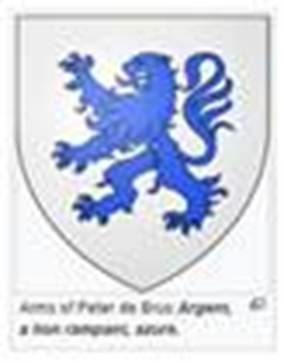
family bore at an early date a lion rampant azure, which the Scottish branch
moved up into a chief and placed a saltire in the field. The saltire must have
been adopted from either the heiress of Annandale or from Isabel of Huntingdon,
in whose right Robert Bruce claimed the throne of Scotland. The saltire cross
of St. Andrew, the national emblem of Scotland, became associated with the
Norman name of Nevill when Robert fitz Maldred, of
the line of earl Gospatric, married the heiress, and it superseded the former canting
device of the Nevills — a skiff, called in Norman French “Navile” which appears
on the seal of Henry de Nevill, t. of John.
(Biographical
Notes on the Yorkshire Tenants named in Domesday Book,
Yorkshire Archaeological Journal, Volume 4, 1876, page
406).
Robert I
married Agnes, possibly Agnes de Pagnall, daughter of Foulques
de Pagnall of Carleton, North Yorkshire, or Agnes de Bainard, daughter of
Geoffrey de Bainard, Sheriff of York. Their children were Adam I de Brus,
eldest son who was heir under English feudal law to all the English estates;
Robert II de Brus, the younger son, upon whom his father had settled the
Scottish Lordship of Annandale, plus several wheat-producing ploughlands at
Skelton; and Agatha de Brus, who married Ralph FitzRibald of Middleham.
1106
Henry I defeated his
elder brother and rival Robert Curthose at the Battle of Tinchebrai.
1107
Robert I de Brus,
First Lord of Skelton and Cleveland, First Lord of Annandale (c 1078 to 1141)
Lord of Skelton and
Cleveland, c1107 to 1141; Lord of Annandale, 1124 to 1138
See
Dictionary of National Biography Volume
7, page 114.
There is a strong presumption that the King had given Robert
his Yorkshire fee soon after the Battle of Tinchebrai.
After his victory
at Tinchebrai, Henry I visited York and Pickering.
Henry I redistributed land from Robert Curtose’s
supporters, including Robert de Stuteville to his New
Men, who included Nigel d’Albini, ancestor of the
Mowbray family and Robert de Brus.
Robert I was
probably given about 80 manors in Yorkshire. This included a large fiefdom in
Cleveland. The Brus family thus came to hold large estates based on Skelton, Danby and in Kildale. It was probably he who built the castles at
Yarm, Skelton and
Danby. He probably also constructed the castle in Castleton, though the struck out text below is probably inaccurate and derives from
the mistaken suggestion that the Brus family received their Yorkshire estates
from William after the Conquest.
Castleton is not specifically
mentioned in Domesday book, although the manor of Danby is noted as being in
the possession of Hugh Fitzbaldric, along with several other estates. Fitzbaldric was the Sheriff of Yorkshire, he died in 1089
without an heir and the estate was reverted to the crown. The Danby estate,
along with Fealholm (Yorkshire) and Crumbeclive (Yorkshire), were given by King William to
Robert de Brus, who is thought to have built the castle at Castleton sometime
between 1100 and 1104. Castleton was the centre of the de Brus estates in
Cleveland, an estate which comprised 40 villages, which may explain why a large
defensive work was constructed at Castleton whilst a smaller ringwork was
constructed at Castle Fevington, near Yarm
(Cleveland). Sometime shortly after 1104 Robert de Brus received the
Skelton estate (Cleveland) from Henry I, and the principal de Brus seat moved
to Skelton from Castleton. (Excavations at Castle Hill, Castleton, SJ Sherlock, Volume 64, 1992, Yorkshire Archaeological
Journal, Volume 64, 1992, page 41).
From 1109 to 1114, Robert de Brus appeared, in early charters, to be in
possession of a large number of manors and lands in
Yorkshire. He appeared in the Lindsey Survey made between 1115 and 1118 which indicated
that he was later given further lands.
1119
In 1119,
Robert founded the Augustinian priory of St Mary at Gisborough (the
priory is generally spelt Gisborough, in contrast to its town of Guisborough). It became one of the richest monastic foundations in England
with grants from the crown and bequests from de Brus, other nobles and gentry
and local people. This was a period of religious revival. Known as regular canons,
the monasteries who followed the Rule of St Augustine of Hippo were distinct
from other monks whose lives were governed by the rather stricter Rule of St
Benedict. Robert appointed his younger brother William as the first prior at
Gisborough.
As his
wealth grew, Bruce established an Augustinian Priory at Guisborough in
Yorkshire, which the family continued to patronise right up until the early
14th century. Indeed, so important was this abbey to them that, despite their conventional
piety, they never established another ecclesiastical foundation, even in
Scotland, after they settled across the border. Gisborough Priory, it would
seem, stole their hearts. (Robert the Bruce, the Champion of
a Nation, Stephen Spinks, 2024 page 35).
1121
Robert was
present at the gathering of northern magnates at Durham in 1121.
1124
Sometime during the period 1124 to 1130 he was with
the King at Brampton.
Robert was a
friend of David FitzMalcolm, who became King David I of Scotland in 1124. David
seems to have been a military companion of Robert in the Cotentin Peninsula of
Normandy, and he seems to have known him by 1120, through Henry's Court.
Henry had
married David’s sister, Edith, known as Matilda, and the two kings seem to have
been close. Henry had awarded the earldom of Huntingdon to David in 1114. When
David I succeeded his elder brother Alexander I (c 1107 to 1124), he returned north
with many boon companions who owed him service, including Robert de Brus, who
had originally hailed from Brix in Normandy where Henry I had spent much time
before his rule commenced. Brus was given lands in Scotland and encouraged to
settle. (Robert
the Bruce, the Champion of a Nation,
Stephen Spinks, 2024 page 26).
When David
became King in 1124, he gave the Lordship of Annandale to Robert, his military
companion and friend. Annandale in southwest Scotland was a lucrative and strategically
important demesne on the border between the two countries. For David, the
appointment of De Brus was part of a much larger and ambitious plan to
anglicise the south, and Annandale gave Robert the task of protecting the west,
where Galloway remained distinctly Gaelic speaking, with its own laws and
entrenched customs. (Robert the
Bruce, the Champion of a Nation, Stephen
Spinks, 2024 page 36). It has been suggested that Robert I became an unofficial warden of the west,
but there is an alternative suggestion that it doesn’t seem that Robert ever
lived on his Scottish estates.
Nevertheless
the Lordship of Annandale was strategically sited. In the twelfth and
thirteenth century, the main route across the western border between Scotland
and England was not past Gretna like today. Instead, travellers crossed the
upper Solway to the west of Gretna at low tide, reaching Scotland near nearer
to Annan, as here the grounds were safer and less marshy. The regular flood of people
making the crossing travelled through or near Annan and Lochmaben
castles, both under the command of House Bruce, making both fortifications a
gateway into the Scottish Kingdom. (Robert
the Bruce, the Champion of a Nation,
Stephen Spinks, 2024 page 36).
However having loyalties
both north and south of the border would bring with it complexities in
political relationships.
1125
Robertus de Brus donated property
to St Mary’s, York by charter dated to 1125 or 1135.
1131
In about 1131 Robert attested with three of his
personal knights a confirmation with Alan de Percy to the monks of Whitby.
1138
After the death of King Henry I, David of Scotland refused to
recognise Henry's successor, King Stephen during the contested Anarchy period.
Instead, David supported the claim of his niece and Stephen's cousin, Empress
Matilda, to the English throne and taking advantage of the chaos in England due
to the disputed succession there, he took the chance to realise his son's claim
to Northumberland. The King of Scots saw his opportunity. Capitalising on
this strife, he marched his army, along with his own son Henry, into the
Scottish Marches, capturing lands there. King Stephen ,
forced to fight wars on multiple fronts, had no real choice but to acknowledge
David’s possession of Carlisle, Cumbria south of the Solway and the earldom of
Huntingdon, the latter of course, having been bequeathed to him by Henry I.
Stephen also granted David’s son Henry the lands in Northumbria between the rivers
Tweed and Tyne, except for the castles of Bamburgh and Newcastle. Father
and son gave fealty to Stephen in return, but shortly afterwards they had
possession of Bamburgh and Newcastle as well. (Robert
the Bruce, the Champion of a Nation,
Stephen Spinks, 2024 page 27).
Robert I de Brus
remained loyal to Stephen as the successor king. Before the battle, Robert made an impassioned plea to David, calling to
his remembrance how he and other Normans had by their influence in Scotland, as
far back as 1107, obliged King Alexander to give a part of the Scottish Kingdom
to his brother David. The appeal was rejected. Robert renounced his homage to
David and relinquished his lordship of Annandale before taking the English side
at the Battle of the Standard in 1138. Robert I, and his eldest son Adam,
joined the English army, while his younger son, Robert II, le meshin (the cadet), hoping to recover the Brus Scottish
inheritance, fought for David. Father and son fought on opposite sides.
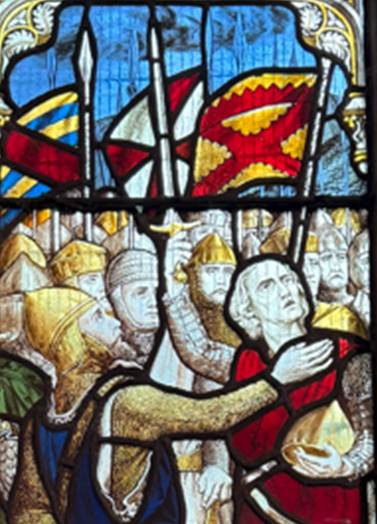
Robert de Brus at
the Battle of the Standard (window at Helmsley Parish Church)
Robert II de Brus,
Second Lord of Annandale (c1120 to c1194)
Lord of Annandale, 1138 to 1194
See Dictionary of National Biography Volume 7, page 114.
Whilst
the elder de Brus' allegiances were compromised when David I invaded England
and had renounced his fealty to David, the younger Robert II de Brus remained
loyal to David of Scotland and was reinstated into his father's land in
Scotland, whilst the English territories remained with the elder Robert and
passed to the latter's elder son Adam de Brus, 2nd Lord of Skelton. Bruce family
tradition has it that Robert II was captured by his father at the battle and
given over to King Stephen of England.
Robert
II spent much more time in Scotland that his father and attracted a band of
knights including the Herrieses, Kirkpatricks,
Crosbies and Johnstones who
he rewarded with lands, establishing a robust feudal structure in southwest
Scotland.
There
is a legend that in the 1140s Robert II was visited at Annan by St Malachy
O’Moore. St Malachy asked Robert to pardon a thief, but Robert hanged him
anyway, and for this the River Annan destroyed part of his castle and the de
Brus line received a curse from the holy man. Robert made Lochmaben
the centre of his lordship and constructed a new caput there. Robert de
Brus’ unforgiving treatment of the local thief had apparently cast a shadow on
the Bruce lordship for more than a century. Anything that went wrong, including
the major flood at Annan or the premature death of an heir or family member,
was quickly attributed to the curse of St Malachy. (Robert the Bruce, the Champion of a Nation, Stephen Spinks, 2024 page 41).
Robert
II married Euphemia, possibly the daughter of Sir Adam de Crosebi
or Crosbi of Albemarle (b c1098). They had three known
children, Robert (who died in 1191), their eldest son; William and Bernard.
1141
Robert de Brus I
died on 11 May 1141 at Skelton Castle in
Yorkshire. As the founder of Gisborough
Priory, he was buried inside the church, in the place of honour between the
Canon’s stalls in the Quire. Priory histories record his death and his burial
there. He was survived by his wife Agnes, and his children. Robert’s son, Adam
de Brus, Second Lord of Skelton, would be buried there in 1143, and his son
Robert, Second Lord of Annandale, would be buried there after his death in
1194. Both the Scottish and English sides of the family would be laid to rest
there, the last being Robert de Brus, Fifth Lord of Annandale in 1295.
Eventually a great Cenotaph would be placed there honouring the Brus Family and also commemorating the Yorkshire family’s then more
distant relative, King Robert Bruce (Brus) of Scotland.
Adam I de Brus, Second
Lord of Skelton and Cleveland (1105 to 1143 or possibly d 1167)
Lord of Skelton and Cleveland, 1141 to 1143
Adam I de Brus was the eldest
son of Robert de Brus I and his wife Agnes Paynell.
Adam was married to Agnes, the daughter of Stephen, the Earl of Albemarle, and
the sister of William, called Le gros under whom Adam had fought,
alongside his father, at the Battle of the Standard. They had a son, Adam and a
daughter Agatha.
All the English estates passed to Adam I in 1141. However,
he only survived his father by 22 months.
1143
Adam II de Brus,
Lord of Skelton (1127
to 1196)
Lord of Skelton and
Cleveland, 1143 to 1196
Adam II de Brus, was born at of Skelton. He married Ivetta d' Arches,
daughter of William de Arches and Ivetta, after 1169.
Whilst still a minor, he was
dispossessed of his castle at Danby by his guardian and uncle, William d’Aumale,
Earl of York. His
uncle also persuaded Adam to grant the churches of Skelton, Kirkleavington
and Yarm away from Gisborough Priory and to William’s own foundation of
Thornton abbey in Lincolnshire.
1153
David
I of Scotland died in 1153. Stephen died in 1153. David I’s son, Henry of
Huntingdon, Earl of Northumbria, had died in 1152. So
the crown of Scotland passed to David’s grandson, Malcolm IV The
Maiden.
Henry
II was determined to restore order and reclaim the lands which had been lost.
1157
By 1157
Henry II had taken back Newcastle, Bamburgh and Carlisle and the lands in
Northumbria.
1165
Malcolm
IV died without issue in 1165 and the Scottish crown
passed to his brother, William I the Lion. Whilst hoping to reclaim the
disputed lands, he was far from successful.
1174
William
the Lion was captured at the Battle of Alnwick and William was forced to do
homage to Henry II at Northampton.
1183
In
1183 Robert III married Isabella MacWilliam, illegitimate daughter of King William
I the Lion of Scotland through William the Lion’s liaison with a daughter of
Robert Avenel, Lord of Eskdale. There were no children.
1185
In
1185, somewhat magnanimously, Henry II granted the earldom of Huntingdon to
William’s brother, David.
1189
Richard I agreed to forego English claims to Scottish
overlordship. However the relationship was left
somewhat ambiguous.
1191
Robert III de Brus, the oldest son of Robert de Brus, 2nd Lord of Annandale,
died in 1191. He predeceased his father, and so did not inherit the lordship of
Annandale, which passed to his brother, William de Brus, 3rd Lord of Annandale.
1194
Robert
II de Brus died in 1194 and was buried at Gisborough Priory. As his eldest son,
Robert III, had predeceased him, he was succeeded by his second son William.
William de Brus, 3rd
Lord of Annandale (d
16 July 1212)
Lord of Annandale,
1194 to 1212
William
de Brus was the second but eldest surviving son of Robert II, 2nd Lord of
Annandale. His elder brother, Robert III de Brus, predeceased their father,
never holding the lordship of Annandale. William de Brus thus succeeded his
father when the latter died in 1194.
William
de Brus possessed large estates in the north of England. He obtained from John,
King of England, the grant of a weekly market at Hartlepool, and granted lands to the canons of Gisburn.
William
married Christina, daughter of Uhtred of Galloway, and had by her three sons
Robert IV de Brus, John de Brus and William de Brus.
1196
Adam II died on 20 March 1196.
Peter I de Brus of
Skelton (1170 to 17 January 1211)
Lord of Skelton and
Cleveland, 1196 to 1211
In 1196 Peter I de Brus
of Skelton, son of Adam II de Brus, Lord of Skelton and Ivetta, inherited the barony of Skelton. Peter had
married Joan.
Peter
I’s poor administration brought him into heavy debt. His debts and rebellion
against King John could have brought about the Brus family’s downfall but he
survived the turmoil. Initially he had been a faithful follower of the king,
accompanying him to Normandy.
1200
In 1200, Peter I was given his first chance to
rejuvenate the Skelton barony and buy back the vill
and forest of Danby which he did for £1,000.

The Danby estate was taken from the de Brus’s by Henry II
in exchange for land at Micklethwaite in West Yorkshire, according to Atkinson,
who argued that this breaking up of the de Brus estate in Cleveland must have
been enforced by the king and that the importance of the Castleton estate to
the de Brus’s is signified by their expensive repurchase in 1200. The Danby
estate was then bought by Peter de Brus I for 1,000 pounds, an expense thought
to be a realistic price for an estate if the exchequer had refortified the original
timber castle in stone. Considering that the capital messuage of the manor was
valued at 6s 8d in 1274 the castle was obviously a ruin at this time. It has
been suggested that the destruction of the castle may have occurred when King
John undertook reprisals against the rebellious northern barons in 1216. (Excavations at Castle Hill,
Castleton, SJ Sherlock, Volume 64, 1992,
Yorkshire Archaeological Journal, Volume 64, 1992, page
41).
1207
In
1207 Peter I purchased the wapentake of Langbaurgh, near Great Ayton. Later
he would obtain a position of greater importance than his father or grandfather
by purchasing the farm at Wapentake in Lambaurgh in
1207. It encompassed the whole tenant of Cleveland.
1211
Peter ll de Brus, Baron of Skelton (c 1185 to
13 September 1241)
Lord of Skelton and
Cleveland, 1211 to 1241
In 1211 Peter ll de Brus became Lord
of Skelton and Cleveland. Peter was married to Helewise, sister of William de
Lancaster, Baron of Kendall.
He served as a justice for Yorkshire,
and also entered into litigation with the prior
of Gisborough, the abbot of Byland and the bishop of Durham; the latter over
rights of wrecks on the Hartness coast (present day Hartlepool).
1212
Robert IV de Brus,
4th Lord of Annandale (c1195 to 1232)
Lord of Annandale,
1212 to 1232
See
Dictionary of National Biography Volume
7, page 115.
Robert
IV’s uncle had died in 1191 before becoming Lord of Annandale, and therefore
his father, William, inherited the title, becoming 3rd Lord of Annandale.
Robert
IV’s father, William died on 16 July 1212 and was survived by his wife
Christina who went on to remarry, as his second wife, Patrick I, Earl of
Dunbar.
Robert
IV became the fourth lord of Annandale.
1214
Some of the Yorkshire barons held no continental lands, and had little interest in John’s overseas interests.
William de Mowbray and Peter de Brus
refused to join the overseas adventure to Poitou or to pay war taxes in 1214.
These barons were prominent amongst the northern barons who forced the Magna
Carta on John in 1215.
1215
John’s unpopular methods of raising taxation came to a
head by the barons’ insistence that King John signed Magna Carta at Runnymede in
June 1215. It included a resolution of countless grievances of the day, but it
also embraced some fundamental legal principles which have passed through to
contemporary legal doctrine, including that No Freeman shall be taken, or
imprisoned but by lawful judgment of his peers.
Magna
Carta imposed restraints on monarchy; might
be taken as the first example of a written constitution, which was unusual
across Europe at that time; and represented a contract between monarchy and the
community of the realm, which started to emerge as a distinct legal entity.
Peter I became increasingly disillusioned
of King John and in February 1216, he had to flee Skelton Castle to avoid capture by the king. He became further disillusioned
by King John when he abrogated the Magna Carta, for in 1217, he was in open
rebellion with those who opposed the king. He fled Skelton Castle shortly is was taken by the monarch's forces. After King John's
death, Peter had Skelton Castle and his lands restored to him by the new King
Henry III by 1219.
1219
In
about 1219 Robert IV married Isabel of Huntingdon, the second daughter of David, 8th Earl of Huntingdon, by which
marriage he acquired the manors of Writtle and Hatfield Broadoak, Essex in
England. They had 2 sons and a daughter, Robert, Bernard de Brus of Exton, and
Beatrice de Brus (who married Hugo de Neville).
Any
Bruce claim to the throne had tentatively rested on an extra marital daughter
of William the Lion who had married Robert III. The Bruce claim was now much
more powerful through the Huntingdon line.
1220
Robert
V de Brus was born in about 1220.
1221
Alexander
II married Joan of England on June 21, 1221, at York Minster. At the time,
Alexander was 23 years old and Joan was almost 11. The marriage helped to bring
peace between England and Scotland.
1232
Robert
IV died in 1232, and was survived by his wife
Isabella. He was buried in the family mausoleum at Gisborough Priory.
Robert V de Brus,
5th Lord of Annandale (c1215 to 31 March 1295)
Lord of Annandale,
1232 to 1292
See
Dictionary of National Biography Volume
7, page 115.
Robert
V was son of Robert IV and Isobel of Huntingdon. Widely known as Robert the
Noble, he was also grandson of David of Scotland, and great-great-grandson
of King David I of Scotland.
In
addition to Annandale, Robert was Lord of Hartlepool (also then known as Hartness) in county Durham, and
Writtle and Hatfield Broadoak in Essex.
His
first wife, Isabella of Gloucester and Hertford, brought to him the village of
Ripe, in Sussex, and his second wife the Lordship of Ireby
in Cumberland.
His
contemporaries called him The Noble, but he came in time to be
remembered as The Competitor. He would live to the age of 75.
He
was a justice and constable of Scotland and England, a regent of Scotland, and
a claimant to the Scottish throne in 1290 to 1292 in the Great Cause. He
is commonly known as Robert the Competitor.
He was handsome appearance, a gifted speaker, remarkable for his
instruments, and, what is more important, most devoted
to Gordon the clergy. It was his custom to entertain and feast more liberally
than all other the other courtiers, and was most hospitable to all his guests,
nor used the pilgrims to remain outside his gates, for his door was opened to
the wayfarer. (The Chronicle
of Lanercost, 1272 to 1346, translated by Sir Herbert Maxwell, 1913, page
111).
1237
The
King of Scots renounced his claim to Cumbria, Westmoreland and Northumberland
in return for English lands in Tynedale and Penrith.
1238
Alexander
II’s queen, Joan, daughter of King John of England, died on 4 March 1238.
Alexander still had no heir at this stage and for the next three years. Before
he remarried to Marie de Cloucy, as an interim measure, Alexander II chose
Robert V de Brus as his heir, whose claim had been founded on his marriage to
Isabel of Huntingdon. Although Robert
V’s position as heir lasted only three years, this was a public recognition of
the Bruce position in the succession. Robert must have felt an elevated
sense of his own position among his peers, and it was something that he would
fail to shake off for the rest of his life (Robert the Bruce, the Champion of a Nation, Stephen Spinks, 2024 page 39).
1240
Robert V married Isabel de Clare, daughter of the
Earl of Gloucester. With additional landholdings in England, Robert V’s gained
influence in England and his reputation was further elevated.
1241
Alexander
III, son of Alexander II and his new wife Mary de Coucy, was born on 4
September 1241.
Peter III de Brus,
Lord of Skelton, Danby, Kirkby, Constable of Scarborough Castle (1240 to 18 September 1272)
Lord of Skelton and
Cleveland, 1241 to 1272
Peter III de Brus was the son of Peter II de Brus and
Hawise de Lancaster. Peter married Hillaria, daughter of Peter de Maulay, Lord
of Mulgrave and Isabella de Thornham.
1249
Alexander
II turned his attention to the Western isles under the Norwegian King Haakon
IV. Alexander II died in 1249.
1251
Alexander
III, aged 10, married Margaret, aged 11, daughter of Henry III at York during Christmas 1251. Unlike his father,
and perhaps due to his vulnerable age, Alexander was urged by Henry III and his
ministers to pay homage for the kingdom of Scotland. Alexander had been well
advised, however, and the young boy replied with some courtesy that he had come
to York to be married, not to answer so difficult a question. This evasion
worked, for Henry did not pursue the issue, but did, through affection for his
daughter, maintain an interest in affairs north of the border, especially when
Margaret took time to settle, writing to her father, according to chronicler
Matthew Paris, that she felt imprisoned in Edinburgh Castle, that ‘dreary and
solitary place’. The marriage
blossomed into an intimate and supportive relationship. (Robert the Bruce, the Champion of a Nation, Stephen Spinks, 2024 page 30).
Robert
Bruce was Regent of Scotland some time during the minority of his second cousin King Alexander III of Scotland and was occasionally
recognised as a tanist of the Scottish throne.
He was the closest surviving male relative to the King since Margaret of Huntingdon's
descendants were all females up until birth of Hugh Balliol sometime in the
1260s. When Alexander yet was childless, Robert V was officially named as heir presumptive, but never gained the throne as Alexander later
had three children.
1260
Alexander and Margaret had a daughter, Margaret born
in England in 1260.
1263
The
Battle
of Largs was a military engagement fought on 2 October 1263, between the
kingdoms of Norway and Scotland on the Ayrshire coast. The battle, which was
tactically inconclusive, became a strategic Scottish victory that ended
centuries of Norse influence in the region and led to Scotland consolidating
control over its western islands in 1266, though not yet Shetland.
The
relationship between England and Scotland continued on
relatively good terms during this period.
1264
Robert V fought with the English King in
the baronial conflict with Simon de Montfort.
When
Robert V was captured in 1264, along with Henry III of England, Richard of
Cornwall, and the future Edward I of England at the Battle of Lewes, Sussex,
Bruce negotiated with his uncle Bernard Brus, and cousin Gilbert de Clare, Earl
of Gloucester, both supporters of Simon de Montfort, over the terms of the
ransom.
Alexander III and Margaret had a son, Alexander,
born on 21 January 1264, but as heir apparent, he died on 28 January 1284, two
years before Alerxander’s death.
1265
Following the Battle of Evesham, in
August 1265, both Robert V and his son Robert VI profited from the seizure of
the rebellious barons' possessions, including those of Bernard. Robert VI
acquired lands in Yorkshire, Northumberland, and Bedfordshire.
Robert
V’s possessions were increased following the defeat of Simon de Montfort at the
Battle of Evesham in 1265, when a series of grants included the estates of
former rebel barons. Henry III also re-appointed Robert a Justice, and
Constable of Carlisle Castle and keeper of the Castle there in 1267, a position
he had been dismissed from in 1255. Robert sought a pardon from Alexander and
probably joined the princes Edward and Edmund on their crusade.
1268
Robert
VI and his younger brother Richard are known to have received letters of
protection, in July 1270, to sail with Edward for crusade that August, and are
presumed to have taken the cross, with Edward, at Northampton in 1268.
They were joined by their father, who had sought pardon from Alexander III, but
their date of return from Acre is less certain.
There
is a legend that the 27 year old Robert VI de Brus was
a handsome young man participating in the Ninth Crusade. When Adam de
Kilconquhar, one of his companions-in-arms, fell in 1270, at Acre, Robert was
obliged to travel to tell the sad news to Adam's widow Marjorie of Carrick. The
story continues that Marjorie was so taken with the messenger that she had him
held captive until he agreed to marry her, which he did in 1271. However, since
the crusade landed in Acre on 9 May 1271, and only started to engage the
Muslims in late June, the story or his participation in the Ninth Crusade
cannot both be correct. A painting
by Albert Pearse depicts the scene.
What
appears to have happened is that in about 1271 Robert’s father obtained the
hand of Marjorie of Carrick, the young widowed heiress
of Niall of Carrick, 2nd Earl of Carrick for Robert.
Around
this time his mother died. The younger Robert VI and his step-mother
do not appear to have got on, with Robert recorded as trying to withhold dower
lands, after his father's death in 1295. This may be one of the reasons why the
father appears to have independently managed the possessions in the north, as well
as intermittently holding the position of Constable of Carlisle, while Robert
VI appears to have confined himself largely to the management of the southern
and midland possessions, with his brother Richard who independently held
Tottenham and Kempston, as well as commanding a Knight banneret for Edward.
Richard is recorded as receiving a number of wards and
gifts of deer and to have sought permission to empark
the forest at Writtle at this time.
Robert
VI, while not part of Edward's household, became an envoy and mouthpiece for
Alexander III at court.
1270
Robert
V, then 50 years old, and VI joined Edward and Edmund of Lancaster on Crusade
for the next two years.
1271
Peter III married Hillaria, daughter of Peter de
Maulay, Lord of Mulgrave and Isabella de Thornham but died without issue on 18
September 1272.
In
about 1271 Robert VI married Marjorie of Carrick. They married without the necessary
royal permission, resulting in a temporary forfeiture and fine of her lands.
They had a large family of twelve children, including Robert VII who became
King of Scotland.
1272
Henry III died on 12 November 1272.
Alexander III was invited to the coronation of Edward I at Westminster in 1274,
again evading the question of homage.
Peter III de Brus
died without issue on 18 September 1272. The death
of Peter de Brus II in 1271 without a male heir led to the de Brus
estate being divided among four sisters, with the Danby, Wolvedale,
Lealholm (Yorkshire), Brotton and Skinningrove
estates (Cleveland) being given to Lucia, married to Marmaduke de Thweng of
Kilton (Cleveland). The Danby estate passed via their son Robert to his
daughter, Lucia de Thweng, who in 1296 married William le Latimer. The couple
had a new castle built for the Danby estate, some 3 miles east of Castleton.
Danby Castle is thought to date from between 1300 and 1305. 6 If this is the
case the ‘ruined peel’ referred to in 1335 must refer to the Castle Hill,
Castleton, establishment (Excavations at Castle Hill, Castleton, SJ Sherlock, Volume 64, 1992, Yorkshire Archaeological
Journal, Volume 64, 1992, page
42).
Following his death, his four sisters became
co-heiresses of the de Brus estates. The de Brus estates were divided amongst
four daughters, Agnes, Lucia, Margaret and Laderina.
The first two daughters stayed within the Cleveland area.
Agnes, the eldest, married Walter de Fauconberg and took, as her share, the manors and castle of
Skelton, Marske, Upleatham and Kirkleatham.
Lucia, the second sister, married Marmaduke de Thweng
of Kilton
castle, taking with her the manors of Yarm, Danby and Brotton.
Margaret, the third sister, married Robert de Ross and
had, as her share, the barony of Kendall.
Laderina,
the youngest, married John de Bellew and had for her share the lordship of
Carlton amongst other holdings.
House Fauconberg
Agnes de Brus, wife
of Walter de Fauconberg, First Baron Fauconberg (c 1220 to
1304)
New Lord of Skelton,
Marske, Upleatham and Kirkleatham, 1272 to 1304
Walter was the eldest son of Piers de Fauconberg and Margaret de Montfitchet. Through his wife
Agnes, he inherited the Barony of Skelton. He was summoned to parliament in
1295.
1273
On
3 May 1273, Robert V married his second wife, Christina de Ireby, the widow of
Adam Jesmond, the Sheriff of Northumberland. This marriage added estates in
Cumberland and dower land from her previous husband to the Brus holdings.
Following the marriage, Robert appears to have restricted himself to the
management of the family's northern possessions, leaving the southern lands to
his sons.
The
prospect of a new step mother was not welcomed by
Robert VI and family tensions grew.
Alexander III and Margaret had a son, David on 30
March 1273, but died in 1281.
1274
Henry
III was succeeded by his son Edward I in 1272. Alexander III met Edward at
Tewkesbury on 16 October 1274. To help protect his dignity, he asked for Robert
Bruce VI, Earl of Carrick, to represent his and act as his proxy in giving
homage to Edward I.
Robert
VII de Brus, later King of Scotland, was born on 11 July 1274. Little is known
of his childhood. It is likely that he was born at Turnberry Castle. There are
no records of his childhood. He would have spoken French as his first language,
with an ability to speak Gaelic and northern English, which had evolved into
Lowland Scots. He would have been given military training.
1275
The
queen of Scotland died on 26 February 1275 at Cupar and Alexander was bereft
and did not marry again for ten years.
1278
On 16 October 1278, Alexander III met
with Edward I at Tewkesbury Abbey, where Alexander performed homage for the
lands he held in England, specifically the lordship of Hexhamshire,
but explicitly avoided giving homage for the kingdom of Scotland itself. Instead he asked for Robert Bruce VI, Earl of Carrick, to
swear fealty on Alexander's behalf. Robert V, Lord of Annandale was still alive
at this point, but Robert VI was in the king’s retinue.
1284
The
succession in the main line of the House of Dunkeld became highly precarious
when, towards the end of Alexander's reign, Prince Alexander died in 1284,
Prince David having died in 1281. Princess Margaret, Queen of Norway had died
in 1283, but had a daughter, also Margaret. The middle aged
Alexander III induced the Estates in 1284 to recognise as his heir presumptive
his granddaughter Margaret, called the Maid of Norway, his only
surviving descendant.
In
February 1284, Bruce attended a convention at Scone, where the right of
succession of Alexander III's granddaughter, Margaret, Maid of Norway was
recognised.
1285
The
need for a male heir led Alexander to contract a second marriage to Yolande de
Dreux, a French noblewoman, at Jedburgh Abbey on 14 October 1285.
1286
Alexander’s
succession planning was in vain. Alexander died suddenly, in a fall from his
horse, when only 45 years old, in 1286.
Alexander’s
death ushered in a time of political upheaval for Scotland. His three year old granddaughter Margaret, who lived in Norway,
was recognised as his successor when the noblemen of Scotland swore fealty to
the Maid of Norway at Scone on 28 April 1286.
1289
At
a meeting at Salisbury on 3 October 1289 Edward I
acted as a guarantor for the young Queen Margaret’s safety and passage, and the
Scottish nobles agreed to her transport, formalised in the Treaty of Salisbury,
a preliminary agreement for bringing her to Scotland and securing the kingdom's
stability. Robert VII had been plotting his own route to power,
but was thwarted at this stage.
1290
In March 1290 there was a plan for
Edward’s son and heir, Edward of Caernarvon, to marry Scotland’s new queen,
Margaret, with the two countries retaining separate identities.
However the then seven year old
heiress Margaret died, travelling towards her kingdom, on the Orkney islands around
26 September 1290. With her death, the main royal line came to an end and thirteen claimants asserted their rights to the
Scottish throne.
The Great Cause
After
the extinction of the senior line of the Scottish royal house (the line of
William I of Scotland) David of Huntingdon's descendants became the primary
candidates for the throne. The two principal claimants to the throne were John
Balliol and Robert V, who represented descent through David's daughters Margaret and Isobel of Huntingdon,
respectively.
Robert
pleaded tanistry and proximity of blood in the succession dispute. He
descended from the second daughter of David of Huntingdon, whereas John Balliol
descended from the eldest and thus had the lineal right. However, Robert was a
second cousin of kings of Scotland and descended in fourth generation from King
David I of Scotland, whereas John Balliol was a third cousin of kings and descended
in fifth generation from King David I, the most recent common ancestor who had
been Scottish king.
Civil
war threatened.
Soon
after the death of young queen Margaret, Robert raised a body of men with the
help of the earls of Mar and Atholl and marched to Perth with a considerable
following and uncertain intentions.
John Balliol’s mother Dervorguilla, had died on 28 January
1290, and he also asserted his claim.
Bishop
William Fraser of St Andrews, worried of the possibility of civil war, wrote to
King Edward I of England, asking for his assistance in choosing a new monarch in an attempt to maintain the peace.
On
28 November 1290, Edward I’s Queen Eleanor died and
the distraught King reemerged into public life after two months, pouring his
grief into the issue of the Great Cause.
1291
A
meeting at Norham in May to June 1291 was dominated
by Edward I’s demand that the Scottish nobles and claimants formally recognise him
as the feudal overlord of Scotland. Edward took this chance to demand sasine of
the Scottish royal estate, but agreed to pass judgment
in return for recognition of his suzerainty. The guardians of Scotland denied
him this, but Robert Bruce was quick to pay homage. All the claimants swore
oaths of homage, and John Balliol was the last to do so. The guardians were
forced to concede and were thus reinstated by Edward.
Thirteen
claimants to the throne came forward.
Judgment processed slowly. On 3 August 1291
Edward asked both Balliol and Bruce to choose forty auditors while he himself
chose twenty-four, who comrpised a total of 104
auditors known as the Court of Claims, to decide the case.
1292
The
Great Cause was concluded on 17 November 1292 when Edward I gave the
Crown of Scotland to the Bruce family's great rival, John Balliol. After
considering all of the arguments, in early November
1292 the court decided in favour of John Balliol, having the superior claim in feudal
law, and greater support from the kingdom of Scotland. In accordance with this,
final judgement was given by Edward on 17 November 1292.
On
30 November 1292, John Balliol was crowned as King of Scots at Scone Abbey. On
26 December 1292, at Newcastle upon Tyne, King John of Scotland swore homage to
Edward for the kingdom of Scotland. Edward soon made it clear that he regarded
the country as his vassal state.
The
Bruce family thus lost what they regarded as their rightful place on the Scottish
throne.
Annandale
was seized, by King John Balliol, and given to John The
Red Comyn, Lord of Badenoch.
In
1296 Annandale was re-gained. Robert married Eleanor.
Robert VI de Brus,
6th Lord of Annandale (1243 to 1304)
Lord of Annandale,
1292 to 1304
See
Dictionary of National Biography Volume
7, page 116.
Robert
VI had supported his father's claim to the vacant throne of Scotland, on the death
of the Maid of Norway in 1290. In 1291 Robert VI swore fealty to Edward I as
overlord of Scotland. In 1292, his wife, Marjorie, died. In November, Robert V,
the unsuccessful claimant, resigned his Lordship of Annandale, and the Bruce
claim to the throne to Robert VI, allegedly to avoid having to swear fealty to
John.
Shortly
afterwards, in 1292, the younger Robert's wife Marjorie of Carrick died and the earldom of Carrick devolved upon their eldest
son, Robert VII, the future King.
In
1292, Robert held a market at Ireby, Cumberland, in
right of his wife. The following year he had a market at Hartlepool, county Durham within the liberties of the Bishop of
Durham.
1295
Sir
Robert de Brus V died at Lochmaben Castle in 1295 and
was buried at Gisborough Priory.
By the time Robert became the 6th Lord of Annandale in 1295, he
also inherited estates beyond and Annandale in Tottenham near London, manors at
Hartness and Writtle in Essex, as well as estates in Yorkshire, Northumberland
and Cumberland. Back in May 1283, he had also become constable of Carlisle
Castle and Sheriff of Cumberland. In just over 160 years, the Bruce family had
become significant land owners, with their chief
residences at Lochmaben, Turnberry and Loch Doon. The
close relationship with the King of Scots continued, a consistent theme through
their years in Scotland since 1124, and it is no surprise that it was Robert, the
6th, Earl of Carrick, whom Alexander III chose as his proxy to perform his
homage for his lands in England at the court of Edward I in 1277. (Robert the Bruce, the Champion of a Nation, Stephen Spinks, 2024 page 43).
1298
Robert
VI had been on the English side when Edward moved against Balliol, but he had
subsequently joined Wallace's revolt. When Wallace gave up the Guardianship of
Scotland in 1298, Robert became joint Guardian with Sir John Comyn of Badenoch
(Balliol's nephew).
1301
Walter de Fauconberg fought in the wars in Flanders and was a
signatory of the Baron's Letter to Pope Boniface VIII in 1301.
1304
Robert
VI died in Easter 1304 Easter en route
to Annandale and was buried at Holm Cultram Abbey,
Cumberland.
Robert VII the
Bruce, King of Scotland (11 July 1274 to 7 June 1329)
Lord of Annandale,
1304 to 1329; King of Scotland 1306 to 1329
See
Dictionary of National Biography Volume
7, page 117.
Robert
the Bruce was the son of the 6th Lord of Annandale. He was the grandson of the Robert Bruce who had been one of the
competitors for the throne after the death of the Maid of Norway.
Walter de Fauconberg died in
1304 and was buried at Nunkeeling Priory,
Walter de
Fauconberg, Second Baron Fauconberg (1260 to
1318)
Lord of Skelton,
Marske, Upleatham and Kirkleatham, 1304 to 1318
Walter de Fauconberg II
became Lord of Skelton, Marske, Upleatham and Kirkleatham.
1306
On
25 March 1306, Robert the Bruce was chosen to be King of Scots and to lead the fight for Scottish independence against Edward
I of England.
A
few weeks before his coronation, Robert killed his greatest rival for the
crown, his joint Guardian, in a Dumfries church, during the last of many
arguments between them. For this murder, Robert was outlawed by Edward I and
excommunicated by Pope Clement V.
His
reign did not begin well.
Robert
the Bruce murdered his chief rival for the Scottish throne, John the Red
Comyn, on 10 February 1306, in the Greyfriars Church in Dumfries. This
sacrilegious act forced Bruce into open rebellion against English rule and to
assert his claim to the Scottish crown by force.
He
was defeated by the English at Methven in Perthshire; his wife, daughter and
sisters were imprisoned; and three of his brothers were executed by the
English. Robert fled westward to the Antrim coast. The story of Robert drawing
inspiration from a persistent spider mending its web in a cave dates from the
sixteenth century.
1307
The First War of Scottish Independence
The
tide turned on the death in 1307 of Edward I, the self-styled Hammer of the
Scots, who was succeeded by his less effective son Edward II.
From
1307 onwards, with energy and determination, Robert waged highly successful
guerrilla warfare against the English occupiers, establishing control north of
the Forth, and gradually won back his kingdom; by 1314, Stirling was the only castle
in English hands. Between 1307 to 1313, Robert the Bruce transitioned from
fugitive to King, securing his rule by defeating Scottish rivals (like the
Comyns at Inverurie in 1308) and English forces (Glen Trool
1307, Loudoun Hill 1307), systematically capturing castles, destroying Comyn
lands (Herschip of Buchan), holding his first
Parliament (1309), and gaining control of Scotland north of the Tay, paving the
way for the decisive Bannockburn victory.
1314
On 17
June 1314, Edward II marched with a powerful army from Berwick into Scotland.
It was the largest army raised for 15 years, perhaps 20,000 soldiers. The Earls
of Lancaster, Warwick, Arundel and Surrey had declined to take part., sending
the minimum number of soldiers. The army arrived near Stirling on 23 June 1314.
Robert
Bruce, with a smaller army of 6,000 infantry and 500 light cavalry,
were camped in the hunting ground known as New Park, south of Stirling.
During
skirmishes on 23 June, Henry de Bohun, Earl of Hereford, was killed by Bruce,
and dissent followed over the leadership of Hereford’s vanguard. There were
divisions in the English ranks.
On
24 June 1314, the armies drew up for battle. Edward miscalculated by keeping
his archers to the rear until it was too late. The battlefield turned to a
chaotic massacre. The King and his escort were evacuated by sea from Dunbar,
leaving thousands of doomed English soldiers to their fate. So many fine
noblemen, so much military equipment, costly garments and gold plate, all lost
in one harsh day, one fleeting hour (The Life of
Edward II).
The
Scots used strategic tactics, including taking a strong defensive position,
using marshy terrain to hinder the English cavalry, and employing formations of
pikemen called schiltrons to break English
attacks. The Battle
of Bannockburn ended with a Scottish triumph, establishing Bruce as king and
significantly weakening English control over Scotland.
Scots Wha Hae or Robert Bruce’s Address to His Troops at
Bannockburn:
|
Scots, wha hae
wi’ Wallace bled, Scots, wham Bruce has aften led, Welcome to your gory bed, Or to victorie. |
Now ’s the day, and now’s the hour; See the front o’ battle lour; See approach proud Edward’s power, Chains and Slaverie. |
Wha will be a traitor-knave? Wha can fill a cowards’ grave? Wha sae base as be a Slave? Let him turn and flie. |
Wha for Scotland’s king and law, Freedom’s sword will strongly draw, Free-Man stand, or Free-Man fa’, Let him follow me. |
By Oppression’s woes and pains! By your Sons in servile chains! We will drain our
dearest veins, But they shall be
free! |
Lay the proud Usurpers low! Tyrants fall in every foe! Liberty ’s in every blow! Let us Do or Die! |
There is an In Our Time podcast on the Battle of Bannockburn of 1314, an important victory for Scotland in its fight to
win independence from England.
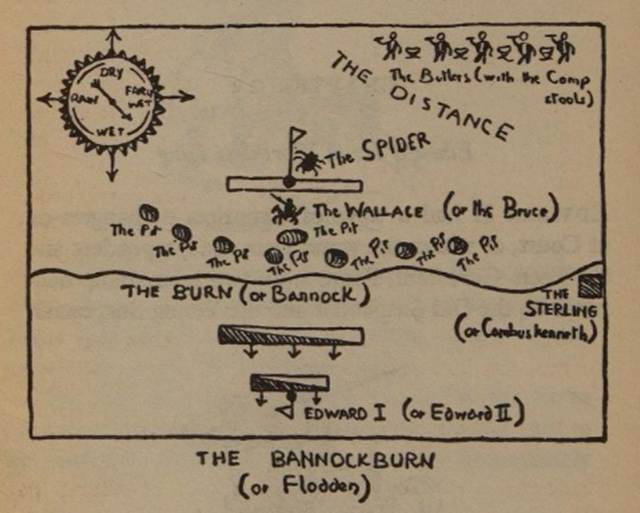
The fact that the English were
defeated has so confused Historians that many false theories are prevalent
…What actually happened is quite clear from the sketch
map shown above. The causes of the English defeat were all unfair and were (1)
the Pits;… (2) Superior numbers of the English … (3)
Foul riding by the Scottish knights … (From 1066 and all that, Walter Sellar and Robert Yeatman, 1930).
The
smashing of the English army under Edward II at Bannockburn on 24 June 1314
marked an end to English ambitions in Scotland.
Robert Bruce was stronger than ever in Scotland. Scots raiders were free
to sweep deep into Yorkshire. The north of England was relatively defenceless
and faced raids from Scotland and destruction of crops and seizing of animals.
After
Bannockburn, Robert the Bruce continued to fight for full Scottish independence
by launching raids into northern England, sending his brother Edward to lead
the Scottish invasion of Ireland as a second front, which he joined for a time.
He
also consolidated his power in Scotland by capturing remaining English
garrisons, re-establishing control over Scottish lands, and solidifying his
legitimacy as king through diplomacy and legal means.
1315
The Great Famine
(1315 to 1322) caused widespread starvation and enhanced the political
instability. This was a period of lawlessness, with the
Folville gang operating in Leicestershire and the Coterel
gang operating in the Peak District.
The
1315 to 1317 campaign of Edward Bruce, brother of Scottish King Robert the
Bruce, in Ireland began with his landing with an army of 6,000 men at Larne in
Ulster and was part of a broader effort by Robert and Edward Bruce to fight England
by opening a second front. Invited by Irish chieftains, including Domnall mac
Brian Ó Néill, and
crowned High King of Ireland in 1316, Bruce had initial successes, creating a
potential Gaelic alliance against England. He pursued a long campaign against
the Anglo-Norman forces. He defeated the army of Richard de Burgh, Earl of
Ulster, Robert’s father in law. He captured
strongholds including the strategic stronghold at Carrickfergus after a long
siege. Religious houses were sacked as they were seen as part of the elite
subjugation of the native Irish.
However,
the campaign faltered due to a lack of widespread support. Bruce failed to
establish long term authority because his power was diluted by local feuds
among the Irish chieftains. The campaign was marred by brutality and widespread
devastation, which alienated the local population and made it difficult to
secure their support. A severe famine beginning in 1315, caused by a mini ice age, further weakened Bruce's army, making it
difficult to supply his forces and capture key English strongholds like Dublin.
1317
The
Remonstrance by the native Irish in 1317, responding to papal
excommunication for the campaign against the Anglo-Norman forces and the church, foreshadowed
the Declaration of Arbroath three years later. It pled the case to the Pope
that the Irish natives population had been unfairly
treated. Of Edward Bruce’s elevation to High King they declared, we have unanimously
established and set him up as our king and lord in our kingdom aforesaid, for
in our judgment and the common judgment of men he is pious and prudent, humble
and chaste, exceedingly temperate, in all things sedate and moderate, and
possessing power (God on high be praised) to snatch us mightily from the house
of bondage with the help of God and our own justice, and very willing to render
to everyone what is due to him of right, and above all is ready to restore
entirely to the Church in Ireland the possessions and liberties. The Papacy neither
recognised Edward I's claim, nor agreed with the Remonstrance, and his
rule remained de facto over parts of Ireland and never de jure over the whole
island
1318
Edward
Bruce’s campaign in Ireland ended in defeat for Edward Bruce in 1318 when he
was killed at the Battle of Faughart in County Louth.
His death was a major blow to the Scots and ended their ambitions of a lasting
presence in Ireland.
Although
the campaign was ultimately a failure for the Bruces, it did cause significant
concern for the English crown and forced them to divert resources from other
conflicts.
Even
after Bannockburn and the Scottish capture of Berwick in 1318, Edward II
refused to give up his claim to the overlordship of Scotland.
John de Fauconberg (1290 to
1349)
Lord of Skelton,
Marske, Upleatham and Kirkleatham, 1318 to 1349
While Skelton Castle and estate was in the hands of
John, in the 13th year of the reign of Edward II, John obtained a licence from
the king to move the market from Sunday to Saturday.
1320
In
1320 the Scottish earls, barons and the community of the realm sent a letter to
Pope John XXII declaring that Robert I was their rightful monarch.
The
Declaration of Arbroath has become perhaps the most famous document in Scottish
history.
...we
gather from the deeds and books of the ancients, that among other distinguished
nations our own nation, namely of Scots, has been marked by many distinctions.
It journeyed from Greater Scythia by the Tyrrenhian
Sea and the Pillars of Hercules, and dwelt for a long
span of time in Spain among the most savage peoples, but nowhere could it be
subjugated by any people, however barbarous. From there it came, twelve hundred
years after the people of Israel crossed the Red Sea and, having first driven out
the Britons and altogether destroyed the Picts, it acquired, with many
victories and untold efforts, the places which it now holds ...
As the histories of old time bear witness, it has held them free of all servitude ever
since. In their kingdom one hundred and thirteen kings of their own royal stock
have reigned, the line unbroken by a single foreigner.
It
warned:
were he to desist from what he has undertaken and be willing to
subject us or our kingdom to the king of the English or the English, we would
strive to expel him forthwith as our enemy and as a subverter of right, his own
and ours, and make someone else our king who is equal to the task of defending
us.
1324
In
1324, the Pope recognised Robert as king of an independent Scotland. Two years
later, the Franco-Scottish alliance was renewed in the Treaty of Corbeil, by
which the Scots were obliged to make war on England should hostilities break
out between England and France.
1327
In
1327, the English deposed Edward II in favour of his son Edward III and peace
was then made between Scotland and England with the treaty of Edinburgh and
Northampton, which began with England's total renunciation of all claims to
superiority over Scotland. Robert had achieved all he had fought for: ejecting
the English, re-establishing peace and gaining recognition as the true king.
By
that time, King Robert was seriously ill, probably with leprosy.
The
peace with France was fragile and on 1 February 1327 as Edward was crowned,
there was a Scottish attack on Norham Castle.
The
Treaty of Paris was significant triumph for the French King Charles IV, who
recovered substantial territories and imposed a heavy financial penalty on
England. England held only the Gascon coast between Bordeaux and Bayonne in
southwest France at a punitive cost of 50,000 marks.
Border
raids from Scotland continued. Edward and his mother rallied with a force of
500 Flemish knights in May 1327 at York. While the army was mustering, a
serious fight broke out between the Hainault mercenaries and local English
archers. The exact cause of the dispute is not specified in detail by
chroniclers, but it escalated into a running battle throughout the city. Both
sides suffered significant losses, with around 100 men reportedly killed in the
conflict before order was restored.
When
the army marched north, the Scots under Sir James Douglas, adopted their usual
tactic of melting into the countryside until they attacked the royal encampment
at Stanhope Park near Durham crying Douglas! and cutting the ropes of
the king’s tent.
1328
English
Funds ran short and at the
Treaty of Edinburgh-Northampton a settlement
was agreed with Scotland to wave its right of overlordship. This ended the
First War of Scottish Independence by recognising Scotland as an independent
kingdom and Robert the Bruce as its rightful king. In exchange for peace,
Scotland agreed to pay a war damages sum of £20,000 and to have Robert's son,
David (later David II), marry Edward's six year old
sister, Joan of the Tower. Despite being a formal peace accord, the treaty's
stability was short-lived, with the Second War of Scottish Independence
beginning a few years later.
1329
Robert
VII de Brus, King of Scotland, died at Cardross, Dunbartonshire on 7 June 1329,
aged 54. A few days later, in response to an earlier request by him, the Pope
granted permission for Kings of Scots to be anointed at their coronation.
Scottish kings had previously been enthroned in a mainly secular ceremony at
Scone. This was an acknowledgement that the Pope recognised Scotland's
independence.
Robert
I was buried at Dunfermline and, in fulfilment of his dying wish, Sir James
Douglas set out to carry his heart to the Holy Land.
The
descent of Scottish Kings following Robert’s death can be seen in the Brus
Family Tree.
1349
Walter de Fauconberg (d 1361)
Lord of Skelton, Marske, Upleatham and Kirkleatham, 1349 to 1361
1361
Sir Thomas de
Fauconberg (1345 to
1407)
Lord of Skelton, Marske, Upleatham and Kirkleatham, 1361 to 1403
He inherited two-thirds of the estate, whilst his
mother, Isobel, received the other third.
1403
In 1403 the estate, by reason of Sir Thomas’s insanity,
was put into the custody of King Henry IV who, later, placed it in the custody
of Robert and John Conyers. In 1407 the estate was settled on the House
Conyers.
The estate of Skelton, Marske, Upleatham
and Kirkleatham was in the custody of the King from 1403 to 1407.
1407
Walter de Fauconberg (d 1407)
Joan Fauconberg (c1406 to 1490)
Joan
married Sir William Neville (died 1462)
She
inherited the estate as an infant. She was described as an idiot from
birth. The castle passed, via her marriage, to her husband, Sir William
Neville, who was made Earl of Kent by Edward IV in 1461.
1428
Joan
and William made alterations to the castle in 1428.
1469
House Conyers
Alicia Neville (1437 to 1490)
John Conyers was
Lord of Skelton, 1407 to 1469
Alicia was Lady of
Skelton from 1469 to 1490
Alicia married Sir John
Conyers (1435 to 1469), later Lord Conyers.
Alicia
was the daughter of Joan Fauconberg and Sir William Neville. She and her
husband passed over the inheritance in favour of their son, William.
1490
Sir William Conyers (1468 to 1524)
Lord of Skelton,
1490 to 1524
He inherited the castle in 1490.
He married Lady Anne Neville (1475 to 1550).
1524
Sir Christopher
Conyers (c1491 to 14
June 1538)
Lord of Skelton, 1524
to 1538
He married Anne Dacre (1501 to 1548) and they had four
children, Jane (1522 to 1558), Leonard (1524 to 1577), John (1525 to 1557) and
Elizabeth (1531 to 1558)
1538
John, Lord Conyers (c 1525 to 1557)
Lord of Skelton,
1538? to 1557
He married Maud Clifford. They had four daughters, Ann
(1540 to 1567), Elizabeth (1545 to 1572), Catharine (1554 to 1622) and Margaret
(b1556).
On his death, the estate was shared between his
daughters. He had no male heir.
Ann married Anthony Kempe, Catharine married John
Atherton (Sheriff of Lancashire) and Elizabeth married Thomas D’Arcy.
It would seem that Lord Conyers
died intestate and no provision had been made by him for an equitable division
of his possessions and lands which included areas beyond Skelton.
There is a record of friction between the husbands of
the 3 daughters regarding their shares and it is said
that they deliberately allowed the Castle to fall into disrepair.
There appears to have been some doubt, though, as to
who exactly owned the Castle.
An attempt was made to divide the Castle itself into 3
equal parts between the above 3 families or their descendants.
‘The goodly chapel, one of the jewels of this
Kingdom, rudely went to the ground, with the fair hall and large towers; so
that now scarcely are the ruins of a chapel to be seen’.
1576
The Atherton -
D’Arcy interest 1576 to 1577
Anthony
Kempe, the husband of Anne Conyers sold their part of the Skelton Estate to
Robert Trotter. Robert was the son of a Robert Trotter senior of Pickering
and married to Margaret who came from Pudsey.
Graves
History states that the remaining two thirds which had been inherited by the
other two Conyers daughters remained in their descendants until the year 1656,
when by exchange or purchase the whole became the property of Robert Trotter
and his descendants.
John
Atherton, possibly in conjunction with his brother-in-law’s family, the D’Arcys, opened Springbank alum
works at Slapewath c.1603-1604. This was probably the
first alum works in north-east Yorkshire.
1577
In
1577, Anthony Kempe (1529 to 1597) sold his share in the estate, including the
castle, to Robert Trotter
The Trotter family
interest
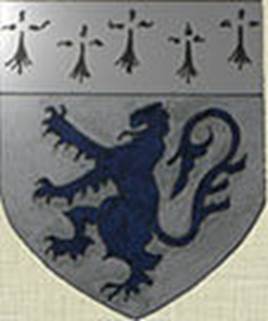
The
Trotter Family Arms
Robert Trotter (d 1611)
Lord of Skelton,
1577 to 1611
A document (North Yorkshire Record Office, Stapleton,
Skelton 73) has survived showing that in 1584 Robert Trotter was living in just
one section of Skelton Castle and that he appointed independent persons to
carry out the difficult task of dividing the building into 3 equal parts. It
was not until 1656 that the Trotter family would acquire full possession of the
Skelton Estate by purchase or exchange.
1584
14th Julie 1584. Skelton castell devided in the yeare above said
by William Ackrigge and Leonard Diggles at the appointment of the Lord thereof.
What follows seems to have been a basic description of a plan which has not
survived. No painting of the Castle has ever been found and unfortunately it is
impossible to form a clear picture of what the Castle looked like from this
document, but several notable features are mentioned.
First for one part to begin at the upper
end of the HALL and so Eastward and with all the rooms thereunto both above and
below, except the low room in the HUMBLE TOWER and also all the rooms and
houses Northwards of that side with the ground from the corner of HUMBLE TOWER
to the East jambs of both the BACK GATES.
And also another
piece of ground adjoining to the said part of the East side of the BASSE COURT
[a term for the Bailey, outer court] from the corner of the GATE HOUSE to the East
corner of the BATTLEMENT of the BRIDGE, leaving a a
sufficient way of 6 yards broad in the BASSE COURT.
And so through
the INNER GATES to all the house and 5 yards broad all alongside through the
INNER COURT to be a common way to every part from the fore GATE to the back
GATE or POSTERN.
Also
for another part the WEST TOWER with all the rooms in it and
also two rooms adjoining towards MR TROTTER HIS HOUSE one above and
another below to a certain BUTTRESS on the West side of MR TROTTER HIS HOUSE between
the said house and the WEST TOWER
also
the STABLES without in the BASSE COURT and a piece of ground in the said BASSE
COURT on the west side of the way between the fore GATE and the inner GATE.
And also one
piece of ground in the INNER COURT from the “HALE” PORCH corner of the West
part to the middle way towards the corner of the CHAPEL.
And so Westwards to the South side of MR
TROTTER his doors for to serve to make an inner court to the said part.
And the “moitie”
of the low part of HUMBLE TOWER with all the Stones in the outer GATE HOUSE.
Also
for the third part beginning at the BUTTRESS on the West side aforesaid where
MR TROTTER dwelleth and so Eastward with all the rooms adjoining both above and
below the CHAPEL.
And the ground lying on the West side of
the two Northern-most GATES leaving a way to pass through all the GATES 6 yards
broad with the remainder of the ground lying between the HALL PORCH aforesaid
and the CHAPEL corner layne
and the “moitie”
of the low part of the HUMBLE TOWER.
And whereas the said part has not so much
grounde as the other two parts in consideration
whereof to have the GARDEN place adjoining on the said part as it is all made
lying on the West side of the said house.
Regarding an area outside the Castle building, The
West part of the HALL to the South part of the Castle with the GREAT CHAMBER
and a CHAMBER PARTITIONED WITH A GREAT WAINSCOAT HAVING TWO WINDOWS, THE ONE
DIRECT AGAINST THE OTHER, with the South part of the house, the South West part
of the OUTER COURT with STABLES AND GRANARIES [spelt “garners”] and other
housing joining to the GRANARIES, going up BAGDALE [the valley on the East side
of the Castle, the stream in which was dammed to create the moat] to the high
land viz
1603
In 1603 there was a record of the Recusants, who
refused to take the sacraments of the Church of England. They included Robert
Trotter Esquier, Margaret his wife ; noncommunicants
this last yeare
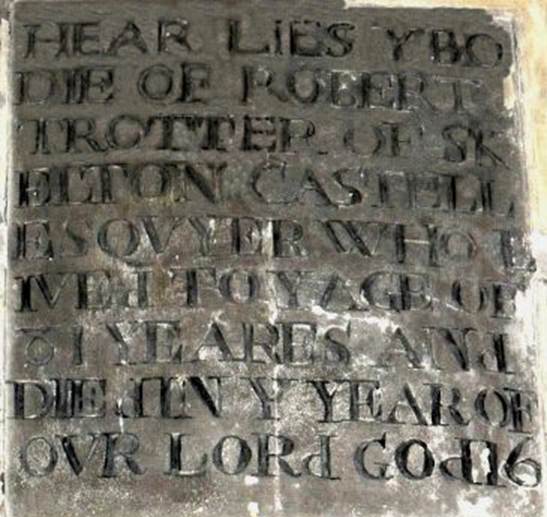
Skelton
Old Church. Here lies y bodie of Robert Trotter of
Skelton Castle Esqvyer who lived at y age of 81 yeares and died in Year of Our Lord God 1611.
1611
Henry Trotter (d 1623)
1623
George Trotter
Lord of Skelton,
1623 to ?
c 1690
Edward Trotter (d 1708)
Lord of Skelton, ? to 1708
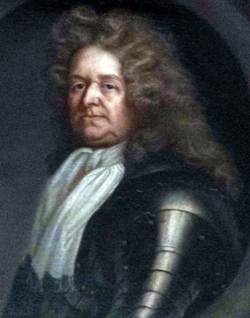
Edward married Mary Lowther
From 1668 to 1671 he was involved in opening Selby Hagg
alum works, near present day Hagg Farm, and Saltburn Alum House, behind Cat Nab, on
behalf of his father-in-law, Sir John Lowther.
1708
John Trotter
c 1715
Lawson Trotter
Lord of Skelton, ? to 1727
He was a grandson of Edward and Mary and died without
issue, the estate passing to his sister, Catherine Trotter.
1727
The Hall Stevenson
(later Wharton) Family interest
Joseph Hall (d 1733)
Lord of Skelton,
1727 to 1733
Joseph married Catherine Trotter
He came into possession of the castle and estates in
1727 by his marriage to Catherine, sister of Lawson Trotter, and by purchasing
land, in 1730, from Lawson Trotter.
1733
John Hall (d 1785)
Lord of Skelton,
1733 to 1785
He
added Stevenson as his surname after his marriage to Anne, the daughter of
Ambrose Stevenson and Ann Wharton.
John
was an author and friend of Laurence Sterne, who wrote “The Life and Times
of Tristram Shandy, Gentleman”.
He
had a reputation for throwing wild parties for his friends (including Lawrence
Sterne, Zachary Moore and Panty Lascelles) who were known collectively as the “Demoniacs”.
He
was something of a hypochondriac and wouldn’t get out of bed if there was an
east wind blowing. The story goes that Sterne paid a youth to fix the weathervane so it never showed an east wind. The castle at
this time was in a state of disrepair, earning for itself the nickname “Crazy
Castle”.
1785
Joseph William Hall
Stevenson (d 1786)
Lord of Skelton,
1785 to 1786
Joseph married Ann, daughter and heiress of James
Foster, Drumgoom, Co. Fermanagh, Ireland
1786
John Hall Stevenson (21 June 1765 – 29 May 1843)
Lord of Skelton,
1786 to 1843
He was born at Skelton
Castle on 21 June 1765, and took the surname and arms of Wharton only, by royal
sign manual, May 3, 1788. He was the son of Joseph William Hall Stevenson and changed
his surname to Wharton in order to
inherit his great-great-aunt Margaret Wharton’s estate at Gilling, near Richmond,
Yorkshire.
John Wharton was educated at the Royal School, Armagh,
Trinity College, Dublin and Lincoln's Inn. He succeeded his father in 1786, and inherited the ruinous Skelton Castle.
1788
During his tenancy he rebuilt both the castle and the
church at considerable expense. He demolished the old Skelton Castle and
between 1788 and 1817 built a similarly named Gothic country house in its
place.
1790
In October 1790, John Wharton married in Oct. 1790, Susan
Mary Anne, daughter of Major General John Lambton, of Lambton, County Durham,
and they had two daughters, Susan and Margaret, Margaret married Thomas Barrett
in 1815, but they had no children.
For 36 years he was MP for Beverley in the East Riding.
He stood no less than nine contested elections for Beverley, on the Whig
interest.
The first was at the general election of 1790, when he
was returned at the head of the poll, which terminated as follows: John
Wharton, esq, 908; Sir James Pennyman, 460; William Egerton, esq, 379.
1796
In 1796 he gave way to Mr. Tatton, but on that
gentleman’s death, in 1799, he contested the seat with Mr. Morritt, of Rokeby
Park, but was defeated by 512 votes to 369.
1802
In 1802 he came in at the head of the poll, and Mr.
Morritt was excluded, the numbers being John Wharton, esq, 736, General Burton,
690; J. B. S. Morritt, esq, 626.
1806
In 1806 he won by 641 votes over Lieutenant General
Vyse’s 609.
1807
In 1807 he was defeated by Capt. R. W. H. Vyse’s 1012
to his 739 votes.
1812
In 1812 he won with 805 votes over Charles Forbes’ 731.
1818
In 1818 he won again with 826 over K. C Burton with
669.
1820
In 1820 he won again with 657 votes.
1826
In 1826 he was excluded from the representation by a
poll in which he received 588 votes to 1030 received for John Stewart.
By 1826 he was so deeply embarrassed in his pecuniary
affairs, that he was immediately arrested, and for the last fourteen years he
has remained a prisoner within the rules of the Queen’s Bench.
1843
He had run up large debts and was confined in Fleet
Debtors Prison, London. His property at Skelton, excluding that which was
entailed and the library, which was mortgaged, was auctioned to pay his debts.
He died in 1843, childless.
An inquest was held on his body, and it was concluded
that he had for many years suffered from a painful disease of the bladder, and
an inquest was returned of Natural Death.
John Thomas Wharton (1795 to 1871)
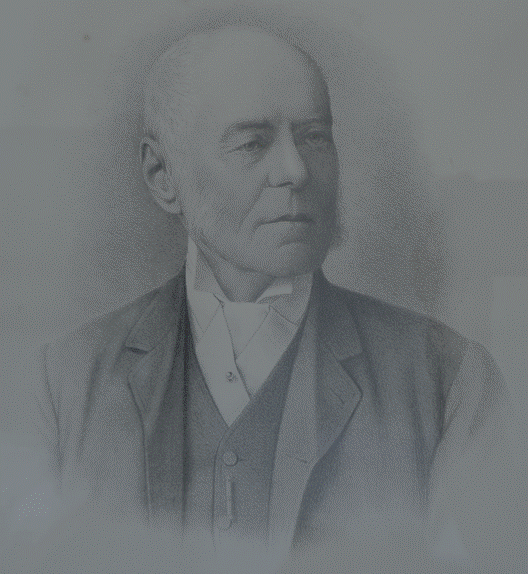
John Thomas Wharton was the son of John Hall Wharton’s
third brother, the Rev. William Hall Wharton, M.A., Vicar of Gilling, and
Charlotte, daughter of Thomas, first Lord Dundas. He was born in York on 9
March 1795.
John married Charlotte, eldest daughter of H W Yeoman.
His uncle, John Wharton died childless and in poverty
in 1843 and Skelton devolved to John Thomas Wharton of Gilling.
John Farndale wrote in 1864
that Kilton
formerly belonged to the Twings and Lumleys, who were
lords of the manor. Dr Waugh, Dean of Carlisle, and Miss Waugh, into whose
hands the estate came, sold it to Mrs Wharton, and this lady made a present of
it to the late J Wharton, Esq, of Skelton Castle, MP for Beverley, a gentleman
of memorable name.
Thanks to the discovery of ironstone
all across East Cleveland, and the royalties associated
with its extraction from under his land, he was able build the estate back up.
1871
John Wharton died at Tadcaster on 25 September 1871,
aged 76.
1900
William Henry
Anthony Wharton (14
November 1859 to 12 December 1938)
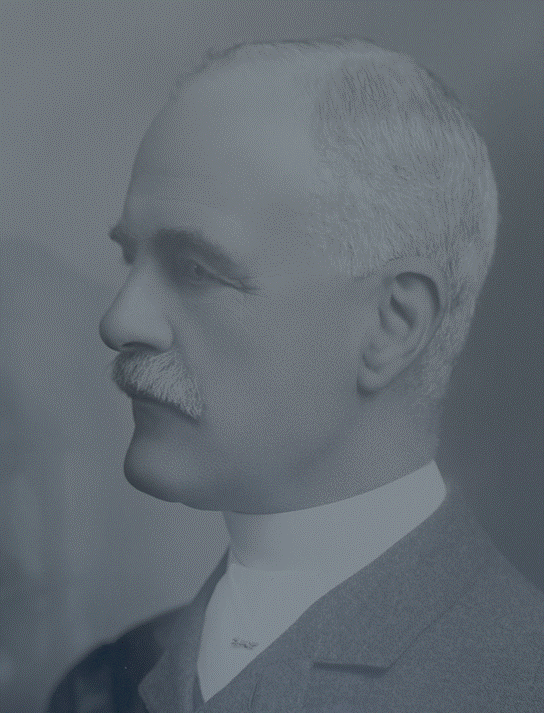
Lord of Skelton,
1900 to 1938
William married Harriot Emily Yeoman
He was Commanding Officer of the 4th Battalion
Yorkshire Regiment, the Green Howards, prior to the outbreak of the First World
War.
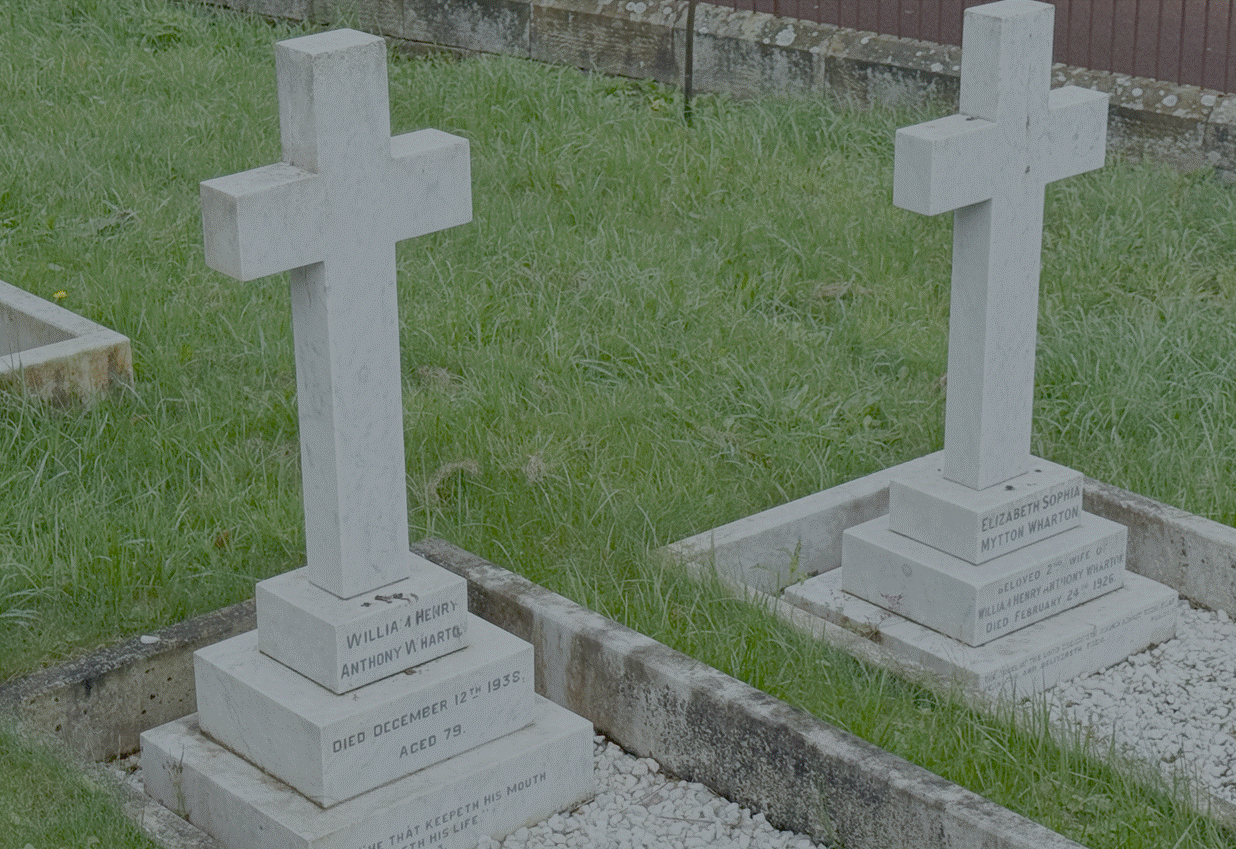
1938
Margaret Winsome
Wharton (1894-1991)
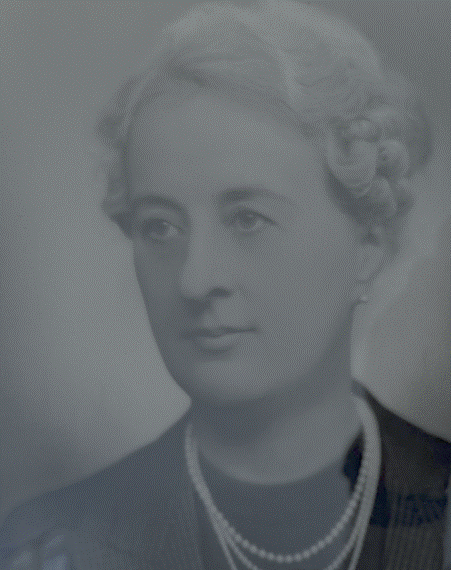
Lady of Skelton,
1938 to 1991
She married Captain Christopher Hilyard Ringrose.
Mrs Ringrose Wharton took an active part in running the
estate and supported many activities in the local community. There were no
children from this marriage and so the estate passed to Anthony.
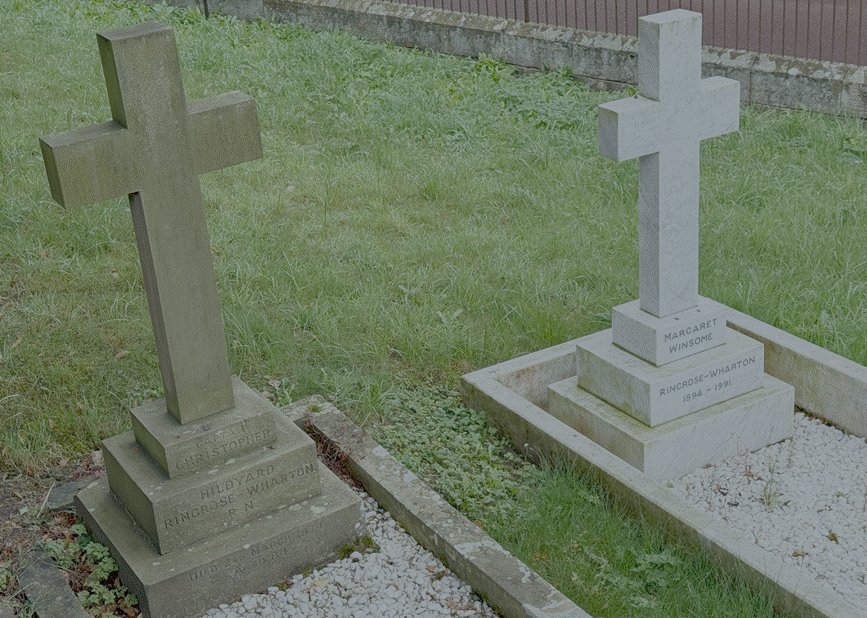
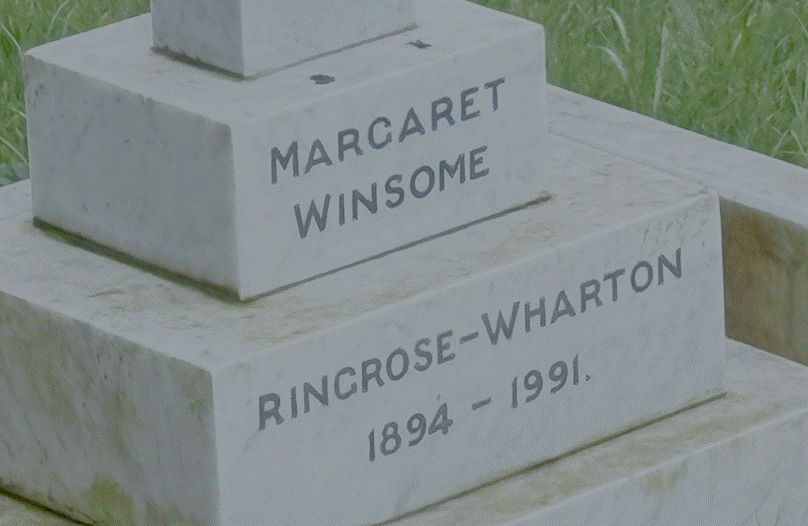
1991
Major Anthony
Charles Philip Wharton DL (10 August 1946 to 9 January 2026)
Lord of Skelton,
1991 to 2026
Anthony is the son of Lawrence Humphrey Wharton,
grandson of Philip Thomas Wharton, great-grandson of James Charles Wharton who was
a brother of John Thomas Wharton and is the current owner of Skelton Castle.
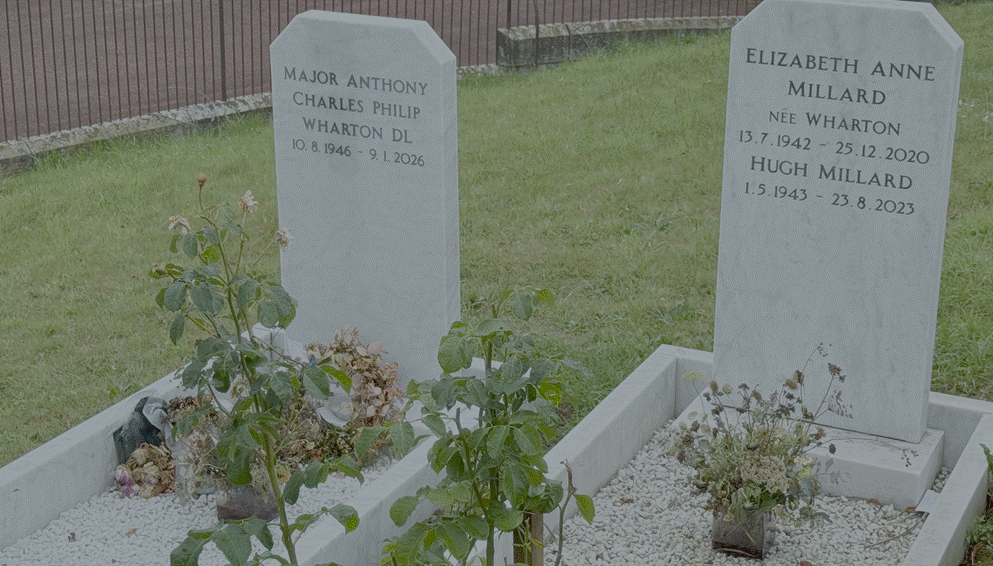
Bibliography
The Brus Family
in England and Scotland 1100-1295, Ruth M Blakely The
Boydell Press, Woodbridge, 2005.
Robert the Bruce,
the Champion of a Nation, Stephen Spinks, 2024.
Biographical
Notes on the Yorkshire Tenants named in Domesday Book, Yorkshire
Archaeological Journal, Volume 4, 1876, page
406.
Skelton and its
history, Tom
Curnow c.1983.
The History of
Cleveland,
John Graves, 1808.
Heraldic
Monuments in Gilling West Parish Church, North Yorkshire, Kenneth
Laybourne privately published, Pickering, 1992.
History of
Cleveland,
John Walker Ord 1846.
The Alum Farm, Robert Bell,
Turton Horne & Son, Whitby, 1938.
Skelton-in-Cleveland in History.