Hartlepool
Historical and geographical information
|
Return to the Home Page of the Farndale Family
Website |
The story of one family’s journey through two
thousand years of British History |
The 83 family lines into which the family is divided.
Meet the whole family and how the wider family is related |
Members of the historical family ordered by date of
birth |
Links to other pages with historical research and
related material |
The story of the Bakers of Highfields, the Chapmans,
and other related families |

Dates are in red.
Hyperlinks to
other pages are in dark
blue.
Headlines are in brown.
References and
citations are in turquoise.
Context and local
history are in purple.
This webpage is
divided into the following sections:
·
The Farndales of Hartlepool
·
Hartlepool
·
Hartlepool Timeline
·
Bibliography
The Farndales of Hartlepool
The Hartlepool 1 Line was a
substantial family, the descendants of Robert G Farndale (1833-1900)(FAR00326) who
became a master book maker and show maker of Hartlepool. His descendants
included Henry Farndale (1869-1952)(FAR00495), acting
Sergeant in Royal Filed Artillery WW1 and Robert Farndale (1877-1936)(FAR00552), hotel
manager in Hartlepool.
Other Farndales associated
with Hartlepool were: George Farndale (1820-1891(FAR00271), tile
maker, ironstone worker and bricklayer; John H Farndale (FAR00302) miner of
West Hartlepool for was killed aged 37 by a fall of iron stone at the Poston
Mines, Ormsby, Middlesborough;
Ethel Farndale (FAR00590); Mary
Hannah Farndale (FAR00596);
Richard George Farndale (FAR00755)
who lived in Stockton, Hartlepool and then Bradford who worked in the merchant
navy and later ran a pub; Wilfred Farndale (FAR00766).
Hartlepool
Hartlepool is
a town in the North East of England governed as part of
the Borough of Hartlepool, a unitary authority in
the ceremonial county of County Durham. Hartlepool is 12 km
north of Middlesbrough and 27 km south of Sunderland.
Hartlepool also forms part of the Tees Valley sub-region. The borough
council also controls outlying villages such as Seaton Carew, Greatham, Hart Village, Dalton
Piercy and Elwick.
Hartlepool Timeline
Seventh
century
Hartlepool was
founded in the 7th century, around the monastery of Hartlepool Abbey. The
early history of Hartlepool is confined to the brief notices of the monastery
of Heruteu, which occur in Bede's
life of St. Hilda. “Heiu, the first
female who took the veil in Northumberland, founded the monastery of Heruteu, and soon after, retiring to Kaelcacaester,
was succeeded by Hilda, as Abbess of Heruteu.”
The Victoria County History – Durham, A History of
the County of Durham: Volume 3 Parishes: Hartlepool, 1928: The
founder of Hartlepool was Hieu, a religious woman, who, under the direction of
St. Aidan, established a monastery for men and women on the promontory about
640.
Ninth
century
The Danes
destroyed the monastery in the 9th century but the village of Hartlepool
continued through the centuries.
1153
By 1153
Hartlepool was a small busy sea port.
The village grew
in the Middle Ages and its harbour served as the official port of
the County Palatine of Durham. The church of St Hilda was built in the
late twelfth century.
1184
The people of
Hartlepool obtained from their Lord, Adam de Brus II a Charter granting them
the same privileges or customs as the burgesses of Newcastle upon Tyne.
1201
King John gave Hartlepool
its first charter.
Franciscan friars
came to Hartlepool in the thirteenth century.
1315
Walls were built
around Hartlepool in the early fourteenth century, but the town was attacked by
Scottish invaders before they were completed in 1315 and the town was sacked.
1569
During the Rising
of the North, the rebels entered Hartlepool but fled when a royal army
approached.
1644
In January 1644 a
parliamentarian army occupied Hartlepool during the Civil War.
1823
By the early
nineteenth century, Hartlepool was still a small town of around 900 people,
with a declining port. In 1823 the council and Board of Trade decided
that the town needed new industry, so the decision was made to propose a new
railway to make Hartlepool a coal port, shipping out minerals from the
Durham coalfield.
But the plan was
faced by local competition from new docks. The Marquis of
Londonderry had approved the creation of the new Seaham Harbour. To
the south the Clarence Railway connected Stockton-on-Tees and Billingham to
a new port at Port Clarence (opened 1833). Further south again, in
1831 the Stockton and Darlington Railway had extended into the new
port of Middlesbrough.
The Durham, History and Antiquities, The History and
Antiquities of the County Palatine of Durham: Volume 3, Stockton and Darlington
Wards Hartlepool, 1823: The Peninsula of Hartlepool forms one of the
most striking features of the Eastern coast, connected with the main shore only
by a narrow neck on the North, the land stretches to the South and South-west,
assuming at high water the shape of a crescent, and forming within its curve a
natural harbour, secure from the Eastern winds, which prevail with violence
during a great portion of the year, and throw a heavy sea on the coast,
increased by the strong current which sets into the Tees' mouth. The old
decaying Borough of Hartlepool, now reduced to little more than a fishing town
and place of summer resort, occupies the South-western portion of the
peninsula, flanking its ruined haven. The cliffs of this semi-isle towards the
main sea are bold and abrupt, and at some distance the whole appears like a
rocky headland, crowned with a shattered diadem of mouldering towers, the wreck
of its ancient strength.
1831
Isambard Kingdom
Brunel visited the town in December 1831, and wrote: "A curiously
isolated old fishing town – a remarkably fine race of men. Went to the top of
the church tower for a view." In 1831 the population of Hartlepool was
still only 1,300.
1832
Like all
nineteenth century towns, Hartlepool was dirty and unsanitary. As a result,
Hartlepool suffered outbreaks of cholera in the nineteenth century. An outbreak
of cholera in Hartlepool in 1832 killed 57 people. The second outbreak in 1849
killed 161 people.
1833
The council
agreed the formation of the Hartlepool Dock and Railway Company (“HD&RCo”) to extend the existing port by
developing new docks, and link to both local collieries and the developing
railway network in the south. In 1833, it was agreed that Christopher
Tennant of Yarm establish the HD&RCo,
having previously opened the Clarence Railway (“CR”). Tennant's plan was
that the HD&RCo would fund the creation of a new
railway, the Stockton and Hartlepool Railway, which would take over the
loss-making CR and extended it north to the new dock, thereby linking to the
Durham coalfield.
The first bank in
Hartlepool opened in 1833.
1835
A railway link
from the north was established from the South Durham coal fields, together
with a new port. The new docks opened in 1835.
1836
From 1836 there
was a gas supply for gaslight.
1838
The area became
heavily industrialised with an ironworks (established 1838)
and shipyards in the docks (established in the 1870s).
1839
After Tennant
died, in 1839, the running of the HD&RCo was
taken over by Stockton-on-Tees solicitor, Ralph Ward Jackson. Jackson
became frustrated at the planning restrictions placed on the old Hartlepool
dock and surrounding area for access, so bought land which was mainly sand
dunes to the south-west, and established West Hartlepool. Because Jackson
was so successful at shipping coal from West Hartlepool through his West
Hartlepool Dock and Railway Company and, as technology developed, ships
grew in size and scale, the new town would eventually dwarf the old town.
The railway and
the docks made it possible to export coal from the Durham coalfield through
Hartlepool. As a result, Hartlepool boomed.
1841
Hartlepool had a
population of 5,236.
1847
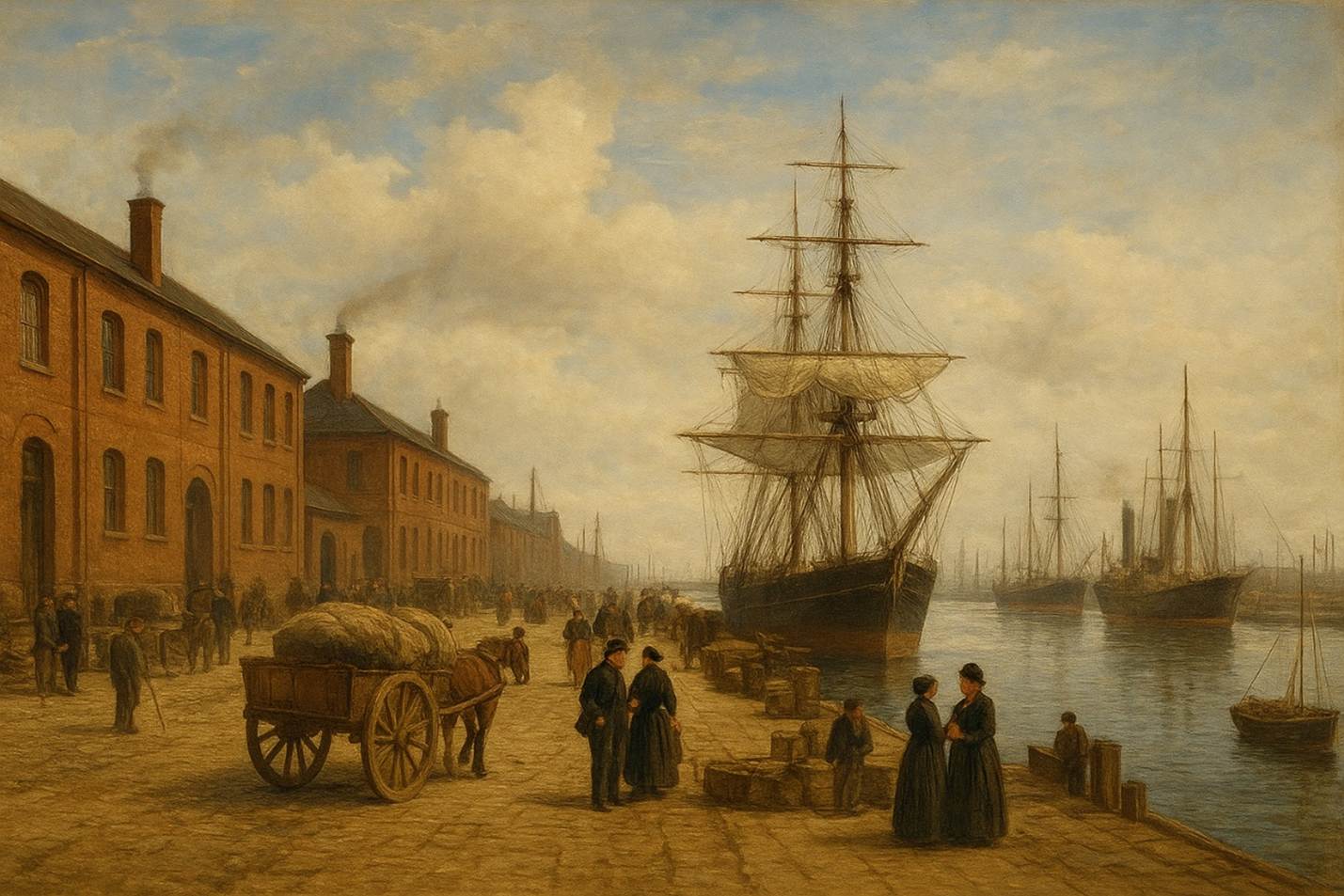
Further expansion
led to the new town of West Hartlepool. West Hartlepool began when the
owners of the railway and the owners of the docks fell out. The owners of the
railway decided to build their own docks South West of the town, The 8 acres
West Hartlepool Harbour and Dock opened on 1 June 1847. Almost immediately a
new town sprang up nearby. It was known as West Hartlepool.
1849
After 1849
Hartlepool had a piped water supply.
1851
Hartlepool’s
population had reached 9,227.
1852
On 1 June 1852
the 14 acres Jackson Dock opened on the same day that a railway opened
connecting West Hartlepool to Leeds, Manchester and Liverpool. This
allowed the shipping of coal and wool products eastwards, and the shipping of
fresh fish and raw fleeces westwards, enabling another growth spurt in the
town.
1854
Christ Church
near the railway station was built in 1854.
1856
The Swainson Dock
was opened on 3 June 1856, named after Ward Jackson's father-in-law.
1865
St Hilda’s
hospital opened in 1865.
1878
In 1878 the
William Gray & Co shipyard in West Hartlepool achieved the distinction of
launching the largest tonnage of any shipyard in the world, a feat to be
repeated on a number of occasions.
1881
By 1881, old
Hartlepool's population had grown from 993 to 12,361, but West Hartlepool had a
population of 28,000.
Ward Jackson
helped to plan the layout of West Hartlepool and was responsible for the first
public buildings. He was also involved in the education and the welfare of the
inhabitants. In the end, he was a victim of his own ambition to promote the
town: accusations of shady financial dealings, and years of legal battles, left
him in near-poverty. He spent the last few years of his life in London, far
away from the town he had created.
1891
In 1891 the two
towns had a combined population of 64,000. By 1900 the two Hartlepools
were, together, one of the three busiest ports in England.
1914
By 1913, no fewer
than 43 ship-owning companies were located in the town, with responsibility for
236 ships. This made it a key target for Germany in the First World War.
One of the first German offensives against Britain was the Raid on Scarborough,
Hartlepool and Whitby on the morning of 16 December 1914, when units
of the Imperial German Navy bombarded Hartlepool, West
Hartlepool, Whitby and Scarborough. Hartlepool was hit with a total of 1150
shells, killing 117 people.
Two coastal
defence batteries at Hartlepool returned fire, launching 143 shells, and
damaging three German
ships: SMS Seydlitz, SMS Moltke and SMS Blücher.
The Hartlepool engagement lasted roughly 50 minutes, and the coastal artillery
defence was supported by the Royal Navy in the form of four destroyers, two
light cruisers and a submarine, none of which had any significant impact on the
German attackers.
Private
Theophilus Jones of the 18th Battalion Durham Light Infantry, who fell as
a result of this bombardment, is sometimes described as the first military
casualty on British soil by enemy fire. This event (the death of the first
soldiers on British soil) is commemorated by the 1921 Redheugh
Gardens War Memorial together with a plaque unveiled on the same day
(seven years and one day after the East Coast Raid) at the spot on the Headland
(the memorial by Philip Bennison illustrates four soldiers on one of
four cartouches and the plaque, donated by a member of the public,
refers to the 'first soldier' but gives no name). A living history group, the
Hartlepool Military Heritage Memorial Society, portray men of that unit for
educational and memorial purposes.
It is now
considered as one of the first attacks by a foreign country on British soil
since 1066.
1928
The Victoria County History – Durham, A History of the County
of Durham: Volume 3 Parishes: Hartlepool, 1928: Hartlepool stands
upon a rocky peninsula on the coast of Durham. The peninsula forms the east
side of a large but shallow bay, the Slake, which extends inland in a
north-westerly direction. A neck of land only 500 yards across at its narrowest
point, formed of blown sand, connects with the shore the headland of magnesian
limestone on which the town is built. It has often been asserted that Hartlepool
was once a tidal island, but there is no proof of this. The east and south
coasts of the peninsula are defended by cliffs between 30 ft. and 40 ft. high,
and by rocks which extend out to sea for a considerable distance, but the
harbour has a sandy shore, and from the earliest times must have been a refuge
for ships, although its depth at high water, before the 19th century, was not
more than 8 ft. or 10 ft. There was also a smaller but deeper natural bay, the
inner harbour, formed by a promontory jutting out westwards from the end of the
peninsula. The outer harbour, on the south of the promontory, was formed in the
15th century by means of a pier.
Bibliography
A brief history of
Hartlepool.