Old Saltburn
Saltburn-by-the-Sea
A Guide to its History including its associations with the
Farndale family
|
Return to the Home Page of the Farndale Family
Website |
The story of one family’s journey through two
thousand years of British History |
The 83 family lines into which the family is divided.
Meet the whole family and how the wider family is related |
Members of the historical family ordered by date of
birth |
Links to other pages with historical research and
related material |
The story of the Bakers of Highfields, the Chapmans,
and other related families |
And now I mount above the sands,
And in amazement see
The mighty works now carried on
At Saltburn by the Sea.
I gazed delighted on the scene
And found it soon moved me,
To write a book, a little book
On Saltburn by the Sea.
John
Farndale, 'A Guide to Saltburn by the Sea' 1862
Introduction
Dates are in red.
Hyperlinks to
other pages are in dark
blue.
Headlines of the
history of Saltburn are in brown.
References and
citations are in turquoise.
Contextual
history is in purple.
This webpage about
Brotton has the following section headings:
· The Farndales of
Saltburn
· Old Saltburn
· Saltburn by the Sea
· Timeline of Saltburn
· Buildings of
Saltburn
· People of Saltburn
· John Farndale’s
Guide to Saltburn by the Sea
· Bibliography
The Farndales of Saltburn
by the Sea
William Farndale
(FAR00243),
Agricultural labourer in Brotton and a cartman of Saltburn.
George Farndale (FAR00540)
Grace Farndale (FAR00566)
John Farndale,
son of John and Grace Farndale, baptised Brotton 24 Mar 1749/50 (FAR00167) wrote a
booklet ‘A Guide to Saltburn By The Sea’.
Old Saltburn
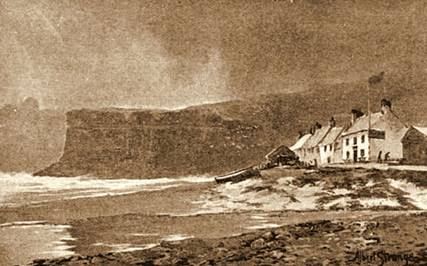
Old Saltburn is
the original settlement, located in the Saltburn Gill. Old Saltburn around
Cat Nab, was an eighteenth century fishing village. It became a centre for
smugglers. In 1856, there was a hamlet around the Ship Inn, comprising a row of
houses where farmers and fishermen lived. The authors Laurence Sterne and John
Hall Stevenson raced chariots on the sands at Saltburn, but otherwise it was
but a small fishing hamlet.
Old Saltburn was the centre of a smuggling trade in the late
eighteen century. The houses were closely packed and contraband was passed
between houses and there were secret rooms to evade the Excise men. Everyone
seemed to be involved, from locals, to farmers and landowners. Like Robin Hood, the general view was that smugglers were
harmless local folk, avoiding paying unfair tax. Old Saltburn was a small
fishing hamlet which was remote and close to hidden beaches hidden by high
cliffs, where smuggled goods could be landed.
Smuggling itself was an accepted way of life for English coastal
villages in the late 18th and early 19th Century and it was an activity
performed by all sorts of people across the social scale from farmhands to
clergymen to local gentry. Entire villages would turn out to help hide the
contraband goods before the arrival of the preventive officers. Folklore and
local legend depicts the smugglers as harmless men, who were merely trying to
avoid paying an unlawful tax
The late eighteenth century was a time of expensive wars against
America and France and heavy and unpopular taxes were imposed on imported goods
such as gin, tea, brandy and textiles to raise funds.
Tales of how the local community out-witted the customs officers
soon became part of local folklore. One tale has an old woman hiding a keg of
spirits underneath her skirts whilst customs officers performed a spot raid of
her house. Another tale tells of a mother who found herself victim of a
surprise search wrapping a jar of spirit in her baby's clothes, and walking
past the guards with it cradled in her arms.
Saltburn's most famous smuggler was John Andrew (AND00001). Born in Scotland, John Andrew moved to Saltburn and became landlord of the
village's Ship Inn in 1780. Andrew's Scottish family were wealthy and well
connected and in Saltburn he was a respected member of the community. He
entered into a partnership with a local brewer and co-ordinated the area's
smuggling trade from the Ship Inn and the White House. His grand daughter christened him 'King of the Smugglers'
and he came close to being arrested on a number of occasions. He managed to
combine being one of the areas most prolific
criminals with a position in the branch of the local militia which was occasionally
called upon to help the customs officers in their pursuit of the smugglers.
Legend has it that John Andrews had a secret cellar underneath one of his
stables where he deliberately kept a vicious mare who could be counted upon to
kick and bite any strangers.
Battles between the customs men and the
smugglers were frequent, fierce and violent and severe injuries were often
sustained during these altercations. Legend and folklore portray the smugglers
as lovable rogues. In reality these were violent men prepared to assault the
excise men.
A book about John Andrew called 'Watch
the Wall my Darling' has been written by Richard Swale.
When the Napoleonic Wars came to an end, the Saltburn smugglers
came under increasing pressure from customs officers. Forced to unload his
latest cargo further a field, John Andrews found
himself at Blackhall, north of Hartlepool, when he was discovered by customs
officers. Legend has it that he galloped across the Tees, whose level was
apparently very low, to Coatham.
He then asked the Coatham coastguard for the time in order to give him an
alibi. The judge at his trial reasoned that he could not have travelled across
the River Tees in the time that had elapsed, and so could not have been at
Blackhall.
In Saltburn, Andrews was a respected member of the community. In
1817 he was elected Master of the newly formed Cleveland Hounds,
demonstrating his high standing in the area. Andrews also managed to combine
being one of the area’s most prolific criminals with a prominent position in
the Corps of Cleveland Pioneer Industry. Ironically, this branch of the local
militia was occasionally called in to assist preventive officers in their
battle against smugglers! After several near misses, Andrew was finally arrested
in Hornsea in 1827 and jailed for two years in York Castle. He died in 1835 at
the age of seventy four.
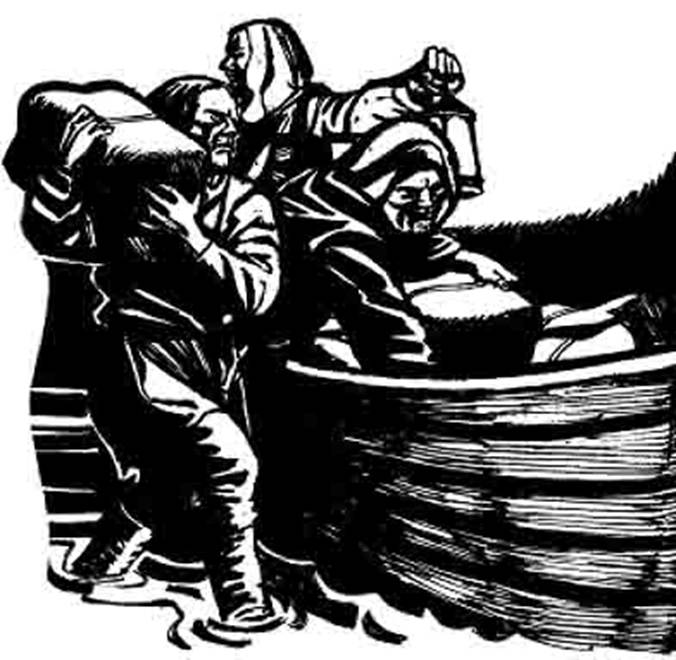
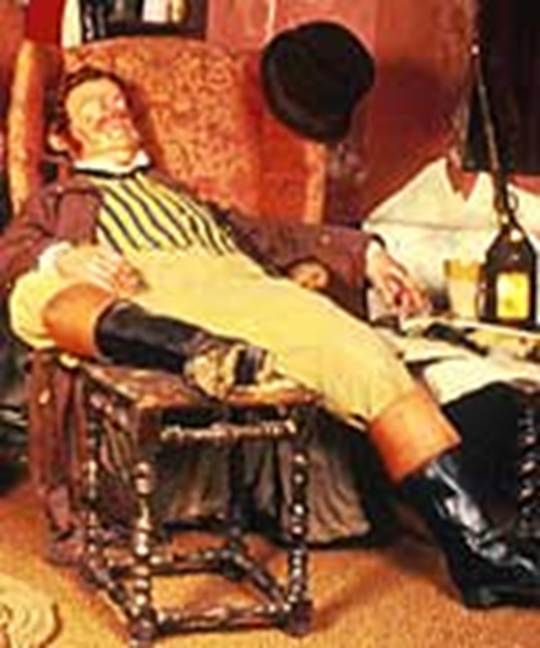
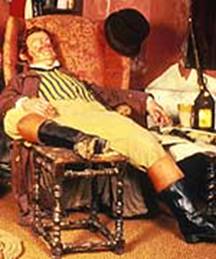
The smugglers of Saltburn John Andrews
relaxing in his chair.
" If you wake at midnight, and hear a horse's feet,
Don't go drawing back the blind, or looking in the street, Them that ask no
questions isn't told a lie. Watch the wall my darling while the Gentlemen go
by. Five-and-twenty ponies, Trotting through the dark - Brandy for the
Parson, 'Baccy for the Clerk; Laces for a lady; letters for a spy, And
watch the wall, my darling, while the Gentlemen go by! Running round the wood
lump if you chance to find Little barrels, roped and tarred, all full of
brandy-wine, Don't you shout to come and look, nor use 'em
for your play. Put the brish wood back again - and
they'll be gone next day ! If you see the stable-door setting open wide; If you
see a tired horse lying down inside; If your mother mends a coat cut about and
tore; If the lining's wet and warm - don't you ask no more ! If you meet
King George's men, dressed in blue and red, You be careful what you say, and
mindful what is said. If they call you " pretty maid," and chuck
you 'neath the chin, Don't you tell where no one is, nor yet where no one's
been ! Knocks and footsteps round the house - whistles after dark - You've
no call for running out till the house-dogs bark. Trusty's here, and Pincher's
here, and see how dumb they lie They don't fret to follow when the Gentlemen go
by ! 'If You do as you've been told, 'likely there's a chance, You'll be
give a dainty doll, all the way from France, With a cap of Valenciennes,
and a velvet hood - A present from the Gentlemen, along 'o being good ! Five
and twenty ponies, Trotting through the dark - Brandy for the Parson, 'Baccy
for the Clerk. Them that asks no questions isn't told a lie - Watch the wall my
darling while the Gentlemen go by !" (The Smuggler’s Song, Rudyard Kipling, 1906)
In 1856, the
hamlet consisted of the Ship Inn and a row of houses, occupied by farmers and
fishermen. In the mid-18th century, authors Laurence
Sterne and John Hall-Stevenson enjoyed racing chariots on the
sands at Saltburn.
Saltburn by the Sea
The development
of Middlesbrough and Saltburn was driven by the discovery of iron stone in
the Cleveland Hills and the building of two
railways to transport the minerals.
The Pease
family of Darlington had developed Middlesbrough as an industrial centre.
In 1858, while walking along the coast path towards Old Saltburn to
visit his brother Joseph in Marske, Henry Pease saw a prophetic
vision of a town arising on the cliff and the quiet, unfrequented and sheltered
glen turned into a lovely garden. The Pease family owned Middlesbrough Estate
and had control of the Stockton & Darlington Railway. The family agreed to
develop Henry's vision by forming the Saltburn Improvement Company (the “SIC”).
After discovery
of iron stone, the Stockton & Darlington Railway and the West
Hartlepool Harbour and Railway Company had developed routes into East
Cleveland. In 1861, the Stockton and Darlington Railway reached Saltburn
as an extension of the Middlesbrough to Redcar Railway of 1846. It was
planned to continue the line
to Brotton, Skinningrove and Loftus but the West
Hartlepool Harbour & Railway Company had already developed tracks in the
area, so there was little point.
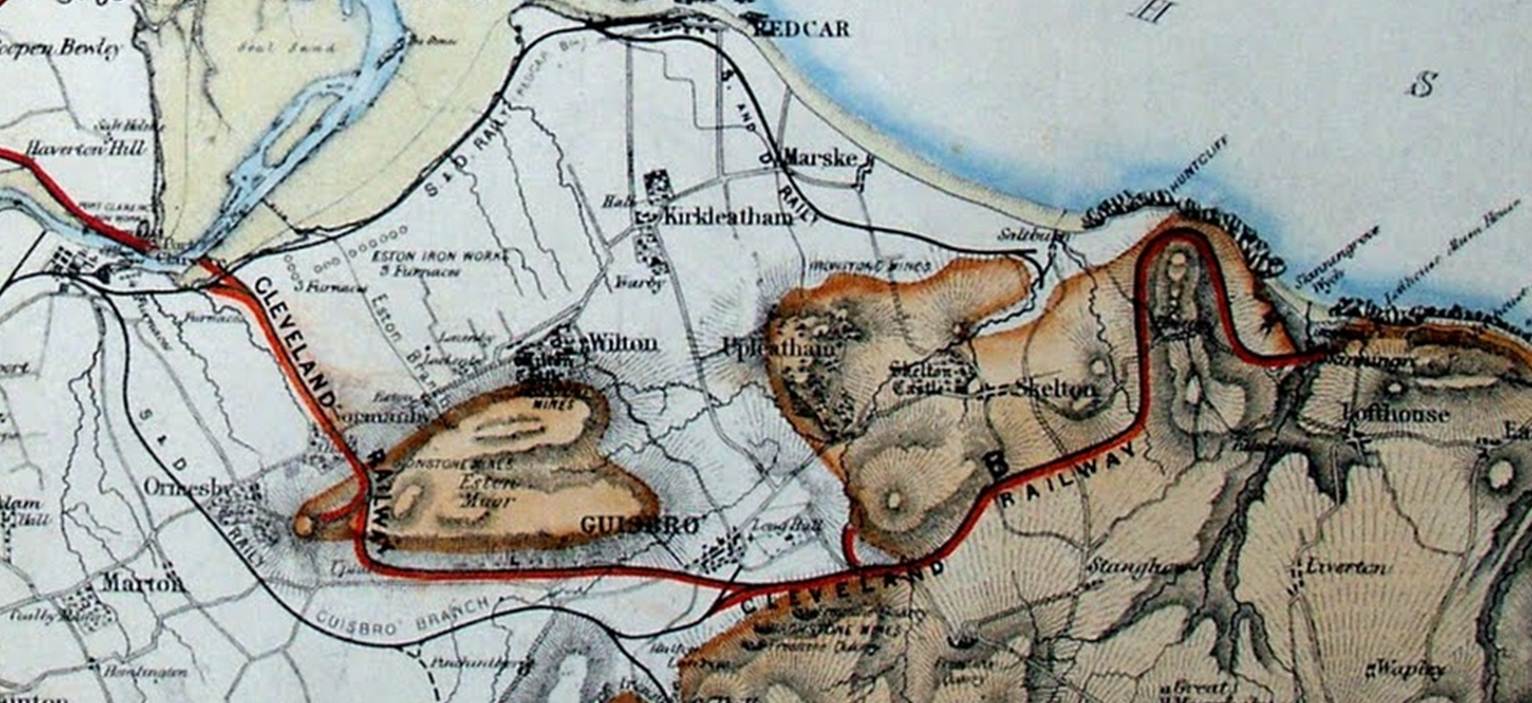
Cleveland
Railways in 1863
Land was
purchased from the Earl of Zetland, and the company commissioned a
surveyor George Dickinson to lay out what became an interpretation of
a gridiron street layout. The railway which ran through the
site. With as many houses as possible having sea views, the layout was
added to by the “Jewel streets” along the seafront—Coral, Garnet, Ruby,
Emerald, Pearl, Diamond and Amber Streets, said to be a legacy of Henry's
vision.
After securing
the best positions for development by the SIC, money was raised for
construction by selling plots to private developers and investors. Most
buildings are constructed using 'Pease' brick, transported from Darlington by
the Stockton & Darlington Railway, with the name Pease set into
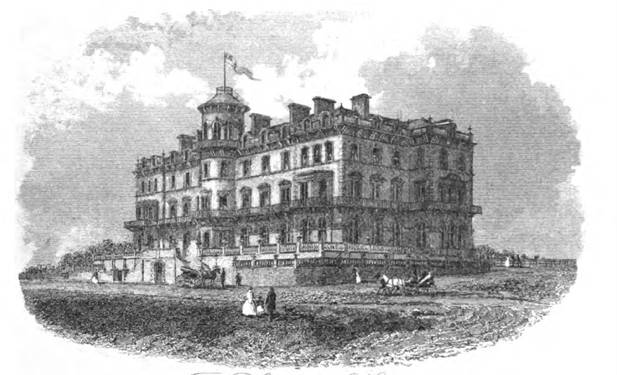
the brick. The jewel in Henry Pease's crown is said to have been
The Zetland Hotel with a private platform, one of the world's
earliest railway hotels.
The SIC
stipulated on the land in the deed of covenant, that any trees planted
along Britannia Terrace (now Marine Parade) were not to exceed 1' 6"
above the footpath to preserve sea views for Britannia Terrace residents
and visitors.
By 1923, the
parish of Marske included Saltburn, and comprised an area of about 4,272 acres,
of which 429 acres were foreshore, and of the remainder more than a third was
arable land, more than half pasture and 25 acres of woods. Mining was being
undertaken in the south of the parish, and the working of the iron-stone had
brought a largely increased population since 1851
From the top of
the high cliffs an inclined tramway constructed in 1884 led to the sands close
to the pier towards the north-east of the town.
'The Pleasure
Grounds' extended along the west of the 'Glen,' a bridge over which connected
the modern town with the hamlet of Old Saltburn.
Further to the
west near Rifts Wood the railway from Whitby crossed the same ravine by a lofty
bridge, and and curves round the west of the town to
Saltburn terminus. South-west of the station in Upleatham Street was Emmanuel
Church, opened in 1869. At the south end of the road was the school.
The Primitive
Methodists and the Wesleyans both had chapels here in 1872, and the
Congregationalists built one in 1889, when both the Society of Friends and the
Plymouth Brethren had meeting-rooms.
The convalescent
home, completed in 1872, was situated on the extreme west, not far from the
sea.
The brine and
swimming baths close to the station were opened in 1890–1, and in 1900 the town
laid out a cemetery of 2 acres
(Victoria County History – Yorkshire, A History of the
County of York North Riding: Volume 2 Parishes: Marske, 1923).
In 1864, John
Farndale wrote:
The other day as I rambled in this enchanted district, viewing the
lovely scenery, embracing both sea, land, woodland, pleasure grounds and the
beautiful sport on which the new town stands, I was moved to sing –
“And now I mount above the sands,
And in amazement see
The mighty works that’s carried on
At Saltburn by the Sea.”
Timeline of Saltburn’s
History
Late Saxon period
The village of
Marske, its church and 10½ carucates of land, according to Simeon of Durham,
were given to the church of Durham by Copsi Earl of
Northumberland. If, however, Durham ever actually had these possessions, they
were lost to that church before 1086 (Victoria County History – Yorkshire, A History of the
County of York North Riding: Volume 2 Parishes: Marske, 1923).
The earliest
evidence of Anglo-Saxons in this area is the cemetery found at Hob Hill. It is
one of the most northerly of Anglo-Saxon burial sites in England and contained
mixed inhumations and cremations. Lecture at
Saltburn 13th March 1911 by the Rev G J Lane, F.G.S. to the Cleveland
Naturalists Field Club: The most interesting part of Mr Lane’s
lecture was his account of the Anglo Saxon Cemetery discovered at Hob
Hill. Anglo-Saxon settlements in the
District were still traceable in the names of Brotton, Skelton, Kilton,
Upleatham etc and he thought that the cemetery at Hob Hill had been a district
cemetery, for the remains of over 100 burial urns had been discovered. These
urns were found in long parallel rows about 2 feet below the surface and were
invariably broken and in which the ashes of the dead had been placed after
cremation. Hundreds of jet, amber and glass beads had been found, as well as
human teeth, a fine iron Saxon axe, knives, parts of spears and several fibulae
or bronze brooches. One of the latter was the square-headed variety and had
been pronounced by the British Museum authorities to be one of the finest that
had been found in Britain. At present these interesting antiquities may be seen
in the reading room of the New Marske Institute.
1066
The persons
recorded in Domesday Book as owning land in Marske were Earl Hugh, who held 2
carucates in the soke of his 'manor' of Loftus, William de Percy, who had 8
carucates before held by Norman, and the Count of Mortain, who had 10
carucates, the soke of which pertained to Brotton (Victoria
County History – Yorkshire, A History of the County of York North Riding:
Volume 2 Parishes: Marske, 1923).
Thirteenth Century
The hermitage of
Saltburn on the banks of 'Holebec' which Roger de Argentein granted to Whitby Abbey in the early part of the
13th century seems to have been in the modern parish of Saltburn.
1407
Redcar (Redker, thirteenth century.; Readkar,
Rydcare, fifteen century.; Redcarre,
sixteenth century) was called by Graves 'a small dependent manor,' but there is
no reference to it as a manor until 1407, and it is doubtful whether it ever
had a manorial existence separate from that of Marske, with which it has
descended since 1272 (Victoria County History –
Yorkshire, A History of the County of York North Riding: Volume 2 Parishes:
Marske, 1923).
1745
As a result of
the government’s imposition of Customs and Excise duties on drink, tobacco and
a variety of other goods, the smuggling trade grew more and more profitable and
the running of contraband from coastal inlets to local villages continued for
the next 70 years.
1763
A 30 ton sloop
went aground at Saltburn after the crew had gone ashore and left a boy on board
the anchored vessel. It was carrying contraband including over one thousand
gallons of brandy and three hundred gallons of gin. Two men from Skelton, Tommy
Tiplady and Bill Richardson, were to help unload it. The Customs and Excise tax
on a gallon of brandy was over 5 shillings, which was the equivalent of a weeks wages and some thought the high profits to be made
were worth the risk of the heavy penalties if they were caught. Apart from the
tax on wine and spirits, a duty was levied on imported tobacco, tea, coffee,
linen and even some household items.
1780
John Andrew (AND00001) moved to Saltburn and became
landlord of the village's Ship Inn in 1780.
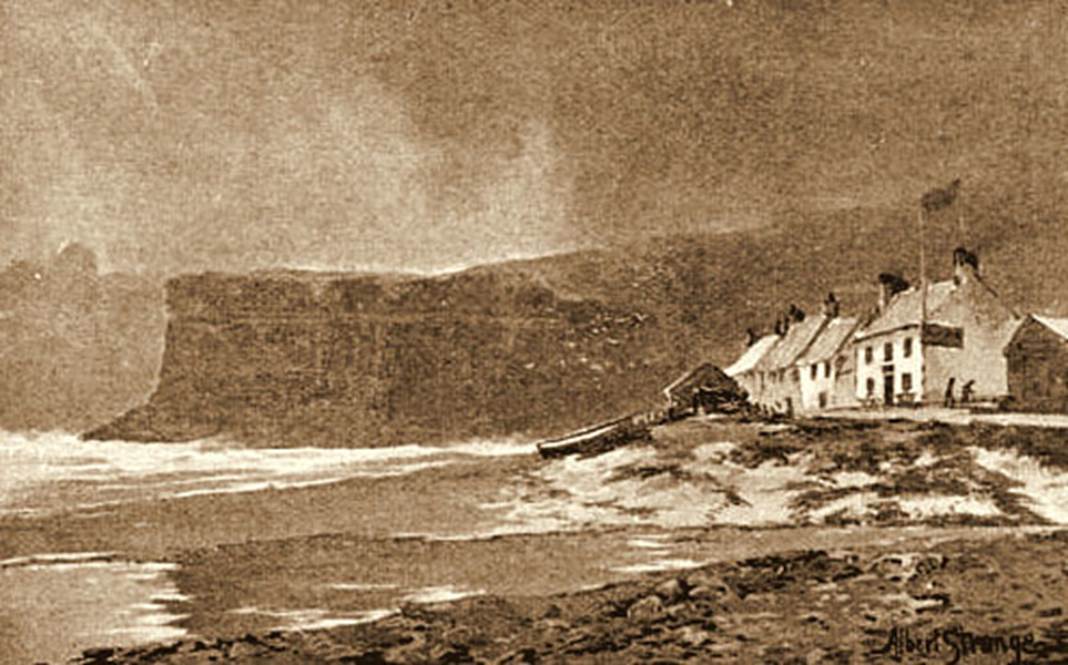
The Ship Inn
1800
John Farndale (FAR00217)
later wrote: Some years ago Old Saltburn imported lime, lime stones, and
coal, and also exported oak timber, prop wood, corf
rods, alum and corn. It had a coal yard and lime
kilns, and there was a large alum house near Cat Neb. My grandfather, who
was a Kiltonian, employed many men at this alum house, and many a merry tale I
have heard him tell of smugglers and their daring adventures and hair breadth
escapes. The lime kilns and coal yard were kept by old Mr William Cooper, whose
sloop, “The Two Brothers”, was continually employed in the coasting trade.
Behind the alum house, Thomas Hutchinson, Esq., late
of Brotton House, made an easy carriage road from Saltburn to that place, which
road will always be a lasting monument to his memory.
In
former days, there were frequently seen lying before Old Saltburn three luggers
at a time, all laden with contraband goods, and the song of the crews used to
be:- “If we should to the Scottish coast hie, We’ll make Captain Ogleby, the
king’s cutter, fly”
The
government, however, being determined to put a stop to this nefarious traffic,
a party of coast guards, with their cullasses,
swords, spy glasses, and dark lanterns, were sent to the Blue House, at Old
Saltburn. This came like a thunderbolt upon the astonished Saltburnians.
They made, however, two more efforts to continue the trade – one proved
successful, the other not.
The
last lugger but one bound to Saltburn was chased by the King’s cutter, and
running aground at Marske, she was taken by the coast guard, and all the crew
were made prisoners, and put into the lock up. While the coast guard were busy
enjoying their prize, all the prisoners escaped except one, who was found in Hazlegrip, and whom the King’s officers sadly cut up. Lord
Dundas, of Marske Hall, threatened to bring them to justice if the man died.
The
last luggar that appeared on the coast was successful
in delivering her cargo. Two of the crew, fierce lion-looking fellows, landed,
and they succeeded in capturing two of the coast guard, whom they marched to
the other wide of Cat Neb, where they stood guard over them till the vessel got
delivered. While these jolly smugglers had the two men in custody, they sent to
the lugger for a keg of real Geneva, and at the point of the sword they
compelled the poor fellows to drink of that which was not the King’s portion.
After releasing their prisoners, and then telling them to go home, the
smugglers returned to their vessel, setting sail, they left the beach with
light hearts and a fair breeze.
Since
the merry days alluded to the glory of Old Saltburn has departed – its
smuggling days have passed away – its gin vaults have disappeared – and the gay
roysterers who were wont to make Cat Neb and the
adjacent rocks resound with laughter, now rest in peace beneath the green
hillocks in the retired grave yards of Brotton and Skelton.
… Of
late years many buildings of Old Saltburn have fallen beneath the ruthless hand
of Time, and all that remain now are two or three humble looking cottages, with
a respectable inn, possessing good accommodation, the fair hostess being a grand daughter of the well known
and worthy huntsman, Mr John Andrews, sen.,, one of
the most ardent admirers of the sports of the field in that fox hunting
locality. In old Mrs Johnson’s days this inn was noted for furnishing visitors
with what were termed “fat rascals” and tea, a delicious kind of cake stuffed
with currants, and which the present obliging hostess, Mrs Temple, who is an
adept ion the culinary art, can make so as to satisfy the most fastidious
palate.
1822
The threat of
Napoleon was receding into history and 7,000 sailors were redeployed as coast
guards to fight the smuggling trade. The coastguards’ cottages, still at that
time considered part of Skelton (Saltburn was just the few buildings around the
Ship Inn) were built to house a section of coastguards.
The wrecking of the Esk. The 350 to
Whitby Waler, the Esk, was returning home after a
whaling expedition north of Shetland, during which four whales had been caught.
In 1816 the same ship had survived being trapped in ice on a voyage to
Greenland. Her Captain Dunbar passed Hartlepool as a gale started to drive her
towards the shore. The morning of 6 September 1826 was marked by strong winds,
mist and crashing surf. The Esk’s sails were soon
shredded and she became grounded at the low water mark off Marske on Sea. The
crew fired guns and burnt a distress light, but at dawn, she went to pieces.
Within seventeen hours she was a total wreck and her riggings, timbers and
cargo came ashore along miles of coastland. Only three members of the twenty
seven strong crew survived. A memorial service was later held at St Mary’s
Church, Whitby and 3,000 folk attended and took a collection for the bereaved
families.
1856
In 1856, there
was a hamlet around the Ship Inn, comprising a row of houses where farmers and
fishermen lived. The authors Laurence Sterne and John Hall Stevenson raced
chariots on the sands at Saltburn, but otherwise it was but a small fishing
hamlet.
1861
The Stockton and
Darlington Railway reached Saltburn as an extension of the Middlesbrough to
Redcar Railway of 1846.
1862
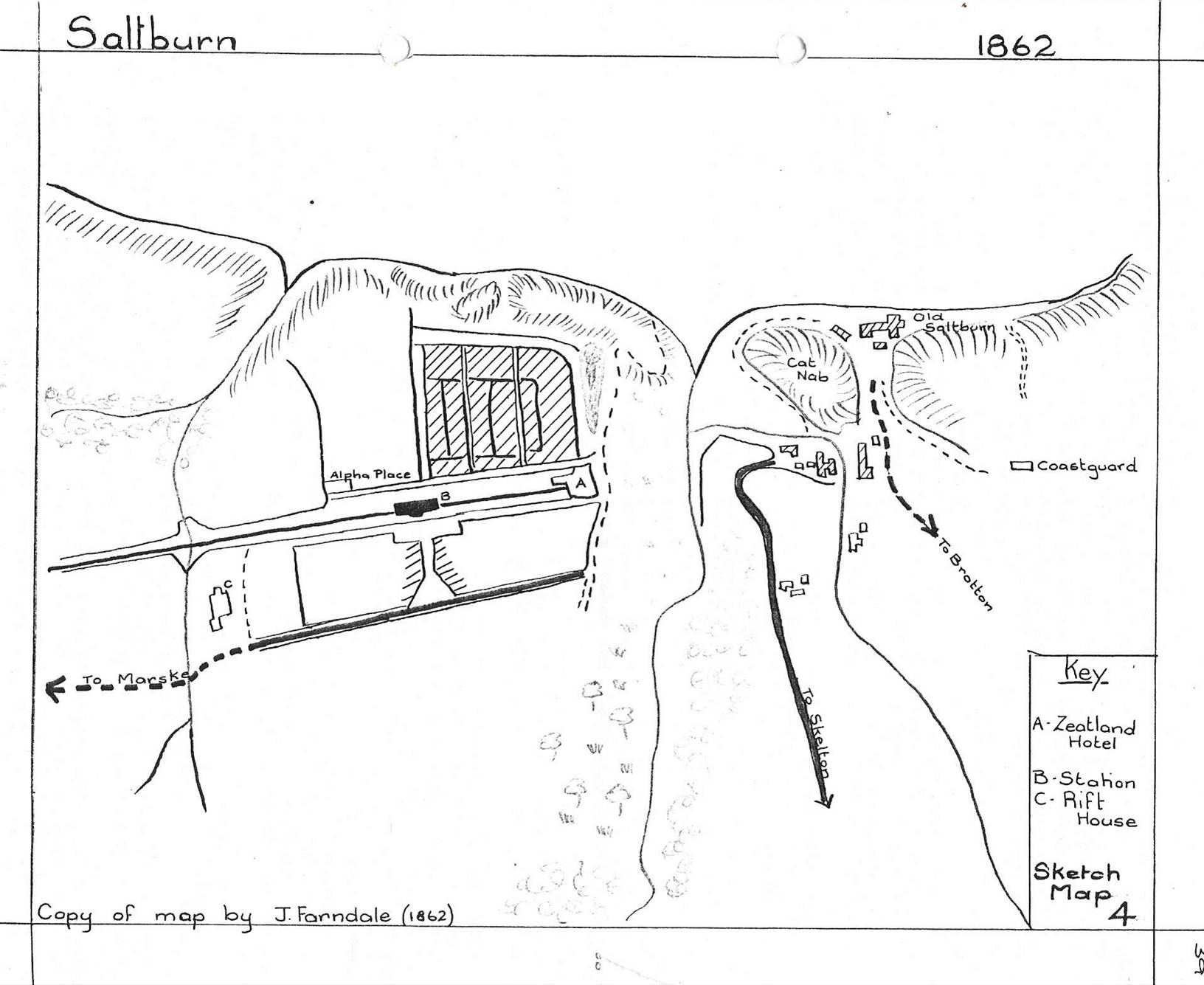
John Farndale’s
1862 map of the plans for the new Saltburn by the Sea, Yorkshire
1863
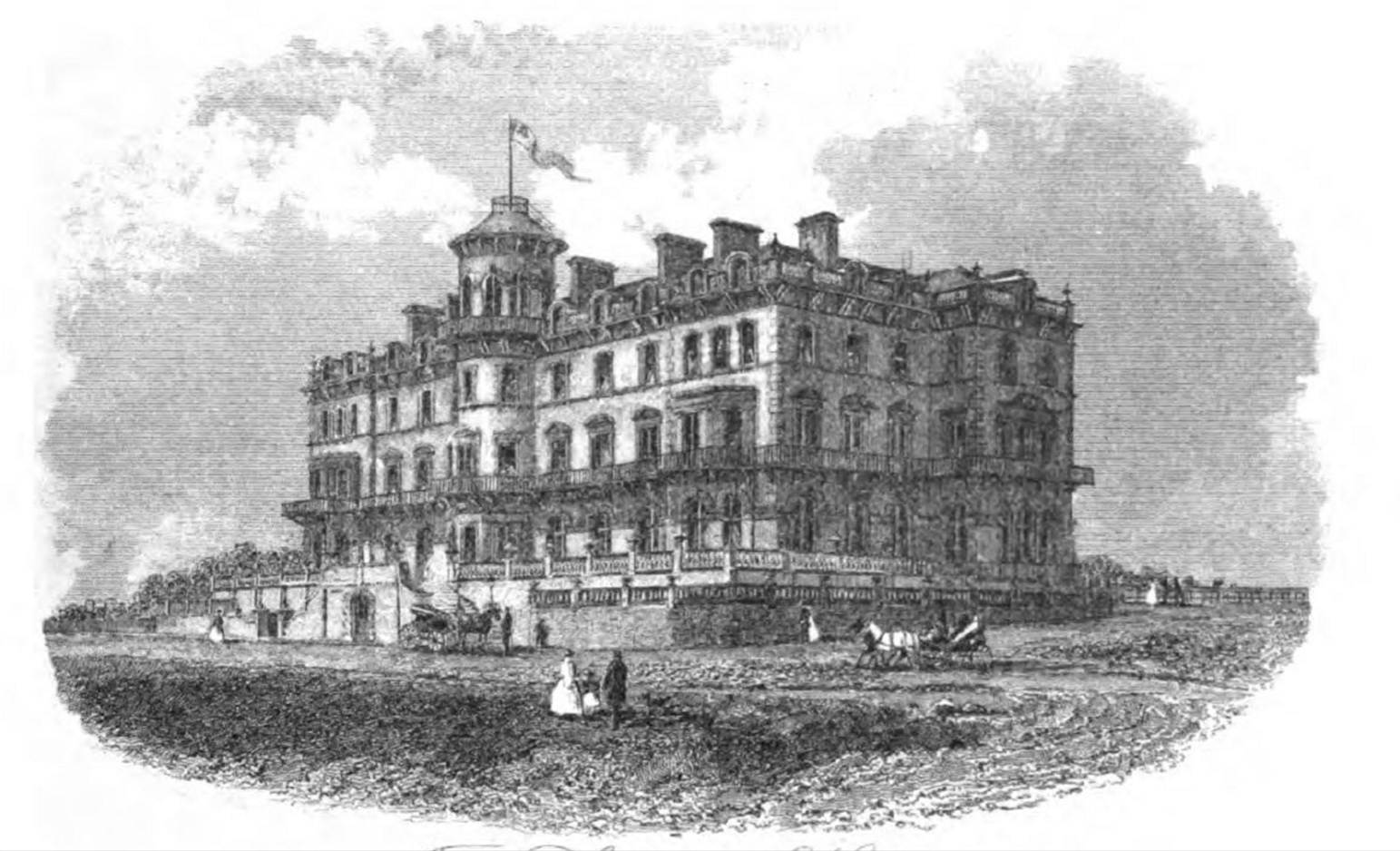
The Zetland Hotel
was designed by William Peachey. On 2 October 1861 the foundations were laid
for the hotel by Lord Zetland. The specification included that white fire
bricks had to be used with Westmorland slate on the roof. A glass canopy from
the station platform to the rear entrance of the hotel had to be constructed to
protect the guests from the elements. The Zetland Hotel was one of the world's
earliest purpose-built railway hotels with its own private platform (the first
was built in Derby). The hotel was opened, again by Lord Zetland on 27 July
1863.
1864
John Farndale
wrote: On the north west is Old Saltburn which was formerly considered the
King of the Smuggling World. Near which is New Saltburn, about to become one
of the most fashionable sea bathing places on the eastern coast, thanks to
the enterprising gentlemen who conduct the railway operations in this
neighbourhood, and who are the public’s benefactors, in a commercial, social
point of view, and are indeed, in every sense of the word, the friends of the
people.
… when the
magnificent position of this place is considered, together with the fact that
it is now in the hands of the enterprising gentlemen who have formed to
Saltburn Improvement Society, and who have both the capital and the energy to
carry out their objects, I can come to no other conclusion, than, as a first
rate sea bathing place, it will soon rise into importance and become a
favourite resort of the public.
At
present the hand of industry is busily engaged at New Saltburn. Hundreds of
labourers of various descriptions, are daily employed erecting buildings,
cutting new walks, forming rural seats and grottos, and carrying out the
plans of the projectors.
The
“Zetland Hotel”, to which I previously alluded, being now completed, stands on a
lofty aclivity, about one hundred yards from the sea shore,
with a broad carriage road in front, and commands on the left a most
magnificent view of the broad ocean, the bold rocky headlands of Huntcliff, Roecliff, and Boulby in front, and on the right the picturesque woodland
scenery in the ravine or dell on whose lofty banks it is situated, and which
extend to the retired village of Skelton, a distance of about two miles. The
northern extremity of these banks is now the property of the Saltburn
Improvement Society, and here a variety of winding walks have already been
formed, where the eye of the visitor may delight to dwell on a wide expanse of
ocean, the boldest coast scenery, the innumerable hills and vales, presenting
altogether a delightful prospect. The walks here are so arranged to lead to an
extensive piece of ground, which the Company have laid out in pleasure gardens;
laid out in a style that tend to enhance the enjoyment of the rambler in this
terrestrial paradise. The noble wood to the south of these gardens is at
present the property of the Earl of Zetland. This wood extends for some miles
along the banks of the vale, and it contains numberless trees, the growth of
centuries. Running through the middle of it is a pleasant walk, which the Earl
of Zetland, with a liberality that does him infinite credit, has granted the
visitors at New Saltburn full permission to enjoy. Newly erected, on the
opposite side, is Bell’s beautiful hall, Rush Pool.
The terminus of the Stockton and Darlington
railway at New Saltburn is at the back of the hotel. Here a splendid
station is erected. It is more than 300 feet in length, with extensive waiting
rooms, and is a most elegant structure. On each side of the railway a number of
streets are projected, with a parade ground, and a spacious terrace, commanding
a fine prospect of the German ocean and the adjacent country. Some of these
streets to the east of the railway are now erected. About thirty houses, three
stories high. Some flagged in front, with spacious shops, having plate glass
windows, have already been built, and others are advancing towards completion,
so that Saltburn by the Sea already begins to assume the appearance of a town.
The houses have an elegant appearance, as they are built of fire bricks from
Pearse’s West, and appear to be quite in keeping with the elegance of the new
Railway Station and the Hotel.
A writer of an article headed “A Day Out”, and
which appeared some time ago in a provincial paper, speaking of Saltburn on the
Sea, says, “Although, at present, it is like Paddy’s fortune, ‘an sure all to
come yet’, nevertheless the site chosen is one of the most beautiful of
Nature’s pictures of marine and inland painting the eye can imagine.”
I think there cannot be a question respecting
the judgement displayed in the selection by the promoters, and as little doubt
of the success of the enterprise, if they only display equal discretion in
embellishing, for unquestionably there stares them in the face this
admonishment – Beware of spoiling nature. They must not attempt to do too much;
nor interfere with Nature’s arrangements, but simply make good her few, her
very few shortcomings. If not, they will surely spoil one of the most lovely
spots on earth for human recreation and health – security. Let the doctors talk
as they may about their tonics and restoratives, there cannot be a doubt that
at this place Nature has thrown her immutable tonic – pure air – broad-cast.
At the foot of the steep aclivity
on which New Saltburn stands, runs a small rivulet, called Skelton Beck,
and two or three hundred yards further to the south east appears Old Saltburn,
described by Mr Ord, in his History of Cleveland, as situated “UPON the sea and
UNDER a mountain,” and certainly a more isolated, strange, and desolate looking
place to build on cannot be conceived; yet, strange to say, Old Saltburn, in
former days, was a thriving fishing and smuggling place. At that time it
exported and imported merchandise of all kinds. It then contained two public
houses, and many a gin shop where a glass of real unadulterated Geneva could be
had for a penny. Here a large and profitable contraband trade was carried on,
the principal articles smuggled being Hollands gin, rum, brandy, silks, tea,
tobacco &c, and most of the business in this line was carried on between
sun set and day break, during which time many a cart load of smuggled goods got
clear off and was soon “over the hills and far away”. Every man in the place
then had a private vault, where his smuggled goods were stowed away, and there
was not then throughout Christendom a happier, a braver, and a merrier set of
fellows than the fishermen and lawless smugglers of Old Saltburn.
1865
The parcel of
land known as Clifton Villas was sold by the SIC in 1865 to William Morley from
London who built the property, 'The Cottage' (now Teddy's Nook) on a site
originally intended for 3 villas.
1872
The Primitive
Methodists and the Wesleyans both had chapels here in 1872.
The convalescent
home, completed in 1872, was situated on the extreme west, not far from the
sea.
1884
From the top of
the high cliffs an inclined tramway constructed in 1884 led to the sands close
to the pier towards the north-east of the town.
'The Pleasure
Grounds' extended along the west of the 'Glen,' a bridge over which connected
the modern town with the hamlet of Old Saltburn.
1889
The
Congregationalists built a chapel in 1889, when both the Society of Friends and
the Plymouth Brethren had meeting-rooms.
1890
The brine and
swimming baths close to the station were opened in 1890–1.
1900
In 1900 the town
laid out a cemetery of 2 acres.
Buildings of Saltburn
Saltburn
Pier. Saltburn's
attractions include a Grade II renovated pier,
the only pleasure pier on the whole of
the Northeast and Yorkshire coast.
The Saltburn
Cliff Lift is
one of the world's oldest water-powered funiculars. After the opening
of Saltburn Pier in 1869, it was concluded that the steep cliff walk
was deterring people from walking from the town to the pier. After the company
was taken over by Middlesbrough Estates in 1883, they discovered that the
wooden Cliff Hoist had a number of rotten supports. The Saltburn
tramway, as it is also known, was developed by Sir Richard
Tangye's company, whose chief engineer was George Croydon Marks. The cliff
tramway opened a year later and provided transport between the pier and the
town. The railway is water-balanced and since 1924 the water pump has been
electrically operated. The first major maintenance was carried out in 1998,
when the main winding wheel was replaced and a new braking system installed.
People of Saltburn
Joseph Pease
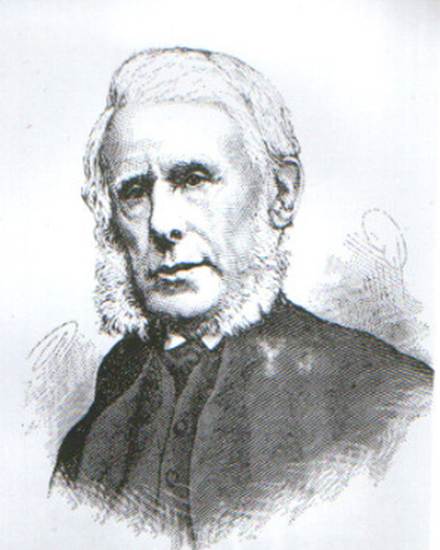
Joseph Pease was a Quaker, born on 22 June 1799 into a wealthy
family. He initially worked in the wool factories at Darlington owned by his
father, Edward Pease who also partnered George Stephenson in his engine factory
at Walker, Newcastle, and was a board member of the Stockton & Darlington
Railway where he became known as the ‘Father of the Railways’.
Joseph became treasurer of the Stockton & Darlington Railway
at the age of 25. With the railway in need of expansion and a more convenient
port necessary to export the harvest of the Durham coalfields, the company
sought a site for a terminus on the lower Tees. Further up, the river was
treacherous and almost unnavigable, only small craft of shallow draught capable
of reaching Stockton and Yarm. The new port was to be called Port Darlington.
In the face of heavy opposition from Stockton and Yarm industrialists, who knew
a new port lower down the river would steal much of their business, it was
Joseph Pease who became prime mover in lobbying parliament to grant the
necessary Act for the Middlesbrough Railway Extension.
With his five sons and his brother Henry, he formed a company
called Pease & Partners. By 1840 when Middlesbrough showed signs of
stagnating, it was clearly in his interest as one of The Owners and as a
director of Pease & Partners to attract alternative industry. The move he
made was to offer Henry Bolckow and John Vaughan land on easy terms and give
them letters of introduction when they started their iron business.
Joseph was elected to Parliament in 1832, representing South
Durham, and became the first Quaker to sit in the Commons. He campaigned
against corruption and slavery while fervently supporting human rights and
religious freedom. He proposed and carried a clause in the Metropolitan Police
Bill prohibiting the common pastimes of bull and bear baiting, and also sat on
many committees dealing with industry. Re-elected in 1835 and 1837 he
eventually resigned from parliament in 1841 because of heavy business commitments.
As the railways pushed east beyond Redcar, Pease & Partners
expanded into ironstone mining. In 1853 they opened the Hutton Lowcross mine
near Guisborough. Soon, they owned Upleatham, Skinningrove and Hob Hill
(Saltburn) mines, between them annually producing almost a million tonnes of
ore. By 1875, eight and a half million tonnes of ironstone, limestone, coal and
coke were being transported, most of which was used in Teesside’s iron
industry.
Joseph Pease was fond of the Cleveland coast. Shortly after
retiring from parliament, in 1844 he bought several fishermen’s cottages on the
seafront at Marske, demolished them then used the site to build Cliff House
where his family spent their summers.
It was from there
one afternoon in 1859 his brother Henry took a stroll over the sandbanks to
discover the old village of Saltburn. Returning breathless, he stated his
intention to build a new town on top of the cliff. With some help from brother
Joseph and the Stockton & Darlington Railway, he succeeded, naming it
Saltburn by the Sea.
Erasmus Darwin IV was the
grandson of the naturalist Charles Darwin. He lived in Albion Terrace (1911 census). He served in the First World
War and was killed in 1915. He is commemorated on the town's war
memorial.
Sir Malcolm
Campbell set
his first speed record (138.08 mph-unofficial) while driving Blue
Bird on Saltburn Sands on 17 June 1922.
David Coverdale, Deep
Purple and Whitesnake lead vocalist, grew up in the Red Lodge on
Marine Parade.
Nicholas
Patrick, later an American astronaut was born in
Saltburn.
John Farndale’s Guide to
Saltburn by the Sea
John Farndale was interested in the idea of
Saltburn by the Sea, as it was being designed and executed by the
Pease family. He started to write his Guidebook, A
Guide to Saltburn by the Sea and the Surrounding District. The work
does describe the evolution of Saltburn by the Sea in some detail, but he was
more interested in the rural landscape inland from Saltburn, and particularly
his beloved Kilton.
The First Edition
was published in 1861, as the railway arrived in the new town. The Second Edition was published in 1863. The Work
must have been popular, because by 1864, it was in its fifth edition, which is
reproduced here.
John
Farndale’s poem, Saltburn by the Sea:
|
When I attained the age of man, I took a trip to see Those fine hard well known golden sands At Saltburn by the Sea |
I passed the place where Esk
was wrecked, A sight most sad to me, When Dunbar and his men lay dead, Near Saltburn by the Sea |
The sea was rough, and mountains high, No storm could greater be, Near all on board that ship were lost At Saltburn by the Sea |
To view the sands then strewed with wreck, Was a sight most sad to see, That noble ship, the Esk, broke up Near Saltburn by the Sea |
So resolute the night before, The Captain said he’d be In Whitby, or far off next day, Not Saltburn by the Sea |
Such sights I wish to see no more, O may they never be; Such loss of life and ship by storm Near Saltburn by the Sea. |
And now I mount above the sands, And in amazement see The mighty works now carried on At Saltburn by the Sea |
I gazed delighted on the scene, And found it soon moved me, To write a book, a little book, On Saltburn by the Sea. |
This little book, this book of mine, I wish you all to see; O mind you have this little book On Saltburn by the Sea. |
This little book, this book of mine, Will tell where you should be, To view the lovely scenes around New Saltburn by the Sea. |
Then when my race on earth is run, O may they gather me, Unto my father’s father’s
tomb, Near Saltburn by the Sea. |
Bibliography
https://www.chrisscottwilson.co.uk/local-history-books/4544927233