Historical
and geographical information
|
Return to the Home
Page of the Farndale Family Website |
The story of one
family’s journey through two thousand years of British History |
The 83 family lines
into which the family is divided. Meet the whole family and how the wider
family is related |
Members of the
historical family ordered by date of birth |
Links to other pages
with historical research and related material |
The story of the
Bakers of Highfields, the Chapmans, and other related families |
Introduction
Dates are in red.
Hyperlinks to other pages are in dark blue.
Headlines are in brown.
References and citations are in turquoise.
Contextual history is in purple.
This webpage about
the York has the
following section headings:
· Farndale family
history and York
·
York, overview
·
Timeline of York history
·
Links, texts and books
The Farndales of York
The York 1 Line were the descendants of
Johannis de Farndale (FAR00030),
a saddler, made Freeman of York in 1363. His son was Johannis de Farendale (FAR0035),
freeman of York. John Fernedill (FAR0048A)
The York Southcliffe Line were
the descendants of Alice Farndale (FAR00058).
Others were
Wylson, wyff of Farndayll (FAR00065);
William Farndale (FAR00220A),
York (Bishop Wilton); Elias Farndale (FAR00224), York
(Bishop Wilton); William Farndale (FAR00281), York
(Bishop Wilton); Joseph Farndale (FAR00285);
Thomas Farndale (FAR00317);
John Farndale (FAR00324),
York (Bishop Wilton); John Farndale (FAR00365); Jane
Ann Farndale (FAR00371);
William Brown Farndale (FAR00384);
Mary Farndale (FAR00393);
Joseph Farndale (FAR00401);
Hannah Farndale (FAR00407);
Jane Farndale (FAR00422);
William Farndale (FAR00425);
William Farndale (FAR00435);
George Farndale (FAR00437);
Henry Farndale (FAR00446);
Mary Farndale (FAR00461);
Joseph Farndale (FAR00463);
Elizabeth Farndale (FAR00470);
Sarah Farndale (FAR00513);
Louisa Farndale (FAR00518);
Mary Emily Farndale (FAR00529);
William Edward Farndale (FAR00576);
Joseph Farndale (FAR00593);
Ellen Farndale (FAR00612);
Lily Farndale (FAR00635);
William Henry Farndale (FAR00655);
John William Farndale (FAR00663);
Florence Farndale (FAR00671);
Arthur Farndale (FAR00694);
Arthur E Farndale (FAR00706);
Ella Farndale (FAR00727);
Lily D Farndale (FAR00768);
John Farndale (FAR00805);
Lorna Farndale (FAR00927);
Denise A Farndale (FAR00949);
Lillian P Farndale (FAR00956);
John Leslie Farndale (FAR00979);
Lydia A Farndale (FAR00991);
John Anthony Farndale (FAR01021).
Joseph Farndale CBE KPM (FAR00463) became
Chief Constable of Margate, York and later of Bradford. He was Chief Constable
of York Police from 1897 to 1900.
York
York is
a city in North Yorkshire, located at the confluence of the
Rivers Ouse and Foss. It is the county town of
the historic county of Yorkshire.
York Timeline
For thousands of
years before the Romans came to the area, prehistoric folk hunted, farmed and
lived in communities. They discovered how to exploit stone, then bronze and
later iron. The first metal objects were made from copper, but by adding tin,
they became much stronger.
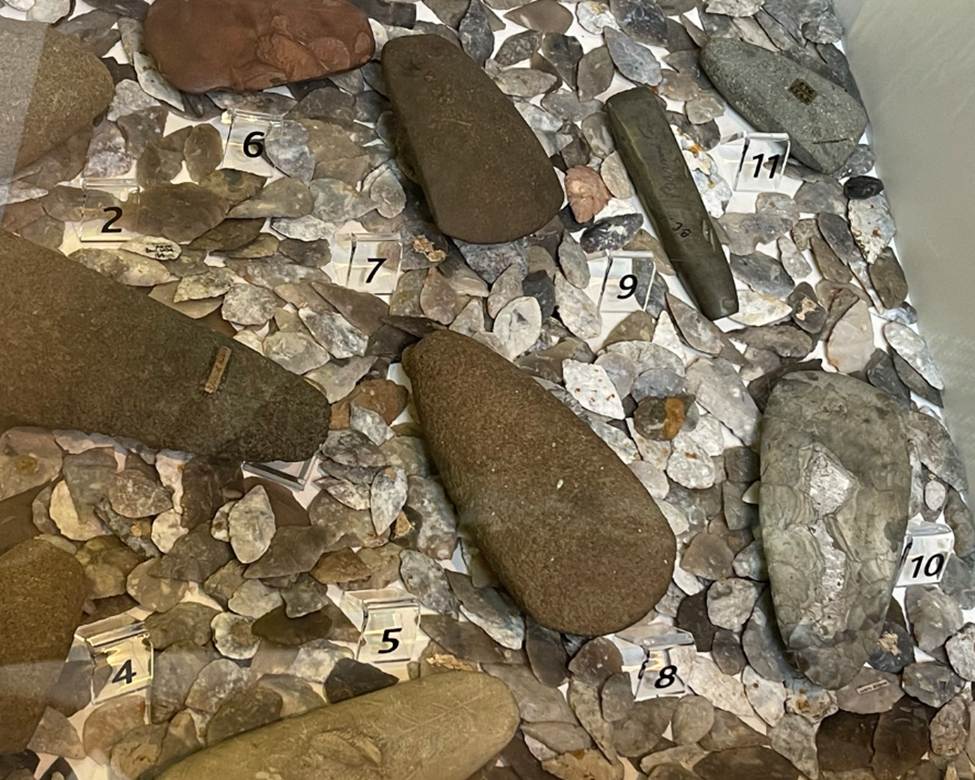
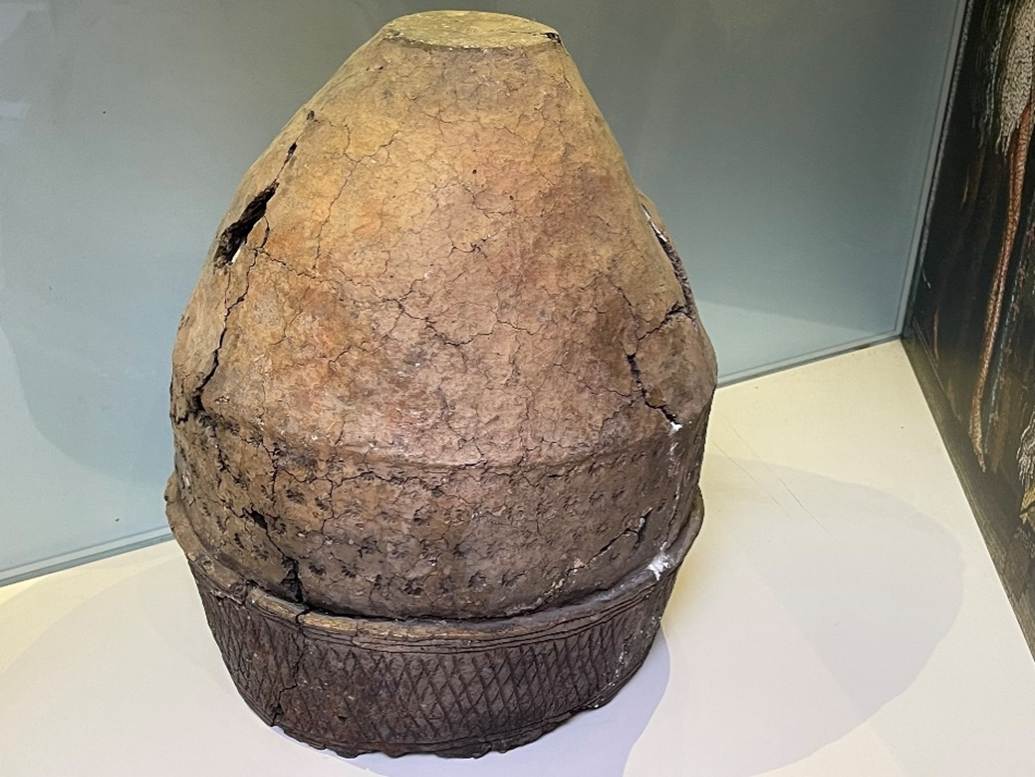
Flint tools, the
Yorkshire Museum
Pottery vessels for cremated remains
The
site of York has been a nodal point of transport and settlement since
prehistoric times, and the factors producing and maintaining this position are
well known. York is at the centre of the largest river valley in Northern
England, at a point where it is 25 miles wide. To the east, the rich Chalk
Wolds supported one of Britain’s most significant prehistoric centres. To the
west, the Vale is separated from the sandstone foothills of the Pennines by the
north-south belt of Magnesian Limestone which has always been a major line of
communication. Northwards, the Vale narrows and passes into the Northallerton
gap, while 40 miles to the south it opens into the Humber estuary and the Vale
of Trent.
The
Neolithic period is represented by axes and concentrations of struck flints.
Within York itself at least 23 axes have been found but those with a detailed
provenance are confined to the south-west side of the Ouse. At least 20 flint
sites, yielding leaf-shaped arrowheads, scrapers, etc. are known in the Vale,
the nearest sites to York being Fulford and Overton.
The
Bronze Age occupation of the Vale is again found on the dry ridges and river
banks. There are several round barrows or burials from the west of York at
Newton Kyme, Clifford, Wetherby and the Little Ribston area, and from the east
of York at Bugthorpe, Skirpenbeck
and Gowthorpe Common, Bishop Wilton.
The
same factors presumably influenced settlement during the Iron Age but there is
extremely little surviving evidence from the York area. Roman York had a Celtic
name Eburacum (‘the place of the yew trees’ or ‘the
field of Eburos’). This certainly implies Celtic
knowledge of the area and if the second meaning is correct Celtic ownership.
Two finds suggest that the site of any Celtic settlement may lie under the
present railway station.
(The Prehistory of the Vale of York, J Radley, Yorkshire Archaeological Journal, Volume 46,
1974, page
10).
Judging
from the earliest historic records, York appears to have been the principal city
of Britain, in proof of which, two ancient manuscripts have been cited ; of
these, one is in the National Library, Paris, the other, formerly in the
Monastery of St. Germain, is now in the Vatican Library, Rome. These each
record a list of the principal cities of Britain, to the number of
thirty-three, with Ebrauc, or Hebrauc,
at the head of the list, thus pointing to the early pre-eminence of the Kingdom
of the Brigantes (Ryedale
and North Yorkshire antiquities, George
Frank, 1888, page 1).
43 CE
The area of York
was inhabited by a Celtic tribal confederation, the Brigantes.
The Romans came
to Britain, to stay, from 43 CE. Initially the Romans didn’t venture north of
the Humber and Don, but traded with the Parisii,
though the Brigantes remained hostile.
Cartimandua was
the Brigantes’ queen. Her position was threatened by an open revolt by her
husband, Venutius. It may have been this revolt that provided a purpose for
Roman intervention.
The University of
Cambridge Roman
York Beneath the Streets Project (“RYBS”) has undertaken a
significant re-evaluation of York’s Roman history led by Professor Martin
Millett based on a fresh review of source material combined with new Ground
Penetrating Radar (“GPR”) Surveys. A summary of the new thinking on
Roman York was given on 5 April 2025 by Professor Millett in the Yorkshire Archaeological and Historical Society
Conference in his presentation Roman York Revisited.
Roman
York - Eboracum
71 CE
In 71 CE the new
Roman Governor, Quintius Petillius Ceralius marched north from Lincoln to
occupy Brigantes and Parisii territory. The Ninth Legion
erected a large camp near where Malton (northeast of York) stands today.
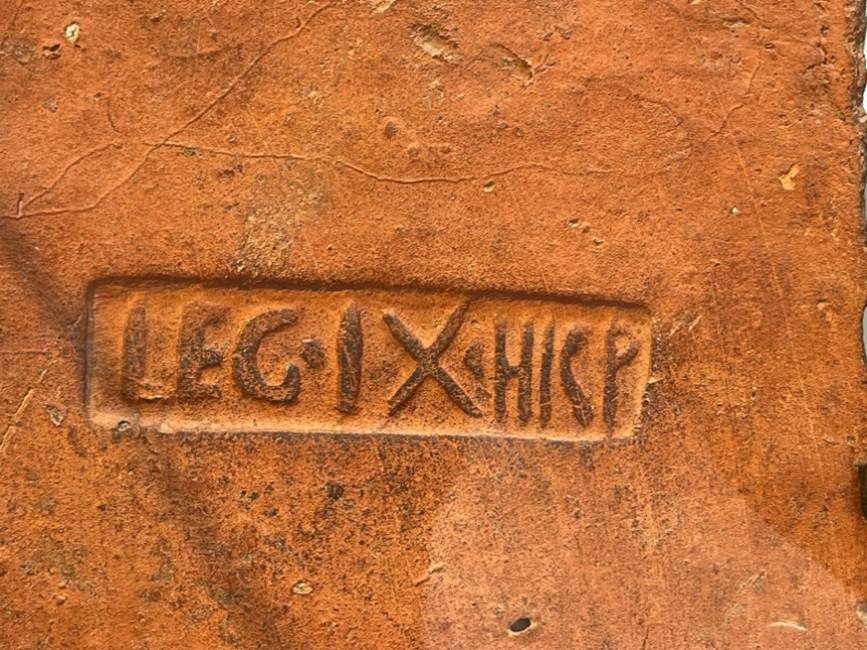
Legionary Tile, 70 to 120 CE (Yorkshire Museum)
They found that
the area of York was an ideal site for a fort in a potentially neutral zone
between the Brigantes and the Parisii.
There is no
significant evidence of an indigenous population in the York area before the
Romans.
A larger military
camp was constructed by the Romans as Eboracum (modern day York) in 71 CE. The
Romans built an earth-and-timber fort on the north-east side of the Ouse, which
formed the basis for York’s city centre today. As this fortress grew in importance,
a civilian settlement developed on the opposite bank of the river.
The RYBS Project suggests that rather than a
massive campaign in 71 CE under Petillius, the Roman occupation was probably
more patchy, and not necessarily wholly focus on the establishment of Eboracum.
The area to the north of York had already been garrisoned prior to the growth
of Eboracum – for instance the Romans were in Carlisle by 72 to 73 CE. The main
evidence of early Roman occupation in York is from coinage and pottery.
There may have been a pre legionary phase with
some Roman occupation in York in the late 60s CE. Activity then picked up in
the early 70s
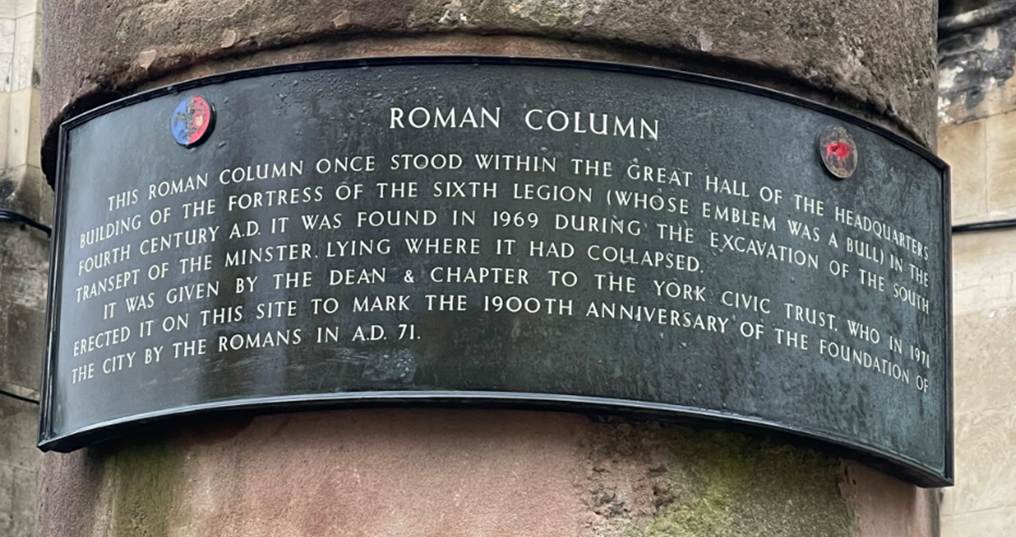
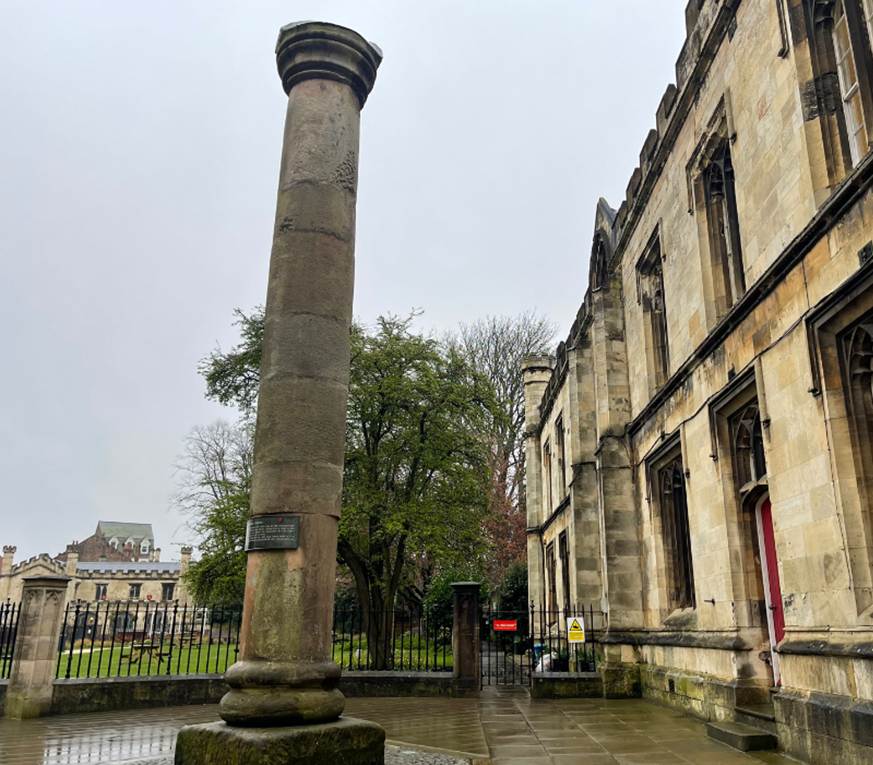
Soldiers
stationed in Eboracum came from across Northern Europe, only a few could have
come from Italy. The Ninth and the later Sixth Legion had been stationed in
Spain, Africa, Germany and Pannonia before they came to Britain.
Urban settlements
grew around the Roman fortifications at Eboracum, Malton and Stamford. Eboracum
became the Roman provincial capital.
The remains of
the Roman Basilica can be seen in the undercroft of
York Minster, and the remains of a bathhouse in the cellar of the Roman Bath
pub.
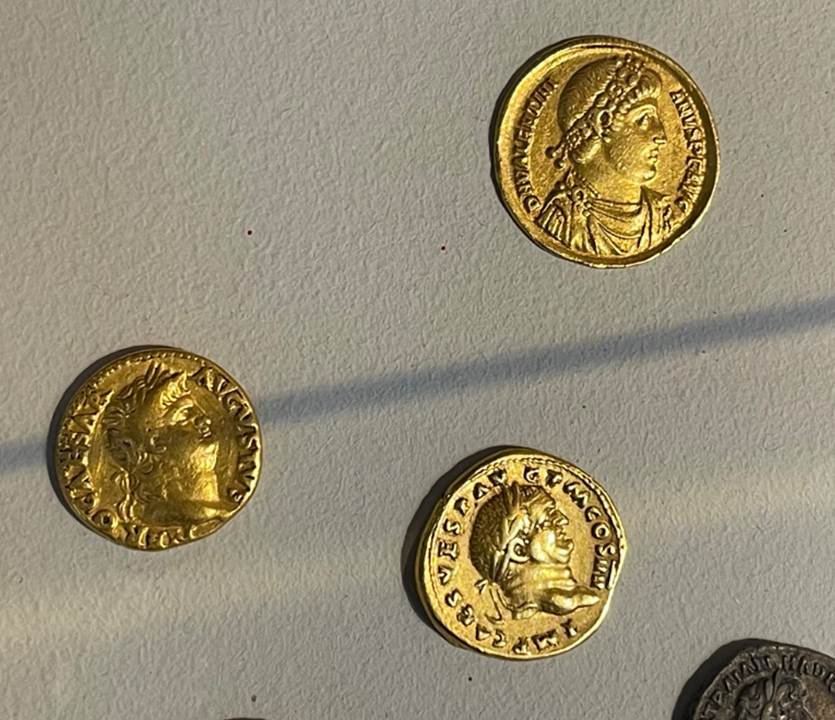
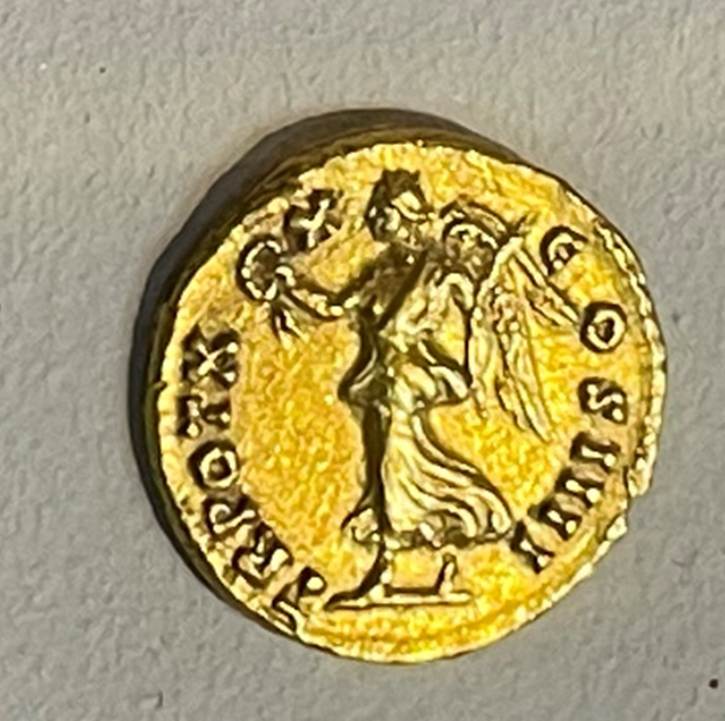
Roman coinage (The
Yorkshire Museum)
The city was
therefore founded by the Romans as Eboracum in about
71 CE. The civilian settlement was just across a bridge, or reached by
ferry. Soldiers from the fortress could relax there and soldiers and officers
sometimes lived in residential properties or large private houses alongside the
civilian population.
The original fort
was monumentalised and rebuilt under Trajan between 107 to 108 CE.
The heart of the
Roman fortress was the principia, the Headquarters.
Roman
troops were garrisoned at York for more than 300 years but little is known of
the history of the city during that period, partly because systematic and
extensive excavation is impossible and partly because the city is so
infrequently mentioned in early writings. Two events, however, were of
sufficient importance in the history of the empire to earn a mention by Roman
writers. Between 208 and 211 the Emperor Severus was at York while he was
conducting campaigns against the Caledonians and in the latter year he died
there. Accounts of his death make some obscure references to York's topography
and mention a temple of Bellona and a domus palatina.
It was from York, moreover, that Severus dated a rescript of 5 May 210 headed Eboraci. Almost a century later, in 305, Constantius
Chlorus died in the city and Constantine was acclaimed there as his successor.
Both Severus and Constantius Chlorus were using York as a base for military
expeditions and it was as the strategic centre of Roman Britain that the fortress
was most important. (A History of the County of York:
the City of York. Originally published by Victoria County History, London, 1961).
Eboracum
itself became one of the biggest military centres in Europe. Its impressive
fort walls stretched along the river Ouse, strengthened with multi-angular
towers, one of which can still be seen. Behind this, where the Minster now
stands, was the pillar-lined main administrative building. (The Little History of Yorkshire,
Ingrid Barton, 2024, page 28).
120 CE
122 CE
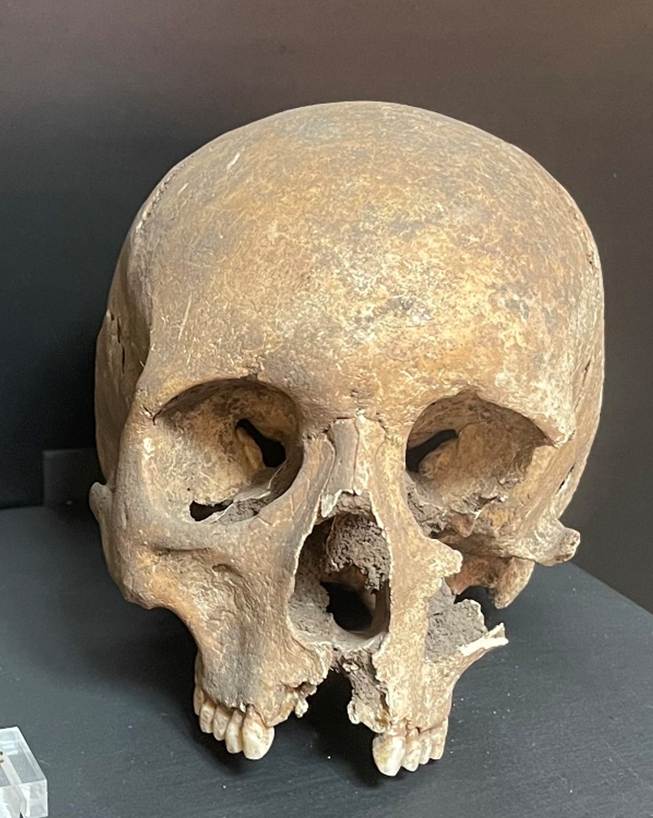
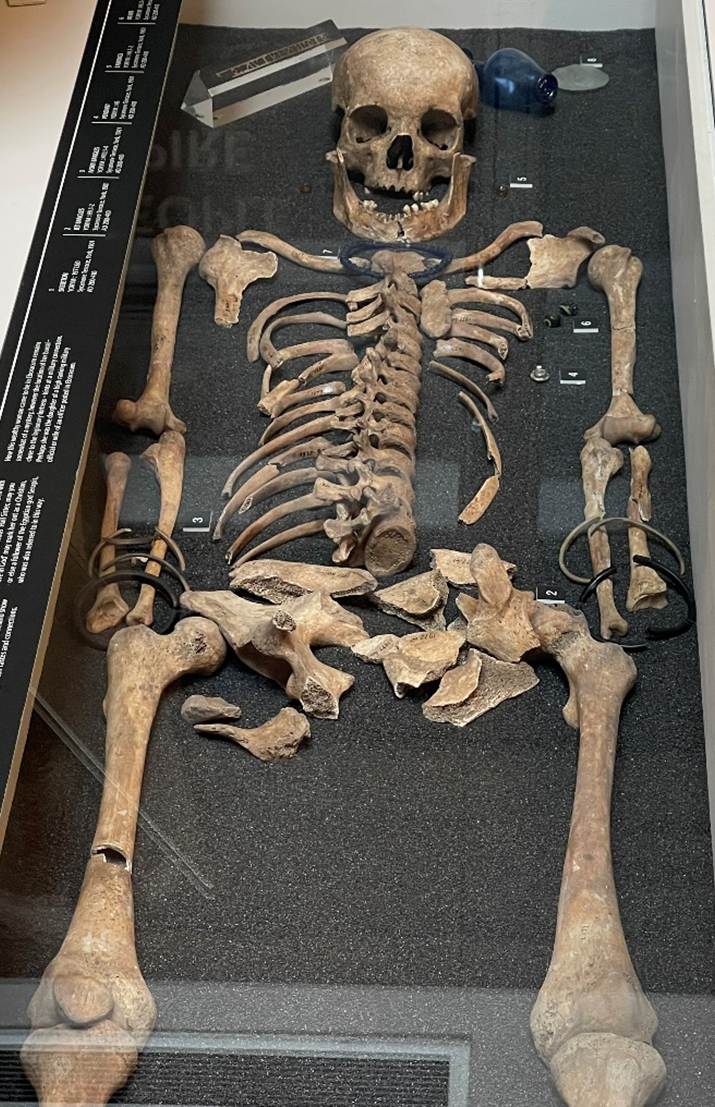
Skull of a man in
his fifties buried between York and Calcaria
(Tadcaster) (Yorkshire Museum).
Skeleton of a wealthy lady found close to the River Ouse, found
accompanied by unusual and expensive objects (Yorkshire Museum).
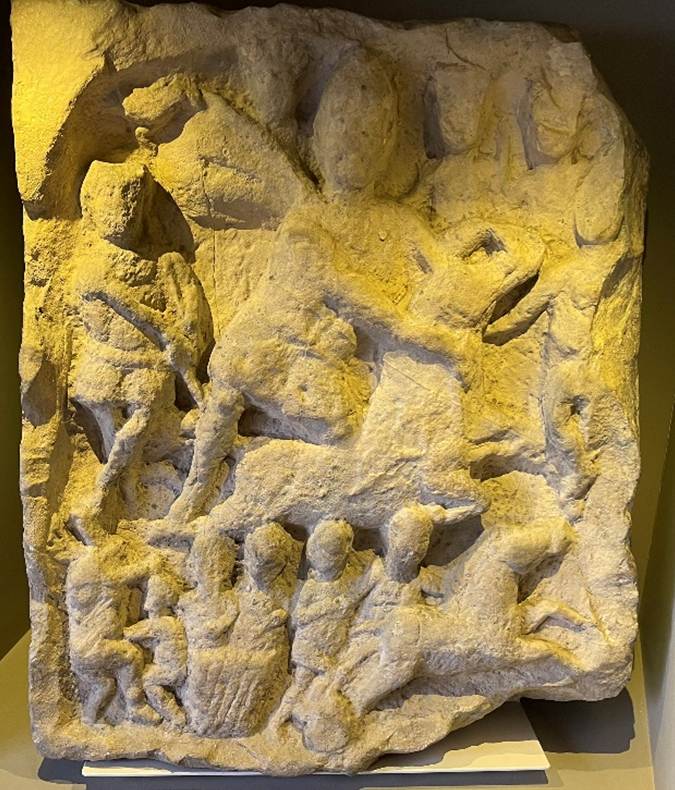
The cult God Mythras
207 CE
Emperor Septimius Severus (of Libyan origin),
who was leading campaigns against the Caledonians to the north, arrived in York
with a very large retinue of civil servants and soldiers, including the
Praetorian Guard. He also brought his wife, Julia Domna, and their sons
Caracalla and Geta. Severus died in York in February AD 211 and, after a bloody
succession squabble in Rome, Caracalla became emperor.
At this time,
Eboracum was designated the capital of Britannia Inferior, the province of
northern Britain, and gained the highest status that a city could have in the
Roman empire, becoming a colonia.
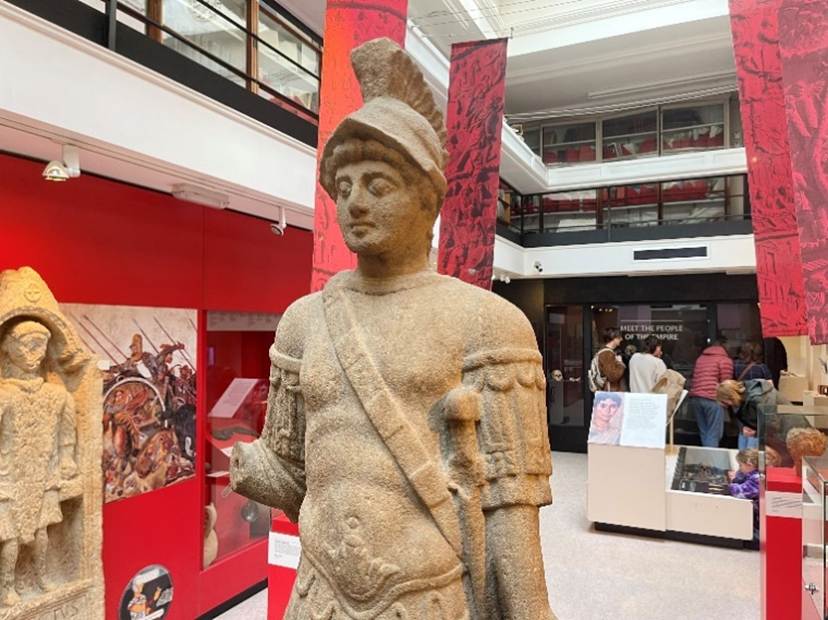
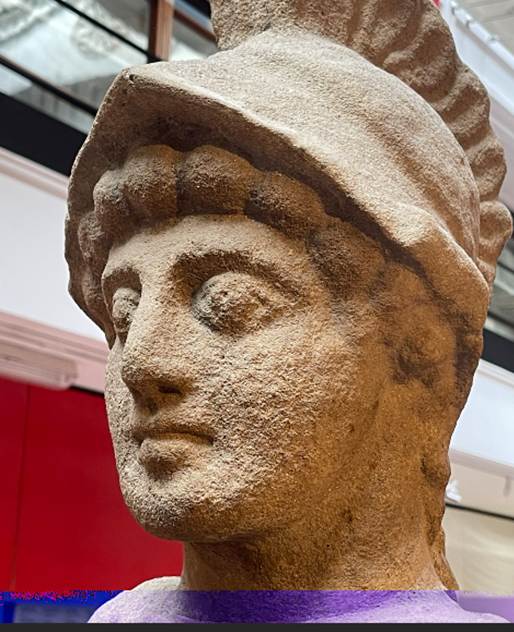
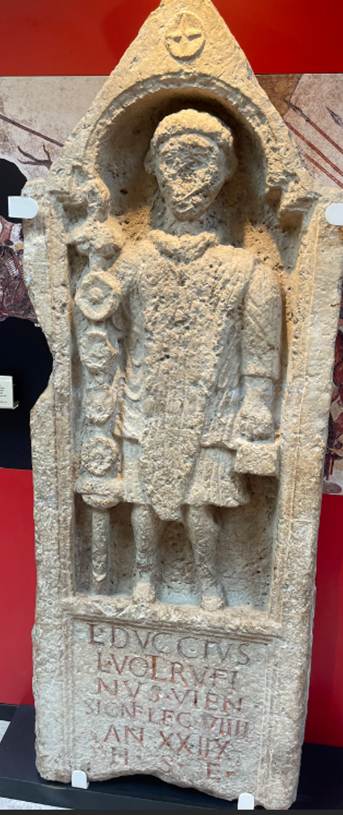
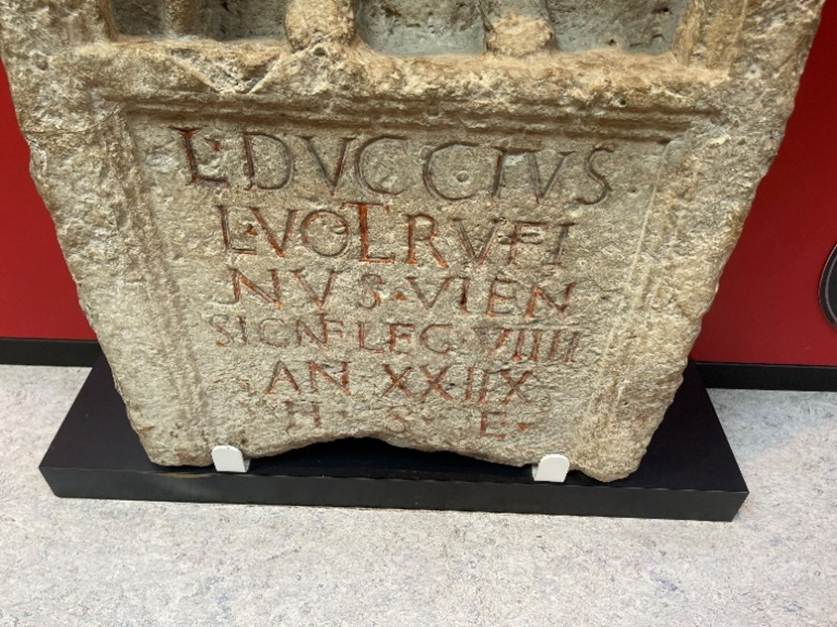
Sandstone statute of Mars 300 to 400 CE
(Nunnery Lane, York, now at The Yorkshire Museum) Lucius Duccius Rufinus, a 28
year old standard bearer from Viennes, France (Mickelgate, York, now the
Yorkshire Museum)
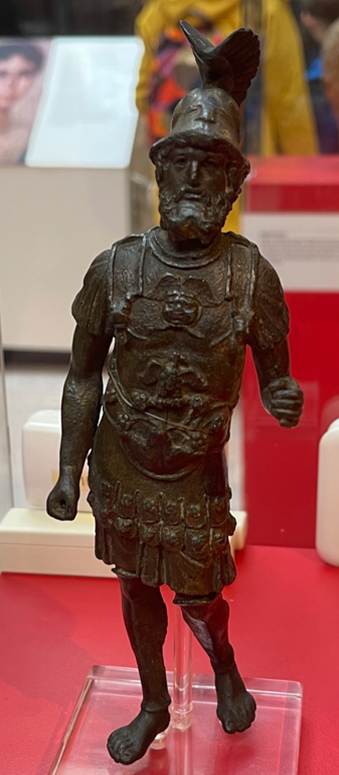
There does seem
to have been a shift of activity from the northeast to the southwest, possibly
due to changes in fluvial activity. However an impression of a lineated
civilian area is probably not right.
Skulls and other
remains from a Roman-era cemetery at Driffield Terrace in York,
discovered in 2004, are believed by many archaeologists to be those of
gladiators, though some suggest they could be soldiers or criminals. The
discovery of a skeleton with lion bite marks on its hips provided the first
physical evidence of gladiator-animal combat in Roman Britain, supporting the
gladiator theory.
306 CE
Constantius Chlorus (of Serbian origin) became
the second emperor to die in York on 25 July 306 CE. He had visited Britain
several times during his lifetime. He was accompanied at the time by his son,
Constantine, who eventually succeeded him. Constantine would have a profound
impact on the city and on global politics.
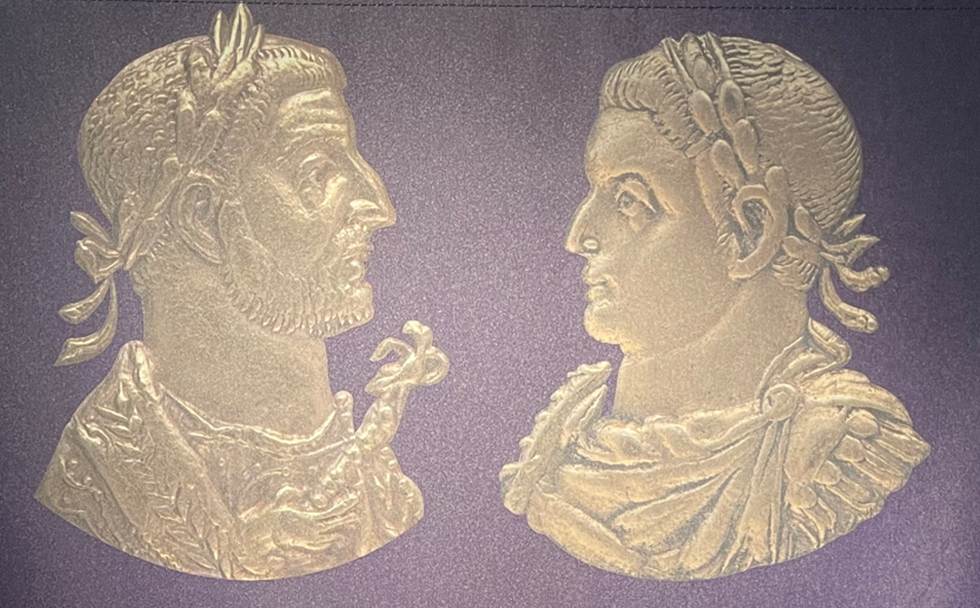
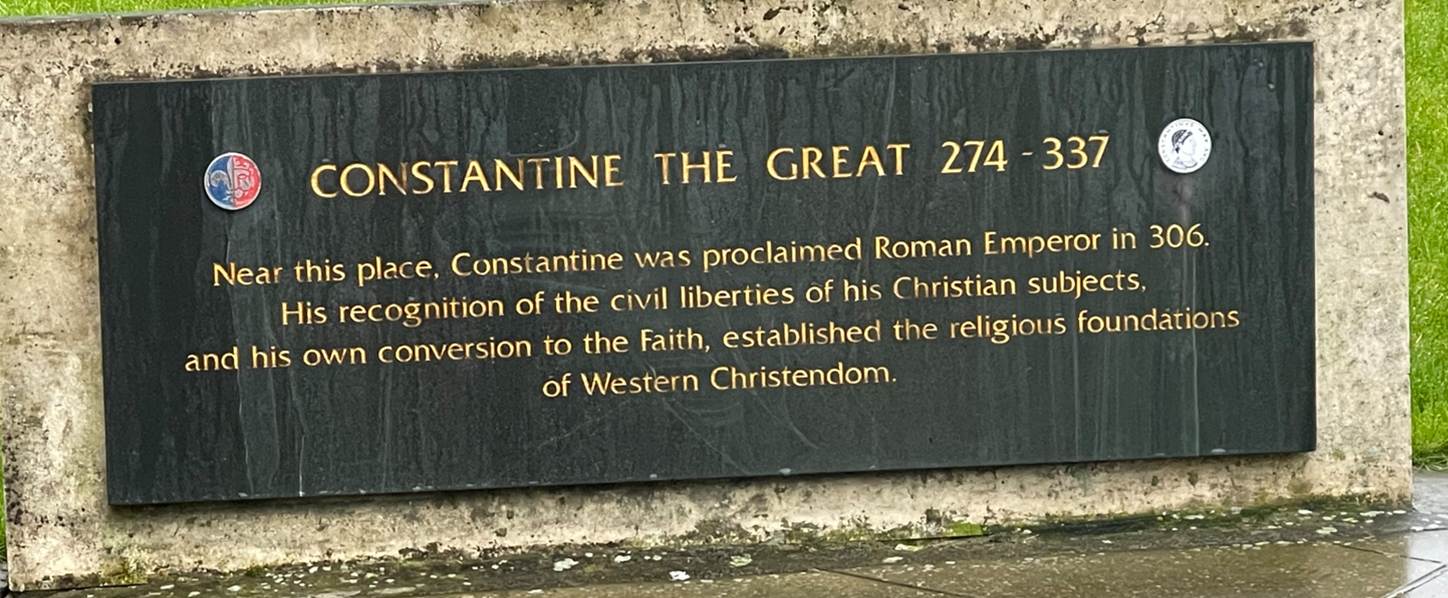
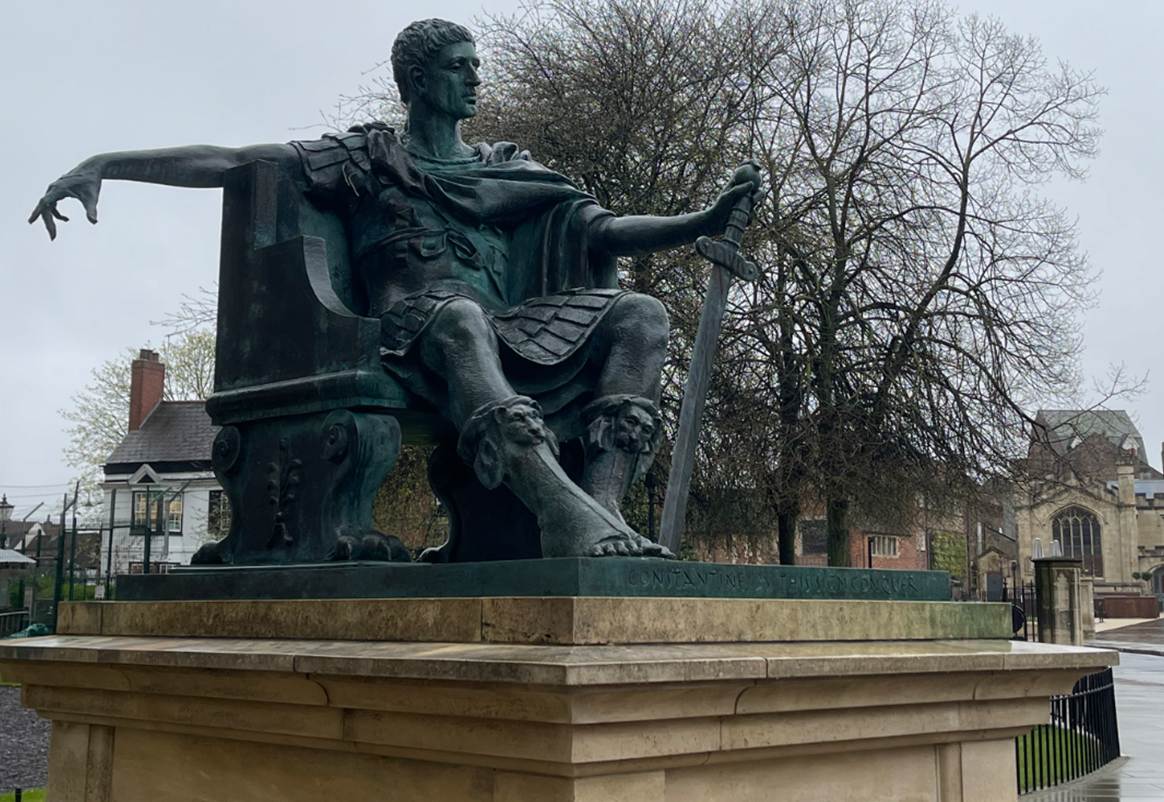
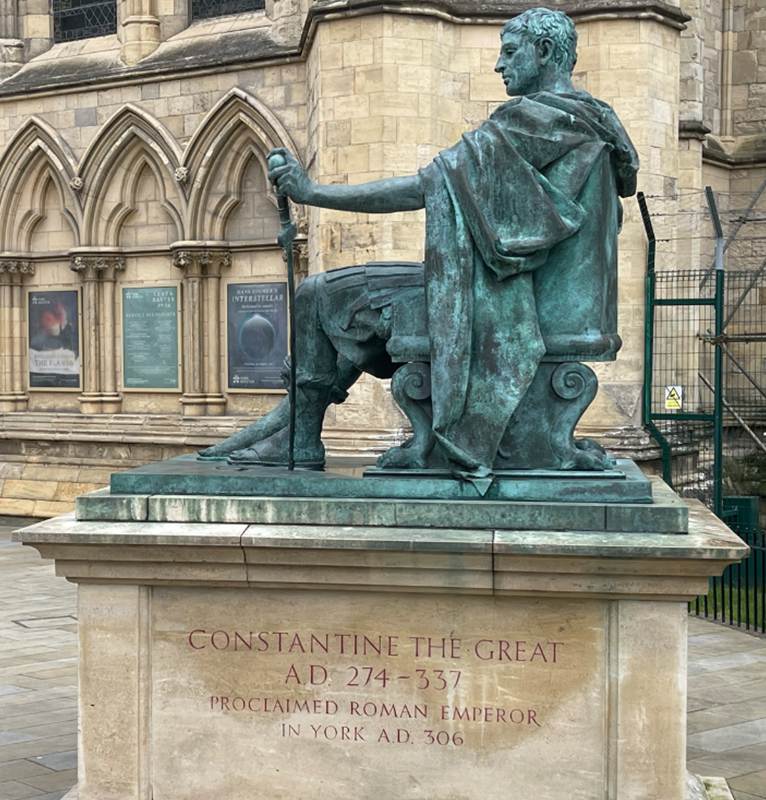
Constantius and Constantine (Yorkshire Museum)
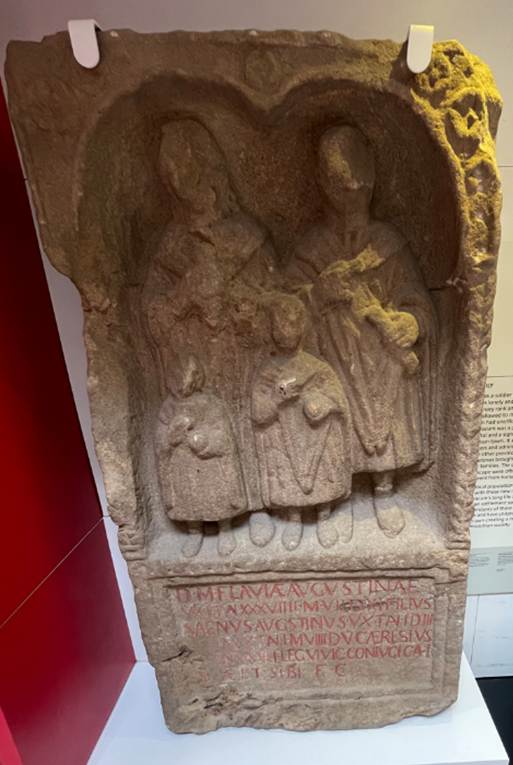
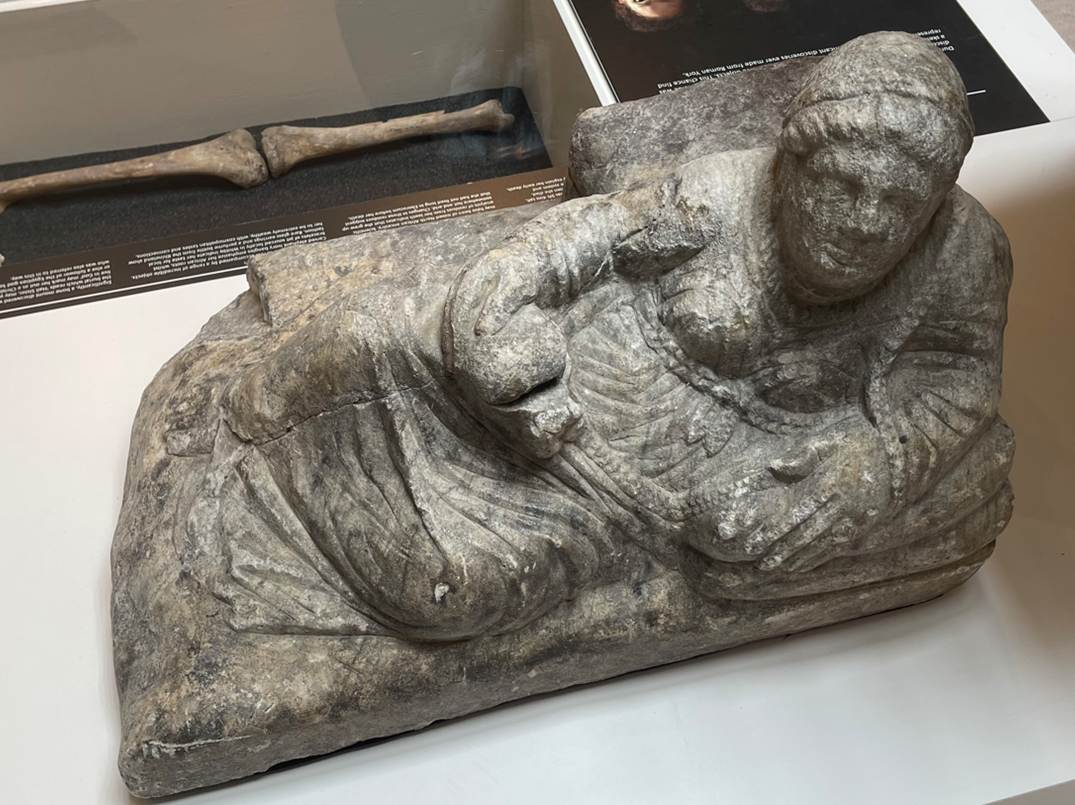
The
veteran soldier Caereslus Augustinus had lost his
wife. Flavia Augustina and his two children. This stone carving (119 to 410 CE)
seems to depict his idea of how they might have grown up as a family, had they
lived. (Yorkshire Museum)
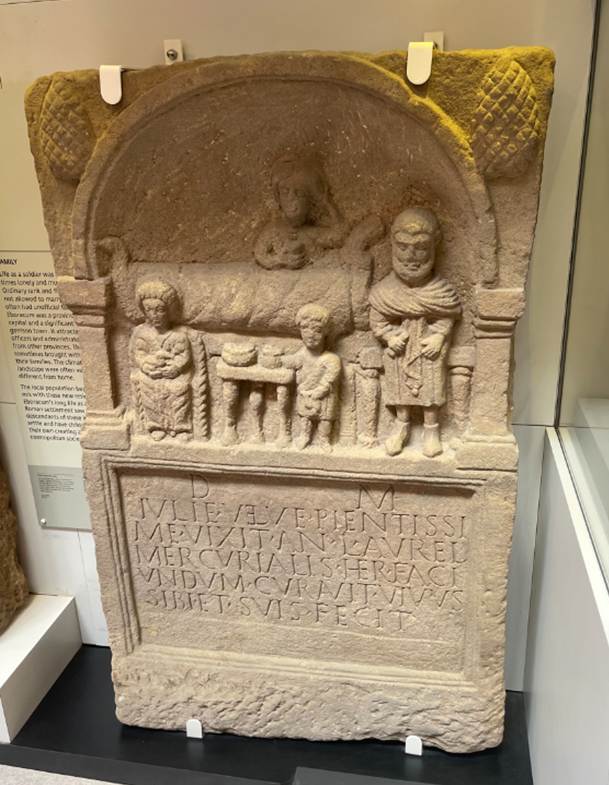
Tombstone
(200 to 300 CE) of Julia Velva. Her heir Aurelius Mercurialis would gather at
the tomb on the anniversary of her death and would have believed she could take
part. (Yorkshire Museum).
313 CE
Constantine supported Christianity, and in 313
CE issued an edict of religious tolerance.
314 CE
Eboracum had its first bishop, Eborius, appointed.
In 314 CE a bishop from York attended the
Council at Arles to represent Christians from the province.
There is evidence
from the late Roman period that might be expected that has not been found.
Whilst there was massive fortification at Aldborough there is no evidence at
York of a strengthening of defences.
400 CE
While the Roman
colonia and fortress were on high ground, by 400 CE the town was victim to
occasional flooding from the Rivers Ouse and Foss, and the population reduced.
Fifth
century
York declined in
the post-Roman era, and was taken and settled by the Angles in the 5th century.
The population shrank, trade declined, and buildings were abandoned. In
contrast to Aldborough, Eboracum became a less important centre and it seems to
have died out as a Roman centre of power by the fifth century.
There is
continued debate about whether activity at Eboracum came to an abrupt end;
whether some activity continued into the fifth century, or whether buildings
continued to be used for some time.
Apart
from … slight indications that the Germanic invasions may not at first have
been inimical to York, nothing is known of the fate of the city in the 5th and
6th centuries. By the first decade of the 7th century, and perhaps earlier, it
lay within but not at the heart of the English kingdom of Deira. (A History of the County of York: the City of York.
Originally published by Victoria County History, London, 1961).
However
cemeteries dating from this period show that Anglo-Saxons settled in the area
as early as the fifth century.
Eoforwic
The
earliest evidence for Anglo-Saxon settlement is in the form of cemeteries that
were placed some way from the Roman city walls, and it is entirely possible
that the built up areas of the Roman city were avoided quite simply because the
masonry and stonework had become dangerous, and besides, the new Anglo-Saxon
tradition was to build in wood. By the seventh century the picture becomes more
clear, with the emergence of Eoforwic and the construction of a small wooden church
on the site of the Minster in 627. A monastery was created in York in the 8th
century, and became a centre of learning and scholarship. (Britain in the Middle Ages, An Archaeological History, Francis Pryor, 2007, page 193).
Seventh
century
From about 600 CE, York became capital of the Anglo-Saxon kingdom
of Deira. Its Anglo-Saxon name, Eoforwic, suggests
that it was an important commercial centre; all ‘-wic’
towns in the period being important trading emporia. By the early seventh
century, it was also a royal base for the Northumbrian kings.
Reclamation of parts of the town was initiated in the 7th century
under King Edwin of Northumbria, and York became his chief city. It was the
capital of the Anglo-Saxon kingdom of Deira and later the combined centre of
Northumberland with the merging of Deira with Bernicia. Its Anglo-Saxon name, Eoforwic, suggests that it was an important commercial
centre as the wic
towns were important trading centres. By the early seventh century, it was also
a royal base for the Northumbrian kings.
Pre Viking York (Eoforwic),
is another likely candidate for wic status.
Personally I am in little doubt that these settlements were fully urban, as we
would understand them today, because I cannot see how such places could survive
and prosper in any other way. Further, a significant proportion of the
population must have spent all their time being merchants or artisans. They
would have had little or nothing to do with the production of food from the
land. (Britain in the Middle Ages, An
Archaeological History, Francis Pryor,
2007, page 47).
601 CE
When
in 601 Gregory the Great sent the pallium to Augustine he planned to divide
Britain into two sees, one of which was to have its centre at York. When the
time was ripe the Bishop of York, like Augustine in the southern province
centred on London, was to ordain twelve bishops and enjoy the rank of
metropolitan. This apparently sudden reappearance of York in the role of an
internationally recognized metropolis has doubtless some connexion with the
facts of population and economics. The Roman roads alone would have sufficed by
this date to focus Northumbrian communications and commerce in such a degree as
to re-create at York the largest urban settlement in the north. But these can
scarcely have been the only reasons for the choice of York. Gregory is unlikely
to have been ignorant of the traditions of the city deriving from its status in
Roman times and, in particular, he may have been reminded by his advisers that
the city had been the centre of a bishopric in the 4th century. Though many
years were to elapse before his plan took effect, we may regard the northern
metropolitan see as the most permanent legacy of Eboracum and so, like the
papacy itself, a 'ghost of empire'. (A History of the County of York: the City of York.
Originally published by Victoria County History, London, 1961).
627 CE
After the Roman
mission to re-establish Christianity in Britain, Bishop Paulinus established
his church in the city The first wooden minster church was built in York. It
was here that King Edwin was baptised in 627, according to the Venerable Bede.
So
King Edwin, with all the nobles of his race and a vast number of the common
people, received the faith and regeneration by holy baptism in the eleventh
year of his reign, that is in the year of our Lord 627 and about 180 years
after the coming of the English to Britain, He was baptised at York on Easter
Day, 12 April, in the church of St Peter the Apostle, which he had hastily
built from wood while he was a catechumen and under instruction before he
received baptism. He established an episcopal see for Paulinus, his instructor
and bishop, in the same city. (The
Ecclesiastical History, Bede)
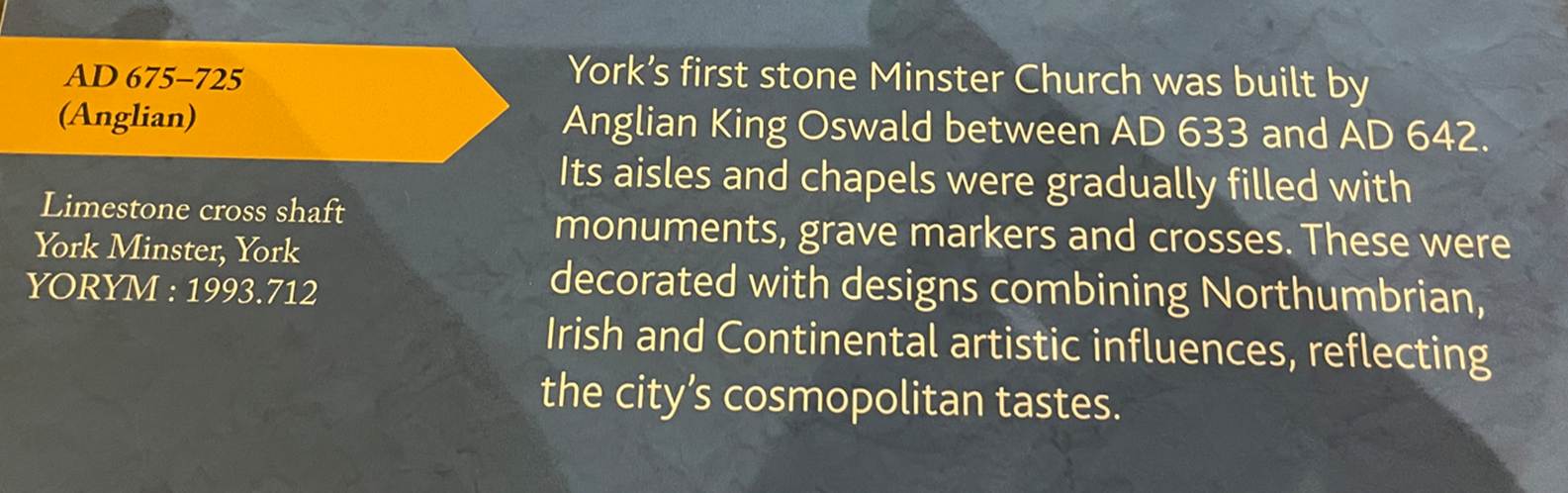
Edwin ordered the
small wooden church be rebuilt in stone; however, he was killed in 633, and the
task of completing the stone minster fell to his successor Oswald.
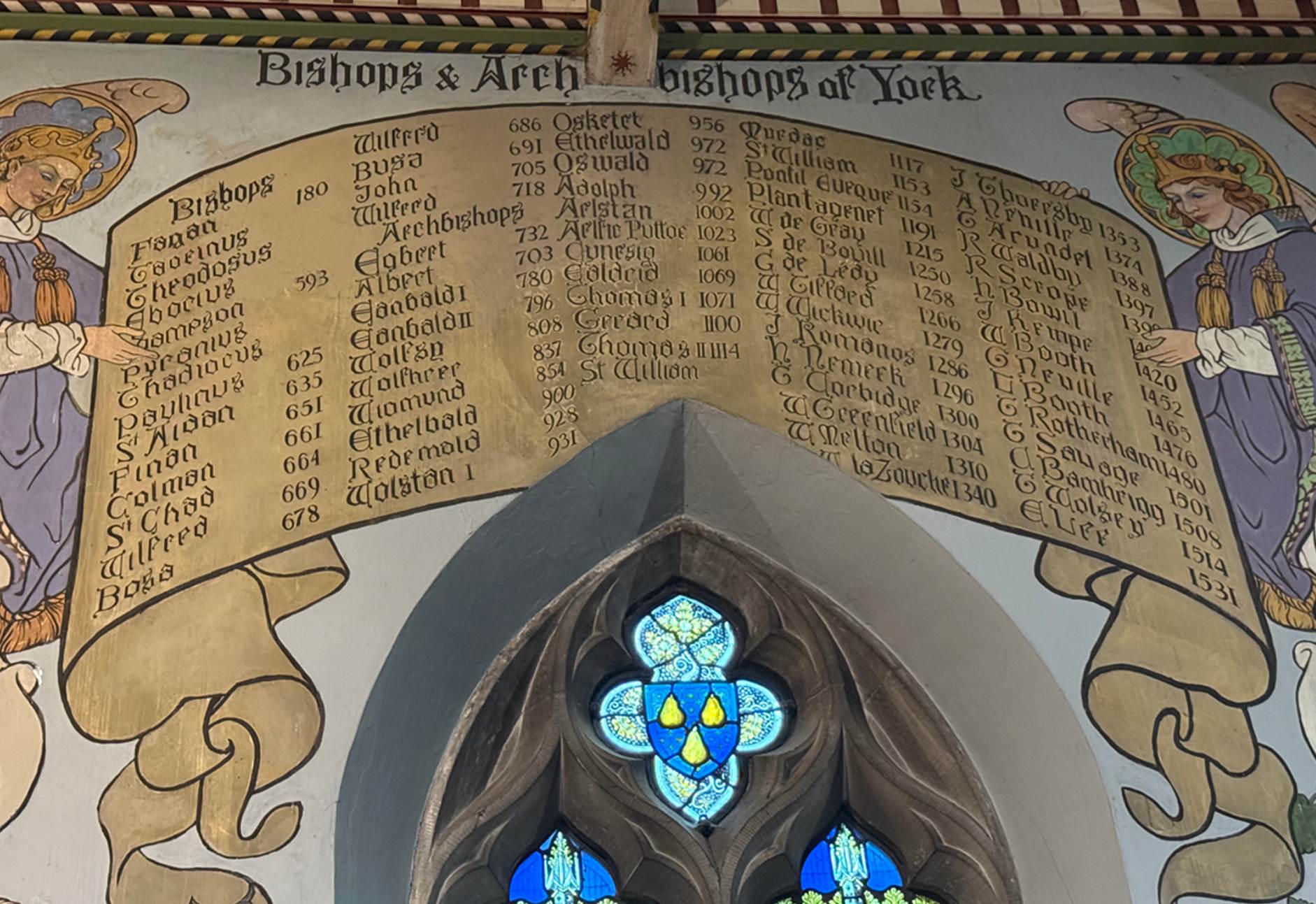
The
York Tree at Helmsley Parish Church showing the Bishops and Archbishops of York
Eighth
century
In the following
century, Alcuin of York came to
the cathedral school of York. He had a long career as a teacher and scholar,
first at the school at York now known as St Peter's School, founded in 627 AD,
and later as Charlemagne's leading advisor on ecclesiastical and educational
affairs.
We do, however,
know that Eoforwic was a very significant place to
the Northumbrian kings. On the other hand, the distribution of Northumbrian
coins suggests that in the later 8th and the 9th centuries, the region was
becoming increasingly isolated from the developing trading world further south.
At present, most informed opinion regards Eoforwic
more as a trading centre, than a town, but I strongly suspect that could change
if large scale research began again at York. I don't want to give the
impression that Middle Saxon York was a place of little consequence, because
that would be far from the truth. We know, for example, that Eoforwic contained the cathedral of the Archbishop of the
Northumbrians, the minster, which was founded in AD 627. There are records that
the Viking leader Guthfrith, successor to the better known Halfdan, was buried
there in 895. The Viking period minster was not on precisely the same spot as
the present minster. It must also be significant that York was an early
strategic objective of the Viking Great Army. It fell to them in 866, very
shortly after their arrival in Britain. We do not know whether it was a direct
result of this conquest, but about that time the focus of settlement moved from
Fishergate, east of the River Foss, to Coppergate,
west of it. The Foss is a tributary of the Ouse, which joins the main river at
York. After the fall of York, and under the leadership and inspiration of
Halfdan, warriors settled down in rural estates in the city and the countryside
roundabout. This policy of settlement and occupation ensured that the Vikings
had a firm power base in the region that would provide a source of loyal
followers in future military operations. Richard Hall makes the point that Eoforwic was very different in both scale and status to the
Jorvik that was recorded in the Doomsday Book of 1086. Norman rulers inherited
a thriving and fully urban city that had largely grown up under Viking control.
It was a major achievement. (Britain in the Middle Ages, An
Archaeological History, Francis Pryor,
2007, page 176).
793 CE
The earliest recorded
Viking raid in Britain was the attack on Lindisfarne in AD 793. At the time the
Scandinavian raiders generally picked largely undefended, wealthy targets such
remote monasteries. The Vikings quickly learned that ecclesiastical centres
were good targets.
865 CE
The Viking Great
Army first landed in East Anglia on the east coast of England in 865 CE, but
soon turned northwards.
866 CE
In 866 CE,
Northumbria was in the midst of internecine struggles when the Vikings raided
and captured York. As a thriving Anglo-Saxon metropolis and prosperous economic
hub, York was a clear target for the Vikings. Led by Ivar the Boneless and
Halfdan, Scandinavian forces attacked the town on All Saints' Day. Launching
the assault on a holy day proved an effective tactical move, most of York's
leaders were in the cathedral, leaving the town vulnerable to attack and
unprepared for battle. It is possible that its gates were open to let in people
from the surrounding countryside.
Jórvik
By the end of the
ninth century, the Norsemen had established themselves in York. And so Saxon Eoforwic became Jórvik.
It became the
capital of Viking territory in Britain, and at its peak boasted more than
10,000 inhabitants. This was a population second only to London within Great
Britain. Jorvik proved an important economic and trade centre for the Vikings.
The city was well connected through river traffic along the Ouse, which linked
via the North Sea to the Viking trade networks that spanned much of the known
world at that time. Artefacts from as far away as Afghanistan have been found
in York. There’s also evidence from the Coppergate
site of industrial production: woodworking, crafting with copper, iron, silver,
gold, even glassmaking – and the raw materials came from far afield. Some were
brought across the Pennines; there was tin from Cornwall, and bones and antlers
for combs and pins from Greenland and Iceland.
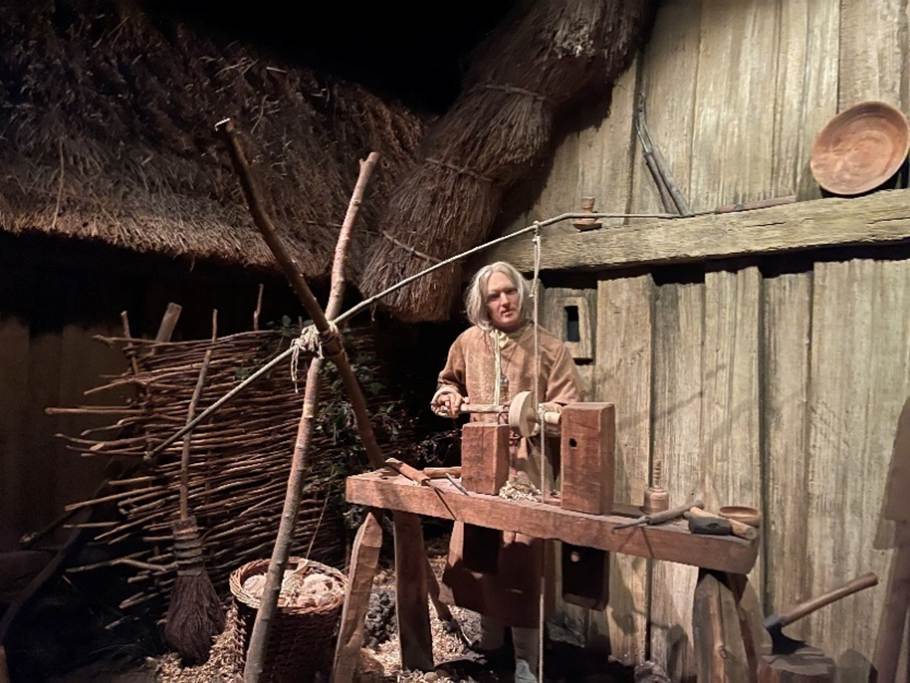
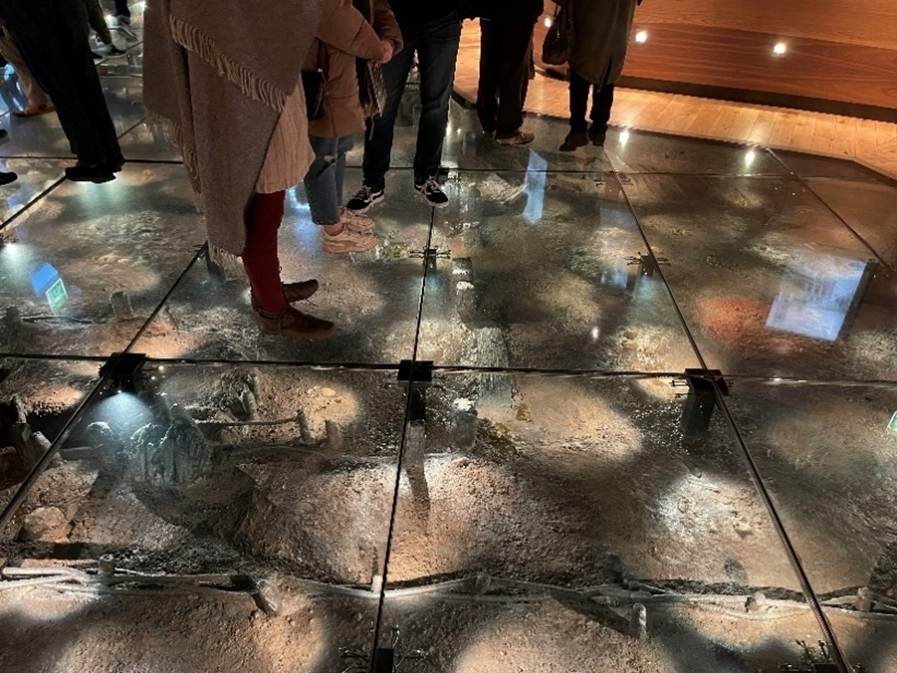
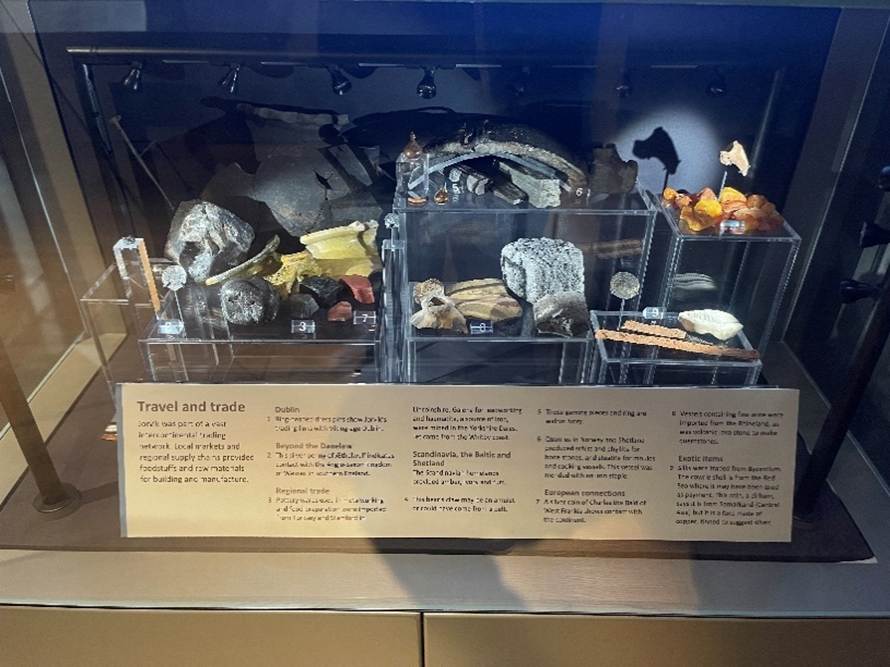
Jorvik Museum
(Photographs RMF)
Norse coinage was
created at the Jorvik mint, while archaeologists have found evidence of a
variety of craft workshops around the town's central Coppergate
area. These demonstrate that textile production, metalwork, carving, glasswork
and jewellery-making were all practised in Jorvik. Materials from as far afield
as the Persian Gulf have also been discovered, suggesting that the town was
part of an international trading network. Under Viking rule the city became a
major river port, part of the extensive Viking trading routes throughout
northern Europe.
The ‘Viking Dig’ was
a 5 year excavation from 1976 to 1981 at 16 to 22 Coppergate.
Some 36,000 archaeological contexts revealed over 40,000 individually
recorded special or small fines, such as coins and brooches, quarter of a
million pieces of pottery, and five tonnes of animal bone. The thoroughness of
the work was legendary, and involves the sieving of more than eight tons of
soil. After the Viking dig, the pace of development in York either slowed down,
or was managed in a way that avoided archaeological destruction. They were
particularly well preserved because many were waterlogged. Pollen grains and
seeds show us the plants that grew there. Parasite eggs show us how sanitary,
or not, conditions were. Even preserved insects survive. With all this
information, we can make a very good stab at recreating what it would have
actually been like to have lived in Jórvik, even down
to the ambient sounds which we take so much for granted in our daily lives.
(Britain in the Middle Ages, An Archaeological
History, Francis Pryor, 2007, page 172).
Their
main conclusion is that the majority of the plants were brought to York from
outside, for all sorts of purposes, ranging from food and drink to bedstraw,
thatch and flooring. Some, like woodland moss, may have arrived attached to
wood or wattle. Others could have been
brought to the city in turves of grass. The insects, on the other hand,
probably reflect the local town fauna. Many may originally have been brought to
the city, but once there they adapted well to the crowded urban conditions of
Viking York, and flourished. (Britain in the Middle Ages, An
Archaeological History, Francis Pryor,
2007, page 178).
900 CE
There
seems to have been a decline in trade in the 9th century, following the gradual
demise of Middle Saxon Eoforwic. Around 900 York’s
Viking rulers strengthened the Roman walls to the north and West of the River
Ouse and Foss, to make a smaller but more readily defended city than the Romano
British Eboracum. The site at Coppergate lies in the
area within the confluence of the Ouse to the West and the Foss to the east. (Britain in the Middle Ages, An Archaeological History, Francis Pryor, 2007, page 178).
926 CE
By AD 926, the
Scandinavian kingdom of York was brought under the overlordship of King Æthelstan. But for the next few decades, it was fought over
between the Anglo-Saxon kings and the Viking kings of the Irish Uí Ímair dynasty.
954 CE
In 954 CE Jorvik
fell to Wessex. The last ruler of an independent Jórvík,
Eric Bloodaxe, was driven from the city in 954 CE by King Eadred in his
successful attempt to complete the unification of England. York was absorbed
into the English kingdom – but it retained its Anglo-Scandinavian culture and
character. There are records of landholders with hybrid names, and inscriptions
around Yorkshire that are partly in Latin and partly in Old Norse.
1066
In 1066 the
Danes, led by the Norwegian King Harold Hardrada, sailed up the Ouse, with
support from Tostig Godwinson and after the Battle of Fulford, they seized
York. King Harold of England then marched his army north to York in four days
to take the invaders by surprise. Live. Bridge. The rebels were defeated at the
Battle of Stamford Bridge in which Harold Hardrada and Tostig were killed. So
far so good. The trouble of course was that Harold then had to march his
exhausted army south again, to confront the second threat from William of
Normandy, near Hastings, and in that episode, he didn’t do so well.
1068
In 1068, two
years after the Norman conquest of England, the people of York rebelled.
Initially they were successful, but upon the arrival of William the
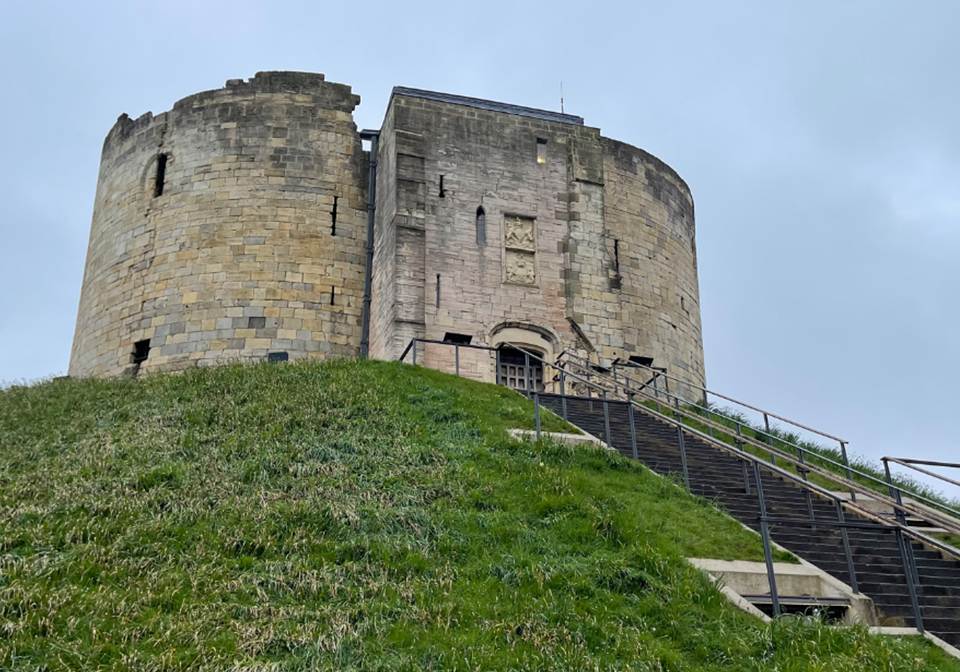
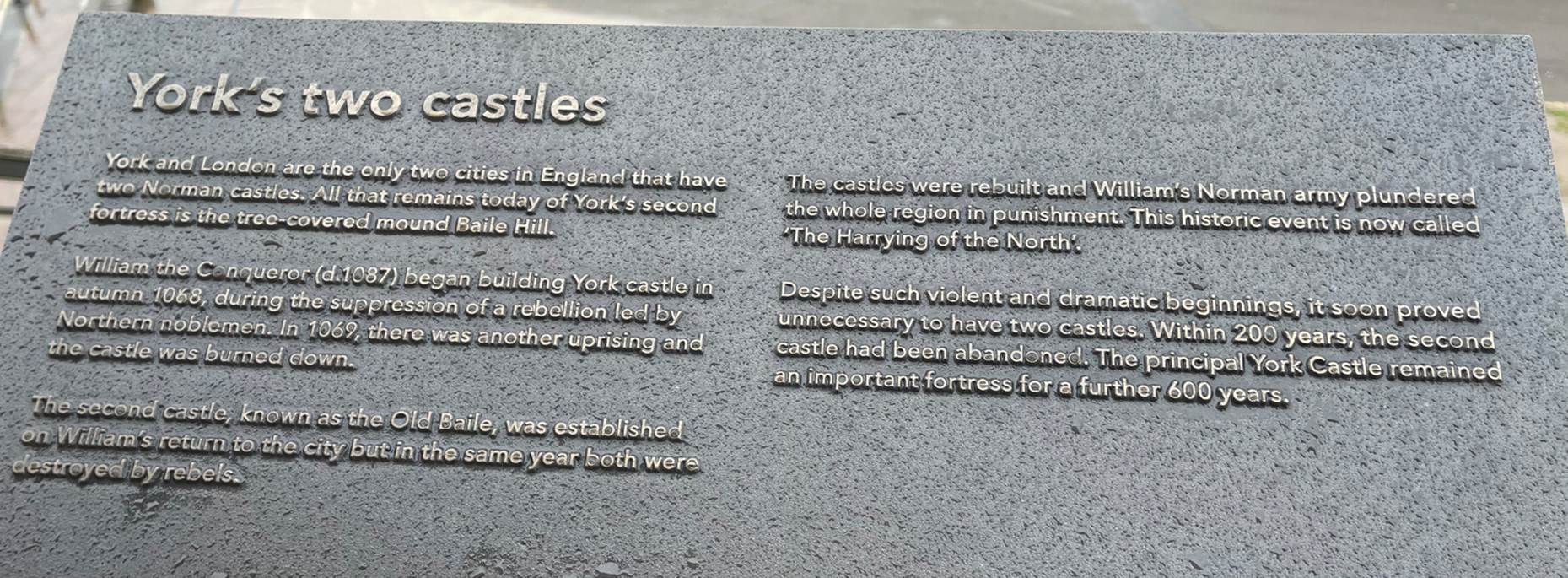
Conqueror the rebellion was put down. William at once built a wooden motte
and bailey fortresses at the site of Clifford’s Tower.
1069
In 1069, after another
rebellion, the king built another timbered castle across the River Ouse. The
original wooden castles were destroyed in 1069 by another rebellion supported
by the Danish King Sweyn II Estridsson.
The Norman
response was to set fires that destroyed swathes of York, including the
Minster. William bribed the Danes to leave, then stamped out local rebellion
during the Harrying of the North. and rebuilt the City and the two castles as
well as. The remains of the rebuilt
castles, now in stone, are visible on either side of the River Ouse.
York
After
the initial problems posed by the uprising against the Normans, the inhabitants
of 11th and 12th century York gave up violence and the city prospered. It
became self governing, and grew into a major regional
centre with trading links over a wide area of northern and midland England, and
indeed overseas. It received its first royal charter from Henry II sometime
between 1155 and 1162. Despite the depredations of the Black Death, York
continued to prosper until about 1475, attracting people from the country round
about. It thrived as a major judicial centre and an inland trading port; but
its commerce overseas was largely taken over by Hull, with its superior access
to the North Sea. After about 1350. The city continued as a major manufacturing
centre through most of the Middle Ages, building on the tradition that had
begun in Viking times. Its gradual descent from pre-eminence began in the final
century of the Middle Ages. After about 1450, other trading towns such as
Wakefield and Leeds joined Hull in capturing York's markets, and the population
of the city declined. (Britain in the Middle Ages, An
Archaeological History, Francis Pryor,
2007, page 194).
1070
The new minster
was begun by Thomas of Bayeaux, who became archbishop in 1070.
1080
The first stone
minster church was badly damaged by fire in the uprising, and the Normans built
a minster on a new site (parts of which can be seen in the modern undercroft). Around the year 1080, Archbishop
Thomas started building the first Norman Cathedral that in time became the
current Minster.
1088
Religious
communities were established, including the hugely wealthy Benedictine
monastery St Mary’s Abbey, the ruins of which are in Museum Gardens. The
original church on the site was founded in 1055 and dedicated to Saint Olaf.
After the Norman Conquest the church came into the possession of the
Anglo-Breton magnate Alan Rufus who granted the lands to Abbot Stephen and a
group of monks from Whitby. The abbey church was refounded
in 1088 when the King, William Rufus, visited York in January or February of
that year and gave the monks additional lands.
Within a few
decades, as many as 40 parish churches stood within York, giving an indication
of its large population. York once more became an important, bustling
commercial city.
Twelfth
century
In the
12th century York started to prosper. In the Middle Ages, York grew
as a major wool trading centre and became the capital of the
northern ecclesiastical province of the Church of
England
1190
Under the
protection of its sheriff, York had a substantial Jewish community. In
1190, Clifford’s Tower was the site of an
infamous massacre of its Jewish inhabitants, in which at
least 150 Jews died. On the night of 16 March 1190, as the new King Richard I,
was about to set off on Crusade, a mob of York citizens, egged on by three
local land owners who owed large sons to the York Jews, began rioting and
plundering Jewish houses. The Jews, believing that they were under the King's
protection, took refuge in York Castle, where Clifford's Tower now stands, but
the land owners brought up siege engines to storm it. Eventually, seeing that
the wooden castle would soon have to surrender, the Jews set fire to it and cut
the throats of their wives and children, asking their rabbi to do the same to
them. At dawn the few surviving Jews, having been promised mercy in return for
Christian baptism, walked from the burnt out keep and were promptly cut down.
180 Jews died that night. The King was furious, mostly at the insult to himself
as their protector. He forced the land owners to pay their debts, into his own
coffers. No one was ever punished in any other way. Jews returned to York after
a few years and flourished again until Edward I expelled all Jews from England a
hundred years later. (The Little History of
Yorkshire, Ingrid Barton, 2018).
1212
The city, through
its location on the River Ouse and its proximity to the Great North Road,
became a major trading centre. King John granted the city's
first charter in 1212, confirming trading rights in England and
Europe. The city was no longer controlled by a sheriff, but headed by a
mayor elected by the citizens.
During the later
Middle Ages, York merchants imported wine from France, cloth, wax, canvas, and
oats from the Low Countries, timber and furs from the Baltic and
exported grain to Gascony and grain and wool to the Low Countries.
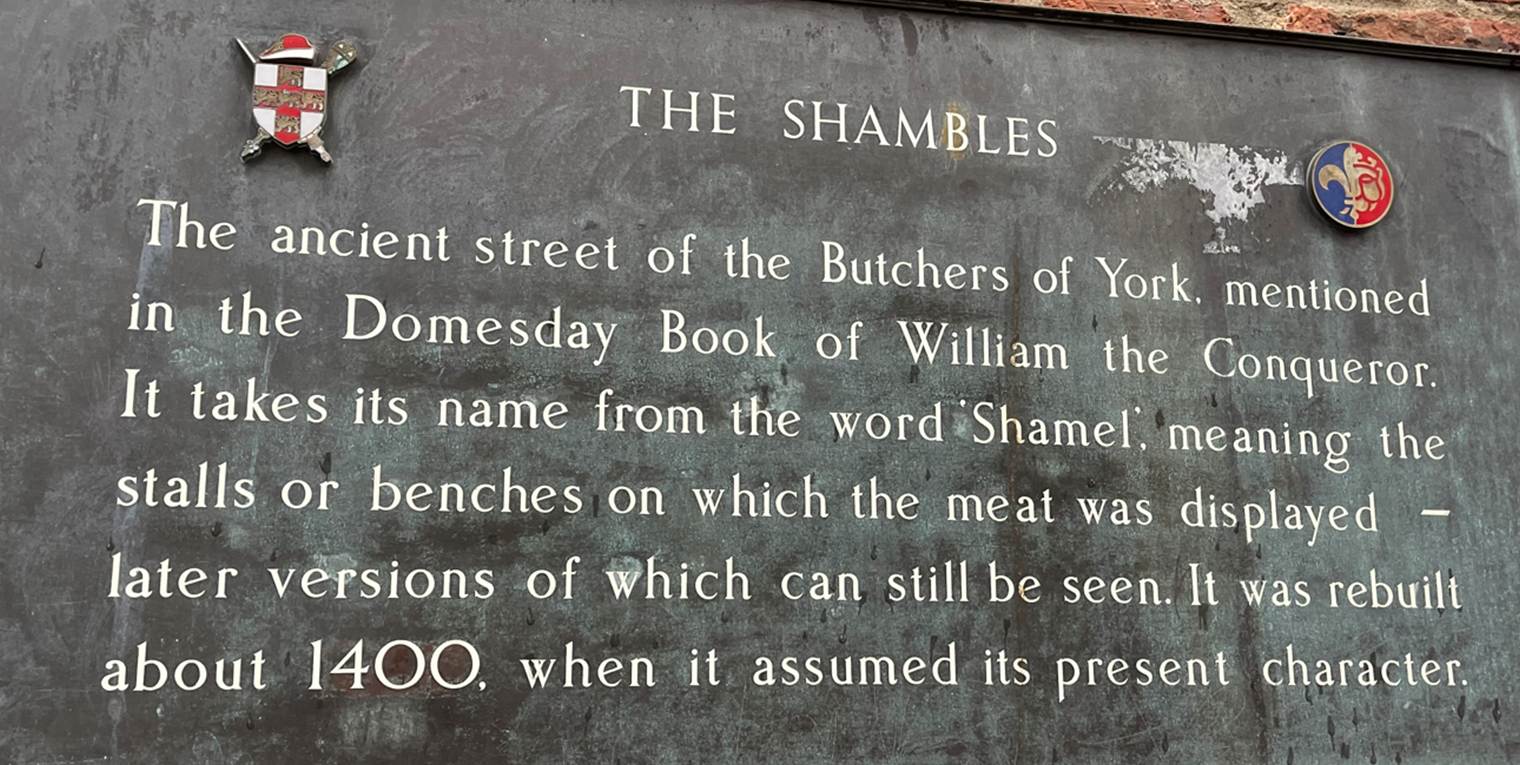
The Shambles was
originally a street for butchers, and you can still see outdoor shelves and
hooks on which meat was hung.
York became a
major cloth manufacturing and trading centre. Edward I further
stimulated the city's economy by using the city as a base for his war in
Scotland.
Two tally sticks
have been excavated from York. They were used to record and make commercial
transactions. They were split or broken, and the parties to the deal kept a
portion each. They were part of everyday medieval business transactions. They
were not crude mechanisms. The notches carved by hand represented a sum of
money or a count of bundles of hides or other cargo taken aboard a ship. The
stick was the receipt for the person who paid for the cargo, rather like bills
of lading.
1226
In 1226 work
started on the construction of York’s town walls.
Before
the mid thirteenth century the buildings at Coppergate
were of earthfast construction, built around posts
driven into the ground. By the mid thirteenth century, the inhabitants of Coppergate found a way to avoid the problems of earlier
designs and used improved carpentry to prefabricate components and joints. New
buildings were constructed around a frame that was braced and rigid. To avoid
rising damp, they were often raised from the ground on stone pads. Foundations
techniques were developed to avoid subsidence. By the fourteenth and fifteenth
century merchants built themselves substantial houses. (Britain in the Middle Ages, An Archaeological History, Francis Pryor, 2007, page 196).
1298
Royal government
relocated to York during the Scottish Wars.
Clifford’s Tower
housed the royal treasury.
1348
On 28 July 1348,
Archbishop Zouche of York warned his flock, Everybody knows, since the news
is now widely spread, what great pestilence, mortality and infection of the air
there are in diverse parts of the world and which, at this moment are
threatening in particular the land of England. This surely, must be caused by
the sins of men who, made complacent by their prosperity, forget the bounty of
the most high Giver. Nearly ten months would elapse before the first cases
in Yorkshire. (The Black Death, Philip Ziegler, 1969, page 144).
By
the arrival of the Black Death in
1349, the city was already in difficulties, since a disastrous flood had
submerged its western province at parishes on 31 December 1348. The River Ouse
in York flooded and burst its banks at the bridge towards Micklegate,
and the event that continued until spring 1349.
York
itself was first struck by the plague in May 1349.
1352
York was made a staple town for lead, wool and leather in 1352.
A considerable hide and
skin trade centred on York but rural tanners were at Oswaldkirk-Ampleforth, Helmsley,
Rievaulx, Bilsdale and Keldholme. Tanners enrolling as York freemen in King
Edward II's time included Richard of Rievaulx, Hugh of Oswaldkirk
and Robert of Ampleforth. Leather was used to make clothes, pitchers, gloves
and saddlery. A lorimer made bridles at Helmsley and shoe-making was an early
rural craft.
(Life in Ryedale in the 14th century, J H Rushton, Ryedale Historian, Volume 8, 1976, page 19).
1377
As a poll tax the 1377 tax is of interest to the demographer, and it
does provide an accurate total of the population of the city of York, within
the terms of reference of such a tax and should be used with caution. The Freemen’s Roll of York has
also been used to estimate population totals, by combining the numbers of
freemen enrolled in each year with an average life expectancy rate, to
calculate how many freemen were alive in any one year as a constant percentage
of the total population.
However it is apparent that at least in the four central parishes,
only half the householders were enrolled freemen, and in a city such as York,
with a thriving cloth manufacturing industry, one concludes that an
unexpectedly large number of men were employed as unskilled workers,
apprentices, or practised as master craftsmen illegally. Craft gilds recognised
the possibility of enrolment evasion and legislated against the employment of
unfranchised workers.
Early poll tax returns should only be consulted as demographic
sources if their limitations are recognised. When they are used with reasonable
reference to other contemporary sources, separate and sometimes contradictory
conclusions can be contrasted and more fully understood within a wider context
than that of a single document. In York there are several groups of records
which separately indicate a general increase in the population of the city
during the last half of the fourteenth century, but none of them, either
separately or in combination, do more than suggest a very approximate figure
for the total population of York, or for the rate of growth of the city.
(The 1377 Poll Tax Return for the City of York, Jennifer I Leggett, Yorkshire
Archaeological Journal, Volume 43, 1971, page 129).
York was one of the largest cities in England; smaller only than
London, and, perhaps, Norwich. Professor Russell estimates the population in
1377 at 10,872. By that date, economic expansion had already been resumed and
the plague, destructive though it was, provided no more than a check in a
process which lasted till the end of the century. (The Black
Death, Philip Ziegler, 1969, page 144).
1381
The city was the
location of significant unrest during the so-called Peasants'
Revolt in 1381.
1396
The city acquired
an increasing degree of autonomy from central government including the
privileges granted by a charter of Richard II in 1396. The
timber-framed Merchant Adventurers’ Hall, built in the mid-14th century, is a
remnant of that era.
Fifteenth
Century
York’s economy
began to decline towards the later Middle Ages. During the 15th century the
city fathers attempted to maintain its image, building a new guildhall and St
Williams College (as accommodation for the Minster’s Chantry priests), both of
which still stand today.
1472
York Minster, the
largest Gothic cathedral north of the Alps, was finally completed in 1472.
Yet the cloth
industry, the mainstay of the city’s economy, had gradually moved to other
parts of Yorkshire, Halifax, Wakefield, Leeds, where trade was less strictly
controlled and regulated. The population fell, houses were abandoned.
1536
The city
underwent a period of economic decline during Tudor times.
Under King Henry VIII, the Dissolution of the Monasteries saw
the end of York's many monastic houses, including several orders
of friars, the hospitals of St Nicholas and of St Leonard, the largest
such institution in the north of England.
This led to
the Pilgrimage of Grace, an uprising of northern Catholics in Yorkshire
and Lincolnshire opposed to religious reform. Henry VIII restored his authority
by establishing the Council of the North in York in the dissolved St
Mary's Abbey. The city became a trading and service centre during this period.
The reestablishment of the King’s Council in the North, turned York again into
a major administrative and judicial centre.
1561
Under Elizabeth
I, the High Commission Court for the Northern Province of York was established
in 1561. The Council and Court together brought government institutions to the
city and, as a consequence, attracted large numbers of people who needed to be
fed, housed and provided with the basics of daily living. This brought renewed
trade into the city, along with a gentry who demanded luxury goods.
Yorkshire cloth
was once more in demand, along with sheepskin, in part to support the quantity
of parchment required for the documentation by the Council and Court. By the
end of the 16th century, York was bustling once again, with more than 60 inns
housing and feeding visitors and merchants.
1605
Guy Fawkes, who was
born and educated in York, was a member of a group of Roman
Catholic restorationists that planned the Gunpowder Plot. Its
aim was to displace Protestant rule by blowing up the Houses of
Parliament while King James I, the entire Protestant, and even most
of the Catholic aristocracy and nobility were inside.
1642
During the Civil
War, in 1642, Charles I fled London and set up court in York for several
months, making it effectively the national capital. Even after his departure,
it remained a royalist stronghold, and was besieged and eventually captured by
the parliamentarians.
1644
In 1644, during
the Civil War, the Parliamentarians besieged York,
and many medieval houses outside the city walls were lost.
The barbican at Walmgate Bar was undermined
and explosives laid, but, the plot was discovered.
On the arrival
of Prince Rupert, with an army of 15,000 men, the siege was lifted.
The Parliamentarians retreated some 10 km from York with Rupert in
pursuit, before turning on his army and soundly defeating it at the Battle
of Marston Moor. Of Rupert's 15,000 troops, no fewer than 4,000 were
killed and 1,500 captured. The siege was renewed; the city could not hold out
for much longer, and surrendered to Sir Thomas Fairfax on 15 July.
1660
Following
the restoration of the monarchy in 1660, and the removal of the
garrison from York in 1688, the city was dominated by the gentry and merchants,
although the clergy were still important.
Competition
from Leeds and Hull, together with silting of the River Ouse,
resulted in York losing its pre-eminent position as a trading centre but the
city's role as the social and cultural centre for wealthy northerners was on
the rise.
York's many
elegant townhouses, such as the Lord Mayor's Mansion
House and Fairfax House date from this period, as do
the Assembly Rooms, the Theatre Royal, and the racecourse.
During this
general time period, the American city of New York and
the colony that contained it were renamed after the Duke of York
(later King James II).
1839
The railway
promoter George Hudson was responsible for bringing the railway to
York in 1839. Although Hudson's career as a railway entrepreneur ended in
disgrace and bankruptcy, his promotion of York over Leeds, and of his own
railway company (the York and North Midland Railway), helped establish
York as a major railway centre by the late 19th century.
The introduction
of the railways established engineering in the city.
At the turn of
the 20th century, the railway accommodated the headquarters and works of
the North Eastern Railway, which employed more than 5,500 people.
1862
The railway was
instrumental in the expansion of Rowntree's Cocoa Works. It was founded in
1862 by Henry Isaac Rowntree, who was joined in 1869 by his brother the
philanthropist Joseph. Another chocolate manufacturer, Terry's
of York, was a major employer.
1900
By 1900, the
railways and confectionery had become the city's two major industries.
1942
In
the Second World War, York was bombed as part of the Baedeker Blitz.
Although less affected by bombing than other northern cities, several historic
buildings were gutted and restoration efforts continued into the 1960s.
Links, texts and books
Victoria County History – Yorkshire, A History of the
County of York: the City of York, 1961.
Seebohm Rowntree, Poverty, A Study of Town Life, 1901 which studied
poverty in York.