Sheriff Hutton
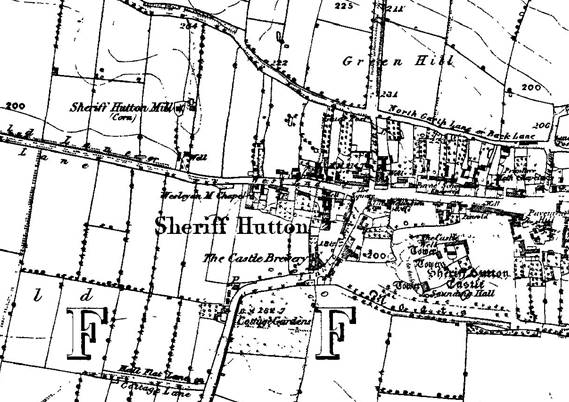
A chronological history of Sheriff Hutton in North Yorkshire
|
Return to the Home Page of the Farndale Family
Website |
The story of one family’s journey through two
thousand years of British History |
The 83 family lines into which the family is divided.
Meet the whole family and how the wider family is related |
Members of the historical family ordered by date of
birth |
Links to other pages with historical research and
related material |
The story of the Bakers of Highfields, the Chapmans,
and other related families |
Section headings are in brown.
Dates are in red.
The Farndale history is in green
References and citations are in turquoise.
The history of the Wars of the Roses is in purple.
Hyperlinks to other pages are in dark blue.
Introduction
This page tells
the story of Sheriff Hutton as a chronology, interwoven with the story of the
Nevilles, who held the lands of Middleham and Sheriff Hutton, and with the
history of England in the dramatic 150 years from the mid fourteenth to the
sixteenth centuries, at the time of the Lancastrian Dynasty of John of Gaunt’s
descendants, and the Age of Henry V,
through the Wars of the Roses between the Houses of York (with whom the
Neville family’s story was closely entwined) and Lancaster. During this period
a line of the Farndale family lived at Sheriff Hutton and Richard Farndale was
a medieval soldier who fought in the Wars at the time of Richard II and Henry
V, and whose daughters, Margorie , Agnes and Alice then witnessed the Wars of
the Roses from Sheriff Hutton, one of the best places to witness the story
unfold.
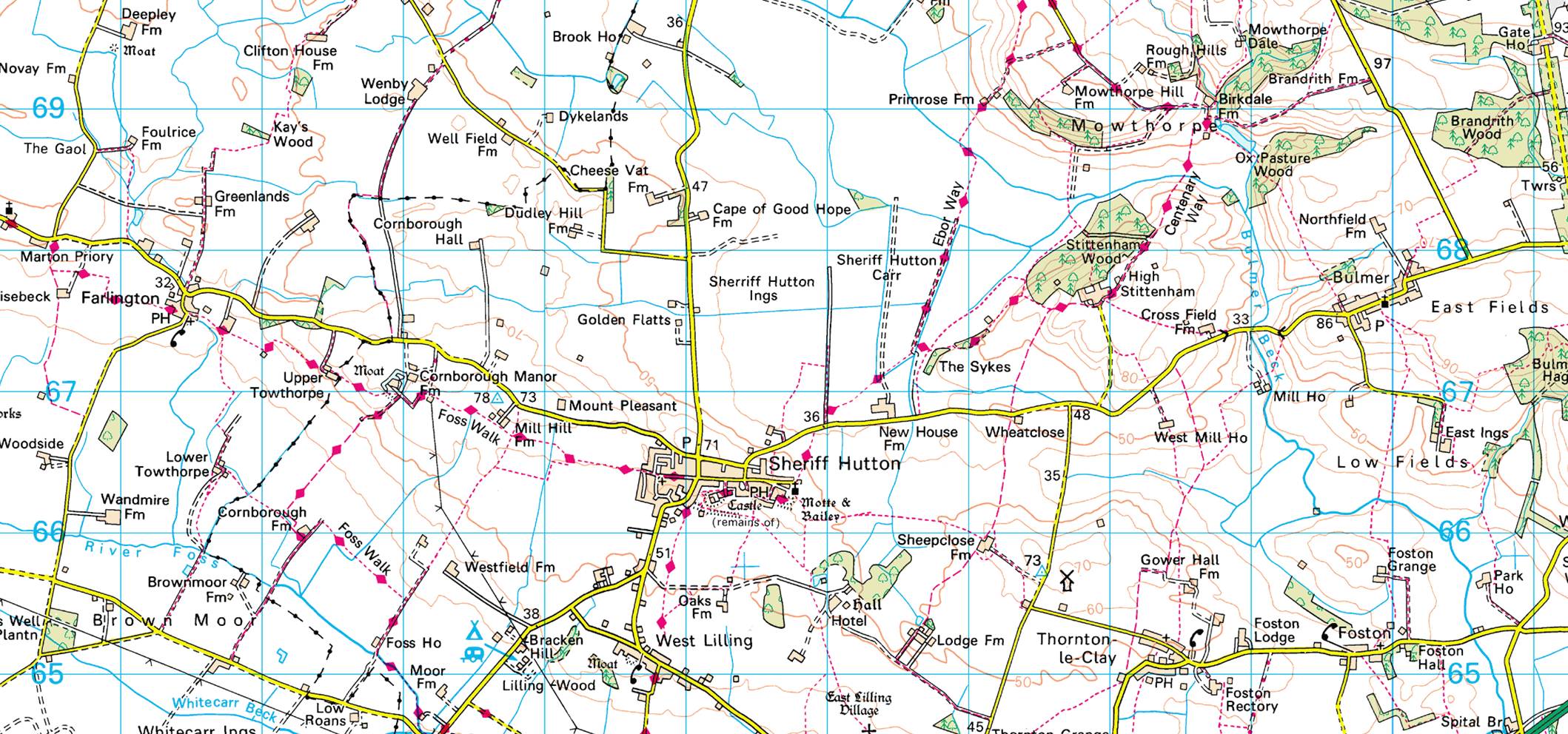
Sheriff Hutton is a village in
North Yorkshire which is about 16 km north-east of York,
situated on a long low ridge which runs east to west between the Vale of York
and the Howardian Hills.
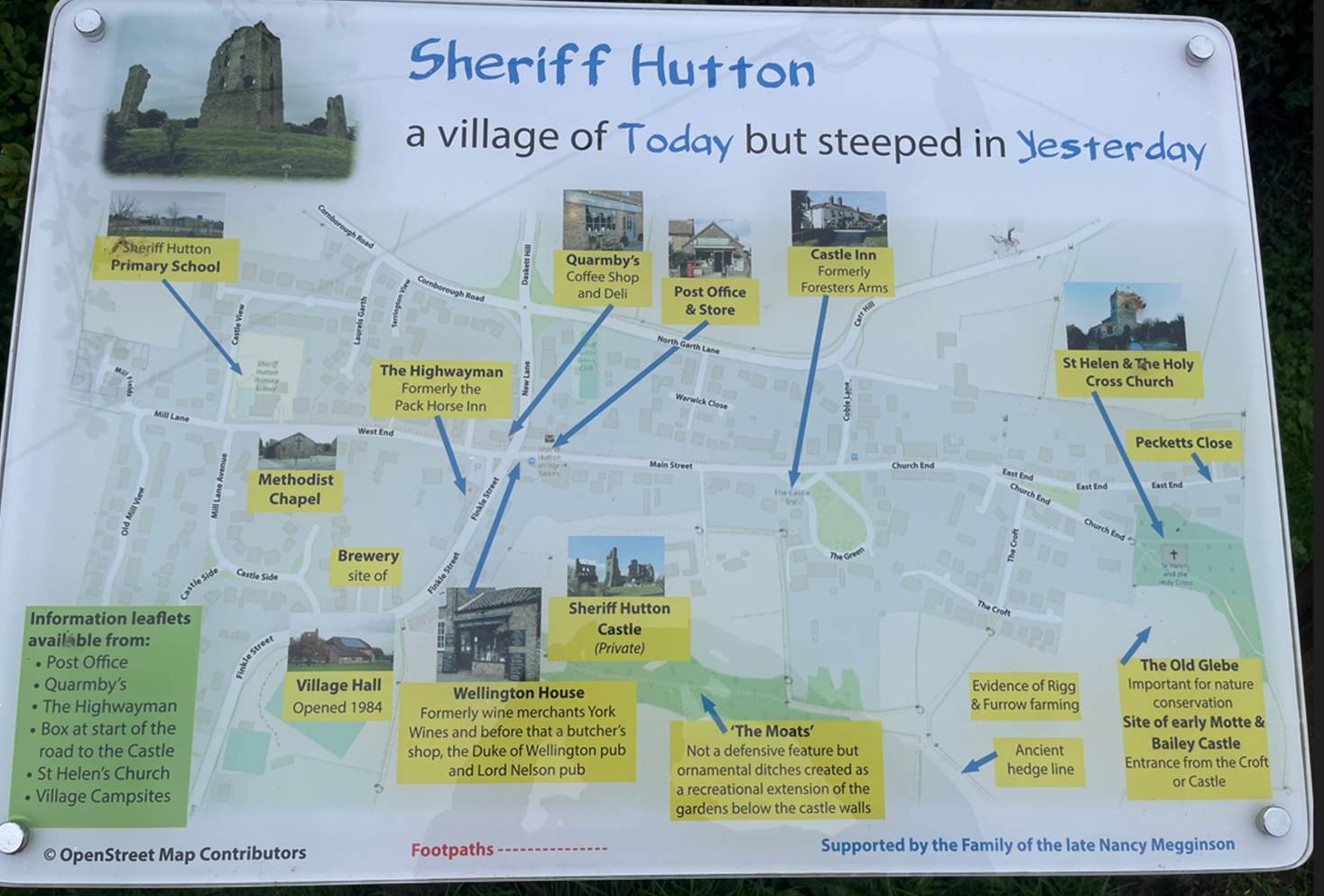
To
the east of the village is our 900 year old Parish church of St Helen and the
Holy Cross. Right in the centre of the village you can find our thriving Post
Office and two charming pubs; to the west our excellent Primary School and
Methodist Chapel and to the south is our Village Hall and a busy industrial
estate. Most noticeable of all are the ruins of Neville Castle built in the
14th century which tower over the village (Sheriff Hutton website).
The Farndale
family were associated with Sheriff Hutton from the mid fourteenth century. The
Sheriff Hutton Line
are the descendants of William Farnedale (FAR00036),
born in about 1332. It is not clear exactly how William Farndale fitted into
the wider genealogy of the Farndale family, but he was likely to have been
related to the medieval
lines of the family, originating from the villeins of Farndale itself. It is possible that he
was one of the sons of Adam of Farndale (1302 to 1352)(FAR00025).
We know a lot
about William’s family, as he left a detailed will in 1397.
In the name of
God Amen. I, William Farnedale, on 23 February 1397/8, in good memory, make my
testament in this manner. Firstly, I bequeath my soul to God and the Blessed
Mary and all the Saints, and my body to be buried in the Churchyard at Schyrefhoton. Item, I bequeath as mortuary payment, the
best animal I have. I bequeath to be burned around my body, as candles, 8lbs of
wax. Item, I bequeath to the High Altar for sins forgiven, 4s. Item, I bequeath
to a Chaplain to celebrate divine services for my soul in the Parish Church of Schyrefhoton for a whole year, 100s. Item, I bequeath to
the fabric of St Peter’s York, 6s 8d. Item, I bequeath to Sir John Ferriby,
Robert Gyllyng and William Barneby, 6s 8d each (20s). I bequeath to the Church
of Schirefhoton for putting lead on the south roof,
20s. Item, I bequeath to each Canon of the Monastery of Marton 12d. I bequeath
to every Chaplain ministering on the day of my funeral, 6d. Item, I bequeath to
my wife Juliana, 4li and to my son Richard, 4li. Item, I bequeath to every poor
person on the day of my burial 1d. Item, I bequeath to my son Richard my small
sword with all my knives. Item, I bequeath to my daughter Helen, two cows.
Item, I bequeath to my daughter, Agnes 2 bullocks and two plough beasts. Item,
I bequeath to Richard Batlay 2 bullocks, Item, I bequeath to Margaret Batlay 2
bullocks and 2 plough beasts. I bequeath the rest of my goods to my wife
Juliana, my son Richard and my daughter Helen. And I appoint Sir John Alwent,
Rector of the Parish Church of Midelham, Juliana
Farndale, Richard Farndale and William Huby, my executors. In witness whereof I
have set my seal. Witnesses: Sir Robert de Hoton, Prior of Marton and Sir John
de Park, Chaplain and many others, date as above.
William married
Juliana, perhaps in about 1358, and they had a son Richard Farendale (FAR00044),
and two daughters Helen (FAR00045)
and Agnes (FAR00046).
It is possible that William Farndayll of Huton (FAR00052)
who held lands at Gowthorpe, about 20 km to the
southeast, was also his son.
We know from his
will that Richard Farendale bequeathed a grey horse with saddle and reins and
his armour, comprising a bascinet, a breast plate, a pair of vembraces and a pair of rerebraces
with leg harness. He appears to have been armed for military service. Perhaps
he had fought in some of the battles of the early fifteenth century. There is
evidence which suggests that Richard Farendale of Sheriff Hutton (FAR00044)
might have been a soldier who fought in the Hundred Years War in the reign of
Richard II, and possibly, as a veteran soldier, in or shortly after the
Agincourt campaign with Henry V or his commanders.
Richard in turn
left a detailed will in 1435:
The Will of
Richard Farendale, proved at Sherifhoton 21 Dec 1435.
‘In the name of God Amen, 8th December 1345. I Richard Farndell being of sound
mind make my will in this manner. Firstly, I bequeath and Commend my soul to
God Almighty, My Creator, and my body to be buried in my said Parish Church.
Item. I bequeath a grey horse with saddle and reins and my armour, viz: a
bascinet, a breast plate, a pair of vembraces and a
pair of rerebraces with leg harness as my
mortuary payment. And I bequeath 3 lbs of wax to be burned around my body on
the day of my burial. Item. I bequeath to the Vicar of my Parish Church 6s 8d
and to every chaplain taking part in my burial service Mass, 4d. And I bequeath
26s 8d for mending a service book for the use of the parish church. And to the
fabric of the Cathedral Church of St Peter York, 12d. And I bequeath to my
daughter Margorie at her marriage 10 marks, if she live to be marriageable age.
And if she die before she arrives at her years of discretion, I wish the said
10 marks to be divided equally between my daughters Agnes and Alice. And I
bequeath to Joan Brantyng 40s and a bed. And to the four orders of friars
mendicant of York 20s and two quarters of corn to be divided in equal portions.
And to John Pyper 2s. And as regards the rest of my funeral expenses, I wish
them to be paid at the discretion of my executors. The rest of my goods, not
bequeathed above, my debts having been paid, I bequeath to the said Margorie,
my daughter, to be divided among them in equal parts. And I make the said
Thomas Robynson and John Couper and Margorie my daughter, my executors,
faithfully to implement the terms of my will. Witnesses; Robert, Vicar of the
Church of Hoton, William Huby of the same, John
Burdley of the same and many others.’
So Richard in
turn had three daughters, Margorie (FAR00049), Agnes (FAR00050) and Alice
(FAR00051). Assuming
they were born in about the 1420s and if they lived until the 1480s or 1490s,
the three Farndale daughters would have lived through the Wars of the Roses, in
the lands of the Nevilles and Richard Duke of Gloucester, later Richard III. They
must have lived their lives through a tumultuous period of English history.
Timeline of the History of
Sheriff Hutton
The history of
Sheriff Hutton is closely interwoven with the Wars of the Roses in the
fifteenth century, so the history of the Wars of the Roses, is shown in purple text, for context.
6,000
BCE
Flint tools have
been found dating back to about 6,000 BCE.
Roman
Period
Roman finds in
the area and crop marks indicate settlement in Roman times.
1086
The village is
mentioned twice in the Domesday Book as Hotun in
the Bulford hundred. Before the Norman invasion the manor was split
between several land owners. Those named
included Ligulf, Northmann, Thorkil, Thorsten and Thorulf.
Afterwards some of the land was retained by the Crown and others given
to Count Robert of Mortain who installed Sir Nigel Fossard as lord of
the manor.
Eleven
carucates in Sheriff Hutton were reckoned amongst the possessions of the Count
of Mortain at the Survey, and were soke of the manor of Bulmer which Niel Fossard then held of the count. There were also 4 carucates
which had been held by Turchil, Turolf
and Turstan as three 'manors' before the Conquest and had afterwards been
unjustly appropriated by Niel. He had surrendered them to the king by 1086, but
it would seem that at some later date he or his son Robert regained this land
and, probably after the forfeiture of the count's son, acquired the 11
carucates also, since the overlordship of all Sheriff Hutton (with the
exception of a close called Bulfordtoftes held of the
king in chief) afterwards came to the Mauleys, lords of Mulgrave, who
represented the female line of the descendants of the Fossards
after the failure of Robert's male heirs. (History
of the County of York North Riding, Volume 2, Sheriff Hutton, 1923).
Soon after the
Conquest, the land was in the possession of the Bulmer family.
1100
The Norman Church
was built in or about 1100. It comprised a tower, a nave and the first half of
the chancel or choir.
1120
The
earliest clear reference to the existence of a church is a gift to St Mary’s
Abbey York by Sir Nigel Fossard, who died in 1120, of the Church of St Helen
and the Holy Cross. There is a small window above the west door that may
pre-date 1100. The Norman building of magnesian limestone ashlar, thought to be
re-used blocks from York's Roman walls, comprise the tower, nave and chancel,
all later extended when the four chantry chapels were built in the C15th for
the manor-holding families of the Nevilles, Gowers, Wythams
and Dacres (Sheriff Hutton website).
1140
Bertram
de Bulmer built the first castle in the village during the reign
of King Stephen. In 1140, during the reign of King Stephen,
a motte-and-bailey castle was built here in the Forest of Galtres by Bertram de Bulmer, the remains of which can
be seen to the south of the churchyard. Those remains have been designated
Ancient Monument status.
Early history
proclaims its builder to have been Bertram de Bulmer, about 1140 ; it was
shortly after seized by King Stephen, but eventually re-purchased by a
descendant of the founder, whose daughter brought it by marriage to Ralph
Neville, the first Earl of Northumberland, who rebuilt and strongly fortified
it (Ryedale and North Yorkshire antiquities, George
Frank, 1888, page
74).
Sheriff
Hutton has two castles. The first is a Norman motte and bailey structure of
which only the mounds remain. It was built by Ansketil
de Bulmer on land given to him by William the Conqueror. Hutton stems from the
Old English hoh (a projecting piece of land) and tun
(a farmstead) while the Sheriff prefix stems from the association with the
Bulmer family, Bertram de Bulmer being sheriff of York in 1115 (Sheriff Hutton website).
Topographical Dictionaries, A Topographical
Dictionary of England Hutton-Buscel – Huyton, 1848: This place is
celebrated for its castle, erected in the time of Stephen (1140) by Bertram de
Bulmer, from whose family it descended by marriage to the Nevilles, who held it
till the battle of Barnet, in 1471, when Richard Neville, Earl of Warwick, was
slain, and his estates confiscated.
Sheriff
Hutton took its name from Bertram of Bulmer, Sheriff of York, who had erected a
motte and bailey castle and a church in about 1140 (A History of Yorkshire: County of the Broad Acres,
David Hey, 2005, p133). Sheriff
Hutton lay on the edge of the forest of Galtres.
Just
south of the church are earthworks which probably mark the site of the early
castle said to have been built here by Bertram de Bulmer in 1140. They are
curious in form and probably indicate that the castle was transitional between
the mount and bailey and the keep and bailey types (History of the County of York North Riding,
Volume 2, Sheriff Hutton, 1923).
1153
After the civil
war between Stephen and Matilda, the castle and manor were seized by the Crown
before being held for the king by the Mauley family.
1190
Emma
daughter of Bertram de Bulmer the sheriff, who died in or before 1166, had
married Geoffrey de Nevill before 1176, when he was called upon to account for
her father's debts. In 1190 Geoffrey was described as Bertram's heir, a title
given at the beginning of the next century to his son Henry, who in 1208–9
rendered account of £100 and a palfrey for having his knights' fees in Raskelf and Sutton. Henry de Nevill, who gave his consent
to his mother's grant of a pension from Sheriff Hutton Church, died without
issue in 1229 or 1230 (A History of Yorkshire: County of the Broad Acres,
David Hey, 2005, p133).
1278
The
third Peter de Mauley confirmed grants of land of his fee in this parish to
Marton Priory in the later years of Henry III, and the manor of Sheriff Hutton
was held of him and his heirs from 1278 to 1331 (A History of Yorkshire: County of the Broad Acres,
David Hey, 2005, p133). Note the consistency of the land ownership
with that of Doncaster.
1282
Henry
de Nevill was succeeded by his sister Isabel and her husband Robert son of
Maldred, lord of Raby, whose son and heir Geoffrey assumed his mother's
surname. His son Robert de Nevill, who had as Sheriff of York shown his loyalty
to the Crown in the Barons' War, died in 1282 seised
of the manor, and was succeeded by his grandson Ranulph first Lord Nevill, lord
until his death in about 1331 (A History of Yorkshire: County of the Broad Acres,
David Hey, 2005, p133).
1331
The manor
eventually came into the possession of the Neville family of Raby
Castle in the 14th century until 1480, when they were surrendered to the Crown.
They enclosed a park and established a weekly market in the village.
The
fifth Peter de Mauley released to Sir Ralph de Nevill all his right to his
service on account of it. Thenceforward Sheriff Hutton was held of the Crown,
the overlordship being merged with the tenancy after its forfeiture on the
death of the Earl of Warwick, 'the Kingmaker,' in 1471 (A History of Yorkshire: County of the Broad Acres,
David Hey, 2005, p133).
Ralph,
Ranulph's son and heir, was steward of the king's household. From him Sheriff
Hutton descended to his son John, who had fought with his father in the battle
of Nevill's Cross and served in the French wars.
In
the time of Richard II, Ralph Neville, styled the great Earl of Westmorland,
rebuilt this fortress (Middleham), and the extensive and picturesque remains of the
present day may be the result of his restoration. He married the King's
half-sister, and according to Surtees, the castles of Middleham and Sheriff
Hutton, and many dependent manors and lordships, were settled upon the issue of
this princely alliance (Ryedale and North
Yorkshire antiquities, George Frank,
1888, page
19).
Alice Neville had
the Neville Chancery Chapel built in the parish Church at Sheriff Hutton to say
mass for deceased members of her family.
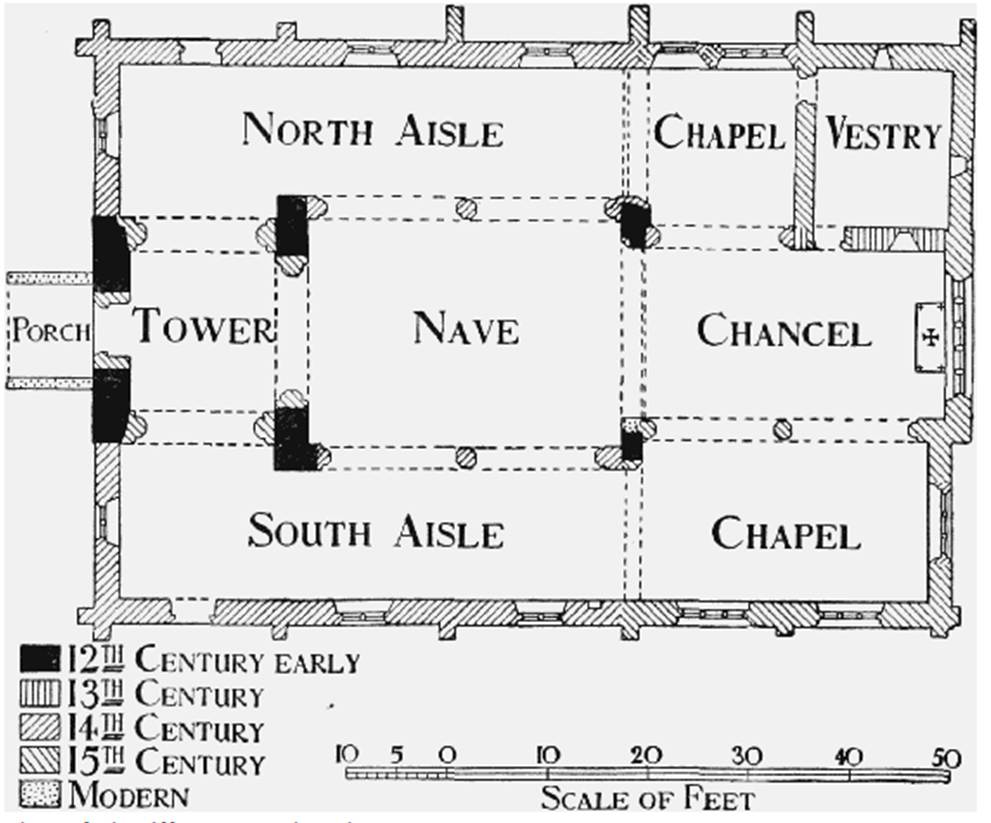
Victorian Plan of
the Church at Sheriff Hutton
In
1273 there were two chapels connected with the mother church of Sheriff Hutton,
for the service of which the vicar was made responsible.
The
advowson (in
ecclesiastical law, the right to recommend a member of the Anglican clergy for
a vacant benefice, or to make such an appointment) descended with the manor
until 1273, when it was given by Emma's greatgrandson
Robert de Nevill to the Prior of Marton, whose successors held it until the
surrender of their house. The church was
appropriated in 1274 and a vicarage ordained, some readjustment of tithes
between the prior and vicar being made in 1332 and again in 1376.
The
Lady Alice de Nevill, presumably the wife of Henry de Nevill son of Emma de
Humez, founded a chantry in Sheriff Hutton Church, and assigned 'le Frith
close' and other lands for its support. In 1348 Ralph de Nevill, for his
'laudable bearing in the battle by Durham against David Brus,' obtained licence
to alienate considerable property, afterwards increased by his heir, to two
chaplains who were to celebrate daily at the altar of St. Mary and St. Peter in
the parish church for the souls of himself and his kindred.
The
church, dedicated in and probably before 1375 in the honour of St. Mary, but
from 1443 in the honour of St. Helen or St. Cross, and more recently St. Helen
and the Holy Cross, was granted by Niel Fossard to the abbey of St. Mary, York,
and seems to have been retained by that house until the early years of the 13th
century, when the abbot quitclaimed his right to Emma de Humez. With the
consent of her son and heir Henry de Nevill Emma granted the abbot in exchange
a pension of 20 marks from the church of Sheriff Hutton.
The
12th-century church was a small aisleless building with a western tower, and of
this there remain the lower part of the tower and portions of the east and west
ends of the nave, which was the same size as that now existing. The first
alteration appears to have been the rebuilding of the chancel in the first half
of the 13th century. This building was aisleless and the eastern portion of the
north wall with one window remains standing. In the following century the
church was enlarged by the addition of wide aisles to the nave extending
westward as far as the western face of the tower, in which was inserted the
present west door. The north and south walls of the old nave were removed and
arcades of two bays erected on each side. A difference in detail shows that the
southern is somewhat the earlier in date. A north chapel was also added to the
chancel. Early in the 15th century the three arches were inserted in the north,
south and east walls of the tower, and shortly after the belfry stage was
added. In the middle of the century the north chapel was rebuilt and the vestry
added to the east of it by Thomas Witham and his wife, the former east window
being removed and inserted in the north wall. At the altar of St. Nicholas and
St. Giles in this chapel a chantry was founded by Thomas Witham. Soon after the
east wall of the chancel was rebuilt, the side walls being raised and a new
roof added. The south wall was entirely rebuilt with an arcade of two bays
opening into a new south chapel, the east end of the south nave aisle being
replaced by an open arch, and the former east window being re-used in the end
wall of the chapel. The last pre-Reformation alteration appears to have been
the addition of the nave clearstory. The only modern addition to the church is the
west porch, which is of 18th or early 19th-century date, but the building has
undergone general restoration and repair (History
of the County of York North Riding, Volume 2, Sheriff Hutton, 1923).
1332
William Farnedale of Shyrefhoton
(FAR00036)
was born in about 1332.
1335
Esmon
de Claveryng, knight to Ralph de Nevill, lord of
Raby: Receipt for an instalment of a pension charged on the said Ralph's manor
of Sheriff Hutton (Hoton Viscont).
Yorkshire North Riding 9 Edw III (National
Archives E210/5277).
South
of the church is the park, which has belonged to the manor since 1335, when
licence was granted Ralph de Nevill to impark his woods of Sheriff Hutton and
make a deer-leap therein. Various grants of the office of keeper of the park in
the 15th and two following centuries are extant, and in 1649 the deer and
timber it contained were valued at a very high price. At that date there were
two dwelling-places within its inclosure; one of
these was the 'Great Lodge,' a brick messuage with large and handsome rooms,
chapel, gallery and walled-in court and garden 'wherein are severall
litle Mounts with Statues thereon placed (History of the County of York North Riding,
Volume 2, Sheriff Hutton).
1344
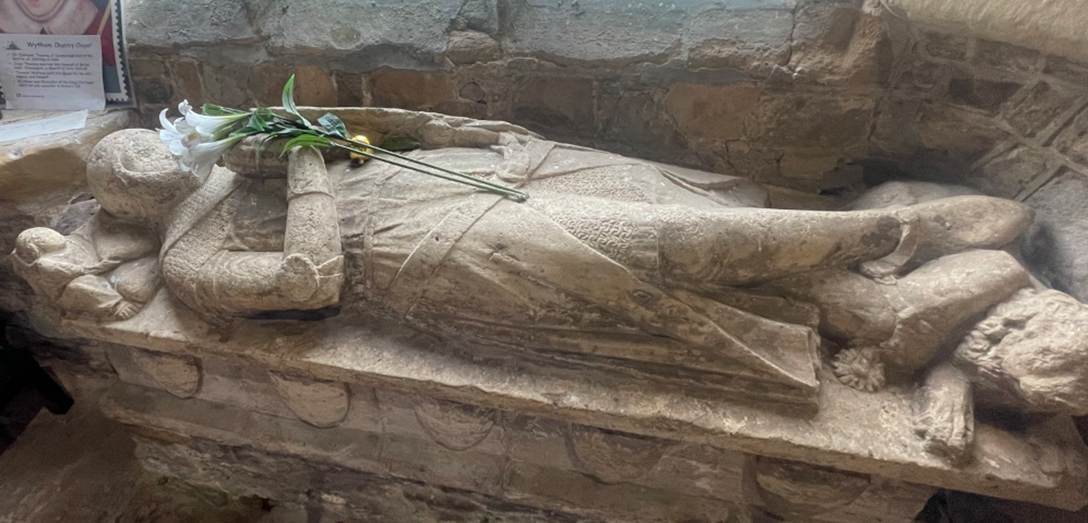
The tomb of Sir
Edmund Thweng, who died at the Stirling in the
Anglo-Scottish Wars in 1344, lies in the Parish Church. He was born in
about 1280 in Cornborough, near Sheriff Hutton, to
John Thweng and Joan de Mauley. He married Isabel Constable and they had a son,
Mameduke de Thweng. Sir Edmund de Thwenge
of Cornburgh, died on 15 Oct 1344 and was buried at
Sheriff Hutton, where his effigy in mail armour still exists in the North
Chapel.
(This was not
the famous Battle of Stirling Bridge against William Wallace of 1297).
1347
Lord Ralph
Neville built the chapel of St Mary and St Peter.
Chancery,
Inquisitions Ad Quod Damnum, taken as a result of applications to the Crown for
license for alternate land. Ralph de Nevill of Raby to grant a messuage, land,
and rent in Sheriff Hutton to two chaplains in the church there, retaining the
manor of Sheriff Hutton. York (National
Archives C143/285/14).
For the next one
and a half centuries, the Neville family, from their base founded on Middleham
and Sheriff Hutton, were to become the most dominant family in the history of
the nation. This was a period of
dynastic upheaval which would lead to the War of the Roses, in which the
Nevilles would play a key role. Richard Neville, Earl of Warwick became known
as the Kingmaker and his mother, Cecily Neville and his daughters Isabell and
Anne Neville married into the Yorkist and Lancastrian families. Therefore, for
the next 150 years, the history of Sheriff Hutton, the Nevilles, and the
nation, are intricately entwined.
In
order to understand the history which would lead to the Wars of the Roses, it
is helpful to understand the complications of the Royal Dynasty at this time.
The Neville family were integrated into the genealogical mix, as was Joan, the
Fair Maid of Kent, and the Holland family, Stuteville descendants and holding
the lands of Kirkbymoorside, and Farndale.
|
A Genealogy which
explains the Wars of the Roses |
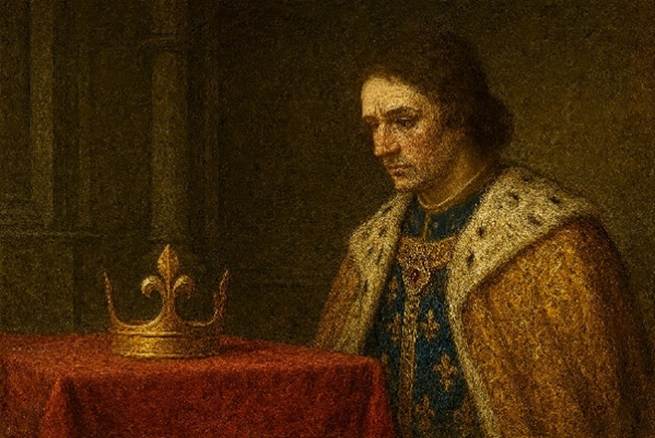
The
traditional feudal system had evolved over the past centuries, and as a system
of the provision of livelihood within royal estates in exchange for rent and
service, it was the source from which an army can be drawn when it is required.
In the late fourteenth century, relying on this system, Edward III had created
duchies for his sons, including the Duchies of York and Lancaster.
Administration was devolved and a new powerful class of rival nobility emerged.
The feudal bond was mutual, so the ordinary classes of folk demanded protection
in return. The duchies grew wealthy and grew in power to be able to raise
powerful armies to protect their interests. This was all fine during the reign
of Edward III, but the seeds of turmoil were sown for the following decades.
The
period was satirically summarised: Noticing suddenly that the Middle Ages
were coming to an end, the Barons now made a stupendous effort to revive the
old Feudal amenities … During the Wars of the Roses the Kings became less and
less memorable (sometimes even getting into the wrong order) (1066
and All That, R J Sellar and Yeatman, 1931)
1350
Grantor:
Ralph de Nevill, knight, lord of Raby. Recipient: Robert de Mustroll, of Bubwith, and Robert de Ulram, chaplains in the church of
Sheriff Hutton. Place or Subject: Sheriff Hutton, with confirmation by William
la Zouche, archbishop of York (National
Archives E326/11354).
1357
William Farnedale of Shyrefhoton
(FAR00036)
married Juliana in about 1357.
1357
Richard Farendale of Sherifhoton
(FAR00044)
was born in about 1357.
1359
Helen Farndale (FAR00045)
was born in about 1332.
1361
Agnes Farndale (FAR00046)
was born in about 1332.
1377
On
Edward III’s death, his grandson Richard II was crowned, at 10 years old.
Richard II was
the son of The Black Prince and Joan (of Stuteville
descent), the Fair Maid of Kent, "the most beautiful woman in all the
realm of England, and the most loving", owner of the estates which
included Farndale.
The
young Richard II’s reign was one of crisis and revolt. He increased his income
to manage the threats against him. A medieval arms race began. Unpopular taxes
gave rise to the Peasant’s
Revolt, but Richard II nevertheless lost land in France. Discontent spread
amongst the noble class.
1380
Richard Farendale of Sherifhoton (FAR00044) may have served in the
Hundred Years Wear in Brittany at this time.
1382
In 1382 John
Neville started to build a second castle on a new site in the village.
The extant
remains of the stone Castle at the western end of the village were built
by John, Lord Neville in the late fourteenth century. In 1382 John
Neville was granted a licence to crenellate (crenallate means licence to fortify), which allowed him to chose a different site for a huge new castle, similar in
design to Bolton Castle, with tall corner towers four or five storeys high and
domestic buildings which were almost as tall arranged around a courtyard.
The
site must have been abandoned by 1382, when John de Nevill was empowered to inclose with a stone wall a plot of his own ground at
Sheriff Hutton and to build a castle there. This plot of ground lies a little
to the west of the earlier site, but on the same side of the village street,
and here John built the castle which became 'the heade
and capitall residence' of his heirs and later the
dwelling of many notable persons. (History
of the County of York North Riding, Volume 2, Sheriff Hutton, 1923).
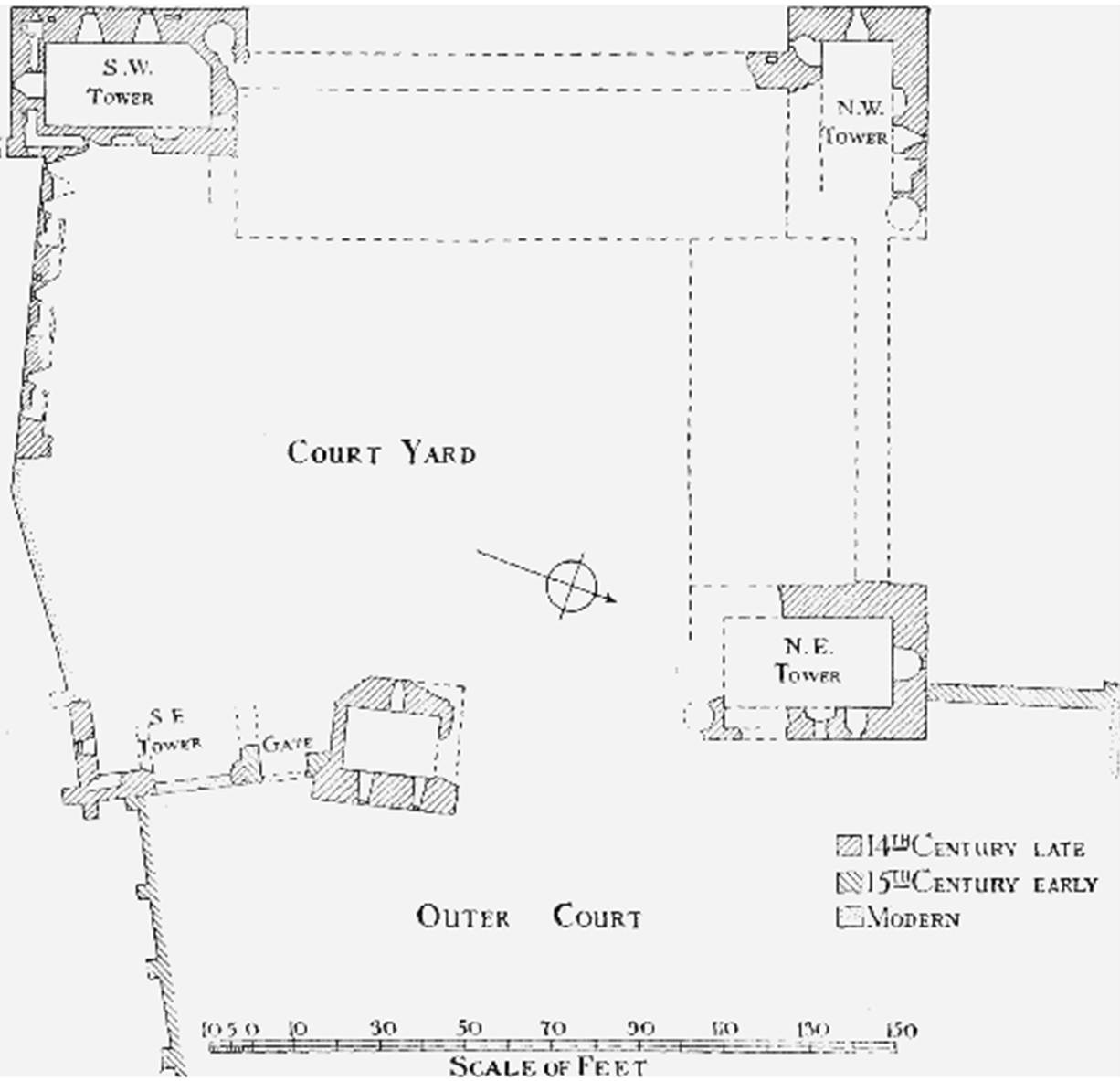
Victorian
Plan Sheriff Hutton Castle
John
de Nevill, lord of Raby to Robert de Coverham: Appointment of William de Hoton
of Tudhoe (Todow) as
attorney to receive seisin of lands, etc, in Sheriff Hutton (Shoroton) (Yorkds, North Riding)
6 Ric II (National
Archives E210/7161).
The
Castle itself was one of several held in this district by the Nevilles, Earls
of Westmoreland, a fragment of one still remains at Kirbymoorside.
Portions of the four towers still defy the ravages of time, while the large
inner area, with its eastern gateway and shields of arms, proclaim it to have
been a place of unusual grandeur. The murky dungeons of the towers, speak in
silent eloquence of deeds of horror enacted under the shelter of its walls (Ryedale and North Yorkshire antiquities, George Frank, 1888,
page
75).
William
Farndayll of Huton (FAR00052) was born in about 1388.
Parties: William de Blakeden and Ralph
lord of Nevill. Place or Subject: Tudhoe (Tuddowe), Newton-Hansard (Newton-haundard)
[In Elwick], Deighton (Dyghton) [in Northallerton], Grewelthorpe (Growelthorpp) [in
Kirkby-Malzeard], Raskelf (Rascall) [in Easingwold], Lillings-Ambo
(Lillyng and Lillyng) [in
Sheriff-Hutton]. Dated at Durham. [Letter of Attorney]. County: [Durham] [Yorks
W.R and N.R.] 12 Ric II (National Archives, E326/5225).
John Lord Nevill died in 1388, and his
son and heir Ralph was created Earl of Westmorland in 1397 for supporting
Richard II against the Lords Appellant, but deserted his king two years later (History of the County of York North Riding, Volume 2, Sheriff
Hutton, 1923).
1397
When Richard Farendale of Sherifhoton
(FAR00044)
perhaps served in the Hundred Years Wear in Brittany in 1380, he had served
under Thomas of Woodstock’s command.
With the addition
of Middleham Castle in Wensleydale and large estates in Cumberland, the
Nevilles came to rival the Percies as the leading
family in northern England.
However his
loyalty to the King was tested shortly afterwards. His first wife, Margaret
Stafford, had died on 9 June 1396, and Neville's second marriage to Joan
Beaufort before 29 November 1396 made him the son-in-law of Richard II 's
uncle, John of Gaunt, 1st Duke of Lancaster.
William Farnedale of Shyrefhoton
(FAR00036)
died, leaving his will:
In the name of God Amen. I, William
Farnedale, on 23 February 1397/8, in good memory, make my testament in this
manner. Firstly, I bequeath my soul to God and the Blessed Mary and all the
Saints, and my body to be buried in the Churchyard at Schyrefhoton.
Item, I bequeath as mortuary payment, the best animal I have. I bequeath to be
burned around my body, as candles, 8lbs of wax. Item, I bequeath to the High
Altar for sins forgiven, 4s. Item, I bequeath to a Chaplain to celebrate divine
services for my soul in the Parish Church of Schyrefhoton
for a whole year, 100s. Item, I bequeath to the fabric of St Peter’s York, 6s
8d. Item, I bequeath to Sir John Ferriby, Robert Gyllyng and William Barneby,
6s 8d each (20s). I bequeath to the Church of Schirefhoton
for putting lead on the south roof, 20s. Item, I bequeath to each Canon of the
Monastery of Marton 12d. I bequeath to every Chaplain ministering on the day of
my funeral, 6d. Item, I bequeath to my wife Juliana, 4li and to my son Richard,
4li. Item, I bequeath to every poor person on the day of my burial 1d. Item, I
bequeath to my son Richard my small sword with all my knives. Item, I bequeath
to my daughter Helen, two cows. Item, I bequeath to my daughter, Agnes 2
bullocks and two plough beasts. Item, I bequeath to Richard Batlay 2 bullocks,
Item, I bequeath to Margaret Batlay 2 bullocks and 2 plough beasts. I bequeath
the rest of my goods to my wife Juliana, my son Richard and my daughter Helen.
And I appoint Sir John Alwent, Rector of the Parish Church of Midelham, Juliana Farndale, Richard Farndale and William
Huby, my executors. In witness whereof I have set my seal. Witnesses: Sir
Robert de Hoton, Prior of Marton and Sir John de Park, Chaplain and many
others, date as above.

1398
The second castle
was completed in 1398.
Appointment
by Ralph [Nevill], earl of Westmorland, lord Nevill, and Joan, his wife, of
John Convers and John de Seton, as their attorneys to receive seisin of the
manor and castle of Sheriff Hutton [Yorkshire], 22 Ric II (National
Archives E326/4517).
The
relationship between Henry Bolingbroke and Richard came to a crisis in 1398. A
remark about Richard's rule by Thomas de Mowbray, 1st Duke of Norfolk, was interpreted as treason by
Henry, who reported it to the king. The two dukes agreed to undergo a duel of
honour at Gosford Green near Caludon Castle,
Mowbray's home in Coventry. However before the duel could take place, Richard
decided to banish Henry from the kingdom (it is said, with the approval of
Henry's father, John of Gaunt), although it is unknown where he spent his
exile, to avoid further bloodshed. Mowbray was exiled for life.
How long a time lies in one little word!
Four lagging winters and four wanton springs
End in a word; such is the breath of kings.
(Henry
Bolingbroke, the future Lancastrian Henry IV reacts to Richard II’s banishment,
Richard
II, William Shakespeare, Act 1, Scene 3)
1399
In
Shakespeare’s depiction, as the Lancastrian John of Gaunt lay dying, he mourned
where Richard had taken his Kingdom:
|
Methinks
I am a prophet new inspired And
thus expiring do foretell of him: His
rash fierce blaze of riot cannot last, For
violent fires soon burn out themselves; Small
showers last long, but sudden storms are short; He
tires betimes that spurs too fast betimes; With
eager feeding food doth choke the feeder; Light
vanity, insatiate cormorant, Consuming
means, soon preys upon itself. |
This
royal throne of kings, this sceptered isle, This
earth of majesty, this seat of Mars, This
other Eden, demi-paradise, This
fortress built by Nature for herself Against
infection and the hand of war, This
happy breed of men, this little world, This
precious stone set in the silver sea, Which
serves it in the office of a wall Or
as a moat defensive to a house, Against
the envy of less happier lands, This
blessèd plot, this earth, this realm, this England, |
This
nurse, this teeming womb of royal kings, Feared
by their breed and famous by their birth, Renownèd for their deeds as far from
home For
Christian service and true chivalry As
is the sepulcher in stubborn Jewry Of
the world’s ransom, blessèd Mary’s son, This
land of such dear souls, this dear dear land, Dear
for her reputation through the world, Is
now leased out—I die pronouncing it— Like
to a tenement or pelting farm. |
England,
bound in with the triumphant sea, Whose
rocky shore beats back the envious siege Of
wat’ry Neptune, is now bound in with shame, With
inky blots and rotten parchment bonds. That
England that was wont to conquer others Hath
made a shameful conquest of itself. Ah,
would the scandal vanish with my life, How
happy then were my ensuing death! |
(Richard
II, William Shakespeare, Act 2, Scene 1)
Whilst
campaigning in Ireland, Richard II was deposed by his cousin, Henry
Bolingbroke, Duke of Lancaster, who became Henry IV, the start of the House of
Lancaster.
|
No
matter where. Of comfort no man speak. Let’s
talk of graves, of worms, and epitaphs, Make
dust our paper, and with rainy eyes Write
sorrow on the bosom of the earth. Let’s
choose executors and talk of wills. And
yet not so, for what can we bequeath Save
our deposèd bodies to the ground? Our
lands, our lives, and all are Bolingbroke’s, And
nothing can we call our own but death And
that small model of the barren earth Which
serves as paste and cover to our bones. |
For
God’s sake, let us sit upon the ground And
tell sad stories of the death of kings— How
some have been deposed, some slain in war, Some
haunted by the ghosts they have deposed, Some
poisoned by their wives, some sleeping killed, All
murdered. For within the hollow crown That
rounds the mortal temples of a king Keeps
Death his court, and there the antic sits, |
Scoffing
his state and grinning at his pomp, Allowing
him a breath, a little scene, To
monarchize, be feared, and kill with looks, Infusing
him with self and vain conceit, As
if this flesh which walls about our life Were
brass impregnable; and humored thus, Comes
at the last and with a little pin Bores
through his castle wall, and farewell, king! |
Cover
your heads, and mock not flesh and blood With
solemn reverence. Throw away respect, Tradition,
form, and ceremonious duty, For
you have but mistook me all this while. I
live with bread like you, feel want, Taste
grief, need friends. Subjected thus, How
can you say to me I am a king? |
(Richard
II, William Shakespeare, Act 3, Scene 2)
Great Duke of Lancaster, I come to thee
From plume-plucked Richard, who with willing soul
Adopts thee heir, and his high sceptre
yields
To the possession of thy royal hand.
(Edmund Duke of York)
With mine own tears I wash away my balm,
With mine own hands I give away my crown.
(Richard
II, William Shakespeare, Act 4, Scene 1)
Quarrels
between rival factions continued. The then Duke of York had an alternative
claim to the throne, which was arguably a better claim.
1400
Richard Farendale of Sherifhoton
(FAR00044)
may have served in an expeditionary force to Scotland.
The
English invasion of Scotland of August 1400 was the first military campaign
undertaken by Henry IV of England after deposing the previous king, his cousin
Richard II. Henry IV urgently wanted to defend the Anglo-Scottish border, and
to overcome his predecessor's legacy of failed military campaigns.
1401
Ralph
was lord of Sheriff Hutton in 1401 (History
of the County of York North Riding, Volume 2, Sheriff Hutton, 1923).
1404
Three
years later Ralph settled the castle and manor on his second wife Joan
Beaufort, daughter of John of Gaunt, and their heirs male, and they were held
by her as his widow from 1425 (History
of the County of York North Riding, Volume 2, Sheriff Hutton, 1923).
1413
The
crisis between the Houses York and Lancaster was put on hold during the reign
of Henry V, the heroic soldier king, victor of the Battle of Agincourt. His
success in France was popular.
1415
Richard Farendale of Sherifhoton
(FAR00044)
may have served with Henry V in the Agincourt campaign
or afterwards, possibly at Harfleur and the Siege of Mantes.
1419
Margorie Farndale (FAR00049)
was born in about 1419.
1421
Anges Farndale (FAR00050)
was born in about 1421.
1422
Henry
V died in 1422 and left a nine month old baby son, Henry VI. The inter noble
rivalry would soon pick up again.
Henry
VI had no father to guide him to Kingship and he relied on his advisors. He
became timid and passive and focused on religion. At this point in history, the
nobility needed strong leadership to control their ambitions. After the
expensive battles in France, financial resources were depleted. The young king
was easily controlled by the rival noble families.
1423
Alice Farndale (FAR00051)
was born in about 1423.
1425
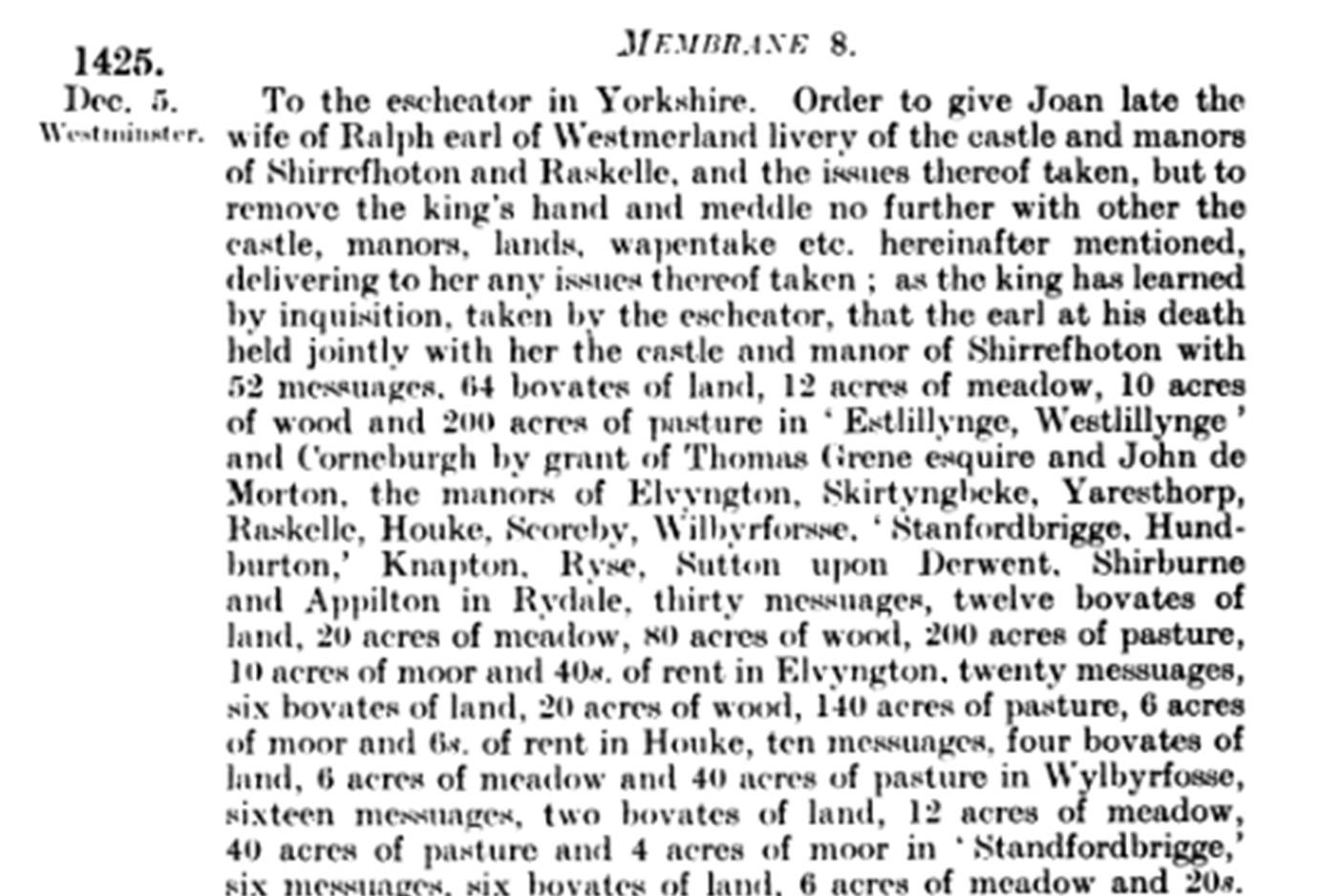
(Close Rolls of the reign of Henry VI, 1422 to 1429, page
238)
1428
William Farndayll of Huton (FAR00052)
held 3 bovates of land at Gowthorpe. Gowthorpe is near Stamford Bridge, about 20 km southeast of
Sheriff Hutton.
1435
Richard Farendale of Sherifhoton
(FAR00044)
died leaving his will:
The Will of Richard Farendale, proved at Sherifhoton 21 Dec 1435. ‘In the name of God Amen, 8th
December 1345. I Richard Farndell being of sound mind make my will in this
manner. Firstly, I bequeath and Commend my soul to God Almighty, My Creator,
and my body to be buried in my said Parish Church. Item. I bequeath a grey
horse with saddle and reins and my armour, viz: a bascinet, a breast plate, a
pair of vembraces and a pair of rerebraces
with leg harness as my mortuary payment. And I bequeath 3 lbs of wax to be
burned around my body on the day of my burial. Item. I bequeath to the Vicar of
my Parish Church 6s 8d and to every chaplain taking part in my burial service
Mass, 4d. And I bequeath 26s 8d for mending a service book for the use of the
parish church. And to the fabric of the Cathedral Church of St Peter York, 12d.
And I bequeath to my daughter Margorie at her marriage 10 marks, if she live to
be marriageable age. And if she die before she arrives at her years of
discretion, I wish the said 10 marks to be divided equally between my daughters
Agnes and Alice. And I bequeath to Joan Brantyng 40s and a bed. And to the four
orders of friars mendicant of York 20s and two quarters of corn to be divided
in equal portions. And to John Pyper 2s. And as regards the rest of my funeral
expenses, I wish them to be paid at the discretion of my executors. The rest of
my goods, not bequeathed above, my debts having been paid, I bequeath to the
said Margorie, my daughter, to be divided among them in equal parts. And I make
the said Thomas Robynson and John Couper and Margorie my daughter, my
executors, faithfully to implement the terms of my will. Witnesses; Robert,
Vicar of the Church of Hoton, William Huby of the
same, John Burdley of the same and many others.’
After Richard died, the three daughters of the probable
old veteran soldier, Margorie (FAR00049), Agnes (FAR00050) and Alice (FAR00051), assuming they were born in
about the 1420s and if they lived until the 1480s or 1490s, would have lived
through the Wars of the Roses, in the lands of the Nevilles and Richard Duke of
Gloucester, later Richard III.
1440
Before
her death in 1440 the widow Joan Neville (nee Beaufort) transferred her rights
in Sheriff Hutton to the eldest son of her marriage with Ralph Neville,
Richard Earl of Salisbury (History
of the County of York North Riding, Volume 2, Sheriff Hutton, 1923).
Richard,
Earl of Salisbury to Henry [Beaufort] the Cardinal of England and Bishop of
Winchester, William Felter, clerk, Alexander Nevile, John Constable, and
Richard Haryngton, Knights, and others: Demise of the castle and manor of
Sheriff Hutton, the manor of Raskelf, and the
wapentakes of Hang, Halykeld and Gilling co. Yorks,
the manors of Clavering and Catmer, co Essex, the castle and manor of Penrith, the manor of
Sowerby, etc: Counties: [Cumberland, Essex, Yorks, N.R.] (National
Archives E327/246).
1445
Henry
VI married Margaret of Anjou. The marriage is arranged to promote a lasting
peace between England and France. Margaret would prove to be the stronger
character in the camp of Lancaster. In the early years though, concerns grow as
no heir is produced, blamed on Margaret, but more likely caused by the naivety
and unworldliness of Henry VI.
In
this period Richard Plantagenet, 3rd Duke of York (husband of
Cecily Neville, the daughter of Ralph Neville), a
veteran commander and politician, commanded the King’s army in France. However
he grew dissatisfied with the King’s conduct regarding the French wars and his
failure to send reinforcements (Richard has to fund his troops from his own
estates). To make matters worse, Richard, but was replaced by his personal
rival, the Duke of Somerset. Somerset sought to influence Henry VI against
Richard of York. Despite his influence and wealth, Richard of York was not
appointed to the royal council.
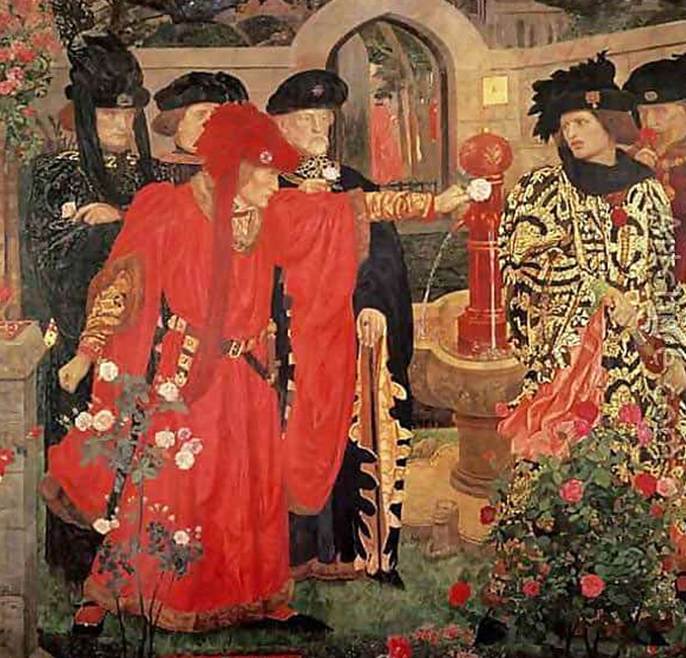
Plucking the Red
and White Roses in the Inner Temple Garden, an allegorical painting by Henry
Arthur Payne, 1910. It depicts the fictional scene by Shakespeare, from Henry
VI, Part 1, of Edmund Beaufort, 2nd Duke of Somerset being challenged by
Richard of York, 3rd Duke of York to choose between the White Rose of York and
the Red Rose of Lancaster.
Richard
Plantagenet (Duke of Gloucester). Since you are tongue-tied and so loath to
speak, In dumb significants proclaim your thoughts:
Let him that is a true-born gentleman And stands upon the honour of his birth,
If he suppose that I have pleaded truth, From off this brier pluck a white rose
with me.
Duke/Earl
of Somerset. Let him that is no coward nor no flatterer, But dare maintain the
party of the truth, Pluck a red rose from off this thorn with me.
Earl
of Warwick. I love no colours, and without all colour. Of base insinuating
flattery. I pluck this white rose with Plantagenet.
Earl
of Suffolk. I pluck this red rose with young Somerset. And say withal I think
he held the right.
Vernon.
Stay, lords and gentlemen, and pluck no more, Till you conclude that he upon
whose side The fewest roses are cropp'd from the tree
Shall yield the other in the right opinion.
(Henry VI Part 1, Act II, Scene 4)
1447
Richard
of York was made Lord Lieutenant of Ireland. This was a prestigious
appointment, but probably made by a cautious Henry VI eager to have Richard
placed away from England and France. There was distrust and misunderstanding
between Richard of York and King Henry. Richard of York was offended by Henry’s
actions and declining of his advice whilst Henry felt threatened by Richard of
York.
As
commander of the English Army, the Duke of Somerset squandered York’s
successes.
1449
Rouen
was surrendered without a siege. The French recovered Normandy and Aquitaine.
There
was serious unrest and Richard of York demanded stronger government and a
rounding up of the traitors who had been so disastrously conducting the war.
There were grievances at high taxation and a desire for legal stability.
This
was Yevgeny
Prigozhin in fifteenth century England. Richard of York did not like the
way the King’s advisers were taking things.
Threateningly
Richard of York returned from Ireland to England without permission, with his
own army, and distributed pamphlets which championed his good governance
implicitly implying Henry’s shortcomings in administration. He built support.
This
led to his arrest and he was forced to swear an oath of allegiance to the King.
1452
Richard,
son of Richard Plantagenet, Duke of York and Cecily Neville (one day to be
Richard III), was born in Fotheringay Castle,
Northamptonshire. He was born into a world of strife, just as the Wars of the
Roses was about to begin.
This was not a
civil war between the counties of York and Lancashire, but a baronial war
between the Houses of Lancaster and York, who each had widespread interests
across the country. The leading families
in the East and West Riding of Yorkshire supported the House of Lancaster, but
in the North Riding loyalty was divided:
· The Nevilles of
Sherif Hutton and Middleham, the Scropes of Bolton,
the Latimers of Danby and the Mowbrays of Thirsk supported the House of
York.
· The powerful
House of Percy, the Clifford of Skipton, Ros of Helmsley and Talbot of
Sherfield supported the House of Lancaster.
1453
After
further setbacks in France, and the recovery by France of Gascony, Henry’s
mental health declined. He was smitten with a frenzy and his wit and reason
withdrawn.
The
Duke of York took control of the situation and established a regency. Appointed
regent, he imprisoned the Duke of Somerset in the Tower of London.
Queen
Margaret of Anjou was furious, but was then in a late stage of her pregnancy.
She then gave birth to a son, Edward of Westminster, Prince of Wales. The
depressed King failed to recognise Edward as his heir which would later give
rise to issues with his illegitimacy.
Margaret
of Anjou stepped in to take a more proactive role in the preservation of
Lancastrian interests. She is probably unfairly maligned as a scheming female
protagonist. Rather she was naturally protecting her family’s interests.
1455
Henry
made a surprise recovery from his mental illness. Richard of York’s council was
dissolved and he was forced out of court. He now faced the risk of charges of
treason. The stakes had become higher.
York
therefore started to recruit an army. His two principal allies were Richard Neville,
Earl of Salisbury and his son, Richard Neville, the Earl of Warwick. The Earl
of Warwick was a political manoeuverist, a master of
political spin. It was probably Warwick who spun tales which painted Margaret
of Anjou in a bad light. Richard of York benefitted
from his own cunning strategist.
From his paternal
Nevill forebears Richard Neville, 16th Earl of Warwick, later known as
the Kingmaker, had inherited great estates in the north of England,
particularly in Yorkshire, with their administrative centres in the two great
strongholds of Middleham the North Riding and Sheriff Hutton a few miles north
of York. He was also powerful in the north western counties, where he was
warden of the west march towards Scotland, with his base at Carlisle.
Through his mother he inherited the Montagu earldom of Salisbury. Through
marriage he had assumed the earldom of Warwick. All this made Warwick
immeasurably the greatest power in the north of England, especially since the
great rivals of his family, the Percy earls of Northumberland, had been
eclipsed by the fortunes of war. His castles of Middleham and Sheriff Hutton,
and it is reasonable assumption that much of the young Richard's time was spent
there, were thus the centres of patronage, influence and aristocratic social
life for the counties north of Trent.(Richard
III, Charles Ross, 2011, page 7).
In
May 1455 Richard of York marched south towards London. The royal army was taken
by surprise. On 22 May 1455, they meet at St Albans.
Henry
IV’s army, commanded by the Duke of Buckingham as Constable of England,
alongside his ally Lord Clifford, were mustered at St
Albans. The pacific Henry IV was there himself. This was his first
experience of battle.
Richard’s
force positioned themselves on the road from the north and barricaded the
gateways.
The
Yorkists didn’t dare to oppose royal authority directly, but had demands
purportedly to protect the King from his poor advisers. Richard of York,
suggested he was not opposing the King directly, but demanded the surrender of
the King’s forces, and for the Duke of Somerset to stand trial. However his
force of arms suggest this is really a coup. But Richard was not for
compromise.
Knowing
that reinforcements were on the way to support the hastily drawn together royal
army, Richard decided to take advantage of his numbers and attacked the
barricades. Richard of York’s ally, the Earl of Warwick led an attack of
archers. Richard Neville, Earl of Warwick outmanoeuvred the royal forces and
they abandoned their positions. The Duke of Somerset was hacked to death, as
were Clifford and other nobles. A street battle ensues and Henry himself was
wounded.
This
was the start of a civil war that came to be known as the
Wars of the Roses between two rival branches of the House of Plantagenet,
the Houses of Lancaster and York.
After
the battle the victorious Richard of York bent the knee to Henry VI in a chapel
of St Albans church (though some say it was in a smelly tanner’s shop). Having
disposed of his enemies, Richard of York apologised for the wounding of the
King and assured him of his loyalty. The weak Henry VI did not then act
decisively, but forgave those who had fought against him at St Albans.
Richard
of York became principal advisor and Constable of England. Richard Neville,
Earl of Warwick was made Commander of the English forces in France.
Henry
VI became a broken man. However Margaret of Anjou gathered support amongst the
nobility in resistance to Richard of York.
There
was high tension in court over the following years.
1456
However
by 1456, Margaret Anjou had taken control of the government.
1459
The six year old
Richard, son of Richard of York, was moved to the Yorkshire stronghold of
Ludlow Castle.
Henry
VI summoned Richard of York, Richard Neville Earl of Warwick, and his father
Richard Neville, Earl of Salisbury to an inquiry into their actions. The three
men decline the summons, but rallied at Ludlow Castle, west of Birmingham. The
young seven year old Richard, Edward’s brother, must have been thrilled at the
excitement of the Yorkist forces who came top Ludlow Castle, in his father’s
cause. The young Richard and his brother George remained at Ludlow.
Margaret
of Anjou gathered a large army to prevent the forces from meeting, but when the
royal army engaged with Salisbury’s at Blore
Heath near Market Drayton (he was travelling south from Middleham), many of
her troops switched allegiance and attacked the rear of her own force. The
Yorkist force won the battle decisively.
There
are traditions that Margaret watched the battle from a church tower and fled
after the battle was lost on a horse whose shoes were reversed to confuse her
pursuers. In reality she was unlikely to have been there.
However
the Earl of Warwick’s troops defected. The Yorkists did not seize power at this
stage, and Richard of York fled to Ireland and Richard Neville, Earl of
Salisbury and Richard Neville, Earl of Warwick fled to France. Ludlow castle was then sacked, and everything
stolen from the castle, witnessed by the horrified young future Richard III.
The Nevilles were
declared traitors and they were disinherited of their lands by an Act of
Attainder. Cecily Neville negotiated an income for her and her younger
children, including Richard. Richard had been forced to grow up quickly as he
witnessed these events during these tumultuous years.
1460
The
Yorkists in exile had nothing to lose. In 1460 Richard Neville, Earl of
Warwick, returned with another army, and with Edward of York, Richard of York’s
eldest son.
The
Yorkist army gathered support in London and then headed to Margaret of Anjou’s
defensive position at Northampton.
Once again a large section of Margaret’s army defected and the Yorkist victory
was swift. King Henry was taken prisoner again.
Richard
of York then returned from Ireland. He arrived in Parliament and provocatively
placed his hand on the throne, which shocked even his own supporters. An Accord
was agreed whereby Henry VI would continue to rule but Richard of York would
succeed him. In reality the discord between factions was such that the
compromise in reality only served to enhance divisions. Henry’s son Edward was
disinherited and Margaret Anjou was furious. She took Edward to their relatives
in Wales, the Tudors.
Margaret
of Anjou continued to rally to the Lancastrian cause, but having secured the
Accord, Richard of York considered this to be illegal. So he marched an army
north, purportedly under the King’s authority, reverting to his old role as
Lord Protector.
Richard
of York was forced to retreat in the face of Lancastrian opposition to Sandal
Castle near Wakefield, The Lancastrian army was led
by the new Duke of Somerset, the Earl of Northumberland and Lord Clifford of
Skipton. On 30 December 1460 at the Battle
of Wakefield, Richard, perhaps unwisely, left the security of the castle
and attacked the Lancastrian force. The Yorkists were initially the superior
force, but then Lord Clifford (whose father had been butchered at St Albans)
attacked from the rear. This was the first of two great Wars of the Roses battles fought
in Yorkshire.
Richard
of York, husband of Cecily Neville, was soon swamped by Lancastrian soldiers
and was killed. His younger son Edmund was also killed in the battle. Richard of York’s head was hung on the city
wall at Middlegate, York, with a paper crown on its head.
The
young future Richard III was sent to the Netherlands for safety.
Richard Neville
Earl of Salisbury escaped to Calais after the Yorkist army collapsed in the
Rout of Ludford Bridge, having been specifically excluded from a royal pardon.
He returned to England with York in 1460, and was slain on 30 to 31 December
1460, the night after the Battle of Wakefield.
1461
The
Lancastrians marched towards London, but Edward of York still relied on the
Accord signed by the King for his claim to the throne.
On
1 February 1461, Edward led an army of 5,000 to intercept the Lancastrian army
near Mortimer’s
Cross, close to the Yorkist stronghold of Ludlow Castle. Before the battle
the armies saw three suns rise at dawn, a phenomenon called a parhelion caused
by the reflection of ice crystals, which was taken by the Yorkists as a
positive omen and later incorporated into the Yorkist arms. Edward won the
battle.
Margaret
of Anjou marched south from the north of England and the Earl of Warwick
marched north to make a stand, this time with the Yorkists on the defensive, at
St Albans where the armies would face each other for a second time. The second
battle at St Albans was once again a battle of urban warfare and this time
the Yorkist army disintegrated and King Henry VI was recovered found singing
under a tree.
The
Lancastrians returned to London with Henry VI.
The
Earl of Warwick then began a propaganda campaign, portraying Margaret of Anjou
as an apocalyptic woman at the head of a Viking like army, about to threaten
the folk of southern England. He gave rise to a probably unfair evil legend of
Margaret of Anjou. Edward of York was a powerful, charismatic individual,
easily contrasted to Henry VI and insisted on his rightful claim agreed by
Henry VI in the Accord. The argument was advanced that Margaret of Anjou had
broken the agreement at the Second Battle of Albans.
Queen
Margaret’s army was still in Yorkshire and regrouped and she set up her force
in position near Tadcaster.
There,
the executed Richard of York’s elder son, Edward won a decisive victory against
Henry VI at the Battle
of Towton on 29 March 1461. This
was the second of two great Wars of the Roses battles fought in Yorkshire. The
battle was fought in a snowstorm. Edward attacked before his reinforcements
from the Duke of Norfolk had arrived. They surprised the Lancastrians with
volleys of arrows carried by the wind up the hill into the Lancastrian army. To
reinforce their success, the Duke of Norfolk then arrived. It was probably one
of the largest battles ever fought on English soil, with over 50,000 combatants
and most of England’s nobility. The rivers were said to have run red with blood
for days after the battle.
Henry
VI, Margaret, and their son the Prince of Wales fled to York
and then on to Scotland, while Edward marched south to London..
On
28 June 1461 Edward Plantagenet was crowned King Edward IV at Westminster. The
Coronation was lavish.
Richard
of York’s younger son, Richard, Duke of Gloucester remained for a time in the
care of the Archbishop of Canterbury and was then sent to the lavish household
of the Earl of Warwick at Middleham. There he started training as a soldier and
courtier.
Richard spent
several years during his childhood at Middleham Castle in Wensleydale, under
the tutelage of his cousin Richard Neville, 16th Earl of Warwick, later known
as 'the Kingmaker' because of his role in the Wars of the Roses. Warwick
supervised Richard's training as a knight. In the autumn of 1465, Edward IV
granted Warwick 1,000 pounds for the expenses of his younger brother's
tutelage. With some interruptions, Richard stayed at Middleham either from late
1461 until early 1465, when he was 12.
He met Warwick’s
daughter and heir, Anne Neville at Middleham. Perhaps they fell in love, but
the records don’t make that clear.
1464
Warwick
pursued the Lancastrians in Ireland and in May 1464 defeated a Lancastrian
force at Hexham. Henry escaped south.
1465
Henry
formerly Henry VI was discovered at Waddington in Yorkshire, close to the
border with Lancashire, sheltering with Lancastrian sympathisers. He was
captured and returned to the Tower of London.
1465
George Neville
was appointed Archbishop of York, reinforcing the leading role of the Neville
family in the north of England.
1468
Beneficiary
of the warrant: Morris Arnold, the king's serjeant porter. Subject: £9 6s 8d
for delivering a grey horse to Lord Wenlock, who then delivered it to a servant
of the marquess of Farrowe; and also for the costs
and expenses of two persons by him conducted from London to Sheriff Hutton to
the earl of Warwick. Authorising clerk: Tilghman. Dated at Westminster, 2 Jul 8
Edw IV (National
Archives E404/74/1/46).
1469
It is possible
that even at this early stage Warwick was considering the king's brothers as
strategic matches for his daughters, Isabel and Anne. Young aristocrats were
often sent to be raised in the households of their intended future partners, as
had been the case for the young dukes' father, Richard of York.
Relationships
between Edward VI and Richard Neville Duke of Warwick then became strained.
Edward negotiated with the Duke of Burgundy to restart the war with France.
Warwick instead sought an alliance with France through a marriage between
Edward and the French King’s daughter. However Edward married a commoner,
Elizabeth Woodville, in secret, the widow of a Lancastrian knight. Warwick was
furious. The Woodville family were promoted into positions of power.
As the
relationship between the king and Warwick became strained, Edward IV opposed
the match of his brothers and the Nevilles.
Edward removed Warwick’s brother from the office of Lord
Chancellor, and the Neville family influence seemed to be in decline.
Warwick recruited George, Duke of Clarence, the King’s
younger brother, and persuaded him to marry his daughter and to start a
rebellion against the King. During Warwick's lifetime, George was the only royal brother to
marry one of his daughters, the elder, Isabel, on 12 July 1469, without the
king's permission.
George
joined his father-in-law's revolt against the king, while Richard remained
loyal to Edward, even though Edward was rumoured to have been having an affair
with Anne.
In
April 1469, there was rebellion in Yorkshire. Warwick and Clarence travelled
north purporting to suppress the revolt. Warwick was really plotting to replace
the King with George, his brother and his own daughter as Queen.
In the ensuing
battles, Edward was captured and taken to Middleham Castle. However it became clear that Warwick and George did not
have the necessary public support. Edward was released and reconstructed his
regime after the 1469 rebellion.
1470
At
this point the Lancastrian Margaret of Anjou exploited the opportunity of intra
Yorkist rivalry and returned to England and met secretly with Richard Neville,
Earl of Warwick. They reached an agreement whereby another of Warwick’s
daughters, Anne Neville, would marry Margaret’s son, Edward, the once Prince of
Wales, and heir to the Lancastrian claim to the throne.
Richard Neville,
Earl of Warwick, and George, Duke of Clarence landed an army in Devon in
September 1470. Edward rushed to meet them but was quickly surrounded.
Henry
VI was released from prison in the Tower of London. He was restored to the
throne, now with Richard Neville, Earl of Warwick, the Kingmaker, as well as
Margaret of Anjou, in support. George, Duke of Clarance, was rewarded for his
treachery to Edward, by becoming the new Duke of York. After rivalry between
the Yorkist brothers, it was becoming less clear who was a York and who was a
Lancastrian!
Richard and
Edward were forced to flee to Burgundy in October 1470 after Warwick had
defected to the side of the former Lancastrian queen Margaret of Anjou. In
1468, Richard's sister Margaret had married Charles the Bold, the Duke of
Burgundy, and the brothers could expect a welcome there.
Warwick’s
daughter Anne Neville was married to Henry VI’s son, Edward.
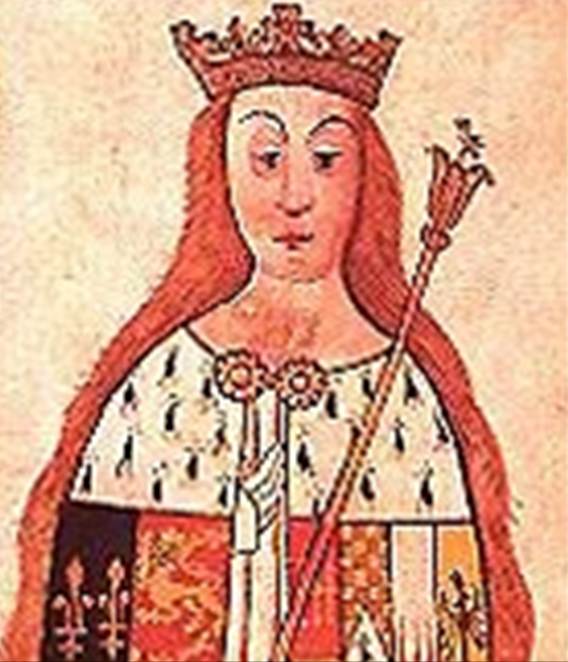
Anne Neville
1471
However
the new restored Lancastrian dynasty found itself isolated, with too many
enemies made from Warwick’s scheming. There were widowed wives and fatherless
sons with long memories who despised Richard Neville.
Edward returned from Burgundy and landed in Yorkshire and
built a large army founded on Richard, Duke of Gloucester’s large power base in
Yorkshire. George, the new Duke of York, sensed a change of the tide, and
joined his brothers, probably encouraged by Cecily Neville, relinquishing his
title to revert to the Duke of Clarence. Edward was welcomed back into London
and Henry was once again imprisoned in the Tower of London, never to leave
again.
Edward
was restored to the throne in the spring of 1471. Warwick’s troops then
confronted Edward’s army at, following the battles of Barnet,
just north of London on Easter Sunday in April
1471. Warwick’s army was destroyed in a foggy battle. Richard Neville,
Duke of Warwick fled, and despite Edward’s orders to the contrary, he was
killed in a brutal fashion. His corpse was displayed at St Paul’s cathedral so
all would know that he had died.
By
his will the earl left this manor to his widow Alice daughter and heir of
Thomas Montagu Earl of Salisbury, with remainder to their eldest son Richard.
The countess did not survive her husband's violent death on the morrow of the
battle of Wakefield many years, and
Sheriff Hutton was held by her son and heir Warwick
'the Kingmaker' when he fell at Barnet in April 1471. (History of the County of York North Riding, Volume 2, Sheriff
Hutton, 1923).
Margaret
of Anjou then landed with French reinforcements on the south coast and they
were joined by soldiers from Wales and their Tudor allies. However they were
also wiped out at Tewkesbury.
The young Edward, son of Edward IV and now first
husband of Anne Neville was killed at Tewkesbury. Anne Neville became a widow.
In both battles
the 18-year-old Richard, Duke of Gloucester, played a crucial role and was in
the thick of the fighting.
|
Richard of
Gloucester’s Northern Interests
The future Richard
III’s interests in Yorkshire and northern Britain |
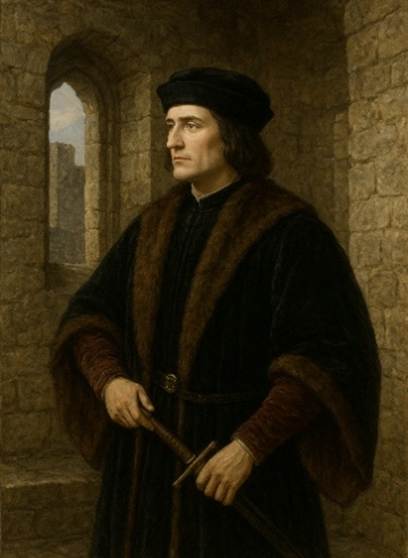
According to
Shakespeare, Richard Duke of Gloucester was already scheming by this stage, but
this was probably Tudor propaganda:
|
Things
were good after the Yorkist Victory Now is the winter of our discontent Made glorious summer by this son of
York, And all the clouds that loured upon
our house In the deep bosom of the ocean
buried. Now are our brows bound with
victorious wreaths, Our bruisèd
arms hung up for monuments, Our stern alarums changed to merry
meetings, Our dreadful marches to delightful
measures. Grim-visaged war hath smoothed his
wrinkled front; And now, instead of mounting barbèd steeds To fright the souls of fearful
adversaries, He capers nimbly in a lady’s chamber To the lascivious pleasing of a lute. |
But
Shakespeare painted a scheming Richard of Gloucester But I, that am not shaped for sportive tricks, Nor made to court an amorous looking
glass; I, that am rudely stamped and want
love’s majesty To strut before a wanton ambling
nymph; I, that am curtailed of this fair
proportion, Cheated of feature by dissembling
nature, Deformed, unfinished, sent before my
time Into this breathing world scarce
half made up, And that so lamely and unfashionable That dogs bark at me as I halt by
them— Why, I, in this weak piping time of
peace, Have no delight to pass away the
time, Unless to see my shadow in the sun And descant on mine own deformity. And therefore, since I cannot prove
a lover To entertain these fair well-spoken
days, I am determinèd
to prove a villain And hate the idle pleasures of these
days. Plots have I laid, inductions
dangerous, By drunken prophecies, libels, and
dreams, To set my brother Clarence and the
King In deadly hate, the one against the
other; And if King Edward be as true and
just As I am subtle, false, and
treacherous, This day should Clarence closely be
mewed up About a prophecy which says that “G” Of Edward’s heirs the murderer shall
be. Dive, thoughts, down to my soul. |
(William Shakespeare, Richard III,
Act 1, Scene 1)
Henry
VI died, probably murdered, in the Tower of London. Lancastrians were executed
in large numbers. Margaret of Anjou fled to France.
There
are many references to the Plantagenet connections with Sheriff Hutton Castle
including the Sun in Splendour of Edward IV and Neville and Dacre shields in
the stained glass, much of it damaged at the Reformation (Sheriff Hutton website).
When Warwick 'the Kingmaker' fell at Barnet in April 1471, in the same year Edward IV included it in a grant to his
brother Richard of Gloucester, which was renewed after the duke's marriage with
Warwick's younger daughter Anne . (History of the County of York North Riding, Volume 2, Sheriff
Hutton, 1923).
All the Neville’s
property was forfeited to the Crown in 1471 to be shared between Edward IV’s
brothers. Richard Duke of Gloucester (the future Richard III) was given Sheriff
Hutton and Middleham, as well as part of the Cumberland estates.
It
appears to have remained in this family until the time of Richard Neville, Earl
of Warwick, who was slain at the battle of Barnet, when it came into the hands
of Edward IV, who granted it to his brother Richard, Duke of Gloucester (Ryedale and North Yorkshire antiquities, George Frank,
1888, page
74).
The widowed Anne
Neville, his Queen, was under house arrest in London. We don’t know whether
Richard was motivated by affection or greed, but he secured Anne’s release.
According to
Shakespeare the meeting of Richard and Anne Neville at this stage did not go so
well:
ANNE (to the bearers of Edward’s coffin): Set down, set down your honorable load,
If honor may
be shrouded in a hearse,
Whilst I awhile obsequiously lament
Th’ untimely fall of virtuous
Lancaster.
..… O, cursèd be
the hand that made these holes;
Cursèd the heart that had the heart to do it;
Cursèd the blood that let this blood from hence
And when Richard Duke of Gloucester appeared,
Shakespeare portrayed him unfavourably:
ANNE: What black magician conjures up
this fiend
To stop devoted charitable deeds?
…RICHARD
I did not kill your husband.
ANNE
Why then, he is alive.
RICHARD Nay, he is dead, and slain by
Edward’s hands.
…ANNE
Never hung poison on a fouler toad.
Out of my sight! Thou dost infect mine
eyes.
(Anne Neville mourning the death of her
husband in William Shakespeare, Richard III, Act 1,
Scene 2)
In Shakespeare’s
interpretation, after the encounter, Richard wonders if he might seduce her: Was
ever woman in this humor wooed? Was ever woman in
this humor won? Shakespeare tells of Anne unable
to resist Richard's advances becoming the Duchess of Gloucester, whilst Richard
engineers the imprisonment of his elder brother, Clarence, in the Tower of
London.
Edward
IV invaded France with Richard Duke of Gloucester leading the largest force.
Edward later signed a treaty with France which incensed Richard. There was a
tension between the brothers. Richard was perhaps still influenced by Richard
Neville’s teaching from his youth.
Edward
sent his young son Edward to Ludlow Castle to be brought up by the Queen’s
brother, Anthony Woodville. His second son, Richard, became Duke of York.
Richard, Duke of
Gloucester was a military hero who had shown bravery in battle. He was the
wealthiest man in Britain after the King.
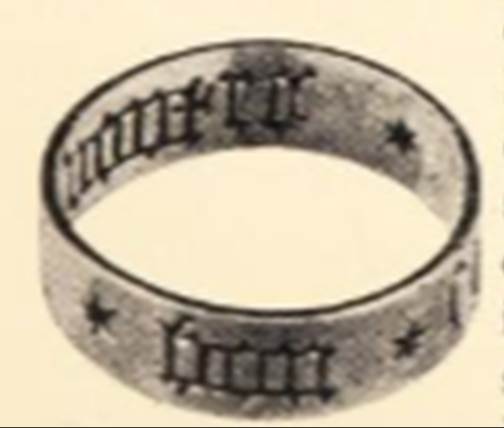
The Sheriff Hutton Posy Ring was found between the moats at
Sheriff Hutton Castle in the early twentieth century. It is a plain circular
band of rather yellow gold, and has love mottoes or posies engraved both
outside and inside in Old French. The outside reads bon core de core and the inside reads le
tout voutre (“All Yours”). The rings dates to the time of Richard III and
Anne Neville, and Elizabeth of York. Posy rings were in great favour from the
middle of the sixteenth to the close of the seventeenth century, and are
mentioned much earlier in Chaucer’s Troilus and Criseyde, Book 3, c1368.
(Yorkshire Archaeological Journal, Volume 29, 1929,
page 352).
1472
As Duke of
Gloucester, Richard, later Richard III (aged 20), then married Lady Anne
Neville (still aged only 16) of Middleham and Sheriff Hutton, the daughter of
the now dead Richard Neville, Earl of Warwick, the Kingmaker on 12 July 1472,
previously married to Edward of Westminster, only son of Henry VI, to seal her
father's allegiance to the House of Lancaster. Richard therefore formerly
inherited the vast Neville estates.
The Croyland Chronicle records
that Richard agreed to a prenuptial contract in the following terms: "The
marriage of the Duke of Gloucester with Anne before-named was to take place,
and he was to have such and so much of the earl's lands as should be agreed
upon between them through the mediation of arbitrators; while all the rest were
to remain in the possession of the Duke of Clarence". Richard retained
Neville's forfeit estates he had already been granted in the summer of 1471:
Penrith, Sheriff Hutton and Middleham, where he later established his marital
household.
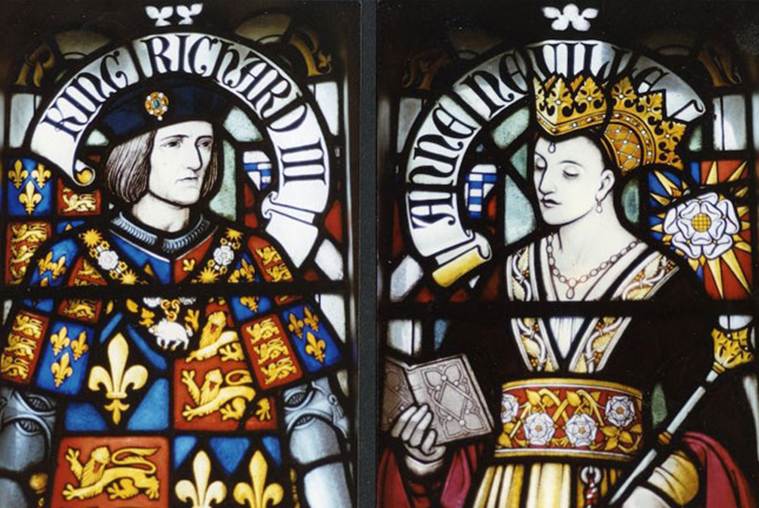
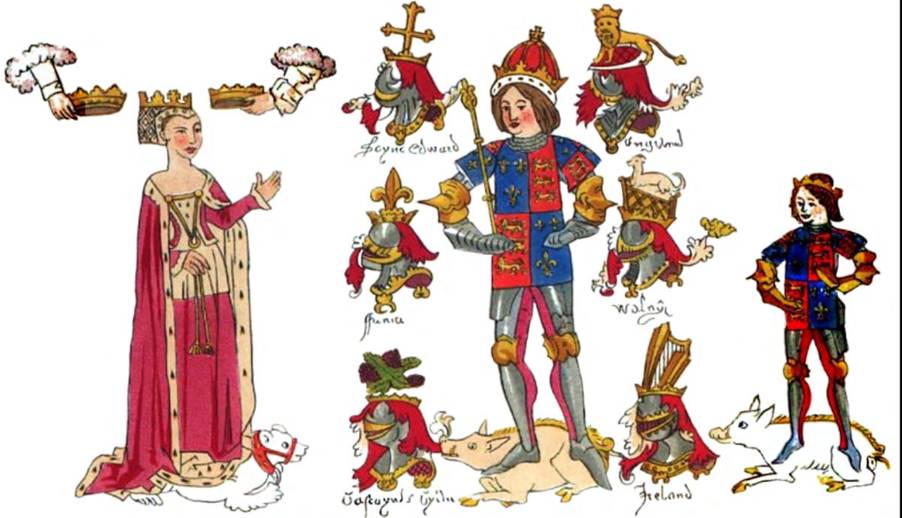
Richard and Anne in stained glass, Cardiff Castle Richard and Anne Neville with their son Edward
from an illumination in the Rous Roll, 1483
Whilst
reinforcing Richard’s claims to the Neville lands, it may be that Anne had
approached Richard with the idea of marriage, for protection in the new Yorkist
England. The match was mutually beneficial.
Both the
treacherous Duke of Clarence, and the Duke of Gloucester, were married to
Neville sisters. This gave both Dukes claims to the Neville lands. A bitter
rivalry grew between them. Edward was forced to intervene to divide the Neville
estates. The Duke of Clarence didn’t like the deal.
He started to spread rumours about Edward’s legitimacy.
1473
Richard’s links
with Yorkshire had developed in his teenage years, when he lived at Richard
Neville’s fine castle at Middleham, Wensleydale, to where he returned in his
twenties in 1473 to live for a decade with his young bride Anne, daughter of
the now dead Earl of Warwick. He held the post of Warden of the West Marches,
which included much of modern North West England. With
the symbol of a white wild boar, in effect he was the Governor, on behalf of
the English Crown, of most of the North of England as the King’s loyal
Lieutenant. As a highly respected Lord Protector and High Constable, Richard
soon established himself as a champion of justice and equality before the law,
admired by rich and poor alike as a good and fair ruler. As Lord of Scarborough,
he ordered building of the borough walls and harbour improvements, encouraging
trade from Whitby,
Scarborough and Hull. Having been granted the Honour of Skipton, he paid for
major improvements to the Parish Church. As King he also became a huge
benefactor of York
Minster, ordering a new chantry and paying for new altars and living
accommodation for priests. He was also a deeply committed Christian. He and his
wife Anne were members of the Corpus Christi Guild in York. See the Yorkshire Branch of the Ricardian
Society.
Richard Duke of Gloucester would have stayed regularly at Sheriff
Hutton and Middleham.
In 1473 (though perhaps
as late as 1476), Richard and Anne had a child, Edward,
though he was sickly and stayed at the protection of Middleham Castle. Richard
had two illegitimate children from before his marriage to Anne (John of
Gloucester (also known as John of Pontefract) and Katherine, Countess of
Pembroke), but Edward was his only true heir.
1476
The Duke of
Clarence’s wife, Isabel Neville, died in 1476. She
had been a calming influence and after she died he started to come up with
conspiracy theories.
1477
Edward’s
brother George started to misbehave. When his wife died, he tried and executed
one of his ladies in waiting accused of poisoning her, and of witchcraft, but
thereby usurped the authority of the King. Les Magiste,
assuming the power of the King, was an act of treason.
Some
additional safeguards against the representatives of the house of Nevill seem,
however, to have been thought necessary. The castle and manor of Sheriff Hutton
were conveyed to the Duke of Gloucester and his trustees in 1477 by Sir Ralph
Nevill and his wife Isabel, in 1480 by Sir John Radcliffe and his wife
Katherine, lately widow of Sir Oliver Dudley, the right therein on each
occasion belonging to the wife (History
of the County of York North Riding, Volume 2, Sheriff Hutton, 1923).
1478
George
was executed on 18 February 1478. A rumour quickly spread that he was drowned
in a vat of Malmsey wine.
1479
Extract from Originalia rolls concerning castles, manors and lordships
of Middleham (National
Archives E 314/68/39).
1483
In
March 1483, Edward fell ill during a fishing expedition and died. Upon his
death, his son Edward, only 12 years old, became King Edward V. In a codicil to
his will, written a few days before he died, Edward IV had named his brother
Richard as Lord Protector.
After
the death of the King, the Earl of Rivers was arrested by Gloucester, and sent
here as a prisoner ; he also, after the brutal murder of the Princes in the
Tower, seized his nephew, Edward Plantagenet, and his neice,
Elizabeth (daughter of the late King) who had refused to marry him, and they
were also imprisoned here. It is thus seen what a prominent part this fortress
has played in the history of our country. (Ryedale and
North Yorkshire antiquities, George Frank, 1888, page
74).
As Edward
IV died, Edward V lived with his uncle Anthony Woodville, Earl Rivers, brother
of the widowed Queen Elizabeth Woodville. The Woodvilles
tried to use this advantage to overthrow Richard as Lord Protector and retain
control of the new King Edward V’s destiny themselves.
In
York, Richard heard of his brother’s death and headed south calling on the Woodvilles to meet him with Edward at Northampton. Edward V
also headed south with the Woodvilles in a long
procession, but did not head for Northampton, but for London. However Richard
took control and seized the Woodvilles, sending Earl
Rivers to Pontefract Castle to be executed. In this chaotic situation, there
was disquiet and rioting in London. At Sheriff Hutton Castle Anthony Woodville was
imprisoned by Gloucester, and here he made his will before being removed to
Pontefract for execution in 1483 (History
of the County of York North Riding, Volume 2, Sheriff Hutton, 1923).
Richard
then accompanied Edward V to the Tower of London, then a royal residence as
much as it was a prison.
Where
it seems best unto your royal self.
If I
may counsel you, some day or two
Your
Highness shall repose you at the Tower;
Then
where you please and shall be thought most fit
For
your best health and recreation
(William Shakespeare, Richard III, Act 3, Scene 1)
The
young King was to be prepared for his Coronation in May. Elizabeth Woodville
took sanctuary in Westminster Abbey. Richard then announced a delay to the
Coronation. In June Elizabeth was persuaded to allow her second son, Richard of
Shrewsbury join her brother in the Tower of London.
The
Canon of St Paul’s then declared that Edward IV had been betrothed to another
women before he married Elizabeth Woodville, which made the marriage to
Elizabeth void, and their offspring illegitimate.
The
Coronation was called off. Richard III was crowned King on 6 July 1483. Richard
gave his oath in English, for the first time at a Coronation. It appears that
he wanted the people to understand his oath as be promised to rule with justice
and mercy and to protect the rights of people and church.
The
Princes disappeared. If they were killed it is generally felt they would have
died in about September 1483. There were subsequent Yorkist Pretender claims by
Lambert Simbel in 1487 and Perkin Warbeck in 1490 who claimed to be the princes
Edward and Richard respectively, bur Warbeck was certainly an imposter.
Richard
has been made villein by the Tudor cause, who having seized the Crown from
Richard III had reason to legitimise themselves. This was led by Sir Thomas
More during the reign of Henry VIII, the story later taken up by Shakespeare
during Elizabeth I’s reign. Whether he really was the monster portrayed is a
matter of strong debate, and Richard’s cause is still advanced by the Ricardian Society.
A Villein?
Richard
had control of the princes, the ability to silence witnesses, had the motive to
kill them, and the events all too transparently point to him usurping the
Crown.
A maligned King?
If Richard’s
intention was to have usurped the throne he would more likely have displayed
the bodies of the young children to prove they had died and secure the throne,
claiming natural causes or blaming someone else. There were other suspects,
including Margaret Beaufort, who sought the coronation of her son Henry Tudor.
Richard
was 30 by this stage, and his past history, including his governance of
northern England, do not suggest a villainous man.
There
is no reason to suppose he would have so quickly decided to betray his brother
Edward IV to whom he had shown every loyalty.
The
story of the princes in the tower emerged under the pen of Sir Thomas More in
the reign of Henry VIII and the story was picked up by Shakespeare, probably
embellished by retelling in the period in between. Shakespeare might have
written his play as a veiled parody of the hunchback Robert Cecil. Richard III
had scoliosis but this would not have given him the hunched back with which he
has been maligned.
After Richard
became King he visited York in 1483 and held a ceremony
of investiture for his son, Edward, Prince of Wales.
In 1483,
a conspiracy arose known as Buckingham’s Rebellion, led by Richard's former
ally, the Duke of Buckingham, among a number of disaffected gentry, many of
whom had been supporters of Edward IV. It is possible
that they planned to depose Richard III and place Edward V back on the throne,
and that when rumours arose that Edward and his brother were dead, Buckingham
proposed that Henry Tudor should return from exile, take the throne and marry
Elizabeth, eldest daughter of Edward IV.
Richard III granted many annuities to his servants from the issues
of the manor of Sheriff
Hutton (History of the County of York North Riding, Volume 2, Sheriff
Hutton, 1923).
Thomas
Wrangwissh, who commanded the city of Tadcaster's forces in June 1483, received
an annuity of 20 marks from the issues of Sheriff Hutton (C.C. Guild, 105; Test. Ebor. iv. 205 n.; Cal. Pat.
1476–85, 450).
1484
The historian P M
Kendall described Sheriff Hutton Castle as a stone chalice holding the royal
blood of the house of York.
In 1484 Richard III established a royal household at Sheriff
Hutton for the young Edward Plantagenet, 17th Earl of Warwick, son
of the wine-drowned George, Duke of Clarence and John, Earl of Lincoln.
Although Richard himself preferred to live in Middleham, in 1484 he made the
castle at Sheriff Hutton one of the two centres that housed the Council of the North. The other was at Sandal, another property of the House of York.
This Council was the administrative structure that Richard established to
govern the north following his accession as King of England. As an
administrative entity, it survived into the seventeenth century.
The
church is to be found up a small lane and whilst it looks unprepossessing from
the outside, it has many fine features inside. Most important is a memorial
possibly for a member of the Neville family; until recently this was thought to
possibly be a memorial for Edward of Middleham, Richard III’s son, who died in
1484. However recent research has proved that it dates from the first half of
the fifteenth century and therefore cannot be associated with Richard’s son.
The memorial is a cenotaph, not a tomb, as the body was buried elsewhere, and
its present position in the north east corner of the church is not where it was
intended to stand. From past records, it would seem that the monument has had
several sites within the church. Made of alabaster, it has suffered over the
years and during the twentieth century, it was twice restored at the Ricardian
Society’s expense.
Edward’s
death created a power vacuum. There was no heir.
If Richard Farndale’s three daughters, Margorie, Agnes
and Alice had lived to about 60, they might have lived until about the 1480s.
1485
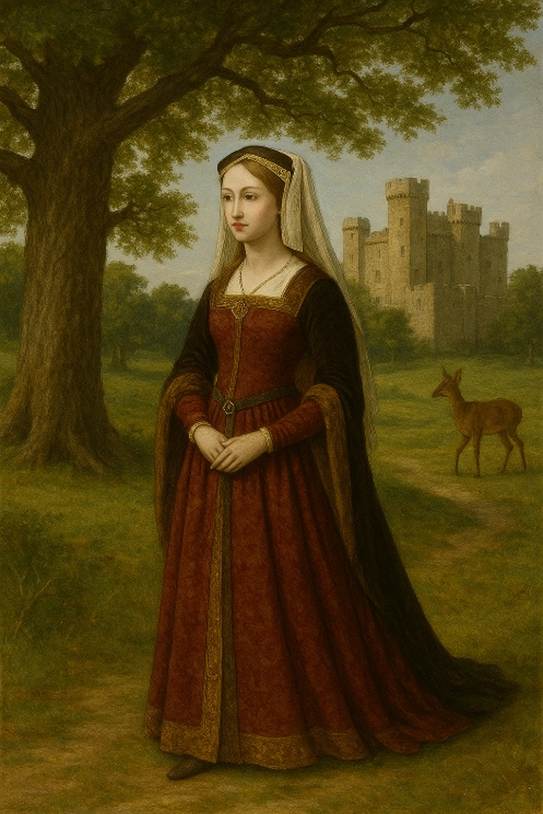
Richard III visited the chapel and authorised payment of £5 to
William Sympson chauntry prest of our Lady Chapelle beside the
church of Shiriefhotone to content him for his over due half year’s stipend
and £10 a year as his salary.
Topographical Dictionaries, A Topographical
Dictionary of England Hutton-Buscel – Huyton, 1848: Edward IV
bestowed it upon his brother, subsequently Richard III, and it became the
prison of Edward Plantagenet, who was confined within its walls until the death
of Richard on Bosworth-Field: the Princess Elizabeth of York, afterwards
consort of Henry VII., was also confined here.
In
1485 having fled to Paris after Buckingham’s failed rebellion, Henry Tudor
secured support from the French regent Anne of Beaujeu, who supplied troops for
an invasion. On 22 August 1485, Richard met the outnumbered forces of Henry
Tudor at the Battle of Bosworth Field. Richard rode a white courser (an
especially swift and strong horse). The size of Richard's army has been
estimated at 8,000 and Henry's at 5,000, but exact numbers are not known,
though the royal army is believed to have "substantially" outnumbered
Henry's.
On
22 August 1485, Richard III was defeated at the Battle
of Bosworth.
Thomas,
Lord Stanley, was a close ally of Richard, but also Henry Tudor’s stepfather.
He was a wily strategist and kept his intentions to himself. There were
effectively three armies at the Battlefield of Bosworth.
Richard
sent a threatening message to Stanley demanding that he support Richard’s
cause. However at the critical moment, Stanley came to the support of Henry
Tudor.
Richard
was killed after losing his horse. His corpse was stripped, stabbed with blades
and treated with disdain. He was taken to Leicester and hastily buried in a
rough grave at Greyfriars. He lay there until his burial place in a Department
of Social Sciences Car Park, under the letter “R” for “Reserved” (or “Richard”
or “Rex” perhaps) was excavated and he was found and DNA tested.
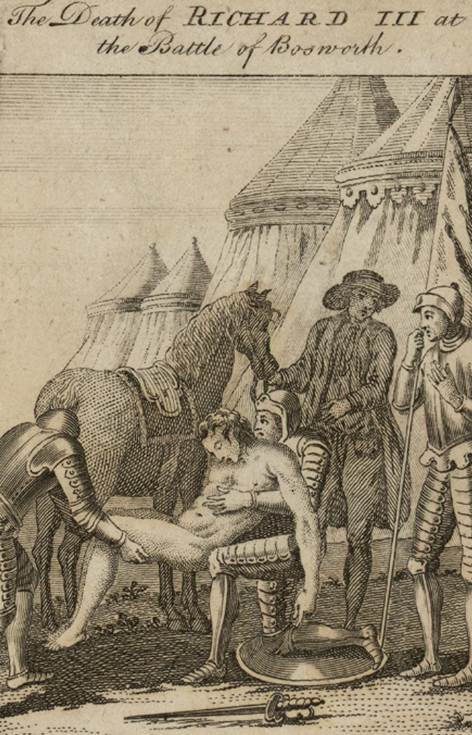
Henry
VII became the first Tudor King of England.
When
in 1485 the
estate of Sheriff Hutton had come into the hands of the first Tudor
sovereign the impression still lingered that it belonged to the Nevill heirs,
and it was described as 'in the hands of the king by reason of the nonage of Edward son and heir of Edward (sic) late Duke of
Clarence.' Somewhat later the revenues were appropriated to the defence of
Berwick, and Sheriff Hutton was declared to have been 'of the inheritance of
Richard, late Duke of York.' Both manor
and castle were in 1495 formally declared to have belonged to the king from the
day of his predecessor's death, and they remained in the Crown until 1525 (History
of the County of York North Riding, Volume 2, Sheriff Hutton, 1923).
These
events bring us to the end of the fifteenth century, when Thomas Howard, Earl of
Surrey, afterwards Duke of Norfolk, resided here ; he had a grant of the castle
for life and died in 1524, when it became the residence of the youthful Henry,
Duke of Richmond, remaining still a royal domain. By grant it passed to Prince
Charles, afterwards Charles I., from whom the Ingram family obtained possession
of it. (Ryedale and North Yorkshire antiquities, George Frank,
1888, page
74).
1524
The
Churchwarden’s Book of Sheriff Hutton for the years 1524 to 1568 include
details of a case regarding the failure to contribute to the repair of Sheriff
Hutton church. It provides an exceptionally clear and detailed picture which
it gives of the administration of a country parish during a period of
exceptional importance in English ecclesiastical and social history. The
entries begin in the reign of King Henry VIII and end in that of Elizabeth, so
covering the whole period of the English Reformation in its most vital and
constructive stages. Its destructive stages also. We begin with an
inventory of Church goods in the year 1524, a copious and most valuable list;
then, as the yearly statements of accounts go on, there are reflections of the
religious changes under Henry VIII, the sweeping destruction of vestments and
ornaments under Edward VI and the provision of a Communion table and other
necessaries according to the Reforms of that reign. Then, under Mary, the
Churchwardens find themselves required to refit their Church and to replace
most of what had been removed and destroyed, finally under Elizabeth to make
yet other arrangements. The Reformation may be studied in the legislation
enacted by Parliament or in the controversial literature of the time, but here
it may be studied in a brilliant light in its actual impact on a typical parish.
(The Churchwarden’s Book of Sheriff Hutton, 1524
to 1568, J S Purvis MA, Yorkshire
Archaeological Journal, 1947, page
178).
1525
Henry
VIII granted the manor and castle at Sheriff Hutton to his son Henry
Fitzroy, newly created Duke of Richmond and Somerset (History
of the County of York North Riding, Volume 2, Sheriff Hutton, 1923).
The Council of
the North continued to meet and from 1525 alternated between Pontefract Castle
and Sheriff Hutton, though by 1545, the Council was at York.
1536
After
the young duke's untimely death without issue eleven years later Sheriff Hutton
reverted to his father, its revenues were once again devoted to the garrison at
Berwick, and it was even proposed that Marton Priory should be annexed to the
manor to make good deficiencies (History
of the County of York North Riding, Volume 2, Sheriff Hutton, 1923).
1547
From 1547 the
castle seems to have been occupied only spasmodically by the Council and
declined since then.
1615
Various grants of
land were made up to the 17th century when its possession was recorded as
belonging to Sir Thomas Ingram. Sir Arthur Ingram (c. 1565 – 1642)
was an English investor, landowner and politician who sat in the House of
Commons at various times between 1610 and 1642. He was influential and his
financial schemes kept James I and Charkles I
independent of Parliament and he grew rich. In 1615 Ingram received the grant
of Sheriff Hutton Park, in the Forest of Galtres, and
over the next years built the New Lodge there as his country residence.
The Ingram
family, by way of various marriages, maintained lordship of the park until
1904, when it passed to Hon. Edward Frederick Lindley Wood.
South
of the castle is Sheriff Hutton Park. The house was built by Sir Arthur Ingram in
1621, Sir Arthurs’s main house being Temple Newsom near Leeds.
Topographical
Dictionaries, A Topographical Dictionary of England Hutton-Buscel
– Huyton, 1848: The
castle and manor remained in the hands of the crown till 1625, when they were
granted to the Ingrams. The ruins of the castle are of quadrangular form, with
a large open court in the centre, and the angles flanked with high square
towers; a considerable part of the warder's tower, over the eastern gateway,
still remains.
It is
not evident from public records at what date the manor of Sheriff Hutton
finally passed from the Crown. The family to whom it belonged in the last
fifteen years of the 17th century had been connected with the parish since the
appointment in 1615 of Sir Thomas Ingram to the offices of ranger and keeper of
the park. The park itself was granted seven years later to Arthur Ingram,
father of Sir Thomas, for life, with remainder to his elder son the younger Sir
Arthur Ingram, keeper of the castle and steward of the honour of Sheriff Hutton
from 1627. In 1646 Sir Arthur paid £320 to Ralph Radcliffe and his wife
Elizabeth for the manor of Sheriff Hutton, but nothing remains to show that
Ralph's interest, from whomsoever inherited, was more than nominal; nor did the
Parliamentarian surveyors of 1649 record any manorial rights beyond those of
George Kirke by virtue of the grant of Charles I (History
of the County of York North Riding, Volume 2, Sheriff Hutton, 1923).
1624
No
fresh Crown grant was made until in 1624 James I settled Sheriff Hutton on
trustees for the use of Charles Prince of Wales, who three years later, as
king, granted it for a term of eighty years to George Kirke, a gentleman of his
bedchamber, at the almost nominal rent of £24 5s. The actual value was shown by
the sale in 1628, to the City of London, of the reversion 'at the ancient rent
of £788 15s. 7¾d.' George Kirke did not reap much profit from his life interest
here (History
of the County of York North Riding, Volume 2, Sheriff Hutton, 1923).
1637
In 1637 the hall
went to his third son Sir Thomas who removed large quantities of stone from the
castle to build stables and a brewhouse (the Rangers House). Thus began the
final decline of the castle. In the reign of Charles II the house was sold to
the Thompson family. Originally the house was Jacobean in its architecture.
This house still survives but about one foot inside the present Queen Anne
exterior built in 1732.
1648
George Kirke
compounded with the Long Parliament for the manor in 1648 and sold his rights
in it in 1650 to Lord Maynard. He was suffering imprisonment for a debt of
£4,000 incurred in the purchase of 'robes and wearing apparel' for his late
master when he petitioned Charles II for arrears of rent in 1666 (History
of the County of York North Riding, Volume 2, Sheriff Hutton, 1923).
1668
Grants
from the revenues of Sheriff Hutton made in 1668 and 1671 to Viscount Grandison
and Edward Villiers were to take effect after the death of Kirke (History
of the County of York North Riding, Volume 2, Sheriff Hutton, 1923).
1685
In
1685, Sheriff Hutton was the property of Sir Arthur's grandson Edward Ingram
Viscount Irvine, who settled a moiety of the manor on his younger brother
Arthur. Arthur Ingram succeeded to the family estates and title in 1688. Five
of his six sons followed him in turn, dying without issue, and Sheriff Hutton
descended to their nephew and heir Charles Viscount Irvine, lord of the manor
in and before 1769. Under the will of Charles Isabella Anne, his elder
daughter, inherited it after her mother's death in 1807, her husband Francis
Seymour Conway Marquess of Hertford then assuming the surname of Ingram (History
of the County of York North Riding, Volume 2, Sheriff Hutton, 1923).
1857
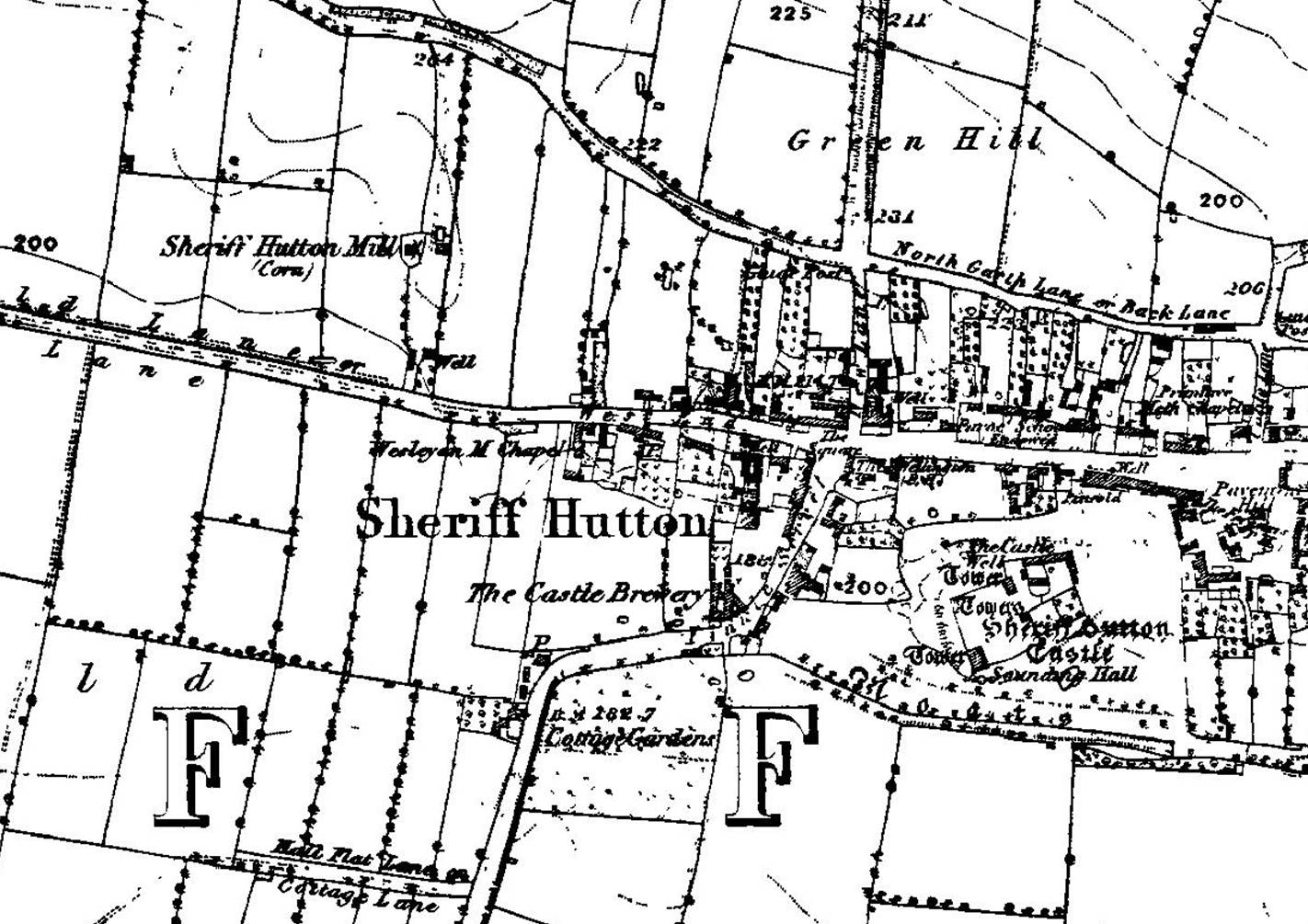
Bibliography
Sheriff
Hutton Manorial Records at the National Archives.
Parish
Records of Sheriff Hutton at the University of York.
Sheriff Hutton
Deeds (WYL100/SH Sheriff Hutton within the Temple Newsham Collection (National
Archives WYL100, held by North Yorkshire Archives Service, Leeds).
History
of the County of York North Riding, Volume 2, Sheriff Hutton, 1923.
A History of Yorkshire: County of the Broad Acres,
David Hey, 2005.
Sheriff Hutton and its Lords by Janet Senior, Rosalba Press. The
publishing group of the Yorkshire branch of the Richard 111 Society, ISBN 0
907604 05 6.
Some notes on the Castle at Sheriff Hutton by Richard W Howarth,
September 1993.
Sheriff Hutton Impressions of a History, a collection of essays
written in 2000 to form a book about the history of the village./
Sheriff Hutton Website – History page.
Richard
III Society – Yorkshire Branch.
Other Material for review
1556: court roll, with list of free tenants and tenants at will,
North Yorkshire County Record Office, ZDV(F) mic 1189/707
1597-1604: ministers accounts, The National Archives, LR 8/351
1607-1608: survey (rental only), The National Archives, LR
2/193/ff. 45-56
1610-1611: estreat, The National
Archives, SC 2/211/123
1624: survey and rental, with other manors, Borthwick Institute
for Archives: University of York, Hickleton Papers
B6.4 NRA 8128 Wood
1624: survey (with names of jury, details of boundaries and information
on estate management), West Yorkshire Archive Service, Leeds, TN/SH/B4/1, NRA
7398 Meynell-Ingram
1624: survey (manor of Rise, parcel of manor of Sheriff Hutton,
with details rel to valuation), Hull History Centre
(Hull University Archives), DDKG/9, NRA 17763 King
1654-1659: steward's accounts, West Yorkshire Archive Service,
Leeds, TN/SH/B2/1, NRA 7398 Meynell-Ingram
1675-1685: rental, West Yorkshire Archive Service, Leeds,
TN/SH/B3/2, NRA 7398 Meynell-Ingram
1702-1742: presentments (119 items, calendered),
West Yorkshire Archive Service, Leeds, TN/SH/B5, NRA 7398 Meynell-Ingram
1722-1736: call books (4), West Yorkshire Archive Service, Leeds,
TN/SH/B6/1-4, NRA 7398 Meynell-Ingram
1765: survey (incl field names, acreage
of freeholders and land held by the lord, common rights), West Yorkshire
Archive Service, Leeds, TN/SH/B4/2, NRA 7398 Meynell-Ingram
1820-1842: call books (2), West Yorkshire Archive Service, Leeds,
DB/216/66-67, NRA 34058 Dibb
1820-1843: jury lists, with other manors, West Yorkshire Archive
Service, Leeds, DB/216/66, NRA 34058 Dibb
1835-1839: warrants (1 bundle), West Yorkshire Archive Service,
Leeds, DB/216/69, NRA 34058 Dibb
1836-1842: verdicts (1 bundle), West Yorkshire Archive Service,
Leeds, DB/216/68, NRA 34058 Dibb
1838-1843: legal papers (incl opinions,
correspondence, precepts, warrants, 1 bdl), West
Yorkshire Archive Service, Leeds, DB/216/70, NRA 34058 Dibb