Law and Administration
The
evolution of law and administration
|
Return to the Home
Page of the Farndale Family Website |
The story of one
family’s journey through two thousand years of British History |
The 83 family lines
into which the family is divided. Meet the whole family and how the wider
family is related |
Members of the
historical family ordered by date of birth |
Links to other pages
with historical research and related material |
The story of the
Bakers of Highfields, the Chapmans, and other related families |

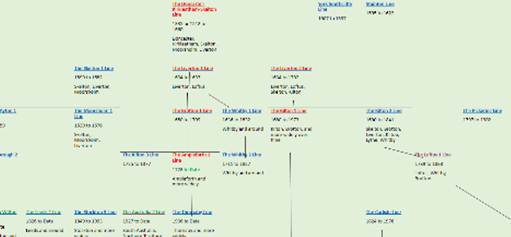

Headlines are in brown.
Dates are in red.
Hyperlinks to
other pages are in dark
blue.
References and
citations are in turquoise.
Context and local
history are in purple.
Geographical
context is in green.
About
1000
Local
organisation focused around a lord’s great hall (later called manors by the
Normans). From these would satellite outlying demesne farms which were called berewicks. Free men held soke estates. There
were some larger sokes which belonged to the
King, church or Earl. In other words, there was an informal hierarchy from
larger to smaller lordships.
Over seventy thegns
are listed in the Domesday Book, including the large landowner Ormr, who held Kirkbymoorside, Earl Siward, Gamal, Tosti
and Ughtred of Cleveland.
Arable farming
focused around vills or towns.
Tax was assessed
on cultivated land through caracutes (derived
from the Latin carruca, plough) and bovates.
Early assessments were therefore focused on the amount of ploughing that could
be achieved in an area of land. These initial measures would last through time,
even though methods of ploughing changed. A carucate was a medieval land
unit based on the land which eight oxen could till in a year.
By this time York had seven administrative districts, with one
controlled by the Archbishop. The townsmen had extensive pasture rights in the
surrounding area. Archaeology has revealed significant manufacturing in metal,
glass, amber, jet, deer horn, wood and bone.
1070
After he faced rebellion, William I adopted a more
ruthless approach to governing the country. He dispossessed the indigenous
aristocracy. He now proclaimed that every part of the kingdom belonged to him
by right of conquest. The Domesday Book
provided William with administrative dominance over 13,400 named places. The
local populations, the nativii, were regarded
as mere peasants and to be scorned and laughed at. Libraries of written
material were lost. He stopped using English in documents by 1070.
However there
were some building blocks from the pre Norman history of the nation that
survived this time of ruthless change. William was persuaded to show some
element of continuity to cement his rule – he did after all place significance
in persuading of natural succession to Edward the Confessor. There were aspects
of Anglo Saxon government that continued, and English saints started to return
into the cultural tradition.
The council of
the English people of witan fell out of use, but was replaced by a gathering of
feudal tenants, initially referred to a concilia
(French) and later parlements. Initially this was more a summoning of
advisers.
The Feudal System
Administration
took a more centralised form.
· William I granted
land, fiefs or fees, to his barons, to pay for their services.
This was reinforced by a homage ceremony, where a public oath of allegiance was
declared.
· The Barons in
turn granted land within their own domains to local folk, also in return for a
declaration of allegiance.
· At the lowest
level were villeins, serfs who were allotted parcels of land in return
for labour, rent and service.
o About 70% of
these folk could be classed as villeins, and held perhaps 15 to 50 acres
o Cottagers held
around 5 acres or less.
o Many became paid
labourers or slaves.
In addition to
the barons, the clergy and monasteries held land in a similar fashion, and in
many ways they were more unpopular in their efficiency and impersonality.
In consequence
previously free landowners became subjects of the invading aristocracy. They
were subject to serfdom and directly confronted with obligations of fighting
and taxes.
Two groups did
retain some autonomy and wealth – townspeople and churchmen.
Language
The Normans ended
the use of English for the purpose of government. Old English tended to
continue as a vernacular language. T survived as the means of communication
with the bulk of the population.
Latin became
widely used for administrative and legal purposes.
French became the
form of communication between the elite classes. Walter Scott in Ivanhoe later
commented that English soon became the language of the farmyard (swine, ox and
calf), whilst French became the language of the table (pork, beef). Noblemen’s
children were sent to France to learn the language well.
Law
After 1066, the
Normans introduced greater complexity in the legal system, with a blossoming
of:
· New laws for the
French population;
· Laws for the
English population;
· New forest laws;
· Canon law
administered through church courts;
· Justice
administered by local lords
· A tradition of
trial by combat.
To some extent
local disputes were resolved locally, royal authority intervening savagely
where local discipline broke down.
1100
To secure support
Henry I agreed in his coronation charter that he would restore the laws of
Edward the Confessor.
1135
The period of
King Stephen (1135 to 1154) saw sporadic conflict between Matilda (Henry I’s daughter
and dowager empress of Germany through marriage), and Stephen of Boulogne
(William I’s grandson). This was a period of breakdown in Royal authority, the
period often being called ‘The Anarchy’.
1154
The reign of
Henry II eventually led to greater rivalry with France, and the consequence for
the English population was higher taxation to fund wars that would sporadically
continue for the next three hundred years or so.
1166
In 1166, Henry II
started to introduce travelling royal judges or eyres (literally ‘journeys’).
1170
Permanent courts
started to sit in Westminster in the 1170s.
Writs came to be used
as the basis of the system of justice, which adopted a standardised form.
This in turn gave
rise to a universal nature of royal justice, and the start of a common law.
This contrasted to the development of law in Continental Europe, which was more
coded, for instance deriving from Roman law and the Code of Justinian (530 CE).
In this way England adopted its own distinct national legal system. In theory,
the law in England rejected the use of torture, in contrast to the rest of
Europe, at least at this time.
There was a
significant focus on property law and land rights.
1184
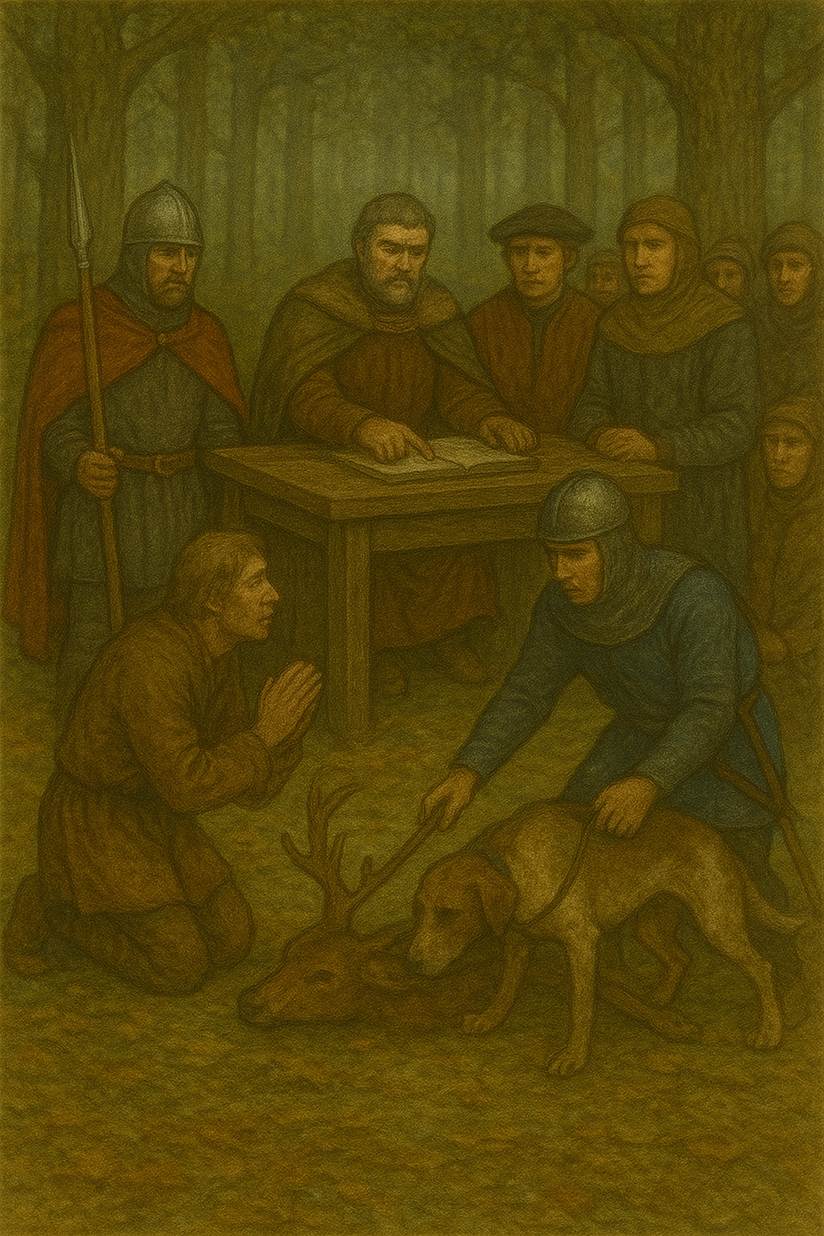
Old forest
customs were codified in the Assize of the Forest in 1184. Under the Norman
kings, the royal forest grew steadily, probably reaching its greatest extent
under Henry II when around 30 per cent of the country was set aside for royal
sport. The object of the forest laws was the protection of ‘the beasts of the
forest’ (red, roe, and fallow deer, and wild boar) and the trees and
undergrowth which afforded them shelter. The definitive form to forest law
occurred during Henry II's reign, most notably in the Assize of the Forest
(also known as the Assize of Woodstock) in 1184. None could carry bows and
arrows in the royal forest, and dogs had to have their toes clipped to prevent
them pursuing game. Savage penalties for any infringements were often imposed.
Discontent with the laws ensured that the forest became a major political issue
in John's reign. It culminated in the Charter of the Forest (1217), but only in
the 14th cent., when large areas were disafforested, did the political issue
subside.
1215
John’s unpopular
methods of raising taxation came to a head by the barons insistence that King
John signed Magna Carta at Runnymede in June 1215. It included a
resolution of countless grievances of the day, but it also embraced some
fundamental legal principles which have passed through to contemporary legal
doctrine, including that No Freeman shall be taken, or imprisoned … but by
lawful judgment of his peers.
Magna Carta:
· Imposed
restraints on monarchy;
· Might be taken as
the first example of a written constitution, which was unusual across Europe at
that time;
· Represented a
contract between monarchy and the community of the realm, which started to
emerge as a distinct legal entity.
1258
Although Henry
III reaffirmed Magna Carta and agreed to an amended form which included forest
rights, he later started to develop a form of absolute monarchy. The barons
were insistent upon their right to advise the King, and there crystalised some
early ideas of communal rights and more radical ideas. By 1258, the barons were
growing impatient again with royal authority. They appointed Simon de Montfort,
Earl of Leicester, to lead them. Although the rebellion was eventually crushed,
the barons wars of this period started to give more force to ideas of a parlement.
1300
Local administration
Most people lived in a village, worshipped in a parish and
worked in a manor (Robert
Tombs, The English and their History, 2023, 92).A
lord might possess many manors, or one. A manor operated as a large collective.
Senior villagers held offices, such as constable or church
warden.
About 2/3 of manorial tenants were not free in 1200, but
were villeins or serfs. Villeins usually paid part of their rent in labour.
Strictly, they could not leave the manor without permission. They could be
sold.
The common law gradually extended to all free men and even
unfree men had certain rights and could even pass on their land to their heirs.
At a local level, the Lord was the pinnacle of local
society and the political, cultural and economic focal point. Norman feudalism
only lasted for about a century and it was replaced by a primitive system of
land tenure. Over time this was increasingly paid for by money rather than
service. The lord provided land, justice and protection. In return the lord
expected obedience and deference; support to profit from the land; and military
assistance when necessary.
By the 1300s landlords comprised about 20,000 individuals
and 1,000 institutions (Robert Tombs, The English and
their History, 2023, 94).
The Crown held about 3% of the land directly.In
the fourteenth century there were perhaps a dozen dukes. There were some 1,500 kinghts. Then came esquires, who came to be referred to by
the 1400s as gentlemen. Some of these were yeoman freeholders.
Nobility became
defined by an air of nobility, enabling it to be distinguished by
appearance, gesture and language.
Baronial courts
existed by royal grant. Forest Law was
separate and had its own hierarchy of courts. Many lords ran lesser manor
courts and benefitted from fines for breaches of local customs. The tenants at
Kirkbymoorside under the Stutevilles and the Wakes
were taxed annually at Michaelmas.
Law
Royal
administration started to see the advent of a legal professional class of
lawyers, clerics and lay administrators. There emerged at Westminster:
· Law courts;
· The Chancery to
deal with documents;
· The Treasury to
hold funds;
· The Exchequer to
account for funds.
The common law
extended to every village. It was well used as it was cheap. Cases were
reported.
Parliament
Parliament had
first been referred to in 1236, when it was no more than the royal council. By
the 1250s it met more regularly and by the 1270s it met twice a year at
Westminster. Its main function had by then become the approval of taxation and
to hear petitions.
1350
The consequences of the Black Death
Following the
Black Death, Edward III took steps to keep society running as it had before the
plague. Edicts were issued requiring folk to maintain their obligations.
The Statute of Labourers in 1349 and Statute of Artificers fixed
princes at pre plague levels, required people to work at those levels and
forbad employers to pay more. Serfs were not to leave their manors. Even the
wearing of clothes was regulated so that ordinary folk would know their
station.
Moral writers
such as William
Langland (1330 to 1386), author of Piers Ploughman, wrote of society
becoming unruly and materialistic.
However the population
had ben reduced from 6M in 1300 to 2.5M in 1350 due to the famines and then the
Black Death.
1376
The Good
Parliament protested as a Commons about the costs of the French Wars and
elected a new office, the Speaker.
The Peasants Revolt
The Peasants
Revolt led by Wat Tyler arose from tensions from high taxes and fixed
incomes following the Black Death.
On 30 May 1381, John Bampton imposed a poll tax in Brentwood,
Essex and a significant uprising was triggered, insisting on reductions in
taxation, the end of serfdom, and the removal of some senior officials and law
courts.
John Ball, Jack Straw and Wat Tyler led the rebels to London and they met Richard II at Mile End
where charters were conceded freeing them from all bondage. However there was a
further meeting between the rebels at Smithfield. Violence broke out. Tyler was
stabbed and killed by the mayor of London.
The rebellion was eventually quashed. However the germs had been
sewn for greater rights for the general population.
Outbreaks of rebellion materialised outside London.
At first it seemed that the cause was lost. It is said that
Richard II soon declared Rustics you were and rustics you are still; you
will remain in bondage, not as before but incomparably harsher.
The
rebels tended to support the King; they had more confidence in landholdings
being taken direct from the King, but their rebellion was targeted primarily at
the aristocratic elite.
Revolts
in Northern England
Revolts
also occurred across the rest of England, particularly in the cities of the
north, traditionally centres of political unrest. In the town of Beverley,
violence broke out between the richer mercantile elite and the poorer
townspeople during May 1381. By the end of the month the rebels had taken power
and replaced the former town administration with their own. The rebels
attempted to enlist the support of Alexander Neville, the Archbishop of York,
and in June forced the former town government to agree to arbitration through
Neville. Peace was restored in June 1382 but tensions continued to simmer for
many years.
Word
of the troubles in the south-east spread north, slowed by the poor
communication links of medieval England. In Leicester, where John of Gaunt had
a substantial castle, warnings arrived of a force of rebels advancing on the
city from Lincolnshire, who were intent on destroying the castle and its
contents. The mayor and the town mobilised their defences, including a local
militia, but the rebels never arrived. John of Gaunt was in Berwick when word
reached him on 17 June of the revolt. Not knowing that Wat Tyler had by now
been killed, John of Gaunt placed his castles in Yorkshire and Wales on alert.
Fresh rumours, many of them incorrect, continued to arrive in Berwick,
suggesting widespread rebellions across the west and east of England and the
looting of the ducal household in Leicester; rebel units were even said to be
hunting for the Duke himself. Gaunt began to march to Bamburgh Castle, but then
changed course and diverted north into Scotland, only returning south once the
fighting was over.
News
of the initial events in London also reached York around 17 June 1381, and
attacks at once broke out on the properties of the Dominican friars, the
Franciscan friaries and other religious institutions. Violence continued over
the coming weeks, and on 1 July a group of armed men, under the command of John
de Gisbourne, forced their way into the city and attempted to seize control.
The mayor, Simon de Quixlay, gradually began to reclaim authority, but order
was not properly restored until 1382. The news of the southern revolt reached
Scarborough where riots broke out against the ruling elite on 23 June, with the
rebels dressed in white hoods with a red tail at the back. Members of the local
government were deposed from office, and one tax collector was nearly lynched.
By 1382 the elite had re-established power.
Robin
Hood
The
emergence of the Robin Hood legends at
about this time was likely to have been inspired in part at the general
grievances of the new aspiring middle class which led to the peasants revolt. It is notable that Nicholaus
de ffarnedale (FAR00838A) paid 4d for the second Poll
Tax in 1379, and may well have had rebellious sympathies with these ideas.
There were rebellions in 1450 (“Jack Cade’s Rebellion”), 1471 and 1497.
It was principally the shortage of labour and the aristocracy’s
dependence upon service, that led over the following half century or so to:
·
Wage growth
·
Tenants increasingly able to use their land as they wished
·
The beginning of tenants dividing up their strips of land by
enclosures
·
Serfs purchasing their freedom
·
Extinction of servile tenures, replaced by rents in money and
copyholds
·
The growth of a cash economy
·
An evolution of village communities and concepts of help for the
poor
·
The evolution of the yeoman, as a landowner of tenant of some importance
·
Workers moving between jobs
Society was more restless and unpredictable, but it was freer.
1468
De Laudibus legem Angliaie (In Praise of the Law of England), by
the lawyer Sir John Fortescue claimed the English Common Law as the most
ancient of the world.
1590s
By the end of Elizabeth’s
reign, the institutions and administration was beginning ot
be called the State, albeit Elizabeth’s government was still small and
personal.
1603
The lack of an
heir left by Elizabeth meant that the son of Mary Stuart, the 37 year of James
VI of Scotland, with his protestant upbringing, was welcomed with relief.
Union of the
Crowns of Scotland and England (though the nations remained separate with their
own parliaments). James’ ambition was to make Scotland and England a single
Great Britain and he introduced a union flag, and common coinage. A new 22
shilling piece bore the motto, faciem eos in gentem unam, I will
make them one nation.
James, influenced
by the French and Scottish styles, had a natural dislike of English
institutions, including Parliament and was surprised that his forebears had
allowed such an institution.
James had the
common law adopted in Scotland. The largely forgotten Magna Carta was re-found
as the fountaine of all the fundamental lawes of the realm. Coke’s Institutes of the Laws of
England found a new and ancient uniqueness in the law.
In 1628
Parliament’s Petition
of Right found intangible and permanent values in the law, giving rise to
the idea of the rule of law, and of fundamental freedoms.
Local government
During the reign
of James I, central government struggled to finance itself, but local
government became more participatrory and gentlemanly
JPs and farmers took turns to serve as churchwardens, constables and overseers
of the poor.
In 1601,
Elizabeth’s Poor
Law Act replaced monastic charity. It sought to consolidate all previous
legislative provisions for the relief of 'the poor'. The Poor Law made it
compulsory for parishes to levy a 'poor rate' to fund financial support
('public assistance') for those who could not work.
1696
After the Glorious
Revolution, an offshoot of concurrent warfighting was the spiralling of taxes,
which trebled between 1688 and 1713. In 1696 an Inspector General was appointed
to levy customs and excise duties. The Land Tax created in 1688 was
administered locally by JPs.
There is a
perception of eighteenth century administration as corrupt, but there is no
real evidence of that and in contract to Continental Europe, there was a
tendency to trust and accept the administration, accepting the need for
national defence, albeit reluctantly. Taxation was generally regarded as fair
and compliance was high.
However taxation
alone was not sufficient. Public debt grew from £3M in the 1680s to £100M in
1760. This was the catalyst for a new more efficient financial system.
· Simple IOUs were
replaced by more sophisticated long term low interest bonds.
· In the 1690s,
there were studies of Dutch and Venetian banking systems.
· In 1694, the
Scot, William
Paterson founded the Bank of England (based on the Bank of Amsterdam). It
immediately acted to prevent a debt crisis to save a collapsed in government
credit.
· As Parliament’s
guarantee made default unlikely and by 1715, half of the tax revenue was spent
servicing the national debt, but ‘as long as land lasts and beer is drunk’,
there was little worry of default.
· Domestic and
foreign savers were eager to lend.
· The rate of
interest fell from 14% in 1693 to 3% in 1731.
· Britain became a
fiscal military state.
· New professions
arose such as bankers and lenders.
(Robert Tombs, The English and their History, 2023,
307-308).
Robert Tombs suggests that the political system as it was in the
early eighteenth century is best preserved in the political system of the
modern US. The king, as by then constituted, was like an American president. He
was at the centre of power and able to choose his Cabinet and a change of king
could mean wholesale change of policy. However he needed the approval of
Parliament and regularly struggled with the legislature to have his polices
accepted. The politicians needed wealth and contacts, a local power base, and
economic influence.
Politics intermingled with social life. It was no democratic.
Landed gentlemen were preferred to nouveau riche merchants. The
electorate was small and there was no real electorate in rotten boroughs. There
was corruption. The electorate of England and Wales was over 30,000, about a
quarter of adult men. Scotland had 45 seats, but only 428 electors. In London
all ratepaying householders could vote. In rural areas owners of land worth 40s
a year could vote.
(Robert Tombs, The English and their
History, 2023, 323-324).
Crime and punishment
On the one hand there was a cultural emphasis on politeness and
cultural achievement. On the other hand, there was ruthless treatment of
criminals and the poor.
In rural areas, there was harsh punishment of innocuous crimes
such as poaching, which in reality was a symbol of rural inequality in times of
enclosure, depriving the poor of common land for pasture and fuel.
In London, there was organised crime. More widely there were
violent armed gangs, involved in smuggling, poaching and housebreaking. Dick
Turpin later romanticised began his criminal career as a gang member in Essex. Jonathan Wild organised crime in London in the 1720s and has been called the
world’s prototype gangster.
Most crime however was petty.
There were few prisons or ‘police’. Victims generally had to take
matters into their own hands.
The death penalty was extended so that by 1800 there were 200
capital offences, often for crime against property. Actual executions were rare
though. Pardons were often given. Juries tended to soften crueller punishment.
Women’s claims of pregnancy were easily accepted and the ‘benefit of the
clergy’ meant those claiming to be clerics were usually given minor punishment.
However there were still regular public hangings, often on a ‘hanging day’ – in
London there were 1,242 public hangings between 1703 and 1772.
Local
power depended on deference, but by the early eighteenth century, deference had
to be earned. There was a growing confederacy between those working on the land
who increasingly saw the Squire’s property as fair booty and who colluded to
help each other against punishment. Attempts to enforce ancient Game
Laws which reserved all game to the lord of the
manor, led to serious confrontation.
(Robert
Tombs, The English and their History, 2023, 325-328).
Victorian Britain
There was a
harping for small government – criticism of grandmotherly government,
harped later calls against the nanny state.
Yet Victorian
Britain could be intrusive and authoritarian:
· The Factory Acts
including the Factory Act 1833 instituted inspection and enforcement.
· The New Poor Law was unparallelled for its social
intervention.
· The payment of
income tax abolished in 1815 but reintroduced in 1842 required detailed
declaration and inspection of matters long felt to be private matters.
· A series of
Public Health and Sanitary Acts from 1848 allowed sanitary inspectors
to enter private dwellings, order cleansing, stop nuisances and remove the sick
to hospital.
· The Contagious
Diseases Acts 1864 saw state intervention in vice.
· The Society for the
Prevention of Cruelty to Animals was founded in 1824 to curb rowdy blood sports
such as bull baiting. It became Royal from 1840 and transformed perceptions
from national toughness instilled by blood sports.
Local authorities
tended to be less oppressive, but managed local issues financed by local rates
including Poor Law guardians, elected school boards under the Education Act
1870 and watch committees supervising the police.
Respectability
Working class
folk began to adopt middle class standards of decorum. Working people
themselves sought greater security, cleanliness and safety. Chartists,
socialists and feminists saw a route to greater equality. People themselves
sought friendship and social conviviality.
Self help
organisations adopted this new respectability. Trade unions and friendly
societies were tough on shirkers and benefit claimants. A declining minority
resorted to the poor law, about 2.6% of the population by the 1890s. It carried
a stigma of failure.
(Robert Tombs, The English and their History, 2023,
469-477).
Victorian
politics
In 1853 Gladstone
commissioned the Tory, Sir Stafford Northcote and the Whig Sir Charles
Trevelyan to eliminate patronage in the civil service.
· The civil service
was e3fficient and relatively accountable.
· However there was
no clear line between politics and administration.
· The Civil Service
Commission 1855 oversaw recruitment.
· The Order in
Council 1870 required recruitment by competitive examination.,
· These reforms did
not make the civil service democratic, but provided a barrier to corruption,.
· The new civil
service was still small – In the 1860s, the Foreign Office had 85 and the whole
UK civil service had 1,173 professional grade civil servants; 1801 superior
grade and 10,000 general clerks.
· In time it became
the domain of public school Oxbridge graduates. Balliol College Oxford grew a
reputation for training a national elite.
Public petitions
had multiplied by 1840 to about 30,000 a year.
Ministers
increasingly took control of business in Parliament from backbenchers. The
French procedure of the guillotine was adopted in response to Irish tactics of
obstruction in Parliament in the 1880s. Parliament slowly became more party
political and less absorbed by local affairs.
The House of
Lords had eventually surrendered over constitutional; reform in the 1830s, and
few members attended regularly, but they gathered to influence significant
issues such as Catholic emancipation, the Corn Laws, Irish home rule and
electoral reform.
Victorian
politicians were rich, often lawyers, and the largest group were landowners.
Political families such as the Cavendish, Grosvenor and Paget families became
dominant.
The Conservatives had a continued
attachment to agricultural protectionism and a paternalistic, hierarchical, Anglican
society. However Disraeli sought a new purpose for Conservatism.
Benjamin Disraeli
(“Dizzy”) was the leader of a party of Church, land and tradition and had a
romantic attachment to autocratic leadership. A middle class Jew, he had no
real religious conviction. He was a dandified bohemian intellectual. He was an
early supporter of votes for women. He started to develop a more or less
coherent Conservative creed, defending Burkean
traditional influences. He was a man of principle and not in reality a
jingoist. His attitude to the Queen was ambivalent. He had the trappings of an
English gentlemen, but preferred small doses of rural life. He was an old
fashioned politician. He invented ideas of Tory democracy and was the wittiest
of Prime Ministers along with Churchill. He spent most of his time in
opposition, but was prime minister in 1868 (on the
resignation of the Earl of Derby due to gout) and 1874 (after an election
victory). He was defeated in 1880 and died in April 1881.
The Liberal Party (its official
name from the 1860s) comprised landowning Whig notables, a few Radicals and a
significant group of businessmen. They inclined towards religious Dissenters
and social reformers. There was a tendency towards free trade.
William
Ewart Gladstone was the perfect foil to Disraeli. He was more an
establishment figure than Disraeli. He came from a Liverpool-Scottish
mercantile and slave owning family. A supporter of Peel, the issue of Fre Trade
moved him to the Liberal Party. His emotional core was Christianity and moral
behaviour. He was highly intellectual, well read, multi lingual and involved
with universities, charities and the arts. His Midlothian Campaigns 1879 to
1892 were the first mass election speeches and he had a preaching style of oratory.
Many disliked seeing their politicians spouting all over the country.
Victorian
politics were not entirely clear in their objectives. Politicians claimed to
have principles, but there were no manifestos. There was generally consensus to
keep the cost of government low and on the importance of individual self reliance. However in appropriate areas like housing,
sanitation and welfare, there was a place for government intervention. The
political statesmen often showed impatience or contempt to their rank and file.
(Robert Tombs, The English and their History, 2023, 496 to
511).
Crime
An acceptance of
rules and conventions generally gave rise to a fall in crime. Violence fell
sharply in the 1870s and drinking diminished. Homicides fell from 1.6 to 0.8
per 100,000 from 1860 to 1914.
However domestic
violence tended to be viewed as minor, even legitimate and fights, especially
after drinking, were rarely prosecuted. Riot and arson almost disappeared.
Weapons were used less and duelling fell out of favour and seconds were
sometimes prosecuted for murder or attempted murder. Weapons had traditionally
been uncontrolled by legislation from 1903 started to limit ownership of guns.
Property crimes
fell from the 1880s. Groups of hardened professional criminals were small in
number. The growth of the finance sector saw an increase in embezzlement and
fraud.
Prison regimes were
harsh and adopted a hard labour and solitary ‘silent’ system, as at Pentonville
in 1842. Juvenile institutions included ‘reformatory schools (1854) and Borstal
institutions (1908).
Notwithstanding
an aspiration to a calmer non violent society,
capital punishment (over one a month in the 1900s) and corporal punishment
continued.
(Robert Tombs, The English and their History, 2023, 517 to
521).
The
Police
The Metropolitan
Police Act 1829 was introduced by Sir Robert Peel, and established the
Metropolitan Police, responsible for policing the newly created Metropolitan
Police District.
Peel hoped that
the Metropolitan force would offer a model for reformed policing in other parts
of the country. Further development was rapid.
In 1835 the
Municipal Corporations Act required newly-created local councils to appoint
paid constables for preserving the peace. This initially brought policing to
178 towns, and the number grew steadily.
In 1839 the Rural
Constabulary Act (also the County Police Act) allowed county areas to establish
police forces if they so wished; Wiltshire was the first county to do this.
By 1851 there
were around 13,000 police in England and Wales, although existing legislation
did not compel local authorities to establish local forces.
Early police
forces were often ex labourers, barely literate and often drunk.
The Metropolitan
Police still had only 13 detectives in 1868.
The police were
rarely armed and the Home Secretary didn’t allow them military training.
Their lot was
often 14 hour days and 24 mile foot patrols.
Standards started
to improve in the last quarter of the nineteenth century. A professional force
emerged. The police saw promotion from the lower ranks and there was no
emerging officer corps as in the armed forces. Their reputation and self respect grew. The middle cl;asses
appreciated them as protectors and working classes increasingly sought the
protection of the law. A select
committee in 1853 reported that people felt safer.
By 1891, in
London, there was 1 policeman for 421 inhabitants who adopted what is today
called a zero tolerance policy.
(Robert Tombs, The English and their History, 2023, 519 to
521).