Historical and geographical information
|
Return to the Home Page of the Farndale Family
Website |
The story of one family’s journey through two
thousand years of British History |
The 83 family lines into which the family is divided.
Meet the whole family and how the wider family is related |
Members of the historical family ordered by date of
birth |
Links to other pages with historical research and
related material |
The story of the Bakers of Highfields, the Chapmans,
and other related families |
Dates are in red.
Hyperlinks to other pages are in dark blue.
Headlines are in brown.
References and citations are in turquoise.
Contextual history is in purple.
This webpage about
the Scarborough has the
following section headings:
· Farndale family
history and Scarborough
·
Scarborough, overview
·
Timeline of Scarborough’s history
·
Falsgrave
·
Bibliography
The Farndales of
Scarborough
The Farndales who
lived at or were associated with Scarborough were Richard Findale (FAR00214),
joiner of Falsgrave; The Scarborough
1 Line; John Findale (FAR00276);
Elizabeth Findale (FAR00295);
Thomas Farndale (FAR00344);
Mary Farndale (FAR00349);
Elizabeth Farndale (FAR00415);
Annie Farndale (FAR00449);
Thomas Farndale (FAR00525);
Edith Annie Farndale (FAR00592);
Frank Farndale (FAR00622);
Albert Goodwill Farndale (FAR00623);
Robert Alan B Farndale (FAR00896);
The Scarborough 2 Line.
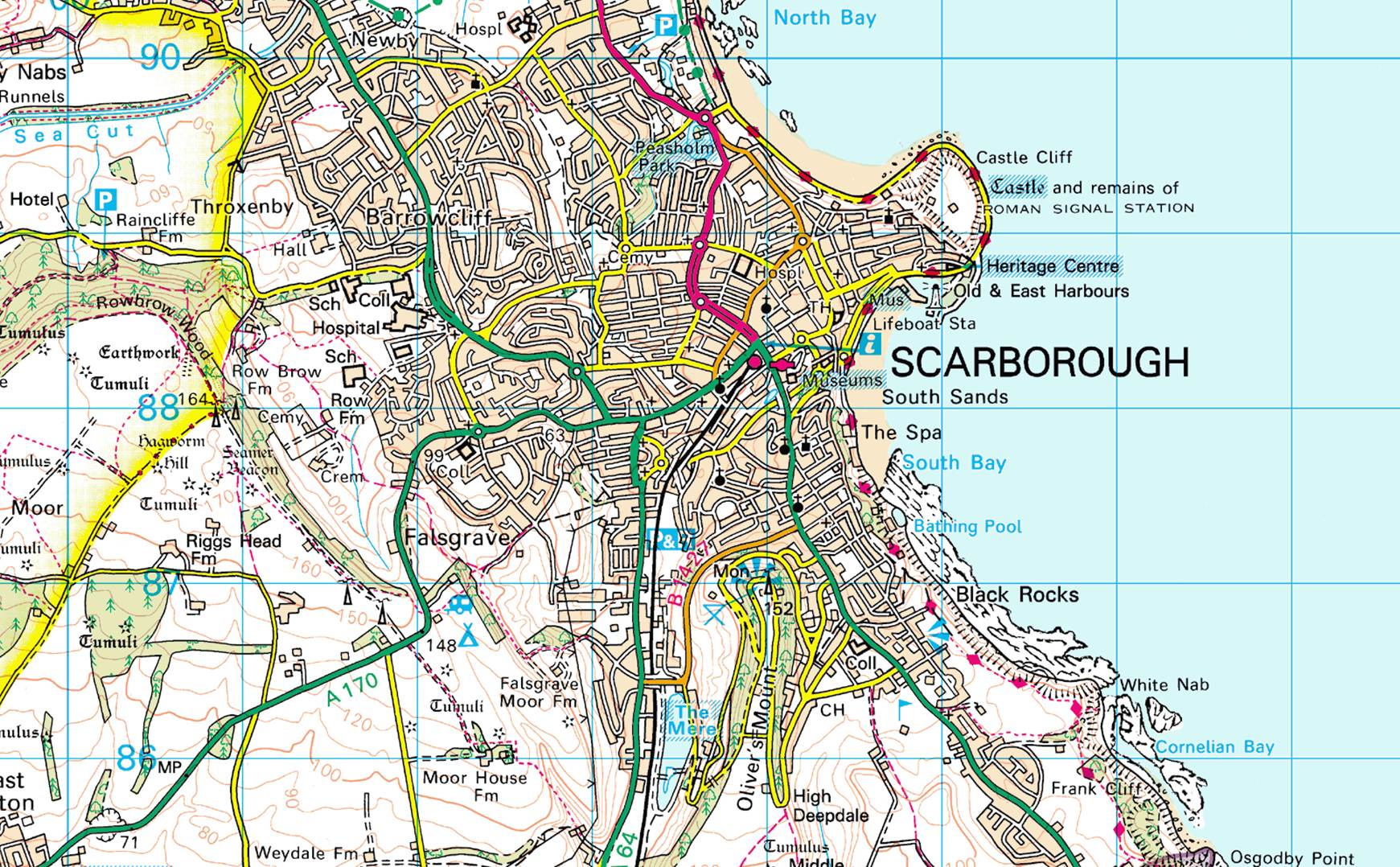
Scarborough
Scarborough is
a town on the North Sea coast of North
Yorkshire, England. Historically part of the North Riding
of Yorkshire, the town lies between 3 and 70 m above sea level,
rising steeply northward and westward from the harbour on to limestone cliffs.
The older part of the town lies around the harbour and is protected by a rocky
headland.
Scarborough has
become the largest holiday resort on the Yorkshire
coast. People who live in the town are known as Scarborians.
Scarborough Timeline
Fourth
century CE
In the 4th
century there had briefly been a Roman signal
station on Scarborough headland and there is evidence of much earlier Stone Age and Bronze Age settlements.
The Victoria County History – Yorkshire, A History of the
County of York North Riding: Volume 2 The borough of Scarborough, 1923: Remains
of the Bronze and Early Iron Ages have been found here.
966 CE
The town was
reportedly founded around 966 CE as Skarðaborg by Thorgils
Skarthi, a Viking raider, though there is no archaeological evidence
to support these claims.
The origin of
this belief is a fragment of an Icelandic
Saga. However any new settlement was soon burned to the ground by a
rival band of Vikings under Tosti (Tostig
Godwinson), Lord of Falsgrave, and Harald III of Norway. The destruction and
massacre meant that very little remained to be recorded in the Domesday survey
of 1085.
The Victoria County History – Yorkshire, A History of the
County of York North Riding: Volume 2 The borough of Scarborough, 1923: A
13th century manuscript relates how in the 10th century a company of
marauding Danes under Knut and Harold, sons of Gorm, defeated Adalbricht son of
Adalmund at 'Skardaborg' and marched thence to York.
The original
inland village of Falsgrave was also Saxon rather
than Viking.
1066
The Victoria County History – Yorkshire, A History of the
County of York North Riding: Volume 2 The borough of Scarborough, 1923: In
1066 Harold Hardraada in alliance with Earl Tosti, lord of Falsgrave, seized
and burnt the castle, 'took to burn then one house after another, and then all
the town gave itself up.'
1086
The Victoria County History – Yorkshire, A History of the
County of York North Riding: Volume 2 The borough of Scarborough, 1923: Scarborough
was not mentioned in the Survey of 1086.
1155
Scarborough
recovered under King Henry II, who built an Angevin stone castle on the headland
and granted the town charters in 1155 and 1163, permitting a market on the
sands and establishing rule by burgesses. The
Victoria County History – Yorkshire, A History of
the County of York North Riding: Volume 2 The borough of Scarborough, 1923:
Henry II, before 1163, granted to the burgesses of Scarborough all liberties
enjoyed by the citizens of York, paying to the Crown as gabelage from each
house 4d. or 6d. according as the gable or side faced the street.
Edward II granted Scarborough Castle to his favourite, Piers
Gaveston. The castle was subsequently besieged by forces led by the
barons Percy, Warenne, Clifford and Pembroke. Gaveston was captured and taken
to Oxford and
thence to Warwick Castle for execution.
The Victoria County History – Yorkshire, A History of the
County of York North Riding: Volume 2 The borough of Scarborough, 1923: The
earliest settlement, or 'aldborough,' lay beneath the castle near the harbour;
it was walled by the time of King John. The wall ran from a moat on the north,
by Auborough and Cross Street, to the sea; from this point the southern wall
went east, along Merchants' Row, now Eastborough, to the castle dykes.
1253
In the Middle Ages Scarborough Fair, permitted in a royal
charter of 1253, held a six-week trading festival attracting merchants from all
over Europe. It ran from Assumption
Day, 15 August, until Michaelmas
Day, 29 September. The fair continued to be held for 500 years, from
the 13th to the 18th century, and is commemorated in the song Scarborough Fair.
Scarborough Fair is a traditional English ballad (existing
in more than one version) that hangs, in some versions at least, upon a
possible visit by an unidentified person to the Yorkshire town
of Scarborough. The song implies the tale of
a man who instructs a third party to tell his former love, who lives in
Scarborough, to perform for him a series of impossible tasks, such as making
for him a shirt without a seam and no needlework and then washing it in a dry
empty well, adding that if she were to complete these tasks he would take her
back into his affections. Often the song is sung as a duet, with the woman then
giving her sometime lover a series of equally impossible tasks, promising to
give him his seamless shirt and her heart once he has finished. As the versions
of the ballad known under the title "Scarborough Fair" are usually
limited to the exchange of these impossible tasks, many suggestions concerning
the plot have been proposed, including the hypothesis that it is about
the Great Plague of
the late Middle Ages. The lyrics of "Scarborough
Fair" appear to have something in common with an obscure Scottish
ballad, The Elfin
Knight by Francis James Child, which has been traced
as far back as 1670 and may well be earlier. In this ballad, an elf threatens to
abduct a young woman to be his lover unless she can perform an impossible task
("For thou must shape a sark to me / Without any cut or heme,
quoth he"); she responds with a list of tasks that he must first perform
("I have an aiker of
good ley-land / Which lyeth low by yon sea-strand").
|
Are you going to Scarborough Fair? Parsley, sage, rosemary,
and thyme; Remember me to one who lives there, For she was once a true love of mine. Tell her to make me a cambric shirt, Parsley, sage, rosemary, and thyme; Without any seam or needlework, Then she shall be a true love of mine. |
Tell her to wash it in yonder well, Parsley, sage, rosemary, and thyme; Where never sprung water or rain ever fell, And she shall be a true lover of mine. Tell her to dry it on yonder thorn, Parsley, sage, rosemary, and thyme; Which never bore blossom since Adam was born, Then she shall be a true lover of mine. |
Now he has asked me questions three, Parsley, sage, rosemary, and thyme; I hope he'll answer as many for me, Before he shall be a true lover of mine. Tell him to buy me an acre of land, Parsley, sage, rosemary, and thyme; Between the salt water and the sea sand, Then he shall be a true lover of mine. |
Tell him to plough it with a ram's horn, Parsley, sage, rosemary, and thyme; And sow it all over with one peppercorn, And he shall be a true lover of mine. Tell him to sheer't with a sickle of leather, Parsley, sage, rosemary, and thyme; And bind it up with a peacock's feather, And he shall be a true lover of mine. |
Tell him to thrash it on yonder wall, Parsley, sage, rosemary, and thyme, And never let one corn of it fall, Then he shall be a true lover of mine. When he has done and finished his work. Parsley, sage, rosemary, and thyme: Oh, tell him to come and he'll have his shirt, And he shall be a true lover of mine. |
Thirteenth
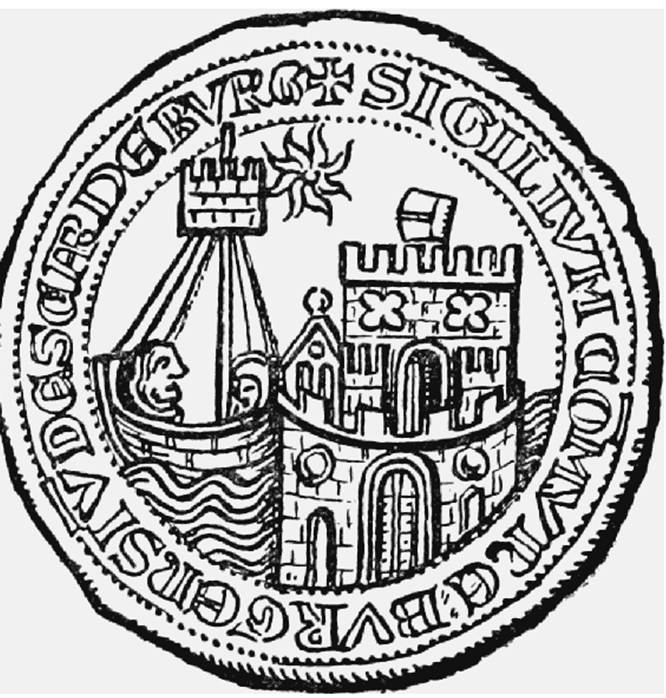
century seal of the Borough of Scarborough
1318
In 1318, the town
was burnt by the Scots, under Sir James Douglas following
the Capture of Berwick upon Tweed.
1626
In 1626,
Elizabeth Farrow discovered a stream of acidic water running from one of the
cliffs to the south of the town. This gave birth to Scarborough Spa.
1640
Scarborough and
its castle changed hands seven times between Royalists and Parliamentarians
during the English Civil War of the 1640s, enduring
two lengthy and violent sieges. Following the civil war, much of the town lay
in ruins.
1660
Dr Wittie's book
about the spa waters published in 1660 attracted a flood of visitors to the
town.
1735
Scarborough Spa
became Britain's first seaside resort, though the
first rolling bathing machines were not noted on the
sands until 1735. It was a popular getaway destination for the wealthy of
London, such as the bookseller Andrew Millar and
his family. Their son Andrew junior died there in 1750.
1845
A young Malton architect, John Gibson,
designed the Crown Spa Hotel, Scarborough's first
purpose-built hotel. In 1841 a railway link between York and Scarborough
was being talked of and he decided that the area above the popular Spa building
could be developed. He designed and laid the foundations before passing the
construction of this hotel to the newly formed South Cliff Building Company. On
Tuesday, 10 June 1845 Scarborough's first hotel was opened: a marketing coup,
as the Grand Hotel, soon to be Europe's largest, was not yet finished.
The coming of
the Scarborough–York railway in 1845
increased the tide of visitors. Scarborough railway station claims a
record for the world's longest platform seat.
1857
1862
The town has a
fine Anglican church, St Martin-on-the-Hill,
built in 1862–63 as the parish church of South Cliff. It contains works
by Dante Gabriel Rossetti, William
Morris, Edward Burne-Jones and Ford Madox
Brown.
1867
When the Grand Hotel was completed in 1867 it
was one of the largest hotels in the world and one of the first giant
purpose-built hotels in Europe. Four towers represent the seasons, 12 floors
represent the months, 52 chimneys represent the weeks and originally 365 bedrooms
represented the days of the year. A blue plaque outside
marks where the novelist Anne Brontë died
in 1849. She was buried in the graveyard of St Mary's Church by the castle.
1880
From the 1880s
until the First World War, Scarborough was one of the regular destinations
for The Bass Excursions, when fifteen trains would
take between 8,000 and 9,000 employees of Bass's Burton brewery on an annual
trip to the seaside.
1916
During the First World
War, the town was bombarded by German warships of the High Seas
Fleet, an act which shocked the British (see Raid on Scarborough, Hartlepool and
Whitby).
1923
The Victoria County History – Yorkshire, A History of the
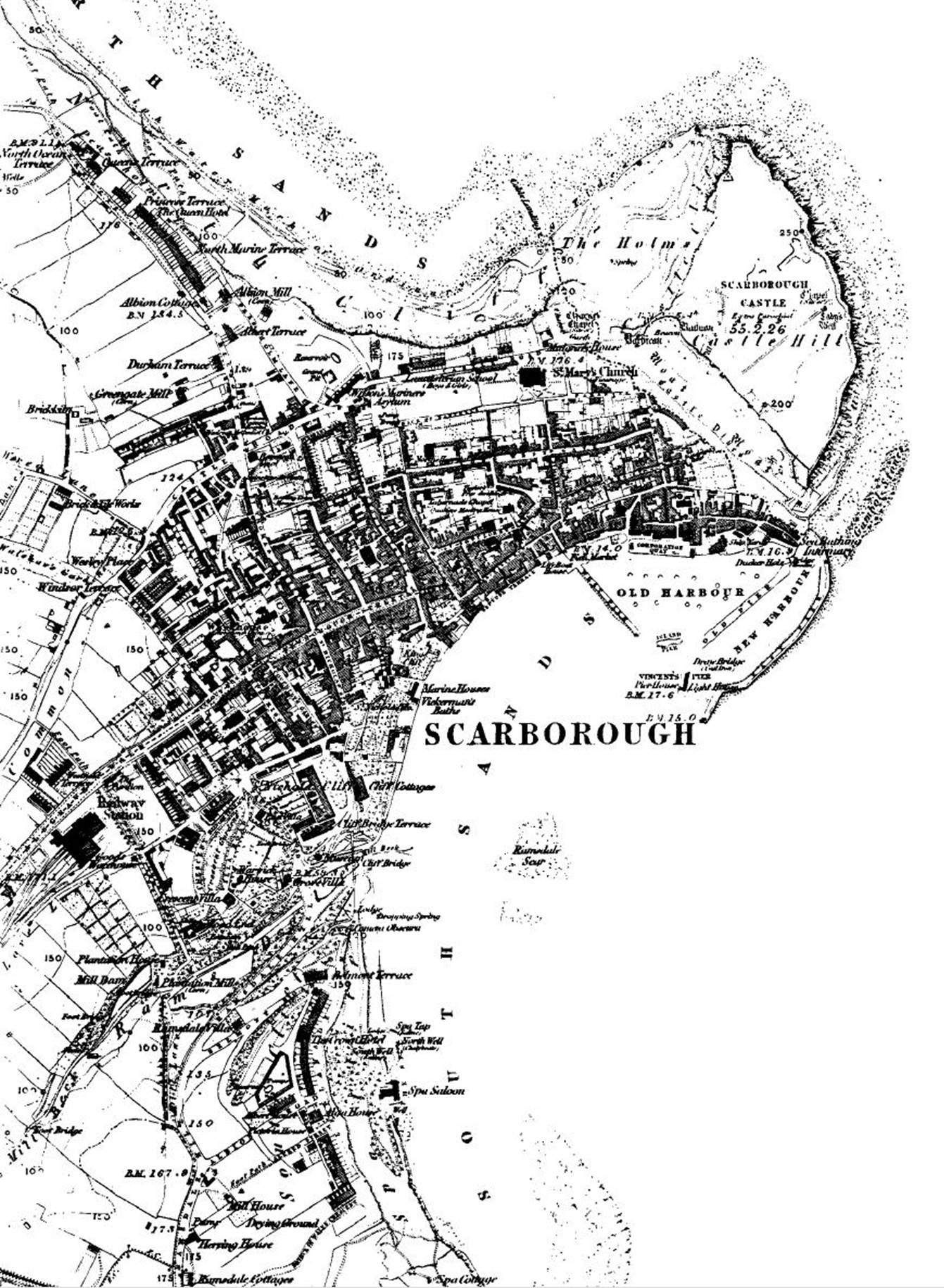
County of York North Riding: Volume 2 The borough of Scarborough, 1923: At the present
day Scarborough occupies the neck of a lofty promontory which runs out to sea
in a north-easterly direction, the extremity forming the castle rock. The
portion of the town along the northern shore is of 19th-century growth, the old
town occupying the southern slope.
1929
In 1929 the steam
drifter Ascendent caught a 560-pound (250 kg) tunny (Atlantic bluefin tuna) and a Scarborough
showman awarded the crew 50 shillings so
he could exhibit it as a tourist attraction.
1930
Big-game tunny fishing off
Scarborough effectively started in 1930 when Lorenzo
"Lawrie" Mitchell–Henry, landed a tunny caught on rod and line
weighing 560 pounds (250 kg). A gentlemen's club, the British Tunny
Club, was founded in 1933 and set up its headquarters in the town at the place
which is now a restaurant with the same name.
Scarborough
became a resort for high society. A women's world tuna challenge cup was
held for many years.
Colonel (and,
later, Sir) Edward Peel landed a
world-record tunny of 798 pounds (362 kg), capturing the record by 40
pounds (18.1 kg) from one caught off Nova Scotia by
American champion Zane Grey. The British record which still
stands is for a fish weighing 851 pounds (386 kg) caught off Scarborough
in 1933 by Laurie Mitchell-Henry.
1993
On 5 June 1993
Scarborough made headlines around the world when a landslip caused
part of the Holbeck Hall Hotel, along with its gardens, to
fall into the sea. Although the slip was shored up with rocks and the land has
long since grassed over, evidence of the cliff's collapse remains clearly
visible from The Esplanade, near Shuttleworth Gardens.
Scarborough has
been affiliated with a number of Royal Navy vessels,
including HMS Apollo, HMS Fearless and HMS Duncan.
Falsgrave
Falsgrave is a
suburb of Scarborough. Historically, the settlement of Falsgrave pre-dated the
Domesday Book survey and was also the manor in the area, existing as the main
administrative seat in the region long before the town of Scarborough
developed. Gradually the settlement of Falsgrave became a suburb of
Scarborough, and lies a little to the west of the town.
1069
During the
Harrying of the North between 1069 and 1071, most of the Manor of Falsgrave was
laid to waste, though to what extent is unknown especially in relation to the
coastal areas.
1086
Falsgrave is
recorded in the Domesday Book as being in the wapentake of Dic (later
Pickering Lythe), with twenty villagers and belonging to King William, though
at the Conquest, it was the property of Earl Morcar, who had ousted Tosti in
1065.
Domesday recorded
the name as Walesgrif, which means Pit or hollow by the hill. The first
part derives from Old Norse Hvalr (a personal name), and the second part
is from the same language gryfia meaning pit.
The Victoria County History – Yorkshire, A History of the
County of York North Riding: Volume 2 The borough of Scarborough, 1923: In
1086 Falsgrave (Walesgrif, xi cent.; Walsgrave, xii–xvi cent.; Waldegrave, xiv
cent.; Walsgrave alias Falsgrave, xvii cent.) was land of the king, and with
its berewick 'Nordfeld' was assessed at 15 carucates.
Tosti held a
manor here before the Conquest; the value was then £56, and in 1086 30s. To the
manor belonged the soke of Osgodby, Lebberston, Gristhorpe, 'Scagetorp,'
'Eterstorp,' 'Rodebestorp,' Filey, Burton, Depedale, West Ayton, Newton,
Preston, Hutton, Marton, Wykeham, Ruston, 'Tornelai,' Stainton, Burniston,
Scalby and Cloughton, in all 84 carucates of land, 1½ carucates in Stemanesbi
(Newby), and 2 carucates in Hackness, Suffield and Everley.
1106
Around 1106, the
area became part of what was known as the wapentake of Pickering Lythe.
1190
The soke of
Falsgrave was still mentioned in 1190.
1201
Scarborough
developed separately from Falsgrave, however in 1201, King John granted 60
acres of fields to the newer settlement from Falsgrave.
The Manor of
Falsgrave was historically an extensive and important administrative manor in
the area, with lands stretching as far north as Staintondale, as far south as
Filey, and as far west as Wykeham (Steintun, Fieulac and Wicham respectively in
the Domesday survey). The Manor of Falsgrave had 21 villages under its legal
control (known as soke in Medieval times).
1256
In 1256, King
Henry III enacted a charter that stated "..to the burgesses of
Escardeburgh [Scarborough], the enlargement of the said borough, by
adding the Manor of Whallesgrave [Falsgrave], with all the lands,
pastures, mills, pools, and all other things to the same manor belonging..”
1296
The manor was
granted to the burgesses of Scarborough in fee farm in 1256 and still belongs
to them.
1351
In 1351 Edward
III granted the warden and scholars of King's Hall, Cambridge, in fee £22 11s.
of the farm. The £42 11s. afterwards paid by Scarborough to Trinity College,
Cambridge, was confirmed to that foundation by Henry VIII.
1377
In 1377, King
Richard II issued an edict so that Walesgrif would be annexed to the
town of Scarborough, ceasing its status as a village, and eventually becoming a
suburb of Scarborough.
In 1624, a bond
was agreed between the town of Scarborough and one George Fletcher (a plumber)
to maintain a steady flow of water from Falsgrave through a lead pipe to the
town.
1648
During the
English Civil War, the water pipe was plundered by soldiers and needed frequent
replacement. During 1648, Falsgrave was where the Parliamentarian side gathered
to besiege the Royalists in Scarborough Castle. They succeeded in December
1648.
1774
The nearby hills
of Falsgrave Moor (or Common) were enclosed in 1774.
1873
The Victoria County History – Yorkshire, A History of the
County of York North Riding: Volume 2 The borough of Scarborough, 1923: Falsgrave was
formed into an ecclesiastical parish in 1873.
1914
In December 1914,
during the First World War raid on Scarborough, several shells fire from German
ships out at sea rained down on Falsgrave including the park. There were no
reports of casualties, but many areas suffered significant damage.
Bibliography