Religion
Religion in the seventeenth and eighteenth centuries in Yorkshire
and beyond
|
Return to the Home Page of the Farndale Family
Website |
The story of one family’s journey through two
thousand years of British History |
The 83 family lines into which the family is divided.
Meet the whole family and how the wider family is related |
Members of the historical family ordered by date of
birth |
Links to other pages with historical research and
related material |
The story of the Bakers of Highfields, the Chapmans,
and other related families |
Dates are in red.
Hyperlinks to other pages are in dark blue.
Headlines are in brown.
References and citations are in turquoise.
Contextual history is in purple.
This webpage about
the Redcar
has the following
section headings:
· Making sense of the world
· Religion in the fifteenth and sixteenth centuries
· Church of England
· Catholic Church
· Ther Methodists
· Primitive Methodism
· Temperance
See also the historical context of the evolution of the Church.
The Farndales and Religion
William Farndale (FAR00435) was a
goods porter, who by 1881 was a Methodist local preacher on the railways. He
led Primitive Methodist Camp Meetings. By 1887 he had moved to Manchester and
became a town missionary in Macclesfield.
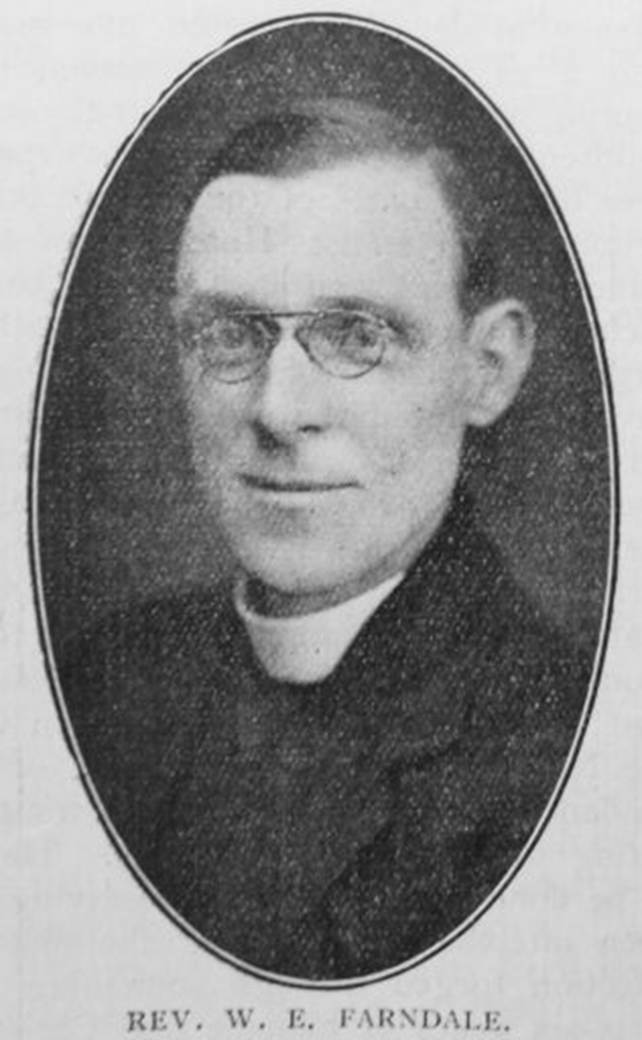
William’s son was Dr William Edward Farndale (FAR00576)
who entered the Primitive Methodist ministry in 1904. He led circuits in
London, Oldham, Chester-le-Street, Birkenhead and
Grimsby before he became President of the Primitive Methodist Conference in
1947. He was particularly interested in rural methodism and led a “Back to the
Soil” campaign.
The
Methodism in Cleveland, The Methodist Recorder 17 April 1902
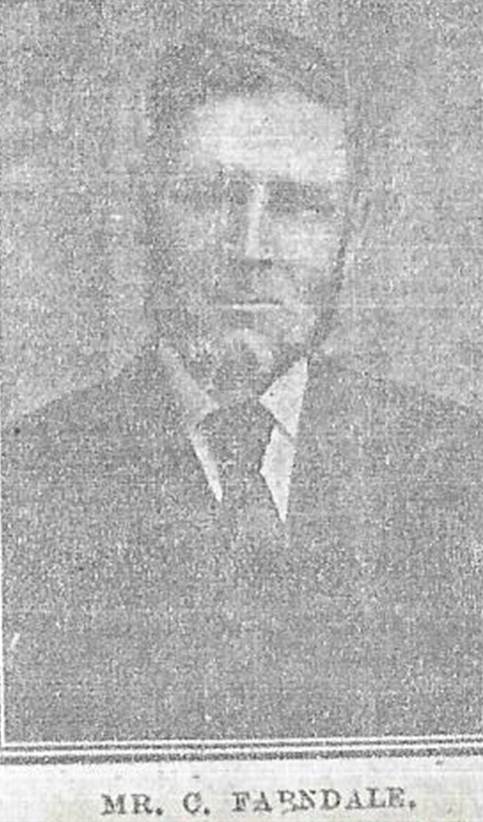
described local methodism and the prominent role of Charles Farndale (FAR00341)‘s
family: … For
very many years services have been held in the spacious farm kitchen of Mr C
Farndale, Kilton lodge, which was also that of his father before him.
Methodism in the neighbourhood and the cause of righteousness generally owes
much to the high Christian character and active interest in all good works
displayed by this devoted Methodist family. Here the preachers have always
found a hearty welcome and ministers and others who know the circuit spent
under this hospitable roof.
When his son George Farndale (FAR00540)
retired from farming in 1940, the Daily Gazette for Middlesbrough, 8 March 1940 reported: For over a century the Farndale
family have been associated with the Loftus and Staithes Wesleyan Circuit, a
connection which is soon to be severed by the removal of Mr George Farndale
from Kilton Lodge to Saltburn. A member of the third generation
of the well known family, Mr Farndale has been a circuit official for over 20
years, and a steward for seven. His grand father
was a local preacher in the circuit for a number of years, and the late
Charles Farndale upheld the family tradition by serving for the major
period of his life as circuit official and steward. In the outlying districts
of the circuit Mr George Farndale has worked equally hard, and stands as Trustee
for many of the circuit chapels.
Making sense of the World
As our ancestors devoted every hour to grunt and sweat under a
weary life, religion helped them to make sense of the world. They faced the
dread of poverty and daily worries about survival.
Inevitably they would have hoped for something better, but would have dreaded
what might happen next. William Shakespeare, Hamlet:
For who would bear the whips and scorns of time, The oppressor's wrong, the
proud man's contumely, The pangs of despised love, the law's delay, The
insolence of office and the spurns That patient merit of the unworthy takes,
When he himself might his quietus make With a bare bodkin? who would fardels
bear, To grunt and sweat under a weary life, But that the dread of something
after death, The undiscover'd country from
whose bourn No traveller returns, puzzles the will And makes us rather bear those ills we have Than fly to
others that we know not of? Thus conscience does make cowards of us all; And
thus the native hue of resolution Is sicklied o'er with the pale cast of
thought, And enterprises of great pith and moment With this regard their
currents turn awry, And lose the name of action.
Hamlet’s soliloquy recognised the worries of the unknown might makes
us rather bear those ills we have and plough on with life.
Religion in the fifteenth and sixteenth centuries
People in the middle ages believed that, after death, the soul
spent a certain length of time in Purgatory and that the prayers of the living
hastened the soul’s passage to Paradise.
Rich people built almshouses where poor
people were cared for. In return, those who relied on this charity had to
attend daily Catholic masses, religious services where they said prayers
especially for their benefactors.
There were many people in medieval England who, while not having
the wealth of the landed gentry to pay for such chantries, had become
relatively rich through trade and they formed religious guilds to ensure a less
painful progress to Heaven. The amount paid to the Skelton priest is recorded
for 1527: “St Mary Gild – Robert Westland, husbandman of the parish of All
Saints: 13s 4d”
The seventeenth century
The Act of Uniformity 1662 prescribed
the form of public prayers, administration of sacraments, and other rites of
the Established Church of England and “for preventing mischiefs and dangers
that may arise by certain persons called Quakers, and others refusing to take
oaths.” The Act declared it “altogether unlawful and contrary to the
word of God” to refuse to take an oath, or to persuade another person to
refuse to do so. It further made it “an offense for more than five persons,
commonly called Quakers. to assemble in any place under pretense
of joining in a religious worship not authorized by the laws of this realm.”
Nineteenth Century
Victorian Britain was a highly religious society. The most reads
books were the Bible and Pilgrim’s Progress.
The 1851 census:
· A
relatively high 5.3M people neglected religious services, 29% of the
population.
· But
7.3M attended church, 41% of the population.
· Morte
than half of the attendances were to Nonconformist chapels.
There had been an explosion of New Dissent groups, particularly
methodists from the 1770s.
The Old Dissent – Presbyterians, Congregationalists, Baptists,
Quakers
The New Dissent – Methodists
The Church of England remained the largest religious body, withy
85% of marriages in 1851 being in churches. The Church of England continued to
play a key role in information, education, welfare, judicial and local
government issues.
(Robert
Tombs, The English and their History, 2023, 459 to 464).
Twentieth century
The inter war years saw a gradual decline in institutional
religion, especially nonconformity.
Religious
belief were challenged by new geological, archaeological and astronomical
discoveries.
Charles Lyell’s Principles of Geology (1830 to 1833).
Robert Chambers’ Vestiges
of the Natural History of Creation (1844)
Charles Darwin’s On
the Origin of Species by Natural Selection was
largely written after the HMS Beagle voyage in the 1830s, under Malthus’
influence but publication was delayed until 1859.
Samuel Smiles’ Self Help.
These
all had implications for theories of divine creation and led to a clash with
the Church at a meeting of the British Association of Oxford in 1860 between Thomas Henry Huxley, defending Darwin and “Soapy Sam” Wilberforce, son
of the anti slavery campaigner, William Wilberforce,
Bishop of Oxford. The Evangelical literal interpretation of the Bible was
particularly threatened.
See
the Kirkdale cave discoveries.
There
was a religious response by building churches and chapels at scale, with
networks of charities, sports clubs and Bible study groups.
Church of England
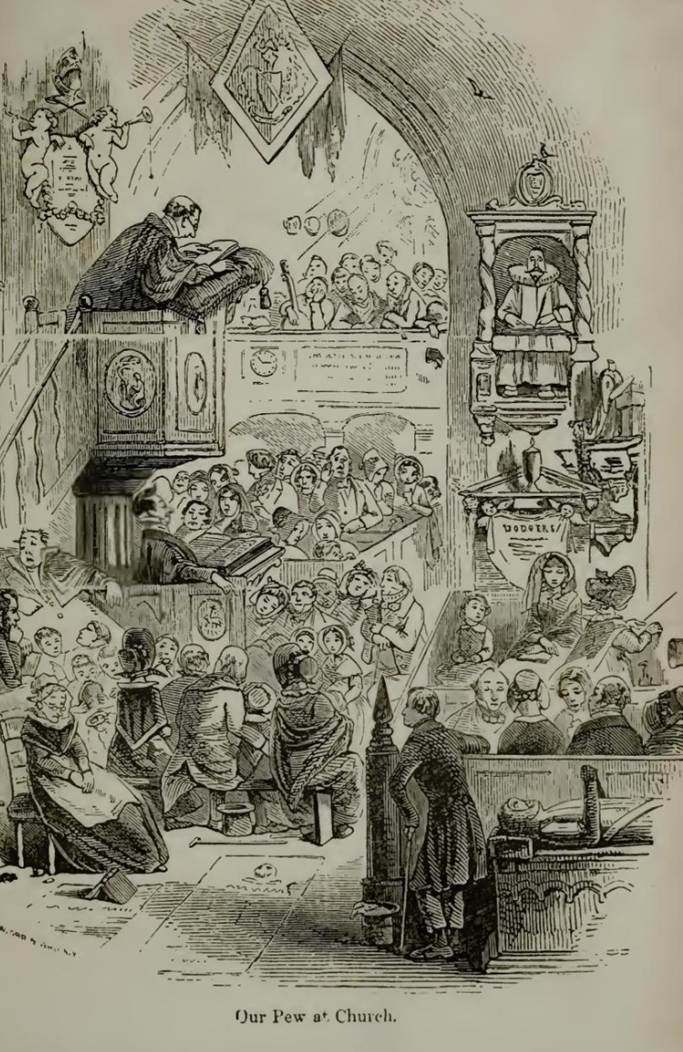
Our Pew at the Church, Charles Dickens, Pickwick Papers, Chapter 2
Here
is our pew in the church. What a high-backed pew! With a window near it, out of
which our house can be seen, and IS seen many times during the morning’s
service, by Peggotty, who likes to make herself as
sure as she can that it’s not being robbed, or is not in flames. But though
Peggotty’s eye wanders, she is much offended if mine does, and frowns to me, as
I stand upon the seat, that I am to look at the clergyman. But I can’t always
look at him—I know him without that white thing on, and I am afraid of his
wondering why I stare so, and perhaps stopping the service to inquire—and what
am I to do?
Lark Rise, Flora Thomson, Chapter XIV, To Church on Sunday: If the Lark Rise
people had been asked their religion, the answer of nine out of ten would
have been 'Church of England', for practically all of them were christened,
married, and buried as such, although, in adult life, few went to church
between the baptisms of their offspring. Every Sunday, morning and afternoon,
the two cracked, flat-toned bells at the church in the mother village called
the faithful to worship. Ding-dong, Ding-dong, Ding-dong, they went, and,
when they heard them, the hamlet churchgoers hurried across fields and over
stiles, for the Parish Clerk was always threatening to lock the church door
when the bells stopped and those outside might stop outside for all he cared.
The interior was almost as bare as a barn, with its
grey, roughcast walls, plain-glass windows, and flagstone floor.
The Parish Clerk
Lark Rise, Flora Thomson, Chapter XIV, To Church on
Sunday: The Parish Clerk at the back to keep order. 'Clerk Tom',
as he was called, was an important man in the parish. Not only did he dig
the graves, record the banns of marriage, take the chill off the
water for winter baptisms, and stoke the coke stove which stood in the nave at
the end of his seat; but he also took an active and official part in the
services. It was his duty to lead the congregation in the responses and to
intone the 'Amens'. The psalms were not sung or chanted, but read, verse
and verse about, by the Rector and people, and in these especially Tom's
voice so drowned the subdued murmur of his fellow worshippers that it sounded
like a duet between him and the clergyman.
Sermons
Lark Rise, Flora Thomson, Chapter XIV, To Church on
Sunday: Mr. Ellison in the pulpit was the Mr. Ellison of the
Scripture lessons, plus a white surplice. To him, his congregation were but
children of a larger growth, and he preached as he taught. Another
favourite subject was the supreme rightness of the social order as it then
existed. God, in His infinite wisdom, had appointed a place for every man,
woman, and child on this earth and it was their bounden duty to remain
contentedly in their niches.
Rector’s visits
Lark Rise, Flora Thomson, Chapter XIV, To Church on
Sunday: The Rector visited each cottage in turn, working his way
conscientiously round the hamlet from door to door, so that by the end of the
year he had called upon everybody. When he tapped with his gold-headed cane
at a cottage door there would come a sound of scuffling within, as unseemly
objects were hustled out of sight, for the whisper would have gone round
that he had been seen getting over the stile and his knock would have been
recognized. The women received him with respectful tolerance. A chair was
dusted with an apron and the doing of housework or cooking was suspended while
his hostess, seated uncomfortably on the edge of one of her own chairs, waited
for him to open the conversation. When the weather had been discussed, the
health of the inmates and absent children inquired about, and the progress of
the pig and the prospect of the allotment crops, there came an awkward pause,
during which both racked their brains to find something to talk about. There
was nothing. The Rector never mentioned religion. That was looked upon in
the parish as one of his chief virtues, but it limited the possible topics of
conversation. Apart from his autocratic ideas, he was a kindly man, and he had
come to pay a friendly call, hoping, no doubt, to get to know and to understand
his parishioners better. But the gulf between them was too wide; neither he nor
his hostess could bridge it. The kindly inquiries made and answered, they had
nothing more to say to each other, and, after much 'ah-ing'
and 'er-ing', he would rise from his seat, and be
shown out with alacrity.
Catholic Church
Lark Rise, Flora Thomson, Chapter XIV, To Church on
Sunday: The Catholic minority at the inn was treated with respect,
for a landlord could do no wrong, especially the landlord of a free house where
such excellent beer was on tap. On Catholicism at large, the Lark Rise people
looked with contemptuous intolerance, for they regarded it as a kind of
heathenism, and what excuse could there be for that in a Christian country?
When, early in life, the end house children asked what Roman Catholics were,
they were told they were 'folks as prays to images', and further inquiries
elicited the information that they also worshipped the Pope, a bad old man,
some said in league with the Devil. Their genuflexions in church and their 'playin' wi' beads' were described
as 'monkey tricks'.
The Methodists
The
Enlightenment which emerged after the Glorious Revolution was also a time of
religious revival. This new evangelicalism was profoundly different from the
Puritanism that dominated the Civil War period.
It
emerged from the Oxford undergraduates in the 1730s, particularly John Welsey
and George Whitefield. Wesley wrote more prolifically than anyone else in the
eighteenth century. He was influenced by Locke’s philosophy to develop a practical method (hence
methodism) of piety. It grew out of the forces of the Enlightenment. It also
grew within the existing Church and found impetus in areas of rapid change,
including rural areas of the north of England and Wales, especially in
industrial towns. It attracted miners, sailors and soldiers and others. This is
why there was an emphasis on travelling preachers who gave open air services.
It also had a strong women’s movement as it gave a unique for the time
important role to women. Singing was an important part of methodism. The Wesley
brothers (John and Charles) produced 30 hymn books and composed well known
hymns including Hark the Herald Angels Sing.
Methodism
was not suppressed by the Church. It was both subversive and conservative.
From
the 1750s the north, Wales and the Scottish borders boomed in population and
many became integrated into non conformist sects,
especially methodism. John Wesley’s flexible approach thrived on socio economic
change,. An autonomous religious movement grew around chapels, Sunday schools.
Mainstream
methodists attracted hard working and prosperous businessmen who were now able
to vote.
In
the Victorian era, Non conformist, generally Liberal
religion thrived in the north, the south west and the industrial Midlands. It
tended to be less agricultural and it formed a peripheral nationalism
with a distinct character.
The
non conformists opposed the public subsidy of church schools under the
Education Act 1870 as they worried that future generations would be brought up
Tory and Anglican.
(Robert
Tombs, The English and their History, 2023, 286 to 287, 460 to 463).
Lark Rise, Flora Thomson, Chapter XIV, To Church on
Sunday: The Methodists were a class apart. Provided they did not
attempt to convert others, religion in them was tolerated. Every Sunday
evening they held a service in one of their cottages, and, whenever she
could obtain permission at home, it was Laura's delight to attend. This was not
because the service appealed to her; she really preferred the church
service; but because Sunday evening at home was a trying time, with the
whole family huddled round the fire and Father reading and no one allowed to
speak and barely to move. The first thing that would have struck any one less
accustomed to the place was its marvellous cleanliness. The cottage
walls were whitewashed and always fresh and clean. The man of the house stood
in the doorway to welcome each arrival with a handshake and a whispered 'God
bless you!' If the visiting preacher happened to be late, which he often
was with a long distance to cover on foot, the host would give out a hymn from
Sankey and Moody's Hymn-Book, Sometimes a brother or a sister would stand up
to 'testify', and then the children opened their eyes and ears, for a
misspent youth was the conventional prelude to conversion and who knew
what exciting transgressions might not be revealed. Most of them did not
amount to much. One would say that before he 'found the Lord' he had been 'a
regular beastly drunkard'; but it turned out that he had only taken a pint too
much once or twice at a village feast. One man, especially, claimed that
pre-eminence. 'I wer' the chief of sinners,' he would
cry; 'a real bad lot, a Devil's disciple. Cursing and swearing, drinking
and drabbing, there were nothing bad as I didn't do. Why, would you believe it,
in my sinful pride, I sinned against the Holy Ghost. Aye, that I did,' and the
awed silence would be broken by the groans and 'God have mercy's of his hearers
while he looked round to observe the effect of his confession before relating
how he 'came to the Lord'. But the chief interest centred in the travelling
preacher, especially if he were a stranger who had not been there before. Then
there was the elderly man who chose for his text: 'I will sweep them off the
face of the earth with the besom of destruction', and proceeded to take each
word of his text as a heading. 'I will sweep them off the face of the earth. I
will sweep them off the face of the earth. I will sweep them off the face of
the earth', and so on. Methodism, as known and practised there, was a poor
people's religion, simple and crude.
In our time podcast on John Wesley.
The Methodists offered something people wanted that was not
offered by the Anglican Church. The new preachers showed a passion for the
souls and many who responded felt a strong sense of sin.
Primitive Methodism
Also known as ‘Ranters’, for
their enthusiastic preaching, ‘Primitive’ Methodists were so called because
they wanted a return to an earlier, purer form of Methodism, as founded by John
Wesley, based on the early church. In 1932 Primitive Methodists joined with
Wesleyan and United Methodists to form the Methodist Church.
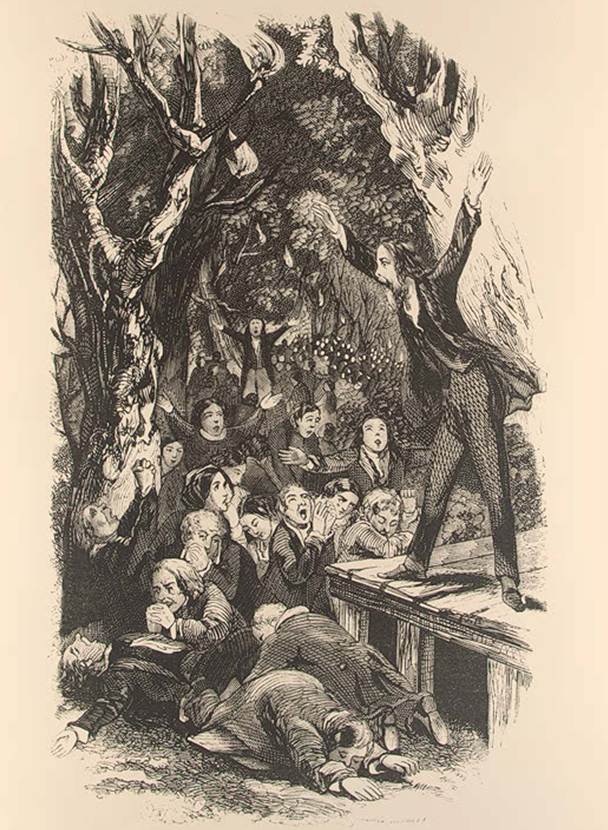
In the early decades of the nineteenth century there
was a growing body of opinion among the Wesleyans that their religion was
moving in directions which were a distortion, even a betrayal, of what John
Wesley’s teachings.
A Methodist preacher called Hugh Bourne became the
catalyst for a breakaway, to form the Primitive Methodists. Their badge of
'primitive' was used to stress their belief that they were the true guardians
of the original, or primitive, form of Methodism.
The
nineteenth century working class movement known as Primitive Methodism,
originated in the Potteries, where an open air ‘camp’ meeting was held at Mow
Cop in 1807, igniting a passion for the ‘love of God’ which quickly spread
across the Midlands. By the end of the century there were over 200,000 members.
The sorts of issues which divided the Primitives and
the Wesleyans might be summarised:
|
Methodists |
Primitive Methodists |
|
Developed a high doctrine of the Pastoral Office to
justify leadership being in the hands of the ministers. |
Focused attention on the role of lay people. |
|
Were open to cultural enrichment from the Anglican
tradition and more ornate buildings. |
Stressed simplicity in their chapels and their
worship. |
|
Were involved with more affluent and influential
urban classes. |
Concentrated their mission on the rural poor. |
|
Were nervous of direct political engagement. |
Stressed the political implications of their
Christian discipleship. |
In
the context of the growing democratisation and sense of dislocation caused by
the Industrial Revolution, Primitive Methodism appealed primarily to miners and
mill hands, farm labourers, and workers in developing factory towns. In rural
areas, Primitive Methodists often came into conflict with the Squire and
Anglican clergy, who saw them as a threat to the established order.
The
conviction that God’s love was for all, led to a concern for social justice,
and many Primitive Methodists became involved in politics, as trade unionist
leaders, Chartists, and later as Labour MPs.
George
Edwards, who championed the cause of farm labourers in Norfolk, is typical of
the early trade union leaders who developed their passion and leadership skills
through the Primitive Methodist Chapels. He started his working life at the age
of six, he was illiterate until he became involved in Primitive Methodism and
he embarked on a journey of self-education, as he recounts in From Crow
Scaring to Parliament.
By the end of the 19th century these two streams of
Methodism realised they had more in common than they might have supposed. So
conversations began which led to their being the two principal partners in the
union to form the present-day Methodist Church in 1932.
In 1865 the Skelton
Primitive Methodist Church was built on Green Road. The Primitive Methodists in
Skelton had previously been meeting in local rooms. The movement was by then 50
years old. It was started by a person called Hugh Bourne, who was born in 1772
at Stoke. He built his own church 1811 and sent out evangelists. Within thirty
years he had 100,000 followers and 1,000 churches. They were popularly known as
the “Ranters”. “Primitive” to them meant, original,
getting back to the real beginnings of whatever they believed in. John Thomas
Wharton of Skelton Castle, being a strong adherent to the Anglican Church,
disapproved of them. At first he refused to let them have the land on which to
build their own Chapel. He finally relented and sold it to them at a high
price. A newspaper of the time reported that one of the Primitive Church
members made 30,000 bricks for the structure, working after his normal daily
stint at work. His employer provided the clay and means of leading them to the
site.
Quakers and
Unitarians
Smaller sects like to Quakers and Unitarians were
adopted by urban and business elites. The Quakers included Cadbury, Fry,
Rowntree, Barclay, Lloyd, Swan and Hunter, Price and Waterhouse,
Evangelism
Evangelism created charities and philanthropic lobby
groups.
Temperance and social influence
The non conformist conscience
extended to political action and law enforcement to promote its moral code.
William Wilberforce’s influence extended beyond anti slavery
to animal protection and religious education. The John Keble’s Oxford Movement
in the 1820s was a High Church revolt against Anglicanism.
Religious life in Britain thus became complex, ranging from Roman
Catholics (relative to whom discrimination was largely degraded in 1791 and
1829 reforms) to Mormons.
Halifax had 7 religious buildings in 1801 and 99 in 1901.
By 1901 England had 34,000 religious buildings, one for every
1,000. Most seats in churches belonged to specific people or families, so there
was an air of exclusivity to membership.
The temperance movement obtained regulation of access to drink and
alcohol consumption declined from the 1870s.
Drink was seen to be at the heart of moral, social and economic
problems. In the 1850s reformers campaigned against beer and ale houses as the
direct causes of crimes. Places of popular entertainment were targeted.
Temperance built up a large organised following focused around churches,
chapels and Sunday school. However drinking culture was also central to social
life and there were only really local successes in the control of drink,
although there was a general decline in drinking in the second half of the
nineteenth century. Temperance measures never came close to those in Wales and
US. (Robert Tombs, The English and their History,
2023, 502).
There is an In Our Time podcast on the Temperance Movement.
Charles Dickens, Hard Times:
Coketown, to
which Messrs. Bounderby and Gradgrind now walked, was a triumph of fact; …
You saw nothing in Coketown
but what was severely workful. If the
members of a religious persuasion built a chapel there—as the members of
eighteen religious persuasions had done—they made it a pious warehouse of
red brick, with sometimes (but this is only in highly ornamental examples)
a bell in a birdcage on the top of it.
The solitary exception was the New Church; a stuccoed edifice with a
square steeple over the door, terminating in four short pinnacles like florid
wooden legs. All the public inscriptions
in the town were painted alike, in severe characters of black and white. The jail might have been the infirmary, the
infirmary might have been the jail, the town-hall might have been either, or
both, or anything else, for anything that appeared to the contrary in the
graces of their construction. Fact,
fact, fact, everywhere in the material aspect of the town; fact, fact, fact,
everywhere in the immaterial. The M’Choakumchild school was all fact, and the school of
design was all fact, and the relations between master and man were all fact,
and everything was fact between the lying-in hospital and the cemetery, and
what you couldn’t state in figures, or show to be purchaseable
in the cheapest market and saleable in the dearest, was not, and never should
be, world without end, Amen.
A town so sacred to fact, and so triumphant in
its assertion, of course got on well?
Why no, not quite well. No? Dear me!
No. Coketown did not come out of its own furnaces, in all
respects like gold that had stood the fire.
First, the perplexing mystery of the place was, Who belonged to the
eighteen denominations? Because, whoever
did, the labouring people did not. It
was very strange to walk through the streets on a Sunday morning, and note how
few of them the barbarous jangling of bells that was driving the sick and
nervous mad, called away from their own quarter, from their own close rooms,
from the corners of their own streets, where they lounged listlessly, gazing at
all the church and chapel going, as at a thing with which they had no manner of
concern. Nor was it merely the stranger
who noticed this, because there was a native organization in Coketown itself, whose members were to be heard of in the
House of Commons every session, indignantly petitioning for acts of parliament
that should make these people religious by main force. Then came the Teetotal Society, who
complained that these same people would get drunk, and showed in tabular
statements that they did get drunk, and proved at tea parties that no
inducement, human or Divine (except a medal), would induce them to forego their
custom of getting drunk. Then came
the chemist and druggist, with other tabular statements, showing that when
they didn’t get drunk, they took opium.
Then came the experienced chaplain of the jail, with more tabular
statements, outdoing all the previous tabular statements, and showing that the
same people would resort to low haunts, hidden from the public eye, where they
heard low singing and saw low dancing, and mayhap joined in it; and where A.
B., aged twenty-four next birthday, and committed for eighteen months’
solitary, had himself said (not that he had ever shown himself particularly
worthy of belief) his ruin began, as he was perfectly sure and confident that
otherwise he would have been a tip-top moral specimen. Then came Mr. Gradgrind and Mr. Bounderby,
the two gentlemen at this present moment walking through Coketown,
and both eminently practical, who could, on occasion, furnish more tabular
statements derived from their own personal experience, and illustrated by cases
they had known and seen, from which it clearly appeared—in short, it was the
only clear thing in the case—that these same people were a bad lot altogether,
gentlemen; that do what you would for them they were never thankful for it,
gentlemen; that they were restless, gentlemen; that they never knew what they
wanted; that they lived upon the best, and bought fresh butter; and insisted on
Mocha coffee, and rejected all but prime parts of meat, and yet were eternally
dissatisfied and unmanageable. In short,
it was the moral of the old nursery fable:
There was an old woman, and what do you think?
She lived upon nothing but victuals and drink;
Victuals and drink were the whole of her diet,
And yet this old woman would NEVER be quiet.