The Farndale Cocktail

|
Return to the Home Page of the Farndale Family
Website |
The story of one family’s journey through two
thousand years of British History |
The 83 family lines into which the family is divided.
Meet the whole family and how the wider family is related |
Members of the historical family ordered by date of
birth |
Links to other pages with historical research and
related material |
The story of the Bakers of Highfields, the Chapmans,
and other related families |
Introduction
Dates are in red.
Hyperlinks to
other pages are in dark
blue.
Headlines of the
history of Boosbeck are in brown.
References and
citations are in turquoise.
Contextual
history is in purple.
General Sir Martin Farndale
KCB
General
Sir Martin Farndale commanded the Northern Army Group (“NORTHAG”) of NATO during the Cold War.
NATO’s structure
As the North Atlantic Treaty Organisation (“NATO”) lined up from Scandinavia to southern Europe to face the Warsaw Pact,
the NATO defensive force was divided into three:
·
the Scandinavian force, the Allied
Forces Northern Europe, in the icy north;
·
NORTHAG, which protected the line of
defence from the Baltic to the Harz mountains; and
·
the Central Army Group (“CENTAG “) to the south.
The Northern Army Group of
NATO
NORTHAG comprised five Corps - a Dutch, German, British, Belgian and
French Corps, with an American Corps (based in USA) to act as its reserve force
and to arrive (perhaps jet lagged) by air as the war started.
Each Corps comprised about 77,000 soldiers. The size of the entire
British Army in 2019 is circa 80,000 soldiers.
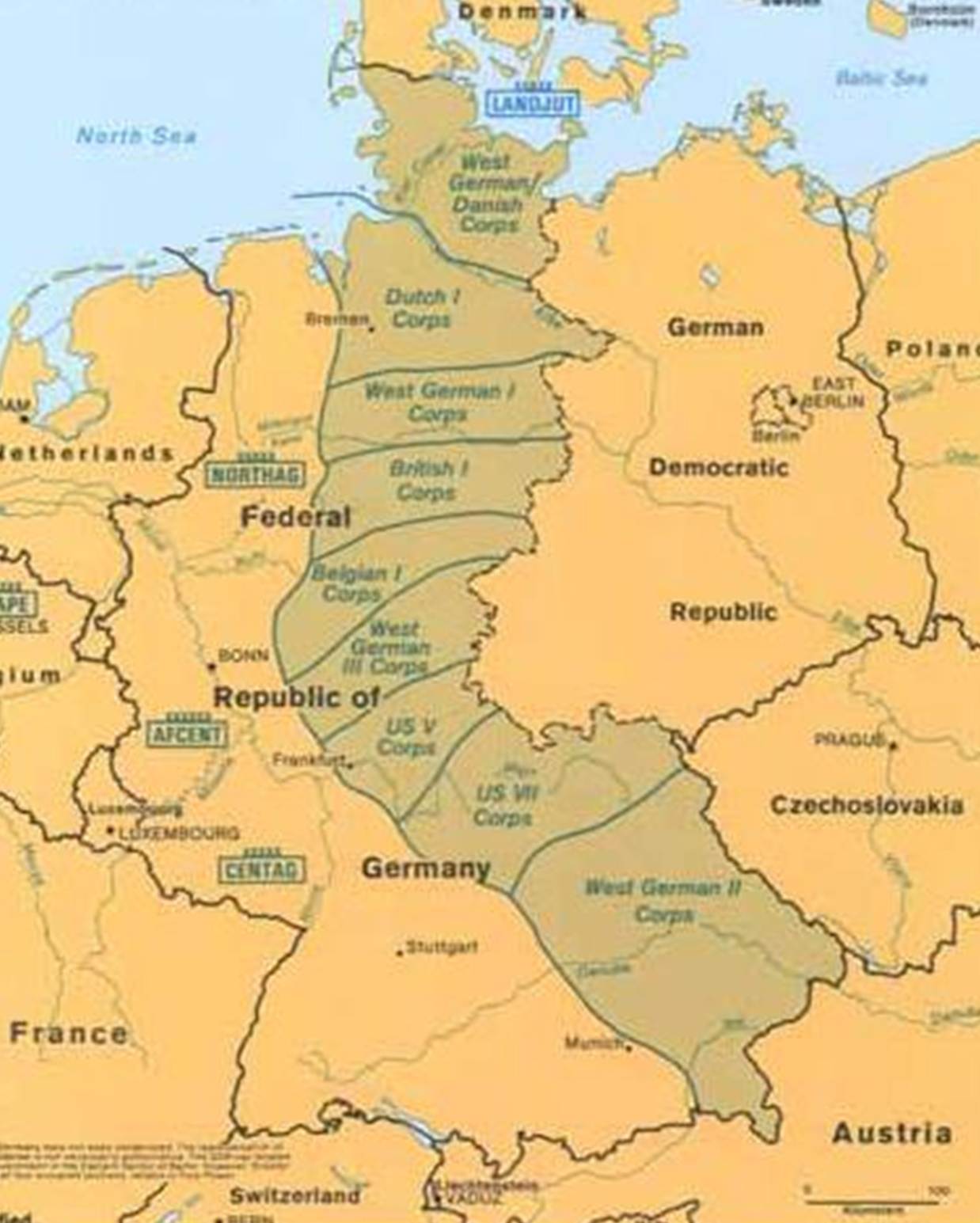
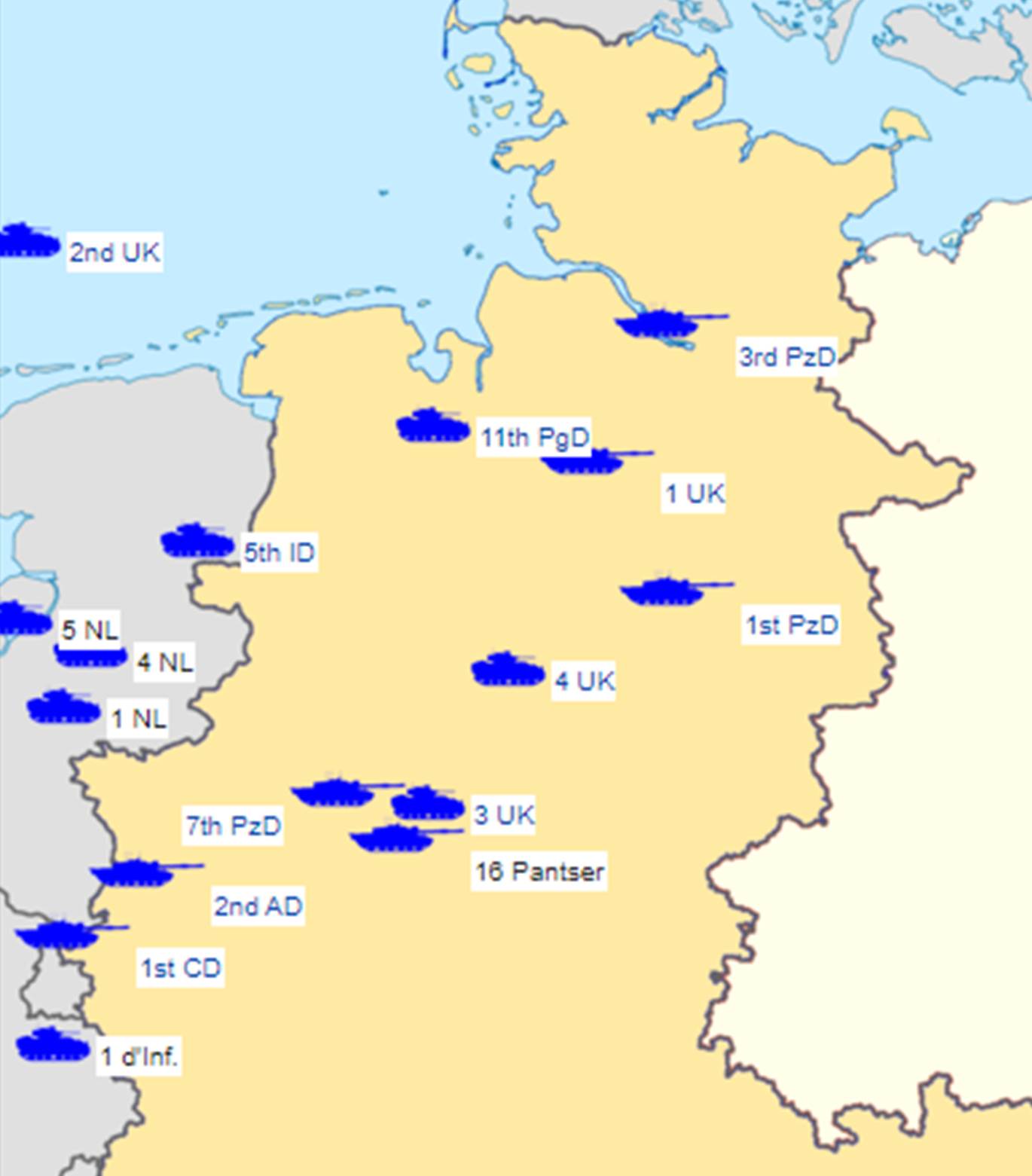
NATO’s central region in 1989
In the NATO command structure NORTHAG belonged to Allied Forces Central Europe (“AFCENT”), which in turn reported
to Supreme Headquarters Allied Powers Europe (“SHAPE”).
NORTHAG’s responsibility was the defence of the North German plains from
south of the river Elbe to the city of Kassel.
The defence north of the Elbe was the task of Allied Land Forces Command
Schleswig-Holstein and Jutland (“COMLANDJUT”), while south of Kassel it was the task of CENTAG.
Commander in Chief of NORTHAG was the commanding General of
the British Army of the Rhine (BAOR). The Chief of
Staff was a German Major General, with a Belgian or Dutch Major
General as alternates.
Northern Army Group was assigned the following formations:
·
I Dutch Corps (Dutch 1st, 4th and 5th Mechanized Divisions and
the 101st Infantry Brigade. From July 1985 the German 3rd Panzer Division was
added.)
·
I German Corps (1st Panzer Division, 7th
Panzer Division, 11th Panzer grenadier Division, and 27th Airborne
Brigade.)
·
I British Corps (1st Armoured Division, 3rd and 4th Armoured,
and 2nd Infantry Division)
·
I Belgian
Corps (1st Infantry and 16th Armoured Division)
·
III French Corps as reserve corps (2nd Armoured Division, and
10th Armoured, and 8th Infantry Division (France))
·
III (US) Corps was assigned as reserve corps. 3rd Brigade, 2nd
Armoured Division was forward deployed at Garlstedt. The rest of 2nd Armoured Division,
along with 1st Cavalry Division, 5th Infantry Division
(Mech), 212th Field Artillery Brigade and 3rd Armoured Cavalry
Regiment would join NORTHAG through OPERATION REFORGER within
days after an outbreak of hostilities. They would draw their equipment
from POMCUS depots
in the Netherlands, Belgium and North Rhine-Westphalia.
These organizations fell in peacetime under their respective national
command authorities. Only in the case of attack did operational control over
the Corps automatically transfer to NORTHAG.
Air support was provided by 2 ATAF.
During peacetime NORTHAG multi-national staff commanded the following
units:
·
13th Belgian
Telecommunications Company (13 Cie T Tr)
·
28th Signal Regiment, Royal
Signals (NORTHAG)
·
German
Telecommunications Battalion 840 (NORTHAG)
·
Dutch telecommunications company
·
NORTHAG telecommunications company
(radio NORTHAG Air Support Squadron), which consisted of soldiers from all four
nations.
In the case of war the headquarters of the 2nd ATAF and NORTHAG would be
relocated to the Joint Operations Centre (“JOC”), a bunker complex in the St. Pietersberg in Maastricht area.
1952
The Army Group headquarters was established on 1 November 1952
in Bad Oeynhausen.
1954
The Army Group headquarters relocated in 1954 to Rheindahlen. The HQ complex near
Mönchengladbach contained NORTHAG HQ and three other command posts; the
headquarters of the Second Allied Tactical Air Force (2
ATAF), British Army of the Rhine (“BAOR”) and Royal Air Force Germany (“RAFG”).
Previously, 21st Army Group had been on the left flank of the
Allied advance into Germany, and had advanced into the North German Plain.
This may have been the reason that a four-corps sized formation, which would
usually be considered an army, was given the title of 'Army group'.
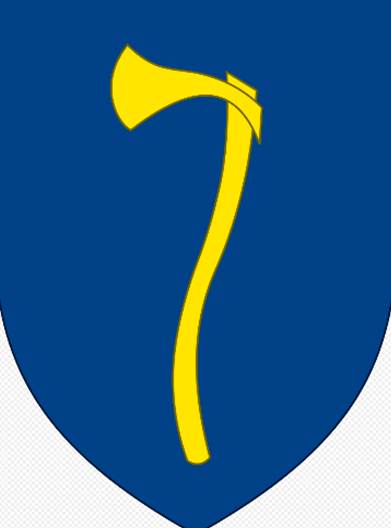
During the construction of the main Joint Headquarters (“JHQ”) building, a Frankish battle axe (Francisca)
was found. It was the badge NORTHAG chose because the Franks were
a Western Europeans defending against attackers from the East. In the year 451
AD the Franks defeated an army under the leadership
of Attila at Châlons-sur-Marne and thus ended a conquest of
Western Europe by the Huns.
1983
General Sir Nigel Bagnall was Commander of NORTHAG in the rank of
General from 1 July 1983. As Commander of NORTHAG he grappled with NATO's
strategy of forward defence, and he persuaded the Germans that some ground
would have to be surrendered to withstand a massive Soviet Army attack. General
Bagnall became Chief of the General Staff in 19856 and was promoted to Field
Marshall in 1988.
1985
Martin Farndale (FAR00911)
commanded the
British Corps, 1st British Corps (comprising the fighting
element of the British Army of the Rhine) between 1983 and 1985 as Lieutenant
General and immediately afterwards he became Commander
NORTHAG as a full general from 1985 to 1987 as a full General.
1986
Martin Farndale followed Nigel Bagnall’s initiative to re-orientate
NORTHAG’s defensive plans from a static defence to a more mobile
approach. By 1986, this plan envisioned the formation of armour-heavy
reserves held under army group command.
1992
Ground operations relating to the crisis in former Yugoslavia began in
late 1992. In November 1992, the United Nations Protection Force in
Bosnia-Herzegovina was provided with an operational headquarters drawn from HQ
NORTHAG, including a staff of some 100 personnel, equipment, supplies and
initial financial support.
1993
On 24 June 1993, the headquarters of NORTHAG and 2 ATAF officially
disbanded during a military ceremony.
The last commander of NORTHAG was General Sir Charles Guthrie, KCB
LVO OBE. The last Chief of Staff was Major General Helmut Willmann,
later commander of the Eurocorps.
The Concentration of Force
One of the key principles of War is the Concentration of
Force being the concentration of military force so as to
bring to bear such overwhelming force against a portion of an enemy force that
the disparity between the two forces alone acts as a force
multiplier in favour of the concentrated forces.
Thus it has long been a key military strategy in attack to concentrate
force at a small perhaps vulnerable point of the battlefield in order to punch
through and overwhelm the defender. That was known to be the strategy of the
Warsaw Pact. It was often applied unsuccessfully in World War 1.
The principle is equally important in defence. Hadrian’s Wall provided a
physical barrier, but was defended by very small numbers of soldiers. Their job
was simply to use the barrier of the wall to slow any attack and to signal to
forts of legions behind the line, who would focus their force in defence at the
point of any attack.
In World War 2 concentration of force in defence was often used
successfully. In March 1943 Field Marshall Von Manstein faced a concentrated
attack by the Soviet force at Kharkov. He allowed his enemy force to penetrate
deep into his territory before ordering a powerful counter strike into the soft
tail of the concentrated force, thus cutting off its logistical tail and
leaving the attacking force exposed and without supplies. The strategy for an
attacker can be a dangerous one if over exploited. A strategy of concentration
of force in attack can be met with concentrated force in defence. Thus a
strategy of a ‘thin red line’, spreading a defence force equally along the line
of defence, was long recognised as an ineffective strategy.
The Strategy developed by NATO in response to the Warsaw Pact threat was
focused on the concentration of effective force. This was a key part of the
strategy of a more mobile defence. NATO commanders intended to allow
significant penetration by Warsaw Pact attackers into western European
territory but to apply their own concentrated force at the most vulnerable
moment against the attacking force. This involved a careful strategy of
intelligence gathering and anticipating the progression of enemy forces.
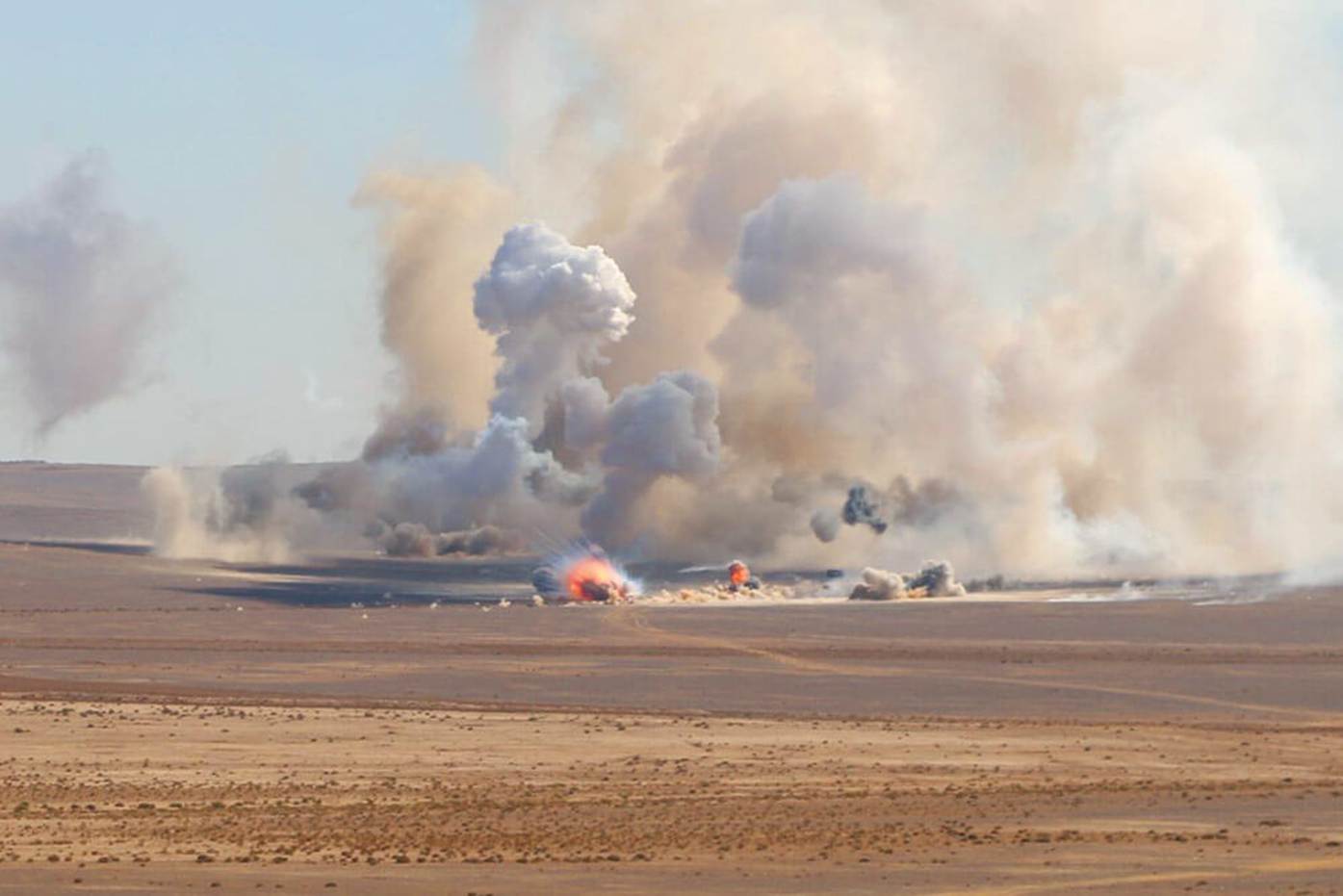
The Farndale Cocktail
Martin Farndale was an artillery officer by background. He understood the
importance of the combined firepower of the infantry and tank units with the
firepower of infantry mortar units, artillery batteries, helicopter anti tank
squadrons, and airpower.
He devised a strategy to concentrate not only the force of tanks and
infantry, but the whole firepower of air, artillery and helicopters, at a
decisive point in the battlefield.
His strategy became known as the Farndale
Cocktail.
Cheers!