c
1270 to c 1327
The Medieval Inhabitants of Farndale
FAR00014A
|
Return to the Home
Page of the Farndale Family Website |
The story of one
family’s journey through two thousand years of British History |
The 83 family lines
into which the family is divided. Meet the whole family and how the wider
family is related |
Members of the
historical family ordered by date of birth |
Links to other pages
with historical research and related material |
The story of the
Bakers of Highfields, the Chapmans, and other related families |

Dates
are in red.
Hyperlinks
to other pages are in dark
blue.
Headlines
are in brown.
References
and citations are in turquoise.
Context
and local history are in purple.
1277
Walter de Farndale might have been born in about 1277 if he was 50 when he
was murdered in Cayton. He was the son of Robert, the Smith of Farndale (FAR00021C).
1295
His sons Walter de Farndale (FAR00015,
later a vicar who travelled widely) and John
de Farndale (FAR00041B) might have been born in about 1295.
1296
His son Nicholas de Farndale (FAR00041A) might have been
born in about 1296.
A number of local folk had taken draught
beasts into Pickering Forest in the reign of Edward III in 1310 or 1311, where
the draught animals were forbidden to wander. Some pasturages were reserved for the use of the King where there
was no right in common and here, cattle were agisted
at a fixed price, to be paid to the bailiff. These sums were collected by the
agisters, of whom there were two in each ward, men of substance it seems by
their assessments in the Lay Subsidies.
Not the least of the profits
derived from the possession of a forest was that arising from the agistment of
cattle in waste grounds. (The Duchy of Lancaster Records, from the North Riding
Record Society, The Honour and Forest of Pickering, Edited by Robert
Bell Turton, Volume IV, 1897, page xxvii).
There
was a lengthy list of those individuals
from Farndale found by the agisters in about 1310 with their cattle in the
forests. Thomas Wake, the Lord
of Liddell, whose tenants they were, said the price had already been paid and
the tenants should be discharged of the matter. Amongst
those fined were Walter
(FAR00014A),
son of Robert the Smith of Farndale (FAR00021C) who had 5 oxen, worth 20s
agisted (North
Riding Records Yorks Volume III,
The Honour and Forest of Pickering, 1894, Edited Robert Bell Turton, page 61, The Great Cowcher
of the Duchy of Lancaster, The National Archives, DL42/1 Folio 273, 273v, DL 42/1/23/U64 folios 273 to 274v).
an ox
and two stirks of Robert the smith 7s 4d , five oxen of Walter, his son, £1
1315
The English army under Edward II
was smashed at Bannockburn on 24 June 1314, which would cause a temporary end
to English ambitions in Scotland. Scots
raiders were free to sweep deep into Yorkshire.
1315 to 1316
The north of England was relatively
defenceless and faced raids from Scotland and destruction of crops and seizing
of animals.
Edward’s military failures against
France and Scotland marked his unhappy reign.
There was discontent, which focused
on his close relationship with Piers Gaveston, a Gascon knight, who he made
Earl of Cornwall.
The Great Famine following bad
weather and poor harvests. Widespread unrest and crime and infanticide.
1322
Robert Bruce rode through Yarm and
nearly captured Edward III at Byland Abbey. Rievaulx
abbey was damaged.
1327
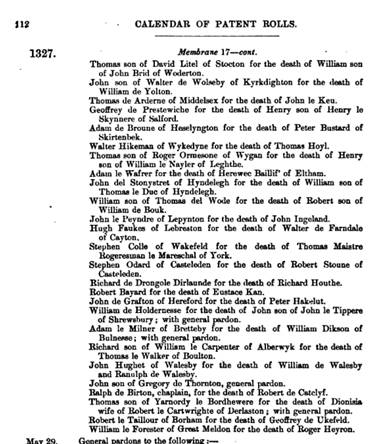
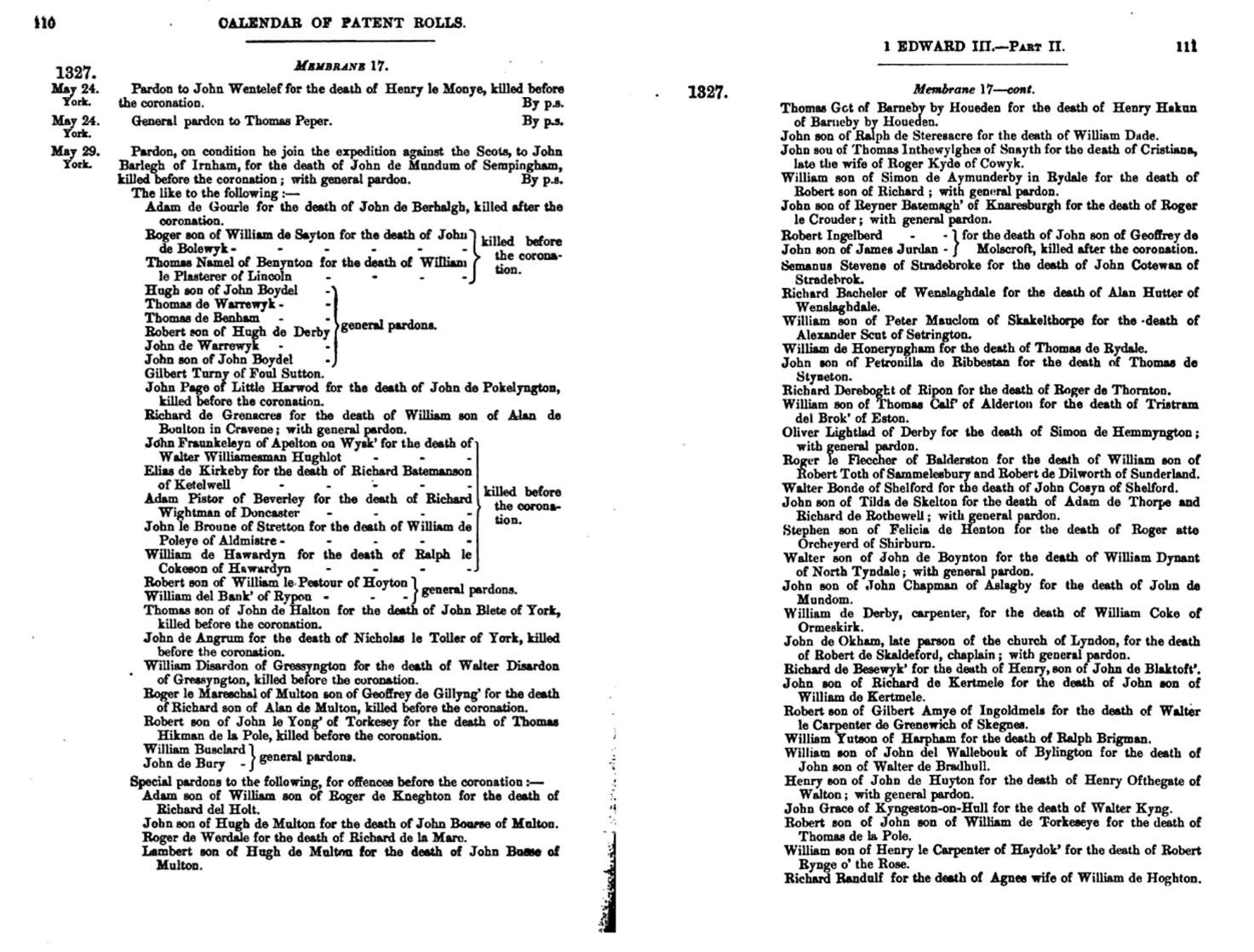
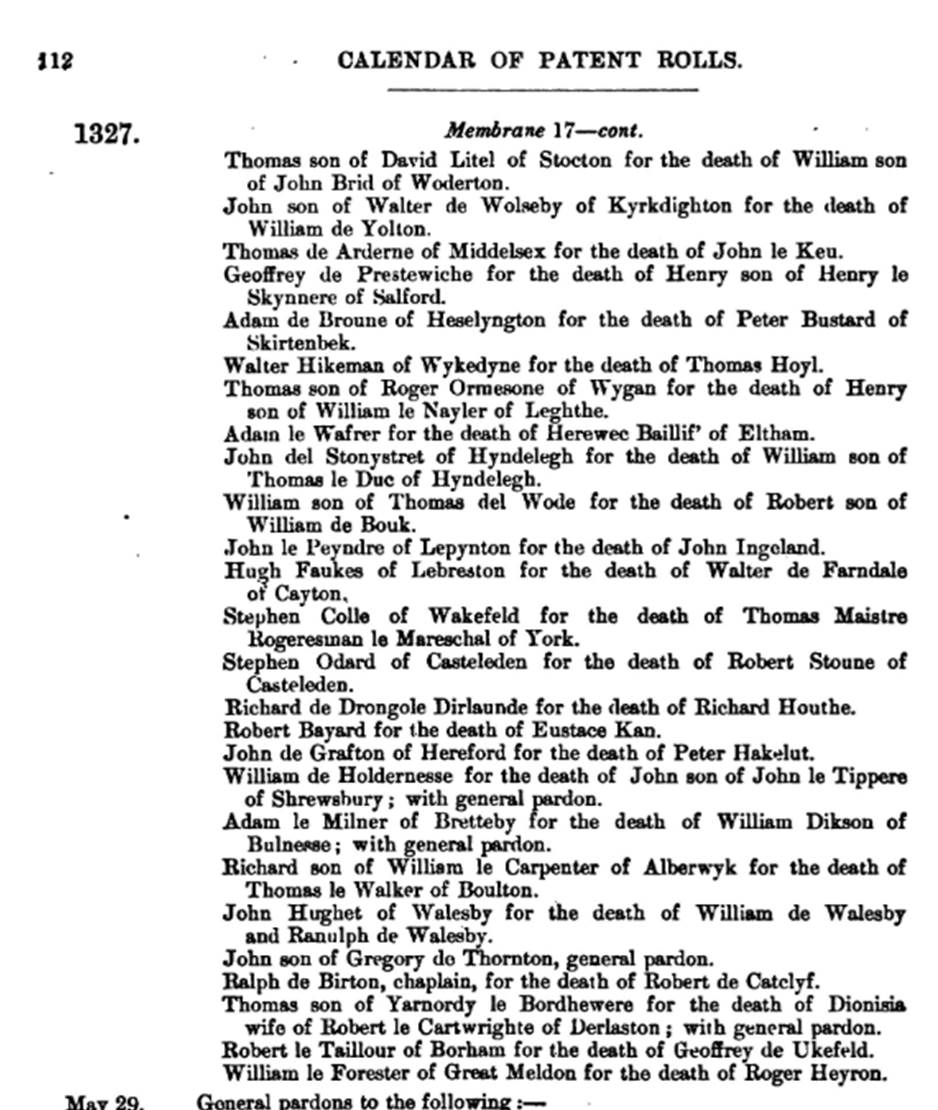
On 29 May 1327 a pardon was granted to Hugh de Faulkes of Lebreston on condition he join an expedition against the
Scots for the death of Walter de Farndale of Cayton. Given at
York 29th May 1327.
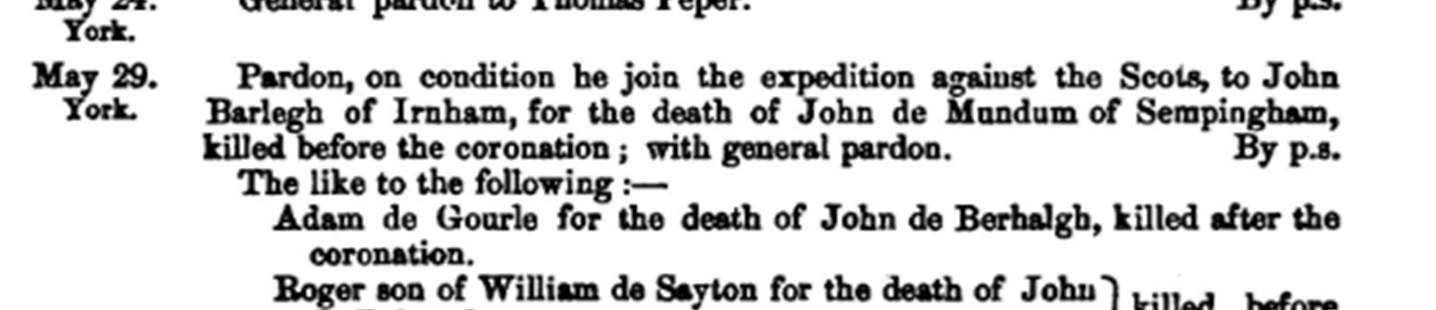

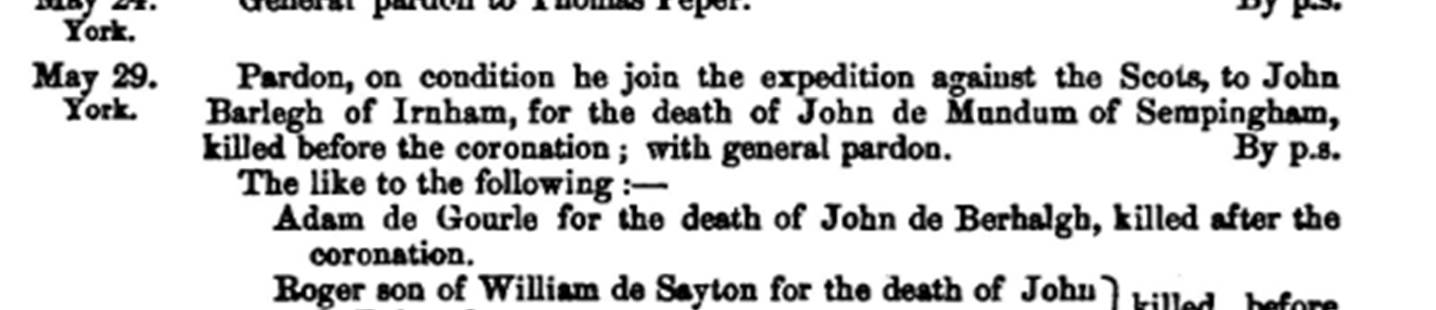

(Calendar
of Patent Rolls)
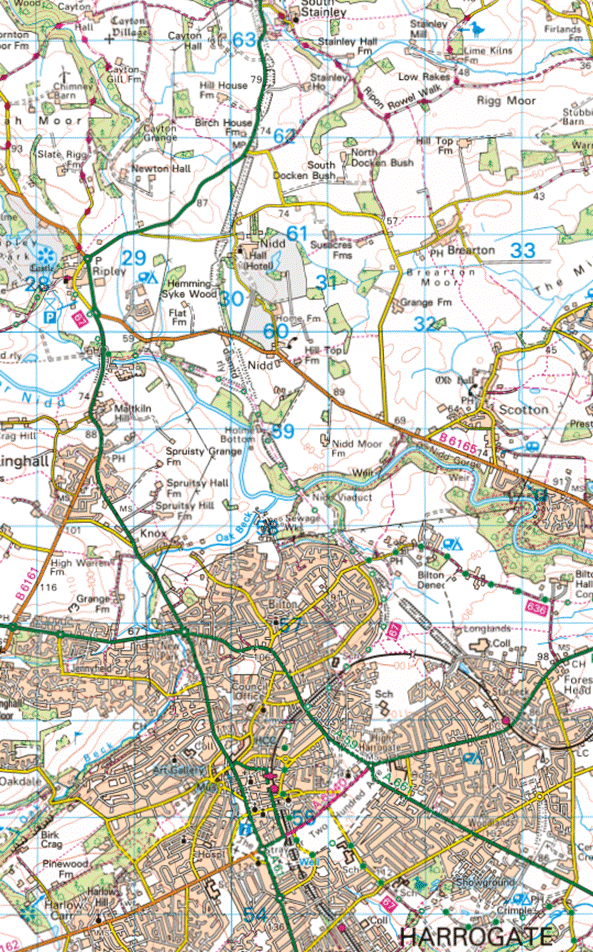
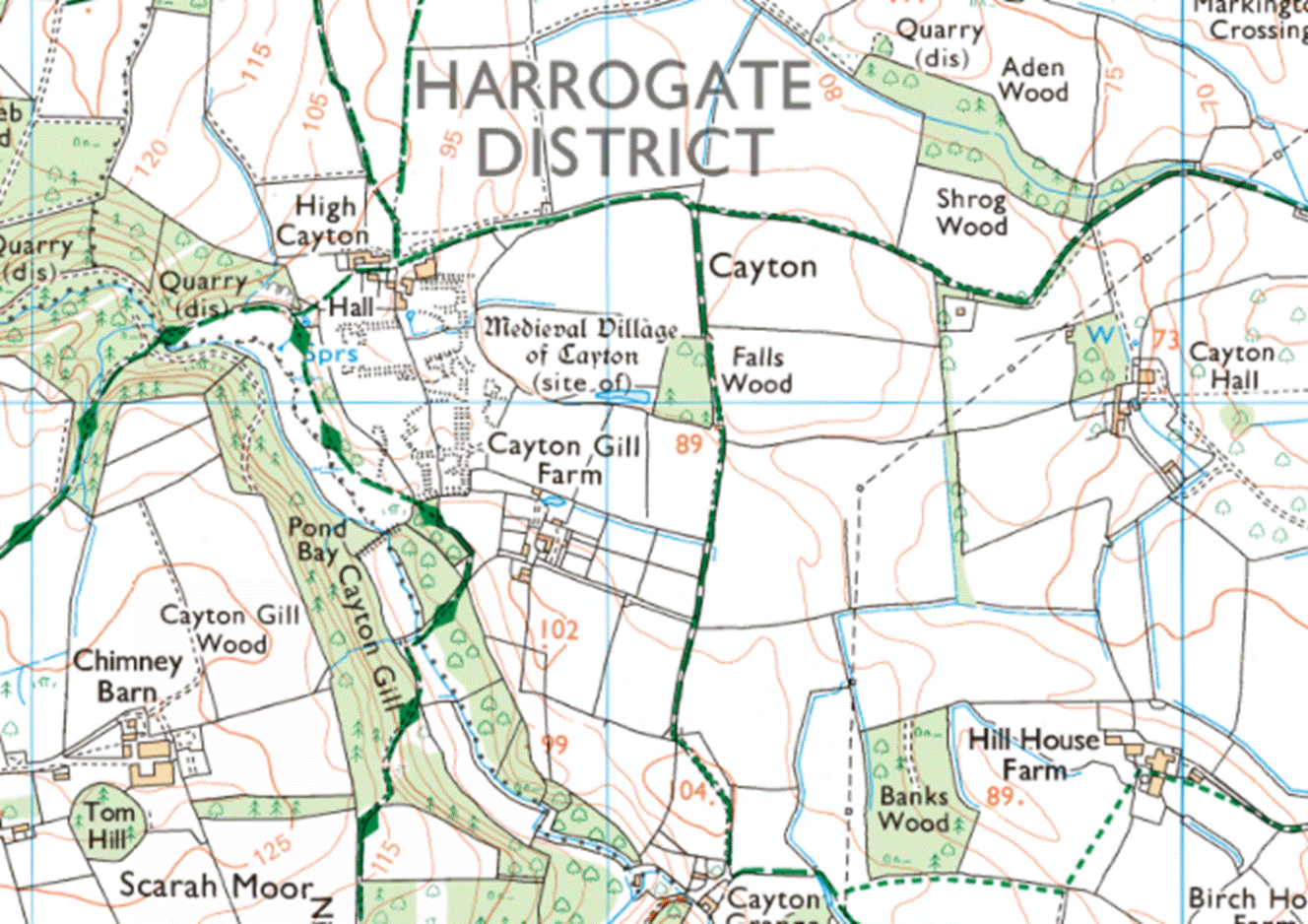
Cayton and Lebberston are two villages only two kilometres apart just
south of Scarborough.
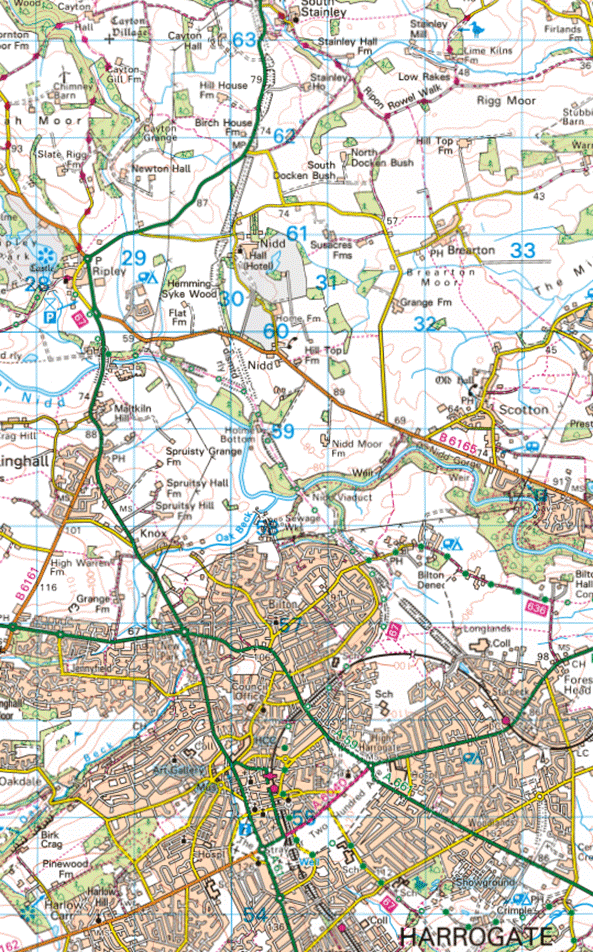
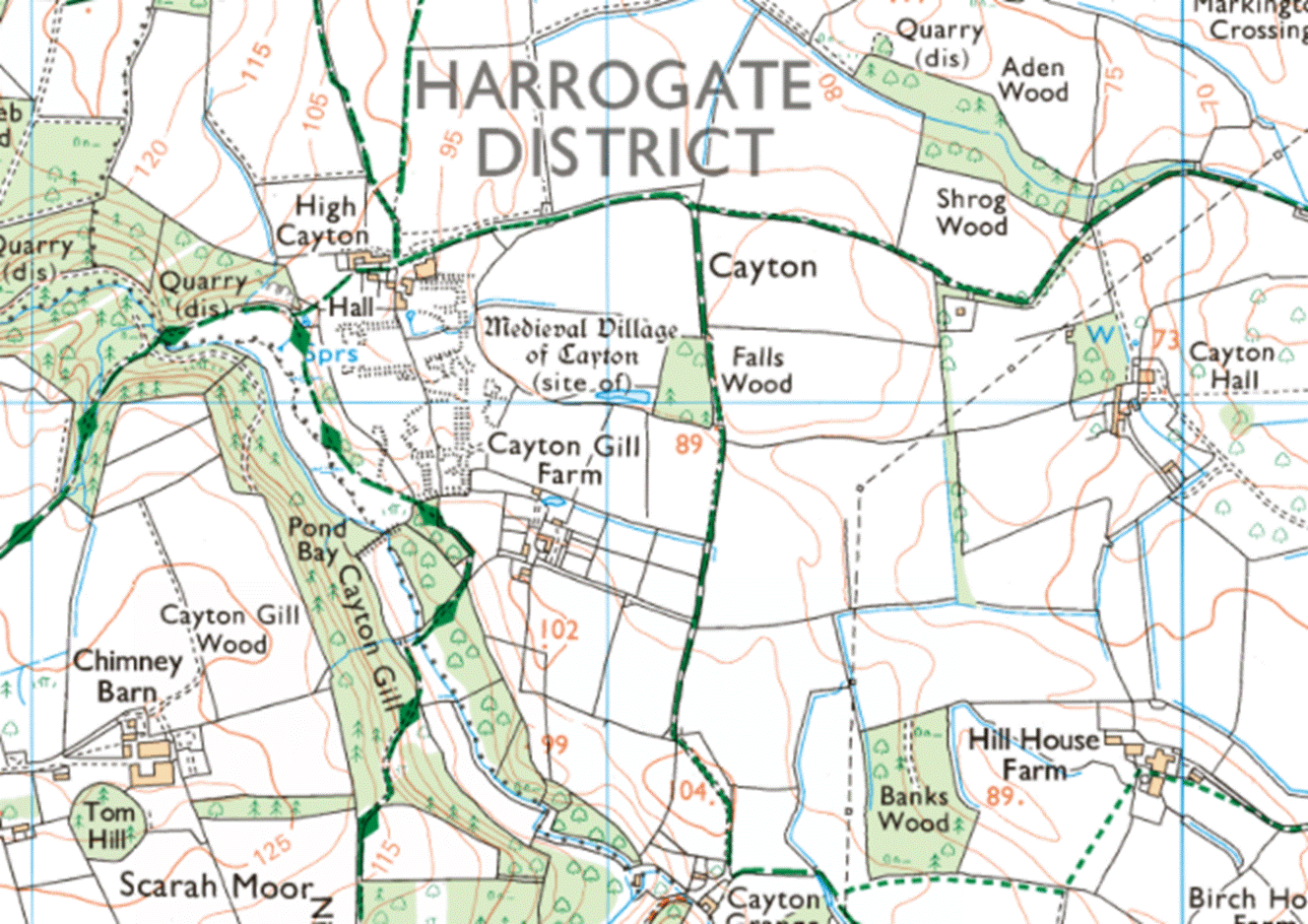
However there is also another place called Cayton, where there was a medieval
village, about ten kilometres north of Harrogate. The proximity of Cayton
and Lebberston, south of Scarborough suggests that this is where
Walter had settled. However Walter’s probable grandson, William Farndale (FAR00036) became associated with a number of locations around the
Harrogate area, so it may be that the murdered Walter came from the medieval
village of Cayton, north of Harrogate.
3
October 1334
After his death, at a
hearing on 3 October 1334, after Robert (WES00005),
son of Richard de Westgill of Farndale (WES00001) had trespassed and hunted in Pickering Forest, others
including William le Smyth of Farndale (FAR00037), John (FAR00041B), son
of Walter of the same (FAR00014A), John Alberd
of the same (ALB00002), and Nicholas (FAR00041A), son
of Walter of the same (FAR00014A), mainperned (provided guarantees) for their
appearance (The Great Cowcher of the Duchy
of Lancaster, The National Archives, DL42/1 Folio 228v, DL 42/1/23/U29 folios 228 to 229).
After John (WES00004),
son of Richard de Westgille of Farndale (WES00001) had trespassed and hunted in Pickering Forest, others
including William le Smyth of Farndale (FAR00037), Richard de Westgill (WES00001),
John le Shepherd of Farndale (FAR00010), John Alberd of the same (ALB00002), Nicholas (FAR00041A), son of Walter of the same (FAR00014A), John del Heued
of the same (HEU00001), and Robert de Westgill (WES00005) mainperned (provided guarantees) for their
appearance (The Great Cowcher of the Duchy
of Lancaster, The National Archives, DL42/1 Folio 228v).
There
are full details of this hearing at
another webpage.
A number of individuals from Farndale were fined
following prior indictments for poaching in 1334 and not turning up at the
Eyre. They paid bail or had bail paid for them (North Riding Records, Volume IV by the North Yorkshire Record
Society, the Honour and Forest of Pickering, 1897, page 23, 28, and 34 not on line but I have a physical copy).
|
Date of Hearing |
Notional date of Offence |
Payer |
Guarantor (malpernor) |
Poacher |
Amount of Fine |
|
3 October 1334 |
c 1320 |
John Alberd |
2s |
There are further
details of these offences at another webpage.
1345
The long wars with the Scots,
involving the people of Yorkshire, ended with an invasion by David II of
Scotland in 1346, encouraged by the French. He reached York, but failed to take
the city.
Archbishop de la Zouche rallied
Yorkshiremen to resist the invasion and a crushing defeat was inflicted at
Neville's Cross. David was imprisoned.