c 1300 to c 1370
The Medieval
Inhabitants of Farndale
Vicar of
St Werburgh Hoo, later Haltwhistle, Master of Elishaw
Hospital, Eldon, and Leysingby Hospital, Allertonshire, parson of Upmeadon
Church, Warden of St Margaret’s, Chelmsford, Turvey in Lincolnshire and Blendworth near Winchester
FAR00015
|
Return to the Home
Page of the Farndale Family Website |
The story of one
family’s journey through two thousand years of British History |
The 83 family lines
into which the family is divided. Meet the whole family and how the wider
family is related |
Members of the
historical family ordered by date of birth |
Links to other pages
with historical research and related material |
The story of the
Bakers of Highfields, the Chapmans, and other related families |
Dates are in red.
Hyperlinks to
other pages are in dark
blue.
Headlines are in brown.
References and
citations are in turquoise.
Context and local
history are in purple.
Geographical
locations are in green
Cayton, near Scarborough or Cayton near Harrogate (see the narratives for Walter
de Farndale, later of Cayton (FAR00014A) and William Farndale (FAR00038) to decide which).
1300
Walter
might have been born in about 1295. It is possible that he was the son of
Walter de Farndale, later of Cayton (FAR00014A).
1335
It is
possible that Walter was the father of William Farndale (FAR00038),
later Vicar of Doncaster, though my current model places William as the son of
John Farndale (FAR00030).
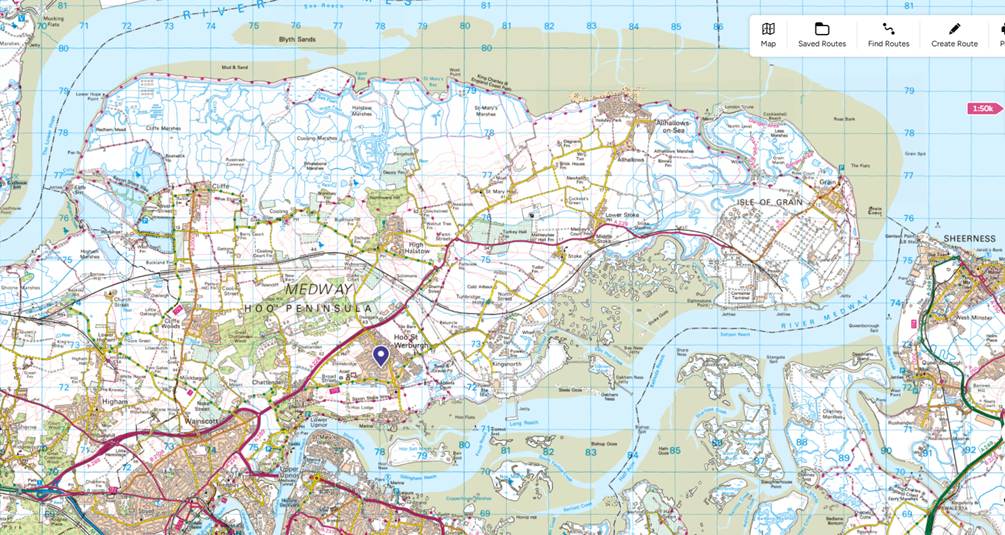
Hoo St Werburgh, Kent
1330
Perhaps
by about 1330, Walter seems to have become the vicar of St Werberg
in Hoo in the Diocese of Rochester in Kent, perhaps by about 1330.
Hoo St Werburgh, commonly known as Hoo, is a village now in the
Medway district of Kent. It is one of several villages on the Hoo Peninsula to
bear the name Hoo, a Saxon word believed to mean "spur of
land" or to refer to the "distinct heel-shape of the ridge of
hills" through the settlement. Hoo features in Domesday Book.
Haltwhistle,
Northumberland
1338
He then exchanged
his parish in Kent for a new parish in faraway Northumberland, at Haltwhistle.
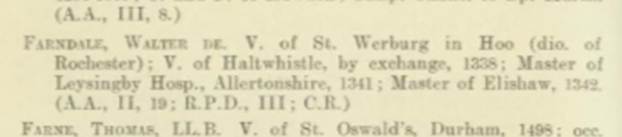
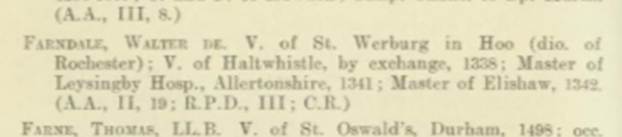
Walter de
Farndale, Vicar of St Werberg in Hoo, Diocese of
Rochester in Kent; Vicar of Haltwhistle in Northumberland by exchange
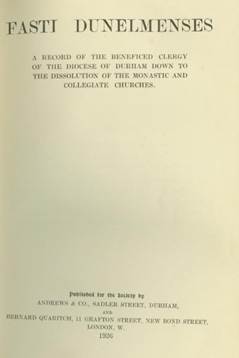
1338; Master of Leysingby Hospital Allertonshire 1341; Master of Elishaw
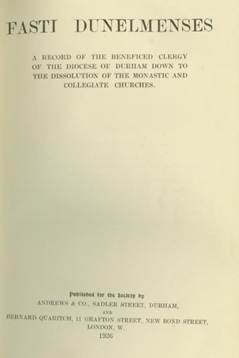
1342 (Fasti Dinelmense, Durham, Suretees Society Volume
CXXXIX, page
44 and page 54)

In 1338 it is recorded that, Persons admitted
to Holy Orders in 1334-1340; Walter of Farnedale,
vicar of Hautwesile (Haltwhistle) (Register of Bishop Daungeville of Bury).
The
Register of Bishop Bury, also known as Richard de Bury, is a collection of
documents and records related to his time as Bishop of Durham from 1333 to
1345. He was also known as Richard Aungerville or Aungervyle. His register, or
a collection of papers related to his episcopate, includes records of
appointments to positions like the Master of Leysingby
Chapel and the Master of Illishaghe Hospital, both
held by Walter de Farndale. Bishop Bury was a prominent figure, known for his
patronage of learning and his book "Philobiblon",
which advocates for the pursuit of knowledge and the love of books.
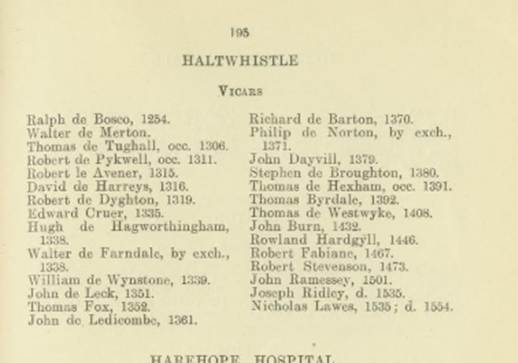
Walter de
Farndale was thus the Vicar at Haltwhistle in 1338 by exchange with Hugh de Hagworthingham (Fasti Dinelmense, Durham, Suretees Society Volume CXXXIX, page
195).
Induction of Walter of Farndale to be vicar of
Hautwesele, etc., 215. … Farndale, W. of, clerk, 65,
76 (a collection of documents issued by
Bishop Richard of Bury, together with papers referring to his episcopate or
bearing on his life).
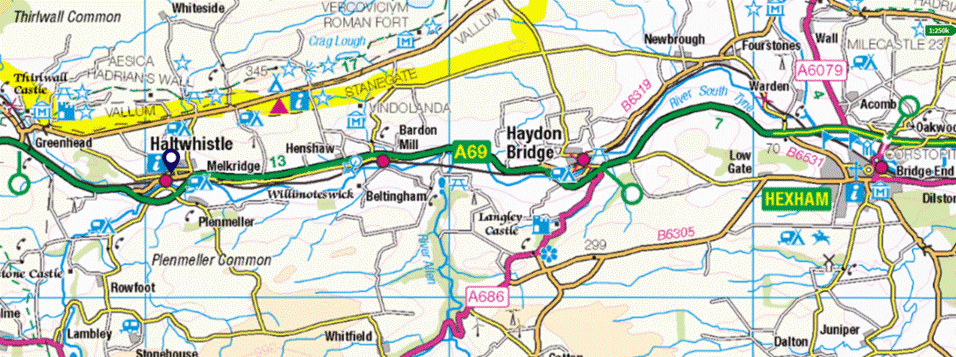
Haltwhistle
Elishaw Hospital, Elsdon
1340
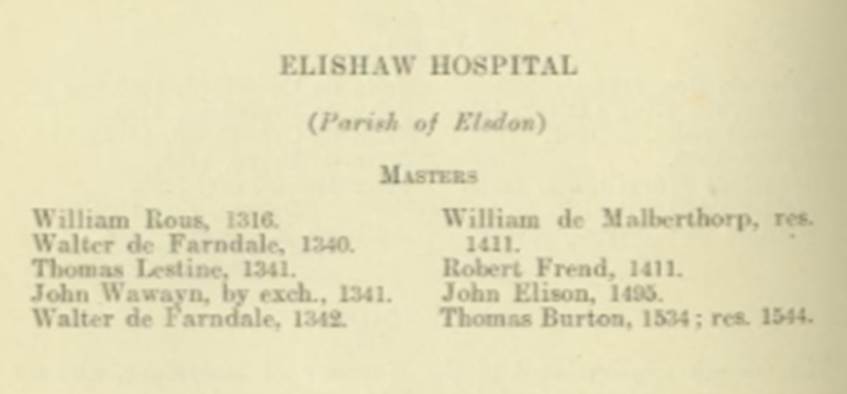
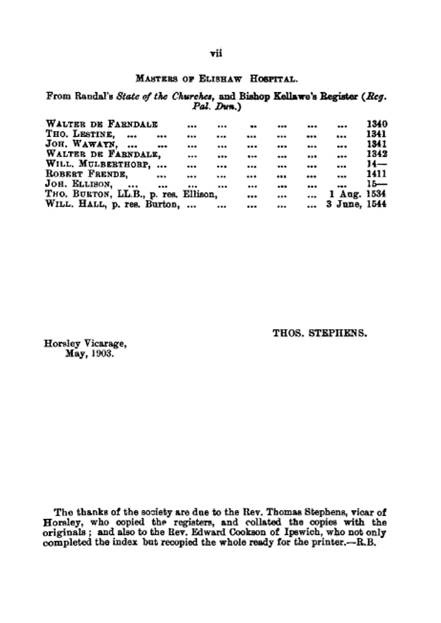
Walter de
Farndale was Master at Elishaw Hospital in the Parish
of Elsdon in 1340 and 1342 (Fasti Dinelmense, Durham, Suretees Society Volume CXXXIX, page
192).
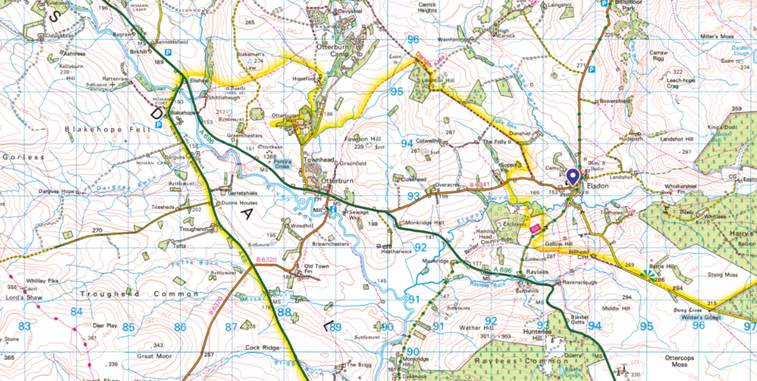
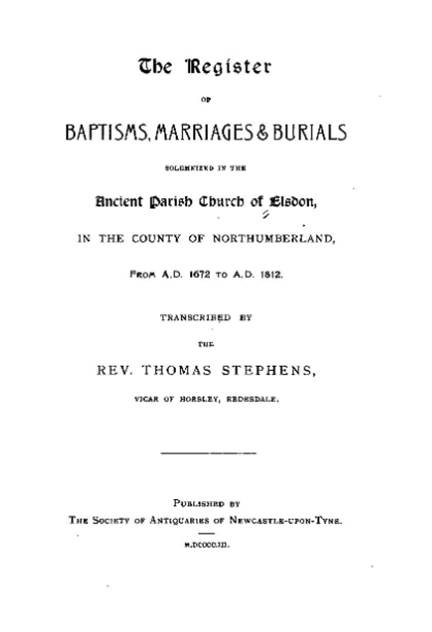
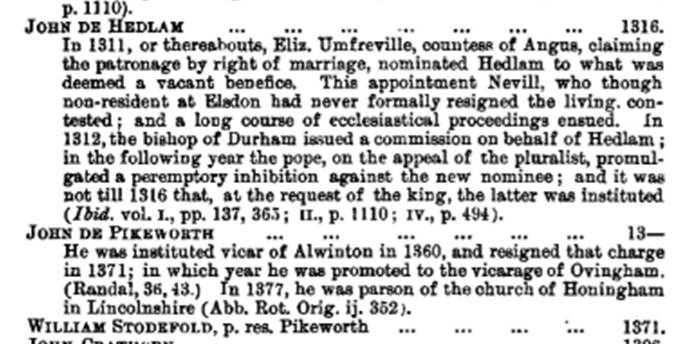
Elsdon is in
Northumbria. John de Hedlam was the Rector from 1311 (Parish
Records, Elsdon, page
v). Walter de Farndale’s masdtership of Elishaw Hospital is also listed there (Parish Records, Elsdon, page
vii)
1341
Walter de
Farndale, was Master of Leysingby Hospital Allertonshire in 1341 (Fasti
Dinelmense,
Durham, Suretees Society Volume CXXXIX, page 44)
In 1340 it is recorded that, Collation of Walter of Farnedale to Leysyngby (Leysonby) Wardship. (Register of Bishop Daungeville of Bury)
Collation of
Walter of Farndale to be Master of the Chapel and Manor of Leysingby,
408 …1340 Collation of Walter of Farnedale to Leysyngby
Wardenship, 465. (a collection of documents
issued by Bishop Richard of Bury, together with papers referring to his
episcopate or bearing on his life).
In 1341 it is recorded that, ‘Collation of Walter de Farndale to be Master to the Chapel and manor of Leysingby (Register of Bishop Daungeville of Bury).
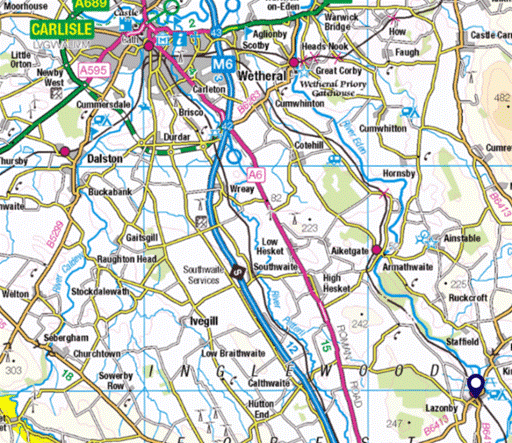
Layzonby
For instance in the Close Rolls 29
Edward I, 1301:

Elishaw Hospital, Elsdon
1342
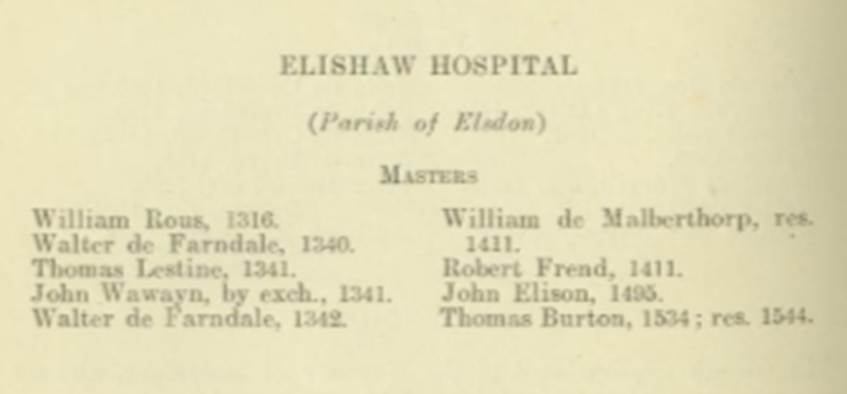
Walter de
Farndale was Master at Elishaw Hospital again in 1342
(Fasti Dinelmense, Durham, Suretees Society
Volume CXXXIX, page
192, page 44).
In 1342 the appointment of Walter de Farndale as
Master of Illishaghe (?) Hospital is recorded (Register of Bishop Daungeville
of Bury). This seems to be an alternative spelling of Elishaw.
Appointment of
Walter Farnedale as Master of Illis-haghe Hospital,
435. Master of Illishaghe, 78, 80, 206 (a collection of documents issued by Bishop Richard of
Bury, together with papers referring to his episcopate or bearing on his life).
1344
On 1 Jun 1344 ..... et
Waltero de Farnedale clericis testibus ad praemissa vocatis
spacialiter rogatis,
which translates and Walter de Farnedale, the clerks of the court,
summoned witnesses to the premises, and requested them sparingly. (Bishop Bury’s Visitation)
Ac caeteros quoscumque ecclesiae et cellarum ejusdem monachos praemunitos et citatos sed nullatenus comparentes, usque in eundem diem
crastinum expectavit ad
faciendum et recipiendum in eodem
negotio juxta vim formam et
effectum citationis eis in hac parte prius factae, omnibus et singulis in eodem statu remanentibus
quo fuerunt, die Jovis supradicto,
praesentibus tune ibidem venerabilibus
et discretis viris Magistro
Johanne de Aton et domino Willelmo de Hemyngtone supradictis ac
Magistro Willelmo Legat dicti
domini Episcopi Cancellario,
et Waltero de Farnedale clericis testibus ad praemissa vocatis
specialiter et rogatis.
And the rest of the monks of the same church
and cells, who had been guarded and summoned, but did not appear at all, waited
until the next day to do and receive in the same business according to the
force and effect of the summons made to them in this part before, each and
every one remaining in the same state in which they were. , on the aforesaid
Thursday, to the venerable and discreet men present there, Master John de Aton
and the master William de Hemyngton aforesaid, and Master William Legat, Chancellor
of the said Lord Bishop, and Walter de Farnedale, clerical witnesses
specially called to the premises and when asked.
Eodem vero die crastino viz. vicesima die mensis Februarii supradicti inter horam ipsius diei
primam et tertiam anno inditione
et pontificatu supradictis
idem Dominus Episcopus in ipsa domo Capitulari personaliter constitutus cum
Johanne de Aton, Willelmo Legat et fratre Johanne de Butterwyk, meque
Symone de Cherryngge notario
publico infrascripto, quos secum habuit, dictus Dominus
Episcopus in actu visitationis
praedictae objecit priori praefato quaedam comperta et detecta in visitatione memorata contra eum, et habitis ad eadem responsionibus
prioris praedicti Dominus
Episcopus praefatus eundem diem ac correctiones hujusmodi continuavit et prorogavit iterate
cum die crastino proxime tune sequenti,
quern cum continuatione et prorogatione
dierum subsequentium usque ad finalem
expeditionem correctionum hujusmodi praedicto priori ac
omnibus et singulis aliis monachis tune ibidem congregatis,
praefixit et assignavit
quod coram eo in ipsa domo capitulari
dicto die crastino comparerent
facturi et recepturi ulterius in dicto correctionum negotio quod justitia suaderet,
et quod fecisse et recepisse
debebant in hac parte die vicesima mensis Februarii suprascripti. Quoscumque etiam monachos ecclesiae et cellarum praedictarum tune absentes, et
diem vicesimam praedictam
ex continuatione seu praefixione hujusmodi habentes, usque in praedictum diem crastinum expectavit ad faciendum et recipiendum
in negotio hujus- modi quod jus esset.
But the same day the morrow viz. On the
twentieth day of February aforesaid, between the first and third hours of the
same day, in the year of the aforesaid consecration and pontificate, the same
Lord Bishop was personally appointed in the very house of the Chapter, with
John de Aton, William the legate, and brother John de Butterwyk, and I, Simon
de Cherryngge, the undersigned public notary, whom he had with him. , the said
Lord Bishop, in the act of the aforesaid visitation, objected to the prior aforesaid
certain things found and discovered in the visitation mentioned against him,
and having regard to the same answers of the aforesaid Lord Bishop, the
aforesaid Lord Bishop continued the same day and made corrections of this kind,
and extended it again and again until the next day after the next day, which
with the continuation and by prolonging the subsequent days until the final
campaign of corrections of this kind, the aforesaid prior and all the other
monks then gathered there, appointed and assigned that they should appear
before him in the said chapter-house on the morrow to be made and received
further in the said business of corrections as justice suggested, and that they
should have done and received in this part on the twentieth day of the month of
February aforesaid. Whatever monks of the aforesaid church and cells were
absent at that time, and having the aforesaid twentieth day from the
continuation or prefixation of this kind, he waited until the aforesaid day to morrow to do and receive in business of this kind that
was right
Upmeadon Church, Eltham
1347
On 7 February 1347, At Eltham. Walter de
Farendale, parson of Upmeadon Church acknowledges
that he owes Richard de Levetun of Tykhill £8; to be levied in default of payment of his lands
and chattels and ecclesiastical goods in the County of Sussex. (Close Rolls of the
reign of Edward III, 1346 to 1349, page
234)
St
Margaret’s, Chelmsford and Turvey Church in the Diocese of Lincoln
1349
On 9
April 1349, At Langley. Presentation of Walter de Farndale as Warden of St
Margaret’s, Chelmerford in the Diocese of London to the mediety of the
Church of Turvey in the Diocese of Lincoln in the King’s Gift by reason of the
Priory of St Neots being in his hands on account of the war with France on the
exchange of benefices with Thomas de Dersyngton. (Patent Rolls).
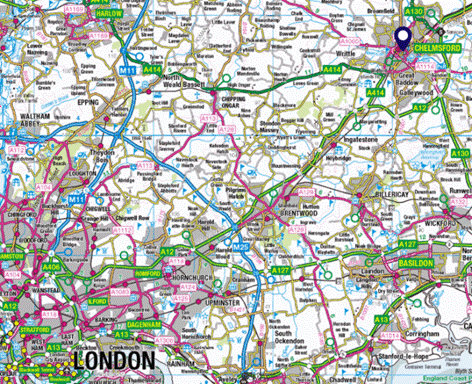
Chelmsford
From the Calendar of Patent Rolls,
Edward III (1348 to 1350), 1349, 23 Edward III, Part I, page 277.
April 9, Langley
Presentation of Walter de Farndale, warden of
the free chapel of St Margaret, Chalmerford, in the
diocese of London, to a mediety of the church of Turveye
in the diocese of Lincoln, in the King’s gift by reason of the priory of St
Neots being in his hands on account of the war with France; on an exchange of
benefices with Thomas de Dersyngton.
Index:
Farndale, Walter de, warden of the free chapel
of St Margaret, Chelmsford, presented to a mediety of Turvey church, 277.
St Margaret’s Chelmsford
St Margaret’s is a Grade II listed building in Margaretting, Essex in the district of Chelmsford. It was
almost completely rebuilt in the early-mid C15th.
Turvey Church
Turvey is now in Bedfordshire. Turvey's Parish
Church is called All Saints and has Saxon origins. It is the largest church in
the deanery of Sharnbrook and was in the Diocese of Lincoln until it was
transferred to the Diocese of Ely in 1837.
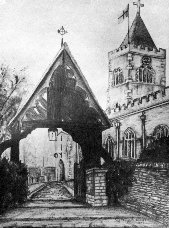
St Neots Priory
St Neots Priory replaced a small Anglo-Saxon
monastery at Eynesbury in which were housed the bones of Saint Neot, a revered
Cornish monk who died around 877. The Priory Centre is located alongside the
attractive riverbank of the Great Ouse in the heart of St. Neots town.
St Neots Priory was a Benedictine monastery beside
the town of St Neots in the historic county of Huntingdonshire, now a
non-metropolitan district in the English county of Cambridgeshire. A monastery
was first founded here in about 974 by Earl Aelric
(or Leofric) and his wife Aelfleda (or Ethelfleda), who granted it two hides of
land, part of the manor of Eynesbury, later called the manor of St Neots. Its
site is uncertain, though it may have been where the present parish church
stands. It is said that the relics of the Cornish Saint Neot were obtained from
Neotstoke (now St Neot) in Cornwall and brought to
the priory in order that it might have relics to attract pilgrims; hence the
name of the town.
Because it was an alien priory (i.e., the dependency
of a French mother-house) it suffered difficulties
whenever there were hostilities between France and England, and particularly
during the Hundred Years' War. Its property was continually seized for this
reason, until like certain other alien priories it was eventually given its
independence from Bec in 1409 by the quasi-naturalisation process known as
denization.
The priory was finally seized during the Dissolution
of the Monasteries in 1539. After the Dissolution of the Monasteries, the
buildings were pulled down.
The prior of St Neots in 1349 was William de
Beaumont (he was elected that year).
Church
of Blendworth, north of Portsmouth in the Parish of
Winchester
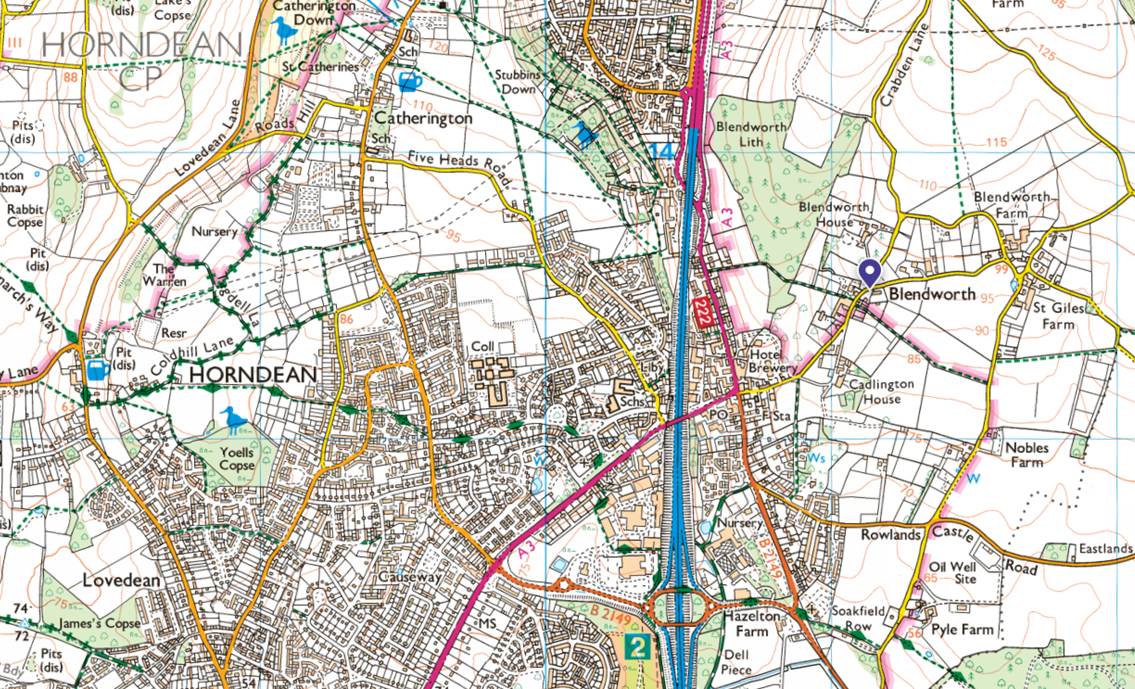
1351

(Patent Rolls of
the reign of Edward III, 1350 to 1354, page 48).
1354
Regesta 226: 1354. Pages 521-529, Calendar of Papal Registers Relating To Great Britain and Ireland: Volume 3, 1342-1362.
Originally published by Her Majesty's Stationery Office, London, 1897.
2 Id. Aug. Avignon. (f. 258.)
To Thomas de Clopton, priest. Rehabilitation on account of
his having, when in his twenty-second year, obtained the church of Wickham, in
the diocese of London, and after holding it for seven weeks, obtained a
sinecure chapel in the bishop's palace in the city of London, which he exchanged with Walter de Farndale for
the church of Blendeworth, which is to be resigned. [Cal. Pet. i. 262.]
Regesta 226: 1354. 2 Id. Aug. Avignon. (f. 258.) To Thomas de Clopton, priest. Rehabilitation on account of his having, when in his twenty-second year, obtained the church of Wickham, in the diocese of London, and after holding it for seven weeks, obtained a sinecure chapel in the bishop's palace in the city of London, which he exchanged with Walter de Farndale for the church of Blendeworth, which is to be resigned. [Cal. Pet. i. 262.] (Calendar of Papal Registers Relating to Great Britain and Ireland: Volume 3, 1342-1362).
https://www.british-history.ac.uk/cal-papal-registers/brit-ie/vol3/pp521-529
Regesta 225: 1354, Pages 516-521, Calendar of Papal Registers Relating To Great Britain and Ireland: Volume 3, 1342-1362.
Originally published by Her Majesty's Stationery Office, London, 1897.
2 Id. Aug. Villeneuve by Avignon. (f. 381d.) To the archdeacons
of Winchester and Colchester, and the chancellor of Salisbury. Mandate to
induct Thomas de Clopton, priest, of the diocese of Worcester, into the church
of Blendeworth, in the diocese of Winchester, which
he has held for five years, he having first resigned the same, which he
obtained by way of exchange, when in his twenty-second year, with Walter de
Farndale for a chapel in the episcopal palace in the city of London, which he
obtained after resigning that of Wickham, in the diocese of London, which
he, in ignorance of the law, had obtained and held for seven weeks, taking no
fruits therefrom.
(See cal. Pet. i.
262.)
1370
Walter might have died in about 1370 on the three score years and
ten principle.