William the Smith of Farndale the Younger
c 1317 to c 1375
The Medieval
Inhabitants of Farndale
Enjoyed
some poaching like his father
FAR00040
|
Return to the Home Page of the Farndale Family
Website |
The story of one family’s journey through two
thousand years of British History |
The 83 family lines into which the family is divided.
Meet the whole family and how the wider family is related |
Members of the historical family ordered by date of
birth |
Links to other pages with historical research and
related material |
The story of the Bakers of Highfields, the Chapmans,
and other related families |


Dates are in red.
Hyperlinks to
other pages are in dark
blue.
Headlines are in brown.
References and
citations are in turquoise.
Context and local
history are in purple.
1310
William Farndale might
have been born in about 1317. He was almost certainly the son of the elder
William the Smith of Farndale (FAR00037)
and probably, in time, continued the Smithy business in the heart of Farndale.
17
January 1348
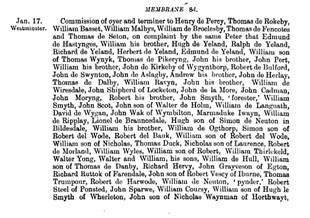
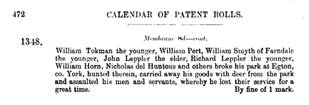
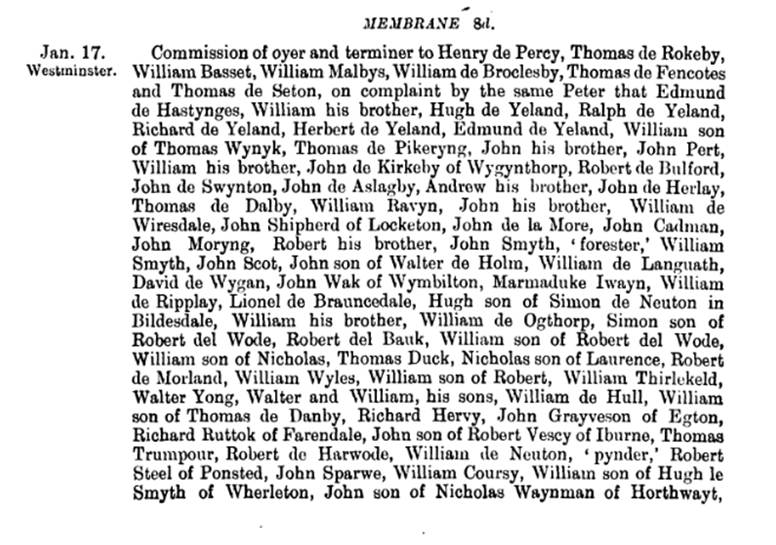
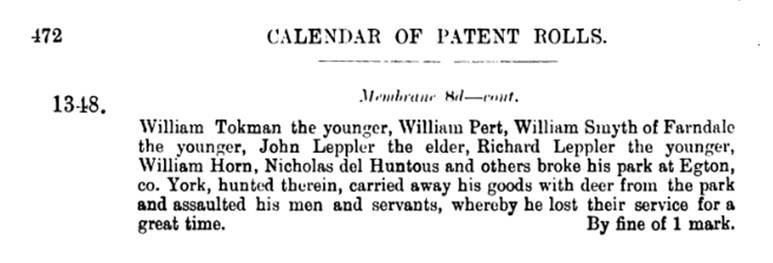
From the Calendar of Patent Rolls, Edward III AD 1345 to 1348, 21 Edward III – Part III, page
472: Jan 17, Westminster. Commission
of Oyer and terminer to Henry de Percy, Thomas de Rokeby, William Basset,
William Malbys, William de Broclesby,
Thomas de Fencotes and Thomas de Seton, on complaint
by the same Peter that Edmund de Hastynges …. William
Smyth of Farndale the younger (FAR00040) … broke his
park at Egton, Co York, hunted therein, carried away his goods with deer from
the park and assaulted his men and servants, whereby he lost their service for
a great time. By fine of 1 mark.
There is also a reference to Richard Ruttok of Farendale (RUD00003) in the long list of names.


So
on 17 January 1348 at Westminster, there was a commission of oyer and terminer
to a long list of names including William Smyth of Farndale (FAR00040)
the younger and Richard Ruttok of Farendale for breaking in to the park at
Egton, hunting and carrying away the property of the owner with deer, and for
assaulting the owner’s men and servants causing their inability to work for a
long time, for which the werefined 1 mark.
A Commission of Oyer and Terminer was a legal
commission issued in England, authorizing judges to hear and determine criminal
cases, particularly those involving serious offenses like treason, felonies,
and misdemeanors. It literally means to hear and determine in
Anglo-French, reflecting its purpose of both investigating and adjudicating
cases. By the commission of oyer and terminer the commissioners (in practice
the judges of assize, though other persons were named with them in the
commission) were commanded to make diligent inquiry into all treasons, felonies
and misdemeanours whatever committed in the counties specified in the
commission, and to hear and determine the same according to law. The inquiry
was by means of the grand jury; after the grand jury had found the bills of
indictment submitted to it, the commissioners proceeded to hear and determine
by means of the petit jury. The words oyer and terminer were also used to
denote the court that had jurisdiction to try offences within the limits to which
the commission of oyer and terminer extended.
8
November 1367
William, on
something of a rampage, in 1367, with William Blackhouse (BLA00001) trespassed,
hunted, felled trees, fished, trod down and ate corn and assaulted the servants
of the complaining knight, William Latimer. In the forty first regnal year of
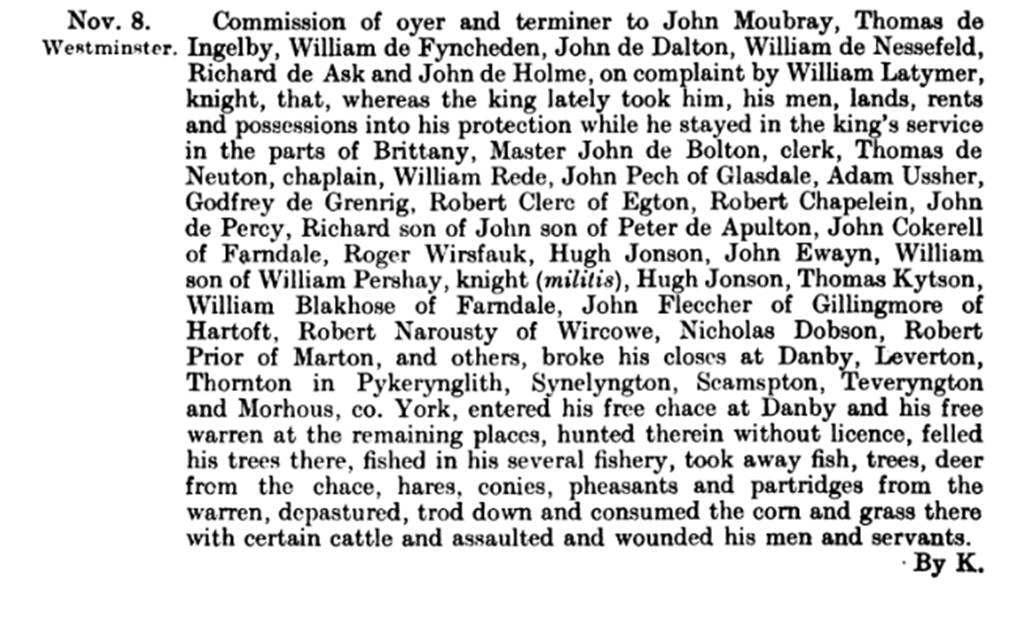
Edward III, on 8 November 1367, at Westminster, Commission of Oyer and
Terminer was ordered to John Mourbray, Thomas de
Ingleby … on complaint by William Latymer, knight, that whereas the king lately
took him, his men, lands, rents and possessions into his protection while he
stayed in the king’s service in the parts of Brittany, Master John de Bolton,
clerk, Thomas de Neuton, chaplain, William Rede … William
of Farndale … William Blakehose of Farndale …
broke his closes at Danby, Leverton, Thornton in Pykerynglith,
Symnelyngton, Scampton, Teveryngton
and Morhous, Co York, entered his free chace at Danby and his free warren at the remaining places,
hunted therein without licence, felled his trees there, fished in his several
fishery, took away fish, trees, deer from the chace,
hares, conies, pheasants and partridges from the warren departured,
trod down and consumed the corn and grass there with certain cattle and
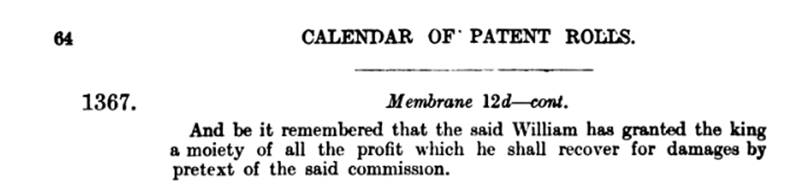
assaulted and wounded his men and servants. By K And be it remembered that the
said William has granted the king a moiety of all the profit which he shall
recover for damages by pretext of the said commission.
Calendar of Patent Rolls, 41 Edward III Part II, page 63: ‘November 8, At Westminster. Commission of Oyer
and Terminer to John Mourbray, Thomas de Ingleby … on complaint by
William Latymer, knight, that whereas the king lately took him, his men, lands,
rents and possessions into his protection while he stayed in the king’s service
in the parts of Brittany, Master John de Bolton, clerk, Thomas de Neuton, chaplain, William Rede … William
of Farndale (FAR00040) …
William Blakehose of Farndale (BLA00001)…
broke his closes at Danby, Leverton, Thornton in Pykerynglith,
Symnelyngton, Scampton, Teveryngton
and Morhous, Co York, entered his free chace at Danby and his free warren at the remaining places,
hunted therein without licence, felled his trees there, fished in his
several fishery, took away fish, trees, deer from the chace,
hares, conies, pheasants and partridges from the warren departured,
trod down and consumed the corn and grass there with certain cattle and
assaulted and wounded his men and servants. By K And be it remembered that the
said William has granted the king a moiety of all the profit which he shall
recover for damages by pretext of the said commission.
See FAR00047.

1375
He might have
lived to about 1375.