William,
smith of Farndale (sometimes
Farndon)
c
1284 to c 1350
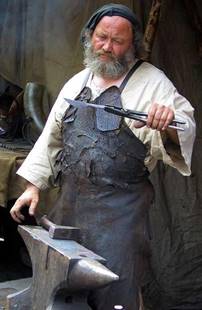
The Medieval
Inhabitants of Farndale
A Smith of
Farndale whose family started to engage in poaching
FAR00037
|
Return to the Home Page of the Farndale Family
Website |
The story of one family’s journey through two
thousand years of British History |
The 83 family lines into which the family is divided.
Meet the whole family and how the wider family is related |
Members of the historical family ordered by date of
birth |
Links to other pages with historical research and
related material |
The story of the Bakers of Highfields, the Chapmans,
and other related families |
Dates are in red.
Hyperlinks to other pages are in dark blue.
Headlines are in brown.
References and citations are in turquoise.
Context and local history are in purple.
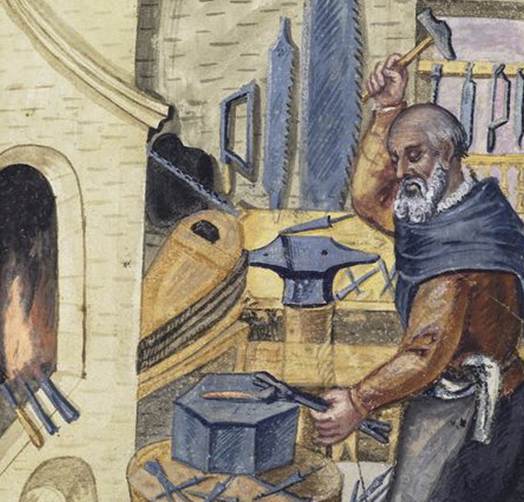
William Farndale might have been born
in about 1284. He might have been the son of Robert, the Smith of
Farndale (FAR00021C), and perhaps continued the family
business.
1301
There were eleven individuals called Willemo in Farndale listed the 1301 tax subsidy, but if we are correct about when he
was born, he was unlikely to have been of age by that time.
1315
William’s son,
John de Farndale (FAR00042A), might have been born in about 1315.
Perhaps William had married at about that time.
1317
It seems likely
that William the Smith of Farndale the Younger (FAR00040) was his son and
continued the family business. He may have been born in say 1317.
Both these sons
were later involved in violent and large scale rustling expeditions.
1330
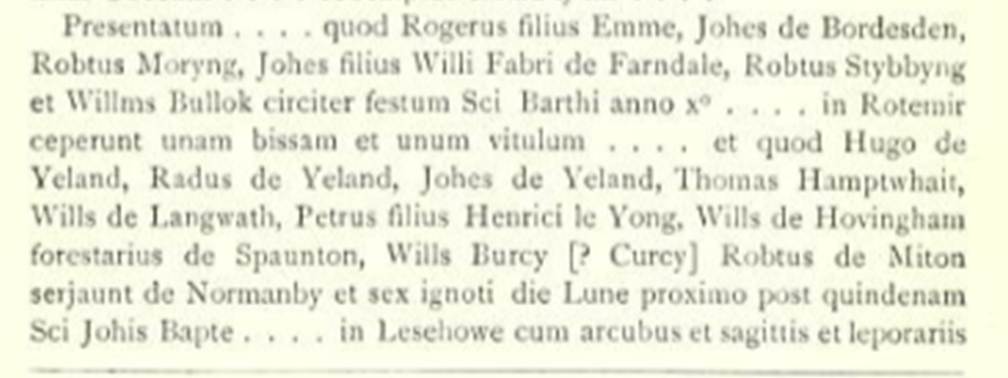
In 1330 Roger son of Emma, John de Bordesden, Robert Moryng, John son of William Fabri (Smith) of Farndale, Robert Stybbing, and William
Bullock, about the feast of S. Bartholomew, captured one hind and one calf at Rotemir."
It seems likely that Rotemir is a place around
Farndale, but it is possible it is a reference to Redmire,
west of Leyburn.
3
October 1334
A
hearing of the itinerant Eyre Court (FAR00015B), picking up cases from several decades
previously, took place at Pickering on 3 October 1334 (The Duchy of
Lancaster Records, from the North Riding Record Society, The Honour and
Forest of Pickering, Edited by Robert Bell Turton, Volume IV, 1897, page
xiii).
At a hearing at Pickering before Justices Richard Willoughby and John de
Hambury on 3 October 1334, a long list of offenders
included Robert (FAR00031), son of Simon of Farndale (FAR00021), Roger del Milne of Farndale (FAR00013A), Robert (FAR00012), son of Peter de Farndale (FAR00008), Walter Blachose (BLA00001), Ralph del Heued (HEU00002), who were ordered for apprehension by the sheriff by
Easter 1335 (The Great Cowcher of the Duchy
of Lancaster, The National Archives, DL42/1 Folio 276v to 277v).
Justices of
the Common Pleas were a later judicial position within the Court
of Common Pleas of England and Wales, under the Chief Justice. The
Common Pleas was the primary court of common law within England and
Wales, dealing with common pleas (civil matters between subject and subject).
Sir Richard
Willoughby (c 1290 to 1362) was the son of Sir Richard Willoughby of
Willoughby-on-the-Wolds, a lawyer, who served as Chief Justice of the Bench in
Ireland from 1323-1325. Richard attended Parliament in 1324 and inherited the
estate from his father the following year. Richard was a successful lawyer and
increased his wealth greatly by his legal career. He was appointed one of the
justices of Common Pleas in 1328 and served between 6 March 1328 to 22 December
1330; 9 October 1340 to November 1341; and 20 November 1343 to 1357. He was one
of the justices of King's Bench in 1330. He was briefly Chief Justice between
1338-1340, but was demoted and charged with corruption. He threw himself on the
King's mercy and was pardoned on payment of 1200 marks. In 1343 he was
re-appointed as a justice, and served until 1357. Sir Richard was buried at
Willoughby-on-the-Wolds, where there is a monumental effigy.
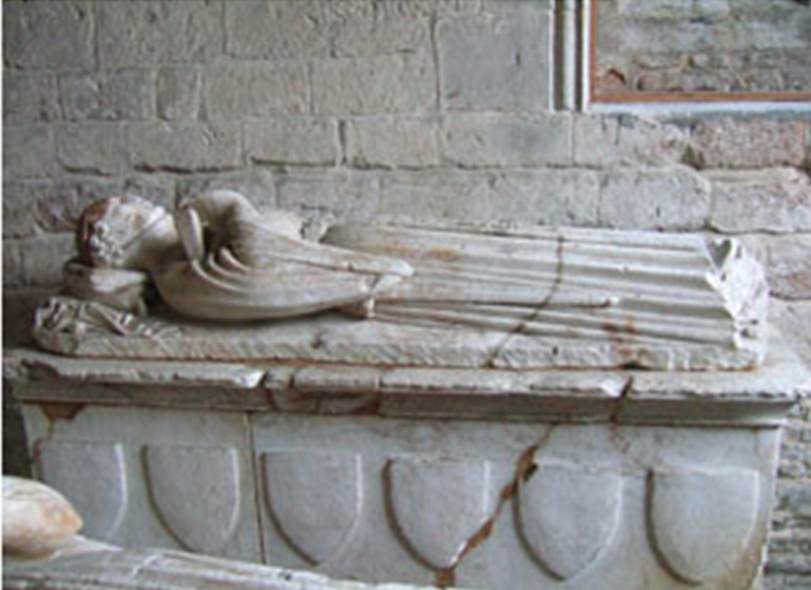
The monument
to Sir Richard Willoughby, judge in chief over the Farndale poachers
Under medieval forest
law, mainpernors were individuals who acted as
guarantors for others, ensuring they appeared in court to answer for alleged
offenses against forest law. These offenses primarily involved the king's
hunting rights and the protection of forest resources like timber and vegetation.
Mainpernors essentially vouched for the accused's
future appearance in court, preventing them from fleeing justice within the
forest jurisdiction.
The folk of
Farndale had clearly been out in significant numbers to engaging in poaching.
John (FAR00042A), son of William
le Smyth of Farndon (FAR00037) became
mainpernor (guarantor) of 4 individuals (The Great Cowcher of the Duchy of Lancaster, The National
Archives, DL42/1 Folios 342v, North Riding Records
Yorks, The Honour and Forest of Pickering, 1894, Volume II at
page 148).

As mainpernors
(guarantors) William le Smyth of Farndale (FAR00037) was fined 2s as mainpernor of Robert (WES00005), son of
Richard de Westgill (WES00001), also indicted for hunting and William le Smyth of Farndale
(FAR00037) was also fined 2s as mainpernor of John (WES00004), son of
Richard de Westgill (WES00001), also indicted for hunting. (The Great
Cowcher of the Duchy of Lancaster, The National Archives, DL42/1 Folios 336v
and 337, DL 42/1/35/U6, Folio 335v-336v (not on public record), The Great Cowcher of the Duchy of Lancaster, The National
Archives, DL 42/1/23/U28 Folios 226v to 228, DL 42/1/35/U9, Folio 341 to 343v).
After John (WES00004), son of Richard de Westgille
of Farndale (WES00001) had trespassed and hunted in Pickering
Forest, others including William le Smyth of Farndale (FAR00037), Richard de Westgill (WES00001), John le Shepherd of Farndale (FAR00010), John Alberd of the same (ALB00002), Nicholas (FAR00041A), son of Walter of the same (FAR00014A), John del Heued
of the same (HEU00001), and Robert de
Westgill (WES00005) mainperned (provided guarantees) for their
appearance (The Great Cowcher of the Duchy
of Lancaster, The National Archives, DL42/1 Folio 228v).
Robert (WES00005), son of
Richard de Westgill of Farndale (WES00001) had trespassed and hunted in Pickering Forest, others including William
le Smyth of Farndale (FAR00037), John (FAR00041B), son of
Walter of the same (FAR00014A), John Alberd of the same (ALB00002), and Nicholas (FAR00041A), son of
Walter of the same (FAR00014A), mainperned
(provided guarantees) for their appearance (The
Great Cowcher of the Duchy of Lancaster, The National Archives, DL42/1 Folio
228v, DL 42/1/23/U29 folios 228 to 229). The
offence was clearly many years before as one or more of the mainpernors
had died.
There are full
details of this hearing at
another webpage.
A number of individuals from Farndale were fined following prior
indictments for poaching in 1334 and not turning up at the Eyre. They paid bail
or had bail paid for them (North Riding Records, Volume IV
by the North Yorkshire Record Society, the Honour and Forest of Pickering,
1897, page 23, 28, and 34 not on line but I have a physical copy).
|
Date of Hearing |
Notional date of Offence |
Payer |
Guarantor (malpernor) |
Poacher |
Amount of Fine |
|
3 October 1334 |
c 1319 |
Nicholas de
Farndale (FAR00041A) |
Nicholas de
Farndale (FAR00041A) |
William the
Smith of Farndale (FAR00037) |
2s |
|
3 October 1334 |
c 1319 |
William the
Smith (FAR00037) |
Robert son
of Richard de Westgill (WES00005) |
John Alberd |
2s |
|
3 October 1334 |
c 1320 |
Nicholas de Repyngale |
Nicholas de Repyngale |
William the
Smith of Farndale (FAR00037) |
2s |
|
3 October 1334 |
c 1321 |
William the Smith (FAR00037) |
2s |
There are further details
of these offences at another
webpage.
The Rotemir Incident
On about 24 August 1336, during the period when the Eyre of the
mid 1330s was sitting, a number of men including John (FAR00042A), son of William the Smith of
Farndale (FAR00037) took hind and calf
in Rotemir (North
Riding Records Yorks, The Honour and Forest of Pickering, 1894, Volume II at page 115, The Great Cowcher of the Duchy
of Lancaster, The National Archives, DL 42/1/35/U26, Folio 223v to
225)
See details
and research notes.
In
the same folio we have an account of how " Roger son of Emma, John de
Bordesden, Robert Moryng, John son of William Fabri (Smith) of
Farndale, Robert Stybbing, and William Bullock, about the feast of S.
Bartholomew, captured one hind and one calf at Rotemir." How
" Hugh de Yeland and John de Yeland, Thomas
Hampthwait, William de Langwath, Peter son of Henry Young, William de
Hovingham, forester of Spaunton, William Burcy (or Curcy), Robert de Miton, sergeant of Normanby, and six
others unknown, captured at Leasehow, with bows and
arrows and hounds, a young hart," and so on (History of the Parish of Lastingham).
It
seems likely that Rotemir is a place around Farndale, but it is possible it is a reference
to Redmire, west of Leyburn.
2 December 1336
On Monday 2 December 1336, William,
smith of Farndale himself came hunting in Lefebow with
bow and arrows and gazehounds. There is another reference to Leasebow and it is likely that Lefebow
and Leasebow are a place. There is a place called
Lease Rigg, near Grosmont and Egton, which is the area that Johannes de Farndale moved to in about 1301, so it is possible this is the place. Also on 2
December 1336 John de Farndale was bailed for poaching at Pickering.
17
January 1348
The
Egton Raid
On
17 January 1348 at Westminster, there was a commission of oyer and terminer to
a long list of names including William Smyth of Farndale (FAR00040)
the younger and Richard Ruttok of Farendale for
breaking in to the park at Egton, hunting and carrying away the property of the
owner with deer, and for assaulting the owner’s men and servants causing their
inability to work for a long time, for which the were fined 1 mark (the
Calendar of Patent Rolls, Edward III AD 1345 to 1348, 21 Edward III – Part
III, page 472).


A Commission of Oyer and Terminer was a legal commission
issued in England, authorizing judges to hear and determine criminal cases,
particularly those involving serious offenses like treason, felonies, and
misdemeanors. It literally means to hear and determine in Anglo-French,
reflecting its purpose of both investigating and adjudicating cases. By the
commission of oyer and terminer the commissioners (in practice the judges of
assize, though other persons were named with them in the commission) were
commanded to make diligent inquiry into all treasons, felonies and
misdemeanours whatever committed in the counties specified in the commission,
and to hear and determine the same according to law. The inquiry was by means
of the grand jury; after the grand jury had found the bills of indictment
submitted to it, the commissioners proceeded to hear and determine by means of
the petit jury. The words oyer and terminer were also used to denote the court
that had jurisdiction to try offences within the limits to which the commission
of oyer and terminer extended.
See
details
and research notes.
William’s
son John Farndale
took part in a large scale cattle rustling expedition in 1384.
1350
William might have died in
about 1350.
|
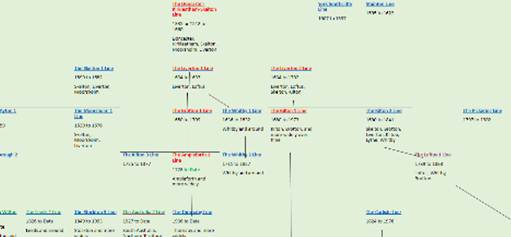
How does William the Smith of Farndale
relate to the modern family? It is not possible to be accurate about the early family tree,
before the recording of births, marriages and deaths in parish records, but
we do have a lot of medieval material including important clues on
relationships between individuals. The matrix of the family before about 1550
is the most probable structure based on the available evidence. If it is accurate, William the Smith, was related
to the thirteenth century ancestors of the modern Farndale family, but his
line of poachers and cattle rustlers seems to have disappeared by about the
fifteenth century. |