The Medieval
Inhabitants of Farndale
FAR00021C
|
Return to the Home
Page of the Farndale Family Website |
The story of one
family’s journey through two thousand years of British History |
The 83 family lines
into which the family is divided. Meet the whole family and how the wider
family is related |
Members of the
historical family ordered by date of birth |
Links to other pages
with historical research and related material |
The story of the
Bakers of Highfields, the Chapmans, and other related families |
Dates are in red.
Hyperlinks to
other pages are in dark
blue.
Headlines are in brown.
References and
citations are in turquoise.
Context and local
history are in purple.
1240s
and 1250s (before Robert was born)
Farndale was
first cleared for agriculture from perhaps about 1220 (FAR00004A). So although we
don’t know about Robert’s parents, it might be supposed that they were the hard
grafters who first broke up the forest in the dale and started farming. As
Farndale was an extension of the existing estate of Kirkbymoorside, Robert’s
grandparents and his ancestors before them, were likely to have come from the
land at the northern edge of the Vale of York, perhaps in the ancient
agricultural lands around Kirkdale. These lands were part of the same
landholdings and estate as Farndale.
c 1260
There is no record of Robert’s birth or of his early life. We
might guess he was in his fifties at the time of an incident involving the
draught beasts of Robert and his son Walter in the forest. He might therefore
have been born in about 1260.
1276
By 1276, at the time of the death of Joan Stuteville, about 545
acres of Farndale was under cultivation (see FAR00017). The bonded
tenants paid a standard rent of 1s per acre. By that time there were seven
cottars in Farndale and further occupation at Duthenwayt,
probably in the area of the Duffin Stone today, up the western side of the
dale. Robert’s parents were likely to have been part of a community of
villeins, tilling the land, and paying high rents to the Stuteville landowners.
Walter de Farndale (FAR00014A),
his son, may have been born in the late 1270s.
1282
By 1282, on the
death of Joan’s son, Baldwin Wake, the cultivated acreage in Farndale had risen
to 768 acres in only six years (FAR000020). There were 90
bondmen by this time in Farndale. This must have represented a planned campaign
of settlement and activity in the dale must have been noisy and
constant at this time.
Perhaps at this
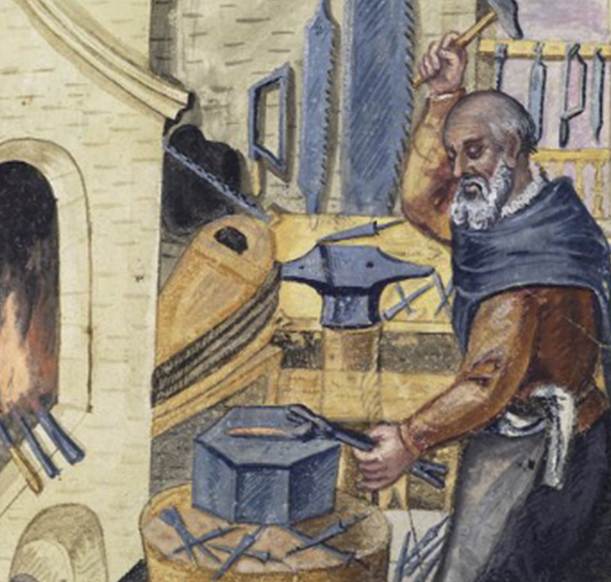
time Robert started his business as a smith. Low Mill seems to have been the
heart of the community, so this may be where he set up his smithy perhaps close
to Simon (FAR00021) and John (FAR00021B), the millers of
Farndale. It was perhaps also about this time that he married.
1284
William
(FAR00037), the Smith of the 1330s may well have been
his son, perhaps born in about 1284. William perhaps later continued his
father’s business as the smith.
A number of local folk had taken draught
beasts into Pickering Forest in the reign of Edward III in 1310 or 1311, where
the draught animals were forbidden to wander. Some pasturages were reserved for
the use of the King where there was no right in common and here, cattle were agisted at a fixed price, to be paid to the bailiff.
These sums were collected by the agisters, of whom there were two in each ward,
men of substance it seems by their assessments in the Lay Subsidies.
Not the least of the profits derived from the possession of a
forest was that arising from the agistment of cattle in waste grounds. (The Duchy of
Lancaster Records, from the North Riding Record Society, The Honour and
Forest of Pickering, Edited by Robert Bell Turton, Volume IV, 1897, page
xxvii).
There was a lengthy list of those individuals from Farndale found by the agisters in about
1310 with their cattle in the forests. Thomas Wake, the Lord of Liddell, whose
tenants they were, said the price had already been paid and the tenants should
be discharged of the matter.
Amongst
those fined were Robert the Smith of Farndale (FAR00021C) who had one oxen and two stirks, worth 7s 4d agisted
and Walter (FAR00014A), son of Robert the Smith of Farndale (FAR00021C) who had 5 oxen, worth 20s agisted (North Riding Records Yorks Volume III,
The Honour and Forest of Pickering, 1894, Edited Robert Bell Turton, page 61).

lron was
extracted in moorland dales, smiths moving their bloomeries up the outcrops
near water and wood. Rievaulx had early Bilsdale workings and charcoal burners
in Riccall Wood. Robert the Iron-Smith in Farndale
was probably an extractor in 1310-11. (Life in Ryedale in the 14th century, J H Rushton, Ryedale Historian, Volume 8, 1976, page 25).
1327
It was probably Robert’s son, Walter de Farndale, who
had moved to Cayton, near Scarborough by 1327, where he was murdered by Hugh de
Faulkes of the neighbouring village of Lebreston.
Hugh de Faulkes was pardoned of the murder, on condition he joined an
expedition against the Scots.

1340
Perhaps Robert may have lived to his late fifties or sixties, so
may have lived until the 1340s.
There is a separate page about poaching in Pickering Forest.