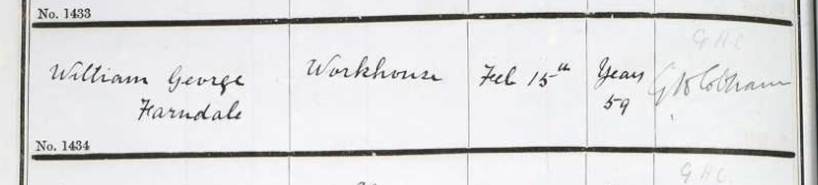
William George Farndale
22 June 1856 to March 1915
FAR00421
|
Return to the Home
Page of the Farndale Family Website |
The story of one
family’s journey through two thousand years of British History |
The 83 family lines
into which the family is divided. Meet the whole family and how the wider
family is related |
Members of the
historical family ordered by date of birth |
Links to other pages
with historical research and related material |
The story of the
Bakers of Highfields, the Chapmans, and other related families |


William served as
a soldier at the time of the Anglo Zulu War. He married in 1902 at the age of
50. He was a butcher in Marske in 1911, living alone as a lodger. He died in
the workhouse in Guisborough in 1915.
Dates are in red.
Hyperlinks to
other pages are in dark
blue.
Headlines are in brown.
References and
citations are in turquoise.
Context and local
history are in purple.
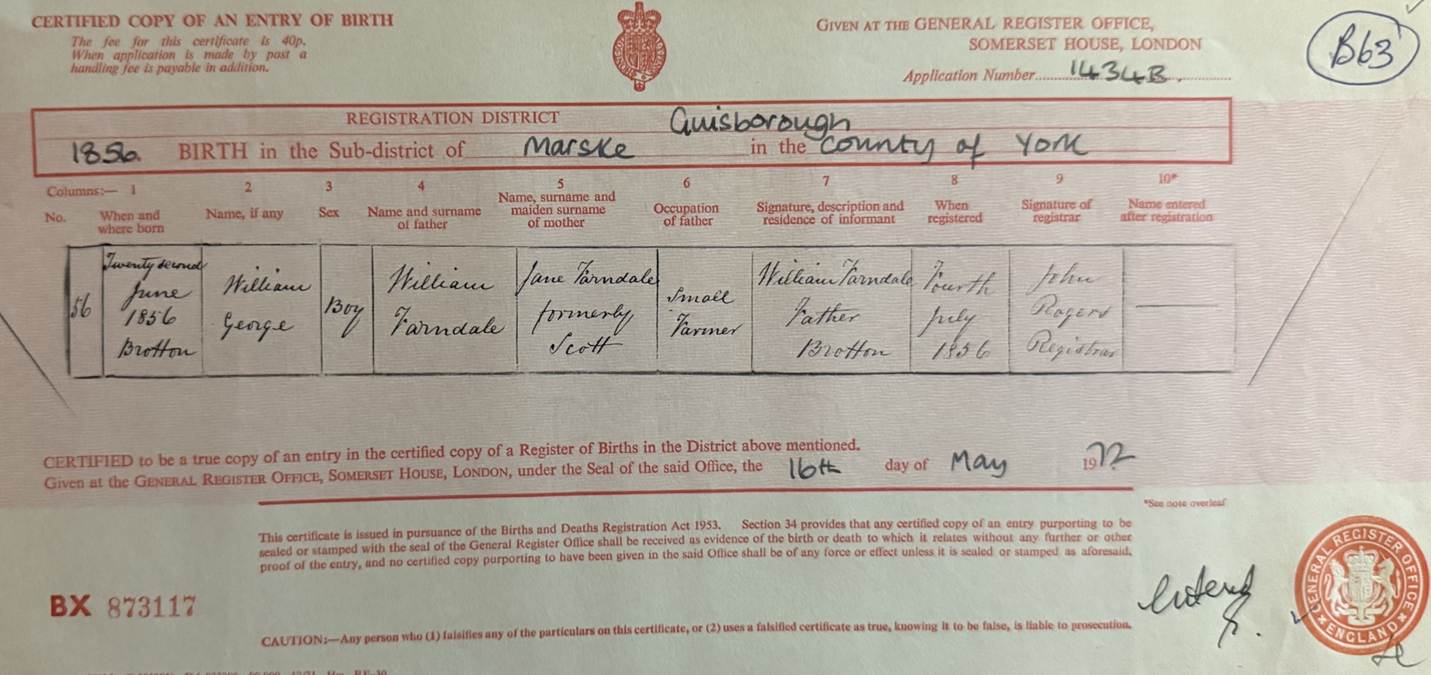
1856
William
George Farndale son of William Farndale (a small farmer of Brotton) and Jane (nee
Scott) Farndale (FAR00243)
was born on 22 June 1856 (Birth Certificate) and baptised on 13 July 1856 at Brotton (Brotton PR). William George Farndale’s birth
was registered in Guisborough District on 4 July 1856 (GRO Vol 9d, page 395).
1861
Census
1861 - Ladgates, Brotton:
William Farndale, head; married; aged 55; farmer
34 acres; born Brotton (1806).
Jane Farndale, wife; married; aged 41; born
Hartlepool (1820).
Hannah Farndale, daughter; unmarried; aged 17;
born Brotton (FAR00360).
William G Farndale,
son; unmarried; aged 4; born Brotton (FAR00421).

William’s parents
William and Jane moved from Brotton to Marske by 1871. William Senior looks to
have become a cartman in Marske after being an agricultural labourer in Brotton
for most of his life, with a short spell as a farmer of 34 acres. William
Senior died in 1876.
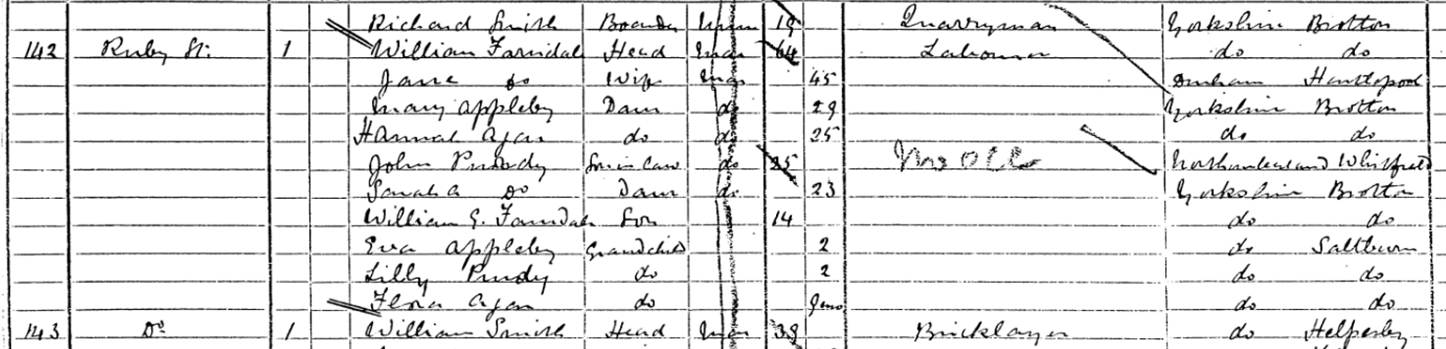
1871
Census
1871 -
Ruby Street, Marske;
William Farndale, head; married; age 64; labourer;
born Brotton (1807).
Jane Farndale, wife; married; age 45; born
Hartlepool (1826).
Mary Appleby, daughter; married; age 29; born
Brotton (FAR00351).
Hannah Agar, daughter; married; age 25; born
Brotton (FAR00360).
Sarah Purdy, daughter; married; age 23; born
Brotton (FAR00368).
William G Farndale,
son; unmarried; age 14; born Brotton (FAR00421).
Also:
John
Purdy, son-in-law; age 25; born Northumberland.
Eva Appleby, granddaughter; age 2; born Saltburn
Lilly Purdy, granddaughter; age 2; born Saltburn
Fenna Agar, granddaughter; age 9m; born
Saltburn
1879
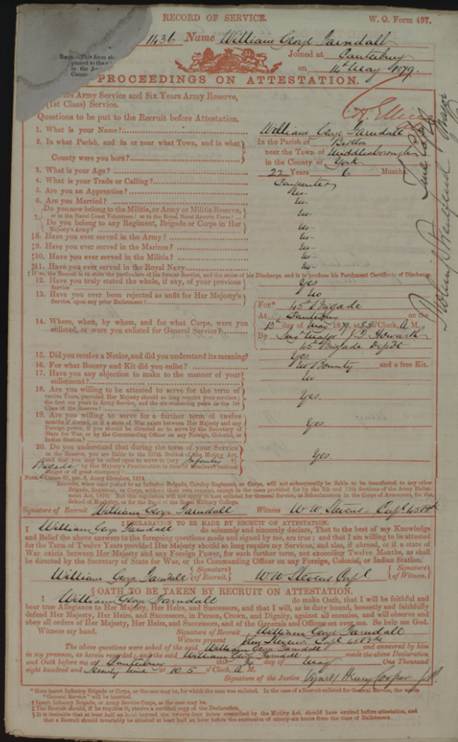
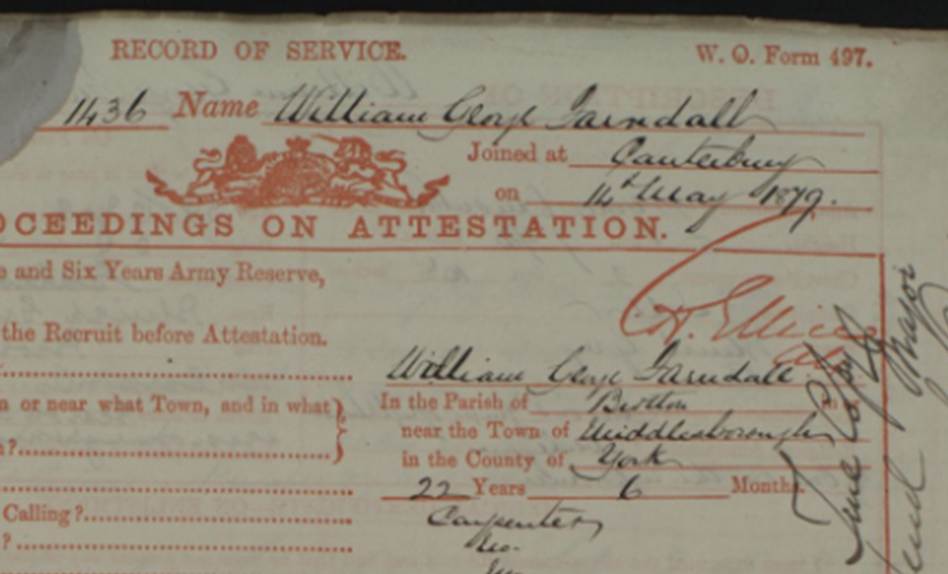
William George
Farndale (born in Brotton in 1857 (error by a year)) was attested into the army
at Canterbury at the age of 22 on 13 May 1879 with service number 1436. He
joined the 45th Brigade, an infantry Brigade. William was a carpenter by trade.
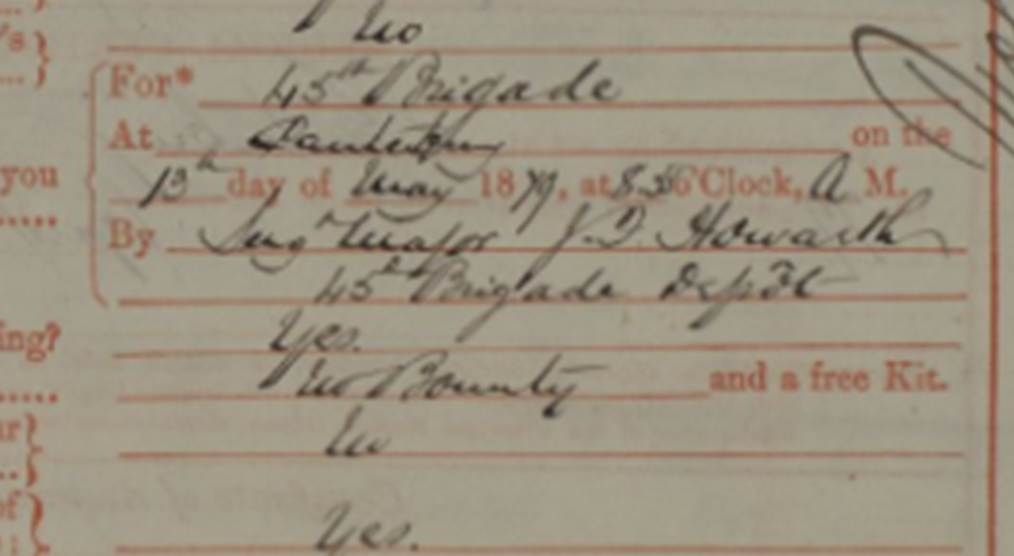
In 1879, the 45th Brigade Depot at Canterbury was
associated with The Buffs (East Kent Regiment), a historic infantry regiment,
with evidence from the National Army Museum showing photographs of the 45th
Brigade Depot (Buffs) officers in 1879 at Canterbury, serving as the regimental
depot for the Buffs, which was already established in Canterbury Barracks under
the Cardwell Reforms for their two battalions. The
Cardwell Reforms of the 1870s established regimental depots, and The Buffs,
already having two battalions, used Canterbury as their base.
In 1858 when the 2nd Battalion was stationed in Malta and
quartered with the 21st Royal (North British) Fusiliers, the Adjutant would not
brook any disarray on the parade ground from his raw recruits, shouting
“Steady, The Buffs! The Fusiliers are watching you!" This greatly amused
the Fusiliers who took to calling out “Steady, The Buffs!" on the
slightest provocation, first in Malta and later whenever the two regiments met
from then on. The phrase caught on and was soon shouted whenever The Buffs
marched by. It then passed into common usage, even appearing in Rudyard
Kipling's novel Soldiers Three (1888) and his play Pity Poor Mama.
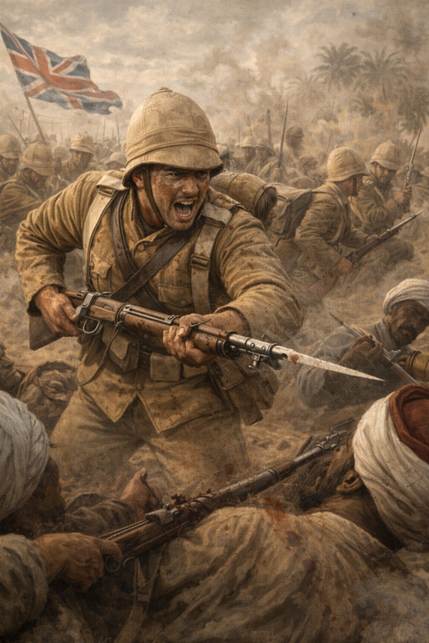
From 1879 to 1891, the Buffs (East Kent Regiment) were
active with their 2nd Battalion fighting in the Zulu War (1879). The Anglo Zulu
War began in January 1879, and. As part of No. 1 Column (the coastal column)
under Colonel Charles Pearson, the Buffs were advancing toward the missionary
station at Eshowe when they encountered a Zulu force at the Inyezane
River on 22 January 1879. The Buffs successfully repelled the attack, fighting
the Zulus in a sharp engagement that lasted about an hour, and continued their
advance. Following the disaster at the Battle of
Isandlwana when 1,200 British soldiers were wiped out also on 22 January 1879,
the central British column was destroyed, leaving the coastal column isolated.
The Buffs were subsequently besieged at Eshowe for 67 days, from 23 January
until they were relieved in March 1879. Although not subjected to a direct Zulu
attack on the fortifications, the regiment endured the hardships of a prolonged
siege. After the siege was lifted, elements of the Buffs formed part of the
relief column's hodgepodge battalion which engaged the main Zulu impi at the
Battle of Gingindlovu on 2 April 1879. The British
force, using a well-fortified lager, inflicted a decisive defeat on the Zulu
army.
We know that William Farndale joined after this on 14 May
1879, at the Buff’s Depot in Canterbury.
There was a second phase of the Zulu Wars. After Eshowe
was relieved, the Buffs were assigned to Major-General Crealock's
1st Division. During this period, they were primarily employed in escorting
supply convoys and did not see further major action, missing the final battle
of Ulundi. Some individual members of the Buffs served
elsewhere, including with the 1st Squadron Mounted Infantry at other key
battles like Hlobane, Khambula,
and Ulundi.
The Regiment was also involved in garrison duties across
the British Empire.
The First Battalion served during the Anglo-Egyptian War
of 1882. The Anglo-Egyptian War of 1882 was a brief
conflict where Britain invaded Egypt to suppress the 'Urabi
Revolution, a nationalist uprising challenging Khedive Tewfik Pasha's rule and
European influence. After bombarding Alexandria, British forces, led by Sir
Garnet Wolseley, defeated the Egyptian army at the Battle of Tel-El-Kebir,
leading to the capture of Cairo, exile of rebel leader Ahmed 'Urabi, and the
establishment of de facto British control and occupation of Egypt,
crucial for safeguarding the Suez Canal.
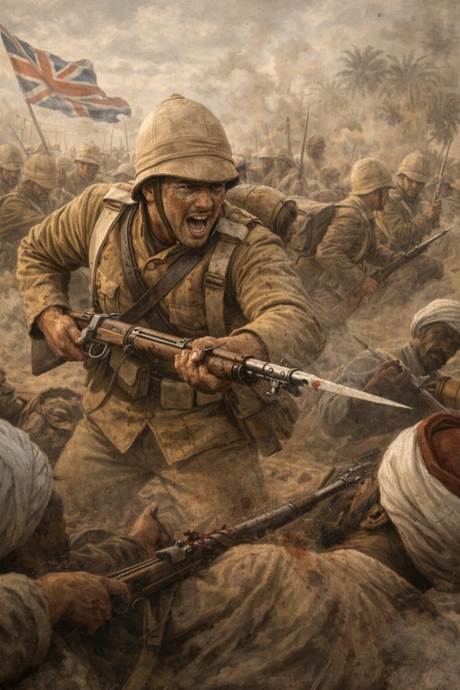
The Buffs were involved in the second engagement at Kassassin Lock on 9 September 1882, a vital position on the
route to the main Egyptian fortifications.
The Battle of Tel el-Kebir was the final and
decisive battle of the war, fought on 13 September 1882. The Buffs formed part
of the 2nd Brigade in the 1st Division, which executed a successful surprise
dawn attack on the heavily fortified Egyptian lines after a night march. The
Egyptian army was decisively defeated, leading to the capture of Cairo and the end
of the rebellion.
For their distinguished service in the campaign, the 1st
Battalion was awarded the battle honours Egypt 1882 and Tel-El-Kebir.
Following the war, the battalion remained in the region for garrison duty in
Cyprus before moving on to India and participating in the Mahdist War in the
Sudan.
The Regiment served in the forces under General Graham,
which were sent to the Red Sea port of Suakin to
suppress the Mahdist leader Osman Digna's threat to the coastal area. They were
involved in the Battle of El Teb and the Battle of
Tamai in early 1884. At Tamai, the British forces faced fierce, close-quarters
combat against determined Sudanese tribesmen.
The 1st Battalion participated in the Battle of Ginnis on
30 December 1885, part of the Anglo-Egyptian force that advanced to relieve the
Dervish blockade of the Ginnis-Kosheh area. This
engagement is historically notable as the last battle in which the British Army
fought wearing its traditional red coats.
After their service in the Sudan, the 1st Battalion was
stationed in Malta and then moved to India for garrison duties.
1881
Generally a British soldier
stationed overseas during census records of this period would not appear in the
England, Wales, or Scotland census returns. The census was designed to
enumerate the population present in the UK on a specific night, with overseas
military coverage only becoming consistent in 1911. His non appearance is
therefore indicative that he may have been serving at the time.
1891
Census
1891 - 11 Ruby Street, Marske;
Jane Farndale, Matron; widow; age 73; b Hartlepool
(1818).
William George
Farndale, son age 37; born Brotton (FAR00421).
Also
Flora Williams, granddaughter; age 21; born Saltburn
Sarah Agar, granddaughter; age 17; born Saltburn
Florence Williams, granddaughter; age 7m; born Guisborough.


1902
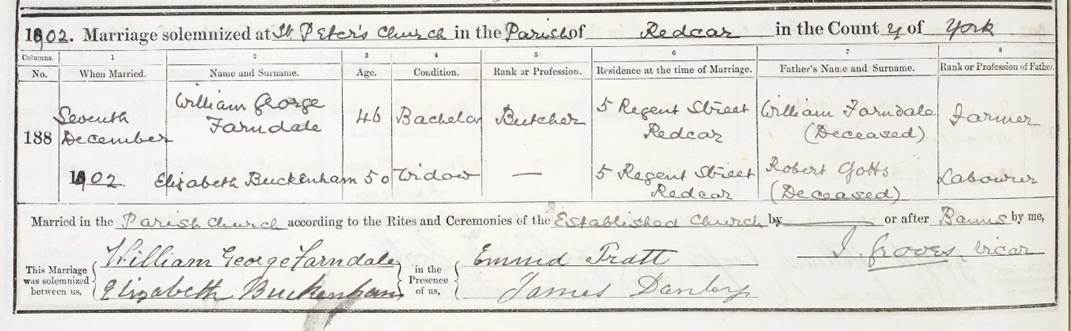
William George Farndale, married Elizabeth
Buckenham (aged 50, a widow) on 7 December 1902 (age 46) at Guisborough District at Redcar Parish
Church (Redcar PR). His father was William Farndale by then deceased.
He then resided at 5 Regent Street, Redcar. By then, he was a butcher.
Elizabeth
may have died by 1908, or they may have separated, as William was alone and in
difficulty by that time.
1908
Whitby Gazette, 16 April 1908: George Farndale, of no fixed abode, was charged with
obtaining a quantity of food, value 24s, from Catherine Cogan, at Redcar, on
the 11th April. According to the evidence, prisoner had called at Mrs Cogan's,
and asked her if she could provide lodging himself and seven others, who were
to work for Mr Senior at the Redcar new schools. She told him she could take
him and four of his friends, and he stayed a fortnight, and then left, without
paying. The other four men never came, and, when she asked him for money, he
said he would write to Mr Senior for it. Fred Senior, stated that prisoner
worked for him at Stokesley till 21st March, when he left his employment. He
had not engaged prisoner to work at the Redcar school. Prisoner who pleaded
that he had no felonious intention, was committed for one month, in default of
payment of a fine of 21s.
Stockton Herald, South Durham and Cleveland Advertiser, 18 April
1908: REDCAR
LANDLADY “BILKED”. William George Farndale, a labourer, of no fixed abode, was
on Tuesday at Guisborough fined 21s, with the alternative of a month’s
imprisonment for obtaining food and lodgings by false pretences from Catherine
Cogan, of West Dyke, Redcar. The evidence showed that he obtained board and
lodgings by representing that he was employed by Mr F Senior in asphalting in
connection with the new school at Redcar. He came to her house on March 28th,
and Mr Senior was today called to prove that he left his service on March 21st,
and that he had no authority to say that he was working for him at Redcar
schools. Inspector Hall stated that when Farndale was charged with false pretences
he replied, “It is alright, she will be paid.” Superintendent Rose said the
defendant was a joiner by trade, and a native of East Cleveland, but he had
lived a roaming life.
1911
1911
Census
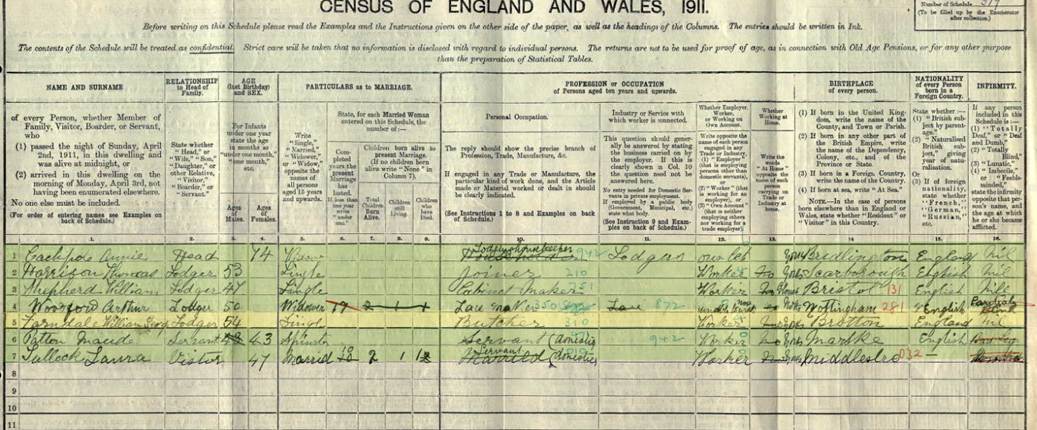
He
was living at 4 East Terrace, Marske, a lodger with a number of other people
who were not relatives. He was working as a butcher. He did not then live with
his wife, who had perhaps died.
1915
William George Farndale died, aged 59, at the
workhouse in Guisborough (Guisborough PR). He
was buried on 15 February 1915.