Durham
A historical guide to Farndale relative to Farndale history
|
Return to the Home Page of the Farndale Family
Website |
The story of one family’s journey through two
thousand years of British History |
The 83 family lines into which the family is divided.
Meet the whole family and how the wider family is related |
Members of the historical family ordered by date of
birth |
Links to other pages with historical research and
related material |
The story of the Bakers of Highfields, the Chapmans,
and other related families |
Introduction
Dates are in red.
Hyperlinks to
other pages are in dark
blue.
Headlines of the
history of the Durham are in brown.
References and
citations are in turquoise.
Contextual
history is in purple.
This webpage about
the Durham has the following section headings:
·
The
Farndales of Durham
·
Durham, an
overview
The Farndales of Durham
The following
Farndales are associated with Durham: Mary Ann Farndale (FAR00397),
Mary Farndale (FAR00402),
James Farndale (FAR00521),
Tom Farndale (FAR00536),
George Farndale (FAR00565),
Albert Farndale (FAR00740),
Cecil Farndale (FAR00742),
Mary E Farndale (FAR00765),
Wilfred Farndale (FAR00769),
Margaret Farndale (FAR00823),
William H Farndale (FAR00840),
Albert W Farndale (FAR00866),
Doris Farndale (FAR00883),
Janet C Farndale (FAR00906),
Colin R Farndale (FAR00932),
Mavis Farndale (FAR00971),
Karen Farndale (FAR01116),
Sonja Farndale (FAR1139).
Richard Martin Farndale (FAR01122)
went to Durham University and met his wife Charlotte there. Nigel Geoffrey
Farndale (FAR01130)
also went to Durham University.
Durham, an Overview
Durham is a
historic city and the county town of County
Durham in North East England. The city lies on the River Wear,
to the south-west of Sunderland, south of Newcastle upon
Tyne and to the north of Darlington. Founded over the final resting
place of St Cuthbert, its Norman cathedral became a centre of
pilgrimage in medieval England. The cathedral and adjacent 11th-century castle were
designated a World Heritage Site by UNESCO in 1986.
The castle has
been the home of Durham University since 1832.
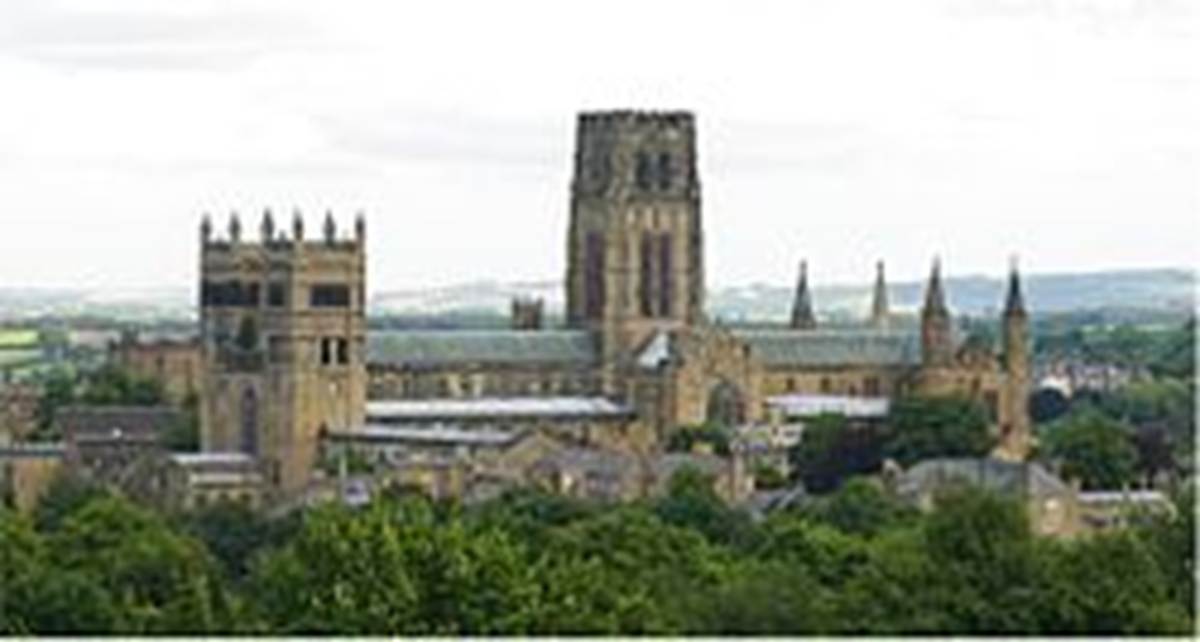
The name Durham
comes from the Celtic dun, signifying a hill fort, and
the Old Norse holme, which
translates to island. The Lord Bishop of Durham takes a Latin variation of
the city's name in his official signature, which is signed
"N. Dunelm". Some attribute the city's name to the legend
of the Dun Cow and the milkmaid who in legend guided the
monks of Lindisfarne carrying the body of Saint Cuthbert to
the site of the present city in 995 AD. Dun Cow Lane is said to be one of
the first streets in Durham, being directly to the east of Durham Cathedral and
taking its name from a depiction of the city's founding etched in masonry on
the south side of the cathedral. The original Nordic Dun
Holm was changed to Duresme by
the Normans and was known in Latin as Dunelm. The modern
form Durham came into use later in the city's history. The north
eastern historian Robert Surtees chronicled the name changes in
his History and Antiquities of the County
Palatine of Durham.
Timeline of Durham
2,000 BCE
Archeological evidence suggests a history of settlement in
the area since roughly 2,000 BCE.
995 CE
The present city
can clearly be traced back to 995 CE, when a group of monks
from Lindisfarne chose the strategic high peninsula as a place to
settle with the body of Saint Cuthbert, that had previously lain in Chester-le-Street, founding a church
there.
Local legend
states that the city was founded in 995 by divine intervention. The Twelfth
century chronicler Symeon of Durham recounts
that after wandering in the north, Saint Cuthbert's bier miraculously
came to a halt at the hill of Warden Law and, despite the effort of
the congregation, would not move. Aldhun, Bishop
of Chester-le-Street and leader of the
order, decreed a holy fast of three days, accompanied by prayers to
the saint. During the fast, Saint Cuthbert appeared to a monk named
Eadmer, with instructions that the coffin should be taken to Dun
Holm. After Eadmer's revelation, Aldhun found
that he was able to move the bier, but did not know where Dun Holm was.
The legend of the
Dun Cow, which is first documented in The
Rites of Durham, an anonymous account about the Durham Cathedral,
published in 1593, builds on Symeon's account. According to this legend,
by chance later that day, the monks came across a milkmaid at Mount
Joy, southeast of the city. She said that she was seeking her lost dun
cow, which she had last seen at Dun Holm. The monks, realising that this was a
sign from the saint, followed her. They settled at a wooded
"hill-island", a high wooded rock surrounded on three sides by the
River Wear. There they erected a shelter for the relics, on the spot where
the Durham Cathedral would later stand. Symeon says that a modest wooden
building erected there shortly later was the first building in the city.
998
Bishop Aldhun subsequently had a stone church built, which was
dedicated in September 998. It no longer remains, having been supplanted
by the Norman structure.
During the
medieval period the city gained spiritual prominence as the final resting place
of Saint Cuthbert and Saint Bede the Venerable. The shrine of
Saint Cuthbert, situated behind the High Altar of Durham Cathedral,
was the most important religious site in England until the martyrdom of St
Thomas Becket at Canterbury in 1170.
1346
The Battle
of Neville's Cross, took place near the city on 17 October 1346 between the
English and Scots.
1299
Owing to
the divine providence evidenced in the city's legendary founding,
the Bishop of Durham has always enjoyed the title Bishop by Divine
Providence as opposed to other bishops, who are Bishop by Divine
Permission. However, as the north-east of England lay so far
from Westminster, the bishops of Durham enjoyed extraordinary powers such
as the ability to hold their own parliament, raise their own
armies, appoint their own sheriffs and Justices,
administer their own laws, levy taxes and customs duties, create fairs and
markets, issue charters, salvage shipwrecks, collect revenue from mines,
administer the forests and mint their own coins.
So far-reaching
were the bishop's powers that the steward of
Bishop Antony Bek commented in 1299
AD: "There are two kings in England, namely the Lord King of England,
wearing a crown in sign of his regality and the Lord
Bishop of Durham wearing a mitre in place of a crown, in sign of his regality in the diocese of
Durham". All this activity was administered from the castle and
buildings surrounding the Palace Green. Many of the original buildings
associated with these functions of the county
palatine survive on the peninsula that constitutes the ancient
city.
Every Bishop of
Durham from 1071 to 1836 was a Prince Bishop except for the first Norman
appointment, Bishop Walcher (in office ca. 1071–1080),
who was styled an Earl-Bishop. Although the term "prince
bishop" has been used as a helpful tool in the understanding the functions
of the Bishops of Durham it is not a title they would have recognised. The
last Prince Bishop of Durham, Bishop William Van Mildert, is credited[by whom?] with the
foundation of Durham University in 1832. Henry VIII curtailed some of the
Prince-Bishop's powers and, in 1538, ordered the destruction of the shrine of
Saint Cuthbert
The Prince
Bishops had their own court system, including most notably the Court
of Chancery of the County Palatine of Durham and Sadberge. The
county also had its own attorney general, whose authority to bring an
indictment for criminal matters was tested by central government in the case
of R v Mary Ann Cotton (1873) Certain courts and
judicial posts for the county were abolished by the Supreme Court of
Judicature Act 1873. Section 2 of the Durham (County Palatine) Act
1836 and section 41 of the Courts Act 1971 abolished others
1544
The city suffered
from plague outbreaks in 1544, 1589 and 1598.
1640 to 1660
The city remained
loyal to King Charles I throughout the English Civil War.
Charles I came to Durham twice during his reign.
He came to the
cathedral for a majestic service in which he was entertained by the Chapter and Bishop at great expense at the
start of his reign.
His second visit
to the city came towards the end of the civil war, escaping from the city
as Oliver Cromwell's forces got closer. Local legend stated he
escaped down the Bailey and through Old Elvet. Another local legend
has it that Cromwell stayed in a room in the present Royal County Hotel on Old
Elvet during the civil war. The room is reputed to be haunted by his
ghost. Durham suffered greatly during the civil war and Commonwealth.
This was not due to direct assault by Cromwell but the abolition of the Church
of England and the closure of religious institutions pertaining to it. The
city has always relied upon the Dean and Chapter and cathedral as an economic
force.
The castle
suffered considerable damage and dilapidation during the Commonwealth due to
the abolition of the office of bishop whose residence it was. Cromwell
confiscated the castle and sold it to the Lord Mayor of
London shortly after taking it from the bishop. A similar fate befell
the cathedral, it being closed in 1650 and used to incarcerate 3,000 Scottish
prisoners. Graffiti left by them can still be seen today etched into
the interior stone.
1660
At
the Restoration in 1660, John Cosin, a
former canon, was appointed bishop and set about a
major restoration project. This included the commissioning of the famous
elaborate woodwork in the cathedral choir, the font cover and
the Black Staircase in the castle. Other renovations were carried out to
both the city and cathedral by his successor Bishop Lord Nathaniel Crewe.
1720
In 1720 it was
proposed that Durham could become a sea port by digging a canal north to join
the River Team, a tributary of the River
Tyne near Gateshead. Nothing came of the plan, but the statue of
Neptune in the Market Place was a constant reminder of Durham's maritime
possibilities.
1759
The thought of
ships docking at the Sands or Millburngate remained
fresh in the minds of Durham businessmen. In 1759, a new proposal hoped to make
the Wear navigable from Durham to Sunderland by altering the river's
course, but the increasing size of ships made this impractical. This was
further compounded by the fact Sunderland had grown as the north east's main
port and centre for shipping.
1787
In 1787 Durham
infirmary was founded.
1801
The first census,
conducted in 1801, states that Durham City had a population of 7,100.
1832
The Great Reform Act 1832 saw the removal
of the Prince Bishop's powers, although he still has the right to a seat
in the House of Lords and is regarded as the second most senior
bishop and fourth most senior clergyman in the Church of England. The Court
of Claims of 1953 granted the traditional right of the bishop to accompany
the sovereign at the coronation, reflecting his seniority.
Durham
University was founded in 1832. Durham Castle became the first
college (University College, Durham) and the bishop moved to Auckland
Castle as his only residence in the county. Bishop Hatfield's Hall
(later Hatfield College, Durham) was added in 1846 specifically for the
sons of poorer families, the Principal inaugurating a system new to English
university life of advance fees to cover accommodation and communal dining.
Later nineteenth century
The Industrial
Revolution mostly passed the city by. However, the city was well known for
carpet making and weaving. Although most of the mediaeval weavers who thrived
in the city had left by the nineteenth century, the city was the home of Hugh
MacKay Carpets’ factory, which produced the famous brands of axminster and tufted carpets until the
factory went into administration in April 2005. Other important industries
were the manufacture of mustard and coal extraction
The Industrial
Revolution also placed the city at the heart of the coalfields, the
county's main industry until the 1970s. Practically every village around the
city had a coal mine and, although these have since disappeared as part of the
regional decline in heavy industry, the traditions, heritage and community
spirit are still evident.
1871
The
first Durham Miners' Gala was attended by 5,000 miners in 1871 in
Wharton Park, and remains the largest socialist trade union event in the
world.
1927
Early in the 20th
century coal became depleted, with a particularly important seam worked out in
1927
1929
During
the Great Depression Durham was among those towns that suffered
exceptionally severe hardship.
However, the
University expanded greatly. St John's College and St Cuthbert's
Society were founded on the Bailey, completing the series of colleges
in that area of the city.
1942
Durham was not
bombed during World War II, though one raid on the night of 30 May 1942
did give rise to the local legend of 'St Cuthbert's Mist'. The legend is that
the Luftwaffe attempted to target Durham, but was thwarted when
Cuthbert created a mist that covered both the castle and cathedral, sparing
them from bombing.
1950s
From the early
1950s to early 1970s the university expanded to the south of the city
centre. Trevelyan, Van Mildert, Collingwood,
and Grey colleges were established, and new buildings for St
Aidan's and St Mary's colleges for women, formerly housed on the
Bailey, were created.
The final 20th
century collegiate addition came from the merger of the independent
nineteenth-century colleges of the Venerable Bede and St Hild, which joined the
university in 1979 as the College of St Hild and St Bede.
The 1960s and 70s
also saw building on New Elvet. Dunelm House for the use of the
students' union was built first, followed by Elvet Riverside, containing
lecture theatres and staff offices.
To the southeast
of the city centre sports facilities were built at Maiden Castle, adjacent to
the Iron Age fort of the same name, and the Mountjoy site was developed,
starting in 1924, eventually containing the university library, administrative
buildings, and facilities for the Faculty of Science.
1986
Durham was
created a UNESCO World
Heritage Site in 1986, under the title 'Durham Castle and Cathedral'.
Bibliography