The
Industrial Revolution
Historical
and geographical information
|
Return to the Home Page of the Farndale Family
Website |
The story of one family’s journey through two
thousand years of British History |
The 83 family lines into which the family is divided.
Meet the whole family and how the wider family is related |
Members of the historical family ordered by date of
birth |
Links to other pages with historical research and
related material |
The story of the Bakers of Highfields, the Chapmans,
and other related families |



Dates are in red.
Hyperlinks to other pages are in dark blue.
Headlines are in brown.
References and citations are in turquoise.
Context and local history are in purple.
Further
work to follow.
During
these Wars many very remarkable discoveries and inventions were made. Most
memorable among these was the discovery (made by all the rich men in England at
once) that women and children could work for twenty four hours a day in
factories without any of them dying or becoming excessively deformed. This was
known as the Industrial Revolution and completely changed the faces of the
North of England (1066 and all that, Walter Sellar and Robert Yeatman, 1930).
At the
same time there was an Agricultural Revolution which was caused by the
invention of turnips and the discovery that Trespassers could be Prosecuted.
This was a Good Thing too, because previously the Land had all been rather
common (1066 and all that, Walter Sellar and Robert Yeatman, 1930).
The Farndales and the Industrial Revolution
The Farndales and mining.
Middlesbrough, Stockton,
Hartlepool, Leeds, Bradford
Change a recurrent theme
Change is a
constant through Britain’s history. It was not exclusive to the industrial
change of the nineteenth and twentieth centuries. Mechanisation and artificial
fertilisers have enabled exponential growths in population. But change has
influenced history since and before the Middle Ages. There was for instance
significant change in the lives of individuals between the Tudor fifteenth
century and the Norman eleventh century.
Gains and losses in the lives of individuals
The
positive account
Subsistence
economy (famine or plague every decade or so) to more choices for individuals
and the potential for some surplus cash with which to seek new options and
experience.
Poor laws.
From fourteenth century a process where elite classes had little option but to
recognise individuals and over time even to provide some limited support in
poverty. From starvation to some recognition of the need to support the poor.
Literacy in
Norman times, tiny proportion of literate people producing relatively limited
work to high level of literacy.
Scientific
understanding – Enlightenment.
Steady
realisation of contra arguments.
The
negative account
Authoritarian
advantage. Technical advance enabled elite to control and organise society.
Military
mechanisation. Machine Guns. Industrial killing power. Warfare has always been
brutal – hacking with swords, filling the key with arrows, poor medical care –
life as a soldier on the medieval battlefield was brutal. Mechanisation and
railway transportation – scale of devastation.
Industrial Change
There was economic change in England back to the Black
Death and the improvements in living standards that followed. Populations rose
in Europe in the sixteenth and seventeenth centuries and the growing demands
were met by intensification of agriculture and new diverse economic activities.
The inception of a new era of economic change emerged
after the Restoration in 1660.
By the eighteenth century Britain and Holland were the
richest nations, even though India and China were the main exporters of
manufactured goods.
The term Industrial Revolution was used from the
1820s. Disraeli would call Britain the workshop
of the world, while William Blake would highlight the dark,
satanic mills.
As change came about, there was a longing in Britain
for unspoiled nature and rural scenes, which emerged in art, literature and
music. James
Thomson’s poetry wrote I hate the clamours of the smoky towns, But must
admire the bliss of rural clowns and
A sylvan life till then the natives led.
The Industrial Revolution might be seen as a sudden
burst and time of rapid change, or change which evolved more slowly over
generations.
The Causes of the Industrial Revolution
External factors. There was stimulation from external influences.
Success in Britain’s ongoing struggle against France provided a bonus in the
dominance of trade.
Overseas Trade. Over 80% of Britain’s tax revenue was spent on war
in the eighteenth century. The Royal Navy received 10% of national income. A
possible explanation is that England’s new economic success was driven by its
predatory nature and/or that it arose from the profits of slavery. That said
the profits that arose from the slave trade continuing in the Americas,
particularly in sugar plantations, was small. It is difficult to say therefore
that slavery was a primary cause of the industrial revolution. That said, slave
produced colonial goods, including American cotton and Caribbean sugar were
significant factors in economic change.
However, it is difficult to say that victory in war,
and foreign and imperial trade, caused the industrial revolution. Holland,
Spain and France possessed significant imperial interests, but there was no
industrial revolution in trade. So we have to look for what was unique about
Britain.
Domestic influences. There was a domestic element. The political and
legal system provided a suitable arena for rapid change. That said, the high
level of taxes and trade regulations would not today be thought to be conducive
to growth.
Profit seekers. It was no doubt given impetus by land owners and
capitalist interests.
Aspiration. Industrial change may have gained some impetus from improvements in
standards of living.
From the late seventeenth
century, there was a new appetite among populations beyond basic needs, but
with appetites for comfort, novelty and pleasure. They sought clocks,
comfortable furniture, mirrors, earthenware and china. Watches
became a fashion item, and by the 1790s there were 800,000 silver and 400,000
gold watches in England.
There was a
marked revolution in clothing. New regional styles emerged. Clothing became an
important mark of social status, and whilst unwritten rules did not allow
dressing to match one’s betters, folk did wear clothes to demonstrate that they
were as good as their fellows.
Clothing
drove the industrial revolution. Cotton was adopted for its colour and
brightness. Folk bought goods for enjoyment and self
invention. There was a move away from Protestant thrift and saving to a
more romantic work ethic driven by self expression
and ambition.
People
consumed more – tobacco, sugar, coffee, fresh bread, alcohol and particularly
tea.
Spending more
required people to work longer hours. More married women took jobs. Working
hours reached 65 to 70 hours a week compared to 40 to 50 hours today. It was
often the new earnings of young folk and married women which enabled the
acquisition of new luxuries.
The
Industrial Revolution was driven significantly by domestic demand.
Enlightenment. The industrial revolution can be related to the
cultural, political and scientific liberties arising out of the Enlightenment.
There was a new interest in science, experiment, literacy and education.
Britain had an unusually high level of literacy and education. Working class
children often received at least some schooling. The majority of workers were
able to sign their names. Two thirds of boys in England took apprenticeships in
the seventeenth and eighteenth centuries, which required the prospect of high
wags to make the cost worthwhile. An Ealing gardener paid 6d a week to educate
his two children. Enlightenment science generally had little connection with
industrial technology. However industrial invention arose out of the
Enlightenment.
New energy sources. It perhaps arose most clearly from new sources of
energy, particularly coal.
Change was significantly driven by technological
changes:
|
Iron smelting with coke |
1709 |
Bypassed the need for charcoal |
|
|
Steam engine |
1712 |
Allowed the pumping out of deep coal mines |
|
|
The flying shuttle |
1733 |
Sped up weaving |
|
|
The spinning jenny |
1765 |
Multiplied the effectiveness of hand spinning |
|
|
Water Frame |
1769 |
Used power for spinning with rollers |
|
|
Condenser |
1769 |
Provided economical steam power |
|
|
Mule |
1779 |
Allowed mass production of high quality yarn |
|
|
Rolling Mill |
1783 |
Sped up the production of iron |
|
|
Loom |
1787 |
Enabled water and steam power to make cloth |
|
|
Engineering |
1724 to 1792 |
The father of modern engineering, founded the
Society of Civil Engineers in 1771 |
|
|
Pottery |
|
|
The ten “macro inventors”
These innovative and labour saving technologies
thrived because wages were already high. Spinning jennies and other innovations
were not taken up in France. Where wages and demand was low, skills were rare,
and expensive technology was wasted.
An organic economy evolved primary to harness the
energy of coal. This allowed England to overtake its nearest economic rival,
Holland. There were significant coal deposits across Britain. Early steam
power, such as Newcomen’s atmospheric engine created a vacuum by heating and
cooling steam, but it used so much coal, that it was only really viable at the
pit head. However there were continual improvements, including Watt’s
condenser, which extended the use of steam.
Two centuries later, it would be realised that these
new technologies posed a significant environmental threat.
(Robert Tombs, The English and
their History, 2023, 367 to 375).
Positive and Negative consequences of the Industrial Revolution
There was a sudden and unique demographic boom
increasing the English population from 5.2M in 1701 to 17.9M in 1851. With
increased wages and new job opportunities after the Restoration, people married
younger and had more children. Rev
Thomas Malthus wrote his Essay on the Principle of
Population (1798).
In exacerbation of this, there were bad harvest caused
by the volcanic
eruption of Mount Tambora in present day Indonesia peaking on 10 April
1815, which disrupted the climate and caused widespread famine.
In the rest of Europe the consequence of this trend of
population growth was sharp deterioration, but this didn’t happen in Britain.
There was no economic disaster. Living standards were maintained at a
relatively high level. Prosperity focused on the growth of urban areas such as
London, Birmingham, Manchester and Liverpool; the growth of new jobs, and
support for incomes through the Poor Laws.
From the 1850s there was a second stage of
industrialisation, boosted by cheap energy from the new mineral economy.
Proponents of change, such as David Hume and Adam
Smith welcomed a new commercial society, and saw a remedy to poverty, and
provision of a more stable, peaceful and civilised society, with new economic
freedoms. The revolution certainly increased living standards. Wages were
already high, and there people had new aspirations and choices.
Opponents of change criticised its moral, social and
aesthetic consequences. Skills were devalued and health deteriorated. Infant
mortality was high. People’s physical condition deteriorated, and heights fell.
The revolution created an impoverished and downtrodden proletariat. Real wages
barely rose from their already high levels, about 4% from 1760 to 1820, but
food prices rose.
(Robert Tombs, The English and their History, 2023,
367 to 375).
There is an In Our Time podcast on the Industrial Revolution.
There is an In Our Time podcast on the far-reaching
consequences of the
Industrial Revolution, which brought widespread social and intellectual
change to Britain.
There is an In Our Time podcast on Isambard Kingdom Brunel,
the Victorian engineer responsible for bridges, tunnels and railways still in
use today.
Textiles
Clothing drove the industrial revolution. Cotton was
adopted for its colour and brightness. Folk bought goods for enjoyment and self invention. There was a move away from Protestant
thrift and saving to a more romantic work ethic driven by self
expression and ambition.
Further
work to follow.
Life in Victorian
Urban Centres
Charles Dickens, Hard
Times:
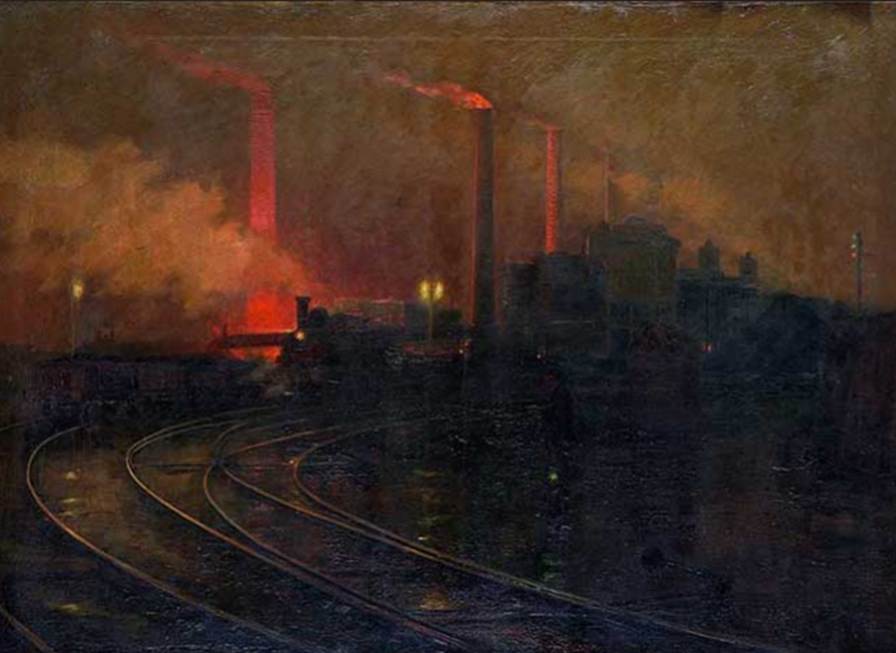
Coketown, to which Messrs. Bounderby and Gradgrind now walked, was a triumph of
fact; it had no greater taint of fancy in it than Mrs. Gradgrind herself. Let us strike the key-note, Coketown, before pursuing our tune.
It was a town of red brick, or of
brick that would have been red if the smoke and ashes had allowed it; but as
matters stood, it was a town of unnatural red and black like the painted face
of a savage. It was a town of
machinery and tall chimneys, out of which interminable serpents of smoke
trailed themselves for ever and ever, and never got uncoiled. It had a black canal in it, and a river
that ran purple with ill-smelling dye, and vast piles of building full of
windows where there was a rattling and a trembling all day long, and where the
piston of the steam-engine worked monotonously up and down, like the head of an
elephant in a state of melancholy madness.
It contained several large streets all very like one another, and many
small streets still more like one another, inhabited by people equally like one
another, who all went in and out at the same hours, with the same sound upon
the same pavements, to do the same work, and to whom every day was the same as
yesterday and to-morrow, and every year the counterpart of the last and the
next.
These attributes of Coketown were in the main inseparable from the work by
which it was sustained; against them were to be set off, comforts of life which
found their way all over the world, and elegancies of life which made, we will
not ask how much of the fine lady, who could scarcely bear to hear the place
mentioned. The rest of its features were
voluntary, and they were these.
You saw nothing in Coketown but what was severely workful. …
Between 1790 and 1850, the sudden industrialisation
caused a loss of status for some and sudden wealth and power for others. Many
saw insecurity, disorientation, slum living and disease. There was uncertainty
as to whether the new era would end in wide prosperity or mass starvation.
The Dark side of the industrial revolution was
emphasised in Arnold Toynbee’s Lectures on the Industrial Revolution in England
and Engels’ denunciation of workers’ suffering and his anticipation of a
proletarian revolution. He denounced the degradation marked by the slums of
Manchester. There was a bleak interpretation of the industrial revolution
trapping the poor in smoke and squalor.
William Blake’s Jerusalem contrasted nostalgia for England’s green and pleasant
land with the new industrial landscapes:
|
And did
those feet in ancient time, Walk
upon England’s mountains green: And was
the holy Lamb of God, On
England’s pleasant pastures seen! |
And did
the Countenance Divine, Shine
forth upon our clouded hills? And was
Jerusalem builded here, Among
these dark Satanic Mills? |
Bring
me my Bow of burning gold: Bring
me my Arrows of desire: Bring
me my Spear: O clouds unfold: Bring
me my Chariot of fire! |
I will
not cease from Mental Fight, Nor
shall my Sword sleep in my hand: Till we
have built Jerusalem, In
England’s green & pleasant Land. |
In reality
the famous hymn, written between 1804 to 1820, which became a great patriotic song
in the first world war, is difficult to comprehend. It was written in
consequence of the Napoleonic Wars and envisaged the ancient English order as
God’s chosen people rebuilding Jerusalem, harping back to the long Civil War
debate between the new post Norman era harping back to underlying rights held
to have existed in Anglo Saxon times. Whilst dark satanic mills has long
been associated with the Industrial Revolution, there are interpretations that
the phrase was a criticism of the conformity of the established Church of
England, and that the phrase referred to the great churches.