Dispersal
The story of those who
left the dale to begin new lives
FAR00030B
|
Return to the Home
Page of the Farndale Family Website |
The story of one
family’s journey through two thousand years of British History |
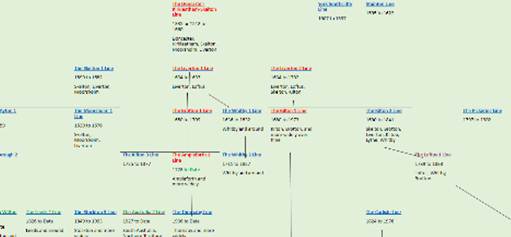
The 83 family lines
into which the family is divided. Meet the whole family and how the wider
family is related |
Members of the
historical family ordered by date of birth |
Links to other pages
with historical research and related material |
The story of the
Bakers of Highfields, the Chapmans, and other related families |
Dates are in red.
Hyperlinks to
other pages are in dark
blue.
Headlines are in brown.
References and
citations are in turquoise.
Context and local
history are in purple.
Then a soldier,
full of strange oaths, and bearded like the pard, jealous in honour, sudden and
quick in quarrel, seeking the bubble reputation even in the cannon’s mouth.
(William Shakespeare, As You Like It, Act II Scene VII)
The York Family
1301
Simon the Miller
of Farndale (FAR00021) had a son, John and it was probably he,
Johanne de Farendale (FAR00030), who had
crossed the moors to Egton by 1301, where he paid 22d in Edward I’s subsidy (Yorkshire Lay Subsidy 1301, Yorkshire Archaeological Society Record Series Volume
21, 1897, ed William Brown page 28 to 29).
At about the same time Willelmo de Farendale (FAR00013) had moved to
Danby where he paid 3s (Yorkshire Lay Subsidy
1301, Yorkshire Archaeological Society
Record Series Volume 21, 1897, ed William Brown page 26).
These were a new generation of pioneers who left the dale to seek new
opportunities taking the name of the dale to define themselves as they did so.
1314
By 1314, John de
Farndale was a sub tenant of Thomas Wake in Rosedale, the dale adjacent to
Farndale. John held 6 acres of land near the vill of
Cropton. He grew five acres with oats, which had been grown every year between
about 1314 and 1334 and one acre was wasteland (The
Great Cowcher of the Duchy of Lancaster, The National Archives, DL42/1 Folio
248). Cropton is at the head of Rosedale, but from later records, it is
apparent that John’s land may have been at Hartoft, near Rosedale Abbey today.
1327
Johanne de
Farndale, paid taxes at Cropton de Arthoft of 2s 1d
in the Lay Subsidy of 1327 (The Duchy of Lancaster
Records, from the North Riding Record Society, The Honour and Forest of
Pickering, Edited by Robert Bell Turton, Volume IV, 1897, page 143) and
2s in the same place in the 1333 subsidy (The Duchy
of Lancaster Records, from the North Riding Record Society, The Honour and
Forest of Pickering, Edited by Robert Bell Turton, Volume IV, 1897, page 154).
1336
Three years
later, John de Farndale of Hovingham in the Wapentake of Ryedale was a debtor
to Thomas de Wrelton, a chaplain of Yorkshire in the
sum of £8 and the transaction was recorded by Henry de Belton, Mayor of York
and William Gra, Clerk taken on 16 April 1336. The first term of the loan was
to last until 19 May 1336. The writ was endorsed by Ebor' Coram Justic' de
Banco (The National Archives C 241/115/94).
1338
It may have been
by about 1338, having taken a loan at Hovingham, that John set up a new
business as a saddler in York.
1363
In 1363, Johannes
de Farnedale was admitted as a freeman of York as a sadler (Register of
the freemen of the city of York from the
city records, 1279 to 1759, 1897 page
58).
1397
His son, Johannes
de Farndall (FAR00035), fil Johannis de Farndall,
sadler, was admitted as a freeman of York by
patrimony in 1397 (Register of the freemen of
the city of York from the city records,
1279 to 1759, 1897 page
101).
1408
In a third
generation of this family, John de Fernedill (FAR00048A) was admitted as a freeman in York in 1408 as
a boucher (Register
of the freemen of the city of York from
the city records, 1279 to 1759, 1897, page
113), most likely working in the Shambles, from the Anglo-Saxon fleshammels, the shelves or benches where meat was
displayed the street, and York’s medieval street of butchers’ shops. This John
was likely John Farodell who served under Henry Percy
and John of Gaunt in Scotland between 1383 to 1389 (British
Library, Cotton Roll XIII.8, m2, The National Archives, E101/39/38, m3d and
E101/40/5, m2) and under Thomas Mowbray as part of a standing force in
the Scottish marches in 1389 (The National Archives
E101/41/17, m1 and m2), alongside his brothers Henry Farendon
(FAR00035B,
The
National Archives E101/41/17, m1 and m2) and William Faryndon (FAR00035C, The National Archives
E101/41/17, m1 and m5).
Davy Farndyn (FAR00044A) was perhaps the fourth generation of this
same family, who served extensively in France during Henry V’s campaigns at
Harfleur (Muster Roll, the National Archive
E101/48/17, E101/48/19) and later a man at arms at Rouen (Bibliothèque Nationale de France, MS. Fr. 25768, no. 433,
Fr. 25769, no. 447, Clairambault 166, no. 30;
Bibliothèque Nationale de France, MS. Fr. 25769, no. 501; The British Library,
Add. Ch. 11668) where he served under Richard Beauchamp, Earl of
Warwick, the superintendent and gaoler of Joan of Arc during her trial and
execution. Perhaps a descendant of the first Farndale community stood guard
over the martyr as she was burnt at the stake.
The Doncaster family
c 1350
William Farndale (FAR00038) moved to Doncaster, perhaps from York, at
about the time of the Black Death and was possibly another son of the saddler,
John Farndale.
1356
William was a
chaplain at the parish church of St George’s in Doncaster by 1356 (Nottinghamshire Archives, Reference DD/FJ/1/291/5).
1369
In 1369, five
acres of land at Loversall, just south of Doncaster, was transferred to him by Ropert Rypers, when he was still
a chaplain (Deed in the Records of the Exchequer,
The National Archives E 40/111457, Feoffment by Robert Ripers
of Loversall to Sir William Farendall, chaplain)
and he received other gifts of land (Title Deeds, A
Calendar to the Records of the Borough of Doncaster, Volume 1, Royal Charters
and Ancient Title Deeds).
1397
Then from 8
January 1397 (Archbishop
Registers, York, Register 14 f.62 (recto) entry
4) until 31 August 1403 (Archbishop Registers,
York, Register 16 f.38 (recto) entry
5) William was the vicar of Doncaster (see also
The History and Description of St George’s Church at Doncaster by John Edward
Jackson, 1855, page
lxvii).
It was probably
his brother, Nicholaus de ffarnedale (FAR00038A), and his wife Alicia, who paid the
controversial 4d poll tax in 1379 in Doncaster (Genuki
extract from Yorkshire Archaeological and Topographical Journal, 1379 Subsidy
Roll for Doncaster).
Due to the
lowered population after the Black Death, there was a food excess which was
sold for profit to inspire a new middle class. As more tax was demanded and
impositions designed to keep the villeins in their place, resistance grew,
leading to the Peasants' Revolt in 1381.
The Lollards,
religious reformers led by John Wyclif, had enjoyed the support of the Fair
Maid, but the violent climax of the popular movement for reform reduced the
feisty Joan to a state of terror. Nevertheless, on her return to London, when
she found her way barred by Wat Tyler and his mob of rebels on Blackheath, she
was saluted with kisses and provided with an escort for the rest of her
journey.
Whilst initially
appearing to understand the demands of the rebels, by the time the episode was
over the young Richard II disdainfully declared rustics you were and rustics
you are still. You will remain in bondage, not as before, but incomparably
harsher.
Whilst the rebel
leaders were executed, the changed circumstances meant that serfdom was slowly
replaced in England, providing to an alternative course to other European
nations.
Sixteenth
century
The Doncaster
family were at Campsall, a few miles north of Doncaster, by the sixteenth
century and later moved to Cleveland and are the probably the ancestors of the
modern Farndale family. Campsall is in the heart of Barnsdale forest, the
original setting for the Robin Hood legends, and likely to have been one of the
locations where the oral tradition was first written.
The coincidence
of a family forced to a life of poaching in fourteenth century Pickering
Forest; part of the armies of archers and men at arms during the Hundred Years’
War; and living in the place where the Robin Hood stories were first set and
captured in writing, suggests a continuity of experience that persevered after
the folk of the dale had left it. Perhaps there was some inspiration for the
oral tradition of the most famous outlaw from the poachers from Farndale who
had been the subject of arbitrary justice in the fourteenth century.
The Sheriff Hutton Family
1327
There was another
line of Farndale folk who left the dale and made their mark. Walter de Farndale
(FAR00014A), who paid £1
for five oxen to the agisters in 1310, suffered a violent death at Cayton at
the hands of Hugh de Faulkes of Lebreston on 29 May
1327 who was pardoned for Walter’s death on condition that he joined an
expedition against the Scots (Calendar of Patent
Rolls, 1 Edward III, Part II, page
112). The recruiting methods of the Wagner group have a deep history.
1338
His son is likely
to have been another Walter de Farndale (FAR00015), who became a vicar at St Werberg in Hoo in faraway Kent but then moved to
Haltwhistle in Northumberland to become its vicar in 1338 (Fasti Dinelmense, Durham, Suretees Society
Volume CXXXIX, page 44).
1340
He then became
Master of Elishaw Hospital in the Parish of Elsdon in
1340 and 1342 (Fasti Dinelmense, Durham, Suretees Society
Volume CXXXIX, page
192) and Master of Leysingby Hospital near
Carlisle in 1341 (Fasti Dinelmense, Durham, Suretees Society
Volume CXXXIX, page 44).
1347
He was later a
parson of Upmeadon Church in Sussex in 1347 (Calendar of Close Rolls, 21 Edward III, Part I, page
234) and Warden of St Margaret’s Chelmsford in 1349 (Calendar of Patent Rolls, 23 Edward III, Part I, page
277). He was later at Blendeworth (Calendar of Papal Registers Relating to Great Britain and
Ireland, Volume 3, 1342-1362, pages
521 to 529, 2 Id. Aug, Avignon (f 258)).
1358
William Farndale
(FAR00036), probably Walter’s son, was a chaplain at
Darley near Harrogate by 1358 (Calendar of Patent
Rolls, 32 Edward III, Part II, page
110).
1370
On 7 May 1370, a
pardon was granted to William Farndale of the King’s suite at Caleys for the death of John de Spaldyngton
whereof he is indicted of any consequent outlawry (Calendar
of Patent Rolls, 44 Edward III, Part I, page
393). Spaldington is about twenty kilometres
southeast of York. Caleys is more difficult to
identify, but there is a location, about ten kilometres southwest of Harrogate,
called Caley Hall. Since Caley is in the vicinity of both Cayton and Darley,
the association seems correct.
It also seems
likely that it was this William Farndale who settled at Sheriff Hutton, the
home of the Nevilles along with Raby and Middleton Castle. William therefore
moved his family into the centre of English political affairs, through the
period of the Hundred Years War and on to the Wars of the Roses, in which the
Nevilles would play a central role. In doing so, a family that had been firmly
rooted in the Yorkshire interests of House Lancaster at Pickering, would place
itself at the heart of a family that would play a key role in establishing the
Yorkist dynasty, before belatedly realigning with the Lancastrians.
1398
On 23 February
1398 William Farndale, who had probably taken some ecclesiastical post at
Sheriff Hutton, made his will at Schyrefhoton in
which he left 100s for a chaplain at the parish church to celebrate services
for his soul for a year; 20s for putting lead on the south roof of the church;
1d to every poor person in the parish on the day of his death; £4 to his wife
Juliana and to his son Richard; 2 bullocks and 2 plough beasts to his daughter
Agnes; and 2 cows to his daughter, Helen (Wills in the York Registry 1389 to 1514, page 60 and Volume 2 folio 13).
His son Richard
Farndale (FAR00044) was a veteran soldier in the armies of
Richard II, Henry IV and Henry V in Scotland and France. When Richard died in
1435 he also left a will (Wills in
the York Registry 1389 to 1514, page 60 and Volume 3 folio 441) in which he
left his impressive armoury of a bascinet (a Medieval combat helmet), a
breastplate, his vembraces (armoured forearm
guards), his rerebraces (armour to protect the
upper arm and shoulder) and his grey horse. He seems to have been of a new
class of professional soldier who began to challenge chivalric traditions.
1380
Richard may have
joined an expedition to France in 1380 (The
National Archives E101/39/7, No 1 m4 and E101/39/7, No 4 m1, Particulars of the
account of William de Wyndesore, engaged in the
expedition to Brittany, with retinue rolls, 3 to 4 Richard II, on pouch of 5
rolls).
1400
Richard Farendon was archer and man at arms in a Scottish
Expeditionary Force who appeared in Retinue Lists on 24 June 1400 (The National Archives E101/42/16, m34, Retinue roll of
various persons, probably for Henry IV's Scottish expedition, 43 membranes)
where the army assembled at York met by Ralph Neville and Henry Percy. The army
of 13,000 men was one of the largest raised in medieval England. Henry IV’s
army marched to Leith, but did not progress much beyond.
1417
Whether Richard
was part of Henry V’s army who besieged Harfleur and then won against the odds
at Agincourt is not recorded, but Richard Farndon was an archer and part of the
garrison at Harfleur by 1417 (The National Archives
E101/48/17, Imperfect muster roll of the garrison of Harfleur, 5 Henry V in
eleven membranes) and later in the 1421 campaign (The National Archives E101/49/37, m4, Particulars of the
account of Richard Wydeville, Seneschal of Normandy
and captain of Gisors and la Tour de Chaumont, with
muster rolls, 8 to 9 Henry V, in eleven membranes).
Richard had three
daughters, Margorie (FAR00049), Agnes (FAR00050) and Alice (FAR00051), who witnessed
the Wars of the Roses from the lands of the Nevilles. From Middleton and
Sheriff Hutton Richard Duke of York administered northern affairs for a decade,
before his subsequent reign as the tyrant (or perhaps victim of a smear
campaign) Richard III. The effigy of the teenage child of Richard and Anne
Neville is still to be found in Sheriff Hutton Church.
In the century
following the first settlement of Farndale, many of the folk of that place had
dispersed, to experience at first hand the progress of the Plantagenets, the
Hundred Years War, and the Wars of the Roses.