Elias Farndale
c 1734 to 1783

A weaver of Thirsk who was later
admitted to the workhouse, his family settling around Yearsley, south of the
moors
FAR00147
|
Return to the Home
Page of the Farndale Family Website |
The story of one
family’s journey through two thousand years of British History |
The 83 family lines
into which the family is divided. Meet the whole family and how the wider
family is related |
Members of the
historical family ordered by date of birth |
Links to other pages
with historical research and related material |
The story of the
Bakers of Highfields, the Chapmans, and other related families |
Headlines of Elias’ life are in brown.
Dates are in red.
Hyperlinks to other pages are in dark blue.
References and citations are in turquoise.
Context and local history are in purple.
1733
I have not found
a record of the birth of Elias. A previous review of Family
Search suggests that he was born in or about 1733. That is plausible if
he married at the age of 21. It seems likely that he was born at about that
time.
Having reviewed
the options for his parentage, it seems most likely
that he was the son of William and Abigail (nee Gear) Farndale (FAR00130)
of the Kilton 1 Line. William and Abigail married in September
1733, and
it seems likely that Elias was the elder son born in about 1734. This would
also be consistent with the birth of siblings in 1735 and 1743. This part of
the Kilton family were also a family who spread geographically to Kilton and
Great Ayton, so it might not be surprising if Elias also left Kilton to move to
Thirsk. It therefore seems most likely
that the Ampleforth Line of
Farndales trace their ancestry back through the Kilton 1 Line, who we met in Act 13 to William
and Abigail.
If you scroll to
the bottom of this page, you will find some notes on the reason I have
identified this lineage as most likely, and some alternatives which can’t be
ruled out.
1754
Elias Farndale of
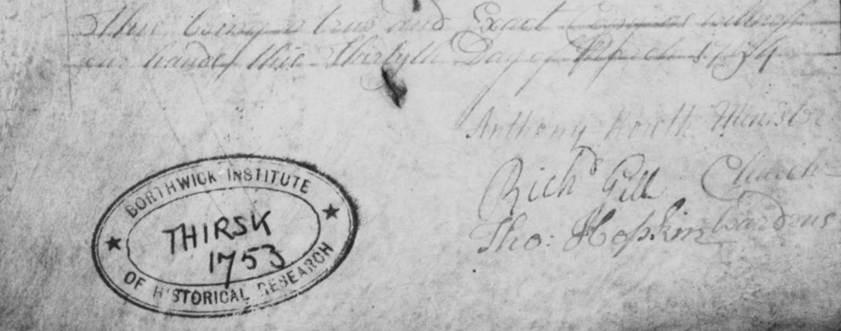
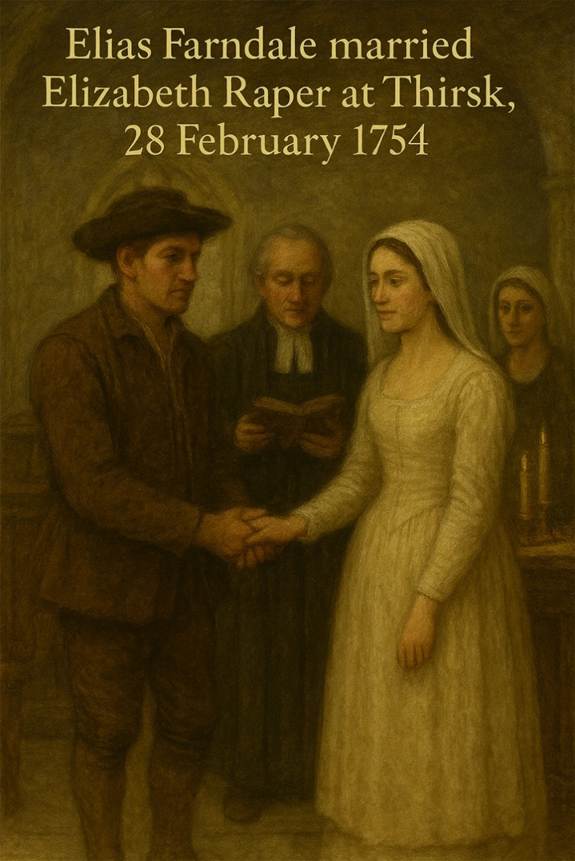
Thirsk married Elizabeth Raper (1732 to 1776) of Topcliffe, at Thirsk, on 28
February 1754 (Thirsk PR). Elizabeth Raper
was probably the person of that name baptised on 20 August 1732 at Topcliffe,
daughter of William and Ann Raper. England,
Marriages, 1538–1973.


1755
Elias Farndale
Junior (1755 to 1825), (FAR00184),
son of Elias Farndale, was baptised at Thirsk on 16 July 1755. (Review Thirsk Parish Records in North Yorkshire County
Records Office PC/TH).
Elias Farndale
Senior became a weaver in Thirsk. In the mid-eighteenth century, Thirsk was a
thriving market town. Weavers operated out of domestic workshops, creating
linen and woollen cloth. While the town's wool industry eventually migrated
south to the West Riding, linen weaving and flax dressing sustained a
significant portion of the local working population well into the mid-1800s.
Weaving was entirely a hand-loom operation done in homes or in small workshops,
often called shops or loomshops,
situated in the yards behind domestic dwellings. Thirsk’s weaving trade had deep
historical roots. The town had been recognised as a royal borough where the
manufacturing of coloured cloths was restricted under a monopoly charter dating
as far back as Henry II (Lee, John S. 2024. Weaving
in Late Fourteenth-Century Yorkshire: An Early Example of
Proto-Industrialisation? In Yorkshire Archaeological Journal Volume 96,
Issue 1, pages
179-200; Heaton, Herbert. 1920. The
Yorkshire Woollen and Worsted Industries. Oxford: Clarendon Press).
1760
On 22 April 1760,
Elias Farndale, by then a Thirsk weaver, brought his loom and all utensils,
a line wheel, 2 stools, a chest, bedstead, bed and bedding when he was admitted
to Thirsk workhouse. Inmates brought the tools of their trade. (Hastings, RP. 1983. The Unreformed workhouse in the
North Riding of Yorkshire, 1730 to 1834 in Aspects of North Riding
History. North Yorkshire County Record Office Publications No 34, Thirsk
Workhouse Accounts, North Yorkshire County Records Office PR/TH/6/9/1).
A poorhouse
accommodating up to forty paupers was set up in 1737 at a site between Long
Street and St James’ Green in Thirsk. The running of the establishment was
contracted to an undertaker, who maintained the inmates, but benefited from any
income from their work, which was mainly spinning. Conditions were squalid but
the diet was wholesome and the regime humane. (Thirsk, The Workhouse).
1777
Elizabeth
Farndale died in 1777 at the age of 45 and was buried in Brotherton (St Edward
the Confessor), Yorkshire. Brotherton is near Pontefract.
1783
Elias Farndale
Senior died in 1783.
His son, Elias
Farndale (FAR00184), appears
to have moved to Yearsley from Thirsk sometime before 1785, so Elias Senior
seems to have lived mainly at Thirsk, and it was his son Elias who later moved
to Yearsley and Ampleforth.
Notes on Elias’ Lineage
Given that Elias and his son clearly used the Farndale spelling by 1754,
it seems very probable that they were descendants of the individuals who left
the dale of Farndale from the mid thirteenth century and settled around York, Sheriff
Hutton and Doncaster
where William
Farndale was the chaplain immediately after the Black Death and then parish
vicar from 1397 to 1403. The
written record is at least for the moment, cold, after 1403 until William Farndale, son
of Nicholas Farndale
and Agnes Farndale, married Margaret Atkinson at
St Mary of Magdalene, Campsall on 29 October 1564. This is about the time when
parish records enable us to gain a better direct record of individuals. That
family then emigrated north to the Cleveland area in or about 1567.
William’s son, George Farndale (1565
to 1606) was then the ancestor of a growing body of families that lived
entirely in the Cleveland area, north of the North York Moors for the following
centuries. Although there are some Farndells and
other spellings living in southern England (especially Sussex and London) in
the seventeenth century, it is very probable that these families were not
related to the Farndales. That being the case the only Farndales in the written
record from circa 1567 to 1754 when there is a record of Elias’ marriage to
Elizabeth Raper, lived in Cleveland, particularly Kirkleatham, Skelton, Loftus,
Moorsholm, Liverton, Kilton,
Brotton, and Whitby.
The focus of the
family history between 1567 to 1754 is therefore in Cleveland. It therefore
seems likely that Elias’ family moved south from Cleveland back to the area of
their original homeland. The most likely explanation is that Elias was
descended from one of the Cleveland families. It therefore seems likely that
Elias moved southward to the Thirsk area before his own descendants settled
around Yearsley/Ampleforth.
Most likely
lineage
It seems most
likely that he might have been the son of William and Abigail (nee Gear)
Farndale (FAR000130) of
Kilton, who married in 1733. His birth record has not been found, but he could
have been the first son born in about 1733. It was not uncommon for first
children to be born very shortly after a marriage.
Alternatives
An alternative
theory is that he was a son of William and Mary (nee
Butrick) Farndale (FAR00125) of the
Brotton 1 Line. William Farndale married Mary
Butrick in 1724 and their son, George Farndale (FAR00144) was born in 1725 at
Stainton, southwest of Middlesbrough and William Farndale (FAR00146) was probably born in
Liverton or Brotton. That would reconcile
with a window between say 1727 to 1735 during which time Elias might have been
born to that family. However this
semes a long window between the birth of the family and therefore less
likely.
The other
possibility is that this whole branch of the Farndale family were not related
to the Cleveland Farndales. Given they ended up immediately south of Kirkdale and Farndale, our ancient ancestral
lands, there is a possibility that they branched off from the main family at a
much earlier date. The location might tend to support this theory, but the
absence of many records of Farndale folk in the area from the sixteenth to the
mid eighteenth century tends to suggest against this theory.
There was an Alice Farnill, daughter of Richard Farnill of Hutton
Conyers, near Ripon, who was baptised on 27 February 1736. Since the spelling
Farnill does appear in this family later, there is a possibility that Alice was
Elias’ sister and Richard, his father. However by 1754
at his marriage, he was clearly using the Farndale spelling, and the location
and spelling of this family doesn’t therefore seem to be the right path here.
